Sarah Kendall sent the message four minutes after the plane left the runway. She did not add a crying emoji, explain that she had slept less than six hours in three days, or remind anyone that the folded American flag resting inside the canvas case beneath her seat had been placed in her hands at her husband’s funeral that morning. She simply typed into the family group chat, Flight lands at 3:05. Can someone pick me up? I just buried Liam. Then she turned the phone facedown and looked through the window as the ground disappeared beneath the clouds.
Her brother answered first. Working late. Try Uber. Two minutes later her mother responded, I thought you arranged transportation before you left. Why didn’t you plan this better? Sarah read both messages once, waited several seconds for another message that never came, then typed, No worries.
That was all. She did not ask whether either of them understood what day it was, remind them that she had flown across the country to attend the military funeral of the man she had loved for fourteen years, or explain that she had requested a ride because the thought of standing alone in another transportation line after the burial felt unbearable. Sarah had spent too much of her life translating her needs into smaller language so other people would not feel burdened by them.
She turned off the phone. The woman beside her slept with her head against the window, a child two rows ahead complained about a tablet battery, and a flight attendant rolled a drink cart slowly down the aisle. Nothing about the cabin reflected the fact that Sarah’s husband was dead.
Liam Kendall had been forty-one. He had served nineteen years in the Marine Corps, survived two combat deployments, spent another tour training partner forces overseas, and was three months from beginning terminal leave when an undiagnosed heart condition killed him during a morning physical-training session at Camp Pendleton. His death was sudden enough that Sarah spent the first twelve hours believing someone would eventually call and explain there had been a mistake.
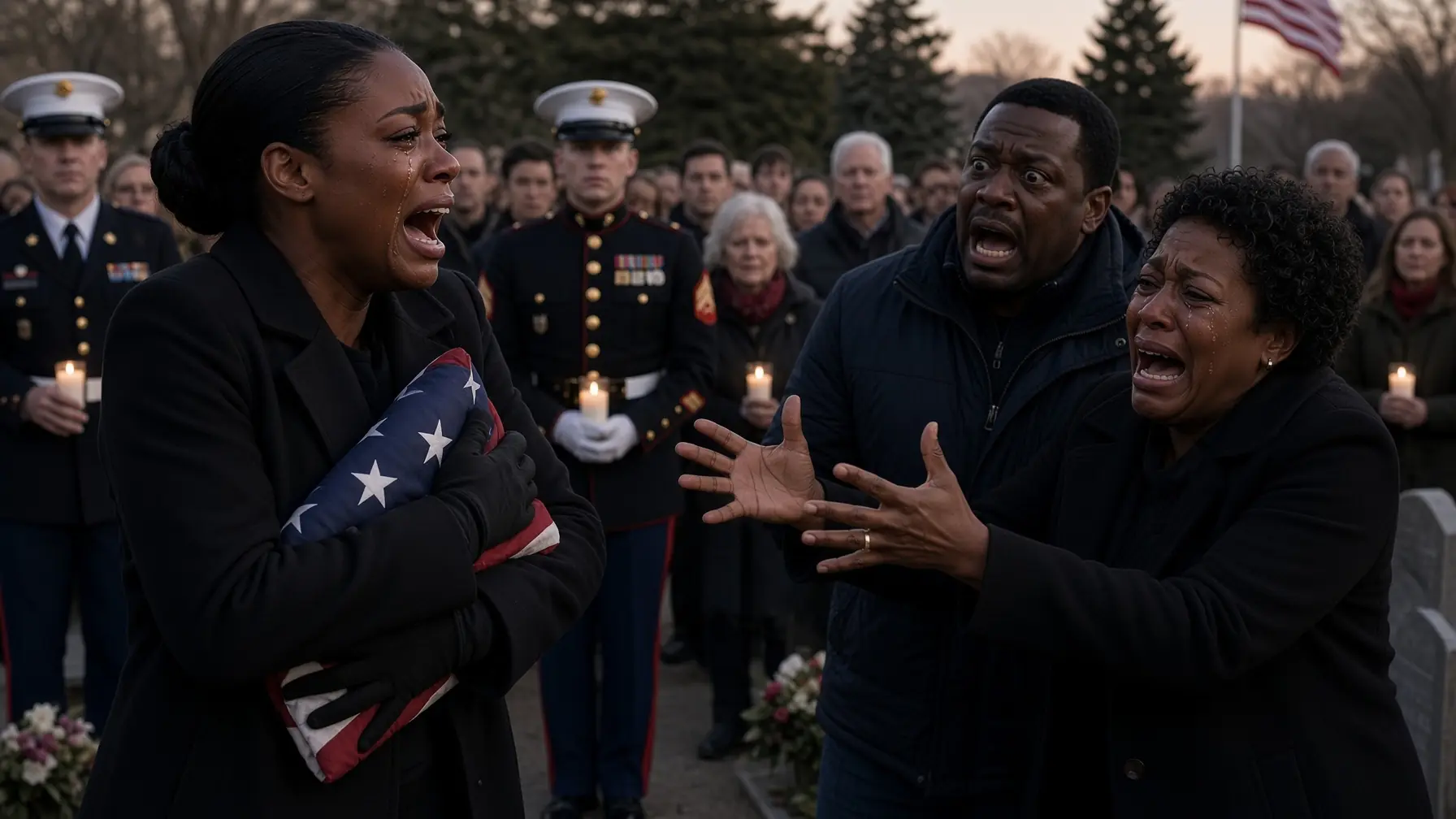
There had been no mistake. Liam’s remains were transported to Kansas, where his parents lived and where he had asked years earlier to be buried if anything happened before retirement. The funeral took place at a veterans cemetery outside Wichita under a gray December sky, with an honor detail, rifle volley, the playing of Taps, and a carefully folded flag that a Marine had placed into Sarah’s hands while thanking her on behalf of a grateful nation.
Sarah remembered none of the exact words. She remembered the young Marine’s white gloves, the smell of cold grass, Liam’s mother collapsing against her sister, and the impossible stillness of the casket after everyone else moved. She also remembered wanting her own mother beside her and knowing Janet Brooks had chosen not to travel because she said flying during the Christmas rush was too expensive.
Sarah had told herself she understood. Janet was sixty-seven, disliked airports, and had been managing health problems with Sarah’s stepfather, Frank, who had recently undergone knee surgery. Sarah’s brother, Michael, had two children and a demanding operations job at a distribution center during the busiest month of the year. There were explanations for why neither had attended the funeral.
Sarah could manufacture explanations for almost anything. She had been doing it since childhood.
She grew up in a family where emergencies were handled efficiently and emotions were expected to recover on their own. Janet brought soup when someone had the flu, remembered birthdays, paid bills on time, and could organize a church fundraiser for two hundred people without writing anything down. She was less skilled at sitting beside pain that could not be fixed.
Michael learned the same style. When Sarah called crying after Liam’s first Afghanistan deployment began, Michael told her to stay busy. When Liam was wounded by shrapnel during his second deployment, Janet mailed Sarah a casserole recipe because she believed cooking would keep her occupied while they waited for updates.
None of them intended cruelty. That almost made the loneliness harder to explain.
Sarah and Liam built a different marriage. They argued, sometimes badly, and spent enough months apart that anniversaries often arrived through frozen video calls or packages that reached the wrong base three weeks late. Yet Liam had a habit of showing up emotionally even when he could not show up physically.
If Sarah had a bad day, he asked about it twice. If she answered “fine” too quickly, he would say, “That wasn’t the question,” until she either laughed or told the truth. Liam understood that attention could be a form of shelter.
The final year of his life had been their most hopeful. Retirement paperwork was moving, Sarah had found a small house they could afford near Raleigh, and Liam had started keeping a list of things he intended to do when nobody could send him anywhere again. The list included learning to bake bread, taking Sarah to Maine, buying a dog, and spending one entire December without looking at a duty phone.
He never reached that December. Instead, Sarah returned from his burial eleven days before Christmas carrying a folded flag, his wedding ring, and the watch recovered from his locker. She wanted one familiar face waiting at arrivals.
The plane landed eight minutes early. Sarah waited until nearly everyone else stood before removing the flag case from beneath the seat, then pulled on her black wool coat and joined the line moving toward the terminal. Her phone remained off.
She expected to order a car once she reached baggage claim. There was no practical reason she could not manage it, and the airport was less than forty minutes from her apartment. The problem had never been transportation.
The problem was watching everyone else be met.
A man near baggage claim lifted a toddler into the air while his wife laughed. Two college students disappeared beneath a handmade sign reading WELCOME HOME, GIRLS, and an elderly couple stood holding each other so tightly that Sarah had to look away. She retrieved her suitcase and walked toward the exit before the pressure behind her eyes became something strangers could see.
Someone called her name. Sarah stopped because the voice was familiar but impossible. Gunnery Sergeant Tomas Reyes stood twenty feet away in Marine dress blues.
Behind him were Staff Sergeant Kayla Warren and Corporal Devin Shaw, both Marines who had served with Liam during his final assignment. Another man stood beside them wearing a dark civilian suit with a small Marine Corps lapel pin. Sarah recognized him as Major Nathan Price, the casualty-assistance calls officer who had guided her through forms, travel, benefits, funeral arrangements, and the thousand administrative decisions death insisted she make before grief allowed her to understand them.
Sarah stared at them. “What are you doing here?” she asked, and Tomas answered, “Making sure you get home.”
She shook her head. “How did you know my flight?” Nathan gave her a look Liam would have enjoyed. “You gave it to me yesterday when we confirmed your return itinerary.”
“That was for paperwork.”
“Apparently paperwork can be useful.”
Sarah laughed once. The sound turned into something dangerously close to a sob, and Kayla stepped forward without speaking. Sarah let the younger woman embrace her.
Nobody formed a ceremonial honor guard. Nobody blocked traffic or turned the airport curb into an official military event, because that would have been inappropriate and because Liam’s funeral honors were already complete. They had simply come as people who knew what it meant for his wife to walk through an airport alone after handing him back to the earth.
Nathan took Sarah’s suitcase. Devin carried the smaller bag containing Liam’s personal effects after asking permission. Tomas walked beside Sarah without touching the flag case.
A local television reporter happened to be near the terminal covering holiday travel delays. The cameraman noticed the Marines first, then Sarah’s black clothing and the folded flag she was holding close against her chest. He filmed several seconds from a distance before the reporter approached Nathan and quietly asked whether they were willing to speak.
Nathan looked at Sarah. She shook her head.
“No interviews,” he told the reporter.
The journalist nodded immediately. “Understood.”
Sarah thought that was the end of it.
The Marines drove her home in two vehicles, not a mysterious convoy. Tomas and Kayla rode with Sarah while Nathan and Devin followed with the bags. Nobody discussed her family.
For most of the drive they talked about Liam. Kayla told a story about him spending forty-five minutes arguing with a vending machine at two in the morning because it had taken his last five-dollar bill, and Sarah laughed harder than she thought she still could. Tomas remembered Liam refusing to admit he needed reading glasses until he accidentally signed the wrong line on a maintenance report.
Every story returned a piece of her husband that the funeral could not. The casket contained his body, but these people carried his annoying habits, his jokes, the way he said certain words, the songs he played too loudly, and the precise expression he made when someone proposed an obviously terrible idea. Sarah realized that was why being met mattered.
They reached her apartment at four-thirty. Kayla put groceries in the refrigerator that someone from Liam’s unit had ordered ahead, Devin checked that Sarah’s heat was working, and Tomas placed his phone number on a sticky note even though she already had it. Nathan remained after the others left.
“There’s no correct way to do the next few weeks,” he told her. “There are benefits appointments we can delay, forms that cannot wait, and people who will say stupid things because they don’t know what else to say.”
Sarah sat at the kitchen table with Liam’s flag in front of her. “My family told me to take an Uber.”
Nathan did not immediately respond. That restraint made her trust him more.
Finally he said, “I’m sorry.”
Sarah nodded.
“That’s more than they said.”
Nathan left shortly before six. Sarah showered, changed into one of Liam’s old sweatshirts, heated the soup Kayla had brought, and turned on the television because silence was suddenly too loud. She was not expecting to see herself.
The local nine-o’clock broadcast included a short holiday-travel segment. After reporting flight delays and heavy traffic, the anchor said a quieter reunion had taken place that afternoon when several Marines came to meet the widow of one of their own. The station used only about twenty seconds of airport footage and did not identify Sarah by name.
The camera showed her emerging from the terminal holding Liam’s folded flag. Tomas appeared beside her, then Kayla embraced her before the group walked toward the parking area. The reporter said the widow had declined an interview and that members of her husband’s former unit had arranged the pickup because they did not want her returning from his funeral alone.
Sarah watched the clip twice. It was dignified, brief, and almost painfully ordinary. Nobody knew her family had refused to come.
Then the family group chat started waking up.
Michael sent the first message. Was that you on Channel 5? Janet followed several minutes later with, Why were Marines picking you up? I thought you said you just needed a ride.
Sarah stared at the second message. She could not decide whether to laugh or throw the phone across the room.
She answered neither.
Michael called. Sarah let it ring.
Janet called four times in the next hour. Sarah turned the phone off again.
The following morning there were eleven missed calls and one voicemail from Michael. He sounded defensive rather than apologetic. “Sarah, I didn’t realize you were coming back with all that going on,” he said, as though a folded flag had been an unexpected accessory she neglected to mention.
She deleted the voicemail. Then she sat on the kitchen floor and cried until the sunlight moved from one wall to another.
Grief was not graceful. Sarah discovered that quickly.
She could stand through a funeral without collapsing and then spend twenty minutes unable to choose a laundry detergent because Liam had always bought a different brand. She could talk calmly with the benefits office about survivor payments and then cry because one of his socks remained under the bed.
For three days Sarah ignored her family. The Marines did not hover either, which she appreciated. They checked in through short texts asking whether she needed food, company, paperwork help, or nothing.
“Nothing is an allowed answer,” Kayla wrote.
Sarah chose nothing more often than not.
The local airport clip circulated through several military-family pages after someone recognized Liam’s unit insignia. Most people did not know Sarah’s name, and the story remained small enough that she could still buy groceries without anyone looking twice. That was exactly how she wanted it.
Then Michael complicated everything.
He posted an old childhood photograph on social media showing himself and Sarah at a Fourth of July parade, both holding small flags. His caption read, Family always comes first, even when life gets complicated.
Sarah stared at the post in disbelief. He had not tagged her, but enough relatives knew about the airport pickup that comments began appearing.
One cousin wrote, Then why wasn’t family at the airport?
Michael removed the comment.
Another person asked the same question.
He deleted the entire post.
Sarah called him.
Michael answered with, “Finally.”
She said, “Why would you post that?”
“It was just a picture.”
“You were trying to make it look like nothing happened.”
“Nothing happened.”
Sarah became very still.
“You told a woman coming back from burying her husband to get an Uber.”
“I was working.”
“That isn’t the problem.”
“I genuinely could not leave.”
“That still isn’t the problem.”
Michael sighed. “Then what is the problem, Sarah?”
She almost hung up because the question sounded too much like their mother.
“The problem is that your first response was logistics.”
“What was I supposed to say?”
“How about, ‘I’m sorry you had to bury Liam.’”
Michael did not answer.
“How about, ‘I wish I could be there.’”
“I assumed you knew that.”
Sarah laughed sadly.
“No.”
She wiped her face.
“That’s what this family always assumes.”
Michael became defensive. He reminded her that he had attended Liam’s retirement-planning party the previous summer, helped Sarah move apartments twice, and taken care of their mother during Sarah’s deployments. None of those things were false.
Sarah said, “I’m not telling you that you’ve never done anything for me.”
“Sounds like it.”
“I’m telling you that when I was at the lowest point of my life, you answered like I asked you to pick up dry cleaning.”
Michael was silent.
Then he said, “I didn’t know what to say.”
Sarah closed her eyes.
“That’s the first honest thing you’ve said.”
They ended the call without resolving anything.
Janet was harder.
Sarah finally answered her mother the next afternoon. Janet immediately said, “I don’t understand why everybody is acting like we abandoned you.”
Sarah stared at Liam’s flag case.
“Did you come?”
“I couldn’t.”
“Did you call before the funeral?”
“You were busy.”
“After?”
“I thought you needed space.”
“Did you ask?”
Janet began crying.
Sarah hated how quickly her mother’s tears made her feel responsible.
“I had Frank here after surgery,” Janet said. “Michael had work, and nobody told me you expected some big airport thing.”
“I expected my mother.”
The sentence ended the argument.
Janet whispered, “I’m sorry.”
Sarah believed part of her.
Then Janet added, “But you know I would have been there if I understood how badly you needed me.”
Sarah looked away.
“No, Mom.”
“What?”
“You would have been there if you decided I mattered enough to ask.”
Janet’s breathing changed.
Sarah continued before guilt stopped her.
“I have spent my entire adult life making myself easy for you.”
“That isn’t fair.”
“Maybe not.”
Sarah’s voice stayed quiet.
“But I’m done explaining grief in a way that makes it convenient to care about me.”
She ended the call.
The conversation left Sarah exhausted rather than relieved. She spent the evening sorting Liam’s uniforms because she needed a task with edges.
Some items would go to his parents. Some would eventually be donated. Several pieces remained untouched because Sarah could not imagine another person wearing them.
Inside one jacket pocket she found a folded piece of notebook paper. Liam had written a grocery list on one side and, beneath it, three words in his block handwriting: CALL YOUR WIFE.
Sarah sat on the bedroom floor laughing and crying simultaneously.
That was Liam.
He scheduled affection because he knew work would otherwise consume it.
The paper stayed in her wallet afterward.
A week later the local reporter who recorded the airport pickup emailed Nathan asking whether Sarah would consider a brief interview about military families returning home after loss. The station had received messages from widows and veterans who said the image resonated because they remembered returning from difficult deployments or funerals to empty terminals. Nathan forwarded the request without encouraging her either way.
Sarah initially declined.
She did not want grief turned into content. She did not want strangers praising her strength when most mornings she needed ten minutes simply to get out of bed.
Then she read one message Nathan had permission to share. A Navy widow wrote that she had driven herself home after her husband’s burial because nobody she knew was available, then sat inside the garage for nearly an hour because walking into the empty house alone felt impossible.
Sarah changed her mind.
The interview was recorded inside the station rather than conducted live. Sarah wore a simple navy blouse and her wedding ring, which she had not yet been able to remove. The reporter, Melissa Grant, began by asking about Liam rather than about the airport.
That mattered.
Sarah told her Liam loved terrible action movies, over-seasoned scrambled eggs, and old motorcycles he never had enough time to repair. She described his military service without turning him into a flawless symbol. Liam could be stubborn, impatient, and almost pathologically incapable of admitting he was lost while driving.
“He was a Marine,” Sarah said. “He believed asking for directions violated doctrine.”
Melissa laughed.
Then she asked what coming home had felt like.
Sarah stopped smiling.
“I buried my husband with people standing around me,” she said. “Coming home was the moment I understood burial and loneliness are different things.”
Melissa waited.
Sarah explained that she had asked family for a ride and had not been met by them.
She refused to name anyone.
“They had reasons they couldn’t come,” Sarah said. “What hurt was that nobody first said, ‘We wish we could.’”
Melissa asked what she learned from the Marines meeting her.
Sarah looked toward the studio lights.
“That presence is often more important than the perfect words.”
She paused.
“If somebody is grieving, you don’t have to fix them.”
“You can just be there when the plane lands.”
The interview aired three nights later.
It lasted five minutes, not an hour-long national special. The station included Liam’s photograph with Sarah’s permission and information about military-bereavement resources supplied by Nathan.
The response was larger than Sarah expected.
Emails came from spouses, parents, adult children, veterans, and civilians who had returned from hospitals, funerals, divorces, or deployments and discovered nobody waiting. One message came from a man whose wife had died during the pandemic and who wrote, People kept saying call if you need anything. I needed someone to arrive without making me design the rescue.
Sarah printed that one.
Another message arrived in an envelope because an older woman preferred letters. Her husband had been killed in Vietnam before she turned twenty-five, and she wrote that the hardest moment was not receiving the telegram but entering their apartment after the funeral and seeing his shoes.
Sarah read the letter three times.
The attention did not make her grief easier.
It made it less private.
That difference was sometimes comforting and sometimes exhausting.
Michael watched the interview.
He sent a message afterward saying, I wish you had told me you felt that way.
Sarah stared at it before answering, I told you I buried Liam.
Michael called.
This time his voice was different.
“I deserved that.”
Sarah did not respond.
“I keep thinking about the message I sent.”
“So do I.”
“I was at work.”
“I know.”
“My manager was already threatening write-ups for people leaving early.”
“I know.”
“And Nicole had both kids.”
Sarah closed her eyes.
“I know, Michael.”
“Then what should I have done?”
Sarah answered, “Called me.”
He went silent.
“If you couldn’t pick me up, you couldn’t pick me up.”
She continued.
“But you could have called.”
Michael whispered, “Yeah.”
Sarah heard something break in his voice.
“I’m sorry.”
She believed him more than she wanted to.
“Thank you.”
That did not restore their relationship.
It opened a door.
Janet reacted differently. The interview embarrassed her.
She told an aunt that Sarah had made the family look heartless without explaining Frank’s surgery, Michael’s work pressure, or how little notice anyone had received.
The aunt repeated the conversation to Sarah.
For several days Sarah wanted to call her mother and fight.
Then she remembered Liam once telling her, “If someone needs you to become the villain so they can survive being wrong, let them rent the costume. You don’t have to wear it.”
Sarah did not call.
The first public gathering connected to the interview happened almost accidentally.
A local chapter of a military-spouse support organization invited Sarah to a December memorial event held annually for families who had lost service members. Sarah agreed to attend quietly and was surprised when someone asked her to light one of the remembrance candles.
There were no television cameras.
That helped.
She stood among people who knew what folded flags felt like.
A seventeen-year-old girl sang during the ceremony. Her voice shook during the first verse, steadied in the second, and cracked again on the final line.
Sarah cried without apologizing.
Near the edge of the crowd, she saw Michael.
He stood beneath a tree with both hands inside his coat pockets.
He did not approach.
Sarah did not wave.
She understood why he came anyway.
The following morning he texted, I didn’t know if you wanted me there.
Sarah answered, I saw you.
Several minutes later he wrote, I’m trying.
Sarah stared at those two words.
Then she replied, Keep trying.
That was their reconciliation for the year.
Christmas arrived ten days later.
Sarah did not go to Janet’s house.
She spent Christmas Eve with Liam’s parents, who had driven in from Kansas after deciding they could not tolerate their first holiday without him inside their own house. His mother, Patricia, brought a box containing Liam’s childhood ornaments.
They decorated Sarah’s small artificial tree with mismatched Marines, footballs, school photographs, and one ceramic reindeer missing half an antler.
Patricia cried when she hung an ornament Liam made in second grade.
Sarah held her.
Neither tried to make the other stop.
On Christmas morning Janet sent, Thinking of you and Liam today. I am sorry I wasn’t what you needed.
Sarah read the message while drinking coffee.
The first sentence was ordinary.
The second was not.
She answered, Thank you.
Nothing more.
Healing began without a dramatic reunion.
January brought paperwork.
Benefits had to be finalized, Liam’s belongings inventoried, insurance claims completed, bank accounts changed, and military records copied until Sarah became certain death’s true administrative purpose was teaching survivors how many signatures one person had possessed while alive.
Nathan continued helping through the casualty-assistance process.
During one appointment he mentioned the airport story had generated repeated calls to the base family-support office from people asking whether someone could meet military widows traveling alone after funerals.
“We don’t actually have a program for that exact thing,” he said.
Sarah looked at him.
“Why not?”
Nathan smiled.
“I was afraid you’d ask.”
The existing systems were more extensive than Sarah had known.
Military casualty-assistance programs supported next of kin through notification, funeral coordination, benefits, and administrative needs, while nonprofits offered grief counseling, peer support, travel assistance, Gold Star family services, meal trains, and practical help.
The gap Sarah had experienced was narrower.
A person could receive excellent official support and still arrive at an airport without someone waiting because personal transportation fell between systems.
Sarah began asking questions.
Not “How do I start a nonprofit?”
She had learned enough from Liam’s paperwork to avoid creating another bureaucracy before understanding the problem.
Instead, she met with an established military-family organization and asked whether volunteers could opt into an airport-arrival program for bereaved spouses and immediate family members who specifically requested assistance.
The organization’s director, Valerie Sutton, liked the concept.
She also immediately listed problems Sarah had not considered.
Privacy.
Airport access.
Background checks.
Liability.
Transportation insurance.
Protecting grieving people from volunteers who might be well-meaning but intrusive.
Avoiding photographs unless explicit consent was given.
Ensuring nobody used the program as patriotic theater.
Sarah loved her for all of it.
“What would it take?” she asked.
Valerie answered, “Months.”
“Good.”
Sarah smiled.
“Then we’ll do it correctly.”
They called the pilot program Welcome Home, though Sarah resisted putting her own name anywhere near it.
The first version operated only at Raleigh-Durham International Airport.
Participants receiving support chose exactly what they wanted in advance: transportation, someone waiting at baggage claim, groceries at home, a meal delivery, quiet assistance with luggage, or simply a text confirming someone was available if plans failed.
No flags were required.
No uniforms.
No cameras.
“The point is presence,” Sarah told the volunteer orientation. “Not performance.”
The first person they helped was not a widow.
He was a twenty-six-year-old Marine named Jordan Ellis returning after attending the funeral of his younger brother, another service member killed in a training accident.
Jordan’s wife was eight months pregnant and medically unable to drive to the airport.
A volunteer named David met him with a plain cardboard sign reading JORDAN.
David carried one suitcase, drove him home, and left after making sure Jordan had his keys.
That was all.
Jordan sent an email the next day.
I didn’t know how much I needed someone to say my name when I walked out.
Sarah printed that one too.
The program helped seven people during its first three months.
Not thousands.
Seven.
Sarah considered every successful arrival more meaningful than a viral statistic.
One participant canceled while the volunteer was already driving to the airport because she decided she wanted to be alone.
Valerie treated the cancellation as success.
“She chose,” she said.
Sarah understood.
Support without control.
That principle became central.
The airport story still surfaced occasionally online.
Each time someone added dramatic details that never happened.
One version claimed Sarah’s family attended a Christmas party instead of picking her up.
Another said her brother refused because he was watching football.
A third claimed Liam’s entire Marine battalion formed an honor line through the terminal.
None was true.
Sarah stopped reading comments.
She understood why people improved reality.
A simple failure of attention felt too ordinary for the amount of pain it created.
Michael visited her apartment in March.
He brought no flowers or grand apology.
He brought Liam’s cordless drill, which Sarah had loaned him almost a year earlier.
“I figured you might want this back.”
Sarah looked at the tool.
“Liam complained about you keeping that every month.”
“I know.”
Michael smiled weakly.
“I kept forgetting.”
“Also true.”
They made coffee.
For the first half hour they discussed work, the children, and nothing that mattered.
Then Michael said, “I keep hearing your voice say I should have called.”
Sarah looked at him.
“I don’t need you to punish yourself forever.”
“I know.”
“Do you?”
He rubbed both hands together.
“No.”
Sarah waited.
Michael admitted he had seen her airport message while standing on the warehouse floor with three supervisors around him.
He replied quickly because he intended to call once he reached his office.
Then a conveyor system failed.
He spent four hours dealing with it.
By the time he remembered, the news segment had already aired.
“That explains the delay,” Sarah said.
“Not the text.”
“No.”
Michael looked at her.
“I treated what you were going through like another problem on my list.”
Sarah nodded.
“That’s what hurt.”
He swallowed.
“I’m sorry.”
Sarah touched his hand.
“I know.”
They were not suddenly siblings from a holiday commercial.
Michael still became defensive too quickly.
Sarah still expected disappointment before he had a chance to offer anything else.
But they began rebuilding.
Janet took longer.
Her apology remained tangled with explanations.
Frank’s surgery had been difficult.
She did not drive comfortably after dark.
She thought Sarah already had military support.
She believed asking too many questions would intrude.
All of those facts could be true.
Sarah eventually told her, “Mom, every time you explain why you didn’t show up, you move farther away from saying you wish you had.”
Janet became quiet.
They were sitting in Sarah’s kitchen six months after Liam’s death.
The folded flag remained in a display case across the room.
Janet looked at it for a long time.
“I wish I had.”
Sarah felt tears fill her eyes.
Janet continued, “I should have found a way.”
“You could have called.”
“I know.”
“I didn’t need you to fix it.”
“I know.”
“I needed my mother.”
Janet covered her mouth.
Sarah crossed the kitchen and embraced her.
The hug did not erase the airport.
It prevented that afternoon from defining everything that came after.
The first anniversary of Liam’s death arrived in November.
Sarah dreaded it from September onward.
She woke that morning expecting some great emotional event and instead discovered the refrigerator had stopped cooling.
Liam would have found that hilarious.
Sarah spent forty minutes moving food into coolers before driving to the cemetery in Kansas.
Patricia and Liam’s father, Robert, met her there.
So did Tomas and Kayla.
Michael came too.
Sarah had not asked him.
He stood slightly behind everyone until she walked over and hugged him.
“Thank you for coming,” she said.
Michael whispered, “I learned something about invitations.”
Sarah laughed through tears.
Janet could not make the trip because Frank had developed pneumonia.
This time she called before Sarah left home.
“I wish I could be there.”
Sarah closed her eyes.
“That’s enough, Mom.”
It was.
Welcome Home expanded to a second airport during the following year through a partnership with another established veteran-support organization.
Sarah still refused suggestions that she create a separate nonprofit bearing Liam’s name.
She wanted sustainable infrastructure, not a memorial project that depended entirely on her grief.
Valerie agreed.
“You’re learning.”
“I had a Marine husband.”
“That explains stubbornness.”
“It explains budgeting.”
They laughed.
Volunteers underwent background screening and training focused less on military ceremony than on practical sensitivity.
Do not force conversation.
Do not ask how someone died.
Do not photograph them.
Do not tell your own grief story unless invited.
Do not say, “Everything happens for a reason.”
Do not turn a stranger’s worst day into proof of your goodness.
Sarah taught one section herself.
“Showing up does not make you the hero,” she told them. “It makes you the person who showed up.”
The program eventually added meal coordination and short-term practical support through vetted partners.
A volunteer might meet someone at the airport on Monday, another person deliver groceries Tuesday, and a third connect the family with an existing benefits counselor Wednesday.
The goal was never permanent dependency.
It was preventing the first days of grief from becoming a logistical punishment.
Sarah understood that need intimately.
During Liam’s deployments she had been independent because she had to be.
After his death, people praised that independence until Sarah wanted to scream.
Competence did not eliminate loneliness.
Being capable of calling a taxi did not mean a grieving person should always have to.
Two and a half years after the airport pickup, a regional newspaper profiled the program.
The headline read, FROM AN EMPTY ARRIVAL TO A NETWORK OF WELCOME.
Sarah disliked the word empty because Tomas, Kayla, Devin, and Nathan had been there.
The reporter corrected it in the online edition after Sarah pointed that out.
The story included no criticism of her family.
Sarah had become protective of that distinction.
What Janet and Michael did belonged to the origin of Sarah’s pain.
It did not belong to the public forever.
A reporter once asked whether her relatives had apologized.
Sarah said, “That’s private.”
The answer disappointed him.
She did not care.
By then Michael volunteered with Welcome Home four times a year.
The first time he signed up, Sarah almost rejected the application because she suspected guilt rather than service.
Valerie stopped her.
“Is he qualified?”
“Yes.”
“Background check clear?”
“Yes.”
“Training completed?”
“Yes.”
“Then don’t use the program to manage your family.”
Sarah stared at her.
“You enjoy doing that.”
“Immensely.”
Michael’s first pickup involved an Army spouse returning after her husband died overseas from illness.
He waited at baggage claim with a simple sign containing her last name.
He carried the bags.
He drove her home.
He did not tell her who his sister was.
Afterward he sent Sarah one message.
I understand the airport differently now.
Sarah cried.
She did not ask for details.
Janet never volunteered at the airport.
Crowds still made her anxious.
Instead, she began assembling care packages at home.
At first Sarah worried the work was another attempt to earn absolution.
Then she saw her mother placing handwritten notes inside boxes without signing her name.
You do not owe anyone strength today.
Sarah recognized the change.
Janet had learned new language.
Their relationship never became effortless.
Sarah still remembered the words Why didn’t you plan better? whenever her mother sounded dismissive.
Some injuries remained sensitive long after they stopped bleeding.
But Janet learned not to defend herself every time Sarah remembered.
That was a form of love too.
Four years after Liam’s death, Sarah removed her wedding ring.
She had expected the act to feel ceremonial.
Instead it happened while washing dishes.
The ring caught against a glass, and Sarah realized she had spent months twisting it whenever she was nervous.
She dried her hands, removed the band, kissed it once, and placed it inside the box with Liam’s ring.
Then she finished washing the dishes.
Grief sometimes released its grip without announcing itself.
Sarah dated once during the fifth year.
The relationship lasted four months.
The man was kind, divorced, and patient enough not to compete with Liam’s memory.
Sarah ended it because she was not ready for the life he wanted.
She did not consider that a failure.
Liam had been her husband.
He did not have to become the last meaningful relationship of her life in order for their marriage to matter.
That thought took years to become comfortable.
Welcome Home eventually operated through partnerships at six airports.
Not fifty states.
Not a miraculous national empire.
Six airports, hundreds of trained volunteers, and enough systems that Sarah could disappear for two weeks without everything collapsing.
That made her proud.
The organization tracked outcomes carefully.
Most people requesting support wanted transportation.
Many wanted meal deliveries.
A surprising number requested only one thing: someone waiting where they could see them when the sliding terminal doors opened.
Sarah never stopped understanding that.
One winter afternoon she joined a welcome team for a young Coast Guard widow named Emily Carter.
Emily was twenty-eight and returning from her husband’s burial in Louisiana with a four-year-old daughter asleep against her shoulder.
Sarah held a sign with their names.
When Emily saw it, her face changed.
Not happiness.
Relief.
Sarah recognized it immediately.
She took the suitcase while another volunteer handled the car seat.
Emily whispered, “I didn’t think anybody would actually come.”
Sarah answered, “We said we would.”
That sentence nearly broke both of them.
A photograph from that arrival later appeared in the regional newspaper only because Emily asked to share it.
The image showed Sarah carrying a suitcase while Emily held her sleeping daughter.
There were no uniforms.
No flags visible.
No dramatic poses.
The caption explained the program.
Janet mailed Sarah a clipping.
On the envelope she wrote, You built something good out of a terrible day.
Sarah called her.
“That day wasn’t terrible because you couldn’t drive to the airport.”
Janet became quiet.
“I know.”
“It was terrible because I thought my grief was inconvenient.”
“I know.”
Sarah smiled.
“Then yes.”
“What?”
“I built something good.”
Janet cried.
This time Sarah let her.
Michael eventually apologized to Liam’s parents.
Sarah did not ask him to.
Patricia told her months later.
“He said he should have been waiting when you came home.”
Sarah looked down.
“What did you say?”
Patricia smiled.
“I told him he couldn’t change the airport.”
Sarah nodded.
“Then what?”
“I told him he could change the next airport.”
Sarah laughed.
“That sounds like you.”
“No.”
Patricia looked toward Liam’s photograph.
“That sounds like him.”
Sarah understood.
Liam had always been interested in the next useful thing.
He could be furious about failure and still ask what needed to happen now.
That mindset became part of Welcome Home without Sarah ever putting his name on the organization.
Years after his death, she sometimes worried that continuing life meant leaving him behind.
Then she would hear a volunteer repeat one of Liam’s favorite phrases without knowing its origin.
What do you need, not what do you think you’re supposed to need?
Sarah would smile.
People survived inside language.
The family group chat eventually existed again.
Michael created a new one after Janet replaced her phone and lost the old thread.
He named it Brooks Family, with no heart emoji.
Sarah laughed when she saw it.
She stayed.
The chat contained ordinary things.
Photographs of Michael’s children.
Janet complaining about grocery prices.
Frank sending the same weather article twice.
Sarah occasionally posting pictures from Welcome Home events.
Nobody pretended the old messages had not happened.
They simply stopped being the final messages.
That distinction mattered.
One December, seven years after Liam’s death, Sarah landed at the same airport after speaking at a military-family conference.
She had not requested a pickup.
Her car was in long-term parking, and she planned to drive herself home.
When she emerged from the terminal, Michael stood near baggage claim holding a cardboard sign.
It read, I CAN ALSO CALL YOU AN UBER.
Sarah stopped.
Then she laughed so loudly several travelers turned.
Michael lowered the sign.
“Too much?”
“Absolutely.”
“Should I have gone sentimental?”
“Never.”
He hugged her.
Sarah let herself be held.
On the drive home Michael asked whether she still thought about the first airport.
“Sometimes.”
“Do you still get angry?”
Sarah considered it.
“Not often.”
“Why?”
“Because anger was useful until it wasn’t.”
Michael nodded.
“I still feel guilty.”
“I know.”
“Do you want me to?”
“No.”
Sarah looked through the passenger window.
“I wanted you to understand.”
“I do.”
“That’s enough.”
Michael drove several miles in silence.
Then he said, “I wish I had been there.”
Sarah looked at him.
“I know.”
They did not need anything more.
The airport incident never became the revenge story strangers occasionally tried to make it.
Sarah’s family did not watch helplessly while she replaced them with Marines.
The news did not destroy anyone’s reputation.
Her mother did not drop a wine glass dramatically when the footage appeared.
Michael did not lose friends, work, or his place in the family.
Something more ordinary happened.
They discovered that love without attention could still fail at the exact moment it mattered.
Sarah discovered something too.
She had spent years assuming independence meant asking for less.
Military life reinforced that instinct because every deployment required her to solve problems, manage households, make decisions, and keep moving even while frightened.
After Liam died, she finally understood that strength and need could occupy the same body.
She had been capable of ordering a car from the airport.
She had also deserved someone who wanted to meet her.
Those statements never contradicted each other.
Welcome Home grew from that idea.
Not that grieving people were helpless.
That capable people should not have to earn care by first becoming incapable.
Sarah eventually stepped away from daily leadership.
Valerie’s successor became executive director, regional coordinators managed each airport, and Sarah remained on the advisory board.
The transition frightened her.
For years, the program had been the most visible proof that Liam’s death produced something beyond loss.
Then a counselor asked whether Liam needed the program to justify his life.
Sarah was offended.
Then ashamed.
Of course he did not.
Liam’s life mattered before anyone met Sarah at an airport.
Welcome Home mattered because people needed it, not because Sarah needed a monument.
That realization allowed her to rest.
She bought a small house with a porch outside Raleigh.
She finally got the dog Liam had planned to buy.
The shelter called him a Labrador mix.
Sarah called that generous.
He had oversized ears, questionable judgment, and the ability to occupy an entire bed despite weighing fifty-two pounds.
She named him Radar.
Patricia said Liam would have approved.
Sarah kept Liam’s flag in the living room.
Not on an altar.
On a shelf beside photographs.
There were pictures of deployments, vacations, Liam asleep on a sofa with a pizza box on his chest, Sarah laughing beside him at a county fair, and one image from their wedding where both looked absurdly young.
Life did not divide neatly into before grief and after grief.
The photographs eventually became one life.
On the tenth anniversary of Liam’s death, Sarah returned to Kansas.
Janet came.
Michael came.
Patricia and Robert were there.
Tomas traveled from Arizona.
Kayla, now a master sergeant preparing for retirement, arrived with her husband.
They stood together near Liam’s grave beneath a pale winter sky.
There was no ceremony beyond what the family created themselves.
Sarah placed fresh flowers.
Patricia touched the stone.
Michael stood slightly behind Sarah until she reached for his hand.
Ten years earlier he had failed to meet her at an airport.
Now he was there without being asked.
Sarah thought Liam would have noticed the difference.
Afterward they ate lunch at a diner he loved.
Tomas told the vending-machine story again.
Everybody pretended not to remember it.
Janet laughed harder than anyone.
Sarah watched her family and felt something she once considered impossible.
Not gratitude for what happened.
Never that.
Gratitude for what happened afterward.
Pain had not magically improved them.
They had improved because eventually each person chose to confront what pain exposed.
Michael learned that practical inability did not excuse emotional absence.
Janet learned that explanations delivered before apologies often sounded like defenses.
Sarah learned that boundaries could leave doors unlocked without requiring her to stand in them waiting.
All three learned that relationships survived through repeated choices rather than blood alone.
Before everyone separated after lunch, Michael handed Sarah an envelope.
Inside was a printed screenshot of the original group-chat exchange.
Sarah stared at him.
“Why would you save this?”
“Because I wanted to write something on it.”
At the bottom Michael had written, Worst message I ever sent. Best lesson I never wanted.
Sarah laughed.
Then she folded the paper.
“I’m keeping this.”
“I hoped you would.”
“Not to punish you.”
“I know.”
Sarah slipped it into her purse beside the old note Liam had written years earlier.
CALL YOUR WIFE.
Two small pieces of paper.
One representing absence.
One representing presence.
Sarah liked the balance.
That Christmas she hosted dinner at her house.
Janet brought sweet potatoes.
Michael arrived early and immediately asked whether anything needed to be picked up.
Sarah pointed toward a missing bag of ice.
He stared at her.
“You’re serious?”
“Completely.”
Michael grabbed his keys.
“Fine.”
Sarah called after him.
“Try Uber.”
He stopped in the doorway.
Janet laughed first.
Then Michael.
Eventually Sarah laughed too.
The joke worked because the wound had healed enough to touch.
Later that evening, after everyone left, Sarah sat alone beside the tree with Radar sleeping across her feet.
She looked at Liam’s photograph.
“You would’ve enjoyed that,” she said.
The room remained quiet.
Sarah no longer mistook quiet for abandonment.
She thought about the woman who had sat on an airplane ten years earlier, phone facedown, believing two cold texts revealed everything she needed to know about family.
That woman had been partly right.
They revealed something important.
They did not reveal everything.
Michael had failed her.
Janet had failed her.
Sarah had been right to stop begging them to pretend the failure did not matter.
She was also glad she eventually allowed them to become more than their worst response.
Forgiveness had not meant reopening the original wound and declaring it painless.
It meant allowing new evidence into the record.
Michael showing up at Liam’s grave.
Janet packing care boxes.
Christmas dinners.
Hospital calls.
Airport signs with terrible jokes.
Years of small repairs.
That was how trust returned.
Not because anybody demanded it.
Because they kept doing the work after apologies stopped being enough.
Sarah never forgot the Marines who met her.
Tomas, Kayla, Devin, and Nathan had not replaced her family.
They had done something more valuable.
They showed her what support looked like at precisely the moment she needed a reference point.
Without speeches.
Without asking what they would receive.
They came.
That action became the foundation of hundreds of later arrivals.
Some were joyful.
Some were terrible.
All carried the same quiet message.
Someone knows you are landing.
Sarah eventually believed that was the simplest description of love she had ever found.
Love noticed the flight number.
It remembered the time.
It checked whether the person had eaten.
It admitted when it could not come.
It called anyway.
It did not require grief to become dramatic enough before responding.
Years earlier, Sarah believed the coldest part of her family’s messages was that nobody drove to the airport.
She was wrong.
Cars were logistics.
The coldest part was that nobody initially said, I wish I could be there.
That distinction became the sentence she repeated most often when people asked what Welcome Home was trying to solve.
The program could provide rides.
What it really tried to provide was recognition.
One human being seeing another at the edge of something difficult and saying, through action, I know this matters.
On Liam’s birthday each year, Sarah volunteered for one arrival.
She never told recipients why she chose that date.
One year she met an elderly Vietnam veteran returning from the funeral of the man who had been his closest friend for fifty-two years.
He walked slowly from the terminal carrying only a small duffel.
Sarah held a sign with his name.
The veteran looked at it.
Then at her.
“You here for me?”
“Yes, sir.”
He swallowed.
“Nobody’s ever waited with a sign for me before.”
Sarah smiled.
“Well, someone is today.”
She carried his bag.
They walked toward the parking garage.
No cameras recorded them.
No news station called.
Nobody went viral.
Sarah preferred it that way.
At the car, the veteran paused before getting inside.
“My wife died four years ago.”
Sarah waited.
“I keep thinking I’m used to coming home alone.”
She knew what he meant.
“You can get good at something without wanting to do it.”
He looked at her.
“Exactly.”
Sarah drove him home.
When she returned to her own house, one message waited on her phone.
It was from Janet.
Thinking of Liam today. Thinking of you too. Call if you want company. No need if you don’t.
Sarah read it twice.
Then she called.
Her mother answered immediately.
For several minutes they spoke about ordinary things.
Frank’s doctor.
Michael’s daughter starting college.
Radar stealing half a sandwich.
Then Janet asked, “Hard day?”
Sarah looked at Liam’s flag.
“Yes.”
“I’m here.”
No explanation.
No advice.
No reminder that ten years had passed.
Sarah closed her eyes.
“Thanks, Mom.”
They stayed on the line awhile longer.
When the call ended, Sarah understood something she wished she had known earlier.
People could fail terribly and still learn.
Not everyone did.
Nobody was entitled to unlimited chances.
But sometimes the person who was not there at the airport could eventually become the person who knew how to sit quietly on the phone.
Sarah did not regret drawing the boundary that first Christmas.
Without it, the family might have returned to the same pattern.
She also did not regret softening it later.
A boundary was supposed to protect a life.
Not become another prison.
The news clip remained online somewhere.
Sarah had not watched it in years.
She remembered the image well enough.
A woman in black walking from an airport terminal with a folded flag pressed against her chest while three people who loved her husband enough to notice her loneliness walked beside her.
Strangers once called that image powerful.
Sarah knew better.
She had not felt powerful.
She had felt broken and relieved at the same time.
Strength was the word people often gave survival after the dangerous part had passed.
Sarah preferred another word.
Carried.
For a few minutes at that airport, when she could not imagine carrying anything else, other people helped.
Years later she helped create a system so strangers could do the same.
That was not revenge against the family who failed her.
It was a refusal to let their failure become the model.
When young widows asked Sarah how she turned pain into purpose, she corrected them.
“I didn’t turn it into anything,” she said.
“I grieved.”
“Then eventually I noticed a problem I understood.”
“Then a lot of people helped solve part of it.”
That answer was less inspiring than the stories written about her.
It was more honest.
Liam’s death never became worthwhile because Welcome Home existed.
Sarah would have traded every article, every volunteer, every airport program, and every word of praise to hear his key turn in the front door once more.
Good things could grow after terrible things without making the terrible thing good.
She guarded that distinction.
On the fifteenth Christmas after his death, Sarah woke before sunrise.
The house smelled faintly of pine and coffee.
Radar’s successor, an elderly rescue mutt named Moose, snored beside the sofa.
Sarah turned on the tree lights.
Her phone buzzed.
The family group chat had three messages.
Michael wrote, Dinner at 4. I’ll bring ice before anyone makes a joke.
Janet wrote, Love you.
Sarah smiled.
Then Liam’s mother sent a separate message containing a photograph of him at twenty-two, sunburned, laughing, and holding a crooked Christmas tree on a Marine base.
Sarah studied his face.
The grief came.
Not violently.
Like weather she knew.
She let it pass through.
Then she typed into the family chat, See you at four. Drive safe.
No dramatic punctuation.
No desperate emoji.
Just four ordinary words.
This time, she knew somebody would come.