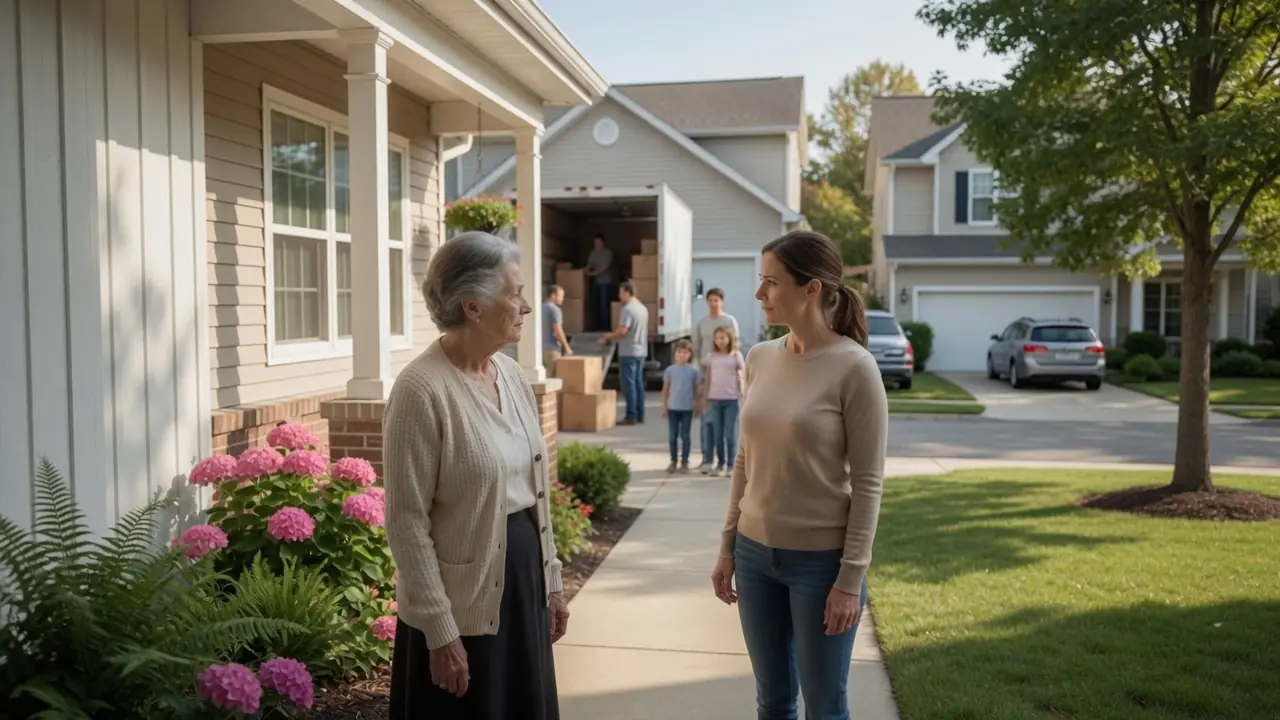
I was standing inside my own front doorway when the moving truck backed into my driveway. The truck doors were open, boxes were stacked neatly inside, and two movers stood near the ramp waiting for someone younger to tell them what to carry next. My son stood in the middle of the driveway with one hand lifted toward me, not quite reaching, not quite apologizing. Beside him, Sable stood with that careful expression she wore whenever she wanted something from me but did not want to sound like she was asking.
My grandchildren were there too, quiet and confused, holding each other’s hands the way children do when adults are pretending everything is normal. The sun was bright, the neighborhood was still, and my house looked exactly as it had looked for decades, steady and mine. I stood in a cream cardigan at the threshold, short gray hair brushed back, my hand resting lightly against the door frame Terrence had painted the summer before he died. Sable looked past me into the house as if she were already measuring what would fit in her future.
“You should really start looking at assisted living places, Mom,” she said with a smile. “We have a lot going on now.” That smile is the part I still remember most clearly, not the words. It was not cruel enough for anyone else to notice, but it was too smooth, too certain, too practiced. She spoke as if moving me out of the house I had bought in 1989 was just another item on her family’s schedule.
My son looked at the pavement. He did not correct her. That hurt more than I expected, even though I had been preparing myself for disappointment for weeks. I looked at him, then at Sable, then at the moving truck sitting in my driveway like a threat wrapped in cardboard. “This is my house, sweetheart,” I said. “My name is still on every paper that matters.”
Sable’s polite smile thinned. “We know that,” she said. “But after everything we’ve helped with, we thought you would understand.” I almost laughed, not because it was funny, but because some things are so backward that laughter is the only sound your body can find before anger arrives. They had lived under my roof for four and a half years, paid no rent for most of it, changed my cabinets, my cable, my garden, and my routines, and now she was speaking as if they had been carrying me. I folded my hands in front of me and said, “No one is moving me out of a life I paid for.”
That was not where the story began, of course. Stories like this rarely begin in the moment everyone else notices. They begin quietly, with one small boundary moved, one drawer rearranged, one decision made without asking, one silence accepted because you do not want to be difficult. By the time someone finally says the thing out loud, they have usually been practicing it in smaller ways for years.
For a while after his funeral, the quiet nearly swallowed me. I kept the garden because he had started it, tomatoes in summer, zucchini that always came too fast, and a rose bush near the back fence that bloomed every June whether I deserved it or not. I learned to eat dinner alone without setting two plates. I learned which sounds were the house settling and which were memories knocking too hard.
Then my younger son fell on hard times. He was forty-one, caught in some company restructuring that pushed him out of a job, and Sable’s part-time work at a dental office could not carry their rent. I offered them the spare room because mothers do that. “Just until you get back on your feet,” I told them, and I meant it.
At first, it was almost nice. The house had voices again. I heard my grandchildren laughing in the hallway and my son opening the refrigerator late at night the way he used to when he was a teenager. Even Sable’s habits seemed harmless at the beginning. She rearranged my spice cabinet, moved the coffee mugs, and organized my pantry like she had been waiting all her life to improve it.
I told myself she was nesting. I told myself a young woman with children needed to feel useful. I told myself that sharing a house required flexibility, and I had more years behind me than ahead of me, so perhaps I could bend more easily. The trouble with bending too often is that people begin to think you were made that way.
My son found work after a year, a good position as a project manager at a logistics company. He drove forty minutes each way and came home tired, quiet, and grateful at first. Sable changed when their money steadied. Not all at once, not in a single scene anyone could point to, but slowly, like a stain spreading behind paint.
She stopped asking before she made decisions. My cable package was reduced because she said “we” never watched those channels. Thursday nights became her friends’ night, even though that had always been when I watched my programs and went to bed early. She started saying “our place” when speaking on the phone. I heard it more than once, and each time I pretended it was just a phrase.
The garden was the first wound I could not pretend away. I came home from a doctor’s appointment one spring afternoon and found the rose bush gone. Terrence’s rose bush. The one he had planted himself, with his work gloves still sitting on the patio table and dirt on his cheek like a boy.
Sable said it blocked light from the patio area they wanted to set up. She said it kindly, efficiently, like she had solved a problem no one else had noticed. I stood at the fence line staring at the raw place in the soil where the roots had been. My son was at work, the children were at school, and Sable had already moved on to discussing outdoor furniture.
I did not confront her. I know how that sounds. I was seventy-two years old, and I did not want to become the bitter mother-in-law everyone whispers about after dinner. I did not want my son caught between his wife and his mother, because I was not sure, deep down, that he would choose me.
So I planted a hydrangea in the place where the rose bush had been. It felt like surrender at first. Later, I would understand it differently. Sometimes you plant something not because you accept what was taken, but because you are reminding yourself that roots still matter.
Then came the lottery ticket. I have never been a serious gambler, but I buy scratch tickets every few months because my mother used to do it. She bought two every time she passed the Sunoco on Route 12, scratched one right away, and saved the other for Sunday after church. After she died, I kept the habit because grief makes rituals out of the smallest things.
One October morning, I stopped at that same Sunoco after buying groceries. I bought four tickets with my debit card, scratched two in the parking lot, won nothing, and brought the other two home. I placed them in the small ceramic bowl on my kitchen windowsill, the one where I keep receipts, birthday cards, and small things I do not want to forget. I forgot about them by Sunday.
Three days later, my son went to the same Sunoco for gas and bought tickets of his own. That evening, he sat at the kitchen table scratching them while Sable sat beside him. I was in the living room watching the news when I heard him make a sound I had never heard before. It was short and sharp, like the air had been knocked out of him.
Then came whispering. I muted the television. My son called out, “Mom, do you know where those tickets are? The ones in the bowl?” I told him yes and asked why. His voice changed when he answered. “Can you come look at this?”
I walked into the kitchen and saw one of my blue tickets in his hand. I recognized it immediately. The scratch panel had a sunburst design, and the corner was bent where it had caught against the ceramic bowl. He had apparently taken it from the windowsill, thinking it was one of his own. Three symbols matched, and the prize listed beneath them was $250,000.
For a moment, no one spoke. The kitchen felt too small for the number on that ticket. I looked at my son, then at Sable, then at the ticket. “That’s mine,” I said.
Sable answered first. She was gentle about it, which made it worse. She said the tickets had been mixed together, that perhaps the station had given them in the same bag, that maybe the receipt would show whose purchase was whose. She was not saying it was not mine, she insisted. She was only saying we should be careful.
I said I was careful. I had bought those tickets on Sunday morning. I had put them in the bowl myself. My son said he believed me, but he said it quietly, looking down at the table instead of at his wife. That was when I first felt the ground shift.
I went to my room and sat on the edge of the bed. My hands were trembling, not because of the money, not entirely, but because of what had entered the house with it. Opportunity does strange things to people. It does not always make them different. Sometimes it only reveals what they had already begun to believe.
I called my neighbor Peg. She is seventy-six, a retired paralegal, and the sort of woman who can make tea sound like a legal strategy. I told her what happened. She did not gasp or scold or tell me everything would be fine. She asked, “Do you have the receipt?”
I did. I am a bookkeeper by trade, and bookkeepers keep receipts. The Sunoco receipt was still in the ceramic bowl with the remaining ticket, showing the date, time, four scratch tickets, and my debit card transaction. Peg told me not to touch anything more than necessary and to come over the next morning. Her steadiness steadied me.
At Peg’s kitchen table, we laid out the receipt, my bank statement, the remaining ticket, and the timeline. My transaction was Sunday at 11:37 in the morning. My son’s purchase had been Wednesday afternoon. There was no overlap, no confusion, no honest ambiguity in the paper. Peg tapped the receipt with one finger and said, “This is yours.”
Still, she told me to call the state lottery office before saying anything more at home. I did. The woman on the phone was matter-of-fact and kind, which was exactly what I needed. She said that with the signed ticket, receipt, and bank record, the claim could be processed in my name. No one else had submitted it. I was the claimant.
When I told my son, he went quiet. Sable did not come to dinner that night, claiming a headache. After the dishes were done, my son sat across from me in the living room and said Sable thought this might become a problem. I asked what kind of problem.
He said they had been looking at houses. He said that if the money came through, maybe they could finally get their own place. I told him that sounded good. Then he said Sable wondered whether I might consider something smaller and more manageable too, since I would be alone in the house.
I looked at my son for a long moment. He is not a bad man. I need that understood. But goodness without courage can still wound the people who need you most. He was uncomfortable saying the words, yet he said them anyway.
Two days later, Sable came to me directly. She was smiling when she suggested assisted living. She spoke of lovely communities nearby, safety, companionship, activities, and care. She said the house was too much for one person. She said they worried about me.
“I own this house,” I told her. “Of course,” she said quickly. “But people sell homes all the time when their situation changes.” I folded the dish towel in my hands and set it on the counter. “My situation has not changed.”
The claim went through in January. After taxes, the $250,000 became about $163,000, deposited directly into my account. I was at Peg’s kitchen table when the notification appeared on my phone. She poured us each a small glass of sherry, and we sat there without making a spectacle of it.
It did not feel like winning. It felt like solid ground. It felt like standing up after years of making myself smaller at my own table. The money mattered, of course, but not as much as the receipt, the record, the simple proof that what I knew to be mine was still mine.
Sable and my son found a rental twenty miles away. They moved out on a gray Saturday in February, the same day the moving truck sat in my driveway and Sable tried one final time to make my staying sound unreasonable. My son hugged me at the door before leaving. He held on longer than usual, but not long enough to say what needed saying.
Sable stood by the walkway and told me to take care of myself. I said I would. The movers shut the truck, the children waved from the back seat, and my son drove away slowly. I watched until the truck turned the corner.
Then I went inside and stood in my kitchen. The house was quiet. Not empty, just quiet in a way that belonged to me again. I opened the cabinet Sable had rearranged and put the mugs back where I liked them. I took down the little sign above the sink that said Good Morning, Sunshine and placed it in the recycling.
Later, I went out to the garden. It was still winter, but the hydrangea had survived. I could see the first small swelling of buds along the branches. Terrence’s rose bush was gone, and that loss still hurt, but the new plant had taken root anyway. There was something to be learned from that.
I am still in the house Terrence and I bought in 1989. My name is still on the deed, my name is still on the tax bill, and the ceramic bowl still sits on the kitchen windowsill. I keep the receipt there now, not because I need it anymore, but because I want to remember what small pieces of paper can do when people try to rewrite the truth.
My mother kept every receipt she ever had. I used to tease her about it, and she would say, “You’ll understand when you’re older.” She was right. She was right about most things.
The hydrangea will bloom this summer. I am sure of it. I plan to cut a few heavy white heads when they turn blue at the edges and place them in the wide-mouth vase on my dining room table. Then I will sit there for breakfast instead of eating in the corner of the kitchen to make room for someone else’s comfort.
I have spent too many years apologizing without words. Moving my routines, swallowing objections, letting decisions happen around me because I feared being left alone. But there are worse things than being alone in your own house. One of them is being surrounded by people who treat your life like an inconvenience.
My son and I are finding our way back slowly. He calls more now. Sometimes he sounds ashamed, though I do not make him say it. I have learned that forgiveness does not mean pretending nothing happened, and love does not require handing someone else the keys to your dignity.
As for Sable, I do not think she is evil. I think she saw an opportunity and reached for it after years of telling herself she had earned more than she had. She had already begun treating my house as hers before the ticket ever appeared. The money only made the belief visible.
That is what I have come to understand. People do not always take your life in one grand gesture. Sometimes they move your cups, then your roses, then your evenings, then your place at the table, and one day they smile at you from your own driveway and suggest it is time for you to leave.
I did not leave. I kept the house. I kept the receipt. I kept the truth.
And for the first time in years, I no longer ask permission to take up space in my own home.