Vanessa Holloway had married Brian two years earlier, and Caroline had tried from the beginning to be kind. She had swallowed the little corrections, the cold smiles, the way Vanessa said “your mother” to Brian as if Caroline were a household problem. Vanessa came from money, or at least from the kind of family that wore money like perfume. Her father, Martin Holloway, owned car dealerships in Connecticut, and her mother Diane served on charity boards that had photographs in glossy magazines.
For three weeks, Vanessa had treated the dinner like a royal inspection. She changed Caroline’s tablecloth because the old lace one looked “too sentimental,” moved the candles because they seemed “too country,” and replaced Caroline’s blue plates with rented white china. Caroline smiled through every correction because Brian kept looking at her with pleading eyes. She told herself it was only one dinner, only one evening, only one more thing a mother could do for her son.
By four-thirty, the dining room looked like it belonged in a magazine rather than the house where Brian had learned to walk. Silverware shone beside folded napkins, white roses sat in glass bowls, and the turkey rested in the center of the table, brown and perfect under the chandelier. Caroline stood in the kitchen doorway, tired but proud, wiping her hands on a towel. Then Vanessa stepped in wearing an emerald satin dress and looked around with a tight, disappointed mouth.
“The gravy boat is wrong,” Vanessa said. Caroline glanced at the old porcelain gravy boat beside the stove, the one her late husband Daniel had bought her on their tenth anniversary. “It is clean, and it matches well enough,” Caroline said gently. Vanessa laughed once, sharp and humorless, then stepped closer until Caroline could smell her expensive perfume over the turkey and butter.
“My parents are not coming here to eat out of your yard-sale memories,” Vanessa snapped. Caroline felt the insult land, but she kept her voice level. “That gravy boat was a gift from Brian’s father.” Vanessa’s eyes narrowed, and Caroline saw the old pattern unfold again, the impatience, the disgust, the certainty that Caroline’s feelings were not worth rearranging even one word.
Brian appeared in the doorway then, adjusting his tie and looking between them. “Everything okay?” he asked, already hoping the answer would be yes. Caroline waited for Vanessa to soften, but her daughter-in-law only grabbed the gravy boat and set it down too hard on the counter. A little gravy sloshed over the lip and spilled onto the polished stone.
“Your mother is trying to make this dinner look like a church basement,” Vanessa said. Brian winced but did not defend her. “Mom, maybe just let Vanessa handle the final details,” he said quietly. Caroline looked at him, and for a moment she saw the boy who used to cling to her skirt when thunder shook the house, not the man standing silent while his wife cut pieces out of her.
Caroline picked up a cloth and began wiping the spilled gravy. “I cooked the dinner,” she said. “I can manage the gravy.” Vanessa’s face changed then, as if Caroline’s small act of dignity had offended her more than any insult could. She grabbed the gravy boat, lifted it toward Caroline’s face, and spat a mouthful of gravy and contempt so close that it splattered across Caroline’s cheek and blouse.
For one second, no one moved. Caroline stood with warm gravy sliding down her face, one hand still holding the cloth. Brian looked at Vanessa, then at his mother, and the silence that followed was worse than any shout. Vanessa breathed hard, her lips trembling with rage, then said, “You are disgusting. You make everything disgusting.”
Caroline slowly turned her eyes toward Brian. “Say something,” she whispered. Brian opened his mouth, closed it, and touched Vanessa’s shoulder as if she were the one who needed comfort. Something inside Caroline broke so quietly that the room seemed to become very still around it. She set down the cloth, walked to the table, lifted the entire roasted turkey with both hands, and threw it through the dining room window.
Glass burst outward with a terrible crash. The turkey flew into the darkening yard and landed in the flower bed beneath the window, steam rising from it like a ruined offering. Vanessa screamed, Brian shouted, and Caroline stood breathing hard while gravy dried against her skin. For the first time all day, she felt no need to apologize.
The doorbell rang five minutes later. Broken glass still glittered across the patio, and the turkey lay outside among crushed roses. Vanessa stood frozen beside the table, one hand pressed to her mouth and the other gripping Brian’s sleeve. Brian stared at Caroline as if he had never seen his mother before.
“Mom,” he whispered. “What did you do?” Caroline laughed once, not because anything was funny, but because the question was too small for the damage in the room. “What did I do?” she asked, wiping her cheek with the napkin she had folded for Vanessa’s parents. “Your wife spat in my face, called me disgusting, and you patted her shoulder.”
Vanessa’s shock turned instantly into fury. “Don’t you dare make this about me. You embarrassed us.” Another knock hit the front door, harder this time. The people Vanessa had spent three weeks trying to impress were standing outside, and the house smelled like gravy, broken pride, and shattered glass.
Brian stepped toward the hall. “We need to calm down before they see this.” Caroline’s voice came out quieter than she expected. “No.” He stopped, and Vanessa turned toward her with disbelief. Caroline picked up the half-empty gravy boat and set it gently in the center of the table.
“No more pretending,” Caroline said. “Open the door.” Brian looked from his mother to the broken window, shame finally beginning to reach his face. “Mom, please.” The word hurt more than the gravy had, because he had saved his pleading for the moment she stopped accepting humiliation.
Vanessa shoved past him toward the front door, smoothing her hair and pulling her mouth into a hostess smile. Before she reached it, headlights swept across the broken window from the driveway. A man’s voice called from outside, “Vanessa? Why is there glass all over the lawn?” Vanessa opened the door, and Martin Holloway stood there with Diane beside him, staring past their daughter into the ruined dining room.
Then Martin’s eyes landed on Caroline. His face went white, but not with ordinary shock. It was the color of a man seeing a locked room open after decades. Caroline took one step forward, gravy still staining her blouse, and said, “Hello, Martin.”
Diane Holloway turned toward her husband. “Martin, what is going on?” Vanessa looked from her father to Caroline, confusion cutting through her anger. Brian moved closer to his mother, suddenly alert in a way he should have been ten minutes earlier. Martin opened his mouth, but no sound came out.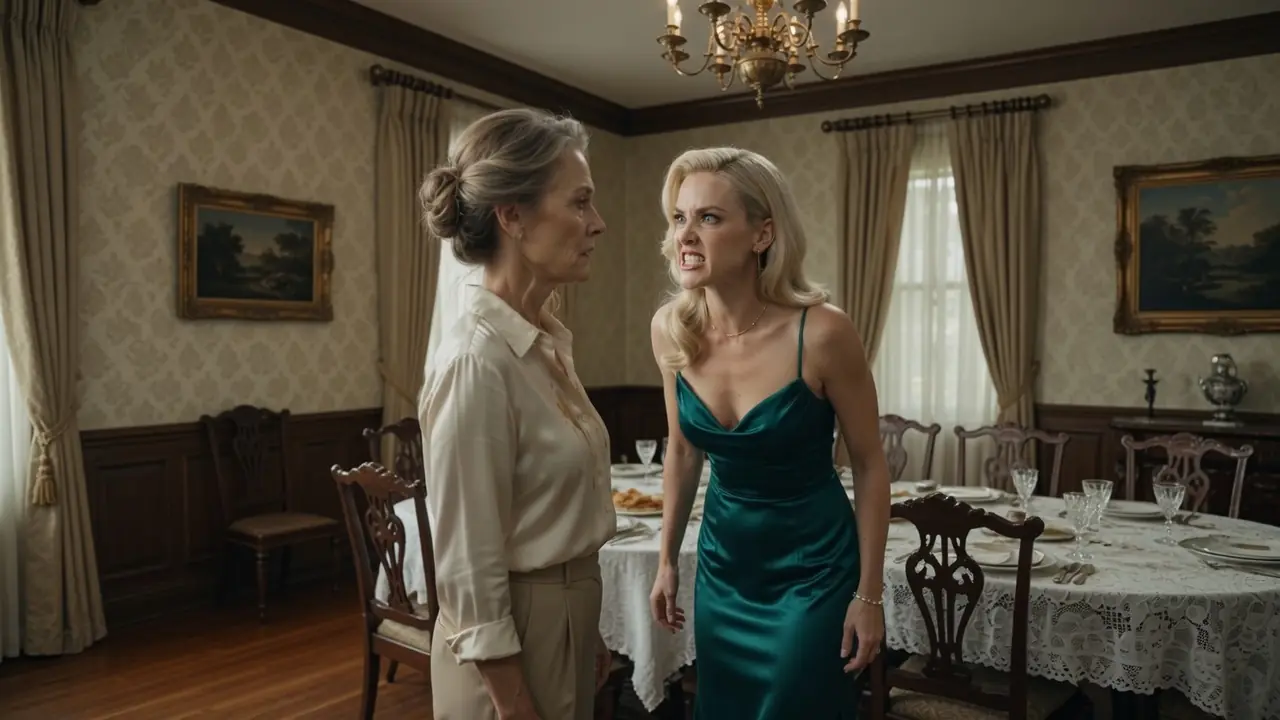
Caroline had imagined this moment for twenty-eight years. She had imagined yelling, crying, maybe even striking the man who had changed the course of her life with a pen and a smile. But standing there with the turkey in the roses and her family staring, she felt strangely calm. “You still wear expensive cologne to cover cheap lies,” she said.
Diane stepped into the house, her heels crunching on a small piece of glass. “You know this woman?” she asked. Martin swallowed hard. “Caroline,” he said, as if her name itself might accuse him. Vanessa snapped, “Why does my father know your name?”
“Ask him,” Caroline said. Martin lifted both hands, his polished confidence cracking. “This is not the time.” Caroline smiled without warmth. “Your daughter spat in my face in my own home because she thought I was too low to serve people like you. I think the time has arrived.”
Vanessa gasped. “That is not what happened.” Caroline turned to her. “Careful.” Something in her voice made Vanessa’s mouth close. Diane looked at her daughter, then at the gravy stain on Caroline’s blouse, and her face hardened in a way Caroline had not expected.
“Martin,” Diane said, “answer the question.” He looked older than Caroline remembered, thicker around the jaw, richer in the suit, but under the money he was the same man who had once stood in a hospital hallway and handed her papers while she was still wearing her widow’s black dress. “I knew Caroline a long time ago,” he said. Diane’s eyes narrowed. “That is not an answer.”
Caroline walked to the sideboard and opened the lower drawer. Brian watched her remove a yellowed envelope tied with string. His face shifted when he realized he had never seen it before, not in all the years he had lived in that house. Vanessa stared at it as if it were a loaded weapon.
“In 1997,” Caroline said, “Martin Holloway was not a dealership owner. He was a junior attorney for my late husband’s company.” Brian’s head snapped toward her. “Dad’s company?” Caroline nodded, her fingers tightening around the envelope. “Your father owned part of a small auto parts business with two partners. It was not huge, but it was growing, and Daniel planned to leave his shares to you.”
Martin took one step forward. “Caroline, stop.” His voice was sharp now, no longer frightened but commanding. Caroline had once obeyed that kind of voice because grief had hollowed her out. She did not obey it now. She untied the string and pulled out old documents, copies, letters, and a folded statement written in Daniel Miller’s hand.
“When Daniel died suddenly, I was thirty-five years old with a seven-year-old son and no idea how business papers worked,” she said. “Martin came to me as the helpful young attorney. He told me there were debts, liabilities, risks, and urgent signatures. He said if I did not sign quickly, Brian and I could lose the house.”
Brian’s face drained of color. “Mom,” he whispered. Caroline looked at him, and this time her eyes were not pleading. “I signed because I trusted the man your father had trusted.” She turned back to Martin. “And within six months, Daniel’s shares were gone, the company was sold, and Martin Holloway somehow had the money to buy his first dealership.”
Diane stared at her husband. “Is this true?” Martin’s mouth tightened. “It was complicated. She did not understand the situation.” Caroline laughed softly. “No. I did not understand your lies. There is a difference.”
Vanessa shook her head violently. “My father built everything himself.” Caroline looked at her with a sadness that almost resembled pity. “People like your father are very good at building things from what widows are too broken to protect.” Vanessa flinched, but Caroline did not stop. “And people like you learn to call others disgusting because you have never looked too closely at the hands that fed you.”
Martin’s face darkened. “Enough.” Caroline lifted Daniel’s letter. “This is your handwriting on the transfer forms. This is Daniel’s letter naming Brian as beneficiary of his shares. This is the bank statement showing the payment you received three weeks after I signed away what I did not know I owned.” She placed each paper on the table beside the gravy boat, as if setting evidence before a judge.
Diane picked up the first document with trembling fingers. Her eyes moved across the page, and the controlled elegance in her face began to crack. “Martin,” she said, very quietly. “Tell me she is lying.” Martin looked at his wife, then at his daughter, then at the son-in-law he had treated as socially beneath him. No answer came.
Brian stepped forward slowly. “You stole from my mother?” Martin’s jaw worked. “Your mother signed legal documents.” Brian’s voice rose. “She was grieving. She was alone. My father had just died.” Caroline saw tears gather in his eyes, but she did not move to comfort him.
For once, Brian needed to stand in the pain without being rescued from it. Vanessa looked at her husband and then at Caroline, the first real fear entering her expression. “Brian, I did not know,” she said. He turned toward her. “You did know how you treated my mother.”
Vanessa’s lips parted. The dining room went painfully quiet. Caroline could hear the wind through the broken window and the faint sound of steam still rising from the turkey outside. It occurred to her that the dinner was ruined beyond saving, yet the truth had finally been served.
Diane placed the document back on the table. “Martin,” she said, “we are leaving.” He looked relieved for one foolish second until she added, “You are not coming with me.” Vanessa gasped. Martin stared at his wife as if she had betrayed him by noticing his betrayal of someone else.
“Diane,” he said. “You do not understand.” Her voice cut through him like polished steel. “I understand enough. I understand that the house, the charity donations, the dealership openings, and the speeches about hard work all began with a widow signing papers she did not understand.” She turned to Caroline. “I am ashamed that I have eaten at tables built on that.”
Caroline had not expected that. The anger in her body faltered for half a second, leaving exhaustion behind. “Your shame does not give me back twenty-eight years,” she said. Diane nodded. “No, it does not. But it may begin the work of returning what can still be returned.”
Martin tried to laugh, but it came out thin. “This is ridiculous. Those documents are decades old.” Caroline looked directly at him. “So is grief, Martin. It still knows your name.” The line silenced him more effectively than a shout would have.
Brian turned to Caroline then, and his face finally looked like a son’s face instead of a husband trying not to choose. “Mom,” he said, his voice breaking. “I am so sorry.” Caroline held his gaze, but she did not move toward him. “I needed those words before the doorbell rang.”
The sentence hit him hard. He nodded, tears sliding down his cheeks. Vanessa stood beside him, suddenly smaller in the emerald dress that had seemed so powerful minutes earlier. “Caroline,” she began, but Caroline lifted a hand. “No. Not tonight.”
Vanessa’s face tightened, not with rage now, but with the humiliation of being refused forgiveness on demand. Caroline saw the child beneath the polish, the daughter of a man who had taught her that money could turn cruelty into refinement. That did not excuse her. It only explained the shape of the knife she had used.
Diane stepped toward Vanessa. “Did you spit at this woman?” Vanessa’s eyes filled instantly. “I was angry.” Diane’s expression hardened. “That is not an answer.” Vanessa looked at the floor. “Yes.”
For the first time since the gravy hit her face, Caroline felt the room understand the weight of what had happened. Brian covered his mouth with one hand, shame bending his shoulders. Martin looked away because even he knew there was no respectable explanation for his daughter’s cruelty. Diane closed her eyes briefly, as if absorbing the failure of both husband and child at once.
Caroline walked to the broken window and looked outside. The turkey lay ruined in the flower bed, ridiculous and tragic, surrounded by glass and roses. She had spent six hours on that meal. She had spent twenty-eight years swallowing another kind of meal, one made of silence, sacrifice, and the lie that peace was worth more than dignity.
When she turned back, her voice was steady. “Brian, you and Vanessa will leave this house tonight.” Brian nodded immediately, but Vanessa looked up in alarm. Caroline continued before either of them could speak. “You may come back when you understand that love without respect is just another kind of hunger.”
Brian whispered, “I understand.” Caroline shook her head. “No. You are beginning to.” He lowered his eyes, and for once he did not argue.
Diane gathered the documents carefully. “May I have copies?” she asked. Caroline studied her face. “You may photograph them. The originals stay with me.” Diane nodded and pulled out her phone with hands that were not as steady as she wanted them to appear.
Martin moved toward the door. “I will not stand here and be accused in my daughter’s in-laws’ dining room.” Caroline looked at him. “You stood in a hospital hallway and accused me of being too emotional to understand money. This room is kinder than you deserve.” Diane turned on him. “Wait outside.”
He opened his mouth, saw her face, and obeyed. It was the first satisfying thing Caroline had seen him do all evening. Vanessa watched her father leave, and something in her certainty broke. For the first time, she looked at Caroline not as an embarrassment, but as a witness to the hidden foundation of her life.
“I really did not know about my father,” Vanessa whispered. Caroline nodded once. “Maybe not. But you knew about yourself.” Vanessa recoiled slightly, as if the sentence had touched something no amount of money could cover. Caroline did not soften it.
An hour later, the house was quiet. Brian and Vanessa had gone to a hotel, Diane had left separately from Martin, and the ruined turkey had been carried out of the rose bushes by Brian with tears on his face. Caroline stood alone in the dining room with a broom in one hand and the old envelope safely returned to the sideboard. The window was boarded with cardboard, and cold air still slipped through the cracks.
She looked at the table, at the perfect plates, the polished silver, the candles burned low. The dinner Vanessa had wanted never happened, but something more important had taken its place. Caroline had not hosted the Holloways. She had exposed them.
The next morning, Brian returned alone. He stood on the porch with red eyes, holding coffee and a package of store-bought muffins like a peace offering from a man who did not yet know how to repair what he had allowed. Caroline let him in but did not hug him. He seemed to understand why.
“I failed you,” he said in the kitchen. Caroline poured coffee into two mugs and set one in front of him. “Yes,” she said. He flinched, but she was tired of making truth comfortable for people who had made silence dangerous for her. “But failure is not the end if you stop defending it.”
Brian cried then, not loudly, but with the shame of a grown man seeing his cowardice without excuses. He told her he had asked Vanessa for space, that he needed to decide whether their marriage could survive what she had done. Caroline listened without telling him what choice to make. A mother could love her son and still refuse to carry his consequences.
In the weeks that followed, Diane’s lawyers contacted Caroline. Martin’s first dealership had grown into many, and untangling the money would take time, but Diane had influence, documentation, and anger sharpened by humiliation. Caroline did not expect justice to come cleanly or completely. Still, the first settlement offer arrived before Christmas, and it was large enough to make Brian sit down when Caroline told him.
Vanessa wrote a letter too. It was three pages long, not elegant, not polished, and not enough. She admitted what she had done, apologized without excuses, and said she had started seeing a therapist because she had realized cruelty had been her inheritance. Caroline read the letter twice, folded it, and placed it in a drawer far from Daniel’s envelope.
She did not forgive Vanessa that day. Forgiveness, Caroline had learned, was not a performance for people who wanted to stop feeling guilty. It was a private door that opened only when the person holding the key was ready. Caroline was not ready.
By spring, the broken dining room window had been replaced. Caroline planted new roses beneath it, choosing yellow ones because Daniel had always said yellow made a house look hopeful. Brian came by every Sunday and cooked with her, badly at first, then better. Sometimes they talked about Daniel, sometimes about the lawsuit, and sometimes about ordinary things that hurt less.
One Sunday, Brian set a gravy boat on the table. It was the old porcelain one, cleaned and shining, the one Vanessa had called a yard-sale memory. Caroline looked at it for a long moment. Brian said quietly, “Dad bought it, didn’t he?”
“Yes,” Caroline said. “He said every family needed one beautiful thing that did not have to impress anybody.” Brian’s eyes filled again, but this time Caroline reached across the table and touched his hand. He was learning, and learning was not the same as being forgiven, but it was a place to start.
Months later, when Caroline thought of that Thanksgiving, she no longer thought first of the gravy on her face. She thought of the doorbell, the shattered window, Martin Holloway turning pale, and the envelope finally opened under the chandelier. She thought of the moment she stopped protecting everyone else from the truth. It had not been graceful, but it had been necessary.
People in town heard pieces of the story, of course. Some said Caroline had lost her temper, some said she had ruined Thanksgiving, and some said throwing a turkey through a window was not the behavior of a dignified woman. Caroline let them talk. Dignity, she had discovered, was not always quiet.
Sometimes dignity stood in a stained blouse and said no more. Sometimes it opened the door while the glass was still on the floor. Sometimes it let the whole room see the mess, because the mess was finally honest. And sometimes, after twenty-eight years of swallowing lies, dignity picked up the turkey and threw it straight through the window.