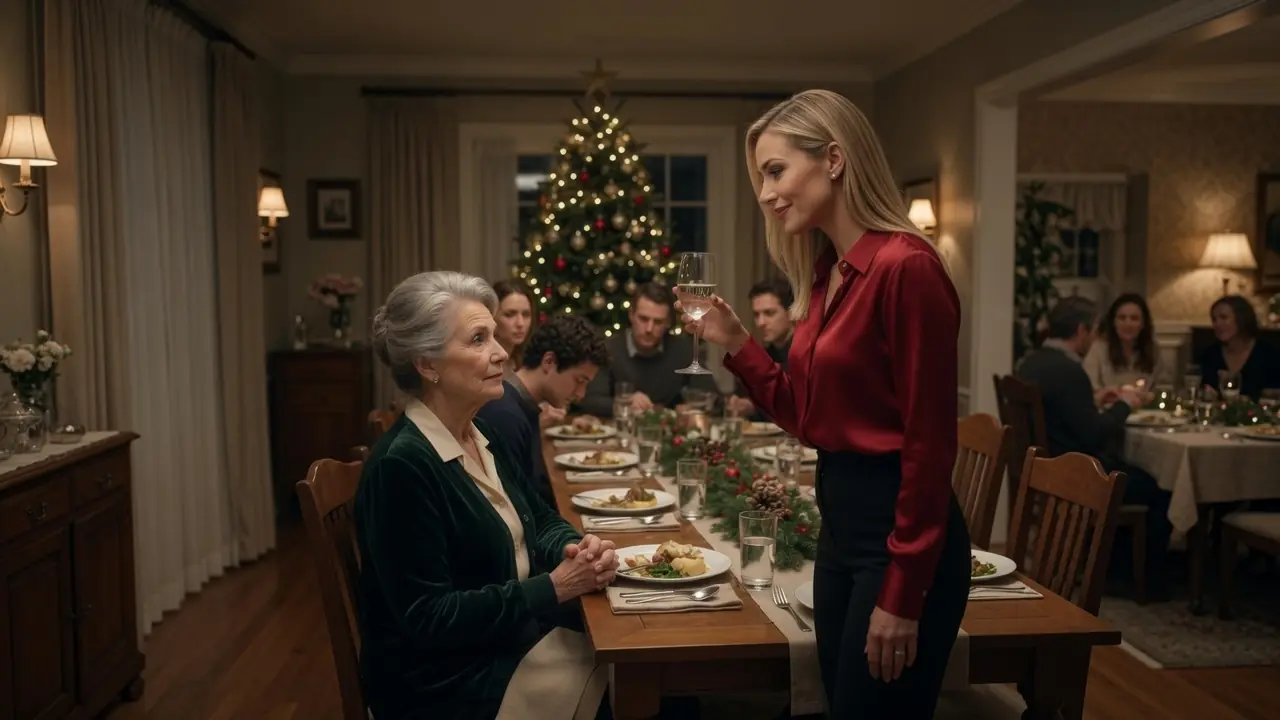
The Christmas tree glowed quietly in the corner of my dining room, its tiny white lights reflecting off the polished water glasses and silver forks on the table. Outside, the December night pressed cold against the windows, but inside my house, the air was warm with roasted meat, cinnamon, evergreen branches, and old family tension. My son Caleb sat with his head lowered, staring at his plate as if the pattern on the china might save him from speaking. His wife, Natalie, stood at the end of the table in a deep red blouse, one hand lifted with a wine glass, smiling like a queen who had already conquered the room.
I was sixty years old, a widow of five years, and the owner of the brick colonial house everyone had gathered in that night. My name is Martha Whitaker, though Natalie had a way of saying it like it was a chore. She never called me Mom, never asked how I was, never thanked me when I hosted dinners, bought gifts, or made room in my life for her family. For nine years, I had watched her treat me like furniture in my own home.
That Christmas Eve, she raised her glass and looked straight at me. “Martha, the attic will suit you just fine this Christmas,” she said, as if she were announcing a seating change at a restaurant. Her parents sat beside her, wearing the same satisfied expressions they always wore when their daughter was being rude. Caleb’s hand tightened around his fork, but he did not lift his head. He had learned to disappear beside her, and I had learned to notice.
I folded my hands beside my plate and smiled gently. “Interesting,” I said. “I was just deciding who still suits my home.”
Natalie’s smile flickered for half a second. Then she recovered and laughed as if I had made a harmless old-woman joke. “At your age, you should be grateful we include you,” she said, looking around the table for approval. Her mother gave a small nod. Her father cleared his throat, but did not object.
I looked at my daughter-in-law with perfect calm. “And at your age,” I said, “you should know when money stops.”
No one spoke after that.
But that was not where the story began.
The story began three weeks earlier, when Natalie handed me a to-do list for Christmas in my own kitchen. She had printed it in neat bullet points, clipped it to a clipboard, and slid it across the table like I was her employee. Caleb sat beside her, holding his coffee mug with both hands, looking ashamed but silent. I remember the soft scratch of the paper against the tablecloth and the way Natalie did not even bother to look embarrassed.
The list was extraordinary in its arrogance. I was expected to roast Christmas dinner for twelve people, decorate the entire house, buy groceries, prepare the guest rooms, wash the holiday linens, and move into the attic bedroom for a week so Natalie’s parents could use my large first-floor master suite. My home, my bed, my labor, my money, all assigned by a woman who had never once asked whether I needed help. She had simply decided.
“It’s just the best way to handle things, Martha,” Natalie said, inspecting her manicure. “Your room is bigger, and it’s not like you use all this space anyway.”
Caleb’s face went red, but he stayed quiet.
I waited for him to say something. He was my only child, the boy I had once stayed up all night nursing through fevers, the teenager whose college applications I had proofread, the man whose down payment I had funded because I wanted his life to start easier than mine had. He said nothing. He just stared into his coffee and let his wife turn me into household help.
I did not shout. I did not cry. I simply looked at the list, smoothed the tablecloth beneath my fingers, and said, “I understand.” Natalie smiled like she had won. Caleb flinched like he knew something had ended, even if he did not yet know what.
After they left, I carried the list to my home office and placed it on my desk. For a few minutes, I just stared at it. Then I opened my laptop and began rearranging my life with the same discipline I had used to build it. If Natalie believed I was a helpless widow with nothing but time and a house too large for me, then she was about to learn how carefully I understood assets, access, and consequences.
The first thing I ended was the monthly transfer to Caleb’s household account. Years earlier, my late husband George and I had set up financial support for him, meant to help him while he built stability. After George died, I continued it because I told myself families help each other. But the money had stopped being support and had become fuel for Natalie’s boutique shopping, spa days, and weekend getaways.
I drove to the bank the next morning. The branch manager, Ellen, had known me for twenty-five years and still remembered George bringing in paperwork with coffee stains on it. She helped me cancel the recurring transfer and separate my accounts from anything Caleb and Natalie could touch. When the process was done, she asked, quietly, “Are you all right, Martha?”
“I am getting there,” I said.
By the time I arrived home, Caleb had already texted.
Mom, is there a bank issue? The transfer didn’t come through.
I replied, No error. Times change.
He did not answer for an hour. Then he sent, Is this because of Christmas?
I typed, No. This is because of nine years.
I did not send anything else.
The second thing I changed was the locks.
Caleb and Natalie had keys to my house because I had given them those keys during a kinder version of my life. At first, they used them for emergencies. Later, they used them whenever they pleased. They entered without calling, left boxes in my hallways, raided my pantry, dropped laundry in my basement, and treated my home like a secondary storage unit with an old woman attached.
The locksmith came Monday morning. He replaced the front and back deadbolts within two hours. I watched him work from the hall, feeling a strange relief with every turn of the screwdriver. When he handed me the new keys, I placed them in my palm and felt, for the first time in years, that my house had chosen me again.
Natalie discovered the change that afternoon.
She arrived unannounced with two plastic bins of decorations and tried to force her old key into the lock. I heard her rattling the handle, then buzzing the doorbell with the impatience of someone who believed waiting was for lesser people. Caleb stood behind her on the porch, holding one of the heavy bins, his face already pale with anxiety.
I opened the door with the chain still fastened.
Natalie stared at me. “Why doesn’t our key work?”
“I had the locks changed,” I said. “For security.”
Her hand shot out. “Fine. Give us the new key.”
“There isn’t one for you.”
Her mouth opened, but no sound came out immediately. Caleb shifted the bin from one arm to the other and whispered, “Mom?” I looked at him, then back at Natalie. “You are welcome to visit if you call ahead and ring the bell. The open-door policy is over.”
Natalie’s face hardened. “This is childish.”
“No,” I said. “It is ownership.”
Then I closed the door.
After that, the house became quiet. Natalie left voicemails I did not listen to, texts I did not answer, and messages through Caleb that only made him sound more tired. I spent those days working in my office, handling calls with attorneys, private equity advisors, and the board of the software company George and I had built together. To Natalie, that company was my “little computer hobby.”
She had never asked what it did.
George and I had started Whitaker Systems thirty years earlier, back when global logistics technology was not glamorous and people laughed at small firms working from converted basements. We built algorithms that helped freight companies optimize routes, reduce fuel costs, predict delays, and manage distribution networks across continents. After George died, I kept the company running from home. Quietly. Efficiently. Successfully.
By the December before that Christmas, our software had become essential to several major shipping and freight networks. A multinational conglomerate had offered to buy us for $280 million, then raised the offer to $340 million when I hesitated. The money was tempting, of course. But the terms were ugly. They wanted the technology, not the people who built and maintained it.
They wanted to dissolve our brand and lay off domestic staff.
I said no.
Instead, I negotiated a different arrangement with a private equity consortium in New York. They purchased a 49 percent stake for $150 million, while I retained controlling interest, protected my employees, and kept the Whitaker name alive. I signed the final papers two days before Christmas Eve.
No one in my family knew.
Not because I was hiding shame, but because they had stopped asking me questions long ago.
On December 23rd, Caleb and Natalie came by again, properly calling first this time. Natalie sat on my sofa with the stiff posture of a woman trying not to explode. She reached toward the thermostat out of habit, intending to raise the temperature the way she always did. I walked over, caught her wrist gently, and set the thermostat back to where it belonged.
“It’s chilly in here,” she said. “Did you run out of heating money now that you froze the bank accounts?”
Caleb winced.
I sat across from them. “I don’t believe in wasting resources on people who don’t appreciate my hospitality.”
She looked as if she wanted to slap me, but she smiled instead. “Tomorrow dinner is at eight. My parents will come after church. I expect everything to be ready.”
I looked directly at Caleb. He still said nothing.
“Don’t worry about the food,” I replied.
Natalie mistook that for surrender.
Christmas Eve arrived with snow dusting the porch railings and candlelight glowing in the windows. Natalie’s parents entered my home with coats that cost more than some families’ monthly rent and expressions that suggested they were tolerating the house rather than visiting it. Her mother gave me a nod so small it could have been accidental. Her father walked straight to the dining room and inspected the table settings like a hotel critic.
I had made dinner because I wanted my final performance to be flawless.
Roast beef, potatoes, green beans, rolls, salad, cranberry sauce, and two desserts sat in perfect order. Natalie looked pleased, which almost made me laugh. She thought she had bent me back into place. She did not understand that sometimes obedience is only camouflage for timing.
The meal began exactly as expected. Natalie talked about her brother’s promotion, her parents’ vacation plans, and the furniture she wanted to buy after the holidays. Her mother praised Natalie’s taste. Her father complained mildly about taxes. Caleb tried twice to speak to me, but each time Natalie interrupted him and redirected the conversation.
I ate slowly and said very little.
When dessert was served, Caleb finally turned to me with a desperate attempt at normalcy. “So, Mom,” he said, too loudly, “how is that logistics software thing going?”
Natalie laughed before I could answer. “Oh, Caleb, please. Your mother clicks around on old websites. It isn’t a real business.” She took a sip of wine, then added, “At her age, it’s sweet that she keeps busy.”
I set my dessert fork down.
The sound was soft, but everyone heard it.
“Actually,” I said, “I finished with the company last week.”
Natalie raised one eyebrow. “Ran out of steam?”
“No,” I replied. “I turned down a $340 million acquisition offer.”
Caleb froze.
Natalie’s father slowly lowered his wine glass. “From whom?”
“The Nexerian Group out of Atlanta,” I said. “They wanted our global logistics algorithms, but the terms were unacceptable.”
The dining room became completely still.
Natalie blinked several times, as if the words had failed to arrange themselves into meaning. Caleb’s mouth opened, but no sound came out. Her mother looked from me to her husband, searching for confirmation that such companies existed. Natalie’s father knew enough to be alarmed.
“The Nexerian Group?” he repeated. “They are a multinational conglomerate.”
“Yes,” I said.
Caleb finally whispered, “Mom, did you say $340 million?”
“I did,” I answered. “I turned it down because they planned to lay off my staff and dissolve our name. Yesterday, I finalized a different agreement. A private equity consortium bought 49 percent for $150 million. I kept control.”
Natalie’s face drained of color.
For nine years, she had ignored me. For nine years, she had taken my coffee without thanks, accepted my checks without curiosity, and treated my home like a facility attached to her convenience. Now she stared at me as if I had transformed into another person at the table. But I had not changed at all. She had simply never bothered to see me.
“You have millions,” Natalie said, her voice thin. “And you cut off Caleb’s allowance?”
“My allowance,” I corrected.
Her eyes flashed. “That is incredibly selfish.”
I looked at her with no anger left in me. “Selfish is handing a widow a chore list for her own house. Selfish is telling me to move into the attic so your parents can sleep in my bed. Selfish is taking nine years of help and never once asking how I am.”
Caleb lowered his head.
Natalie tried to recover. “Martha, we obviously didn’t know.”
“No,” I said. “You didn’t ask.”
Her mother shifted uncomfortably. Her father stared at his plate. The room had turned so quiet I could hear the grandfather clock ticking in the hallway.
Caleb looked up at me, shame written across his face. “Why didn’t you tell us?”
“Because every time I tried to speak about my life, Natalie changed the subject or looked at her phone,” I said. “And you let her. Eventually, I stopped trying.”
His eyes filled, but I did not soften. Not yet.
I rose from the table and walked to the buffet cabinet. Inside waited a folder I had prepared that afternoon. I carried it back and placed one page in front of Caleb. “This is a breakdown of the down payment assistance, monthly transfers, and financial gifts I have provided over the last several years.”
Natalie stiffened. “What is that supposed to mean?”
“It means I own 60 percent of the house you currently live in,” I said. “I provided the entire down payment through a documented loan structure Caleb signed. In January, I will sell my share to a private real estate investment firm unless you buy me out before then.”
Natalie stood up so quickly her chair scraped the floor. “You can’t do that.”
“I can.”
“We have a mortgage.”
“I know.”
“We have bills.”
“I know that too.”
Her voice rose. “Where are we supposed to live?”
I looked at her evenly. “Perhaps the attic will suit you just fine.”
Caleb closed his eyes.
Natalie’s mother gasped. Her father looked suddenly fascinated by the tablecloth. Natalie stared at me with hatred, fear, and greed fighting across her face. For the first time, she had no useful insult.
I continued, “My money is closed to you. My house is closed to you. My bedroom is not available. My time is not yours to assign.”
Caleb whispered, “Mom, I’m sorry.”
“I believe you,” I said. “But sorry is not a plan.”
Dinner ended shortly after that. Natalie’s parents left without thanking me for the meal. Natalie gathered her coat in stiff, frantic movements and refused to meet my eyes. Caleb lingered by the door after the others stepped onto the porch.
“I should have spoken up,” he said.
“Yes.”
“I don’t know when I became this weak.”
I placed my hand briefly on his shoulder. “Then find out. And when you do, decide whether you want to keep living someone else’s life.”
He nodded once and walked into the cold.
When the front door closed, I stood alone in the entryway and listened to the quiet of my own house. It did not feel lonely. It felt returned.
The next morning, Christmas Day, I slept until nine. No one demanded breakfast. No one asked where the good towels were. No one adjusted my thermostat, opened my refrigerator, or treated my home like a service desk. I made coffee and sat by the tree in my robe, watching light move across the floor.
Three months later, Caleb and Natalie sold their house because they could not afford to buy out my share. They moved into a smaller rental outside town. I did not celebrate it, but I did not rescue them either. Caleb began calling me once a month, and slowly, awkwardly, he learned how to ask questions and listen to the answers.
Natalie never apologized.
That was fine.
I used part of my new capital to start a foundation for older women entering technology and business ownership. Women like me, who had been overlooked because they were quiet, aging, widowed, or underestimated. I funded grants, mentorship programs, and training partnerships. I gave lectures, sat on panels, and looked younger people in the eye when I told them invisibility is not the same as weakness.
Sometimes, in the evenings, I sit on my back patio with a glass of water or wine and listen to the birds settle in the trees. Money brings comfort, yes. It brings security. But the deepest peace I have found comes from self-determination.
Natalie thought she was sending me to the attic.
Instead, she helped me take back the whole house.
And if there is one thing I learned after nine years of being ignored, it is this: quiet women do not always stay quiet because they are afraid.
Sometimes they are simply choosing the exact moment to speak.
And when that moment comes, the entire table listens.