The words tore out of a kid who didn't look like he'd eaten a real meal in a week, and they were already too late to matter because the dog was gone. A streak of dirty gold cutting across water that had turned the color of melted copper in the last hour of light. The lake had been glass a moment before. The kind of evening stillness that makes the whole world seem to hold its breath while the sun lowers itself behind the tree line. 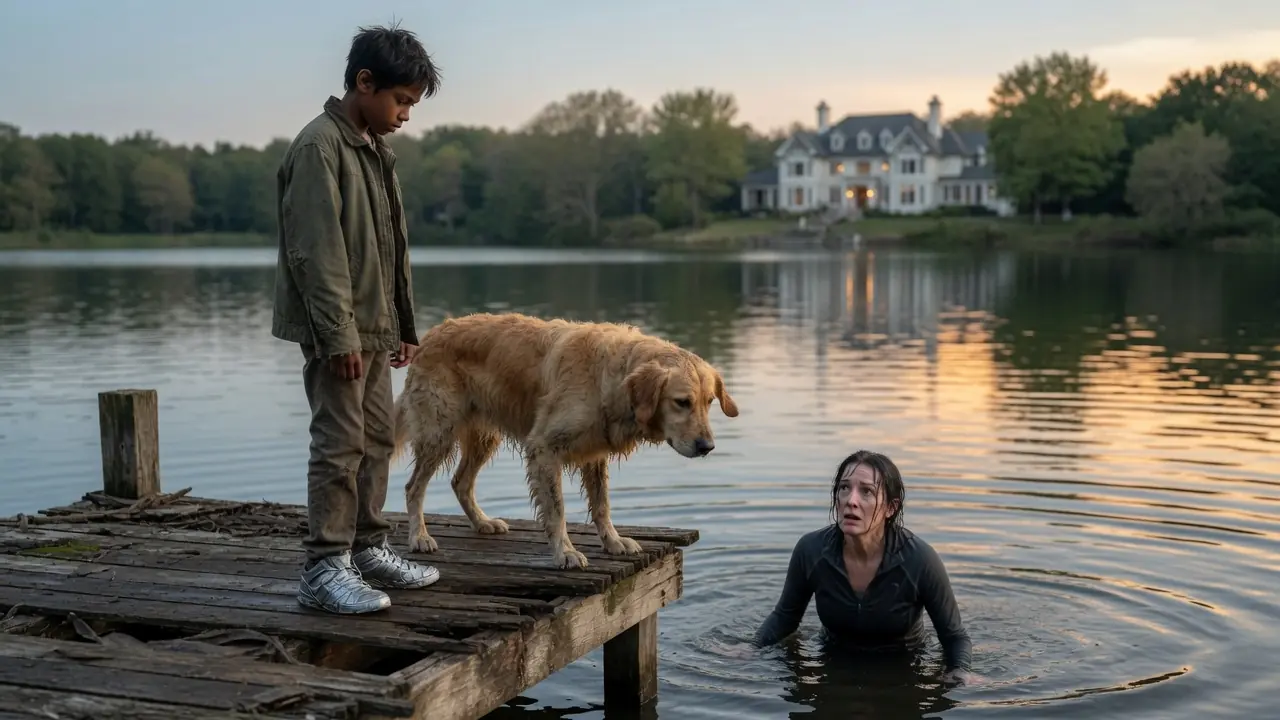
On the far shore a white house the size of a small hotel sat lit up gold against the dusk. Its tall windows catching the last of the day like a row of stacked coins. Somewhere over there a sprinkler was ticking across a lawn nobody ever walked on. And in the middle of all that wealth and all that calm, a woman was going under.
She was not waving, though from a distance it looked like waving. The boy knew better. He had watched enough hard things from the edges of the world to know that when a person's arm goes up slow and comes down slower and the head tips back too far, that person is not waving. That person is running out of water to stand on.
He had been up on the grassy rise above the old boat ramp where the manicured shoreline gave way to weeds and broken cattails and a rusted out dock the rich people on the far side never used. That was his spot. He'd found it three nights ago. Nobody came to this side of the lake at sundown, which was exactly why an 11-year-old with everything he owned zipped into one army green backpack had chosen it.
You learn to pick the places people forget. He had heard the splash before he saw anything. A flat wrong sound. Then a gasp that cut off too fast. And now he was running, sliding down the muddy bank on the side of one duct-taped sneaker, screaming at the only living thing in the world that had ever once listened to him.
The dog had no name. The boy had been splitting half of nothing with him for 2 weeks, and in return the dog had decided, in the silent way strays decide things, that the boy was his. He was a big animal gone gaunt, the cream coat hanging over a frame you could count the ribs on. One ear folded wrong from some old fight.
He swam the way a starving dog swims, like the water was just one more thing trying to take something from him, and he was done letting things take. He reached her where the gold light broke into a thousand pieces on the surface. The woman's hand came up clawing at nothing. And then the dog did the thing no one had ever taught him to do.
The woman's eyes found the dog, found the gold fur and the notched ear and the impossible stubbornness on the face of an animal that had no reason left in the world to save anybody. And some instinct older than panic told her to stop fighting. She went limp against the pull. The dog towed her lunging, his back legs churning the copper water white.
On the surface behind her, a designer handbag that had slipped from her shoulder when the bank gave way bobbed once, soft black leather, a gold clasp catching the dying sun, then tipped and sank and was gone, and not one of the three creatures fighting for her life so much as glanced at it. Because it didn't matter. Not the bag, not the building she owned across the city, not the house on the far shore with her name on the deed.
Out here in the last 20 minutes of daylight, the richest woman on that lake was being saved by a dog who'd eaten garbage that morning, and a boy whose own mother couldn't have told you where he slept. The dog reached the pilings. The boy threw himself flat on the rotted dock, reaching down with both thin arms. "I got you," he said quiet now, that strange calm voice that didn't match the size of him. "I got you. Grab my hand. I'm not letting go."
He had said that to people before in his short life. It was the first time it had ever been true. Getting her out of the water was harder than getting her to the dock. The boy was strong for his size, but his size was the problem. 11 years old and built like a coat hanger, all sharp shoulders and not enough underneath them.
He had her wrist in both hands and his sneakers wedged against a piling. And for a long, terrible moment, the lake seemed to want her back more than he could keep her. The dog had let go of her sleeve and scrambled up onto the bank. And now he came back to the edge of the dock and clamped his teeth into the collar of her jacket and hauled, growling low through his nose, every rib in his body pumping.
Between a starving dog and a half-grown boy, they brought her up onto the boards an inch at a time. She came over the edge and rolled onto her back and lay there, and the boy fell back onto his heels, gasping, watching her chest to see if it would move. For 1 second, it didn't. Then she turned her head and coughed up half the lake and kept coughing, her whole body folding around it, and the boy let out a breath that shook on the way out of him.
"Okay," he said, "okay. You're okay. Breathe. Just breathe." The dog stood over her dripping, planted, like he decided his job now was to keep the sky off her. He licked the side of her face once, then sat down hard against her shoulder, and that was when she finally got enough air to make a sound that was almost a laugh and almost a sob.
She was shaking violently. The light was going fast now, the gold sliding down to a deep bruised orange across the far hills, and the temperature was sliding with it. She had on running clothes that cost more than the boy had held in his hand in his entire life, and they were soaked through and useless, and her skin had gone the color of the underside of a fish.
The boy knew cold. He knew it better than he knew almost anything. He pulled off the army green coat without thinking about it. It was the only thing that had kept the wind off him for 2 months, and he laid it over her chest and shoulders. It smelled like smoke and wet dog and the underside of a highway overpass.
She didn't seem to notice. She gripped the front of it with both shaking fists the way drowning people grip anything and pulled it close. "Hospital." she managed. Her teeth were going so hard the word came out in pieces. "I need phone. My phone was in the" "It's gone." the boy said. "Your bag went under. I saw it."
He looked back across the water where it had sunk, and for the first time something flickered across his face, some old caution. He'd seen what happened when poor people stood too close to rich people's missing things. "I didn't touch it. I want you to know I didn't touch nothing of yours."
The woman looked at him then. Really looked for the first time through eyes that were finally focusing. She saw a boy with no coat now, his thin arms going gooseflesh in the dropping cold. She saw the duct tape on his shoe. She saw the backpack he'd dropped in the mud that held, she would understand later, every single thing he owned on this earth.
And she saw that the first words out of his mouth, with her own life still draining lake water onto the boards, had been a defense against being called a thief. "I know you didn't," she said. He looked away. He wasn't used to being believed that fast.
"There's a road up past the trees," he said. "Somebody will come by. Or your house." "That's your house, right? The big one?" He nodded across the water at the lit-up white mansion, because it was the only house anywhere near, and she was clearly the only kind of person who'd live in it.
She turned her head and looked at the house across the lake for a long moment. Something complicated moved behind her face. "No," she said quietly, "that's not mine." It was. The deed said so. But she didn't say that, and he didn't push it, and the dog leaned harder into her side, and the three of them sat on a rotting dock in the last light while the cold came down, and the great gold house glittered across the water, close enough to see, far enough to be another world entirely.
"What's your name?" she asked the boy. He hesitated the way he did before everything. "Eli," the boy said finally. "It's Eli." It wasn't quite. It was the name he gave people, because his real one was attached to a file in a county office two towns over, and files meant phone calls, and phone calls meant a van coming to take him back to a house he had walked out of in the dark 11 days ago, and would walk out of again every single time.
Eli was close enough to true. Eli was safe. "Eli," the woman repeated. She got one hand free of his coat and held it out, formal, absurd, her arm trembling like a struck wire. "Catherine."
He looked at the hand like it might be a trick. Then he shook it. His grip was light and quick, the handshake of a kid who had learned that you don't hold on to anything longer than you have to. "And him." Catherine tipped her chin at the dog pressed against her ribs.
"He doesn't have a name." Eli pulled his knees up to his chest against the cold. "I just call him boy cuz that's what I yell when I need him." A small crooked thing happened at the corner of his mouth that wasn't quite a smile. "He always comes."
As if he understood, the dog thumped his tail once against the dock boards. Catherine looked at the two of them, the nameless dog and the boy who gave fake names. And something she had spent decades building, some smooth hard surface she presented to the world, developed a hairline crack she could feel but not yet see.
She had stepped onto that bank an hour ago as a woman who managed 1,100 employees and could not have told you the first name of the one who parked her car. She had nearly died and the only beings on the whole earth who had moved to stop it were the two least counted things in this entire city. "Eli, I'm very cold," she said, "and I think I'm in shock, which means I'm going to stop making good decisions soon. So I need you to help me a little longer. Can you do that?"
"Yeah." He stood up fast, glad to have a job. Jobs were easier than sitting still being looked at. "There's a gas station up the road and over the bridge. It's not super close, but it's got a guy in it at night and a phone on the wall. I've been there." He hauled his backpack up out of the mud and slung it on. "Can you walk?"
She could not, it turned out, walk well. She got to her feet with his shoulder under her arm and the dog circling them both, and her legs went out from under her twice in the first 30 ft. And Eli, 80 lbs of him soaking and shivering in just a T-shirt now, took her weight each time without a word, the way he took everything, like it was simply the next thing.
They went up off the dock and through the weeds and onto the dark path, the great gold house shrinking behind them across the water. And Eli kept up a low steady stream of talk the whole way. Not because he had anything to say, but because he'd learned somewhere that talking keeps a scared person walking.
"My grandma used to walk me to the bus this way of talking," he said. "Just saying stuff. Doesn't matter what. You just keep your feet going. Left then the other one. There you go. The bridge has a light on it. See it? That orange one. We aim at that."
"Your grandmother," Catherine said through her teeth, "where is she now?" Eli was quiet for about 10 steps. "She got sick," he said, "last winter. Then there wasn't anybody, so they put me somewhere. The somewhere wasn't good." He shifted her arm higher on his shoulder. "So I left. Don't worry about it. Aim at the orange light."
Catherine, who had a building downtown with her family name carved into the granite over the door, who had a private wealth manager and a personal physician and an assistant whose entire job was to make sure she was never inconvenienced, walked through the dark on the shoulder of an 11-year-old runaway and felt, for the first time in longer than she could measure, completely and totally taken care of.
They reached the bridge. The orange light buzzed overhead. And down at the far end of it, headlights swung around the bend and pinned all three of them, woman, boy, and dog, in a sudden white glare. Eli's whole body went rigid. He knew that shape of car. It was the police.
Eli did the math the way he did everything, fast and from the bottom of the situation up. A cop car meant a grown-up in a uniform. A grown-up in a uniform meant questions, and questions meant a name, his real name, and his real name plugged into a radio meant a runaway flag and a county van and the somewhere he'd left.
He'd rehearsed this exact moment a hundred times in the dark under bridges. The rule was simple. When the lights come, you go. You let go of whatever you're holding, and you go. And you take the dog, and you disappear into the kind of dark a kid can disappear into and a car cannot.
His arm was still under Catherine's. His feet were already turning him toward the weeds at the edge of the bridge. And he didn't go. He would think about that night for the rest of his life and never be able to fully explain it. Except that her arm was heavy across his shoulders and her teeth were chattering against the cold.
And the smart thing and the right thing had for once pointed in two different directions, and he had picked the one that was going to cost him. "Stay," he said to the dog low, and the dog stayed pressed against his leg hackles up at the lights.
The cruiser rolled to a stop, and a door opened, and an officer got out. A heavy-set man, 50s, with the unhurried way of moving that comes from 20 years of small-town nights where most calls turn out to be nothing. He had his flashlight up but not unkindly sweeping it over the three of them. A soaking wet woman in a man's filthy army coat, a shivering kid in a wet T-shirt, a stray dog with its ribs showing.
"Whoa," the officer said, "Okay. Somebody want to tell me what's happening here?" Catherine straightened off Eli's shoulder with what was clearly an enormous effort and stood on her own swaying. And then she did a thing that rearranged something permanently in the boy beside her.
"My name is Catherine Mercer," she said, and even half drowned and shaking apart, the name landed with a weight that made the officer's posture change. "I fell into the lake about 40 minutes ago. I went under three times. I would be dead right now. I want you to write this down. I would be dead at the bottom of that lake if this young man and his dog had not pulled me out."
"He gave me the only coat he owns. He has been holding me up for half a mile. I need a hospital. I need a blanket. And I need you to understand before anything else happens tonight that I am alive because of him." The officer looked at the boy. The flashlight found the duct taped shoe, the wet t-shirt, the backpack that held a whole life.
"Son," he said gently, "what's your name?" And there it was. The question. The one that ended everything. Eli felt the dark at the edge of the bridge pulling at him, felt the dog tense, felt his whole body coil up to run.
"He's with me," Catherine said. The officer's flashlight swung back to her. "He's with me," she said again slower, in the voice she used in rooms where men twice this officer's salary went quiet when she spoke. "Whatever you need to file, you file it tomorrow through my attorney with me standing in the room. Tonight he is cold and he is a minor and he just saved a life and he is not answering questions on the side of a bridge at night without an adult who has his interests in mind. I am that adult. Are we clear?"
It was, Eli understood dimly, the single most powerful thing anyone had ever done for him and she had done it for a kid whose actual name she did not know. The officer looked at the two of them for a long moment. Whatever he saw, the coat, the cold, the way the boy hadn't run when any sensible runaway would have, it moved him to the side of mercy.
"Get in the car," he said, "both of you. Heater's on. There's a blanket in the back." He glanced down at the dog who glared up at him with frank suspicion. "Dog, too. He earned it." He keyed his shoulder radio. "Dispatch, I've got a near drowning, two for transport plus a yeah, plus a dog, requesting an ambulance to meet us at the river road."
Eli climbed into the warm back seat with the dog's head heavy on his knee, and for the first time in 11 days, the dark did not seem to be the only safe place left in the world. The hospital was a wall of light after the dark of the river road, and Eli hated it on sight. Hospitals were where his grandmother had gone in last winter and not come out.
Hospitals had front desks and clipboards and people in scrubs who asked in the same soft voice every time, "Who's your guardian, sweetheart?" And the answer to that question was the thing he had been running from for 11 days. He sat in the molded plastic chair where a nurse had put him. The dog lying flat across both his feet because they'd let the dog in only as far as the waiting room and not one step past it.
And he watched the double doors swallow Catherine on a gurney and felt the old familiar urge to be somewhere else before anyone got a good look at him. He'd run from easier rooms than this. But the coat was in there. His coat riding off down the hall on a half-drowned stranger.
And he could admit it to himself, sitting in the buzzing light with a dog on his feet, he wanted to know if she lived. He had pulled people-shaped things out of his imagination a thousand times, and they had mostly not made it in the stories he told himself in the dark. He wanted just once to find out that the thing he saved stayed saved.
So he stayed. He told the dog to stay, which the dog was doing anyway, and he stayed. It was almost 2 hours before a woman came looking for him. She was not a nurse. She was tall and silver-haired and wore a coat that probably cost what the whole waiting room full of vending machines was worth.
And she walked the way Catherine walked, like the floor was hers and had simply been letting other people use it. She found Eli by the simple method of scanning the room for the only thing in it that didn't fit and walking straight to him. "You're the boy," she said. Not a question. "I'm Margaret. I'm Catherine's lawyer. I've been her lawyer for 22 years, which is longer than anyone else has managed to put up with her."
She sat down in the chair beside him without asking, which Eli noted because grown-ups usually asked or didn't bother, and she had done a third thing, which was to do it like they were already on the same side. "She's going to be fine. Hypothermia, some water in the lungs, a great deal of bruising. They're keeping her overnight. She has asked for you four times. The last time loudly enough that a nurse came to find me. So," she looked at him over the top of a pair of reading glasses she hadn't put on. "Here I am."
Eli didn't say anything. The dog lifted its head and studied Margaret and decided she was acceptable and put its head back down. "I'm going to tell you what I know," Margaret said, "because I've found that's faster than waiting for a frightened person to decide whether to trust me. I know you gave the officer a name that isn't yours. I know you didn't run when you had every reason to. I know you're sleeping rough because your shoes are taped and your bag is packed like someone who can't leave anything behind. And I know," she said this part gently, "that there is a missing juvenile report somewhere with a real name on it, and that the thing you are most afraid of in this building is that I am going to make a phone call."
Eli's hand had found the dog's fur. He gripped it. "I'm not going to make that phone call tonight," Margaret said. "I'm going to make a different one. Catherine asked me to. There's a hotel two blocks from here. Tonight you and the dog are going to sleep in a real bed with the door locked from the inside and nobody coming through it. Tomorrow, when she's discharged, the three of us are going to sit down and figure out the actual situation, the real name, the where you came from, all of it. And we are going to figure it out in a way that does not end with you in the back of a van. That's the deal. You can take it, or you can walk out that door right now, and I won't stop you, and neither will she. But I'd think hard about the bed."
Eli looked at her for a long time. "The somewhere they'd send me back to," he said very quietly, "the first time they catch me they put me in a group home with older kids who took whatever they wanted. The second time they said next time it would be juvenile detention. I left before they could decide."
Margaret listened without interrupting. When he finished she simply nodded once. "Then tonight we start with the bed." The room at the hotel was clean and quiet and bigger than any place Eli had slept in years. The dog curled up on the floor beside the bed like he had always belonged there. Eli lay under blankets that smelled like nothing but soap and stared at the ceiling until the shaking finally stopped.
In the morning Margaret came with clothes that fit and breakfast that didn't come from a dumpster. Catherine was waiting in a private room at the hospital, pale but steady, her eyes finding Eli the moment he walked in. She didn't say thank you again. She simply looked at him and the dog and said, "I have a house with more rooms than I know what to do with. There's a yard. There's food that doesn't run out. And there's no one who will come looking for you there unless you want them to."
Eli stood very still. The dog pressed against his leg. Catherine waited. Margaret waited. The choice sat between them like something fragile and enormous. "Boy can come too?" Eli asked finally, his voice small. "Boy comes too," Catherine said.
And that was how an 11-year-old runaway and a nameless stray dog moved into the big white house across the lake. The days that followed were careful and quiet. Catherine recovered slowly. Eli learned the shape of rooms that didn't have locks on the outside. The dog learned that bowls appeared every morning without anyone having to fight for them.
Catherine never asked for his real name until he offered it months later on a warm afternoon when the three of them sat on the dock where it had all begun. She listened to the whole story without flinching. Then she made some calls. Papers were filed. Guardianship was arranged. The somewhere that had been waiting for him faded into a file that was quietly closed.
Years later people would ask Catherine Mercer how she had come to have a son who looked nothing like her and a dog who went everywhere with them. She would always tell the same story. About a boy who gave away his only coat and a dog who refused to let go. About the night the lake tried to take her and two of the least likely creatures in the world refused to let that happen.
And about how sometimes the greatest rescues begin when the ones who have the least decide to give everything anyway. The house on the lake stayed lit up gold long after the sun went down. But now there were footsteps on the lawn and laughter in the kitchen and a boy who finally stopped looking over his shoulder every time a car slowed down.
The dog had a name now too. They called him Hero. Because that was what he had always been. And the boy who had once been Eli learned that some hands you can hold onto after all.