Dad, I'm here now. You don't have to fight alone anymore. The courtroom went absolutely silent. Every reporter froze. Every camera turned because the man sitting at that defense table, the man with tattoos running up both arms, the man the headlines had already buried, that man was not supposed to have anyone.
He was a former Hells Angels biker, a loner, a man the world had written off before the trial even started. But the young blonde attorney who just walked through those doors, she had a different story to tell. Before we go any further, if this is your first time here, please hit that subscribe button and follow this story all the way to the end. And drop a comment right now telling me what city you're watching from. I want to see exactly how far this story travels.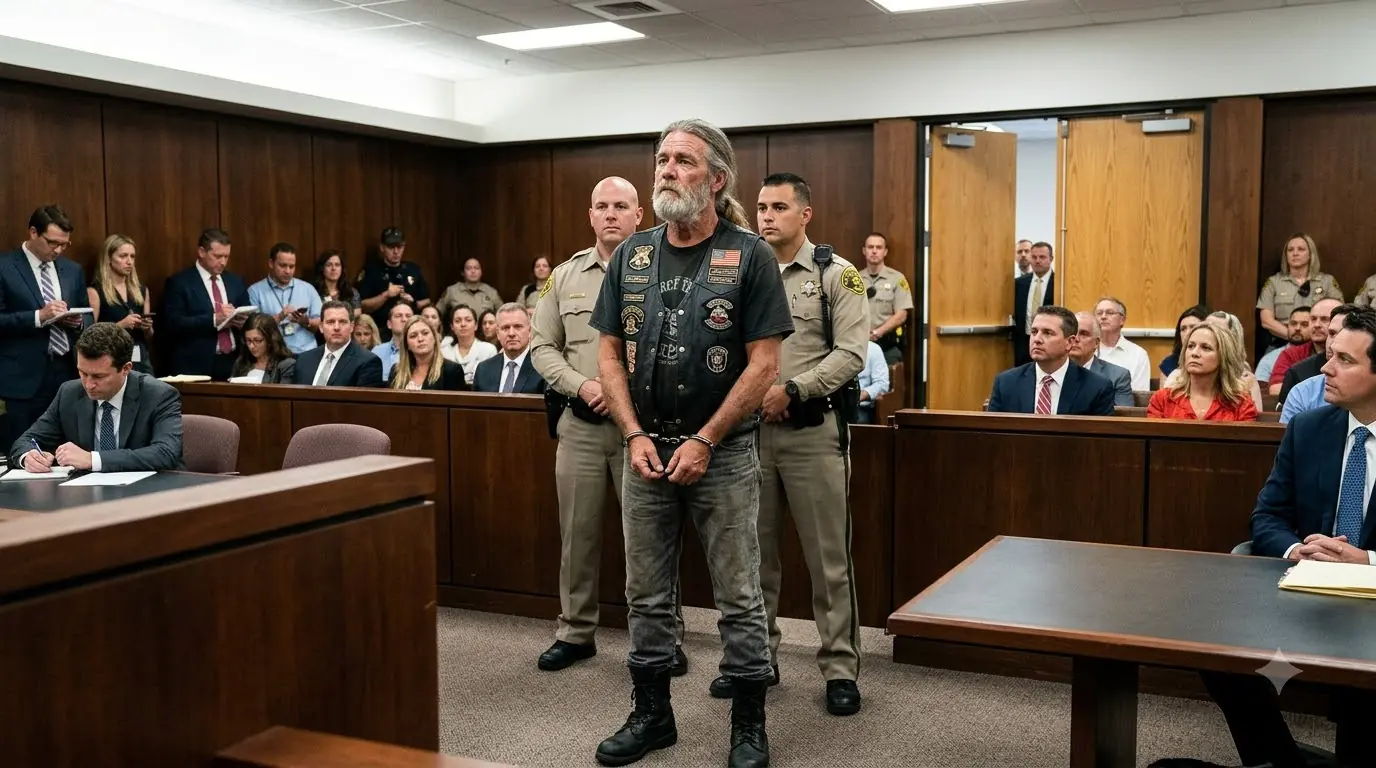
Now, let's go back to where it all began. Jackson Walker had not cried in 31 years. Not when he buried his road brother, Tommy, after a crash outside of Flagstaff. Not when the club fell apart and half the men he trusted turned their backs on each other. Not even when he stood beside his wife's hospital bed in the final hours and held her hand until it went cold.
He had learned a long time ago that crying didn't fix anything. Crying was something you did when you still believed someone was coming to help you. And Jackson had stopped believing that a long, long time before any of this happened. So, when the young woman pushed open the heavy oak doors of Maricopa County Superior Court on a Tuesday morning in October and the entire room turned to look at her, Jackson Walker did not cry. But his hands, those big, calloused, scarred hands that had built engines and fixed fences and done things he would never speak about out loud, those hands started to shake.
And for a man like Jackson Walker, that was the same thing. The morning had started badly. It had started badly in the way that only truly devastating mornings can, not with some dramatic explosion, but with quiet. Jackson had woken up at 5:15, the same time he always woke up. He'd made coffee in the small kitchen of his rented house on the edge of Mesa, Arizona.
He'd sat at the table with a mug he'd owned since his wife was still alive, a blue ceramic thing with a small chip in the handle that he'd never gotten around to replacing. He'd looked out the window for a long time. Then he'd put on his one good shirt, a dark navy button-down that felt strange against his skin because he almost never wore anything without his vest, and he'd driven himself to the courthouse. Alone. That was the part that would have surprised people who didn't know him.
Not the vest, not the tattoos, not the reputation that followed his name around like a shadow. The part that would have surprised people was the alone because Jackson Walker had spent 40 years being the kind of man that other people leaned on. He was the one you called when your car wouldn't start at 2:00 in the morning. He was the one who showed up with food when someone's wife got sick. He was the one who sat with you in the waiting room and didn't say anything, but made you feel like maybe you were going to get through it.
He was never the one who needed help until now. His attorney that morning was a court-appointed public defender named Gerald Oaks. Gerald was not a bad man. He was overworked and underpaid, and he had 17 other cases that week, and he'd met Jackson exactly four times before today. He carried a briefcase that was too full and a look on his face that Jackson recognized immediately.
It was the look of a man who had already made peace with losing. "Jackson," Gerald said, sliding into the chair beside him at the defense table. "I need you to understand what we're walking into today. " "I understand it fine," Jackson said. "The prosecution has the access logs. They have the timestamp on your key card entry.
They have two employees who will testify that you were in the building during the time the files went missing. " Gerald lowered his voice. "I've done everything I can, but I need you to be prepared for the possibility that that I'm going to prison for something I didn't do. Jackson said, not a question, just a statement flat and clear and calm. Gerald looked at his papers. I didn't say that.
You didn't have to. Gerald opened his mouth and then closed it again. He looked at the table, then he said quietly, Is there anyone, anyone at all who can speak on your behalf? A character witness, a colleague, a family member? No, Jackson said, just that one word, no.
Oh, and that was the truth as far as Jackson understood it. His wife Marie had been gone for seven years. They had never had children of their own. Most of his old Hells Angels brothers had scattered years ago, some dead, some incarcerated, some just gone disappeared into the kind of lives that men with complicated histories disappear into. The few who remained were not the kind of men you brought into a courtroom and asked to vouch for your character.
His neighbors knew him as the quiet guy with the motorcycle in the driveway. His coworkers at WestBridge Solutions knew him as a security guard who made decent coffee and didn't talk much. His supervisor had already given a deposition supporting the company's position. Jackson Walker at 62 years old was completely and utterly alone. And he had made a kind of peace with that.
He told himself he had made a peace with that. The courtroom filled slowly. Journalists came in first the way they always do setting up their notebooks and their recorders, murmuring to each other with the comfortable familiarity of people who cover disasters for a living. Then came the WestBridge Solutions people, Victor Reynolds, the CEO in a suit that cost more than Jackson made in two months flanked by two corporate attorneys who looked like they'd been manufactured in a factory somewhere for exactly this purpose. Reynolds did not look at Jackson when he walked in.
That was deliberate. Jackson had been around enough men in his life to know when someone was deliberately not looking at you. It meant they didn't want to see your face. It meant they'd made a decision about you, and looking at your face made it harder to hold on to that decision. Jackson looked directly at Reynolds.
Reynolds sat down and started reviewing documents. Then came the jury, 12 people who had been selected over 3 days of questioning. Jackson had watched them during jury selection with the same quiet attention he brought to everything. An older woman who knitted during breaks, a younger man in his 30s who kept checking his phone until the judge asked him not to. A retired school teacher who had looked at Jackson's forearms, at the ink that covered them, and then looked quickly away.
He understood what they saw when they looked at him. He had understood that his whole life. The prosecutor was a woman named Diana Cho, and she was very good at her job. She was somewhere in her mid-40s, precise in everything she did, the kind of person who placed her pen at the exact same angle on her notepad every single time. She had a voice that was calm and reasonable, and carried absolute certainty in it, the way a doctor sounds when they're telling you something you don't want to hear.
When she stood and addressed the jury in her opening statement, Jackson listened to every word. "Ladies and gentlemen," she said, "the facts of this case are not complicated. Jackson Walker had access. Jackson Walker had opportunity. And Jackson Walker, as you will see from the evidence we present, made a deliberate choice to betray the trust of his employer and steal confidential information worth millions of dollars. " She paused.
"Let that sit. You will hear about his background. You will hear that Mr. Walker was for many years a member of an outlaw motorcycle club with a well-documented history of criminal activity. Now, I want to be clear, membership in that club is not on trial here. What is on trial is what Mr. Walker did on the night of March 14th when he used his security clearance to access files he had absolutely no legitimate reason to access.
Another pause. The evidence will show that he copied those files, that he transmitted them, and that when his supervisors began to notice irregularities, Mr. Walker attempted to cover his tracks. She looked directly at the jury. The defense will likely ask you to have sympathy for this man, and I understand that sympathy is a human impulse, but I am asking you today to follow the evidence because the evidence tells a very clear story. Gerald leaned over and whispered, "She's good. " "I know," Jackson said.
Gerald's opening statement was shorter and considerably less confident. He talked about reasonable doubt. He talked about the fact that access logs could be manipulated. He talked about Jackson's years of service in the community. He was saying the right words, but Jackson could hear the hollow space underneath them, the way you can sometimes hear the structural weakness in a building before anything actually falls.
When Gerald sat back down, he didn't look at Jackson. That was when Jackson fully understood. He was going to lose. The first witness was a man named Craig Hollis, the head of IT at WestBridge Solutions. He was nervous on the stand, not guilty nervous, just regular nervous, the kind that comes from being under oath in a room full of people.
He explained carefully in un-technical language that he occasionally paused to define for the jury how the company's internal security system worked. He explained how each employee's badge created a log entry every time it was used. He explained how file access was tracked on the company's servers. And then Diana Cho asked him to walk through the logs from March 14th, which he did. Jackson's badge had been scanned at 10:47 p.m. entering through the the lobby.
According to the logs, the same badge had been used to access the server room at 11:03 p.m. The confidential files, client contracts, proprietary software, schematics, negotiation records, worth an estimated $4 million had been accessed and copied between 11:03 and 11:47 p.m. The badge was scanned again at the main lobby exit at 11:52 p.m. And in your professional assessment, Diana Cho said, is there any way for these logs to have been altered? Craig Hollis hesitated for just a moment. It would be extremely difficult. But not impossible, she pressed. Not impossible, no.
But you would need, he paused, you would need significant system access, administrator level access. And Mr. Walker did not have administrator level access. No, he did not. Gerald cross-examined Craig for almost 20 minutes, pushing on the word impossible, trying to crack open enough space for doubt. Craig held firm, not because he was lying.
Jackson didn't think he was lying, but because Craig believed the logs. Craig had built the system. He trusted the system. Jackson didn't blame him. The system had been manipulated by someone who knew it far better than Craig did.
But he had no way to prove that. Not yet. The morning pressed forward, witness after witness, each one adding another brick to the wall being built around him. A security supervisor who testified that Jackson had seemed distracted and irritable in the weeks before March 14th. A corporate attorney from WestBridge who walked the jury through the financial impact of the stolen files.
A former colleague who said he'd once heard Jackson complain about not being valued by the company. That last one stung a little because it was true. He had said that once to this man over coffee in the break room after being passed over for a supervisor position he'd applied for. He hadn't meant it as anything more than the ordinary frustration of ordinary working life. Now it was evidence of motive.
Gerald objected when he could. The judge sustained some of them, overruled others. The wall kept going up brick by brick, steady and patient and methodical. Jackson sat with his hands folded on the table and kept his face neutral. This was something he had learned a long time ago in a different kind of room in a different kind of confrontation.
You don't give people the satisfaction of seeing that they're reaching you. You stay still. You stay quiet. You make them work harder to find the crack. But inside behind all that stillness, something was happening that he couldn't entirely stop.
I was thinking about a 15-year-old girl huddled behind a gas station in the rain. So, I didn't know why that memory was coming back now of all moments. Maybe because that night was one of the last times he'd made a truly free choice. A choice with no calculation behind it. No self-interest.
Nothing but the simple reflex of a man who saw someone hurting and couldn't keep walking. He'd been coming back from a run. February late, the kind of cold Arizona gets at night in winter that surprises people who think the desert is always warm. He'd stopped for gas at a station on the edge of town. And when he walked around the side of the building toward the restroom, he nearly stepped on her.
A girl sitting on the ground, back against the cinder block wall. Knees pulled to her chest, soaking wet from a rain that had passed through an hour earlier. A backpack beside her that had clearly been through worse than rain. She looked up at him with eyes that were absolutely flat. Not scared.
Not angry. Just flat. The way eyes get when someone has already been through every version of afraid and come out the other side into something colder. He'd seen that look before. He'd worn that look before.
He didn't say anything clever. He didn't have a speech prepared. He just crouched down so he wasn't standing over her and he said, "You got somewhere to go tonight? " She stared at him for a long time. "No," she finally said. "What's your name? " Another long pause, deciding whether a name was information she could afford to give.
"Lily," she said. "Lily. " He nodded. "I'm Jackson. You hungry, Lily? " She didn't answer that one, but something changed in her face, something so small that most people would have missed it. Jackson didn't miss it.
"Come on," he said, straightening up. "There's a diner about a mile down. They've got good pie. " He started walking back toward his bike. He didn't look back, didn't tell her to follow, didn't make it into anything bigger than it needed to be. He heard her footsteps behind him about 10 seconds later.
That was 13 years ago. Now he was sitting at a defense table in a courtroom while a prosecutor dismantled his life piece by piece, and he was alone. The thought hit him with a weight he hadn't anticipated. Not the loneliness itself, he was used to loneliness, but the specific, precise recognition that the choice he'd made that night outside the gas station, the one good, pure, clean thing he'd done without expecting anything back, had apparently not been enough to change the fundamental shape of his life. He'd done good, and now he was going to prison anyway.
He pressed his hands flat against the table, stayed still, stayed quiet. The lunch recess came at 12:40. Gerald collected his papers with the careful movements of a man managing his energy, and he said, "I'll meet you back here at 1:30. I need to make some calls. " Jackson nodded. He stayed in his seat while the room emptied around him.
A court officer stood near the door, not watching him specifically, just present the way court officers are. One of the WestBridge attorneys said something quietly to Reynolds as they filed past, and Reynolds made a sound that was almost a laugh, low and satisfied. Jackson heard it. He let it go. A few minutes passed.
The room was almost empty now. Just Jackson at the defense table and the court officer by the door. And the particular quality of silence that courtrooms have when they're between acts. Then the door opened. A man slid into the room.
Jackson recognized him immediately. Ryan Mitchell, 34, one of WestBridge's senior network engineers. They'd spoken a handful of times over the past 18 months. The kind of brief functional conversations that happen between security staff and tech employees, mostly about access protocols and after-hours procedures. Ryan had come to see him twice since the arrest.
Both times he'd brought coffee, sat across from Jackson in the jail visiting room, and spoken in a tone of careful, measured sympathy. He sat now in the gallery about three rows back and leaned forward. "How you holding up? " He said low enough that only Jackson could hear. Jackson looked at him. "Fine.
Listen. " Ryan glanced toward the court officer who wasn't paying attention. "I know this looks bad. I know it looks really bad, but Gerald told me they might be open to a deal, reduce charges. No prison time, just restitution and probation. " "All it would take is signing an acknowledgement of" "No," Jackson said. Ryan blinked.
But I'm not signing anything that says I did something I didn't do. " Ryan held his gaze for a moment. Something passed through his expression, something complicated and quick that was gone before Jackson could fully name it. "You're sure? " Ryan said. "I've never been more sure of anything. " Ryan sat back. He looked at his hands.
Then he looked up at Jackson with something that might have been respect, or might have been something else entirely. "Okay," he said. "Okay, good luck then. " He stood up and left the room. Jackson watched him go, filed that complicated expression away somewhere in the back of his mind. Lunch was a vending machine sandwich eaten at a table in a room down the hall.
Gerald came back 20 minutes before they were due to reconvene, and he had the look of a man who had not had good phone calls. "Jackson," he said, sitting across from him. "I have to ask you something, and I need you to be completely honest with me. " "All right. Is there anyone, anyone from your past, anyone connected to the club, anyone at all who might have had a reason to set you up? Cuz if there's something I should know, something about enemies you might have made "That's not what this is," Jackson said.
"You sound very certain. " "I am certain. This is about WestBridge. This is about someone inside that company who needed a name to put on this, and my name was the easiest one. " He paused. "Someone who knows that system from the inside, someone with administrator access. " Gerald looked at him carefully. "Do you have any evidence of that? " "No," Jackson said.
"Then I can't use it. " "I know. " Gerald was quiet for a moment. Then he said very quietly, "I'm sorry, Jackson. I really am. I don't think the system is serving you well here, and I "Gerald. " Jackson met his eyes. "Do what you can.
I know your hands are tied. I'm not blaming you. " Gerald nodded. He looked down at his papers. Neither of them said anything else. The afternoon session started at 1:35.
Diana Cho called two more witnesses, another IT employee who corroborated the log data, then a forensics consultant who had been hired by WestBridge to analyze the server activity, a woman with credentials that filled an entire page who walked the jury through a visual presentation of the file transfer in precise, devastating detail. Jackson listened. He kept his hands still. He kept his face neutral. And somewhere around 3:00 in the afternoon while the forensics consultant was explaining the specific encryption signature on the transferred files, Jackson heard the courtroom door open behind him.
He didn't turn around. People came and went, reporters, observers, whoever. It didn't matter. He kept his eyes forward. But then Gerald sitting beside him made a small sound, something between a breath and a word that he didn't quite finish.
Jackson glanced sideways. Gerald was looking toward the back of the room with an expression that was hard to read, confusion maybe, or surprise. The forensics consultant kept talking. Jackson turned his head just slightly, and then he saw her. She was standing near the back wall, not in the gallery seats standing because she had only just arrived, only just come through the door, and she hadn't sat down yet because she was looking at him.
The last time he had seen Lily Carter she was 23 years old standing at his door with her law school acceptance letter in her hand shaking with something between terror and joy. He had taken her to dinner to celebrate and they'd talked for 4 hours and he driven her home. And on the way she'd fallen asleep in the passenger seat and he'd sat in the driveway for a few minutes before waking her up because he wanted to hold onto that moment a little longer. That was 9 years ago. 9 years of phone calls that got shorter and less frequent.
9 years of distance, not angry distance, not broken distance, just the natural gravitational drift of two people pulled in different directions by the momentum of their separate lives. She was building something. He understood that. He had never wanted to be the thing that held her back. She had built something.
Standing against the back wall of Maricopa County Superior Court in a dark blazer with a single folder pressed against her chest. Lily Carter looked like exactly what she was, a woman who knew what she was doing and why she was there. She looked at Jackson. He looked at her. Across the length of a courtroom, across nine years of distance, across everything that had brought them both to this room, she looked at him and her face said everything her voice hadn't said yet.
She wasn't here as a visitor. She was here as his attorney. The forensics consultant was still talking. Nobody else in the room had quite processed what was happening yet. Then Lily moved.
She walked forward down the center aisle, her footsteps quiet and deliberate, and she came through the gate and set her folder on the defense table beside Gerald's papers. And she leaned down close to Jackson and said in a voice that was low, but absolutely steady, "Dad, I'm here now. You don't have to fight alone anymore. " The forensics consultant stopped talking. The judge looked up. Diana Cho turned.
Victor Reynolds turned. Every camera in the room turned. And Jackson Walker, the man who had not cried in 31 years, the man who had buried his brother and his wife and his own grief without a single tear, Jackson Walker felt something break open in his chest. Not painfully, not explosively, the way a dam breaks when the water finally rises high enough. Quiet, inevitable, unstoppable.
He pressed his lips together. He looked at his hands. He breathed. "You shouldn't have come," he said. His voice came out rough around the edges.
"You've got your own life, your own career. You didn't need to stop. " She pulled out a chair and sat beside him. She opened her folder. "I'm here. We're going to do this together.
And then we're going to go home and you're going to cook me whatever you want because I have been on planes for 11 hours and I'm starving. " Jackson looked at her. She was looking at the papers in her folder. Professional, composed, but he could see at the corner of her jaw the muscle that was working, the one that meant she was holding herself together harder than she was making it look. He almost said something then. He almost said, "I was afraid you'd forgotten me. " But instead, he said, "I make a decent chili. " She looked up at him, one quick glance full and real and complicated.
"I remember," she said. Then she turned to Gerald Oaks, who was watching all of this with an expression of pure bewilderment, and she said, "Gerald, my name is Lily Carter. I'm licensed in Arizona, and I'm going to need 10 minutes with my client before proceedings resume. Would you mind asking the judge for a brief recess? " Gerald opened his mouth, closed it, then he stood up. The judge, a measured, precise man named Honorable William Tran, granted the recess with the minimum possible disruption to his courtroom and the maximum possible displeasure made visible through the controlled tightening around his eyes.
Lily didn't waste the 10 minutes. She sat across from Jackson in a small conference room off the main hallway, and she talked fast and clear the way someone talks when they've been organizing their thoughts for 11 hours on an airplane, and every sentence has been sorted and stacked and is waiting to come out. "I saw the news eight days ago," she said. "I recognized you immediately, even though they didn't use your face in the early coverage. I recognized your name and the company and the details, and I knew something was wrong. " "Lily, let me finish.
I pulled every public document I could find. The complaint, the access logs, the IT forensics report. I have a colleague who specializes in digital forensics, and he went through the technical evidence with me. " She paused. "Jackson, there are irregularities in those logs. " He looked at her. Craig Hollis didn't see them because he wasn't looking for them.
He built the system to track legitimate access. He wasn't looking for evidence of the system itself being manipulated from inside. " She flipped open her folder. There are timestamp discrepancies, very small ones. The kind that happen when data is overwritten rather than originally entered. Your access to the server room at 11:03, that log entry was created after the fact.
Jackson was very still. You're saying someone planted it? I'm saying the forensic evidence suggests the log entry was written retroactively, yes. She met his eyes. Someone with administrator access.
Someone who knew the system well enough to do it cleanly and leave only the smallest trace. Jackson thought about Ryan Mitchell sitting in the gallery at lunch with that complicated expression on his face. He thought about the way Ryan had asked, "You're sure? " the way he'd said it, like the answer mattered for a different reason than the one he was pretending. "I think I know who it is," Jackson said. Lily looked at him.
"Tell me everything," she said. But, so he did. He told her about Ryan Mitchell, about the after-hours conversations about the technical fluency Ryan had displayed in casual conversations. The kind of casual fluency that signals deep familiarity rather than basic competence. About the two visits to the jail.
About the deal being offered through Gerald. About the way Ryan had said, "You're sure? " when Jackson refused to sign. Lily listened without interrupting. She wrote things down in a small notebook. Not everything is keywords, anchors.
When he finished, she sat very still for a moment. "He visited you twice," she said. Yes. "Before or after the deal was on the table? " Jackson thought about it. Second visit, the deal came up.
First visit was 2 days after the arrest. He just came to see me. "To see how you were handling it," Lily said. Not a question. "That's what I think now, yeah. " She wrote something down.
"Was he the one who told Gerald about the deal? " He said he'd been talking to people at the company. She looked up at him. He's the one who put the deal on the table, she said. He wanted you to sign. He wanted this over before anyone with the right skills could look at those logs.
Jackson let that settle. If I'd signed, he said slowly, it would have been closed. No further investigation, no reason for anyone to look at the forensics again. She closed her notebook. Jackson, you almost signed.
I didn't. Why not? He looked at her, at this woman who had once been a 15-year-old girl with flat eyes and wet hair and nothing to her name, and he said simply, because I once told someone that your name is the one thing nobody can take from you unless you give it away. Lily looked at him for a long moment. Then she looked down at her folder.
All right, she said, then let's make sure it wasn't taken anyway. When they walked back into the courtroom, something had changed. It wasn't anything dramatic. The room looked the same. The people in it were the same.
The evidence being presented against Jackson Walker was the same. But the man at the defense table was no longer alone. And the people who knew how to read a room, the reporters, the jurors who paid attention to things beyond the testimony, even Diana Cho, who was a thorough professional and noticed everything those people could feel it. The dynamic had shifted. Jackson sat straight.
He placed his hands flat on the table, not gripping, just resting. He looked at Diana Cho when she continued her examination of the forensics consultant with the expression of the man who knows that the story is not over. Because it wasn't. Gerald Oaks leaned over and whispered, what happened in there? Jackson looked at him.
We're not losing this, he said quietly. Gerald blinked. Lily on Jackson's other side was already writing notes without looking up. Mr. Oaks, she said still writing, I'll be taking over cross-examination for the remainder of the session if that's agreeable to you. Gerald looked at her, then at Jackson, then back at her.
Yes, he said, absolutely. The forensics consultant finished her direct testimony. Judge Tran looked up. Cross-examination. Lily stood.
She buttoned her blazer. She picked up her folder. And she walked toward the witness stand with a particular measured certainty of someone who has been preparing for this moment, not for 11 hours, but for 13 years in every class she attended, every case she argued, every late night she sat with law books spread across a kitchen table in a city far from home building piece by piece the person she had decided to become. The person Jackson had told her she could decide to become. "Ms. Carter," the judge said.
"Yes, your honor," Lily said. "Just a few questions. " She opened her folder. She found the page she wanted, and she looked up at the forensics consultant with eyes that were no longer flat. They were absolutely, precisely, terrifyingly clear. "Can you tell me," she said, "what specific methodology you used to verify the original creation timestamps on the access logs presented in evidence, and whether your analysis accounted for the possibility of retroactive data entry at the administrator level? " The room was quiet.
The forensics consultant looked at her, and in that silence, in that single precise question, everything that was coming became visible. Not to everyone, but to the people who mattered. To the jury member in the front row who leaned forward slightly. To Diana Cho, who was very good at her job and whose pen had just stopped moving. To Victor Reynolds in his expensive suit, who had not looked at Jackson all morning, but was looking at Lily now with an expression that had gone very, very careful.
And to Jackson Walker, who looked at the young woman standing at the front of the courtroom, the girl he had found in the rain, the daughter he had chosen, the person who had flown 11 hours and walked through those doors without a hesitation, and understood perhaps for the first time with his full heart what he had actually done that night behind the gas station. He hadn't just given a scared girl a meal and a place to sleep. He had given her the world, and she had come back to give it to him. The forensics consultant's name was Dr. Sandra Price, and she had testified in 47 cases over the past 11 years. She had a wall of certifications.
She had a reputation that prosecutors trusted and defense attorneys feared. She was not accustomed to being surprised on the stand. Lily let her sit with the question for exactly 3 seconds before she repeated it. Dr. Price, in your forensic analysis of the access logs submitted as exhibit seven, did your methodology specifically account for the possibility of retroactive data entry at the administrator level? Dr. Price adjusted her posture.
A small adjustment, barely visible, but Jackson saw it from the defense table, and he knew what it meant. It meant the question had landed somewhere real. "My analysis followed standard forensic protocol," Dr. Price said. "That's not what I asked," Lily said. Her voice was calm, not aggressive, not theatrical, just precise.
"I asked whether your specific methodology accounted for retroactive entry. Yes or no, Dr. Price. " A beat. "The standard protocol does not specifically isolate for that scenario," Dr. Price said. The jury member in the front row leaned forward again. The retired school teacher who had looked away from Jackson's tattoos looked up from her hands.
Diana Cho was already on her feet. "Objection, Your Honor. Counsel is implying a theory of tampering without any evidentiary basis. " "I'm asking about the limits of the witness's methodology," Lily said, turning briefly toward the judge. "The jury has a right to understand what the analysis can and cannot rule out. " Judge Tran looked at Diana, then at Lily. "Overruled.
The witness may answer. " Dr. Price took a careful breath. "Standard forensic analysis does not typically screen for administrator-level retroactive entry because such manipulation would require a very high level of system access and technical sophistication. "But it is possible," Lily said, "theoretically. " "And if such manipulation had occurred, would your current analysis have detected it? " The pause this time was longer, and in that pause something shifted in the room. Not dramatically, not loudly, the way the first crack in ice sounds small, sharp, and then suddenly enormous in implication. "Not necessarily, Dr. Price. " Lily nodded.
She didn't smile. She didn't perform triumph. She simply wrote something in her notebook, closed it, and said, "No further questions. " And walked back to the defense table. Jackson watched her sit down. She didn't look at him.
She arranged her folder and picked up her pen and wrote something at the top of a fresh page. He leaned slightly toward her and said very quietly, "That was good. " "That was the opening," she said, still writing. "We haven't started yet. " Gerald Oaks made a small sound on Jackson's other side. Something between a cough and a laugh, swallowed immediately. Jackson glanced at him.
Gerald was looking at his notepad and with the expression of a man recalculating something. Good, Jackson thought. Let him recalculate. Diana Cho stood for redirect. She spent 6 minutes carefully rebuilding what Lily had shaken, walking Dr. Price through a detailed explanation of why administrator level tampering was, in her professional opinion, extraordinarily unlikely given the specific configuration of the WestBridge system.
Dr. Price was steady and confident and technically thorough, and by the time she stepped down from the stand, a casual observer might have thought the moment had been neutralized. But Jackson had spent 40 years reading rooms, and the room was not the same as it had been an hour ago. Something had been introduced that hadn't been there before. A question. A genuine, uncomfortable, specific question that 12 people were now carrying around in the backs of their minds, whether they knew it or not.
That was enough for now. Judge Tran called a 15-minute recess at 3:45. The room began to move, to murmur, to breathe again. Jackson stayed in his seat. Lily stayed in hers.
Then she said, without looking up, "Ryan Mitchell is in the gallery. " Jackson had known that. He'd registered Ryan's presence when they returned from the recess. Third row, far left. He'd been watching the proceedings with the careful attention of someone who needed to know exactly what was happening. "I know," Jackson said.
"He's been watching you, not the testimony. " "I know. " Lily was quiet for a moment. Then she said, "He's worried. " "He should be. " She finally looked up at him. There was something in her expression that was hard to name. Not fear, not satisfaction. Something more complicated.
The look of someone who understands that the thing they're walking toward is real and dangerous, and also the only path available. "I need something from you," she said. "Something you haven't given me yet. " Jackson waited. "I need you to tell me everything about Ryan Mitchell that you didn't tell me in that conference room. Not what you know, what you felt, what your instincts told you the first time you met him and every time after that.
Because right now I'm working with forensic theory, and I need to understand who I'm actually dealing with. " Jackson looked at his hands for a moment, then he started talking. He'd met Ryan Mitchell about 18 months ago, two weeks after Ryan joined WestBridge Solutions as a senior network engineer. The introduction had been unremarkable, the kind of brief hallway exchange between security staff and tech employees that happened dozens of times a week. But something had registered in that first meeting that Jackson hadn't been able to articulate at the time. Something about the way Ryan moved through the building.
Not nervously, not arrogantly, just strategically. Like a man who was always calculating the shortest path between where he was and where he wanted to be. Over the next several months, Ryan had made a point of building relationships across the company. Not in an obvious or aggressive way, subtly, steadily, the way a plant grows into the shape of whatever space it's given. He knew the IT team.
I was friendly with accounting. He went to drinks with the sales floor. He remembered people's birthdays. He asked questions about their weekends. He had also, Jackson noticed, spent a lot of time in the server room.
More time than his job technically required. Jackson had mentioned it once to his supervisor, not as an accusation, just a note of routine observation. His supervisor had smiled and said, "Ryan was a hard worker who took his responsibilities seriously. " The notation had gone nowhere. He told Lily all of this. She listened without interrupting, writing steadily.
When he finished, she sat back and looked at what she'd written. "He spent 18 months building relationships and moving freely through the building," she said. "And he specifically cultivated a relationship with you. " "Yes. " "Why you specifically? " Jackson had thought about this. He'd thought about it a lot over the past several weeks. "I think he was looking for someone whose badge he could use without it looking suspicious. " "Someone who had access, but who wouldn't be the first place anyone looked for technical sophistication. " "Someone whose history would make them an easy target if things went wrong. " "He picked you before he needed you," Lily said.
"I think so. " "He was planning this for a long time. " Jackson nodded slowly. "Long enough to make sure I was isolated. Long enough to know that when this happened, I wouldn't have anyone in my corner. " Lily looked at him. Her jaw was doing that thing again, working, holding. "He almost got that right," she said.
"Almost," Jackson agreed. The recess ended. People filtered back into their seats. Ryan Mitchell returned to the third row, far left, and sat down and folded his hands in his lap. He was looking at the front of the room now, carefully, deliberately not looking at the defense table, which meant he absolutely knew that he was being watched.
Diana Cho called her next witness. His name was Marcus Webb, a former colleague of Jackson's from the security team, and he had a story to tell about a convert conversation he'd overheard in the parking lot 6 weeks before March 14th. A conversation in which, according to Marcus, Jackson had said that the company owed him and that he was tired of being overlooked. Jackson remembered that conversation. He remembered it clearly.
It had been a bad day. He'd found out about the supervisor position. He was tired, he was frustrated, and he had said something loose and unguarded to Marcus in the parking lot that he'd forgotten about by the time he got home. He had not at any point said anything about stealing anything, but Marcus Webb had a talent for compression, for taking something long and gray and complicated and pressing it into something short and sharp and dark. Gerald started cross-examination.
He was doing better now. The recess seemed to have sharpened him, or maybe it was watching Lily work. He pushed Marcus on the exact words, on the context, on whether he'd reported the conversation at the time or only remembered it after the investigation began. Marcus held up reasonably well, but there were cracks. Gerald found two of them and pressed them carefully without overdoing it.
Then he sat down and nodded at Lily. Lily stood up. "Mr. Webb," she said, "you testify that you overheard this conversation in the parking lot. Were you alone at the time? Yes.
No one else was present. No. So, there's no way to corroborate the specific words you've described. I know what I heard. I'm not suggesting you don't.
I'm asking whether there's any corroboration. " She paused. "Is there No. Thank you. " She started to turn away, then stopped, like she'd just thought of something. One more question. How long after March 14th did you first speak with anyone from the company's legal team about this conversation?
Marcus shifted slightly. I'm not sure of the exact date. Approximately. A few weeks maybe. A few weeks?
Lily looked at her notes. Is it accurate that the company reached out to you on April 2nd, approximately 18 days after the alleged theft and that this was your first communication with anyone about this specific conversation? Marcus looked at Diana Cho. Diana Cho did not look back. That sounds about right, Marcus said.
So for 6 weeks from the time of the conversation until March 14th and then for another 18 days after the incident, you did not think this conversation was important enough to report to anyone. I didn't think. But then the company's legal team contacted you and suddenly you remembered it clearly enough to testify under oath. Objection, Diana said, argumentative. Sustained, Judge Tran said.
Rephrase, Ms. Carter. Lily nodded without missing a beat. Mr. Webb, did anyone from the company or its legal team suggest to you that this conversation might be relevant to the investigation? A long pause. They asked if I had any relevant memories of interactions with the defendant, yes.
They asked you to search your memory. I suppose you could say that. And after they asked you to search your memory, you found this conversation. Yes. Thank you, Lily said.
No further questions. She came back to the table. Jackson said nothing. There was nothing to say. She already knew what she'd done.
The witness stepped down. Diana Cho looked at her notes for a long moment, then she stood. Your Honor, the prosecution has no further witnesses at this time. We would request a brief continuance until tomorrow morning to finalize the presentation of physical evidence. Judge Tran looked at the clock.
We'll reconvene at 9:00 a.m. Court is adjourned. " The gavel came down. The room exhaled, and then something happened that Jackson didn't expect. Ryan Mitchell stood up in in the third row. He straightened his jacket. He looked at the defense table, and for just a moment, not long, barely 3 seconds, his eyes found Jackson's.
In that look was everything that hadn't been said. Every calculation, every manipulation, every carefully constructed move over 18 months of patient maneuvering. And underneath all of that, just barely visible, like something seen through clouded water, fear, real fear. Then Ryan turned and walked out of the courtroom. Jackson watched him go.
"He's going to run," Jackson said quietly. Lily was already packing her folder. She didn't stop. "No, he's not," she said. "You sound very certain. " She looked up.
"Because he's not going to run. Running admits guilt. Running creates a whole separate set of problems he can't control. He's going to go home tonight, and he's going to make calls, and tomorrow morning, he's going to come back in here, and he's going to sit in that same seat, and he's going to act like everything is still going according to plan. " She paused. "Because up until today, it was.
And now," she looked at him steadily, "now it isn't. But he doesn't know exactly how much it isn't, and that's the only advantage we have. So we need to use tonight. " Gerald was listening to all of this with the focused intensity of a man who has realized he's been given an unexpected second chance and is not going to waste it. "What do you need? " he said. Lily looked at him.
"I need you to file a motion tonight requesting the court compel WestBridge to provide full unredacted administrator access logs for the 60 days prior to March 14th, and I need you to subpoena Ryan Mitchell's company email records for the same period. " Gerald blinked. "On what grounds? " "Newly identified forensic irregularities in the existing evidence. Dr. Price opened that door today. We walked through it. She closed her folder.
Can you do that tonight? Gerald looked at his watch. It was 4:42 p.m. It'll be tight. Gerald, her voice didn't change, can you do it? Yes, he said, yes, I can do it.
She nodded once. Then she turned to Jackson and said, let's go. We need to talk more and I haven't eaten since Dallas. Jackson almost smiled, almost. They walked out of the courthouse together.
The reporters who'd been waiting at the bottom of the steps called out questions, mostly directed at Jackson, some at Lily, all of them following the same lazy script about the Hells Angels biker and the corporate theft. Lily walked through them without breaking stride or acknowledging a single question. Jackson did the same because he had been walking through spaces where people were shouting things at him since he was 22 years old. On the sidewalk away from the cameras, Lily slowed. Jackson slowed with her.
How are you doing? she asked. It was a simple question, a quiet question, the kind of question that cuts through everything else precisely because it's so simple and so quiet. Jackson was not accustomed to being asked that question by anyone who actually wanted to know the answer. He thought about giving her the standard response, the fine, the managing, the I've handled worse. He started to, then he stopped.
Scared, he said, and cost him something to say it, the way words sometimes cost you when they're true. Lily nodded. She didn't try to fix it. She didn't offer reassurance or platform or any of the things people reach for when they don't know what else to do. She just nodded and said, yeah, me too.
And somehow that was exactly the right thing. They found a diner three blocks from the courthouse, a small worn-in place with good coffee and a menu that hadn't been updated since approximately 2003 and food that was genuinely uncomplicatedly good. They sat in a booth by the window and ordered without looking at the menu because Jackson knew this diner and he knew what was worth ordering. While they waited for the food, Lily spread her materials across the table with the focused efficiency of someone who had not stopped working and was not planning to stop working and she talked Jackson through what she was thinking. She had a colleague named David Reyes, a digital forensic specialist she'd worked with on two previous cases who was already in Phoenix.
She'd called him from the plane. He had arrived 3 hours ago and was currently at a hotel on Central Avenue with every piece of publicly available technical documentation about WestBridge's security system that he'd been able to pull together. "He found something this afternoon," she said. Jackson looked at her. "A report, not sealed, not confidential, a vendor audit that WestBridge commissioned 14 months ago.
The company that manages their security software flagged a vulnerability in the administrator access control module. A specific vulnerability that would allow someone with the right credentials and the right knowledge to write retroactive entries into the access logs. " Jackson was very still. "WestBridge was notified of the vulnerability," Lily continued. "They were given a recommended patch timeline. The patch was scheduled for June of last year.
She looked up from her papers. "It was never installed. The food arrived. Neither of them moved to eat. "The vulnerability was still active on March 14th," Jackson said.
"Yes. And someone with administrator access and knowledge of that vulnerability could have could have written your badge into those logs at 11:03 p.m. without you ever being in that building. " She put her pen down. "Jackson, where were you at 11:00 p.m. on March 14th? " He'd been asked this before, many times, by Gerald, by the police, by anyone who'd had the question put to them in any official capacity. His answer had always been the same and it had always sounded insufficient even as he said it. Home, he said, alone.
I ordered food around 9:00. I have the receipt. I was on the phone with He stopped. Lily looked at him. He looked back at her.
He told the police he'd been alone that night. He told Gerald he'd been alone. He had been so certain in his bone-deep habit of not burdening people that there was no point mentioning a brief phone call that had happened 2 hours before the alleged crime that he'd filed it away as irrelevant. Who were you on the phone with? Lily said.
You, he said. Absolute silence. Then Lily said very carefully, explain. He explained he'd called her at 9:47 p.m. He knew the time because he'd looked at the clock before he dialed, which was a habit of his when calling people in different time zones because Lily was in New York and he never wanted to call too late. He'd gotten voicemail.
He'd left a message, nothing important, just checking in, the kind of brief, unremarkable message he left occasionally just to maintain the thread between them. Then around 10:15 she'd called him back. They'd talked for 43 minutes. He'd been home, on the phone with her at the exact time someone was using his badge number to access the server room. Lily was looking at him with an expression he couldn't fully read.
Something between professional calculation and something raw and more personal. Your phone records, she said, would show the call. 43 minutes starting at 10:15. She picked up her pen. Her hand was not entirely steady.
Jackson, that call is your alibi. That call proves you were not at that building at 11:00 p.m. I know. Why didn't you tell Gerald? He looked at the table, looked up. Because I didn't want to pull you into this.
The words sat there between them. Lily stared at him for what felt like a long time, but was probably 6 seconds. Her expression moved through several things, frustration, recognition, something that might have been grief. Then she shook her head once slowly. "Jackson," she said.
"I have been pulled into this since the moment I saw your face on that screen 8 days ago. The only question was whether you were going to let me help you. " She exhaled. "Phone records. You are carrier here. T-Mobile.
I've had the same number for 12 years. I know I've called it enough times. " She was already writing. "I need subpoenas for both lines, yours and mine, showing the call, the duration, the time stamp. " She looked up at him. "This is significant. This isn't just a crack.
This is a structural problem for the prosecution's entire timeline. " "Will it be enough? " She considered. Honest, not reassuring. "By itself, probably not. You could have left the building and called from the parking lot, they'll argue. It complicates the timeline, but it doesn't destroy it. " She paused.
"But combined with the forensic irregularities, combined with the vulnerability report, combined with what we find in Ryan Mitchell's emails, if Gerald's subpoena goes through, she stopped. It might be. " "Might," Jackson said. "Yes, might. " She met his eyes directly. "I'm not going to lie to you. I'm not going to tell you this is certain.
What I'm telling you is that the ground underneath this prosecution is not as solid as it looked this morning. And tomorrow I'm going to find every crack in it. " Jackson looked at her. He had carried Lily Carter in his heart for 13 years the way you carry someone when you love them and know they're living a full life that doesn't need you in it at a distance quietly with the particular satisfaction of someone who gave a good gift and doesn't need to see it being used to know it mattered. He had told himself in the years since her calls got shorter and her visits got rarer that this was exactly right. That this was what it looked like to have done something well.
He had not let himself understand until this moment, sitting in a diner booth with her files spread across the table, and her voice telling him the truth about his chances, how much he had missed her. "Eat your food," he said. She blinked blinked, then looked down at the plate that had been sitting there. "Right. " "You've been on planes for 11 hours and you haven't stopped talking about law for 3 hours straight. " She picked up her fork. "Someone has to. " "I know. " He picked up his own fork.
"I'm glad it's you. " She didn't say anything to that. She ate for a moment, then she said without looking up, "I'm sorry I didn't come sooner. I mean before this. I should have. " "Don't," he said. "Jackson, you built a life.
That's what you were supposed to do. That's the whole point. " He said it without self-pity, without accusation. Just fact. "I'm not someone you owe visits to. I'm your dad.
The only thing I ever wanted from you was for you to be okay. " She looked up at him. Her eyes were bright in a way that she was working hard to manage. "I'm okay," she said. "I know you are," he said. "I can see that. " A moment passed between them.
Not comfortable silence, not uncomfortable silence, but the specific loaded quiet of two people who have had something important happen and are both still catching up to it. Then Lily's phone buzzed. She looked at her, expression changed. "It's David," she said, "your forensics guy. He found something else. " She was reading the screen and as she read something shifted in her face.
Not alarm, not quite, but something sharp and focused the expression of someone who has just seen a door open that they'd hoped for but hadn't been sure about. She looked up at Jackson. "On March 14th," she said carefully, "did Ryan Mitchell ever specifically ask you about your plans for that evening, whether you were going home, whether you had anything scheduled? " Jackson thought about it. He thought about it carefully because he remembered now he had not thought about it since the arrest had not flagged it as significant, had filed it away in the same category as all the other unremarkable workplace interactions of that week. But he remembered.
Tuesday afternoon, break room. Ryan getting coffee, Jackson refilling his thermos. Ryan asking in that easy, friendly way he had what Jackson was up to that night. Jackson saying nothing, going home, probably ordering food. Ryan nodding, saying something like nice quiet night or that sounds good or something equivalently forgettable.
It hadn't meant anything at the time. Now it meant everything. "Yes," Jackson said slowly. "He did. He asked me directly what I was doing that night. " Lily set her phone face down on the table.
"David found emails," she said. "Between Ryan Mitchell and an external address. Forwarded from his personal account, not his company account, his personal one, which means WestBridge's IT team wouldn't have flagged it. But David found the headers in a metadata layer of a document Ryan submitted to the company network. " She paused. "Jackson, he was communicating with someone outside the company about the files, about the timeline. " Another pause.
"About you. " The diner hummed around them. A family in the next booth, a couple at the counter, a waitress refilling coffee, cheerful and unhurried. Jackson set his fork down. "He didn't just choose me because I was available," he said. "No.
He planned around me specifically. He found out my schedule. He confirmed I'd be home. " He heard his own voice flat and measured processing this the way he processed everything, not slowly but steadily, without flinching from the shape of it. "He used my badge number knowing I'd have an alibi that I wouldn't use because I wouldn't want to involve anyone. " "He knew you," Lily said quietly. "He'd spent 18 months learning exactly how you operate.
He knew you'd protect the people around you even at cost to yourself. Jackson was quiet for a moment. Then he said, "He was right. I almost did. " "But you didn't. " "No. " "Because you called me that night. " She looked at him, "Not strategically, not as part of any plan. You just called. " "I call you sometimes," he said, "when I'm thinking about you.
It's not complicated. " She looked at him for a long moment. Then she picked up her phone and dialed. Two rings. "David," she said, "I need everything. Full documentation, timestamp verification, the external email chain.
I need it in a format I can present to a judge tomorrow morning. " A pause. She listened. "How long? " Another pause. "Okay, work through the night. I'll be there by midnight. " She hung up.
She looked at Jackson. "Go home," she said, "sleep if you can. Be at the courthouse at 8:30. " "And you? I'll be there. I'm always where I say I'll be. " She started gathering her materials.
"Lily. " She stopped, looked at him. "When this is over," he said, "I want to make you that chili. Proper this time, not the quick version. The one that takes 2 days. " She stared at him. Then she did something that cracked through all of her professional composure in a single, simple, unstoppable way.
She laughed. Not a polite laugh, a real one sudden and surprised and full the kind that comes from somewhere deep before your control has a chance to catch it. The laugh of someone who spent years building walls and found them briefly helplessly insufficient. Jackson watched it happen and felt something settle in his chest that had been unsettled for a long time. "2-day chili," she said when she recovered.
"Yeah, okay, deal. " She stood up, slung her bag over her shoulder, picked up her folder, looked at him one more time with those clear, precise, terrifying eyes. "Tomorrow," she said, "we end this. " She walked out of the diner. Jackson sat alone for a moment. He looked at his coffee. He looked at the table where her files had been spread and were now gone.
He looked at the empty seat across from him. Then he left $20 on the table for a $9 check. He walked outside. He stood for a moment on the sidewalk under a sky going dark at the edges. Somewhere on the other side of the city, Ryan Mitchell was going home.
Probably telling himself the situation was manageable. Probably telling himself that what had happened today in that courtroom was a complication, but not a collapse. Probably calling someone, the external address from those emails, whoever that was, and saying something reassuring. And somewhere across the city, Lily Carter was walking fast toward a forensic specialist who had been working through databases for hours building something real out of fragments and timestamps and metadata layers, piece by piece, with the precision of someone who had been trained to find the truth in the place that people thought to hide it. Jackson Walker got in his car.
He drove home. He did not sleep particularly well. But for the first time in months, when he lay in the dark and listened to the silence, it didn't feel like the silence of a man who had already lost. It felt like the silence before something breaks open. And Jackson had been alive long enough to know the difference.
He woke at 5:15, same as always. The coffee was made before his eyes fully adjusted to the kitchen light. He stood at the counter with the chipped blue mug, and he breathed, and he did not let himself think too far ahead. That was something he had learned in his 40s. Thinking too far ahead was just fear wearing the costume of preparation.
You could only control the next step. So he focused on that, the next step, 8:30, the courthouse, Lily. His phone buzzed at 6:03, a text from Lily, three words, "We have it. " He stared at those three words for a long time. He texted back, "I'll be there. " He put the phone down. He finished his coffee.
He put on the navy shirt again because it was the only good shirt he owned that didn't have something written on the back of it. He looked at himself in the bathroom mirror for a moment. The lines in his face, the gray at his temples, the ink on his forearms that had been there so long. He sometimes forgot it was visible to other people. 62 years old standing in a rental house in Mesa, Arizona getting dressed to go fight for his name.
He thought about Marie. He thought about her often still 7 years later with a low steady ache of someone who has made a kind of peace with loss, but hasn't pretended it into something it isn't. She would have liked Lily. They'd never met. Marie died 2 years before the night at the gas station, but he knew it with the certainty of someone who had known one person deeply enough to predict her reactions.
She would have looked at what Lily was doing right now working through the night in a hotel room on the other side of the city. And she would have said, "You did that, Jackson. Whatever she is, you had a hand in making it. " He had never thought of it that way. He was starting to. He drove to the courthouse in the dark of early morning and he was the first person in the parking lot.
He sat in his car and waited. At 7:45, Gerald Oaks arrived moving faster than Jackson had ever seen him move. Gerald was carrying two folders instead of one and there was something different about the set of his shoulders. A forward lean purposeful like a man who had been given unexpected ammunition and was very aware of how much it weighed. Gerald knocked on the passenger window.
Jackson unlocked the door. "The motion went through," Gerald said sliding in. "Judge Tran ruled on it at 6:00 a.m. WestBridge has been compelled to produce the full unredacted administrator logs by 8:30 this morning. " And he paused for effect and Jackson could see that Gerald Oaks had not experienced many moments like this in his career and was allowing himself one brief second to feel it. Ryan Mitchell's company email records have been subpoenaed. It is required to provide access before the session begins.
Jackson said nothing for a moment. Lily filed that motion at 11:30 last night. Gerald continued, "I signed off as co-counsel. Judge Tran apparently reviewed it at 5:00 a.m. I don't know if he sleeps. " He looked at Jackson. "She's extraordinary.
I want you to know that. In 20 years of public defense work, I have never seen anyone move that fast with that kind of precision. " "I know," Jackson said. "She called me at midnight," Gerald said. "She called me at midnight to go over every argument in the motion before filing it. She made me rewrite one paragraph three times. " "Did she tell you why? " "She said the language needed to be airtight because opposing counsel would attack the procedural basis. " Gerald paused.
"She was right. Diana Cho filed an opposition at 1:00 a.m. Judge Tran denied it. " He almost smiled. "Your daughter is terrifying. " "I know," Jackson said again. They got out of the car. Lily was waiting at the courthouse entrance.
She was in a different blazer today, charcoal gray, sharper than yesterday's, the kind of choice that was not accidental. She had a messenger bag over one shoulder and two cups of coffee in her hands, and she looked like someone who had slept 3 hours and decided that was sufficient. She handed Jackson one of the coffees without preamble. "David finished at 3:00 a.m.," she said already walking. "Full forensic documentation of the timestamp irregularities, the vendor audit on the security vulnerability, and" she glanced at him "the metadata from Ryan's emails.
11 separate communications with an external address over a period of 4 months preceding March 14th. " "What do the emails say? " Jackson asked. "We don't have the content of the external account, but we have Ryan's outgoing messages, which were forwarded from his personal server. They contain references to timeline, to access protocols, to what he calls the subject. She stopped walking for just a moment. He refers to you as the subject, Jackson.
In writing, 4 months before the theft. The word landed with a weight that was entirely specific. The subject, not a target selected in a moment of desperation, not a name pulled from a list. A person studied, evaluated, and chosen with deliberation over the course of 4 months. He planned everything, Jackson said.
Everything, Lily confirmed. Including the offer through Gerald. He anticipated you'd refuse to sign. He noted it in one of the emails. He called it a containment protocol.
If you sign, case closed. If you refused, he believed the evidence was strong enough to convict without it. Gerald was listening to all of this and looking at his feet with the expression of a man who has had his understanding of a case completely reconstructed in the span of 30 seconds. He didn't account for you, Jackson said. No, Lily said.
She started walking again. He didn't account for me. They went inside. The courtroom at 8:15 had a different energy than it had had the previous 2 days. The journalists felt it and didn't know what to do with it yet.
Several of them were on their phones. Two of the WestBridge attorneys were conferring in tight, urgent whispers near the prosecution table. Diana Cho was at her table reviewing documents with the controlled intensity of someone who has received unexpected information and is recalibrating in real time. Ryan Mitchell was in the third row. Same seat, same folded hands, but something was different.
His posture was slightly more contained than yesterday, tighter, smaller. The involuntary compression of a person who has spent the night managing fear and has not entirely succeeded. He looked at Lily when she walked in. She did not look at him. That was deliberate, and Jackson could see from the way Ryan's jaw tightened that he understood it was deliberate.
Not being looked at by someone who knows what you did is its own particular kind of message. Jackson sat at the defense table. Lily sat beside him. She opened her bag and began laying out materials with the efficiency of someone who had rehearsed this arrangement in her mind multiple times. The forensic report from David Reyes, the vendor audit, printed documentation of the email metadata, the phone records both lines his and hers showing the 43-minute call starting at 10:15 p.m. on March 14th.
She placed them in a precise order. Then she looked up at the bench as Judge Tran entered the room. All rise, the bailiff said. Everyone rose. Judge Tran sat.
He looked at the room with the measured assessment of a man who had presided over enough proceedings to read the temperature of a courtroom from the quality of its silence. His eyes moved to the defense table. Then to the prosecution. Then briefly and without expression to the gallery. Before we proceed, he said, I want to address the motions filed last night.
The court has reviewed both the motions submitted by defense counsel and the prosecution's opposition and has issued its ruling which both parties have received. Counsel, are there any preliminary matters before we continue? Diana Cho stood. Your honor, the prosecution would like to note its objection to the scope of the compelled disclosure under last night's ruling. We believe the evidentiary basis for compelling WestBridge's administrator logs does not meet the threshold for Bartram.
Your objection is noted and on the record, Judge Tran said. It was also considered and denied at 6:00 a.m. this morning. Unless you have new grounds, I'd suggest we move forward. He looked at her steadily. Ms. Cho.
A beat. No new grounds, your honor. Then let's proceed. Ms. Carter, you indicated you wish to recall Dr. Price. Lily stood.
Yes, your honor. The defense recalls Dr. Sandra Price. Dr. Price returned to the witness stand with the composure of a professional who has been in difficult courtrooms before. But she had also had 18 hours to think about Lily's questions from yesterday, and there was a careful quality to the way she arranged herself on the stand. The care of someone who is no longer certain about the ground they're standing on.
Lily approached. She had a single document in her hand. Dr. Price, she said, I'm going to show you what has been marked as defense exhibit A. This is a vendor audit report commissioned by WestBridge Solutions and delivered to the company on August 9th of last year. Have you seen this document before?
Dr. Price looked at it. Her expression remained controlled, but something moved behind her eyes. No, she said, I haven't. This document was not provided to you by WestBridge when you were retained to conduct your forensic analysis. No, it was not.
I'd like to draw your attention to section 4 subsection C pages 11 through 13. Lily waited while Dr. Price found the pages. Can you tell the court what this section describes? Dr. Price read, The courtroom was very quiet. Jackson could hear the air conditioning.
He could hear someone shifting in the gallery. He did not turn to see if it was Ryan. This section describes a vulnerability in the access log module of the security software used by WestBridge Solutions. Dr. Price said, Her voice was careful and precise and professional, but there was something under it now that hadn't been there yesterday. Something that sounded like controlled alarm.
Can you describe the nature of that vulnerability? It indicates that under specific conditions, an administrator-level user could create or modify log entries with backdated timestamps that would appear authentic within the system's standard verification framework. Meaning that someone with administrator access and knowledge of this vulnerability could write a log entry showing a specific badge used at a specific time, even if that badge was never actually used at that time. That is what this document describes, yes. And based on your professional expertise, having now read this audit, would your standard forensic methodology have detected such a manipulation?
The pause was longer this time, more costly. "No," Dr. Price said, "it would not, not without specific specifically screening for that vulnerability. So, when you testified yesterday that the log showed Jackson Walker's badge accessing the server room at 11:03 p.m. on March 14th, that finding was based on a forensic analysis that was not equipped to detect the specific manipulation described in this audit. " Diana Cho was on her feet. "Objection, assumes facts not in evidence. There is no proof that any such manipulation occurred. " "Your Honor," Lily said without turning, "I am establishing the limits of the forensic analysis, not asserting that manipulation occurred.
The distinction is significant and the jury is entitled to understand it. " Judge Tran looked between them. "Overruled. The witness may answer. " Dr. Price exhaled. "That is correct," she said quietly. "If manipulation of the type described in this audit had occurred, my analysis would not have detected it. " "Thank you," Lily said.
"No further questions. " She walked back to the defense table and sat down. She did not look triumphant. She looked like someone moving through a sequence with complete focus on the next step, which was the most frightening thing a person could look like in a courtroom because it meant she wasn't finished. Diana Cho's redirect was sharp and aggressive and went on for almost 20 minutes. She established that the vendor audit described a theoretical vulnerability that had not been confirmed as exploited.
She established that the patch, while delayed, had been scheduled. She established that Dr. Price's methodology was industry standard and had been accepted in dozens of previous cases. She did everything right, and it was not enough, because what Lily had placed in the record could not be unplaced. The jury now knew that a door existed which the forensic analysis had not checked. Whether or not someone had walked through it was a separate question, but the door was real, and it was documented, and it had been withheld from the expert witness.
That last part was the part Diana Cho could not rehabilitate. And every person in the room who understood how evidence worked understood that. Dr. Price stepped down for the second time. Lily leaned to Jackson and said very quietly, "How are you holding up? " "Better than yesterday," he said. "Good. " She looked at the papers in front of her, "Because the next part is going to get loud. " She was not wrong.
Lily stood and addressed the judge. "Your Honor, the defense calls Ryan Mitchell. " The room reacted, not loudly, a breath of shift, the collective adjustment of a group of people who have been watching a story and have just been told that the story has changed direction. The WestBridge attorneys exchanged a look. Diana Cho went very still. Gerald Oaks on Jackson's other side pressed his lips together and looked straight ahead.
And in the third row, Ryan Mitchell did not move for exactly 3 seconds. Then he stood up. He straightened his jacket. He moved to the aisle. He walked to the front of the room and took his oath and sat in the witness chair and looked at Lily Carter with the expression of a man who is very good at controlling his face and is currently deploying that skill at maximum capacity.
He was 34 years old, and he was attractive and composed, and he had the kind of easy confidence that comes from being good at things and knowing it. He looked at Lily, and he looked at the jury, and he looked briefly at Jackson, and his expression throughout all of it was measured and open and cooperative. The expression of someone who had prepared for this. "Mr. Mitchell," Lily said, "how long have you worked at WestBridge Solutions? " "18 months," Ryan said. "And your role? " "Senior Network Engineer. " "And as Senior Network Engineer, what level of system access do you have? " A brief, almost imperceptible pause.
"Standard engineer access, same as others on my team. " Lily tilted her head. "Standard engineer access, not administrator access? " "That's correct. " "And who at WestBridge holds administrator access? " "The IT director, the CTO, and designated senior IT staff. " "Are you on the designated senior IT staff list? " Another pause, slightly longer this time. "My role involves some elevated access for network management purposes. " "That's not quite what I asked," Lily said. She opened her folder. "Mr. Mitchell, I'm going to show you what's been marked as defense exhibit B.
This is a portion of the administrator access designation list for WestBridge Solutions compelled under this morning's court order. Can you find your name on that list? " Ryan looked at the document. His jaw moved almost invisibly. "Yes," he said. "So, you do have administrator access to the WestBridge security system? " "For specific network management functions, yes. " "Including the access log module? " The pause this time was long enough that Judge Tran glanced at the witness.
"In a limited capacity," Ryan said. "Limited in what way? " "I can view logs for network diagnostic purposes. I'm not supposed to modify them. " "You're not supposed to," Lily said, "but you have the technical capability to do so. " Diana Cho objected. "Assumes facts not in evidence. " "The question goes to capability, your honor, not conduct. " "Overruled. " Ryan looked at Lily steadily. "The system has safeguards. " "The same system that was flagged 14 months ago for the vulnerability described in defense exhibit A, Lily said.
The silence that followed lasted about 4 seconds. In a courtroom, 4 seconds of silence is an eternity. Every juror felt it. The retired school teacher in the front row was no longer looking away from anything. She was looking directly at Ryan Mitchell with the focused attention of a woman who has spent 40 years reading the faces of people who are trying to get away with something.
"I'm not familiar with that audit," Ryan said. "You're a senior network engineer at WestBridge Solutions. A security vulnerability in the company's core access control system was flagged 14 months ago, documented in a formal audit, and delivered to company leadership. You're not aware of it. " "No. " Lily made a note by "I'd like to direct your attention to defense exhibit C. " She walked to the evidence table and picked up a document. "These are email records from your WestBridge company account produced this morning under subpoena.
I'm going to read from an email dated February the 23rd, 7 weeks before March 14th. You wrote to a colleague in IT, and I'm quoting now, 'Following up on the discussion, what's the current ETA on the access module patch? Need to know for my Q2 planning.' Does that refresh your memory about your awareness of the vulnerability? " Ryan's composure was still intact, but it was working harder than it had been 5 minutes ago. "That could refer to any number of patches," he said. "The response from your IT colleague, which is attached to the same email chain, says, and I'm quoting again, 'Still on schedule for June.
The access module fixes the big one. That's the one we've been waiting on since the August audit.'" Lily looked up from the document. "Does that clarify which patch you were asking about? " Ryan looked at his hands, then at Lily. "I may have been aware of it in general terms. " "In general terms? " Lily repeated. "So, you were aware of a vulnerability that would allow administrator-level users to create backdated log entries.
A vulnerability that was still active on March 14th, and yet you just testified under oath that you were not familiar with that audit. Diana Cho was on her feet. Objection. Mischaracterizes the testimony. I'll rephrase, Lily said not missing a beat.
Mr. Mitchell, were you or were you not aware prior to March 14th of the vulnerability described in the August audit? Ryan said nothing for a moment. The moment stretched. I may have had some general awareness, he said finally. The courtroom exhaled as one.
Jackson felt it, the shift. Not a conclusion, not yet, but the unmistakable sensation of a narrative changing direction under the weight of facts. The jury felt it. He could see it in the way they collectively stopped settling in their chairs and gone very still. The way people go still when they're listening with something more than their ears.
Lily moved without pausing. She picked up a second document. Defense exhibit D, she said. These are records from your personal email server produced under this morning's subpoena. Specifically, the metadata and headers of emails forwarded from your personal account.
The content of these emails includes references to what you call, and I'm reading your own words, the subject, the timeline, the access window, and the containment protocol. These emails were sent over a period of 4 months preceding March 14th. She looked at Ryan. Who is the subject in these emails, Mr. Mitchell? Ryan had gone very still.
I don't know what you're referring to, he said. These are emails sent from your personal account. I'd need to see the specific emails to comment. The metadata confirms your account. The headers confirm your server.
Lily placed the document on the witness stand. Do you deny sending these emails? I'd need to review them before I could confirm or deny anything. Of course, Lily said. Take your time. " She stepped back.
Ryan picked up the document. He looked at it and in that moment in the specific quality of the silence that filled the room while Ryan Mitchell looked at evidence of his own words, something happened to his composure that hadn't happened before. It didn't break. Not exactly. It developed a crack.
A single thin visible crack, the kind that runs through glass when something strikes it in exactly the right place. His breathing changed. Barely. Enough. Jackson saw it.
The retired school teacher in the front row saw it. Lily, who was watching Ryan Mitchell with the absolute focused attention of someone who has been waiting for this precise moment, saw it. "Mr. Mitchell," she said, "I'd like to draw your attention to the email dated November 11th, 4 months before March 14th. In this email you write, and I'm reading precisely, 'Subject is isolated. No family, no close colleagues, no one who would dig.
This works.'" She looked up. "Who were you writing about? " Ryan's lawyer he'd retained, his own attorney at some point in the past 12 hours, a man named Patterson who was now sitting in the gallery looking like he very much wished he'd gotten a phone call earlier, made a visible decision and stood up. "Your Honor, I represent Mr. Mitchell in a personal capacity and I'd like to advise my client that he may have Fifth Amendment rights relevant to these questions. " The room exploded in murmurs. Judge Tran raised a hand. The murmurs stopped.
"The witness has the right to invoke his Fifth Amendment privilege against self-incrimination in response to specific questions. Mr. Mitchell, you should consult with your attorney before proceeding. " Ryan looked at his attorney. His attorney gave him a single tight nod. Ryan looked at the document in his hands. He looked at Lily.
He looked at Jackson. Jackson looked back at him. Same as always, steady, quiet, without anger. The look of a man who simply needs the truth to be visible. Ryan looked back at Lily.
"On the advice of counsel," he said, "I invoke my Fifth Amendment right and decline to answer that question. " The murmurs came back louder this time. Judge Tran let them run for 3 seconds, then called for order. The room settled, but it was not the same room it had been an hour ago. Something had crystallized. Something that the jury would carry with them regardless of what happened next, because a Fifth Amendment invocation in a civil proceeding is not the same as in a criminal one.
It does not prove guilt, but it is a fact the jury is allowed to weigh. And the question it was invoked in response to, "Who were you writing about when you said no one would dig? " was a question that only invited one interpretation. Lily waited for the room to settle, then she said very calmly, "Mr. Mitchell, I have one more area of questions. On the afternoon of March 14th, did you speak with Jackson Walker in the WestBridge break room? " A beat. Ryan's attorney was on his feet again, but Ryan spoke first.
"Yes," he said. He decided to answer. Answering was still safer than invoking here. Invoking on a simple factual question about a break room conversation would look worse than answering. "What did you discuss? " Lily asked.
"I don't remember the specifics. It was a brief conversation. " "Did you ask him about his plans for that evening? " "I may have. It was a casual exchange. " "You may have," Lily said. "Let me show you defense exhibit E. " She walked forward with another document. "This is a text message from your personal phone sent at 4:47 p.m. on March 14th, approximately 1 hour after the break room conversation, to the same external number that received the emails I've been referencing.
The text reads, 'Tonight he's going home. Window is open.'" She looked at him. "Did you send this text message? " Ryan's attorney stood immediately. "Your Honor, Fifth Amendment," Ryan said. His voice had changed.
Still controlled, but thinner. The control that's doing more work than it should have to. "No further questions. " Lily said. She walked back to the defense table. She set her folder down.
She sat down. She did not look at Jackson because she was already looking at the next thing. But Jackson looked at her. He looked at the woman who, 11 hours earlier, had told him the ground under the prosecution was not as solid as it had appeared. Who had promised that she would find every crack.
She had not found cracks. She had found a fault line. Diana Cho requested a recess. Judge Tran granted 20 minutes. In the hallway outside the courtroom, the world had apparently received news of what was happening inside it.
Jackson could see journalists on their phones typing fast. He could see the two WestBridge corporate attorneys moving down the hall at speed phones pressed to their ears. The controlled urgency of people who report to someone who is going to be very unhappy. Gerald came to stand beside Jackson. "That," Gerald said, and then stopped.
Started again. "That was," he stopped again. "I don't have the right word. " "She's not done. " Jackson said. "I know. " Gerald looked down the hallway to where Lily was standing with her phone talking quietly and fast to someone. David Reyes probably going over what had just happened, preparing for what came next.
"Jackson, I owe you an apology. " Jackson looked at him. "When I said be prepared for the possibility of losing. " "You were doing your job. " Jackson said. "You had what you had. You were being honest. " "I should have pushed harder on the forensics. " "Maybe, but you didn't have David Reyes and you didn't have Lily Carter. There's nothing wrong with not having what you don't have. " He paused.
"You signed in that motion last night. You showed up this morning. That's what matters. " Gerald was quiet for a moment. Then he nodded. "For what it's worth, I believed you. " "From the beginning.
Beginning. I didn't think you did this. " "I know you didn't. " Jackson said. "It wasn't much, but it was something, and Jackson had learned a long time ago to take the something seriously because the somethings were what the world was actually made of underneath all the grand gestures. " Lily came back. She looked at Gerald. "Diana Cho is going to try to was going to try to limit the scope of the Ryan Mitchell testimony.
She's going to argue the Fifth Amendment invocations were unfairly prejudicial and ask for an instruction limiting what the jury can draw from them. " "Can she? " Jackson asked. "She can try. Judge Tran will probably give a limiting instruction, which means he'll tell the jury they can't treat the invocations as evidence of guilt in your case specifically, but he can't unring the bell. They saw what they saw. " She was moving as she talked back toward the courtroom doors. "There's one more thing I need to do this session.
The phone records. Mine and yours. " "Yes, I'm going to move them into evidence, and then I'm going to call you to the stand. " Jackson stopped. "You're putting me on the stand? " "Yes. " "Diana Cho will cross-examine me? " "Yes. " She looked at him. "You're 62 years old. You've been a Hells Angels member, a mechanic, a truck driver, and a security guard.
You've had run-ins with law enforcement. You have a history that Diana Cho is going to go through like she's looking for ammunition because she is. " She paused. "I need you to tell me right now if there is anything in that history that could hurt us. " Jackson thought about 40 years of a life that was not simple and was not clean and was not the kind of history that looks good under a prosecutor's light. He thought about it honestly, the way he'd learned to think about things without flinching and without excusing. "Nothing illegal," he said.
"Nothing recent. Things I'm not proud of, but nothing that nothing that's a crime. No. " "Then I can work with it. " She looked at him steadily. "Jackson, when you're on that stand, I need you to be exactly who you are, not who you think they want to see. Not a performance, just you.
Can you do that? He looked at her. The girl who had learned not to trust anyone asking the man who had trusted her with everything. "That's all I know how to be," he said. "Good," she said.
"Then let's go. " They went back inside. The recess ended. Judge Tran returned. Diana Cho made her motion for a limiting instruction regarding the Fifth Amendment invocations. Judge Tran listened, considered for 60 seconds, and issued a measured instruction to the jury that acknowledged their right to note the invocations, but cautioned against treating them as direct evidence of guilt in the present case.
It was the right legal call. It was also, as Lily had predicted, insufficient to unsee what had already been seen. Then Lily moved the phone records into evidence. Defense Exhibit F, two pages, his number and hers. Call initiated at 10:15 p.m. on March 14th.
Duration 43 minutes. Location ping for his phone, his home address on East Juanita Avenue, Mesa, Arizona, consistent for the entire duration of the call. She walked the jury through it simply and clearly. No theater, just math. The prosecution's timeline placed him entering the server room at 11:03 p.m. His phone, which pinged from his home address, was an active call at 10:15.
The server room was 22 minutes from his house in normal traffic conditions. For him to have ended the call, driven to WestBridge, accessed the server room, and completed the file transfer in the window described by the prosecution's own evidence, he would have needed to end the call at 10:22 at the latest, she said. The phone records show the call continuing until 10:58 p.m. She looked at the jury. Either Mr. Walker placed his phone at his home address and drove to WestBridge while it remained there tethered to a 43-minute phone call with no one on the other end, or he was not at WestBridge at 11:03 p.m. She left that in the air. Then she said, "The defense calls Jackson Walker. " Jackson stood up.
He buttoned his jacket. He walked to the witness stand, and he sat down, and he looked out at the room. He saw Lily at the defense table composed and watching. He saw Gerald beside her taking notes. He saw the jury, 12 people who had been looking at him for 2 days, and were now seeing him from a different angle from the witness stand, rather than the defense table, and something about that shift seemed to change the way they looked at him.
Not dramatically, just slightly, enough to matter. He saw Victor Reynolds at the prosecution table, who was finally looking at him, and the expression on Reynolds' face was not satisfaction anymore. It was something more complicated. The expression of a man who is beginning to understand that the story he told himself about the situation may not have been entirely accurate. He saw Ryan Mitchell still in the gallery, still in the third row.
Ryan was looking at his own hands, and Jackson thought, "You chose me because you thought nobody would come. You thought I was alone. " He looked at Lily. She gave him one small nod. The nod of someone who has placed something very heavy in your hands and has complete confidence that you won't drop it. Jackson turned to face the room.
"Mr. Walker," Lily began, "can you tell the court where you were on the evening of March 14th between the hours of 9:00 p.m. and midnight? " Jackson looked directly at the jury. "I was at home," he said, "on East Juanita Avenue. I ordered food from a place on Main around 9:00. I have the receipt. I ate.
I watched some television. At 9:47, I called my daughter. " He paused. "She didn't pick up. I left a voicemail. At 10:15, she called me back. " Another pause.
"We talked for 43 minutes about nothing important, about everything important, the way you talk to someone you love and don't call often enough. He stopped. I was at home the entire night. I never went to WestBridge. I did not steal those files, and I have spent the last several months trying to understand how to prove something that shouldn't need proving, that I am not the person this company decided I was when they needed someone to blame.
The room was very quiet. Lily let it stay quiet for a moment. She understood the weight of what had just been said, and she knew enough to leave space for it to settle. Then she said, "No further questions. " And Diana Cho stood up. Diana Cho stood up slowly.
She did not rush. She never rushed. It was one of the things that made her effective, that carefully maintained pace, the signal to the jury that she was not rattled, that whatever had just happened with Ryan Mitchell and the phone records and the vendor audit was manageable, that she had prepared for contingencies, and this was simply one of them. Jackson watched her approach the witness stand and recognized the performance for what it was. He had seen enough men project control they didn't fully feel to know the difference between confidence and the performance of confidence.
Diana Choe was performing, not badly, but performing. He stayed still, hands on the armrests, eyes forward. "Mr. Walker," she said, "you testified that you were home all evening on March 14th. Is that correct? " "Yes. " "Alone? " "Yes. " "The food delivery receipt you mentioned, what time was that order placed? " "9:04 p.m. " "And delivered? " "9:31. " "So between 9:31 and 9:47, when you say you called your daughter, you were alone with no verifiable contact with anyone? " "I was watching television. " "Alone? " "Yes. " "And from 10:58 p.m., when you say the phone call ended, until midnight, you were alone again? " "Yes. " She nodded, like established something. She hadn't established anything that the jury couldn't already see, but she was planting a rhythm, building a frame, and Jackson understood the technique.
He'd watched enough people do it over the years. Mr. Walker, you were a member of the Hells Angels Motorcycle Club for how many years? 18 years. And during that time, were you ever arrested? Yes.
How many times? Three times. Can you describe those arrests? Gerald started to stand, but Lily was already there. Objection, Your Honor.
Prior arrests without convictions are not relevant to the charges before this court and are being introduced solely for prejudicial effect. Your Honor, Diana said, "The defense has asked this jury to evaluate this man's credibility. His history is directly relevant to that evaluation. " Judge Tran considered. "I'll allow prior convictions only. Prior arrests that did not result in conviction are excluded.
Ms. Cho, please limit your questions accordingly. " Diana pivoted without missing a beat. "Mr. Walker, were any of those arrests followed by convictions? " "No. " "None of your three arrests resulted in conviction. " "No. " She moved on. She asked about his finances, his salary at WestBridge, his rent, his expenses. She was building toward something, laying groundwork for a motive argument based on financial pressure. Jackson answered each question directly and completely.
No elaboration, no defensiveness. He'd been advised by Lily that morning, "Answer what is asked, nothing more, nothing less. Short sentences, no editorializing. Your security guard salary at WestBridge was $41,000 a year. Is that accurate? " "Yes. " "And your rent on East Juanita Avenue is $1,200 a month. " "$1,150, actually. " A small correction.
She noted it without reacting. "You have no significant savings, according to your financial disclosures. I have a small amount in a checking account. Less than $4,000. Yes.
So, a man with financial pressures, knowledge of the company security systems through his daily work, and a history of involvement with an organization known for operating outside the law. Objection. Lily's voice was sharp, argumentative. The witness is not here to respond to characterizations. Sustained, Judge Tran said.
Diana changed course. Mr. Walker, you testified that you and your daughter had lost touch to some degree over the years. Is that fair? Jackson felt the shift in the room. This was a different angle, more personal, more dangerous in a different way.
We talked less frequently, he said. People get busy. When was the last time you spoke before this trial? He thought. About 3 months before the arrest.
3 months. Yes. And before that, a few months prior to that. So, your communication had become quite infrequent. It had slowed down, he said.
That happens between adults. And yet, you called her at 9:47 p.m. on the night in question. I call her when I'm thinking about her. And you were thinking about her that particular night. March 14th.
Yes. Not a special occasion, not a birthday or a holiday. No. You simply felt like calling. Yes.
She paused, let it sit. The implication hanging in the air like smoke that this call, this perfectly timed for 43-minute call was too convenient. Jackson could see where she was going. He could see the shape of the argument she was building, and he felt something tighten in his chest. Not because the argument was true, but because it was the kind of argument that sounds plausible to people who want a reason to doubt, who have already decided what they think of a man with tattoos and a complicated history, and who need the doubt to look like logic.
He took a breath. He thought about what Lily had said. Be exactly who you are. Miss Cho, he said, and his voice came out level and clear. I called my daughter because I was sitting in a quiet house and I missed her.
I've called her at 10:00 p.m. on random Tuesdays before. I'll call her at 10:00 p.m. on random Tuesdays again. That's what parents do. He paused. That's what I do.
Something shifted in the jury box, small but real. Diana's rhythm had been interrupted. She moved on quickly back to the technical questions about his access protocols, about his familiarity with the server room layout, about who had trained him on the security procedures. All solid ground for her, all things where his answers confirmed capability and opportunity. She was doing what a good prosecutor does when the personal angle doesn't land, return to the facts you control.
Jackson answered everything. 15 minutes, then 20. She was thorough and relentless and professional, and Jackson gave her nothing she could build with. He had nothing to hide on the technical questions because the technical questions revealed capability, not guilt, and capability alone was not enough. She knew that.
He knew that. The jury was beginning to know that. At the 22-minute mark, Diana Cho stopped. She looked at her notes. She looked at Jackson.
She made a decision. Mr. Walker, are you aware that Ryan Mitchell's attorney filed a motion this morning requesting immunity in exchange for cooperation into the events of March 14th? The room detonated. Not literally, but the collective reaction, the intake of breath, the sudden forward lean of 12 jurors, the sharp sound of Gerald's pen hitting the defense table, the murmurs that broke across the gallery like water over rocks, it had the quality of a detonation. Something that changes the air pressure in the room.
Lily was on her feet instantly. Your honor, I'm going to object to this line of questioning on the grounds that defense counsel was not informed of any such motion and introducing it through cross-examination of the defendant is "I'll withdraw the question," Diana said. She said it quickly, almost too quickly, like someone who had made a calculated decision to put that information in the room and didn't need the answer, just needed the information to land. Judge Tran looked at her with an expression that was several degrees colder than his normal judicial neutrality. Both attorneys went to the bench.
Jackson sat in the witness chair and watched the conference. He couldn't hear the words, but he could read the body language clearly enough. Judge Tran was not happy. Diana was explaining something. Lily was responding with the precise contained energy of someone managing genuine fury.
The conference lasted 4 minutes. Judge Tran addressed the jury. "Ladies and gentlemen, the last question posed by counsel is stricken from the record. You are instructed to disregard it entirely in your deliberations. " He looked at Diana Cho. "Ms. Cho, do you have further questions for this witness? " Diana looked at Jackson, then at her notes, then back at Jackson.
"No, Your Honor," she said. "No further questions. " She sat down. Lily came back to the defense table. She did not sit immediately. She stood for a moment with her hand resting on the table and in the 2 seconds before she composed herself and turned to look at Jackson, he saw something pass through her face that she would not have wanted anyone to see.
It was not defeat. It was not fear. It was something more complex, the expression of someone who has just been informed of a major development in a context specifically designed to prevent them from responding to it properly. Then she turned. She looked at him.
"Redirect," she said to the judge. "Ms. Carter. " She approached the witness stand. She stood close enough that her voice could stay low, almost conversational, the way she must have spoken to clients in consultation a hundred times. "Jackson," she said, dropping the formality of surname because they were past that and everyone in the room already knew it. "Did you know prior to this moment that Ryan Mitchell's attorney had filed a motion for immunity? " "No," Jackson said.
"Did Ryan Mitchell ever indicate to you in any of his visits or conversations that he was considering cooperating with investigators? " "No. " "If Ryan Mitchell is cooperating with investigators in exchange for immunity," she said, and her voice was steady and precise and carried all the way to the back of the room. "What does that tell you about what those investigators are looking for? " Diana was on her feet. "Objection, calls for speculation. " "Withdrawn," Lily said immediately. She had made her point. She didn't need the answer.
"Nothing further. " Jackson stepped down from the witness stand. He walked back to the defense table. He sat down. Lily was already writing. He leaned close and said very quietly, "You didn't know about the immunity motion. " "No," she said, still writing.
"She ambushed you with it. " "Yes. " "Why would she do that? She knows the judge will strike it. " Lily stopped writing. She looked at the paper in front of her for a moment. Then she said, "Because the immunity motion means Ryan Mitchell is talking. It means there's a criminal investigation opening parallel to the civil case and it means the prosecution knows their case is collapsing and they needed the jury to hear that word immunity regardless of whether they're allowed to use it. " She paused.
It was a Hail Mary. "Does it work? " She looked at the jury, the retired school teacher, the younger man who had stopped checking his phone two days ago, the eleven other people who had been sitting in that box listening to a story become a different story. "I don't know," she said honestly, "but I know what I'm going to say in closing. " The session broke for lunch at 12:20. In the hallway, the energy was entirely different from the day before. The journalists were not writing lazy, predetermined headlines anymore.
They were making calls, comparing notes, reassessing. Jackson heard his name several times as he and Lily and Gerald moved through the crowd, heard it stripped of the adjectives that had surrounded it for the past several months, former Hells Angels member accused defendant, and heard it just as a name. Just as Jackson Walker, a man at the center of something more complicated than anyone had initially reported. Gerald peeled off to make calls. Jackson and Lily found a corner of the hallway that was slightly less populated, and for a moment, they just stood there.
Both of them aware that the morning had been something they couldn't fully process until it was over, and it wasn't over yet. "Ryan Mitchell is cooperating," Jackson said. "That's what the motion suggests. " "He's going to tell them everything. " "Probably. " "About whoever he was working with, the external email address. " Lily nodded slowly. "There's someone on the other end of those communications, someone Ryan was feeding those files to, someone who paid for this or had something to gain from it. " "Getting the files was the point. You were just the mechanism for making it untraceable. " She looked at him.
"You were always the mechanism, not the target, just the most convenient instrument. " Jackson let that settle. There was something both better and worse about it, better because it meant the malice wasn't personal, wasn't about him specifically. Worse because it meant he had been chosen the way you choose a tool, selected for his properties, his isolation, his history, his usefulness. "Who wanted the files? " he said. "That's what the criminal investigation is going to find out," Lily said.
"That's not our job today. Our job today is closing argument. How much time do you have to prepare? " She looked at her watch. "40 minutes. " "That's not much. " "I've been preparing this closing since the plane. She said it simply without boast.
I just need to adjust for this morning. She looked at him. There's something I want to say to you before we go back in. He waited. She took a breath.
Not theatrical, a genuine breath, the kind people take before they say something they've been carrying a while. When you called me that night, she said the night of the 14th, I almost didn't call back. Jackson looked at her. I was tired. I'd had a long day.
I saw your name on my phone and I thought I'll call him tomorrow. I almost put the phone down. She paused. I almost didn't call back. He didn't say anything.
If I hadn't called back, she said, we wouldn't have the phone records. The 43 minutes, the location ping. She met his eyes. If I had put that phone down, we would have nothing. Jackson held her gaze.
But you called back, he said. I called back. Why? She thought about it, like she'd been turning the question over since that night and was still not entirely sure of the answer. Because you never call without a reason, she said.
Even when the reason is just that you're thinking about me, that's still a reason. And I knew if I didn't answer, you'd think I was too busy for you and you'd wait another 3 months before trying again. She stopped. I didn't want you to wait another 3 months. Jackson looked at her for a long moment.
Then he said, I'm glad you called back. So am I, she said, for more reasons than one. They went back in. The afternoon session began at 1:35. Judge Tran called for closing arguments.
Diana Shaw went first as the prosecution does and she gave a closing argument that was organized and clear and substantially less confident than her opening had been. She returned to the core evidence, the access logs, the opportunity, the financial pressure and she worked to reframe the morning's developments. She told the jury that Ryan Mitchell's cooperation with investigators was a a matter, that whatever he may or may not have done did not automatically exonerate the defendant. That the evidence against Jackson Walker stood on its own merits. She was professional and measured and she did the best she could with a foundation that had developed significant cracks.
She spoke for 31 minutes. Then it was Lily's turn. She stood up. She did not have notes in her hand. She had put the folder down.
She stood at the front of the courtroom with nothing, no paper, no prop, no visual aid and she looked at the jury the way someone looks at people they're speaking to directly, not performing for. "Ladies and gentlemen," she said, "I want to start with something simple, a phone call. " She let that land. "On the evening of March 14th at 9:47 p.m. Jackson Walker picked up his phone and called his daughter. He got voicemail. He left a message.
Nothing important, just a father checking in the way fathers do. And at 10:15 p.m. his daughter called him back and they talked for 43 minutes. " She paused. "That phone call is in evidence. The timestamps are in evidence. The location data is in evidence and those 43 minutes are the reason Jackson Walker is not in prison right now.
Not because we made it up, not because we manufactured it, but because it happened. It happened the way ordinary life happens without plan or strategy. Simply because a man picked up the phone one Tuesday night and called someone he loved. " The room was quiet. The prosecution has asked you to believe that Jackson Walker is a thief. They've shown you access logs that appear to place his badge in a server room at 11:00 p.m. They've shown you file transfer records that appear to show stolen data moving from that room to an external source.
They have asked you to look at these records and to look at this man, at his tattoos, at his past, at the word Hells Angels and to conclude that the records must be true because they fit the story you'd already started to tell yourself. She walks slowly along the front of the jury box. But this morning you saw something else. You heard a forensics expert acknowledge that the analysis used to authenticate those logs was not designed to detect the specific manipulation that a vendor audit, a real audit conducted by the company's own vendor, delivered to company leadership 14 months ago, specifically warned was possible. You heard that warning was never acted on.
That the vulnerability was still active on March 14th. She stopped. You heard Ryan Mitchell, a man with administrator access to that exact system, invoke his Fifth Amendment right rather than answer a question about who he was referring to when he wrote in his own words, "No one would dig. " She let that sit for a full 3 seconds. And you heard moments ago that Ryan Mitchell's attorney has filed for immunity, which means Ryan Mitchell has information he is prepared to trade. Information about what actually happened on March 14th.
She turned and looked at Jackson at the defense table. He looked back at her. Jackson Walker spent 18 years with a motorcycle club. He has tattoos. He has a complicated history.
He is not the image of the defendant people expect to feel sympathy for, and I am not going to stand here and ask you to feel sympathy for him. I am going to ask you to do something harder. She turned back to the jury. I'm going to ask you to apply the same standard you would want applied if it were you sitting in that chair. If it were your father, your husband, your neighbor.
The man who shows up when you need help and doesn't make a production of it. She clasped her hands in front of her. Because here is what I know about Jackson Walker and what I can tell you from personal experience, not from legal argument. 13 years ago I was 15 years old. I was sleeping behind a closed gas station in February with a broken backpack and nowhere to go.
I had been through things that I will not belittle here, and they had done what hard things do to a person. They had made me stop expecting anything from anyone. She stopped. Jackson Walker found me that night. I didn't call anyone.
He didn't make it complicated. He took off his jacket and he said, "You don't have to sleep outside tonight. " And then he walked back toward his bike, and he didn't look back, and he didn't tell me to follow him, and I followed him anyway. Because something in the way he moved told me he didn't need anything from me. He just meant what he said. Absolute silence.
He worked two jobs so I could go to school. He made sure I had food and a safe place to sleep and someone who showed up for parent-teacher conferences. Even though no one would have blamed him for not coming because I wasn't his obligation and everyone knew it. Her voice did not waver. He never once treated me like an obligation.
He treated me like a daughter. And when I left for law school, he stood at the airport and told me to go build the life I deserved, and he meant that, too. He meant everything he ever said. She turned back to the jury one final time. This man has one thing in this world that has never been taken from him.
Through all of it, through the club, through the losses, through the years of hard work and quiet living, and being the person other people leaned on. He has his name. He has who he is. She paused. Ryan Mitchell chose Jackson Walker specifically because he believed that name could be taken.
That a man with his history, with his background, with his past, that man would be an easy target. That no one would dig. That no one would come. She let the silence hold. Ryan Mitchell was wrong.
She walked back to the defense table. She sat down. She placed her hands flat on the table. Judge Tran waited a moment, then he began his instructions to the jury. Jackson listened to the instructions with the stillness he'd maintained throughout the external stillness.
That cost more now than it had at any point in the past 3 days because the waiting was the hardest part. The doing was finished. There was nothing left to do but sit with the consequence of everything that had been done. He felt Lily's hand cover his on the table. Not dramatically, not a statement.
Just her hand on top of his steady and warm and present. He turned his palm up and held on. The jury filed out at 2:47 p.m. The room exhaled and immediately filled with movement. Journalists heading for doors, the WestBridge attorneys conferring with Reynolds Gerald, making calls, bailiffs repositioning. The procedural business of a courtroom in recess.
Jackson stayed in his seat. Lily stayed beside him. Gerald came back after 10 minutes. He sat across from them and looked at Lily with an expression that was deeply tired and deeply sincere. "Whatever happens," he said, "that closing argument was the finest piece of legal advocacy I have witnessed in 20 years of practice. " Lily said, "Thank you, Gerald. " "I mean it.
I've been doing this job long enough to know what I'm looking at. " She nodded, looked at her folder, then after a moment looked back up. "Did you always believe him? " Gerald didn't hesitate. "Yes. " "Then that's what matters," she said. "The rest is the jury's job now. " The rest of the afternoon passed in the particular suspended way that time passes when you are waiting for something large. Jackson and Lily and Gerald sat in the courtroom or walked briefly in the hallway or sat again.
They talked sometimes about nothing consequential, the kind of conversation people have when the silence is too loud and the waiting is too long. Lily asked Jackson about the chili again. He described the process, the specific combination of dried peppers he used, the way the meat needed to go in at a certain temperature. She listened with actual interest. Gerald, to his credit, also appeared interested.
At 4:19 p.m., the bailiff came through the door. "Jury's back," he said. Gerald looked up sharply. "That fast? " It had been 1 hour and 32 minutes. Lily did not look surprised.
She stood up and began gathering her materials with calm, organized movements. But Jackson noticed her hands, the way the left one was not entirely steady as she closed her folder. He said nothing about it. He stood up. He put his jacket on.
They took their places at the defense table. Reynolds and his attorneys came back in. Diana Cho came back in. The journalists who had gone to various corners of the building came back in with the instinctive speed of people who are paid to be in the right place when things happen. The gallery filled in under 2 minutes faster than at any point in the preceding 3 days.
Ryan Mitchell did not come back. His seat in the third row was empty. Jackson noticed this. He didn't know what it meant exactly, but he noticed it. The jury filed in.
12 people. Jackson looked at each of them, a habit from a lifetime of reading rooms. The retired school teacher in the front row, who had once looked away from his tattoos. She looked at him now, directly, without looking away. He didn't know what that meant either.
He'd learned over the years that you could read a jury's faces wrong as easily as right. But he noticed. Judge Tran settled. The foreperson, the younger man in his 30s, who had stopped checking his phone, stood with a folded paper in his hand. The room was completely silent.
Jackson felt Lily's hand find his under the table again. He held on. "Mr. Foreperson," Judge Tran said, "has the jury reached a verdict? " "We have, Your Honor," the young man said. "Please read the verdict. " The young man unfolded the paper. He looked at it for a moment that lasted approximately 1,000 years.
Then he looked up. "On the charge of theft of trade secrets, in violation of the Economic Espionage Act, we the jury find the defendant, Jackson Walker, He stopped. Not dramatically, just a natural pause of someone making sure they are reading precisely. Not guilty. The sound that went through the room was not a cheer and was not a gasp.
It was something in between the uncontrolled exhale of a room that had been holding its breath released all at once. Jackson did not move. He sat very still and he heard the words and he felt Lily's hand tighten on his and he breathed. On the charge of unauthorized computer access in violation of the Computer Fraud and Abuse Act, we, the jury, find the defendant not guilty. The second verdict landed differently than the first, not with surprise, but with the accumulating weight of confirmation.
The jury had not split the difference. They had cleared him on everything. Judge Tran called for order. The room settled. Gerald had both hands pressed over his mouth.
His eyes were wet. He was not a man who cried in court. Jackson could tell that from looking at him, but he was very close. Lily had let go of Jackson's hand. She was sitting straight, professional, composed, accepting the verdict with the measured dignity of a practicing attorney receiving a favorable ruling.
Her face was controlled, but her right hand, which had let go of his, was now pressed flat against the table and the pressure she was exerting through that palm, Jackson could see it from 6 in away, was the kind of pressure that comes from holding yourself together with everything you have. Jackson put his hand over hers. She looked at him. He looked back. "Okay," he said.
She pressed her lips together, nodded once. "Okay. " Judge Tran thanked the jury and dismissed them and said several further things that Jackson processed his words, but not meaning because the meaning had already arrived and taken up all the available space. When the gavel came down for the final time, the room broke open. Sound, movement, people rising, cameras clicking, the WestBridge attorneys doing something quiet and urgent near the prosecution table. Diana Cho sitting perfectly still and with her hands folded and her expression that of a person who has lost something and is deciding how to carry it.
Gerald reached across and shook Jackson's hand with both of his and said something that Jackson heard but wouldn't remember precisely, something genuine and tired and relieved. Jackson thanked him and meant it. Then Gerald moved away to deal with the procedural aftermath and it was just Jackson and Lily standing at the defense table in the middle of the breaking apart room. She was looking at the table, then she looked up at him. "Jackson," she said, "I know. " He said, "I need to say it. " "Okay. " She looked at him steadily.
"You're free. This is over. They can't bring it again, double jeopardy. It's done. " She stopped. "You're free. " He heard the words.
He'd known what the verdict meant the moment the foreperson spoke. He understood the law in the broad strokes that a man learns from a lifetime of brushing up against it, but hearing her say it, hearing Lily Carter say you're free made it real in a different way. In the specific way that things only become real when someone you love says them to your face. He felt something in his chest that he hadn't felt in a very long time. Something that might, if he examined it, turn out to be relief or something bigger than that.
The reporters were waiting outside. They would want statements, reactions, the machinery of the story restarting in its new configuration. That was fine, he could deal with that. There would be the criminal investigation to follow Ryan Mitchell, cooperating the external address, unraveling whoever had wanted those files, eventually being named and faced. That was someone else's work now, the police's work, the investigators' work, not his.
Victor Reynolds across the room was speaking quietly with his attorneys. He had not looked at Jackson since the verdict was read. That too was fine. "Two-day chilly," Jackson said. Lily blinked.
Then something happened in her face, the same thing that had happened in the diner, the same unstoppable crack through the controlled surface. "Tonight," she said. "It takes two days," he reminded her. "Then tomorrow night. " "I'll start it tonight. " She laughed again, quieter this time, but real. The laugh of someone who is choosing ordinary things because the ordinary things are what make the extraordinary ones matter.
"Okay," she said. "Tomorrow night. " They walked toward the doors together. Outside the courtroom, hallway was full of people and noise in the specific organized chaos of a courthouse when something significant has just happened. Cameras found them immediately. Voices called out questions, names, the usual collision of demands that follows any verdict.
Jackson walked through all of it the way he'd always walk through difficult spaces, forward, steady, without flinching. And Lily walked beside him, not behind him, not ahead of him, beside him, the way people walk when they have chosen each other, when the choosing is mutual and clear, and doesn't need to be announced. At the end of the hallway before the outside doors, Jackson stopped. He looked at the door, looked at the room behind them. Then he looked at Lily.
"Thank you," he said. She looked back at him. "You would have done the same for me," she said. I thought about that, about a rainy night in February 13 years ago, a 15-year-old girl sitting in the dark with flat eyes and nothing to her name. A man who stopped because stopping was the only thing he knew how to do when someone needed him.
"Yes," he said. "I would have. " She pushed open the door. The light outside was very bright. They walked into it together. The light outside the courthouse was the kind that makes you squint and breathe at the same time.
Jackson stood on the top step for exactly 3 seconds before the cameras found him. Then they were there, six, eight, a dozen lenses pointing at a man who had walked into that building 3 days ago as a defendant and was walking out as something the reporters hadn't quite figured out how to categorize yet. Their prepared headlines were wrong. Their prepared narratives were wrong. And there is nothing a journalist finds more disorienting than a story that refuses to be what they expected it to be.
A woman from a local news station pushed a microphone toward him. "Mr. Walker, do you have a statement? " Jackson looked at the microphone. He looked at the cameras. He thought about everything he could say about Ryan Mitchell, about Victor Reynolds, about 18 months of calculated betrayal, and the specific cruelty of being chosen as someone expendable. He thought about what it felt like to sit at that defense table and know that the world had already written you off before anyone heard your side.
He said, "I'm going home. " Then he walked down the steps. The reporters redirected to Lily, who handled them with professional brevity, thanking the jury, noting the importance of thorough forensic analysis, declining to comment on the ongoing criminal investigation. She said everything correctly and revealed nothing she didn't intend to reveal, and within 4 minutes she had broken free of the cluster and was at the bottom of the steps beside him. Gerald Oaks was already there. His briefcase finally closed his jacket, finally hanging correctly on his shoulders instead of being pushed around by the weight of everything he'd been carrying for weeks.
He shook Jackson's hand again properly this time, with both feet planted, looking him in the eye. "I'm going to remember this one," Gerald said, "for a long time. " "Good work, Gerald," Jackson said. "Seriously. " Gerald nodded. He turned to Lily. He started to say something, changed his mind, and then said it anyway.
"You should know in 20 years I have never co-counseled with anyone who worked the way you worked these 3 days. I'm not saying that to be gracious. I'm saying it because it's true and you should hear it. Lily looked at him. You signed a midnight motion without hesitation and you showed up the next morning at 7:45.
That matters. Don't undervalue it. Gerald made a sound that was not quite a laugh and not quite anything else. He nodded once. Then he walked away toward the parking structure and he walked differently than he had 3 days ago.
Lighter like a man who has remembered something about his own profession that had gotten buried under the weight of too many losing cases. Jackson watched him go. Then he and Lily stood on the sidewalk in the afternoon light and the sound of the city came back to them. Traffic voices, the ordinary noise of a world that had continued to exist throughout everything that had just happened. Indifferent and sustaining at the same time.
Your car, Lily said. Parking lot on third. Mine's on fifth. She looked at him. I'll walk with you.
They walked for two blocks. Neither of them said anything. Not because there was nothing to say. There was probably more to say than either of them could manage yet. But because the silence was the right size for the moment.
The kind of silence that doesn't need to be filled. Then Lily said David found the external email address. Jackson looked at her. I identified it this morning just before we went in. I didn't tell you because I didn't want it in your head during testimony.
She kept walking. It's registered to a shell company based in Delaware. But the metadata traces to a server cluster in Chicago. And the files that were transferred from WestBridge, the prosecution's own evidence, shows they were transmitted to that address. A competitor, Jackson said.
Almost certainly. The FBI is involved now. The criminal investigation that Ryan Mitchell's immunity motion triggered, it's already moving. David says his forensic documentation was sent to the federal investigators this afternoon. She paused.
Ryan is going to give them everything. He doesn't have a choice. Immunity only works if you're a completely cooperative. He'll name the buyer. Yes.
And the buyer will face charges. Federal charges if the interstate transmission evidence holds, which it will. She looked at him sideways. You're going to be called as a witness probably in the criminal case. Jackson absorbed this.
All right. It won't be like this week. You'll have time to prepare. You'll know what's coming and the government will be on your side. She paused.
You'll be the victim, not the defendant. He turned that word over. Victim. It didn't quite fit the shape of how he thought about himself, but he understood what it meant legally and he understood that in this context it was simply accurate. Okay, he said.
You're not bothered by that? I'm bothered by a lot of things. Being called a victim in a federal proceeding is pretty far down the list right now. She almost smiled. What's at the top of the list?
He thought about it honestly. Starting the chili, he said. She did smile then, full and real the way she laughed in the diner suddenly without defending against it. They reached his car. He unlocked it.
He stood with his hand on the door and looked at her. Come for dinner tomorrow, he said. Not late, come early and we'll sit on the back porch while it finishes. You have a back porch? I have a back step, he admitted.
And two folding chairs. That counts. I know it does. She looked at him. The afternoon light was doing something to the planes of her face that made her look for just a moment both exactly her age and also somehow 15 years old again.
The specific doubleness that people carry when you've known them long enough to see every version of them at once. Jackson, she said. Yeah. I'm sorry it took something like this. He knew what she meant.
Not the trial, not the the the coming back, the calling back, the choosing to walk through the courthouse doors. Don't be, he said, you came. I should have come sooner. Maybe, he said, but you came when it mattered most. That's not nothing.
That's everything. She looked at him for a long moment. Then she said, "6:00 tomorrow. I'll bring bread. " "I don't need bread. " "You always needed bread. Your chili is too spicy without it. " He stared at her.
"You remember that? " "I remember everything," she said. "I just don't always say so. " She turned and walked toward Fifth Street. He watched her go until she turned the corner. Then he got in his car and sat there for a moment with his hands on the steering wheel and the engine not yet started. He thought about Marie.
He thought about the years before Lily. The years when the house on East Juanita was just a place he came back to. He thought about the night at the gas station and the choice he'd made without understanding what he was choosing. He thought about the chipped blue mug and the two folding chairs on the back step and the 43-minute phone call that had, without either of them knowing it at the time, saved his life. He started the car.
He had chili to begin. The grocery store was three blocks from his house and he went there the way he went everywhere. Direct without dawdling with a specific list in his head and no interest in wandering. He knew what he needed. He'd made this chili enough that times that the list was part of him.
The woman at the checkout counter looked at him the way people sometimes looked at him when he was dressed up, the slight double take of someone encountering a disconnect between the tattoos and the navy button-down shirt. He paid and thanked her and carried his bags to the car and drove home. His phone buzzed as he walked in the front door. He looked at it, a number he didn't recognize. Phoenix area code.
He almost didn't answer. Then something made him answer. "Jackson Walker," he said. A pause. Then, "Mr. Walker, my name is Special Agent Carol Dennison, FBI. I apologize for reaching out so quickly after your acquittal.
I wanted to personally introduce myself and let you know that our office has been in contact with David Reyes and we've received his documentation. I want to assure you that the investigation into Ryan Mitchell and the parties he was working with is moving forward aggressively. Jackson set his grocery bags on the kitchen counter. Okay. I also want to say and then I recognize this is not standard procedure that based on everything we've reviewed it is our assessment that you were deliberately and systematically targeted.
The operation against you was sophisticated and premeditated. A pause. Someone worked very hard to put you in prison, Mr. Walker. We intend to find out exactly who and why. Jackson leaned against the counter.
I appreciate that Agent Dennison. You may receive a formal request for interview within the next few weeks. You're not obligated to participate without counsel present of course. Given the circumstances I'd recommend I'll have my daughter with me, he said. A brief pause.
Yes, given what she did in that courtroom today, that seems like an excellent idea. Another pause, warmer, less official. She was remarkable, Mr. Walker. I know, he said, she's been remarkable her whole life. Most people just didn't see it until today.
He hung up. He put the phone on the counter. He unpacked the groceries, the dried anchoes and guajillos in a single pasilla, the chuck roast he'd cut himself, the canned tomatoes and the chicken stock, and the two kinds of beans he used despite the ongoing debate about whether beans belonged in chili at all. He assembled everything with the particular satisfaction of a man who knows exactly what he's doing, who has done this enough times that the doing of it is its own answer to any question that might be hanging in the air. He turned on the stove.
He let the peppers toast. And standing in his kitchen in the navy button-down shirt he'd worn to fight for his name, Jackson Walker began to make something that would take two days to be ready. Because some things couldn't be rushed. That night he slept the way he hadn't slept in months. Not dreamlessly, he dreamed about roads, which was a thing he sometimes dreamed about wide open roads that went somewhere he hadn't been yet.
Not frightening, just open. He woke at 5:15. He checked the chili. He adjusted the heat. He made coffee with the chipped blue mug.
Then his phone buzzed again. Not the FBI this time, Lily. A text saw the news this morning. Did you know they're calling you the biker who fought back? He read it twice.
Type back I didn't fight back. You did. Three dots. Then we did. Don't make me into a hero story.
I'm just a lawyer who knows how to read metadata. He almost typed something about how she was more than that. Then he stopped. She knew that already. She didn't need him to say it.
What she needed, what they both needed, was for this to become ordinary again. The ordinary of calls and dinners and two folding chairs on a back step. The ordinary that had been interrupted and was now being rebuilt. He typed, "Chili is looking good. 6:00. " She replied, "I'm bringing the bread. " He put the phone down and finished his coffee.
Three days later the story broke in a way that nobody had anticipated. Ryan Mitchell in his first formal interview with federal investigators had not only named the external contact, a man named Donald Prewitt, vice president of operations at a Chicago-based company called Nexum Technologies, WestBridge's primary competitor, he had provided something that the investigators had not expected to find. Documentation of a second operation. A prior one. Nexum Technologies had done this before.
Not to Jackson, to someone else, a security guard at a different company 18 months earlier in Nevada. That man had taken the deal. He had signed the confession. He had served 8 months before a public defender in Reno had filed an appeal on grounds that were now in retrospect clearly connected to what had come out in Phoenix. His name was Arthur Bemis, 64 years old, former electrician, no family nearby, a man who had been chosen for the same reason Jackson had been chosen, isolated, dismissible, easy to make disappear.
Lily called Jackson when she saw the report. "Did you see this? " she said. "Just read it. " he said. "Arthur Bemis, he's out on appeal. The appeal's been pending for 3 months. " "I saw. " "Jackson. " Her voice had changed, not professional, not attorney, just Lily.
"He took the deal. He signed because he didn't have anyone telling him not to. " Jackson was quiet for a moment. "I know. " he said. "If you had signed" "I didn't. " "I know you didn't, but if you had, there would be no investigation. Ryan Mitchell would have nothing to trade.
Arthur Bemis would still be waiting on an appeal that might not have gone anywhere because there was no federal pressure, no parallel case. " She stopped. "You staying in, you refusing to sign, it didn't just save you. " Jackson stood in his kitchen with a phone pressed to his ear and thought about a man he'd never met named Arthur Bemis who had sat across from his own version of Ryan Mitchell 18 months ago and not had anyone to tell him that his name was the one thing nobody could take unless he gave it away. "Is there anything I can do? " he said. "Actually" Lily's voice shifted, the attorney voice coming back but warmer than usual, infused with something else. I've been thinking about that.
I called Arthur Bemis's public defender in Reno this morning. Of course you did. His appeal has merit but it needs an evidentiary leg. The federal investigation gives him that leg. I think if we file a joint motion connecting the two cases explicitly, presenting the Nexeum Technologies pattern as evidence of a systematic operation.
"Do it," Jackson said. "Jackson, it's not simple. It'll take months, probably. It'll" "Lily. " He said her name the way he'd always said it, steady, sure, without hedging. "Do it. " A pause.
"Okay," she said. "Okay, I'll start the paperwork. " He thought about something. "Does he have family, Bemis? " "A daughter," Lily said. "She's in Portland. They've been estranged for years, apparently.
She didn't know about the conviction until the appeal started. " Jackson stood with that for a moment. An estranged daughter, a man who made the choice that Jackson had almost made, who had not had the right voice in his ear at the right moment, who had given his name away because nobody was standing there to help him hold it. "Tell me when you know more," he said. "I will. " He hung up. He stood in the kitchen.
He thought about the particular chain of things that had led to this moment from a rainy night in Arizona to a gas station to a blue ceramic mug to a girl who grew into a woman who got on a plane with one folder and walked through a courthouse door. He thought about how none of it had been planned, how the most significant things in his life had happened because he'd made one unremarkable choice at one unremarkable moment, and then shown up consistently in the years that followed. He didn't know if that was fate. He'd never been a man who thought in those terms. He thought it might just be what a life looked like when you paid attention to it, when you didn't look away.
Six weeks after the acquittal, three things happened in the same week. The first, federal prosecutors indicted Donald Prewitt of Nexium Technologies on six counts, including conspiracy to commit theft of trade secrets, wire fraud, and obstruction of justice. Ryan Mitchell's cooperation had been comprehensive and catastrophically detailed. The indictment named two additional NXIVM executives. Victor Reynolds of WestBridge Solutions was named as a cooperating witness, which explained why his corporate attorneys had been moving so urgently in the courthouse hallway on the day of the verdict.
Reynolds had known, not the details, probably not, but he had known enough to start cooperating quietly the moment the defense case began to crack the prosecution's foundation. He had seen which way the wall was falling, and he had gotten out from under it. Jackson read the indictment. He read every name on it. He read the specific charges and the specific evidence cited, and he felt going through it not triumph exactly, more like the particular satisfaction of watching a true thing become visible after a long time underground.
He called Lily. "I read it," she said before he could say anything. "Prewitt," he said, "six counts. The minimum sentencing guidelines on the federal charges alone put him at five to eight years. " "And Ryan? " "Ryan cooperated fully. He'll get reduced charges, probably.
Community service and probation if his attorney is very good. " She paused. "He'll carry it the rest of his life, though. That follows you. " "Good," Jackson said, and meant it simply without venom. The second thing that happened that week, Arthur Beamis's conviction was vacated. Lily called him at 7:00 in the morning to tell him.
He was already awake, already coffee in hand. She sounded the way she'd sounded outside the courthouse six weeks ago, controlled, professional, but with something underneath it that was bigger than either. "The joint motion worked," she said. "The federal pattern evidence was exactly what the Nevada court needed. Arthur's conviction was vacated yesterday afternoon, and the DA's office has declined to retry given the NXIVM indictment. " Jackson sat down.
"He's free," he said. "He's free. " A silence. "Lily," he said. "Yeah. " "His daughter in Portland to" "I know. " "Did anyone" "I called her," Lily said, "two ago before the ruling came down because I didn't want it to be a news headline she saw on her phone. A pause.
She cried for about 10 minutes. Then she asked me how to get to Nevada. Jackson pressed his lips together. He looked at the chipped blue mug on the counter. Okay, he said.
Okay, she said. Lily. Jackson. You're a good person. She was quiet for a second.
The kind of quiet that means someone is choosing between several responses and picking the most honest one. I learned it somewhere, she said. The third thing that happened that week was smaller than the other two in every external measure. It did not appear in any news report. No one filed paperwork about it.
It was not connected to any indictment or any verdict or any legal proceeding. What happened was this, Jackson Walker's phone rang on a Thursday evening. Unknown number. Nevada area code. He answered.
Mr. Walker, a man's voice, older. Rough around the edges in a way that Jackson recognized the roughness of someone who has been through something that left marks. Speaking, Jackson said. My name is Arthur Beamis. A pause.
I think you know who I am. I do, Jackson said. How are you, Arthur? A long pause. The kind that happens when someone has been thinking about what they're going to say and then all the prepared words scatter when the moment arrives.
I'm I'm okay, Arthur said. Better than I was, better than I thought I'd be, honestly. Another pause. I wanted to call you. Your daughter's firm handled the motion.
She gave me your number. I hope that's all right. Of course it's all right. I just Arthur stopped, started again. I wanted to say thank you.
I know you didn't know me. I know what you did, refusing to sign it, fighting it. You didn't do that for me. You did it for yourself because that's what a person does. But it it came back around, I guess, to me.
And I have my daughter coming in tomorrow, and I'm going to see her for the first time in 4 years, and I just His voice caught. Jackson waited. "I just wanted someone to know," Arthur said, "that it mattered. That what you did mattered beyond you. I know that's a strange thing to say to someone you've never met. " "It's not strange," Jackson said.
"It's the right thing to say. " A pause. "Your daughter," Arthur said, "she told me you took her in when she was a kid. That she was sleeping outside somewhere. " "She was," Jackson said. "And now she's" Arthur made a sound, half laugh, half something more broken and more real. "Now she's the one who got me out. " "That's the way it works sometimes," Jackson said.
"How do you mean? " Jackson thought about it. Thought about the chain, the rainy night, the gas station, the two decades of phone calls and school supplies, and parent-teacher conferences, and finally the airport and the plane disappearing into the sky. Sky, the 9 years of distance, the 11 hours on a plane with one folder, the 43-minute phone call that nobody knew would matter. Arthur Bemis's daughter driving down from Portland. "Something you do travels further than you can see from where you're standing," Jackson said.
"You put something good into the world and it moves. You don't get to track it. You just have to trust that it does. " Arthur was quiet for a long moment. "Did someone teach you that? " he said. Jackson thought about Marie, about the men he'd ridden with who were better than their reputation, about Lily at 15 with her flat eyes learning not to need anyone, and then slowly learning to need again.
"Life taught me that," he said, "the long way around. " "The long way around," Arthur repeated like he was writing it somewhere. They talked for another 20 minutes. Not about the case, not about Prewitt or Ryan Mitchell or any of it. Arthur told him about his daughter. Her name was Sonya.
She was 31. She worked at a hospital in Portland and had two kids who were four and six. Jackson told him about the chili recipe, which made Arthur laugh, a real laugh, surprised out of him, the kind that happens when joy catches you off guard. When they hung up, Jackson sat in the quiet of his kitchen for a long time. I thought about the conversation, about the chain, about the specific texture of a life that is lived without keeping score, without expecting the return, and then finds one anyway.
Not because the universe is fair, not because good deeds are automatically rewarded, but because kindness is at its core a thing that propagates. It moves through people. It changes the direction of small choices that change the direction of larger ones. It travels further than you can see. I had not saved Lily Carter because he expected anything in return.
He had not called her that Tuesday night because he was building an alibi. He had not refused to sign the confession because he was thinking about Arthur Bemis in Nevada. He had done each thing because it was the only thing he knew how to do in that moment, and all of it had come back. Not to him specifically, not as a reward, not as a transaction. It had come back to Arthur Bemis and to Arthur's daughter driving down from Portland, and to Sonia's two kids who would grow up with their grandfather in their lives because a man they'd never met refused to give his name away.
Jackson got up. He went to the stove. He checked the chili, the second batch, the one he'd started 2 days ago, the one that was almost ready. He adjusted the heat. He put the lid back.
Then he picked up his phone and called Lily. She answered on the second ring. "Hey, everything okay? " "Everything's fine," he said. "I talked to Arthur Bemis. " A pause. "How was that? " "Good," he said.
"Really good. " He leaned against the counter. "His daughter's coming tomorrow. " Lily didn't say anything for a moment, then "Yeah, she called me when she got to Nevada. She wanted to know if there was anything she could do to say thank you, to help anything. What did you tell her? I told her to go be with her dad.
Jackson nodded even though she couldn't see it. That's exactly right. I know. A comfortable silence. The kind they were building between them again.
One phone call at a time, one dinner at a time, the fabric of something being rewoven. "Are you coming Sunday? " he said. I said I was coming Sunday. "You said maybe. " I meant yes. I just said maybe because I hate committing to things before I check my schedule and then I check my schedule and it's always fine.
"I know. " he said. "You've done that since you were 16. " She laughed. "You remember everything, too. You just pretend not to. " "Guilty. " he said. Another silence.
This one warmer. "Jackson. " she said. "Yeah. " "I'm going to come more often. I mean it. Not just for trials. " A pause.
"I've been thinking about relocating. Not necessarily Phoenix, but something closer. Something that doesn't require an 11-hour plane ride if something happens. " He felt something move through his chest. Not dramatic. Steady.
"You don't have to do that for me. " he said. "I know I don't have to. " she said. "That's not why I'm doing it. " A pause. "I'm doing it because I want to. Because I've spent nine years being busy in a way that felt productive and important and I looked at the last week and I thought this is what actually matters.
This. " Another pause. "You. " Jackson looked at the chipped blue mug on the counter. He looked at the two folding chairs visible through the back window waiting on the step. He thought about a rainy night in February 13 years ago. A choice made in 30 seconds that changed the direction of two lives.
"Okay. " he said. "Okay, yeah. " he said. "Okay, I think that's a good idea. " She exhaled. Something released in it. Something she'd been holding that she hadn't said she was holding the specific relief of a decision made out loud.
"Sunday," she said. "Sunday," he said, "I'll have bread this time. " "You hate buying bread. " "I know. I'm making an effort. " She laughed again. He listened to it, the sound of his daughter laughing in his ear, warm and real and close. And the chili on the stove, and the two chairs on the back step, and the quiet house that was not empty anymore.
Not empty anymore. Six months after the verdict, three things had settled into permanence. Prewitt's trial was set for the following spring. The federal case was airtight. Ryan Mitchell had provided everything.
And what Ryan hadn't provided, David Ross's forensic work had documented beyond dispute. Jackson would testify. He was not afraid of it. He had testified to the truth once already, and the truth had turned out to be enough. Lily had relocated to Scottsdale, 40 minutes from East Juanita Avenue.
She had taken a position with a firm that did a mix of criminal defense and civil rights work, the kind of work that suited the particular precision and passion she brought to everything she did. She had a good apartment. She came for dinner most Sundays. Sometimes she brought colleagues. Sometimes it was just the two of them on the folding chairs in the cooling air of an Arizona evening.
Arthur Bemis and his daughter Sonya had started a nonprofit. It was early days, a website, a small fund, a mission statement about providing legal support to isolated defendants who couldn't afford proper representation. They had reached out to Lily for guidance. She had given it freely and without charge, and had spent two weekends helping them structure the organizational framework. She had not mentioned any of this to Jackson until he saw a flyer on his kitchen table one Sunday and recognized the name.
"Arthur's nonprofit," he said, holding up the flyer. Lily looked up from the counter where she was slicing bread. "He asked me to help. I helped. " "When were you going to tell me? When it was worth telling.
It's early. It might not go anywhere. It'll go somewhere, Jackson said. She looked at him. How do you know?
Because the people who start something from real experience don't usually stop, he said. They have a reason that doesn't run out. She looked at the flyer in his hand, then at him. You should call him, she said. Arthur, tell him you saw the flyer.
It would mean a lot to him. I will. Tonight, she said. Not in 3 months. He looked at her.
Tonight. Good. She turned back to the bread. He looked at the flyer for another moment. The name of the nonprofit was printed at the top in simple block letters.
The Long Way Around Project. He stood very still. Lily, he said. She turned, saw his face, saw what he was looking at. He named it after what you said to him, she said quietly.
On the phone, when you told him what you told him. Jackson set the flyer down on the counter. I thought about the phone call with Arthur, about the chain, about the rainy night in the gas station, and the 43-minute phone call, and the two folding chairs, and a man he'd never met whose daughter was now coming to Sunday dinner sometimes because Lily had invited her, because Lily was the kind of person who invited people in. The kind of person she had become because someone had once invited her in. I thought about Marie who never got to see any of this, and who would have understood all of it perfectly.
He thought about the road brothers he'd lost and the ones he'd simply outlived, and the years of hard work and loud living, and quiet grief, and the specific strange grace of arriving at 62 years old in a rented house in Mesa, Arizona with a daughter who drove 40 minutes on Sundays, and chili on the stove, and a name that was still his. I thought about the man Ryan Mitchell had seen when he looked at Jackson Walker. The isolated target, the man without anyone, the name that could be taken. and he thought about how completely, how absolutely, how spectacularly wrong Ryan Mitchell had been. Not because Jackson had powerful friends, not because he had money or influence, or the machinery of institutions working in his favor, but because one night 13 years ago he had done one unremarkable thing, had crouched down so he wasn't standing over a frightened girl, and offered her dinner without asking for anything in return, and that unremarkable thing had traveled further than he could see, and come back to him in a courthouse through a door, in the form of a woman carrying one folder and saying four words that changed everything. Dad, I'm here now.
He picked up the flyer and set it carefully on the refrigerator, held in place by the same magnet that had been there since Marie put it up 15 years ago, a small enamel thing in the shape of a motorcycle that she'd found at a market and bought because it made her think of him. He stood back. He looked at it. Then Lily set a slice of bread on the counter beside him and said, "Chili's almost ready. Stop being sentimental and set the table. " "I'm not being sentimental," he said.
"You're absolutely being sentimental. I can tell because you'll get a specific look. You've had it since I was 16. " He picked up the bowls. "I don't know what you're talking about. " "Yes, you do. " She took the pot off the stove and set it on the trivet and lifted the lid and the smell of 2 days of slow cooking filled the kitchen completely and perfectly. She breathed it in.
Then she looked at him with a full, unguarded, completely real expression on her face, the one she'd been building toward since the moment she walked through those courthouse doors, the one that had been coming for 13 years. "It smells exactly like I remembered," she said. He looked at her. His daughter, the girl no one had chosen who had become everything. "Yeah," he said, "it does. " He set the bowls on the table.
She brought the bread. They sat across from each other in the small kitchen of the house on East Juanita Avenue in the ordinary grace of an ordinary Sunday evening and they ate. Outside the Arizona sky went from orange to purple to the deep clear dark of a desert night. Inside there was warmth and food and the sounds of two people who had found their way back to each other through something that should have broken them and hadn't. Because some things cannot be taken unless you give them away.
Because kindness travels further than the eye can follow. Because the person you save can become the person who saves you. And sometimes if you are very lucky, the saving goes on and on beyond both of you into the lives of people you haven't met yet and may never meet carried forward by the simple unstoppable ancient fact that one good choice made without expectation, without strategy, without anything except the reflex of a decent heart. One good choice never truly ends. Jackson Walker had learned this the long way around and he would not have had it any other