On a Tuesday morning in February of 1983, the loan officer at Pottawattamie County Savings Bank in Council Bluffs, Iowa, sat down with his list and started making phone calls. His name was Gerald Wynn, and the list had fourteen names on it. Fourteen farmers whose operating loans were being called, not restructured, not extended, called. Pay in full within ninety days or the bank seizes the collateral. The collateral, in every case, was the land.
Gerald worked down the list alphabetically. Anderson, Benke, Dalberg. Each call was the same. Each farmer on the other end went quiet, then panicked, then angry, then desperate. It was the sound of a man being told that everything he owned now belonged to someone else. Gerald had made calls like this before, but never fourteen in one morning. The farm crisis was accelerating, and the bank’s board had decided that mercy was no longer affordable.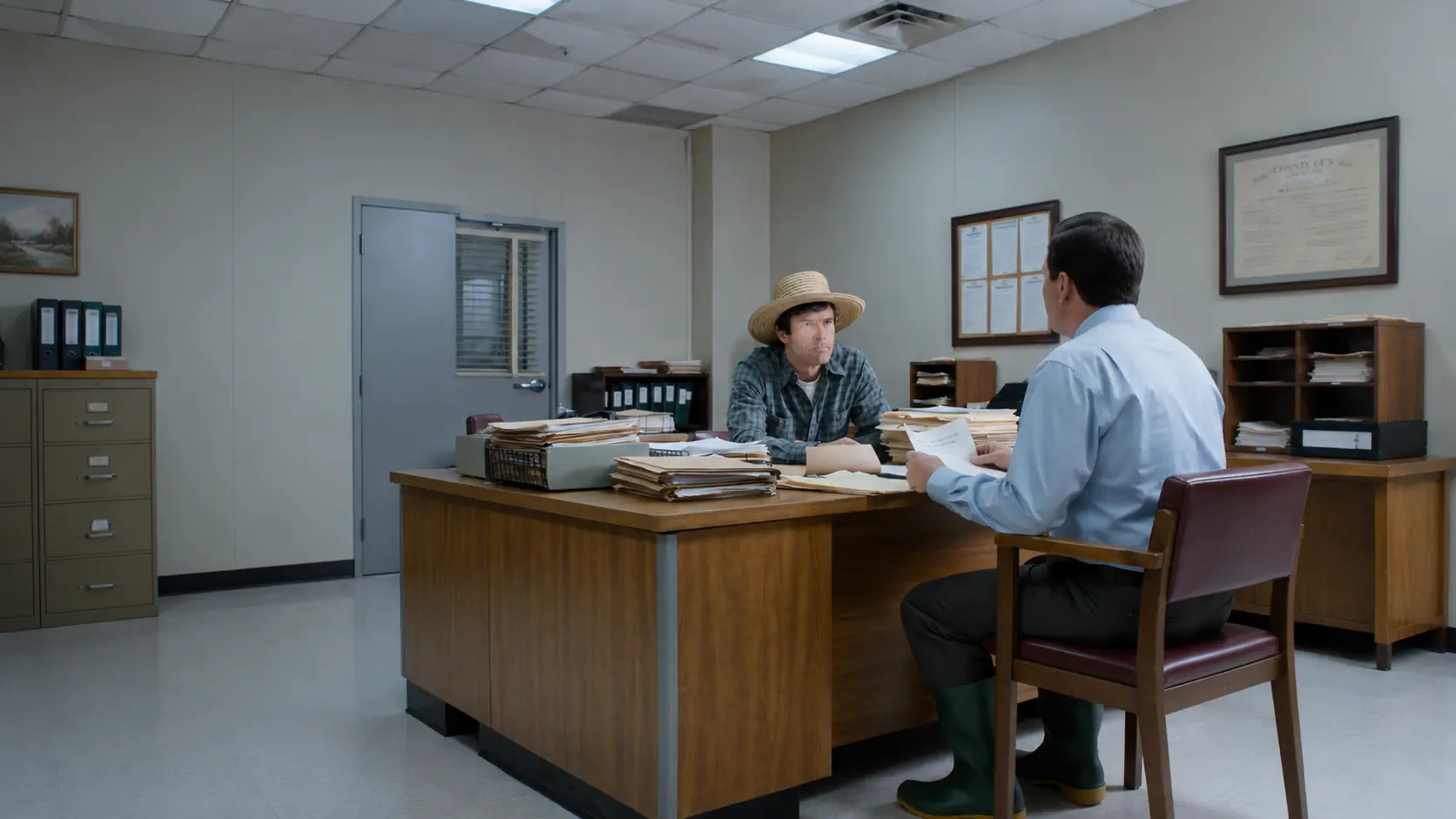
He reached the eleventh name on the list. Millard. Russell Millard. Two hundred eighty acres south of Neola. Operating loan of forty-two thousand dollars at fourteen point five percent variable rate, secured by a first lien on the farm. Gerald dialed the number and waited. “Millard residence.” “Mr. Millard, this is Gerald Wynn at Pottawattamie County Savings. I’m calling regarding your operating loan. I need to inform you that the bank is exercising its right to call the loan in full. You have ninety days to—”
“Read me the clause.” Gerald paused. In ten calls that morning, no farmer had interrupted him. They had listened. They had gone quiet. They had asked how much. They had asked why. Nobody had asked him to read the clause. “I’m sorry?” “The acceleration clause. The one that gives you the right to call the loan. Read it to me, word for word.”
“Mr. Millard, I don’t have the actual loan document in front of me.” “I do. I’m looking at it right now. Section seven, paragraph three. The acceleration clause. It says the bank may call the loan in full if, and I’m reading directly here, if the borrower fails to maintain the collateral in a condition consistent with its appraised value at the time of origination.” Gerald said nothing. “That’s the trigger, Mr. Wynn. That’s the only trigger in my contract. Not market conditions, not the bank’s portfolio, not the board’s decision. The only way you can call my loan is if I’ve damaged the collateral.”
Gerald shifted in his chair. “Mr. Millard, the bank’s position is that declining land values constitute a failure to maintain—” “Declining land values are a market condition, Mr. Wynn, not a maintenance failure. My farm is in better condition today than the day I signed that loan. The fences are tight. The buildings are painted. The soil is tested and limed. The drainage is maintained. I haven’t damaged the collateral. The market damaged the price. Those are two different things, and my contract doesn’t say anything about the market.”
Another silence followed, longer this time. “I’d like to speak with the bank president,” Russell said, “at his earliest convenience. And I’d suggest he bring my loan file, the original, not a summary. The original document with my signature on it.” Gerald Wynn hung up the phone and sat at his desk for a full minute before making the next call. He had just spoken to the only farmer on his list of fourteen who had read his own loan contract. And that farmer was smiling.
The reason Russell Millard read the fine print went back to 1957 and a kitchen table in Neola, Iowa, where his father lost everything. Russell was born in 1941 in Pottawattamie County, the only son of Clarence and Dorothy Millard. Clarence farmed two hundred eighty acres of good Iowa ground, corn and soybeans, the standard rotation, productive and reliable. He ran the operation with a 1950 Farmall M and later a 1958 Farmall 560, both bought used, both paid for with cash from the harvest.
Clarence was a careful man in every way except one. He didn’t read contracts, not because he was illiterate. He had finished high school, which was more than most farmers of his generation. He didn’t read contracts because he trusted the men who wrote them. The banker was a neighbor, the dealer was a friend, the co-op manager went to his church. In Clarence’s world, a handshake was a contract, and a contract was just the handshake written down. Same thing, same trust.
In 1955, Clarence took out an operating loan from the First National Bank of Neola, eight thousand dollars at six percent interest to cover seed, fertilizer, and a new grain drill. Standard farm loan. The banker, a man named Howard Voss, was Clarence’s friend. They had played baseball together in high school. Their wives were in the same church circle. Howard drew up the papers, Clarence signed them, and they shook hands across the desk. Clarence didn’t read the contract. He didn’t read the clause on page four that said the bank could adjust the interest rate annually at its sole discretion based on prevailing market conditions. He didn’t read the clause on page five that allowed the bank to demand additional collateral if the loan-to-value ratio exceeded seventy percent. He didn’t read the acceleration clause on page six that gave the bank the right to call the full balance with thirty days’ notice for any reason the bank deemed necessary to protect its interests. For any reason. Those three words. Not for cause. Not for default. Not for failure to pay. For any reason.
For two years, nothing happened. Clarence made his payments on time. The interest stayed at six percent. Howard Voss cashed the checks and smiled at church on Sundays. Everything was fine. In 1957, the First National Bank of Neola was acquired by a larger bank based in Omaha. The new owners reviewed the loan portfolio and decided to raise interest rates on variable loans to match their own cost of capital. Clarence’s rate went from six percent to nine point five percent overnight. His annual interest payment jumped from four hundred eighty dollars to seven hundred sixty dollars. Not catastrophic, but a shock. Three months later, the new management decided that the loan-to-value ratios in the Neola portfolio were too high. Land values had softened slightly, nothing dramatic, maybe a ten percent dip. The Omaha office wanted additional collateral on every loan above sixty percent loan-to-value. Clarence’s loan was at sixty-five percent. The bank demanded he pledge an additional forty acres as security. Clarence didn’t have forty additional unencumbered acres.
Everything he owned was the two hundred eighty acres already pledged. The bank called the loan. Eight thousand dollars. Thirty days. For any reason the bank deemed necessary. Clarence didn’t have eight thousand dollars in cash. The harvest wasn’t in yet. He couldn’t sell the crop because it was still in the field. He went to Howard Voss, his friend, his neighbor, his baseball teammate. Howard sat behind his desk and said the words that Clarence would hear for the rest of his life. “It’s not my decision anymore, Clarence. The Omaha people make the calls now. Your contract allows it. I’m sorry.” “My contract allows what? I’ve never missed a payment.” “The acceleration clause, page six. The bank can call the loan for any reason.” “I didn’t read page six.” “I know.”
Clarence Millard lost part of the farm in October of 1957. Not the whole two hundred eighty acres. He managed to sell one hundred twenty acres to a neighbor at a distressed price and used the money to pay the bank. But one hundred twenty acres of prime Iowa farmland were gone. Sold at sixty cents on the dollar to cover an eight-thousand-dollar loan he had never missed a payment on. All because of three words on page six of a contract he had never read. Russell was sixteen years old. He was standing in the kitchen when his father came home from the bank that day. Clarence sat at the table, put his head in his hands, and told Dorothy what had happened. Russell listened from the hallway. He heard everything.
The interest rate change. The collateral demand. The acceleration clause for any reason. That night, after his parents went to bed, Russell walked to the kitchen and found the loan contract on the table where his father had left it. He sat down and read it. Every page, every paragraph, every clause, every word of fine print. It took him two hours. He was sixteen years old and most of the legal language was beyond him. But he understood enough. He understood that his father had signed a document that gave the bank the right to take his farm at any time for any reason, and that his father hadn’t known it because he hadn’t read it. Russell made a decision that night that shaped the next forty years of his life. He would never sign a document he hadn’t read. He would never agree to a term he didn’t understand. And he would never, never allow three words buried on page six to do to him what they had done to his father.
Russell took over the remaining one hundred sixty acres from his father in 1963 when Clarence retired at fifty-eight, broken, exhausted, six years older than his age. Russell farmed it with the Farmall 560 his father had bought in 1958, the only piece of equipment that hadn’t been sold to cover the loan. He ran the operation the way his father had, corn and soybeans, careful costs, money saved after every harvest. But Russell did one thing differently.
Whenever he signed anything, a loan, a lease, a seed contract, an equipment agreement, a co-op membership, an insurance policy, he read every word, not skimmed, read with a dictionary beside him for the legal terms, with a notepad for the clauses he didn’t understand, with a red pen for the parts he wanted changed. The first time Russell took out an operating loan in 1965, he sat in the Pottawattamie County Savings Bank for three and a half hours. The loan officer, a man named Dennis Creel, had never had a farmer spend more than twenty minutes on a loan closing. Most signed where the tabs were, shook hands, and left. Russell read every page, asked about every clause and requested changes to four provisions. “What’s this on page three?” “Interest rate adjustable at the bank’s discretion. I want it fixed. Eight percent for the term of the loan. No adjustments.” “Mr. Millard, our standard loan agreement includes a variable rate provision. All our farm loans—” “I understand it’s standard.
I want it changed. Fixed rate. Eight percent. Or I’ll go to the bank in Neola.” Dennis looked at Russell. He was twenty-four years old farming one hundred sixty acres with a used Farmall asking a bank to rewrite its standard loan agreement. It was by any measure absurd. Farmers didn’t negotiate loan terms. Farmers signed what the bank put in front of them. But the bank wanted Russell’s business. His one hundred sixty acres was good collateral and his payment history was perfect. So Dennis agreed. Fixed rate. Eight percent.
For the next eighteen years, Russell read every document that crossed his path. Every loan renewal took at least two hours. The bank learned to schedule Russell’s closings at the end of the day because he would tie up the loan officer until closing time. Every seed contract, Russell caught a provision in 1971 that allowed the seed company to substitute varieties without notice. He had it removed. He caught a liability waiver in 1975 that would have prevented him from suing if the seed failed to germinate. He had it removed. He caught a binding arbitration clause in 1979 that would have forced any dispute into a private forum chosen by the company. He had it removed. Every equipment agreement. When Russell bought a used John Deere grain drill from the local dealer, he read the bill of sale and found a clause that said the dealer retained a security interest in the equipment until all obligations between buyer and seller were satisfied. All obligations.
That could mean anything. Russell had it changed to specify the purchase price only. The John Deere dealer in Council Bluffs, Pete Sadler, called Russell the most difficult customer in western Iowa. He meant it as an insult. Russell took it as a compliment. “You know what Pete Sadler calls me?” Russell told his wife, Helen, one evening. “The most difficult customer in western Iowa.” “Are you?” “Probably, but I’m also the only customer who knows what he signed.” The neighbors talked. Of course they talked. At the diner, at the co-op, at the elevator. Russell Millard and his fine print. Russell Millard who takes three hours to sign a loan. Russell Millard who carries a dictionary to the bank. “Man’s got a problem. Some kind of paranoia. Who reads a seed contract? Just sign it and plant.” “I heard he made the bank rewrite his acceleration clause. Who does that?” Somebody with too much time and not enough trust. Pete Sadler had the best line, delivered at the feed store in 1980. “Russell Millard reads the fine print the way other men read the Bible. Religiously, obsessively, and without understanding why normal people don’t.” Everyone laughed. Russell heard about it. He didn’t respond. He just kept reading.
Then February of 1983 came, and the laughter stopped. Interest rates were above eighteen percent. Corn was below two dollars. Land values had been cut in half. Pottawattamie County Savings Bank, like every rural bank in Iowa, was drowning in bad loans. Their farm portfolio was underwater. The Omaha examiners were threatening action.
The board decided to call every operating loan that was vulnerable. Every loan where the collateral had declined below the loan-to-value threshold. Every loan where the acceleration clause gave them the right. Gerald Wynn made fourteen calls that Tuesday morning. Thirteen of those farmers had signed the standard contract, the standard acceleration clause, for any reason the bank deems necessary. Thirteen farmers who had sat in Dennis Creel’s office, signed where the tabs were, shook hands, and left without reading page six. Russell Millard was the fourteenth call. And Russell Millard’s contract was different.
Three days after the phone call, Russell drove to Council Bluffs. He wore clean clothes. Not a suit, because Russell didn’t own a suit. But clean boots, pressed jeans, and a flannel shirt that Helen had ironed that morning. He brought one thing with him. A manila folder containing his original loan contract, every renewal agreement, every modification, and every piece of correspondence the bank had ever sent him. Eighteen years of paperwork organized by date, tabbed with colored stickers, annotated in Russell’s handwriting.
The bank president was a man named Carl Edberg. Carl had replaced the previous president in 1980 and had never met Russell personally. He had inherited the loan portfolio and the crisis that was eating it alive. He was fifty-two years old, gray-haired, and running on three hours of sleep and too much coffee. He did not want to be in this meeting. Gerald Wynn was there. Dennis Creel, who had closed the original loan in 1965, was there. The bank’s attorney, a man named Foster, was there. Russell sat down, set his manila folder on the table, and waited. “Mr. Millard,” Carl began, “I understand there’s some disagreement about the terms of your loan.” “There’s no disagreement. Your loan officer called me Tuesday and told me the bank was calling my loan. I told him to read the contract. He couldn’t because he didn’t have it in front of him. I did. I’ve had it in front of me since 1965.” Russell opened the folder and removed the original loan document.
He turned to page six and laid it flat on the table. The acceleration clause was highlighted in yellow. Russell had highlighted it eighteen years ago, the day he signed it. “This is my acceleration clause. It says the bank may call the loan only in the event of borrower default on scheduled payments. That’s the language I negotiated with Mr. Creel in 1965. I have never missed a payment, not one. Not in eighteen years.” He turned to the bank’s attorney. “Mr. Foster, has there been a default on my loan?” Foster looked at Gerald. Gerald looked at his files. “No. Mr. Millard’s payments are current.” “Then the bank has no right to call my loan.
Then he set them down and looked at Carl Edberg with the expression of a lawyer delivering bad news. “The contract is clear, Carl. The acceleration trigger is limited to default. There’s no default. We can’t call this loan.” Carl leaned back in his chair. He looked at Russell Millard, a farmer in a flannel shirt and clean boots sitting across from three bankers and an attorney with eighteen years of paperwork organized in a manila folder and a highlighted clause that was about to save his farm. “Mr. Millard, you negotiated this clause in 1965.
You were what, twenty-four?” “Twenty-four.” “And you’ve maintained these records for eighteen years. Every document, every letter, every renewal. May I ask why?” Russell looked at the bank president. “Because in 1957, my father lost one hundred twenty acres of this farm to the First National Bank of Neola. He had never missed a payment. The bank called his loan under an acceleration clause that said ‘for any reason.’ My father didn’t know the clause existed because he never read the contract. He trusted the banker. The banker was his friend.” Russell paused. “I was sixteen years old. I sat in the kitchen and read my father’s contract after he went to bed. Every page, every clause, every word.
And I decided I would never sign something I didn’t understand, and I would never give a bank the right to take my land for any reason other than my own failure.” The room was very quiet. “Your father lost land to a call clause,” Carl said. “One hundred twenty acres, good ground. Sold at sixty cents on the dollar to cover an eight-thousand-dollar loan he had never defaulted on.” “Because of three words on page six.” Carl looked at the thirteen files stacked on his desk.
Thirteen farmers whose loans were being called that week. Thirteen families about to lose their land. Every one of them had signed the standard contract. Every one of them had an acceleration clause that said “for any reason.” “Mr. Millard,” Carl said, “I can’t call your loan. Your contract doesn’t allow it. You’re free to continue under your existing terms.” “I know.” Russell stood up. He gathered his documents, placed them back in the manila folder, and tucked the folder under his arm. Then he stopped. “Those other thirteen farmers on Mr. Wynn’s list. How many of them read their contracts?” Carl didn’t answer. He didn’t need to. They both knew. “My father didn’t read his. It cost him one hundred twenty acres, and his health, and his pride, and the last six years of his life. He died at sixty-three, looking like he was eighty.” Russell looked at the files on Carl’s desk. “I hope those thirteen men have families who can help them through what’s coming, because what’s coming is what came for my father in 1957.
Same clause, same words, same result. Twenty-six years later, and nobody’s learned a thing.” Russell walked out of the bank into the February cold. He got in his truck, drove home, and walked to the barn where the Farmall 560 was parked. He put his hand on the hood the way his father used to, feeling the cold metal, and stood there for a while. Not moving. Not talking. Just standing on land that was still his because he had read page six.
Of the thirteen farmers whose loans were called that week, nine lost their farms within two years. Nine families. Nine operations. Some had been on their land for three generations. The acceleration clause gave the bank the right, and the bank exercised it. The auctions happened through 1983 and 1984, one after another. The same auctioneer’s chant. The same grim crowds. The same equipment sold at pennies on the dollar.
Four of the thirteen managed to refinance through other institutions or negotiate workouts that saved their operations, but all four lost significant equity in the process, paying penalty fees, accepting higher interest rates, pledging additional assets. None of them emerged whole. Pete Sadler’s John Deere dealership was crushed. Half his customer base was being foreclosed. The machines he had sold on credit were being repossessed and stacked on his lot. Pete filed for bankruptcy in 1985, closed the dealership, and took a job selling insurance in Omaha.
Russell’s loan stayed in place, same terms, same fixed rate, same restricted acceleration clause. He made his payments on time every year through the crisis, the same way he had made them every year before the crisis. The bank couldn’t touch him. Not because he was wealthy. Not because he was lucky. Because he had read the contract. By 1986, Russell had sixty-seven thousand dollars in savings, accumulated through twenty-three years of farming one hundred sixty acres with a paid-for Farmall 560, keeping costs low and putting money away after every harvest while his neighbors borrowed and expanded and signed documents they did not read. When the foreclosed farms came to auction, Russell was there.
In 1988, Pete Sadler returned to Pottawattamie County for a weekend visit and found himself at the co-op in Neola. Russell was there picking up seed. They hadn’t spoken since before the crisis. “Russell.” “Pete.” “I heard about the loan. The bank tried to call it and you fought them off with the contract.” “I didn’t fight them. I showed them what they had already agreed to. There’s a difference.” Pete was quiet for a moment. “I said some things about you over the years. The fine print stuff, the dictionary at the bank. I made fun of you for reading contracts.” “I know.” “I signed my own contracts the same way everyone else did. I didn’t read them. My dealership agreement with John Deere had a clause that let them pull the franchise with sixty days’ notice for underperformance. I didn’t know what underperformance meant until they defined it for me in 1985.
Turns out it meant whatever they wanted it to mean. Same clause, different document. Same clause, same result. I lost everything because I didn’t read page twelve of my franchise agreement.” Pete looked at Russell. “You were the only one who read. The only farmer, the only dealer, the only person in this county who actually knew what they had signed. We all called you paranoid.” “My father called it something different.” “What did he call it?” “The most expensive lesson he ever learned. He told me the night he lost the one hundred twenty acres. He said, ‘Russell, I trusted a man instead of reading a piece of paper, and the paper took my land. Don’t ever trust what a man tells you the paper says. Read the paper yourself.’” Pete extended his hand. Russell shook it. “I’m sorry I laughed at you,” Pete said. “I’m sorry you didn’t read yours.”
Russell Millard farmed the combined two hundred eighty acres, the original one hundred sixty plus the one hundred twenty he bought at auction, restoring the farm to the exact acreage his father had owned before 1957 until 2004 when he was sixty-three, the same age his father was when Clarence died. Russell noticed the symmetry and decided it meant something. He handed the operation to his son, Thomas, who farms it today.
Thomas grew up watching his father read contracts. He thought it was normal. He thought everyone did it. When he went to college at Iowa State, he mentioned it to his roommate, who looked at him like he had grown a second head. “Your dad reads every contract? Even the seed invoices?” “Every one. He has a filing cabinet with thirty years of paperwork.
Every document he’s ever signed, highlighted, annotated, organized by date.” “That’s insane.” “That’s why we still have the farm.” The filing cabinet is still in Russell’s farmhouse office. Forty years of contracts, agreements, renewals, and correspondence. Everyone read. Everyone understood. Everyone negotiated where the terms were unfair. The original 1965 loan contract, the one with the highlighted acceleration clause, is in the front of the top drawer in a clear plastic sleeve with a note paper-clipped to the front in Russell’s handwriting. “Page six. Read it.”
The Farmall 560 is in the barn. Thomas uses a modern Case IH now, but the 560 is maintained, started every spring, driven around the yard. It is the tractor Clarence bought, the tractor that survived the first loan call in 1957 because it wasn’t pledged as collateral. Clarence had bought it with cash before the loan, the tractor that Russell farmed with for forty years. The tractor that still starts on the first crank because some things, if you take care of them, outlast everything the banks can do. Thirteen farmers signed the standard contract. Thirteen farmers trusted the bank. Nine of them lost their farms.
Not because they were bad farmers. Not because they were lazy or stupid or unlucky. Because they didn’t read page six. One farmer read the fine print. One farmer negotiated his clause. One farmer kept his records for eighteen years. And when the bank came, the same bank, the same crisis, the same Tuesday morning phone call, that one farmer was the one smiling. The contract does not care if you read it. The contract does what the contract says. And what the contract says is whatever you agreed to when you signed it, whether you understood it or not. The law does not protect the trusting. It protects the literate. Clarence Millard trusted. Russell Millard read. The difference was one hundred twenty acres and a lifetime of sleeping soundly. The only farmer who read the fine print, when the bank came, he was the one smiling. Because he already knew what page six said.