Nathaniel “Nate” Stevens did not begin the evening of October 6, 2025, expecting to defend his sobriety, his judgment, or even his right to remain free. The call that brought officers from the Grayson Police Department in Kentucky concerned a two-vehicle, non-injury traffic collision, the sort of routine event police departments across America handle every day without anyone imagining a courtroom will eventually dissect every sentence. One vehicle had left the immediate scene by the time Officer Michael Bell and Sergeant Alvarez responded, while Nate remained connected to an incident in which he had not originally been described as an impaired driver. What happened after the officers arrived would eventually matter far more than the collision itself.
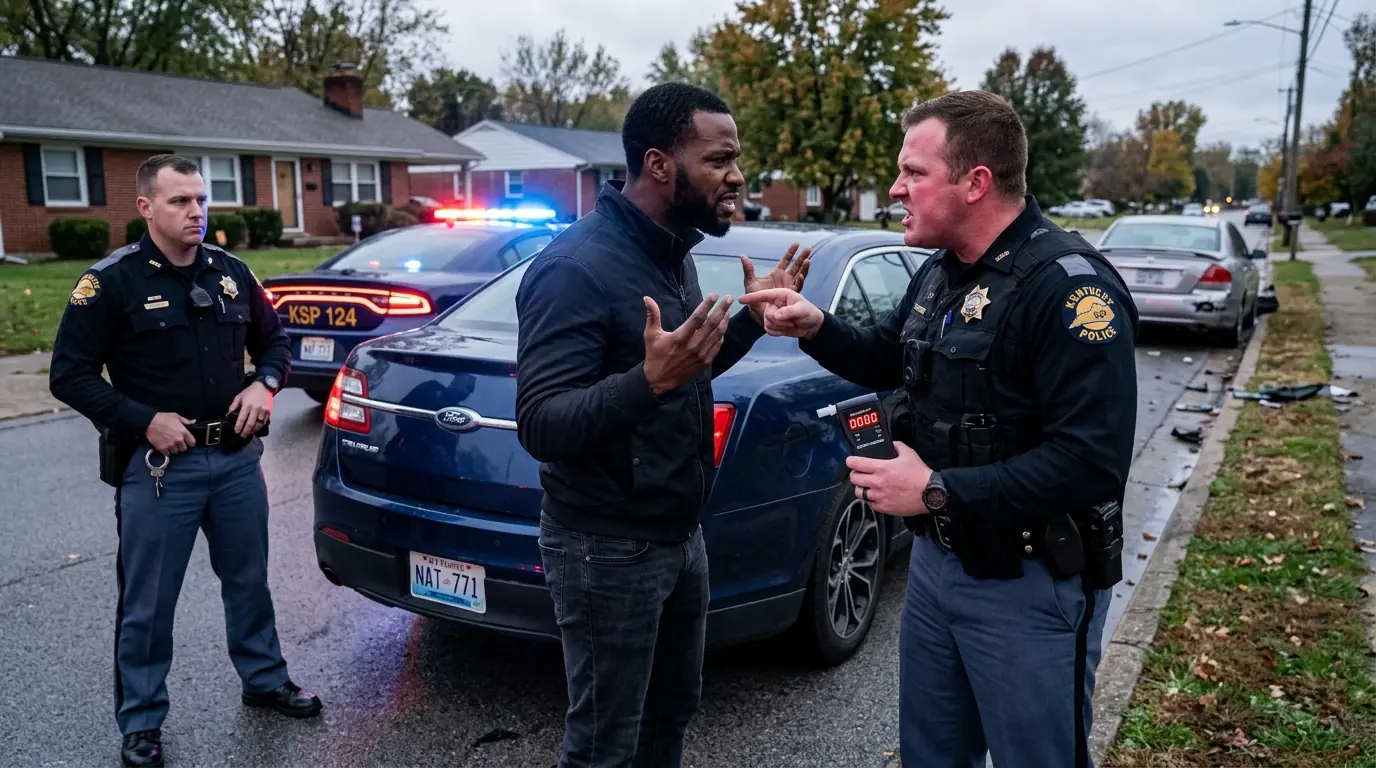
The defense would later describe the underlying accident as simple: a seventeen-year-old had backed from a driveway and struck Nate’s vehicle, the two exchanged information, and the situation did not become contentious until the teenager’s father learned what had happened and police became involved. Officer Bell could not personally verify every detail of that version when questioned under oath, and the Commonwealth objected when defense counsel began pushing him toward facts he had not witnessed firsthand. That distinction mattered because courtrooms do not exist to reward whichever side tells the cleaner story, and evidence must be separated from assumptions even when an explanation sounds plausible. Yet everybody agreed on one important starting point: police had been dispatched to a non-injury accident, not to a call reporting an obviously intoxicated driver weaving through traffic.
Bell and Alvarez arrived expecting to investigate the collision and the vehicle that had left. Somewhere during that investigation, however, attention shifted toward Nate himself, and Bell began wondering whether the man standing in front of him might be under the influence. The transformation was consequential because suspicion of DUI carries powers and consequences completely different from those involved in exchanging insurance information after a minor collision. From that moment forward, every observation would either strengthen the theory of impairment or give officers a reason to reconsider it.
Bell later wrote that he detected a strong odor of alcoholic beverage. In many DUI investigations, such an observation can become an important piece of probable-cause analysis when combined with slurred speech, poor balance, red eyes, erratic driving, failed sobriety exercises, or other indicators. Yet when Bell eventually testified, one part of his own description became difficult to reconcile with the rest of the encounter because he acknowledged there were no corresponding signs of alcohol coming from Nate himself. A smell was being asserted, but the physical picture normally expected to accompany meaningful intoxication appeared much less obvious.
Nate denied drinking. The body-camera exchange showed him questioning what the officers believed they were observing rather than admitting alcohol use or struggling to understand where he was. His willingness to challenge the officers did not make the encounter easier, but argument and impairment are not synonyms. That distinction would later become one of the central tensions in the courtroom.
At one point Bell moved close enough to Nate that the question of alcohol odor became almost literal. Nate exhaled, apparently attempting to demonstrate that he had not been drinking, and Bell initially interpreted the movement as potentially aggressive because someone blowing toward an officer’s face could conceivably be perceived as an attempt to spit. Under questioning later, however, Bell acknowledged that Nate had actually exhaled rather than spit. The moment became important not because exhaling proves sobriety, but because conduct Nate appeared to regard as cooperation was being interpreted through an increasingly suspicious lens.
Bell warned him that another aggressive movement could result in arrest. Nate continued insisting he had not consumed alcohol. The officer continued trying to determine whether impairment existed, and the roadside encounter began moving away from accident documentation and toward standardized DUI investigation. Somewhere inside that transition, Nate and Bell stopped agreeing about what cooperation even looked like.
Nate was asked to participate in testing. According to the later courtroom questioning and the account presented with the footage, he completed field-sobriety exercises without producing the kind of clear failure the prosecution would normally want to emphasize. The defense would later characterize those tests as passed, while Bell’s testimony focused more heavily on Nate’s nervousness, questioning, and changing willingness to participate. The difference between those descriptions became essential because probable cause has to be grounded in observable facts rather than simply in how irritating or difficult an encounter feels.
Then came the preliminary breath test. Bell specifically asked Nate whether he would take it, and Nate agreed. The device produced a reading of 0.000, showing no detected alcohol on that preliminary breath sample. The number did not scientifically rule out every possible intoxicating substance, and it did not make it impossible for an officer to investigate suspected drug impairment, but it unquestionably required the developing alcohol theory to be reconsidered.
Nate saw the zero as vindication. To him, he had denied drinking, cooperated with the breath test, and now possessed an objective result showing no alcohol detected. Bell did not necessarily see the investigation as finished because DUI laws can encompass substances beyond beverage alcohol and because a preliminary breath test is not the only possible evidence of impairment. The legal problem was not whether continued investigation was theoretically possible, but whether the facts actually developing in front of Bell justified what happened next.
That question became increasingly uncomfortable because the objective evidence described during the later hearing did not appear to be accumulating in the direction Bell expected. Nate was not falling down. The record presented in the transcript did not establish slurred speech, obvious confusion, or a positive alcohol result, while the defense emphasized that he followed instructions and completed the tests put before him. What remained most prominently in Bell’s description was behavior: nervousness, pacing, questioning, hesitation, and what he called confrontational conduct.
Anyone who has stood beside a road while police control the scene understands why nervousness can be difficult evidence. Completely sober drivers become anxious when blue lights appear behind them, especially when an officer begins discussing arrest, and a person who believes he is being falsely suspected may become more agitated precisely because he knows he has done nothing wrong. None of that means nervous behavior must be ignored, because officers are allowed to consider the totality of circumstances. It means nervousness must be weighed rather than allowed to substitute for everything objective that points in the opposite direction.
Bell described Nate as back-and-forth about some of the testing. The defense would later argue the hesitation reflected confusion over what was being requested and what legal consequences accompanied refusal rather than an attempt to evade investigation. That difference became especially important once Nate began asking questions about a lawyer. The more uncertain he became about his choices, the more Bell appeared to interpret uncertainty as noncooperation.
Nate apparently attempted to contact attorney Gordon Hall. The body-camera discussion later became a point of contention because Bell told him that if Hall came to the scene, Hall could become a witness and therefore could not represent him in the same way Nate seemed to expect. Bell later defended the statement by explaining that a roadside traffic stop did not automatically entitle Nate to have an attorney physically present during every investigative step. The defense attacked a different problem: whether Bell’s explanation had confused Nate about his ability to call counsel at all.
That issue becomes particularly significant under Kentucky’s implied-consent procedures. Once certain chemical testing is requested after a DUI arrest, the statutory warning explains consequences of refusal and provides an opportunity to attempt communication with an attorney for a limited period. The precise rights involved are not identical to the familiar television version of a Sixth Amendment lawyer standing beside a suspect during roadside testing. Yet a person trying to make an informed decision still needs the officer’s explanation to be accurate enough that confusion created by police does not become the basis for penalizing the person later.
Nate’s attorney would eventually ask Bell a blunt question under oath. If Nate was trying to call counsel, what authority did the officer have to tell him that the lawyer could not represent him? Bell attempted to distinguish between having counsel arrive as a witness at the roadside scene and the later statutory opportunity to communicate by telephone during the implied-consent process. The difficulty was that the body-camera exchange did not necessarily show those distinctions being explained clearly to Nate when the confusion actually arose.
Bell later acknowledged that he had not sat Nate down and carefully explained the difference between a lawyer becoming a witness by physically coming to the traffic scene and a lawyer providing advice during the limited implied-consent contact period. That omission did not automatically make every subsequent decision invalid, but it gave the defense a powerful argument about whether Nate understood the consequences attached to saying no. A refusal hearing does not simply ask whether the word “no” was spoken. It asks whether a legally meaningful refusal occurred under the governing procedures.
Before the case ever reached that question, however, another moment complicated Bell’s justification for the arrest itself. Nate told the officers they would be sued. Criticizing police, threatening legal action, or announcing an intention to contact a lawyer can be protected speech, and those words cannot independently manufacture probable cause that did not already exist. An officer who genuinely has probable cause does not lose that authority merely because the person threatens litigation, but the timing of the statement becomes relevant when the evidence supporting arrest is already uncertain.
The defense focused relentlessly on that chronology. Before Nate completed the requested roadside investigation, Bell had made comments suggesting he believed Nate might be going to jail based partly on reluctance to perform sobriety testing. Then Nate participated, and the PBT registered zero alcohol. Afterward, once Nate mentioned legal consequences and the possibility of suing, the arrest followed.
Correlation alone did not prove retaliation. An officer can lawfully make an arrest seconds after protected speech if probable cause independently exists, and the courtroom was not entitled to turn timing into motive without evidence. Yet defense counsel understood something every experienced trial lawyer knows: chronology often exposes whether an explanation is truly driving a decision or merely being assembled afterward to defend one. He therefore forced Bell to walk through the encounter one piece at a time.
“What exactly did you want him to do?” became the practical question beneath several rounds of testimony. Nate had answered questions. He had agreed to the PBT. He had gone through sobriety exercises, and the defense emphasized that objective indicators of alcohol impairment were not appearing.
Bell responded that Nate had been confrontational and uncertain about testing. Defense counsel returned to the same problem from another angle. If Nate completed what the officer requested after being given explanations, how could that same hesitation continue operating as proof of intoxication? The hearing slowly transformed from an examination of Nate’s behavior into an examination of the officer’s reasoning.
That transformation is one reason body-camera footage has become so important in modern policing. Human memory changes under stress, reports compress complicated moments, and even honest witnesses can later remember a conversation in ways that fit the conclusions they reached afterward. Video does not interpret itself, and camera angle, sound, perspective, and missing context still matter. Yet a recording can force everybody in a courtroom to confront what was actually visible before hindsight began rewriting it.
The defense emphasized that Bell’s camera remained active through most of the interaction. At one point, Bell removed or covered the camera while speaking privately with Sergeant Holloway, and counsel questioned him about what was discussed away from Nate. Bell testified that he was speaking with the sergeant rather than secretly consulting a prosecutor and denied remembering any improper conversation. The defense was unable, from the supplied testimony alone, to prove that the off-camera discussion contained anything unlawful.
What the defense could show was timing. Bell had one set of observations before the conversation, another set of objective results from the testing, and then an arrest decision. Counsel wanted the judge to focus on what evidence existed at the precise moment police decided custody was justified. Probable cause is not supposed to be created retroactively by facts learned hours later.