Sunday morning on Maplewood Drive was supposed to be quiet.
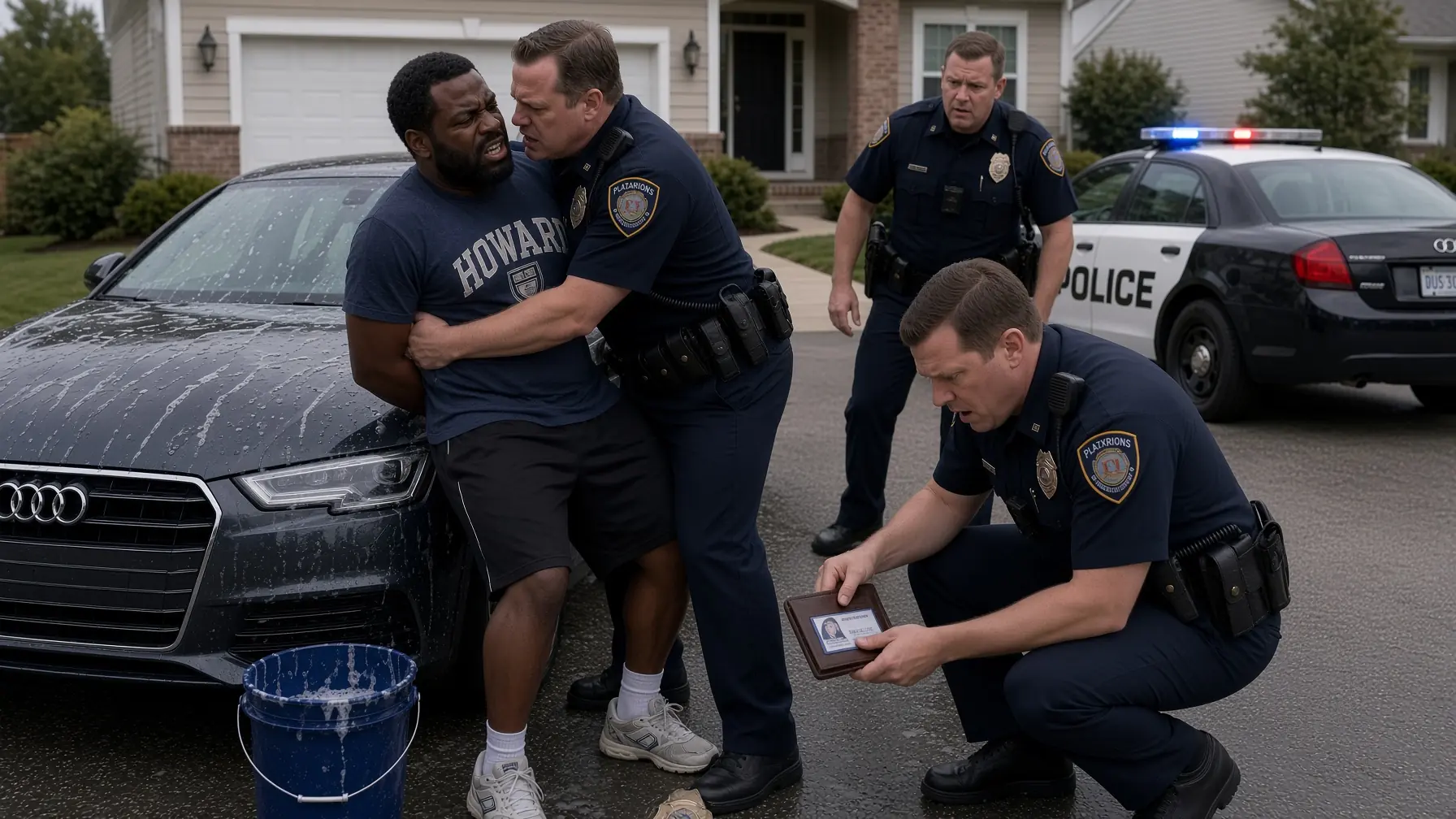
It was the kind of spring morning Marcus Reynolds had spent most of his adult life learning to appreciate because nothing important was happening.
Sprinklers clicked across trimmed lawns. Garage doors stood open. Somewhere two houses down, a radio played an old Motown song through a portable speaker while somebody worked on a flower bed. The smell of coffee drifted from Marcus’s kitchen whenever the screen door opened.
He stood in his driveway beside a charcoal-gray Audi A6, wearing a faded Morehouse College T-shirt, black gym shorts, and sneakers so old his wife had threatened to throw them away twice.
A garden hose lay behind him.
Soap covered half the car.
Marcus ran a sponge across the hood and stepped back to inspect a streak he had missed near the windshield.
For once, his phone was inside.
His department-issued radio was inside.
His badge was inside his wallet beside the bucket.
And Lieutenant Marcus Reynolds of the Maplewood Police Department’s Internal Affairs Division was simply a fifty-one-year-old man washing his car.
He liked being that man.
Thirty years in law enforcement had taught Marcus that uniforms changed the way strangers behaved around you. Some became polite. Others defensive. Some looked frightened before you said a word.
Marcus never forgot that.
So on weekends, he preferred old shirts, bare legs, and ordinary work.
He had just reached for the hose when a patrol cruiser rolled slowly onto Maplewood Drive.
Marcus barely noticed.
Police cars passed his house all the time.
The cruiser continued another twenty yards.
Then brake lights flashed.
It stopped.
Marcus looked up.
The cruiser reversed several feet.
That got his attention.
The driver’s door opened.
A white patrol officer stepped out.
Mid-forties. Broad shoulders. Dark sunglasses. Nameplate too far away for Marcus to read.
The officer stood beside the cruiser for a moment looking at the Audi.
Not Marcus.
The car.
Then he walked toward the driveway.
“Morning.”
Marcus nodded.
“Morning.”
The officer stopped near the sidewalk.
“Nice car.”
“Appreciate it.”
Marcus turned back toward the hood.
He expected the conversation to end there.
It did not.
“Who owns it?”
Marcus stopped.
Water dripped from the sponge.
He looked toward the officer again.
“Excuse me?”
“The Audi.”
The officer nodded toward it.
“Who owns it?”
Marcus studied him.
Not aggressively.
Professionally.
Even after decades in policing, there were moments when instinct arrived before thought.
Something about the officer’s tone had changed between nice car and who owns it.
“My car,” Marcus answered.
The officer looked at him.
Then toward the house.
“You live here?”
“Yes.”
“How long?”
Marcus almost smiled.
“Why?”
The officer stepped off the sidewalk and onto the driveway.
“Just asking.”
Marcus lowered the sponge.
“Okay.”
“You got ID on you?”
Now Marcus knew this was no casual conversation.
“My identification?”
“Yes.”
“For what?”
The officer removed his sunglasses.
His eyes were pale and impatient.
“Routine.”
Marcus glanced at the Audi.
Then at himself.
Then toward his open garage, where a shelving unit contained his lawn tools, a bicycle, two cardboard boxes, and an old basketball hoop he kept promising to install for his nephew.
“Officer, I’m standing in my own driveway washing my own car.”
“I heard you.”
“Then I’m trying to understand why you need identification.”
Across the street, eighty-year-old Margaret Harper stopped clipping roses.
Marcus noticed.
Mrs. Harper had lived across from the Reynolds family for nine years. She knew the Audi. Knew Denise. Knew Marcus’s children. She had once borrowed the same garden hose he was using.
The officer took another step forward.
“I asked for identification.”
Marcus’s expression changed slightly.
He knew the type of encounter unfolding.
Not because he assumed every officer asking questions had bad intentions.
Because he had investigated enough complaints to recognize a familiar sequence.
An officer noticed something.
Developed a suspicion.
Then treated questions about that suspicion as evidence supporting it.
Marcus kept his voice even.
“Am I suspected of something?”
“There have been vehicle thefts in the area.”
“What theft?”
“Several.”
“Was an Audi stolen?”
The officer’s jaw tightened.
“I’m asking the questions.”
Marcus glanced at the body camera mounted on his chest.
Small red light.
Recording.
Good.
“What’s your name, Officer?”
Instead of answering, the officer asked, “Where’s your ID?”
Marcus almost laughed at the irony.
“You haven’t asked my name.”
“I’m asking for identification.”
“That’s not the same thing.”
The officer placed one hand near his duty belt.
“Step away from the vehicle.”
Marcus looked down.
At the driveway beneath his sneakers.
Then back at him.
“This is my driveway.”
“Then you won’t mind proving it.”
That sentence altered something inside Marcus.
Not anger.
Something colder.
He had heard versions of it before.
If you belong here, prove it.
If it’s your car, prove it.
If you have nothing to hide, cooperate.
On paper, each phrase could sound reasonable.
In practice, Marcus knew how easily they could turn ordinary existence into a test some people were expected to pass more often than others.
Still, he did not raise his voice.
“Officer, what specific behavior did you observe that makes you believe I don’t belong here?”
The officer stared at him.
“You’re becoming argumentative.”
“No.”
“You are.”
“I’m asking why I’m being detained.”
“I didn’t say you were detained.”
“You ordered me away from my vehicle.”
“For officer safety.”
Marcus looked at the sponge in his hand.
Soap dripped onto the concrete.
The officer’s radio came up.
“Unit Twelve, requesting another unit to Maplewood Drive. Possible stolen vehicle investigation. Male subject refusing identification.”
Marcus stared at him.
There it was.
He had not refused identification.
He had asked why it was required.
No plate check.
No stolen vehicle confirmation.
No name.
No attempt to verify the address.
Yet the radio description already sounded more serious than the reality.
Mrs. Harper had lowered her shears completely now.
Her neighbor, Thomas Bell, stepped onto his porch carrying coffee.
A curtain moved in the house beside Marcus.
The officer noticed the attention.
Instead of calming him, it seemed to harden him.
“Put the sponge down.”
Marcus obeyed.
“Hands where I can see them.”
“They are.”
“Step back.”
Marcus took one step away from the Audi.
The officer moved farther into the driveway.
“What’s your name?”
Marcus almost smiled.
Finally.
“Marcus Reynolds.”
The officer’s expression showed no recognition.
Marcus had not expected any.
Internal Affairs did not make celebrities.
Most officers knew his name on paperwork, not his face on Sunday mornings.
“Date of birth?”
Marcus gave it.
“Address?”
Marcus looked at the house directly behind him.
“This address.”
“Say it.”
Marcus did.
The officer still did not radio dispatch.
That interested him.
If the purpose were verification, every answer Marcus gave created an easy next step.
Run the address.
Run the plate.
Check registration.
The officer did none of those things.
Instead he asked, “How long have you owned the Audi?”
“Three years.”
“Where’d you buy it?”
Marcus stared.
“Why is that relevant?”
“There you go again.”
“What?”
“Getting defensive.”
Marcus exhaled slowly.
“I’m not defensive.”
“You keep questioning me.”
“Yes.”
“Why?”
“Because I’m standing on private property engaged in legal activity and you’ve turned it into a suspected vehicle theft without telling me what connects me to one.”
The officer’s eyes narrowed.
“You know a lot about procedure.”
Marcus said nothing.
That was intentional.
He could have ended the psychological advantage immediately.
Could have said:
Lieutenant Marcus Reynolds. Internal Affairs.
Could have watched the tone change.
He did not.
Because this encounter had begun before the officer knew who he was.
Marcus wanted to understand why.
A second patrol cruiser turned onto Maplewood Drive.
Then another.
Marcus looked toward them.
Three officers for a man washing a car.
The first backup officer stepped out of the nearer cruiser.
Young. Black. Maybe thirty.
Officer Daniel Keller.
The second was a Latina officer Marcus recognized vaguely from department photographs but had never met, Elise Moreno.
Keller walked toward the driveway.
“What’ve we got?”
The original officer answered.
“Possible stolen high-end vehicle. Subject claims he lives here, refusing ID.”
Marcus looked directly at Keller.
“I have not refused identification.”
The original officer snapped, “Don’t interrupt.”
Keller looked from Marcus to the Audi.
Then at the open garage.
Then the hose.
Something in his expression changed.
Moreno noticed too.
“Vehicle reported stolen?” she asked.
“Not yet confirmed.”
Marcus almost spoke.
Stopped himself.
Keller glanced at the plate.
“Did you run it?”
The officer looked irritated.
“I was handling the subject.”
That was the first obvious crack.
Keller’s eyes moved toward Marcus.
Marcus saw recognition nowhere in them.
Good.
This was still about facts.
“My wallet is beside the bucket,” Marcus said.
The officer turned.
“What?”
“You want identification.”
“Yes.”
“My wallet is on the ground beside the wash bucket.”
The officer looked.
A dark leather wallet lay partly wet from water splashed off the car.
“Get it.”
Marcus nodded.
He moved slowly.
Very slowly.
Bent at the waist.
His fingers were less than a foot from the wallet when the officer shouted.
“Hands where I can see them!”
Marcus froze.
Mrs. Harper gasped.
Moreno’s hand moved toward her holster.
Keller stiffened.
Marcus remained bent halfway toward the bucket.
Then he slowly looked up.
“You told me to get my wallet.”
“I said move slowly.”
“I am moving slowly.”
“Stand up.”
Marcus did.
The officer’s face was flushed now.
The situation had become something he seemed determined to dominate simply because it had become tense.
Keller finally spoke.
“He said where the wallet was before he reached.”
The first officer looked at him.
“I’ve got it.”
Keller stopped.
Marcus noticed the dynamic immediately.
Seniority.
Pressure.
Silence.
He had seen it in dozens of Internal Affairs interviews.
Young officers rarely admitted how powerful another officer’s disapproval could feel until after something went wrong.
The first officer nodded toward the wallet.
“Pick it up. Two fingers.”
Marcus almost asked whether the man wanted him to levitate it.
He decided humor was not worth the risk.
He bent again.
Two fingers.
Lifted the soaked wallet.
Water ran down his wrist.
“Open it.”
Marcus opened it.
The driver’s license was deeper inside than usual because Denise had reorganized his cards the night before after borrowing one for an online purchase.
Marcus’s thumb landed on the first credential instead.
He pulled it out.