The sentence was buried near the bottom of Caleb Mercer’s marriage advertisement, beneath the acreage, the cattle, the Wyoming winters, and one painfully practical paragraph explaining that any woman who answered should understand the nearest doctor lived nearly twenty miles away.
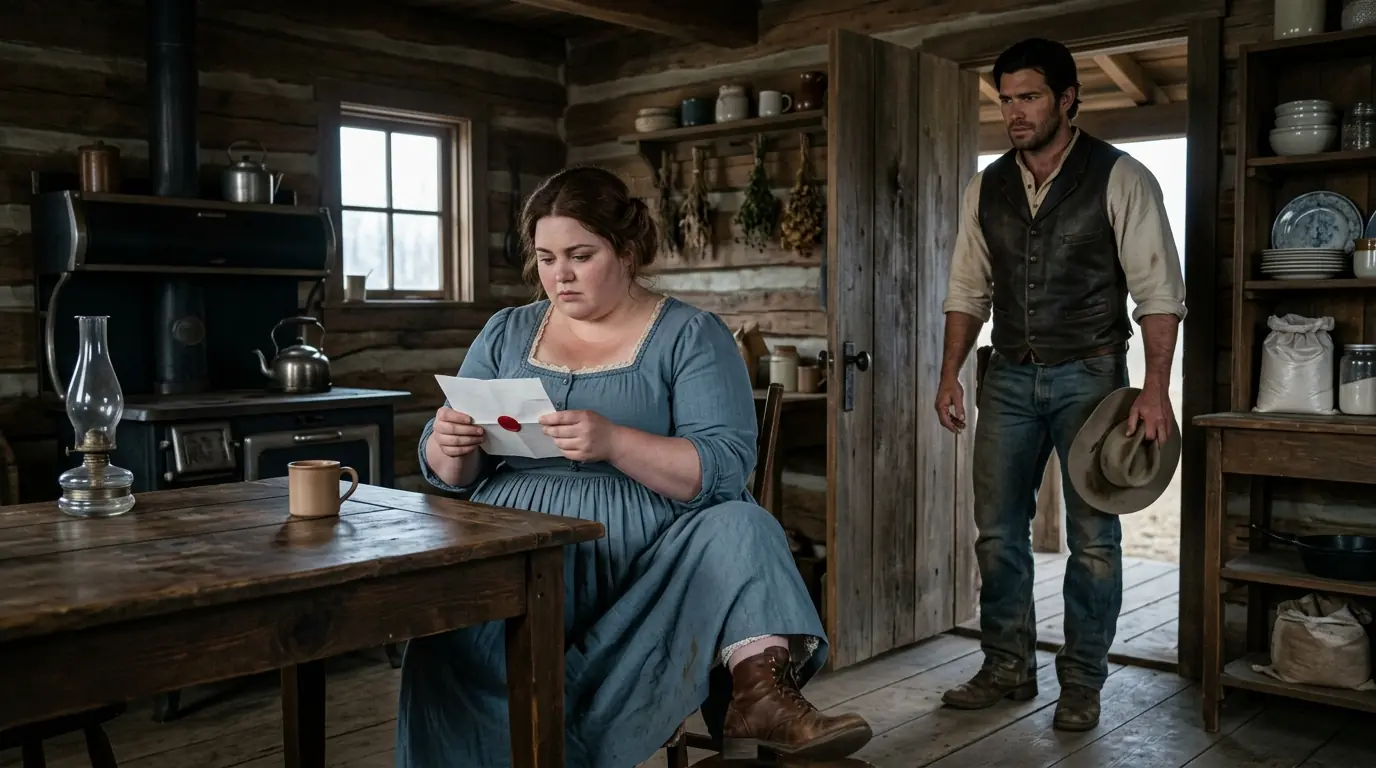
But Caleb knew six words mattered more than everything above them.
I can never father a child.
He had written the sentence himself.
Then crossed it out.
Then written it again.
The first version sounded apologetic. The second sounded bitter. The third simply sounded final, which was what Caleb had believed the truth to be for almost eleven years.
At thirty-eight, Caleb Mercer was the kind of man other people described as fortunate without ever asking whether he agreed. He owned more than seven hundred acres outside Red Willow, Wyoming Territory, with strong cattle, two reliable wells, a creek that survived most dry summers, and a farmhouse built solid enough that January wind only found three places to whistle through. His barn roof was new, the mortgage was manageable, and the iron lockbox beneath the office floor held enough savings to survive a bad winter without selling breeding stock.
Men envied him.
Women called him dependable.
Neighbors trusted him with livestock, money, and disputes.
Yet when darkness settled over Mercer Ranch and the last hired hand rode back toward town, Caleb returned every evening to something land and cattle could not repair.
Silence.
One plate at supper.
One chair pulled away from the table.
One lamp burning beside a bed large enough for two people and occupied by one.
He had once imagined children filling the house.
Not vaguely.
Specifically.
A son tracking mud across Anna—no, there had been no Anna then—across the kitchen his mother once scrubbed every Saturday. A little girl sitting on the porch rail asking why cows knew when storms were coming. Two children fighting over a wooden horse until Caleb threatened to throw the toy into the stove, then secretly repairing it after bedtime because he could never actually do such a thing.
That future had ended when Caleb was twenty-seven.
The accident happened during spring roundup.
A young gelding panicked when a rope snapped beneath its hind legs, threw Caleb into frozen mud, then came down partly across his lower body before three men dragged the horse away.
The pain lasted weeks.
The fever lasted longer.
Dr. Warren Bell treated Caleb in Red Willow, returning every other day until the swelling went down and Caleb could stand without becoming nauseated.
Then, during one final examination, Bell closed the office door.
Caleb remembered the click of that latch more clearly than the doctor’s face.
“Mr. Mercer,” Bell said, “the injury was severe.”
Caleb sat on the edge of the examination table.
“I noticed.”
Bell did not smile.
Something about that frightened him.
“The damage on the left side is substantial.”
Caleb stared.
Bell folded his hands.
“You should not expect to father children.”
The room changed.
Caleb did not understand how a room could remain physically identical while becoming unrecognizable, but that was what happened.
He asked, “Shouldn’t expect?”
Bell looked down.
Caleb’s voice became harder.
“Doctor.”
Bell finally met his eyes.
“You cannot.”
One word.
Caleb remembered hearing a wagon outside.
Someone laughing in the street.
A woman asking the clerk whether cough syrup contained alcohol.
Ordinary life continued on the other side of the door.
“Never?”
Bell shook his head.
“No.”
Caleb rode home alone.
He told one person.
His uncle Asa Mercer.
Asa was his father’s younger brother, fourteen years older than Caleb, and had been the nearest thing to a second father after Josiah Mercer died unexpectedly of pneumonia. Asa helped settle the estate, negotiated two grazing agreements, taught Caleb how to read bank contracts, and stood beside him when the first drought threatened the ranch.
When Caleb told him what Bell had said, Asa put one hand on his shoulder.
“You’re still a whole man.”
Caleb nearly struck him.
Instead he stood there staring toward the south pasture.
“I know.”
But he did not.
Not then.
Six months later, Caleb ended a courtship with Rebecca Hall, the schoolteacher in Red Willow.
He never told her why.
She demanded an explanation.
Caleb gave her none that deserved believing.
Eventually she married a carpenter in Cheyenne.
Caleb attended the wedding because avoiding it would have looked like regret.
He shook her husband’s hand.
Kissed Rebecca’s cheek.
Then rode home and vomited behind the barn.
After that, he stopped trying.
Years passed.
Asa occasionally suggested marriage.
Caleb always refused.
“You don’t need children to have a wife.”
“No.”
“You don’t need to live alone.”
“I don’t.”
Yet he did.
By thirty-five, the solitude had become a habit.
By thirty-eight, the habit had begun feeling like surrender.
So one winter evening Caleb sat at his kitchen table with a newspaper advertisement form and wrote the truth.
Rancher, 38, financially secure, healthy, hardworking, seeking respectable woman for marriage and partnership in western household. Life isolated but stable. Must be willing to endure severe winters, livestock work, distance from town, and a husband not skilled at conversation. I can never father a child. Honesty requested and offered.
He almost tore it up.
Instead he mailed it.
The replies began three weeks later.
One woman apologized because she had always dreamed of a large family.
Caleb respected that.
Another asked how many acres he owned before telling him her first name.
That letter went into the stove.
A widow from Iowa wrote six pages about Jesus, three about her late husband, and four lines about Caleb.
A twenty-two-year-old asked whether the ranch would pass entirely to a wife if he died.
That one joined the fire too.
Then Anna Whitmore wrote from Missouri.
Her letter began:
Mr. Mercer, you say honesty is requested and offered, so I suppose I should test whether you mean it. I am thirty-one years old. I have no fortune, no remarkable beauty, and no talent for pretending uncomfortable things are charming. I can cook, keep accounts, sew badly but persistently, and have been accused of asking questions after men consider a conversation finished. I would rather know whether you become cruel when tired than how many cattle you own.
Caleb read it twice.
Then once more after supper.
His reply became four pages without his permission.
Anna wrote back.
Soon Caleb knew she disliked raisins, loved thunderstorms, could remember almost any number after seeing it once, and had spent nine years keeping accounts for a freight company owned by her cousin.
Anna learned that Caleb drank coffee too strong, hated dancing, once lost three calves because he refused to believe a creek could rise six feet overnight, and owned a piano nobody had played since his mother died.
After the eighth letter, Caleb wrote what he had been afraid of repeating.
I want to be certain you understood the sentence near the bottom of my advertisement. This is not modesty. It is not something a wife could change with patience. A doctor told me years ago that I will never father children. If motherhood is necessary to your happiness, I would rather lose your letters now than disappoint you later.
Anna’s answer arrived eleven days afterward.
It contained no pity.
I understood it the first time.
Below that she had added:
Children are one way to build a family. They are not the only way.
Caleb carried that letter in his coat for three months.
By spring, he invited her west.
The stagecoach arrived in Red Willow under rain.
Caleb stood beneath the hotel awning feeling more nervous than he had during any cattle drive, negotiation, or storm in his life.
Then Anna Whitmore stepped down.
She wore a modest blue traveling dress and practical brown boots. Her chestnut hair had escaped several pins around her face, her gray eyes looked exhausted, and the battered suitcase the driver handed her appeared to have survived the journey through personal resentment rather than craftsmanship.
Anna looked around.
Then saw him.
“You’re Caleb?”
He nodded.
“And you’re Anna.”
She smiled.
“You’re taller than your handwriting suggested.”
Caleb stared.
Then laughed.
He had expected awkwardness.
Instead something shifted inside him.
Not love.
Not yet.
Relief, perhaps.
Anna was real.
Not paper.
Not imagination.
Real enough to make an observation about handwriting before hello.
They married three weeks later.
Quietly.
The ceremony took place in the small Red Willow church with Asa Mercer, two ranch neighbors, and Anna’s cousin from Missouri as witnesses.
The night before the wedding, Caleb brought up the subject one final time.
They were standing on the porch while thunder moved far out across the plains.
“Anna.”
“I know that voice.”
“What voice?”
“The one you use before saying something you’ve already said.”
Caleb almost smiled.
“You understand there won’t be children.”
Anna’s expression softened.
“I understand what you were told.”
He frowned.
“What does that mean?”
“It means I understand.”
“That isn’t exactly—”
“Caleb.”
She took his hand.
“I am not marrying the children you cannot give me.”
His throat tightened.
“I’m marrying you.”
So Caleb believed the subject closed.
Their marriage began without drama.
Anna moved into Mercer Ranch with one trunk, fourteen books, three framed photographs, and enough opinions to make the house feel occupied before the first week ended.
Curtains appeared over windows Caleb had left bare for thirteen years.
The pantry was reorganized.
He complained.
Anna labeled shelves.
He complained more.
She discovered his mother’s piano needed tuning and paid a traveling repairman from her own savings before Caleb could object.
Flowers appeared beside the porch.
Fresh bread appeared almost every morning.
Caleb gained eleven pounds before he realized what was happening and accused Anna of attempting to make him too heavy to leave.
“You own the ranch,” she told him. “Where would you go?”
He had no answer.
He taught her to ride.
Anna hated it.
The first horse she tried sensed that and behaved like a criminal discovering weak law enforcement.
After the animal stepped on Anna’s skirt for the third time, she looked directly into its eye.
“I know people with glue pots.”
Caleb laughed so hard he had to sit on the fence.
Anna eventually became competent on a calm gray mare named Daisy.
Caleb never told anyone he had quietly sold the difficult horse afterward.
The farmhouse changed.
But more importantly, Caleb changed inside it.
He began returning from the barn earlier.
He stopped eating supper while standing over the stove.
He found reasons to tell Anna stories he had not told anyone in years.
Sometimes after dark they sat together without speaking, and Caleb discovered silence became a completely different thing when another person chose to share it.
Three months after their wedding, Anna touched his face one evening and said, “You laugh more.”
“I always laughed.”
“No.”
“You’ve known me three months.”
“I have letters.”
“That is unfair evidence.”
“I keep records.”
Caleb kissed her.
It was not a grand marriage.
It was better.
It was ordinary.
Then Anna began getting sick.
The first morning, Caleb blamed breakfast.
Anna agreed.
Too quickly.
The second time, he suggested spoiled milk.
She said perhaps.
By the third week she had stopped drinking coffee altogether.
That frightened him.
“You’re ill.”
“I’m fine.”
“You hate mornings, but you normally hate them with coffee.”
Anna stared at the cup.
“It smells terrible.”
“It has always smelled terrible.”
“Yes.”
“So?”
“Now it smells personally offensive.”
She rushed outside before finishing.
Caleb followed.
Anna bent near the porch rail.
He put one hand against her back.
She waved him away.
“I’m all right.”
“You are vomiting behind the hydrangeas.”
“They weren’t doing well anyway.”
“This isn’t funny.”
“No.”
She straightened slowly.
“Probably something I ate.”
Caleb watched her.
Something uneasy settled beneath his ribs.
Over the following days, he noticed things he wished he had not.
Anna tired before supper.
Her dresses seemed tighter at the waist.
Certain foods she loved now made her turn away.
She began counting dates in a small notebook.
Whenever Caleb entered the room, she closed it.
Then one afternoon he found her standing beside the kitchen window.
Her hand rested across her stomach.
Not casually.
Protectively.
Caleb stopped in the hallway.
Anna did not see him.
Something cold moved through him.
He backed away.
For the first time since their wedding, Caleb did not ask what was wrong.
He was afraid of the answer.
That night, he lay beside Anna without sleeping.
Dr. Warren Bell’s voice returned from eleven years away.
You cannot.
Caleb had repeated those words so many times they no longer sounded like a doctor’s opinion.
They sounded like physical law.
If Anna were pregnant, there seemed only one explanation.
Caleb hated himself for thinking it.
Then thought it again.
Someone in Red Willow?
A ranch hand?
A traveler while Caleb was moving cattle north?
Had Anna known a man before coming west?
Had she already—
No.
He stopped.
Anna had never given him reason.
None.
He reminded himself of that.