The letter that brought Eleanor Vale to Harlan County was only half a page long. It said the man needed a wife who could cook, keep house, help preserve beef before winter, and was not afraid of hard work. It did not mention romance, comfort, music, laughter, or any of the pretty lies men sometimes wrote when they placed advertisements for women they had never met. That was why Eleanor read it twice on the post office steps and decided it might be honest enough to answer.
She arrived in Delwood six days before Samuel Rourke came for her. She was thirty-one years old, a widow with dark auburn-brown hair, steady hazel eyes, and hands that knew work better than softness. She carried a canvas bag, a sewing basket with a broken clasp, a small tin of salt, and the habit of expecting very little from anyone. The town watched her the way small towns watch new women, quietly and completely.
Samuel found her outside the livery on a late October afternoon, standing with the letter folded in her coat pocket. He was thirty-nine, tall and lean, with weathered fair skin, tired brown eyes, and the look of a man who had been holding a failing ranch together with pride and wire. He did not smile when he saw her, but he looked directly at her, which Eleanor preferred. Men who smiled too quickly often wanted something hidden.
“You are the one who answered the advertisement,” he said.
“I am,” Eleanor replied.
He looked at the sewing basket, then at her boots, then back at her face. “The ranch is nine miles out. The work is hard, the house is plain, and I won’t promise comfort I don’t have.”
“That is better than promising what you cannot keep,” she said.
Samuel seemed to consider that. Then he nodded toward the buckboard. “There is a room off the kitchen. It has a window facing east.”
That small detail stayed with her as they rode out of town. A man who only wanted a woman for labor did not usually mention morning light. Eleanor sat beside him without clinging to the bench, letting the wagon teach her its rhythm. The road ran dry and rutted beneath them, and the land opened into long pale grass that had clearly been asking for rain longer than anyone wanted to admit.
Samuel did not speak for nearly an hour. Eleanor did not fill the silence because silence, when left alone, often revealed more than conversation. She watched the fields, the fences, the low lines where water should have run, and the tired color of grass that had been grazed too long without rest. By the time the ranch appeared below a low rise, she already knew his trouble was deeper than a bad season.
The Rourke ranch had strong bones. The barn was solid, the house stood level, and the corral had been built for far more cattle than it held now. A thin herd moved slowly near the fence line, their ribs showing just enough to tell a careful eye that winter would not be kind unless something changed. Samuel stopped the wagon at the ridge, as if unwilling to bring her down into the truth too quickly.
“It was a good operation,” he said.
Eleanor looked at the barn, the house, the dry troughs, the pasture, and the long shallow line of a creek bed beyond the corral. “It still is,” she said.
Samuel turned his head slightly. “You haven’t seen enough to say that.”
“I have seen enough to know the bones are not dead,” she replied.
They rolled down toward the yard, where a gray-haired ranch hand named Cale came out of the barn and looked Eleanor over with quiet suspicion. He was older than she expected, stiff in the knees, with sharp eyes and the weary loyalty of a man who had stayed past the point most others would have left. “You got her,” he said to Samuel. Then he looked at Eleanor again and added, “Hope she eats better than we do.”
Eleanor climbed down from the wagon without waiting for help. “That depends on whether you know where the beans are.”
Cale blinked once. “We know where the beans are.”
“Then tonight will already be an improvement,” she said.
That was the first time Eleanor saw the corner of Cale’s mouth shift like it might become a smile if given permission. Samuel said nothing, but he carried her canvas bag to the small room off the kitchen. The room was exactly as promised: a cot, a hook on the wall, and one clean window facing east. It was not much, but it was honest.
Eleanor unpacked quickly. Her spare dress went on the hook, her thread case and bone-handled knife went on the windowsill, and the tin of salt went where she could reach it. She had learned during widowhood never to bury necessary things beneath sentimental ones. Sentiment was heavy, and necessity had to be found in the dark.
When she returned to the kitchen, the stove was cold and the wood box nearly empty. She found kindling, brought in split wood from the lean-to, and built a fire without asking whose job it was supposed to be. By the time Samuel entered from the barn, water was heating and she had already found beans, salt pork, and a dented iron pot. He stopped in the doorway and looked at her as if the house had changed shape while he was outside.
“You want to eat tonight?” Eleanor asked.
“Cale and I usually manage something.”
“This will be better.”
Samuel did not argue. He washed at the basin and sat down with his back to the wall, facing the door, a habit so old he probably no longer knew he had it. Cale came in a few minutes later, smelled the air, and sat without ceremony. They ate in silence, but both men finished everything in their bowls.
After supper, Samuel took his plate to the basin himself. Cale did the same. Eleanor had not expected that, and she marked it quietly as a point in their favor. Men who believed work belonged only to women rarely carried their own plates.
The next morning, she rose before dawn and found ice forming along the water pail. She built the fire, sliced the last of the salt pork thin, and mixed biscuits while the sky beyond the east window brightened from black to gray. Samuel entered while she was at the stove, his boots already muddy, his coat dusted with frost. He paused again, not from surprise this time, but from something closer to discomfort at being cared for.
“You don’t have to start that early,” he said.
“The fire needs laying whether I start it or not.”
He sat at the table. “You talk like a woman used to deciding things.”
“I am a woman used to seeing what happens when no one does.”
Cale came in and ate two biscuits before speaking. “She is going to notice the herd by noon.”
Eleanor poured coffee. “I noticed it yesterday.”
Samuel looked up.
She went to the window and looked out at the cattle moving toward the trough. “How many did you have in spring?”
“Fifty-four head,” Samuel said after a pause. “Thirty-nine now.”
“What happened?”
“Dry summer. Then sickness. Lost eleven between July and September, and sold four to cover feed debt.”
Eleanor turned from the window. “I want to ride the fence line.”
Samuel looked as if he almost refused out of habit. Then he saw something in her face and swallowed the refusal. “Can you ride?”
“Yes.”
“Can you read land?”
“I grew up on a sheep farm in Missouri.”
“Sheep are not cattle.”
“No,” Eleanor said. “But thirsty grass looks the same everywhere.”
They rode east after breakfast. Samuel brought her a short bay mare with one white sock and patient eyes, and Eleanor mounted without fuss. The air was cold but clear, the kind of morning that made every weakness in the land visible. Cale watched from the barn door, arms folded, saying nothing.
Eleanor did not speak for the first mile. She watched the fence posts, the slope of the ground, the patches where grass had returned and the larger stretches where it had not. Twice she stopped to dismount and press her fingers into the soil. Samuel stopped both times without asking why, though impatience moved through him like a horse pulling against a rein.
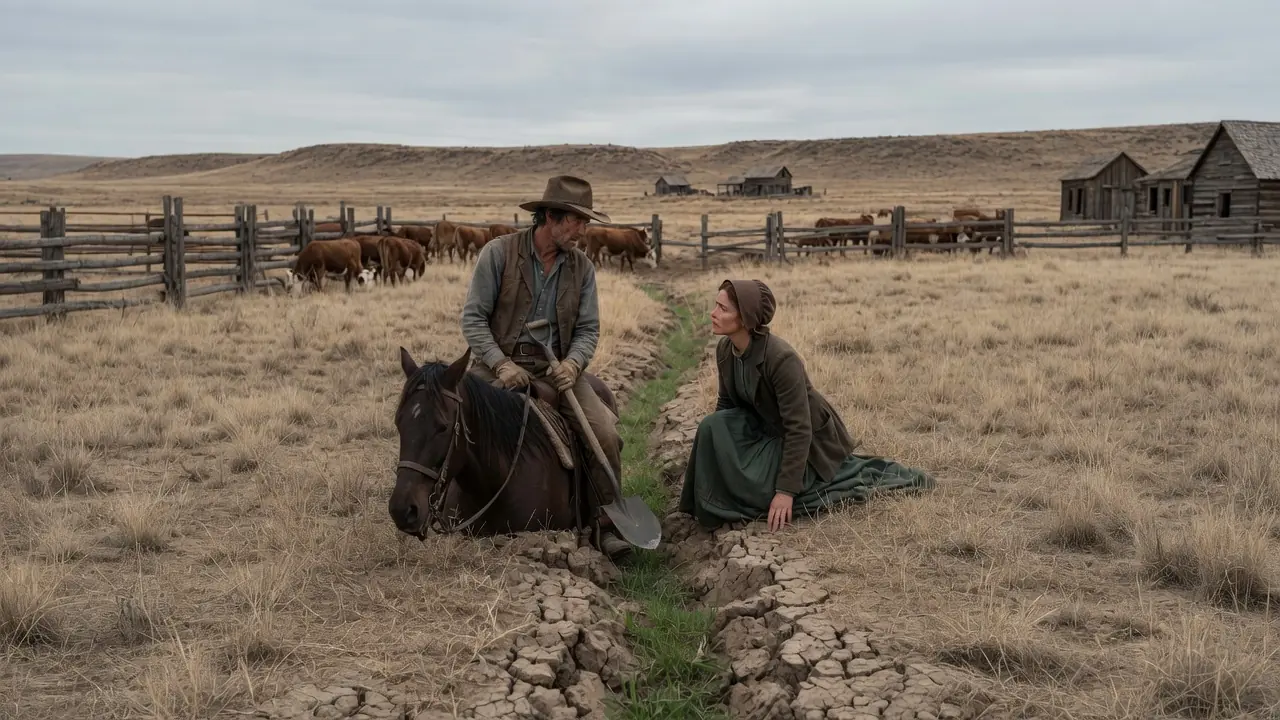
At the north end of the pasture, the land dipped into a shallow creek bed. Most of it was dry, but a strip of green still clung to the lower bank, narrow and stubborn. Eleanor crouched there longer than she had anywhere else. She touched the grass, then the soil beneath it, then looked toward the ridge rising beyond.
“How many acres on the other side?” she asked.
“Another hundred and sixty.”
“Fenced?”
“Not anymore.”
“Water?”
Samuel’s jaw tightened. “There was a spring. My father used it before he overran that pasture and ruined most of the grass. It silted over years ago.”
Eleanor stood slowly. “Years ago, or since your wife died?”
Samuel’s face closed so quickly she knew she had struck truth. He looked out over the creek bed instead of at her. “That is not your concern.”
“The ranch is my concern if I am supposed to salt the beef that survives winter.”
His eyes returned to hers, sharp now. “I wrote for a wife who could cook, keep house, and salt beef before winter.”
“Then you wrote too small, Mr. Rourke.”
The words sat between them in the cold air. Samuel looked at her as if no one had spoken to him that directly in a long time. Eleanor did not apologize. The land did not care about pride, and neither would winter.
Samuel glanced toward the dying pasture. “This ranch is nearly finished, and clever words will not bring dead grass back.”
“The grass is not dead,” Eleanor said. “The water is trapped beyond that ridge, so hand me the spade and I will show you where this ranch begins again.”
For a moment, neither of them moved. Then Samuel turned his horse and rode back toward the barn. Eleanor waited by the creek bed, kneeling again to examine the slope and the line where water had once traveled. She could feel the ranch holding its breath around her.
He returned with a long-handled spade tied across his saddle. They rode over the ridge, past broken fence posts and old wire half buried in grass. The ground changed on the far side, not lush, but different. The color was deeper, the roots stronger, the soil holding a memory of water that had not vanished completely.
The spring lay in a hollow between two rock outcroppings. It was not impressive at first glance: a dark wet place, clogged with silt, gravel, and dead sedge. But when Eleanor pressed her hand into the mud, it came up wet and cold in a way that made her heart quicken. There was real water beneath the blockage.
“This is a two-day job,” she said.
Samuel stared at the spring. “I have been meaning to clear it for ten years.”
“I believe you.”
“That is not forgiveness.”
“No,” Eleanor said. “It is a fact.”
He looked at her then, and something like shame moved through his expression. Eleanor understood it because she had carried her own unfinished things for years. Grief could make people call delay by gentler names. Meaning to do something was not doing it.
They dug until afternoon. Samuel cut through the top crust first, and Eleanor cleared the wet silt beneath. The work was ugly and heavy, the kind that pulled at the shoulders and filled the hands with grit. Neither of them spoke much because good work did not require decoration.
By late afternoon, Samuel drove the spade into a softer place and stopped. Water seeped into the cut, slow and brown at first, then clearer. Eleanor knelt beside it, watching the flow gather, thin but steady. Samuel stood above her with the spade handle resting against his shoulder, breathing hard.
“There,” she said. “It remembered where to go.”
Samuel did not answer. His eyes stayed on the water, and Eleanor saw that he was not only looking at the spring. He was looking at ten lost years, at every season he had told himself the ranch was dying because that was easier than admitting one part of it had only been waiting for him to dig.
They worked the second side the next morning. Cale came with them after breakfast, grumbling about his knees and carrying a second shovel. By noon, they had opened the spring enough for water to run from the hollow into the shallow channel. It was not a river, not even close, but it was movement.
Cale stood with his hands on his hips and watched it trickle toward the lower ground. “Well,” he said. “That is the prettiest little accusation I ever saw.”
Samuel looked at him. “Against who?”
“Against every fool who walked past it for ten years.”
Eleanor hid her smile by wiping mud from her sleeve.
Over the next weeks, the work changed. Samuel and Cale stopped patching only what broke and began building toward what could grow. They cleared the channel, reset ridge posts, repaired the old fence line, and moved cattle in sections instead of letting them chew one pasture to dust. Eleanor managed the books at night and the land by day, making columns for feed, labor, timber, salt, and debt.
At first, Samuel resisted her figures. Not because they were wrong, but because they were honest. The ledger showed the ranch was closer to ruin than pride had allowed him to admit. It also showed that ruin was not certain if they changed quickly enough.
“You keep writing the ugly numbers first,” he said one evening.
“The pretty numbers do not need courage.”
He leaned against the kitchen doorframe, studying her. “You always talk like that?”
“Only when men pretend the truth is rude.”
Cale laughed so hard from the table that coffee nearly came out of his nose. Samuel looked offended for half a second, then shook his head and went back outside. But the next morning, he asked Eleanor what the ledger said before he ordered supplies. That was the first sign that his pride had begun to bend in the direction of survival.
Winter came early, but not as cruelly as Eleanor feared. The herd was smaller, but healthier. The spring kept running beneath ice where they had cleared it deep enough, and the south pasture held longer than anyone expected. They lost two calves, which hurt, but they did not lose eleven head, and by December Samuel stopped looking at the corral like a man counting graves.
Eleanor salted beef, yes. She cooked, kept house, mended shirts, and made the kitchen warmer than it had been in years. But she also marked calving dates, tracked pasture recovery, sent letters to neighboring ranches, bargained with feed merchants, and refused to let Samuel sell good breeding stock to solve short problems. Cale began calling her “the boss” when Samuel was within hearing distance.
“She is not the boss,” Samuel said one morning.
Cale looked at him. “Then why do we do what she says?”
Samuel had no answer that pleased him.
By March, the first calves came strong. Eleanor stood beside Samuel near the fence at sunrise, wrapped in a dark coat, hands around a coffee cup gone cold. The smallest calf fell twice before finding its legs. On the third try, it stood, wobbled, and stayed.
“That one will give us trouble,” Samuel said.
“It is the ones with fight in them that usually survive,” Eleanor replied.
He looked at her then, and the light was soft enough that she could see the tiredness in his face had changed. Before, his exhaustion had been hopeless, the fatigue of a man holding back collapse. Now it was clean, earned, and shared. That kind of tired left room for tomorrow.
Spring came with mud, then green. The repaired channel carried water farther each week, and the old pasture beyond the ridge began showing life in patches. Samuel hired two brothers from across the county line, quiet men who knew cattle and asked no foolish questions about Eleanor giving instructions. By June, the Rourke ranch had more grass than it had seen in years.
The town began to talk, of course. Delwood had watched Eleanor arrive with a canvas bag and a broken sewing basket, and now it watched supply wagons go out to Samuel’s place twice a month. Men at the feed store said Samuel had gotten lucky with the spring. Women at the general store said luck did not keep books, clear water channels, or make cattle gain weight before auction.
One afternoon, a rancher named Abel Price rode out to see the spring for himself. He walked the ridge, inspected the channel, and asked Samuel how he had thought to reopen it after all that time. Samuel looked toward Eleanor, who was standing by the fence with the ledger under one arm. Then he looked back at Abel.
“I didn’t,” Samuel said. “She did.”
Abel’s eyebrows rose. “Your wife?”
Samuel paused. They had spoken to the reverend before winter, as the letter had said they might, but the marriage had begun as arrangement more than affection. It had become something else slowly, through work, silence, coffee, and mud. Samuel looked at Eleanor again, and this time his voice softened.
“My wife,” he said.
Eleanor lowered her eyes to the ledger, but he saw the faint color rise in her cheeks.
That evening, he brought a small bundle of dried grass into the kitchen. Not flowers, because there were none yet worth picking, but tall grass with seed heads intact from the recovering pasture. He set it on the corner of the table beside her open ledger and said nothing. Eleanor looked at the grass, then at him.
“Is this your idea of courtship?” she asked.
Samuel glanced toward the stove. “It was what the field had.”
“That is better than what most men bring.”
He looked relieved, though he tried not to show it. She left the grass in the ledger until the seeds began falling across the pages. Years later, when the ranch had become famous, she would still keep a few of those seed heads pressed between the earliest records.
By the next autumn, the herd had doubled. By the third year, Samuel owned cattle on both sides of the ridge, and the creek channel had been deepened, guided, and protected by stone where needed. Eleanor negotiated a grazing lease with two neighboring widows whose land had gone underused because men assumed women could not make hard bargains. They learned otherwise.
The Rourke operation expanded not in one grand leap, but by a hundred disciplined choices. Calves were tracked carefully, weak lines culled, strong grass protected, water guarded, debt reduced, and profit reinvested before comfort was allowed to tempt them. Samuel managed men and cattle with renewed steadiness. Eleanor managed numbers, land plans, contracts, and the quiet politics that made Delwood’s merchants stop underestimating her.
A territory newspaper came in June to write about them. The reporter called Samuel a visionary cattleman, which made Cale snort. The article mentioned Eleanor only as “Mrs. Rourke, who assists with domestic management.” Eleanor corrected her name in pencil and wrote three numbers in the margin: head count, acreage, and profit.
Samuel found the clipping tucked into the ledger. He read the article once, then looked at the correction. The next time the newspaper wrote, he refused to speak unless they interviewed Eleanor first. The second article called her “the mind behind the water plan.”
“That is too much,” she said after reading it.
“No,” Samuel replied. “The first one was too little.”
The porch got a second chair that summer. Samuel built it himself in the evenings from good wood, sanding the arms smooth and setting it beside his own facing east. Eleanor found it there one morning and said nothing. That evening, she sat in it while he sat beside her, and they watched the pasture move in the soft wind.
“You built this without asking,” she said.
“I thought you might use it.”
“I will.”
“Good.”
That was how tenderness grew between them: not in grand speeches, but in chairs, repaired gates, coffee poured without asking, and hands wrapped carefully after wire cuts. Samuel learned where she kept her thread case. Eleanor learned the exact silence that meant he was worried but not yet ready to speak. They did not become young with love; they became steadier.
In the fifth year, the Rourke ranch was the largest cattle operation in the territory. Men who once pitied Samuel now rode out asking advice. Some tried to speak only to him, and Samuel would point them toward the kitchen table where Eleanor sat with maps, ledgers, and coffee. “Ask Mrs. Rourke,” he would say. “She is the one who knows whether your land is thirsty or dead.”
One winter morning, after a heavy frost, Samuel and Eleanor rode to the ridge where she had first seen the green strip along the creek bed. The pasture below was full now, grass lying silver beneath the cold, cattle moving strong and slow in the distance. The spring ran clear through its channel, dark and steady under the ice. Samuel stopped his horse where she had once demanded the spade.
“I thought I was hiring someone to salt beef,” he said.
Eleanor looked at him. “You were.”
He turned in the saddle. “No. I hired the woman who saved my ranch.”
She studied the land before answering. “I did not save it alone.”
“You saw what I had stopped seeing.”
“That is not the same thing as doing all the work.”
Samuel smiled faintly. “You still won’t take a compliment clean.”
“And you still deliver them like confessions.”
He laughed then, a real laugh, and Eleanor felt something warm move through her chest that had nothing to do with pride. The land stretched around them, alive and working, not rescued once but tended daily. That was the truth people missed when they spoke of miracles. Most miracles were maintenance done before dawn by people too stubborn to quit.
Samuel dismounted and helped Eleanor down, though she did not need the help. She allowed it anyway because by then she understood that care did not always mean doubt. They stood beside the creek bed, looking at the water moving where dry earth had once cracked open beneath her hand. Samuel took off his hat and held it at his side.
“I spent years thinking this place was dying,” he said. “Truth was, I had stopped asking what it needed.”
Eleanor looked up at him. “And what did it need?”
His eyes met hers. “You.”
She shook her head, but gently. “It needed water, fences, better grazing, honest books, and fewer proud decisions.”
“And you,” Samuel said again.
This time, she did not correct him. She took his hand, the same hand she had once bandaged in the kitchen after a wire cut, the same hand that had passed her the spade on the day everything began again. They stood there in the cold, surrounded by proof that dying things sometimes waited for someone willing to look harder.
The advertisement had asked for a wife to cook, keep house, and salt beef.
Eleanor had done all of that.
Then she had read the land, opened the spring, rebuilt the books, challenged the pride of a grieving rancher, and helped turn a failing operation into the largest cattle ranch in the territory.
And years later, when people asked Samuel Rourke how his ranch had survived, he never told them he got lucky.
He told them the truth.
“The land was not dead,” he would say. “I just needed a woman brave enough to prove it.”