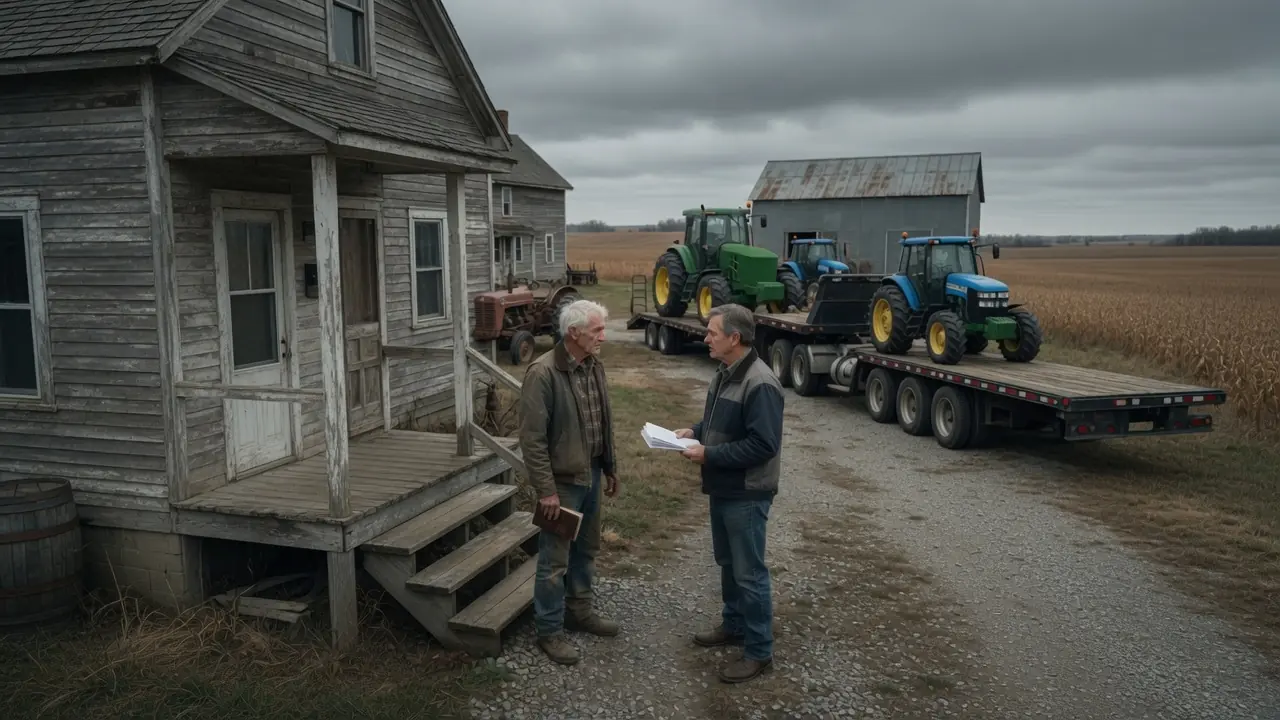
The brand-new green tractor sat on the delivery trailer in Warren Holt’s gravel driveway like a trophy nobody had won yet. Its paint was clean enough to catch the gray Missouri morning, its yellow wheels spotless, its cab tall and shining beside the old white farmhouse and weathered red barn. Behind it, Warren’s older tractors looked almost ashamed by comparison: a faded red tractor parked near the fuel tank, a weathered blue one beside the grain shed, and an old utility tractor with mud still dried along the tires. Anyone driving past would have thought the future of Holt Farms had arrived and was only waiting for Warren to sign his name.
Phil Garrett stood beside the new tractor with a leather folder under one arm and the confident smile of a man who had already sold the machine in his mind. He was fifty-eight, polished, experienced, and respected across the county as the largest tractor dealer within a hundred miles. He did not personally drive forty minutes to a farmer’s house unless the invoice was worth the trip. Warren Holt was worth the trip.
Warren stood near the porch steps, one hand tucked inside the pocket of his faded brown canvas jacket, the other holding a small handwritten notebook against his hip. He was in his early sixties, with weathered skin, short white hair, sharp gray eyes, and rough hands that had repaired more machinery than some younger men had ever operated. His plaid shirt was clean but worn at the elbows, his jeans were stained near the cuffs, and his boots carried enough mud to prove he had already been across the yard twice before breakfast. He looked at the new tractor the same way he looked at weather, prices, and soil conditions, with interest but not trust.
Phil opened the folder and pulled out the contract. “Warren, this is the best deal in the county,” he said, tapping the papers with two fingers. “Trade-in value is strong, financing is better than most men will ever see, and that tractor right there will change this farm.”
Warren glanced at the green machine, then toward his older tractors. “My farm needs staying power,” he said quietly, “not a prettier payment.”
Phil laughed once, thinking it was humor. Then he saw Warren’s face and realized it was not. “You cannot keep relying on those old tractors forever,” he said, his smile thinning. Warren looked down at his notebook, thumb resting on the worn cover. “Old tractors don’t scare me, Phil. Debt does.”
They went inside and sat at the kitchen table because serious farm business was still done best beside a coffee pot. The table was scarred from forty years of meals, bills, seed catalogs, and machinery parts set down where they did not belong. Warren’s wife had died eight years earlier, and the house had grown quieter since then, but the kitchen still held order. On one side of the table sat Phil’s glossy contract, and on the other sat three of Warren’s notebooks, plain brown covers, pencil marks, and pages thick with thirty-four years of numbers.
Phil explained everything again. Guidance system, variable-rate controls, telematics, fuel efficiency, service support, better resale, reduced overlap, improved accuracy, a machine built for the next decade of farming. He was not lying, and Warren knew that. The tractor was excellent, the offer was fair, and the financing was structured with care.
But fair was not the same as safe.
Warren listened without interrupting, which made Phil more confident at first. When Phil finished, Warren opened one notebook, looked at a page he had marked with a folded receipt, and sat in silence for nearly a full minute. Then he closed the notebook, slid Phil’s contract back across the table, and said, “No.”
Phil blinked. “Is it the number?”
“No.”
“The financing?”
“No.”
“No.”
Phil leaned back, studying him. “Then what exactly is the issue?”
Warren rubbed one thumb along the edge of the notebook. “I’m going a different direction.”
That was all he said.
Phil waited for more because customers usually gave more. They blamed interest, timing, wives, sons, taxes, rain, pride, or the bank. Warren gave none of that. He simply sat there in his quiet kitchen with the old tractors outside and the new tractor on the trailer, acting as if turning down the future was the most reasonable thing a man could do.
Phil packed the contract with slower movements than usual. He had been selling equipment for more than two decades and had developed an instinct for when resistance could be negotiated. This was not that. Warren Holt had not rejected the deal emotionally. He had rejected it before Phil ever arrived.
By Saturday afternoon, the whole county knew.
Gene Purvis saw a trailer come through carrying a used red Massey Ferguson instead of the new green tractor everyone expected. Gene called his wife, who mentioned it to her sister, who repeated it at the hair salon, and by the time men gathered at the grain elevator that afternoon, the decision had already become a public mystery. Warren Holt had turned down a strong John Deere deal and paid cash for a used Massey Ferguson three counties over. Nobody understood it, so most people decided it was foolish.
At the elevator, the talk came hard and easy. Some said Warren was getting old and losing his feel for where farming was headed. Some said he had always carried an old loyalty to different brands because of his father. Others said it was plain stubbornness, the kind that made older farmers mistake memory for wisdom.
Gene Purvis leaned against the counter and shook his head. “That new machine would have saved him inputs, time, and headache,” he said. “You cannot farm six hundred acres with yesterday’s thinking forever.”
Nobody argued much.
Warren was known as a sound operator, which made the decision harder for people to dismiss completely. He was not flashy, not reckless, and not sentimental in any obvious way. He kept equipment because it worked, not because it reminded him of childhood. Still, the used Massey looked like a step backward, and small counties do not tolerate unexplained decisions quietly.
Warren heard the talk and said nothing.
He brought the Massey home, parked it beside the grain shed, and spent three weeks preparing it for fieldwork. The paint was rough, one fender was dented, and the cab needed cleaning, but underneath, the machine was solid. Warren had inspected it twice before buying it, and the second time he brought Albert Rusk, a mechanic who had been repairing farm equipment since before some dealership technicians were born.
Albert looked it over and grunted. “Cosmetics are rough,” he said. “Mechanicals are better than the price.”
Warren nodded. “That’s what I thought.”
The seller needed the machine gone quickly and had priced it as if faded paint and field hours told the whole story. Warren knew better. He knew the difference between ugly and unreliable. He knew the difference between a problem that cost pride and a problem that cost a harvest.
The first year gave the county nothing dramatic to talk about.
The Massey ran. Warren planted inside his target window, finished fieldwork on schedule, and made his harvest without an unplanned mechanical stop. His older tractors still pulled augers, wagons, and implements around the farm, while the Massey took over the heavier work without complaint. At the elevator, men noticed but did not admit they noticed.
One good year proved nothing, they said.
Gene Purvis had bought a new tractor that same spring with a full precision package, and it ran well too. He liked the guidance, liked the data, liked the maps, and especially liked telling people how much overlap he had reduced. “Twelve percent input savings,” he told the elevator crowd that December. “System shows it clear as day.”
Warren stood nearby, listening.
He did not mock Gene or dismiss the technology. Instead, he went home, opened a notebook, and wrote what Gene had said. Then underneath it, he added one question. “When the system fails at 4 a.m. in October, who controls the answer?”
That was the difference between Warren and the men who laughed at him.
He did not reject information because it disagreed with him. He wrote it down. He kept it, weighed it, compared it, and let the numbers settle where they belonged. His notebooks were not diaries; they were thirty-four years of field memory converted into cost.
Fuel costs. Parts costs. Downtime. Repair causes. Labor hours. Moisture penalties. Yield by field, hybrid, rainfall, and date. The notebooks held the kind of truth that did not arrive in brochures.
The second year began to separate things.
Not loudly, and not enough for the county to fully understand, but enough for Warren to notice. Gene’s guidance system went down during a critical application window in June, and the dealer’s service department was backed up. Gene waited two days for a technician. He told everyone it was just a minor issue, and in one sense, it was.
But Warren knew two days outside an application window was not minor.
Two days became a number. That number became yield. Yield became revenue. Revenue became margin. Margin became survival.
Warren had no telematics failure because he had no telematics dependency. He had his own judgment, built from thirty-four years of watching the same fields and knowing how that soil behaved when humidity stayed high after a storm. It did not produce a dashboard. It produced a decision at the right time.
That fall, Warren’s numbers came in clean.
Not miraculous, not spectacular, but steady. His per-acre operating cost stayed where he expected it. The Massey required normal maintenance, one bearing, two filters, and a minor hydraulic repair Albert handled in the shed on a Saturday morning. Gene’s numbers were still good, but Warren wrote them down when he could reconstruct them from elevator talk, and the gap began to show.
People still laughed.
They said Warren got lucky.
They said a farmer could look wise for a year or two with any decent machine and cooperative weather. Warren agreed with that privately. Cooperative years hide weak systems. Hard years expose them.
The hard year came in the third season.
Late August turned strange, with weather arriving earlier than the old patterns suggested. The heat broke, moisture hung heavy, and forecasts shifted every day until nobody trusted them. By September, harvest windows compressed across the county, and every farmer knew the same thing at the same time. If you were ready, you moved. If you waited, you paid.
That was when the expensive equipment began to show its other cost.
Not everywhere and not for everyone, but enough to matter. Machines with advanced systems needed updates, sensors failed, diagnostic codes locked men out of repairs they might once have handled themselves, and technicians became the most valuable people in the county. Dealer support was good, but good support can still be late when everyone needs it at once. Parts that were usually available became back ordered because too many machines required the same fixes in the same short window.
Warren was already moving.
The Massey had been inspected, serviced, and staged before the first harvest day arrived. His older red tractor was hooked to the auger, the blue tractor to a wagon, and the old utility machine ready for yard work. On shelves in the shed sat a small but specific parts inventory Warren had built over three years. Belts, filters, sensors, bearings, hoses, fittings, and a few parts most men would not have bought until they failed.
Albert had once asked why he kept so much money sitting on a shelf.
Warren answered, “Insurance that doesn’t require a phone call.”
On the sixth day of harvest, Warren heard a sound that did not belong. It was faint, nearly buried under engine noise, a slight change in vibration that would have meant nothing to a man listening to music or watching only the screen. Warren shut down early, pulled the panel, and found the beginning of a problem that could have become a disaster. He and Albert fixed it at four in the morning with a part from the shelf.
It cost him two hours.
Had he ignored it, it might have cost him ten days.
Across the county, Gene Purvis lost nearly four days waiting on a part and dealer diagnostics. Another operation south of town waited six days after a system issue stopped a machine in the middle of the window. A third kept running but lost efficiency because the guidance package was unstable, and the operator had grown too dependent on it to work confidently without it. None of those problems made any machine bad. They simply revealed dependencies no one had priced honestly.
Warren finished harvest on September twenty-eighth.
The county average was October ninth.
Eleven days.
Eleven days was not a rumor. It was not pride, preference, brand loyalty, or stubborn old-man logic. Eleven days was a number. It showed up in moisture, quality, labor, fuel, and grain checks. It showed up in the silence of men at the elevator when Warren’s name came up.
Phil Garrett heard the number in November.
He did not drive to Warren’s farm that time to sell anything. He was too experienced for that. He drove there because he had spent three years carrying a question with no answer, and now the answer had begun to show itself. He pulled into the same gravel drive, but this time there was no new tractor on a delivery trailer. There were only Warren’s machines, old and used and ready, parked around the yard like tools that had nothing to prove.
Warren made coffee.
They sat at the same kitchen table where Phil had slid the contract across three years earlier. For a while, neither man spoke. Phil looked at the notebooks stacked near the window. Then he said, “I need to understand what you saw before I did.”
Warren got up and went to the back room.
He returned with an older notebook, not the current one, but the one from the year before Phil brought the contract. He opened it to a marked page and turned it toward Phil. The writing was neat, small, and done in pencil. Phil leaned forward and began to read.
It was not a criticism of John Deere.
It was not a sentimental defense of older machines.
It was a ten-year equipment cost calculation built from thirty years of Warren’s own numbers. Normal years, cooperative years, difficult years, and hard years were all represented. Repair costs, financing, dealer response averages, downtime, parts availability, interest exposure, resale, labor, and harvest risk were all written in columns. Under those assumptions, the used Massey strategy was cheaper per acre every year, but especially in the hard ones.
Phil read the page twice.
Then he sat back slowly. “You did this before I came out.”
“Yes,” Warren said.
“You knew before I drove here.”
“I thought I knew.” Warren took a sip of coffee. “There’s a difference.”
“And the last three years?”
“Confirmation.”
Phil looked at the notebook again.
The number was not enormous in any one season, but it was consistent. That was the part that mattered. Agriculture did not always reward the biggest machine, the best paint, or the newest system. It rewarded the structure that survived when the weather narrowed and everyone’s weaknesses became expensive.
Phil rubbed one hand over his jaw. “You weren’t buying a tractor.”
“No.”
“You were buying a cost structure.”
Warren nodded. “A controllable one.”
That winter, Phil thought about that sentence more than he expected.
The equipment business had been telling farmers for years that more technology meant more efficiency. In many cases, it did. But Warren’s notebooks told a more complicated story, one about operational resilience rather than simple advancement. Technology helped when systems worked. Complexity hurt when support chains failed during compressed windows.
The question was not whether new equipment was good.
The question was for whom, under what conditions, at what cost, and with what dependencies.
In February, Phil called Warren and asked if there was a version of the technology story that worked for an operation like his. Warren said there might be. Larger acreage, different geography, stronger capital position, better support access, or a machine with technology simple enough to service locally might change the calculation. The notebooks did not argue against progress. They argued against pretending progress had no price.
Phil laughed softly. “That’s more nuanced than I expected.”
Warren said, “I had three years.”
By spring, other men began arriving at Warren’s shed.
Gene Purvis stopped by one morning with no real reason except the one he was too proud to say. He looked at the Massey, then at the old tractors, then asked what Warren’s per-acre operating cost had been the previous year. Warren told him. Gene stood there quietly for a moment.
“Mine was higher,” Gene said.
“I know.”
Gene looked over. “How?”
Warren pointed toward the fields. “The numbers talk if you know what questions to ask.”
Gene nodded. “Phil has a used unit on the lot. Different brand, less complexity, good price. I’m going to look at it Thursday.”
Warren said, “Sounds reasonable.”
After Gene left, Warren opened his notebook and wrote the date. Then he wrote one sentence about the way understanding moves through a county. Not all at once. Not in a speech or a single dramatic reveal. It moves in spring mornings, shed conversations, cost comparisons, and men quietly admitting what the numbers have already proved.
The county learned the truth slowly.
It learned from the eleven days in September. It learned from yield reports, repair delays, and grain checks. It learned from the difference between a machine that impressed people in the driveway and a system that kept working when everyone else was waiting on help. It learned from Warren’s silence, which forced the numbers to speak for themselves.
Phil Garrett changed how he sold after that.
He still sold new tractors, good tractors, expensive tractors, and machines that made sense for many operations. But he stopped treating technology as a universal answer. He began asking farmers harder questions about acreage, cash flow, repair ability, dealer distance, parts access, and risk tolerance. Some customers appreciated it. Some wanted the shiny pitch. Phil gave them numbers anyway.
Warren kept farming.
The green tractor that once sat in his driveway went to another farm and performed well enough there. Warren never claimed it was a bad machine because that would have been dishonest. His decision had never been about brand hatred. It had been about fit.
Three years after he turned down the contract, the county understood that.
Not because Warren made a speech.
Not because he proved people wrong in one grand moment.
Because the ground told the truth eventually, and Warren had learned to read it earlier than most. His notebooks had already seen the hard year before the hard year arrived. His old tractors had not been symbols of fear. They had been pieces of a plan.
One evening near the end of spring, Warren stood in his equipment yard as the sun dropped behind the grain shed. The Massey sat ready near the barn, the older red tractor beside the fuel tank, the blue tractor hooked to a wagon, and the small utility tractor parked where it always waited for morning work. They were not beautiful machines. They were not impressive in the way new paint and tall cabs impressed men passing on the road.
But they were paid for.
They were understood.
They were ready.
Warren opened the notebook in his hand and wrote down the day’s fuel cost, a minor repair, and a note about soil moisture in the west field. Then he paused, looking at the yard around him. Three years earlier, the whole county thought he had rejected the future. Now some of them were beginning to see that he had rejected only the part of the future that would have put his farm in a weaker position when strength mattered most.
The wind moved through the fields.
The tractors sat quiet.
Warren closed the notebook and slid it into his jacket pocket.
He had never needed the county to understand on the day he made the decision.
He only needed the ground to prove him right in time.