A 12-year-old boy presses binoculars against a frozen window. Across the street, leather-clad men with battle scars and thousand-yard stares guard a clubhouse most neighbors cross the street to avoid. Nobody watches the iron vultures closer than Eli Mercer. Nobody listens to Eli Mercer at all.
But tonight, on the coldest night this town has seen in years, Eli witnesses something that will tear a brotherhood apart from the inside. A betrayal so quiet, so calculated that the men who live by loyalty never even heard it coming. And the only person who can prove it is a boy the entire world has already decided doesn't matter. The binoculars were older than Eli Mercer.
Scratched lenses, cracked rubber grip, a focusing ring that stuck unless you twisted it with both hands. His grandfather had used them for bird watching before the dementia took everything, including the old man's name. Now they sat on Eli's window sill every night, aimed not at the sky, but at the low-slung building across Garfield Street. The Iron Vultures Motorcycle Clubhouse with its rusted corrugated roof and the hand-painted vulture sigil above the door that looked like it had been bleeding into the wood for decades.
Eli pressed his forehead against the cold glass. His breath fogged a circle on the window and he wiped it with his sleeve without thinking. Habit. He'd been doing this for 2 years, ever since his mother moved them into the upstairs apartment of the duplex his aunt owned. Two years of watching men in leather cuts come and go.
Two years of memorizing which Harley belonged to, which rider by the sound of the exhaust alone. He could tell you that Roach, the sergeant-at-arms, always parked crooked because his left knee was fused from a combat injury he never talked about. He could tell you that the prospect they called Nickel smoked exactly four cigarettes during his gate shift, spacing them 45 minutes apart like a man counting down a prison sentence. He could tell you that the vice president, Cade, never entered through the front door. Always the side, always alone, always carrying something heavy that had nothing to do with his hands.
Nobody asked Eli these things. Nobody asked Eli anything. At Ridgemont Middle School, his teachers had long since filed him under a category that required no further investigation. Quiet, odd, possibly on the spectrum, definitely not worth the energy. He sat in the back row of every class and filled spiral notebooks with observations so detailed they read like surveillance reports.
Mrs. Hargrove, his English teacher, had once confiscated one and flipped through it during lunch. She'd found six pages describing the exact sequence of events at a gas station robbery Eli had witnessed from a bus window. The color of the getaway car, the limp in the driver's left leg, the fact that the passenger had bitten his fingernails down to raw skin. Mrs.
Hargrove had written overactive imagination on a sticky note, returned the notebook, and never mentioned it again. The police report later confirmed every detail Eli had recorded. Nobody connected the dots. Nobody ever did. His mother, Jolene, worked double shifts at a packaging facility 14 mi outside of town.
She left before Eli woke up and came home after he'd already made himself a peanut butter sandwich and gone to bed. On her days off, she sat in the kitchen with the lights low, drinking coffee that had gone cold hours ago, staring at a spot on the wall like she was trying to decode a message only she could see. Eli had learned not to talk to her during those times. He'd learned not to talk to her during most times. Jolene wasn't cruel.
She was just somewhere else. Some internal geography that Eli couldn't reach. A place carved out by a husband who'd left without warning. And a life that kept demanding payments she couldn't afford. So Eli watched the bikers instead.
There was something about their world that made sense to him in a way his own never had. The Iron Vultures operated on a system of rituals and hierarchies that Eli could map and predict. Church meetings every Thursday at 7:00. Runs every other Saturday unless the weather dropped below 20 degrees. Prospects handled the grunt work, cleaning, gate duty, hauling supplies, and full patch members moved through the clubhouse with a gravity that Eli recognized as earned, not given.
These men didn't smile often, but when they did, it meant something. Their silences weren't empty. Their silences were architecture. Tonight was different. Eli noticed it first in the parking pattern.
On a normal Thursday, the bikes would line up along the east wall of the building. Chrome catching whatever light leaked from the single sodium lamp at the corner of the lot. But tonight, two slots were empty. Roach's Indian Chief was missing. Unusual because Roach never missed church unless he was in the hospital or in county lockup.
And the second empty slot belonged to a bike Eli knew better than any other in the lineup. Cade's 1998 Road King, flat black with a handstitched leather seat, that Cade had rebuilt himself over the course of three winters. Eli adjusted the focus ring. The cold had made the mechanism even stiffer than usual, and his fingers ached as he forced the image into clarity. The clubhouse door was shut.
A thin line of light escaped from beneath it, yellow and warm against the frozen concrete. No one was outside. The prospect's folding chair sat empty by the gate, a cigarette still smoldering in the tin can beside it. Something was wrong. Eli felt it the way animals feel earthquakes.
Not in his mind, but in his chest. A tightening that had no name. He checked the time. 11:47 p.m. Church would have ended hours ago.
On a normal night, the last bikes would have cleared out by 10:00. Stragglers, usually deacon and a quiet rider everyone called glass, might stay until 10:30, nursing beers in the back room. But by midnight, the clubhouse was always dark. Tonight, it was lit up like a holding cell. Then the side door opened.
Eli's breath stopped. He pressed the binoculars harder against his eye sockets, ignoring the pain where the rubber bit into bone. A figure stepped out. Not one of the regular members. This was someone Eli had seen before, but not often.
A visitor. Tall, lean, moving with the kind of deliberate calm that Eli had learned to distrust. The man wore a dark jacket, no cut, and he carried himself like someone who knew exactly where every camera was, and had already calculated the blind spots. Eli had cataloged this man three times over the past month. Once at a barbecue the club had thrown in late October, where the man had stood at the edge of the crowd with a beer he never drank.
Once on a Tuesday afternoon, arriving in a pickup truck and spending 40 minutes inside before leaving without speaking to anyone in the parking lot. And once, this was the detail that had lodged in Eli's brain like a splinter. The man had been given the side door code by Cade himself. Eli had watched Cade punch in the numbers while the man stood beside him. And even from across the street with shaking binoculars, Eli had caught the sequence 4721.
The man now used that code. The keypad's tiny light blinked green and the side door opened from the inside. He slipped into the lot and moved directly toward the row of parked motorcycles. Not his own vehicle. He'd come in the pickup.
Eli could see it parked a block east under the dead elm tree where the street light had been out since September. The man walked past three bikes without slowing. Then he stopped at the fourth. Cade's road king. Eli's hands began to tremble.
Not from cold, from the recognition of what he was watching, the nauseating clarity of witnessing something no one was supposed to see. The man crouched beside the road king, his hands moved with practiced efficiency. Eli couldn't see exactly what he was doing. The angle was wrong, the shadows too thick, but the body language was unmistakable. This wasn't admiration.
This wasn't maintenance. This was acquisition. 90 seconds later, the engine turned over. Not with a roar. The man had done something to muffle the exhaust.
A temporary fix that reduced the Harley's signature thunder to a low, guttural moan. The sound was wrong. Eli knew the voice of every bike on that lot the way a musician knows individual instruments in an orchestra, and this was a note played through a cloth, suffocated and deceitful. The man rolled the Road King out of the lot, past the empty prospect chair, through the open gate, and into the street. He didn't accelerate.
He kept the speed just above idle, letting the bike coast down the slight grade of Garfield Street toward the intersection with Route 11. At the corner, he turned right and disappeared into a darkness so complete it looked intentional. Eli lowered the binoculars. His hands were shaking badly now. His heart hammered against his ribs like something trying to escape a cage.
He looked at the clubhouse, still lit, still closed. Nobody had come out. Nobody had heard. He grabbed his notebook from the nightstand and began writing. The time, the physical description, the jacket, dark navy, no patches, zippered pockets, the boots, square toed, not motorcycle boots, work boots, the way the man had favored his right hand, the coat he'd used, the direction he'd gone, the color of the pickup truck, still parked under the dead elm, dark green, maybe black in the bad light, rust along the rear wheel well, a dent in the tailgate shaped like a fist.
Eli wrote for 20 minutes without stopping. When he finished, he read it back, every detail locked in place, every observation precise. Then he closed the notebook and sat on his bed and did nothing. Because who was he going to tell? The question sat on his chest like a stone.
He was 12. He had no phone. Jolene couldn't afford one. The school counselor had once suggested Eli might benefit from social skills intervention, which was a clinical way of saying nobody wanted to be his friend, and the adults had given up trying to fix it. His aunt downstairs watched television until 2:00 in the morning and answered every knock with suspicion and a baseball bat.
He could call the police. But the last time Eli had tried to report something, a man in a gray sedan following a girl from the bus stop three blocks over, the dispatcher had asked to speak to his mother. Jolene hadn't been home. The dispatcher told him to have an adult call back. No adult ever did.
Eli watched the gray sedan return twice more before it finally stopped coming, and he never found out what happened to the girl. The system had a word for kids like Eli, unreliable, which was the cruelest lie the world had ever told. Because Eli was the most reliable witness in the entire neighborhood. He just happened to be 12 and small and quiet and poor. And in a world that measured credibility by volume and authority, Eli possessed neither.
He lay in bed and stared at the ceiling. The wind outside pressed against the window like something trying to get in. He could hear the distant rumble of a freight train passing through the railyard 3 mi south. Its horn cutting through the frozen air with the lonely persistence of something calling out to no one. Sleep didn't come.
It never did on nights like this. Eli's mind wouldn't release the image. The man's hands on Cade's bike, the muffled engine, the casual precision of a theft that had been rehearsed. This wasn't some tweaker grabbing an opportunity. This was planned.
This was someone who knew the codes, knew the schedule, knew which bike to take, and when the prospect would be away from the gate. This was inside. That word sat in the dark like a lit fuse. Dawn came gray and bitter. Eli hadn't slept.
He stood at the window with the binoculars and watched the clubhouse wake up the way he'd watched it a hundred times before. The front door opening, a prospect sweeping the steps, cigarette smoke curling into air so cold it barely moved. Except today, the rhythm was off. The prospect wasn't sweeping. He was standing still, staring at the row of bikes.
And even from across the street, Eli could read the posture. Confusion hardening into alarm. The prospect went inside. 30 seconds later, the door burst open and three men came out fast. Boots hitting concrete.
No one spoke. They moved to the bike line and stood where the road king should have been, looking at the empty space the way you look at a wound you can't explain. Then more men came. Eli counted seven in total, all wearing cuts, all moving with the controlled urgency of men who understood that panic was a luxury they couldn't afford. One of them, Deacon, the club president, a thick-necked man with a gray beard and hands like excavator buckets, stood apart from the others, arms crossed, scanning the lot with eyes that missed nothing.
Except they'd missed everything. That was the part Eli couldn't stop thinking about. These men who lived by vigilance, who trusted no one outside their circle and very few inside it, had been robbed in their own house by someone they'd let through the door. Eli watched for another hour. He saw Cade arrive.
Not on a bike because his bike was gone, but in a borrowed truck that pulled up to the curb with an exhaust rattle that sounded like a cough. Cade got out slowly. He was a tall man, early 40s, with a face that looked like it had been carved from wood and then left in the rain. His eyes were set deep beneath a brow that seemed permanently furrowed, and he carried himself with the careful stillness of someone who had learned long ago that movement attracted attention, and attention attracted pain. Eli knew fragments of Cade's history from overheard conversations and careful observation.
Two tours overseas. A marriage that ended the way most military marriages end, not with an explosion, but with a slow leak that drained everything until there was nothing left to hold. A daughter somewhere in another state who Cade mentioned only when he'd been drinking, and even then only in half sentences that trailed off into silence. The Road King wasn't just a motorcycle. Eli understood that.
It was the last thing Cade had built with his own hands that hadn't fallen apart. And now it was gone. Eli dressed. Jeans, two sweatshirts layered under a coat that was too thin for the weather, sneakers with the left sole separating at the toe. He put the notebook in his back pocket.
He stood at the top of the stairs for a full minute listening. His aunt's television murmured through the floor. A morning talk show, canned laughter, the smell of instant coffee seeping up through the heating vents. He went downstairs and out the front door without saying a word to anyone. The cold hit him like a wall.
His eyes watered immediately, and he shoved his hands into his pockets and crossed Garfield Street with his head down, walking directly toward the Iron Vultures Clubhouse for the first time in his life. The prospect at the gate saw him coming. A young guy, maybe 22, with a patchy beard and a neck tattoo of a compass rose. His name was Dill, and Eli had watched him fumble through gate duty for the past 4 months with the anxious determination of someone who knew this was his only shot at belonging somewhere. "Hey kid, wrong street.
" Eli stopped. He looked up at Dill and felt the full weight of what he was about to do settle over him like a net. Every instinct told him to turn around. Every experience he'd ever had with adults told him this would go badly, that he'd be laughed at, dismissed, sent home, forgotten. The pattern was so familiar, it had its own gravity.
But the notebook was in his pocket, and the truth was in the notebook. And if Eli turned around now, the truth would stay there, trapped in a spiral-bound prison where no one would ever read it, and Cade would never know what happened to the last thing he'd ever built. "I need to talk to someone," Eli said. His voice came out smaller than he wanted. He hated that.
About what? About the bike. The one that's missing. Dill's expression changed. Not softened, sharpened.
His eyes narrowed, and he straightened up from his slouch against the gate post with a speed that suggested the subject had turned every nerve in his body to wire. What do you know about that? I saw who took it. Dill stared at him. Eli could see the calculation happening behind the prospect's eyes.
The disbelief colliding with the desperation, the instinct to dismiss a 12-year-old warring with the reality that nobody else had any answers. Wait here. Dill disappeared inside. Eli stood in the cold, his sneakers soaking through on the frozen concrete, his breath coming in short white bursts that dissolved into nothing. He counted 60 seconds, then 90.
At 2 minutes, the side door opened and Deacon walked out. Up close, the club president was even more imposing than he appeared through binoculars. He moved with the deliberate economy of a man who had learned that wasted motion was wasted energy. And at his age, Eli guessed late 50s, energy was a resource he managed carefully. His eyes found Eli and held him with a gaze that felt less like scrutiny and more like an X-ray.
"You. The kid from across the street. " It wasn't a question. "Yes, sir. " "Dill says you saw something.
" "I saw who took Cade's Road King last night. 11:47. " Deacon's jaw tightened. He didn't speak for a long time. Behind him, through the open door, Eli could see the inside of the clubhouse for the first time.
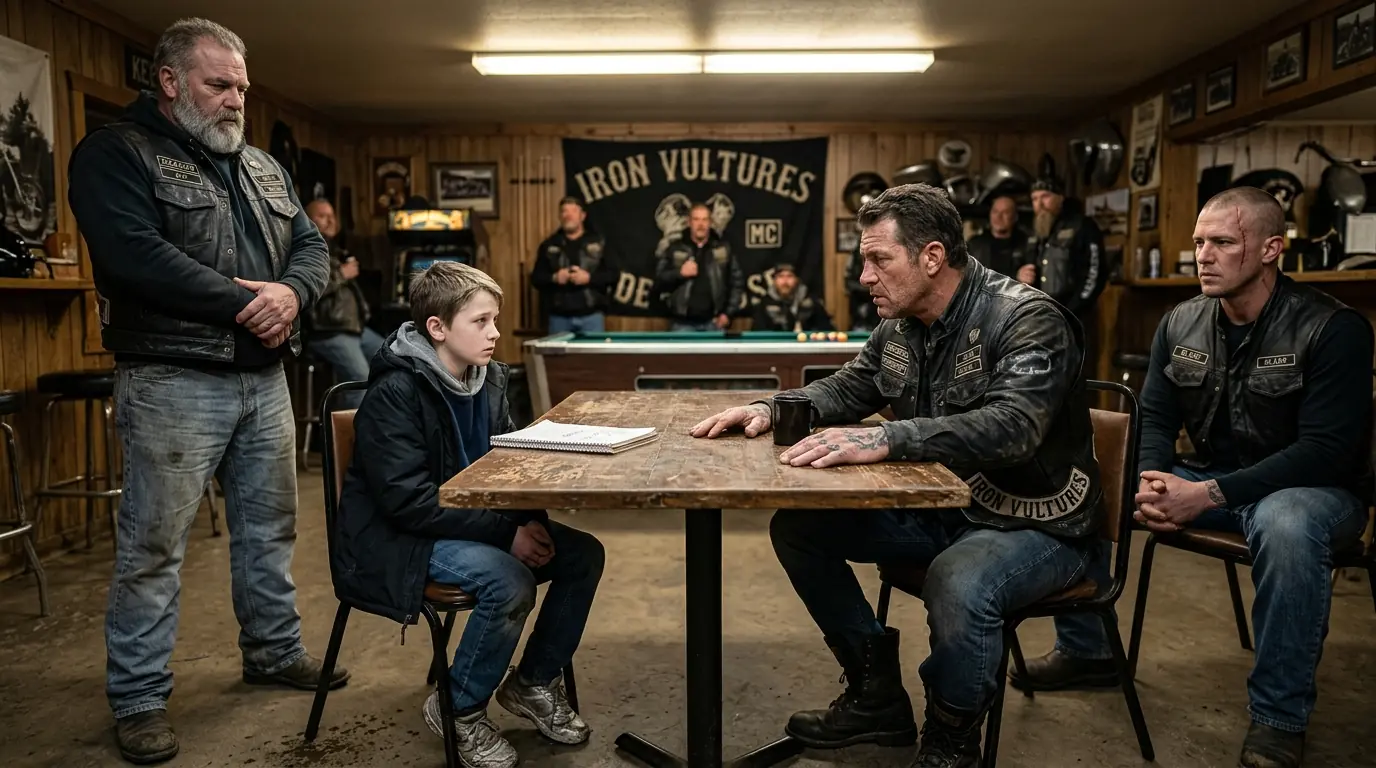
Dim light, wood-paneled walls, a bar along the far side, and men sitting at tables with the coiled stillness of people waiting for a reason to move. "Come inside," Deacon said. The clubhouse smelled like engine oil and old leather and coffee that had been on the burner too long. Eli's sneakers squeaked on the concrete floor as he followed Deacon past the bar, past a pool table with a torn felt surface, past a wall covered in framed photographs of men on motorcycles. Some laughing, some stoic, some no longer alive.
The air was thick with something Eli couldn't name at first, and then he could. Grief. Not the loud performative kind, the kind that sits in a room like humidity, invisible but impossible to ignore. Seven men watched him cross the room. Eli felt their eyes like heat lamps.
He was the smallest person in the building by a factor that felt almost comical, and he understood with absolute clarity that if he stumbled over his words or got a single detail wrong, these men would write him off and he'd never get another chance. Cade sat at a table near the back wall, a coffee mug in front of him, untouched, his hands flat on the table, palms down, fingers spread, the posture of a man holding himself in place. "Sit down," Deacon said, pulling out a chair. Eli sat. He pulled the notebook from his back pocket and placed it on the table.
He didn't open it. He didn't need to. Everything in it was already in his head, organized and indexed and ready to deploy with the mechanical precision of a kid who had spent his entire life watching because no one had ever invited him to participate. Last night at 11:47 p.m., Eli began, a man exited the clubhouse through the side door using the keypad code 4721. He walked directly to the fourth motorcycle in the east row, the flat black road king with the handstitched seat.
He disabled or muffled the exhaust system, started the engine, and rolled the bike out through the open gate. He turned right on Route 11, heading south. The Prospect chair was empty at the time. The man drove a dark green pickup truck with rust on the rear wheel, well, and a dent in the tailgate. The truck is still parked under the dead elm on the east side of Garfield, one block from this building.
The silence that followed was so complete, Eli could hear the coffee maker ticking on the counter behind the bar. Every man in the room was looking at him now, not with amusement, not with dismissal, with something Eli had never experienced before in his 12 years of life. The terrified recognition that this small, shivering kid in a too thin coat might be telling a truth none of them were ready to hear. Cade's hands hadn't moved from the table, but his knuckles had gone white. "The side door code," Cade said, his voice low and stripped of everything except the question.
"How do you know the side door code? " "I watched you give it to him," Eli said. 3 weeks ago, Tuesday afternoon. You punched it in while he stood next to you. 4721.
"Watched from where? " "My bedroom window, second floor, across the street. " Cade looked at Deacon. Something passed between them. A communication that bypassed language entirely, built on years of shared silence and mutual understanding.
Eli saw it and cataloged it. Fear, not of him, of what his words meant. Because if the thief had the side door code, the thief wasn't a stranger. The thief was someone Cade had personally trusted enough to stand beside while he entered the club's security. And there was only one person Cade had done that for in the past month.
Cade's mouth opened, then closed. His jaw worked like he was chewing something that wouldn't break down. The coffee mug sat untouched in front of him, and steam no longer rose from it. It had gone cold while the room held its breath. "The man you saw," Cade said, each word landing like a footstep on thin ice.
"Describe him again. " Eli didn't blink. Tall, lean, dark navy jacket, no patches. Square-toed work boots, not riding boots. Favors his right hand.
Moves like he's already counted the cameras. Across the table, a man Eli recognized as glass, mid-30s, shaved head, a scar that ran from his left ear to his collar, leaned forward, and spoke for the first time. ""That's Wyatt. "" The name landed in the room like a grenade with the pin already pulled. Nobody moved.
Nobody breathed. The coffee maker ticked. Somewhere outside, a gust of wind rattled the corrugated roof, and the sound was so lonely it hurt. Cade's hands finally moved. They curled into fists slowly, deliberately, the way a man closes a door he knows he'll never open again.
His eyes stayed fixed on the table, but Eli could see something behind them collapsing. A structural failure happening in real time. Load-bearing walls giving way inside a man who had already lost more than most people ever carry. Wyatt Cross, the name Eli had never known, but the face he'd recorded three times in his notebook, the man Cade had personally vouched for. The man Cade had let stand beside him at the side door while he punched in the code that was supposed to keep the brotherhood safe.
Deacon stood up, his chair scraped against the concrete floor, and the sound cut through the silence like a blade. "Everyone out," the president said, "except Cade and the kid. " The room emptied in seconds. Boots on concrete, leather creaking, the side door opening and closing with a finality that made the walls shutter. Then it was just three of them.
An old biker with a gray beard and hands that could crush stone. A broken man staring at his cold coffee. And a 12-year-old boy in wet sneakers who had just detonated a truth that no one in this building had been prepared to survive. Deacon sat back down. He looked at Eli with an expression that Eli would spend years trying to decode.
Respect, sorrow, and something close to apology, all compressed into a single glance from a man who had long since abandoned the luxury of showing what he felt. "Kid," Deacon said quietly, "do you understand what you just walked into? " Eli looked at Cade's fists on the table. He looked at the wall of photographs behind the bar. The dead men, the gone men, the men who had worn the patch and paid the price.
He looked at the vulture sigil painted above the door, its wings spread wide, its eyes empty, its talons gripping something invisible. "Yes, sir," Eli said. "I do. " Outside the wind picked up. Snow began to fall.
Not gently, but with the hard, angular determination of a winter that had no intention of showing mercy. Somewhere under a dead elm tree one block east, a dark green pickup truck sat cooling in the cold, its tailgate dented, its owner gone, and the truth of what it meant ticking like a bomb that had already started its countdown. And inside the clubhouse, Cade Mercer unclenched his fists, looked up from the table, and spoke the words that would change everything. Wyatt Cross is the closest thing I've had to a brother in 15 years. His voice cracked on the last word.
Not dramatically, not cinematically. The way real things break quietly in the middle of an ordinary sentence without warning or witnesses. Except tonight there were two. An old man who had seen too much and a boy who had never been allowed to see anything at all. Deacon didn't respond.
He didn't need to. The answer was already in the room, hanging in the air between the three of them, like smoke from a fire no one had the courage to name. The question wasn't whether Wyatt Cross had stolen the Road King. The question was what Cade Mercer was willing to destroy to get the truth and whether the boy sitting across from him, the boy no one had ever believed, was ready for what came next. The silence after Cade's confession lasted 11 seconds.
Eli counted. Counting was what he did when the world became too heavy to process any other way. Reduce everything to numbers, to sequence, to data points that didn't carry emotional weight. 11 seconds of Cade Mercer staring at his own fists like they belong to someone else. 11 seconds of Deacon sitting motionless, his breathing so controlled it barely moved his chest.
11 seconds of the coffee maker ticking on the counter like a metronome, keeping time for a song nobody wanted to sing. Then Deacon spoke. "How long have you known Wyatt? " Cade didn't look up. "Since Fallujah.
" The word landed differently than Wyatt's name had. Not like a grenade, like a door opening onto a room that had been sealed for years, and the air coming out was stale and toxic and full of things that should have been buried. "He pulled me out of a vehicle," Cade said. His voice had flattened into the register. Eli recognized from men who talked about pain, the way mechanics talked about engine failure.
Clinical, detached, describing damage without acknowledging the thing that had been destroyed. IED took the front axle. Driver was already gone. Wyatt dragged me 60 yard across open ground while people were shooting at both of us. Deacon's jaw tightened.
I know the story, Cade. Then you know why I gave him the code. I know why you thought you had a reason. That's not the same thing. Eli sat perfectly still.
He understood, with the intuition of a child who had spent his life reading rooms instead of living in them, that he was witnessing something private, a conversation between two men who had built their trust on a foundation of shared damage, and that foundation was now showing cracks neither of them knew how to repair. Cade finally looked up. His eyes were dry, but something behind them was flooding. You're asking me to believe that a man who carried me across a kill zone stole my bike. I'm not asking you to believe anything.
The kid is. Both men turned to Eli. He felt their attention like a change in atmospheric pressure. The room getting heavier, the air getting thinner, everything contracting around the small, cold center of his wet sneakers on the concrete floor. "Tell me again," Cade said.
The jacket dark navy, no patches, zippered pockets, not buttoned. The zipper pulls were silver toned, not brass. Boots square-toed work boots, not riding boots. Brown, maybe tan, hard to tell under the sodium light, worn heels. He walks with his weight on the outside edges of his feet.
Cade closed his eyes. Eli watched the muscles in his jaw work beneath the skin, a grinding motion that looked involuntary, like the man's body was trying to chew through something his mind refused to swallow. "That's why it's boots," Cade said without opening his eyes. "He's got flat feet. VA wouldn't cover orthotics, so he wears those square-toed Ariats because they're the only ones that don't wreck his knees.
Deacon leaned back in his chair. The wood creaked. Outside, a gust of wind hammered the corrugated roof, and somewhere in the parking lot, a loose chain rattled against a fence post with a sound like teeth chattering. "We need to bring this to the table," Deacon said. Cade's eyes opened.
""No. This isn't a request. " You bring this to the table and 12 men decide why it's fate based on the word of a kid none of them know. That's not justice, Dee. That's a firing squad.
Eli flinched. Not at the words. At the way Cade said the word of a kid without looking at him. Like Eli had already become evidence. Like the moment he'd crossed Garfield Street and opened his mouth, he'd stopped being a person and become a weapon someone else would decide how to aim.
Deacon noticed the flinch. His eyes moved to Eli and stayed there, and something in the old president's face shifted. A softening so subtle it would have been invisible to anyone who hadn't spent 2 years studying human expressions through scratched binoculars. "What's your name, son? " "Eli.
Eli Mercer. " Deacon's eyebrows rose. He looked at Cade. "Mercer? " Cade shook his head.
"No relation. " I asked around when they moved in. Different Mercers. Small world, small street. Deacon turned back to Eli.