The storm reached Boon Laramie’s ranch just before dusk, rolling over the open plains with a low sound that made the horses restless before the first hard rain ever struck the roof. Wind tore across the pasture, bending the tall grass flat and rattling the wet fence rails until they groaned like old bones. The barn lantern swung from a wooden beam, throwing uneven light across the stalls, the scattered hay, and the nervous eyes of Juniper, Boon’s favorite mare. Willer Keredine stood beside the frightened animal with rain dripping from her hair, her shawl soaked through, and both hands raised gently toward the mare’s trembling neck.
She had not thought about herself when the thunder cracked so close it shook the barn boards. She had only thought of Juniper, the way the mare reared back in the stall, wild with fear, hooves striking the dirt hard enough to send mud against the walls. Willer knew that kind of fear. The kind that made the body move before the mind could choose. So she ran from the house through the rain, ignoring Ada’s shout behind her, and slipped into the barn before anyone could stop her.
By the time Boon found her, she had one hand on Juniper’s mane and the other against the stall gate, whispering softly through chattering teeth. “Easy, girl. Easy now. Nobody’s leaving you.” The words were meant for the mare, but they sounded like something Willer herself had wanted to hear all her life. Her dress clung to her thin frame, her apron was dark with rain, and her brown hair had come loose from its tie, sticking to her pale freckled cheeks.
Boon stopped in the doorway, soaked from hat brim to boots, his scarred face hard with alarm. He was a tall man, broad across the shoulders, with steel-gray eyes that could make grown men lower their voices in town. People said he had buried too much, fought too much, lived too long with grief to ever be soft again. But when he saw Willer shivering beside Juniper, his anger faded before it reached his mouth.
“You could have been hurt coming in here alone,” he said.
Willer flinched at the tone, though there was no cruelty in it. Flinching was simply what her body knew how to do. In the Keredine house, any sharp voice had usually been followed by something worse: laughter, insult, blame, or a reminder that she was slow, plain, useless, unwanted. She lowered her eyes and moved one hand away from the mare.
“I’m sorry,” she said quickly. “She was scared. I didn’t mean to cause trouble.”
Boon stepped closer. Rain dripped from his coat onto the dirt floor, forming small dark circles around his boots. The lantern light caught the scars along one side of his face, making him look rougher than he sounded. “You are not trouble, Willer.”
She blinked as if the sentence had been spoken in a language she had never learned.
Outside, the storm beat harder against the barn roof. Inside, Juniper huffed and settled, calmer now that Willer’s hand had returned to her neck. Boon watched the mare lean into the girl’s touch and understood something he had missed during the first days after Willer arrived. Her family had called her ugly, useless, a joke, but frightened creatures seemed to know better.
Two weeks earlier, Willer had come to his ranch in a wagon hired by his foreman, carrying little more than a worn shawl, a broken book, and a wooden brooch from her grandmother. Her brothers had sent her because they thought the idea was funny. Boon Laramie, scarred and lonely, taking the plain daughter nobody wanted as a bride. They had kept the travel money, mocked her as she climbed into the wagon, and watched her leave as if they had finally swept a problem off the porch.
Boon had known some of that by the second day. He knew from the way Willer apologized before asking for water. He knew from the way she sat at supper afraid to take a second helping. He knew from how she worked herself raw before breakfast because she thought usefulness was the only rent she could pay for kindness. He did not know the whole truth yet, but he knew enough to hate the people who had taught her to make herself small.
The first time she asked if he was keeping her, Boon had frowned. “I sent for a bride,” he said. That was the simple truth, though the circumstances behind it were more complicated than any letter could explain. Ada, his sister, had urged him for a year to stop living like a man waiting for the last light to leave the room. The house needed a woman’s care, she said, but more than that, Boon needed a reason to speak at supper.
He had expected a practical arrangement. A woman who needed security. A man who needed companionship and help keeping a ranch. Nothing pretty, nothing soft, nothing that might reopen the grief he had buried with his first wife five years earlier. Then Willer stepped down from the wagon, eyes lowered, shoulders tight, looking like a woman who expected rejection before the dust had settled around her boots.
He had not rejected her.
That had confused her more than cruelty would have.
Now, in the storm-lit barn, Willer stood shivering in front of him, still expecting to be blamed for saving his mare from panic. Boon turned to a peg near the stall and took down a dry wool blanket. He unfolded it with rough hands, then moved slowly enough for her to step away if she wanted. She did not.
He placed the blanket around her shoulders.
Willer stiffened at first, then sagged under the warmth. It was not much, just wool and a man’s quiet care, but to her it felt dangerously close to mercy. Her brothers had thrown sacks at her and called them gifts. Her mother had handed her chores and called them lessons. Nobody had ever wrapped warmth around her simply because she was cold.
“You’ll freeze if you stand here soaked,” Boon said.
“I’m used to cold.”
“That does not make cold right.”
She looked at him then. Really looked. The lantern flickered between them, showing the scars on his face, the worry in his eyes, and the stern line of his mouth that softened when he thought she would not notice. She wondered how many people had looked at Boon and seen only the scars. Maybe that was why he did not stare at hers, not that she had visible scars, but she carried marks all the same.
“My family sent me here as a joke,” she whispered.
Boon’s jaw tightened.
“They told me you’d send me back before sundown. They laughed when I climbed into the wagon.” Her voice shook, but once the words started, she could not stop them. “Clay said not to scare you too bad. Morgan said you’d be desperate enough maybe to keep me. My mother told me not to embarrass them and to try being useful for once.”
Boon did not move.
“That’s what I am,” Willer said, staring down at the dirt. “A cruel joke delivered to your gate.”
“No.”
She gave a small, broken laugh. “You don’t have to be kind.”
“I am not being kind. I am being honest.”
Willer lifted her eyes.
Boon reached up slowly and brushed a damp strand of hair away from her cheek. His hand was large, scarred, and rough from years of rope, reins, weather, and work, but his touch was careful enough to make her breath catch. He tucked the strand behind her ear, then let his fingers linger for one quiet second against her cheek.
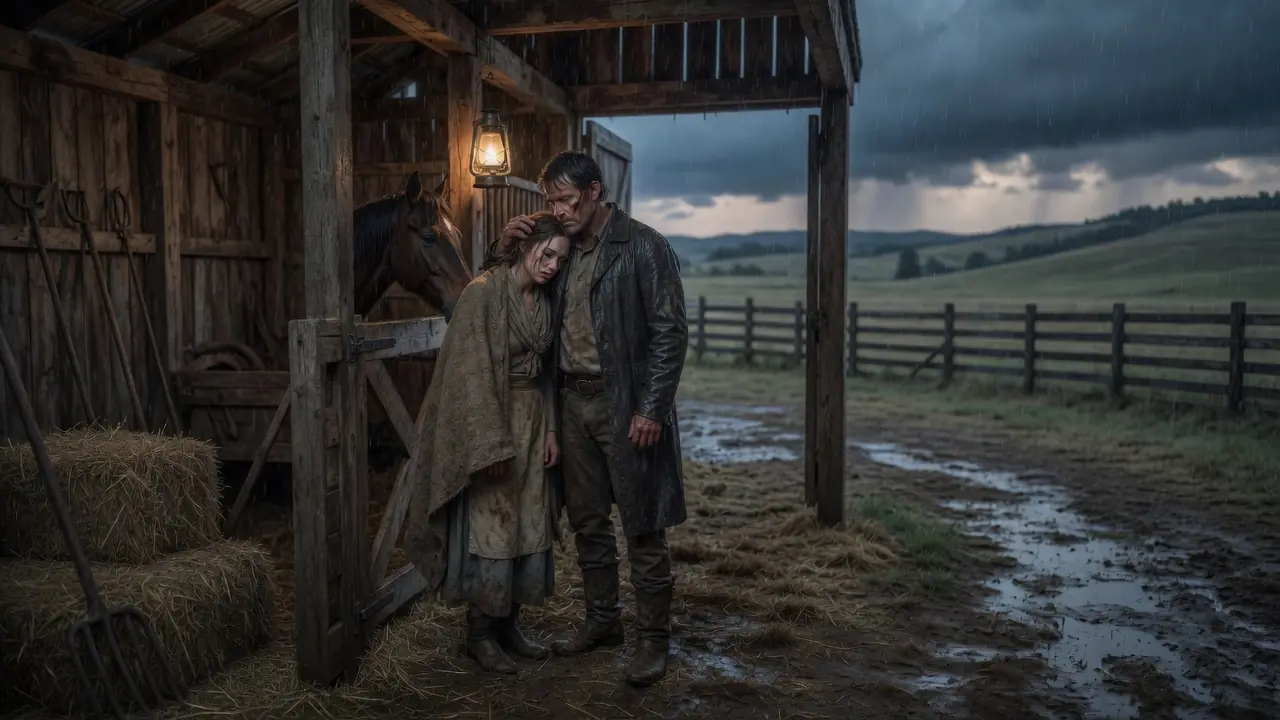
“They were fools,” he said. “You are the only honest thing that ever walked onto this ranch.”
Willer’s knees weakened.
Maybe it was the cold. Maybe the storm. Maybe hearing worth spoken over her by a man who did not know how to flatter and therefore could only mean what he said. Whatever caused it, her strength gave way all at once. Boon caught her before she fell.
She landed against his chest, one hand gripping the front of his wet coat, her forehead pressing just below his shoulder. For a heartbeat, she froze, horrified by her own need. Then his arm came around her back, steady and protective, not trapping her, only holding her upright. She could hear his heart under the soaked cloth, strong and even.
“I’m sorry,” she whispered again.
Boon looked down at the top of her bent head. “Stop apologizing for needing someone.”
That broke her more than the storm had.
She closed her eyes and let herself lean into him for one breath, then another. The barn smelled of hay, wet leather, horse sweat, and rain. Juniper shifted quietly in the stall beside them, now calm. The lantern light warmed the space around Boon and Willer as if the storm outside had pushed the whole world away and left only this one small place where she could breathe.
“Why are you so kind to me?” she asked.
His voice lowered. “Because you make this place feel like home again.”
Willer opened her eyes. Home. The word had always meant duty, fear, mockery, and the sound of boots on the kitchen floor before sunrise. She had never imagined it could mean a barn in a storm, a scarred rancher’s arm around her, and the first fragile sense that she might not be unwanted everywhere.
Before she could answer, Ada’s voice called from the barn door. “Boon? Willer?”
Boon loosened his hold but did not step away quickly, as if he refused to act ashamed of having held her. Willer pulled the blanket tighter around herself. Ada entered with another lantern, took one look at them, and her worried face softened. She did not tease. She was too kind for that.
“Child, you’re soaked through,” Ada said. “Come inside before fever finds you.”
Willer nodded and started to move, but Boon touched her elbow gently. “Can you walk?”
“Yes.”
“Tell the truth.”
She looked at him, startled, then nodded again, slower. “Yes. I think so.”
He walked beside her all the way back to the house, close enough that his arm brushed hers whenever the wind shoved at the door. Ada fussed over her, made tea, set a dry nightdress near the stove, and wrapped her in another blanket. Willer sat in the rocking chair, hands around a hot cup, trying to understand how one storm could leave her life so changed.
That night, she lay awake in the small room Ada had prepared. The mattress was soft. The blankets were clean. No one shouted through the walls. No one laughed at her for taking comfort. Yet hope frightened her more than thunder.
Because if Boon was truly kind, then leaving would hurt.
And if he chose her, truly chose her, then she would have to learn how to be seen.
Morning came pale and cool, the storm washed clean from the plains. Willer stepped out onto the porch and saw Boon already in the corral working a young colt. His movements were slow and certain, his voice low enough that she could not hear the words, only the calm shape of them. The colt tossed its head once, then settled.
Ada came to stand beside her with two mugs of coffee. “He was worried about you.”
Willer’s cheeks warmed. “He worries about the animals too.”
Ada smiled. “Yes, but he does not usually wrap horses in blankets and look like someone knocked the wind out of him.”
Willer stared into her coffee.
Ada looked toward the corral. “You’ve brought light into this house.”
“I haven’t done anything.”
“Oh, you have. Boon’s been talking more. Laughing once or twice when he thinks nobody hears. Living more.” Ada’s voice softened. “He was a good man before you came, but he was a lonely good man. There’s a difference.”
Willer watched Boon place one steady hand on the colt’s neck. “He reminds me of the land.”
“How so?”
“Hard on the outside,” Willer said, “but kind underneath if you know how to listen.”
Ada’s eyes warmed. “Then maybe you know how.”
The peace did not last long.
By midmorning, Sheriff Merritt Cole rode up the path, dust rising behind him despite the wet ground. Boon met him near the yard, his expression guarded. The sheriff removed his hat and glanced toward Willer with concern.
“Trouble from town,” Merritt said. “The Keredines are talking loud.”
Willer’s fingers tightened around the porch rail.
“They’re saying you took their daughter like payment,” Merritt continued. “Clay has been stirring men up at the saloon. Thought you should know in case he rides this way.”
Boon’s eyes darkened. “She is not payment.”
“No,” Merritt said. “I can see that.”
Willer stepped down from the porch. “Clay gets mean when he’s embarrassed.”
Boon looked at her. “You have nothing to fear here.”
“I don’t want trouble brought to your ranch.”
“You are not trouble, Willer.”
She wanted to believe him. The wanting itself hurt.
That evening, the trouble came in the shape of two riders. Clay and Morgan Keredine rode hard across the open land, their horses kicking dust into the red light of sunset. Ada stood in the doorway, one hand at her throat. Boon moved toward the yard, calm as a loaded rifle.
“Stay inside,” he said.
“No,” Willer replied.
He turned.
“This is about me,” she said, though her voice trembled. “I’ve spent my whole life hiding from them. I don’t want to do it here.”
Boon studied her face. Then he nodded once. “Then I stand beside you.”
Clay swung off his horse first, smirking like the world had been built for his amusement. Morgan followed, spitting into the dirt. “Well, look at you,” Clay called. “Playing rancher’s wife already.”
Willer stood on the porch step, hands clenched in the blanket Ada had draped around her shoulders. “Why are you here?”
“Pa says you belong with family,” Morgan said.
“You don’t get to call yourselves that.”
Clay laughed. “Hear her? Two weeks with a rich rancher and she thinks she can talk proud.”
Boon took one step forward, but Willer lifted a hand slightly, asking him without words to let her speak. He stopped. That gave her courage.
“You sent me here as a joke,” she said. “You kept the travel money and laughed because you thought Mr. Laramie would shame me worse than you did.”
Morgan looked away first.
Clay’s smirk thinned. “You always were sensitive.”
“No,” Willer said. “I was quiet. You mistook that for weak.”
Boon’s gaze shifted to her, and something like pride moved across his face.
Clay took a step toward the porch. “Get your things.”
“She stays if she chooses,” Boon said.
Clay glared at him. “She’s our blood.”
“She is her own person.”
“She ain’t wanted here.”
The words struck old places in Willer, but they did not knock her down this time. Before Boon could answer, she lifted her chin. “I am wanted here.”
Clay sneered. “He told you that?”
“Yes.”
“And you believe him?”
Willer looked at Boon. His scarred face was steady, his eyes fixed on her as if her answer mattered more than anything her brothers could say. She looked back at Clay. “I do.”
Clay stared at her, stunned by the strength in her voice. Morgan shifted in his saddle, uncomfortable now. The joke had stopped being funny the moment Willer refused to play her part.
“You’ll regret this,” Clay spat.
Boon’s voice dropped, calm and dangerous. “Not as much as you will if you keep standing in my yard.”
Clay’s hand twitched near his belt, not toward a weapon exactly, but enough to make the air tighten. Boon did not move. That was worse than moving. A man like Boon did not need to prove danger; he simply stood there, and danger understood where to wait.
Morgan grabbed Clay’s sleeve. “Come on.”
Clay jerked free but backed toward his horse. “This ain’t over.”
“It is for me,” Willer said.
Clay mounted hard and rode off in anger. Morgan followed, slower, throwing one uneasy glance back at his sister before turning down the road. When the dust swallowed them, Willer’s strength broke. Her knees buckled.
Boon caught her again.
This time, she did not apologize at first. She pressed her face into his chest, shaking with the force of everything she had held in. Boon wrapped both arms around her, careful but firm, and held her like she was something precious, not fragile. Ada stood in the doorway, wiping tears with the corner of her apron.
“I didn’t think I could say it,” Willer whispered.
“You said it.”
“I was afraid.”
“You said it afraid,” Boon replied. “That counts more.”
She looked up at him. “You really meant it? That I’m wanted here?”
His expression softened. “Willer, you were wanted here before you believed it.”
Her eyes filled. “What am I to you?”
Boon swallowed. He was a man more comfortable with rope and cattle than words, but some truths were too important to hide behind silence. He lifted one hand and touched her cheek, thumb wiping away the tear that had slipped free.
“You are someone worth standing for.”
The words moved through her like warmth after years of cold rooms.
Days passed, and the ranch changed around her. Not in appearance at first, but in feeling. The kitchen no longer felt like a place she had to earn. The porch became a place where she could sit without waiting for someone to call her lazy. The barn became the place where Boon had held her during a storm and told her she made the ranch feel like home.
Then her father came.
Mr. Keredine rode in with Clay and Morgan three mornings after the first confrontation, his face hard and mean beneath a dust-stained hat. He dismounted before his horse had fully stopped and pointed at Willer like she was property misplaced. “Get your things,” he snapped. “You’re coming home.”
“No,” Willer said.
Clay barked a laugh. “Listen to her acting brave.”
But she did not shrink.
Boon stepped between them, his broad shoulders blocking half her father’s glare. “A family does not toss a daughter away for travel money.”
Mr. Keredine’s face reddened. “She is our blood. We decide where she goes.”
“No,” Boon said. “She decides.”
Willer stepped beside Boon, not behind him. Her arm brushed his, and the contact steadied her. “This ranch is my home,” she said. “Not the house I came from.”
“You’re choosing him over your kin?” her father demanded.
“I am choosing kindness,” Willer replied. “Something I never had with you.”
For the first time in her life, she saw uncertainty in her father’s eyes. Not guilt, not remorse, but fear. Fear that the quiet daughter he had dismissed was no longer quiet because she had no strength. She had been quiet because no one had been worth wasting her voice on.
Mr. Keredine mounted without another word.
Clay and Morgan followed, their pride reduced to dust behind them.
When they were gone, Willer exhaled like she had been holding her breath for twenty-five years. Boon turned to her. “You all right?”
“I think so.”
“You faced them.”
“We faced them.”
His eyes softened.
She looked up at him, the morning light catching his scars, and for the first time she did not see a frightening man. She saw a man who had buried grief and still made room for kindness. A man who had been sent a joke and found a woman. A man who had looked at what everyone else mocked and called it worth.
“I don’t understand why you’re so good to me,” she whispered.
Boon stepped closer and tucked a loose strand of hair behind her ear. “Because you see me. Not the scars, not the stories. Me.”
A tear slipped down her cheek.
He wiped it with his thumb. “Slow and careful, Willer.”
She nodded, though her heart was anything but careful.
“You make this house feel like home again,” he said.
“You make me feel like I’m not invisible.”
“You never were.”
Then he leaned down and kissed her forehead.
It was not bold. It was not hurried. It was gentle, tender, and full of everything Boon Laramie did not yet know how to say aloud. Willer closed her eyes and let the moment settle into her bones. For the first time in her life, being touched did not feel like being claimed or corrected. It felt like being cherished.
When she opened her eyes, Boon was looking at her as if she were something rare.
“You belong here,” he murmured.
Her voice trembled. “I do. With you.”
Boon smiled then, real and warm, a smile Ada later said she had not seen in five years. Behind them, the ranch stretched wide under a clearing sky. Horses grazed near the fence. The barn stood open and quiet after the storm. The house waited with supper to be made, chores to be done, and a future neither of them had expected.
Willer Keredine was no longer the ugly daughter.
She was no longer the joke her brothers had sent away.
She was the woman who had walked into a scarred rancher’s life and brought warmth back into rooms grief had emptied. She was the woman who calmed frightened animals because she knew fear. She was the woman who stood up to the family that had made her small and chose the place where kindness waited for her.
And Boon Laramie, who thought he had sent for a bride out of loneliness, finally understood what he had really been waiting for.
Not beauty as the world named it.
Not pride.
Not polish.
But a steady heart.
A brave soul.
A woman who made his ranch feel like home.