Boaz Ledford hired one man in the spring of 1888. By July, he had eight extra mouths to feed, seven strange beds to build, and a girl of 16 standing in his kitchen doorway with her chin up telling him she hadn't come to cook. He was 52 years old, a widower 11 years, and the Anvil Fork range had been carrying him alone since the fever took his wife Adelicia in the spring of 1877. And six years before that, his only boy Rufus at the age of six. Boaz had built the ranch for a son who never grew tall enough to run it.
And he had never once in all the years since imagined it run by anyone but a son. That was the shape of the man who answered the newspaper notice from a family named Winder. The notice had been placed by McKaja Winder, 24, the oldest of eight children left to fend for themselves when their father Josephus Winder died of lung fever that January, and the bank took the home place in Piney County three weeks later. McKaja wrote plainly, he could ride, rope, mend fence, and would work for board and $10 a month. Boaz wrote back the same week.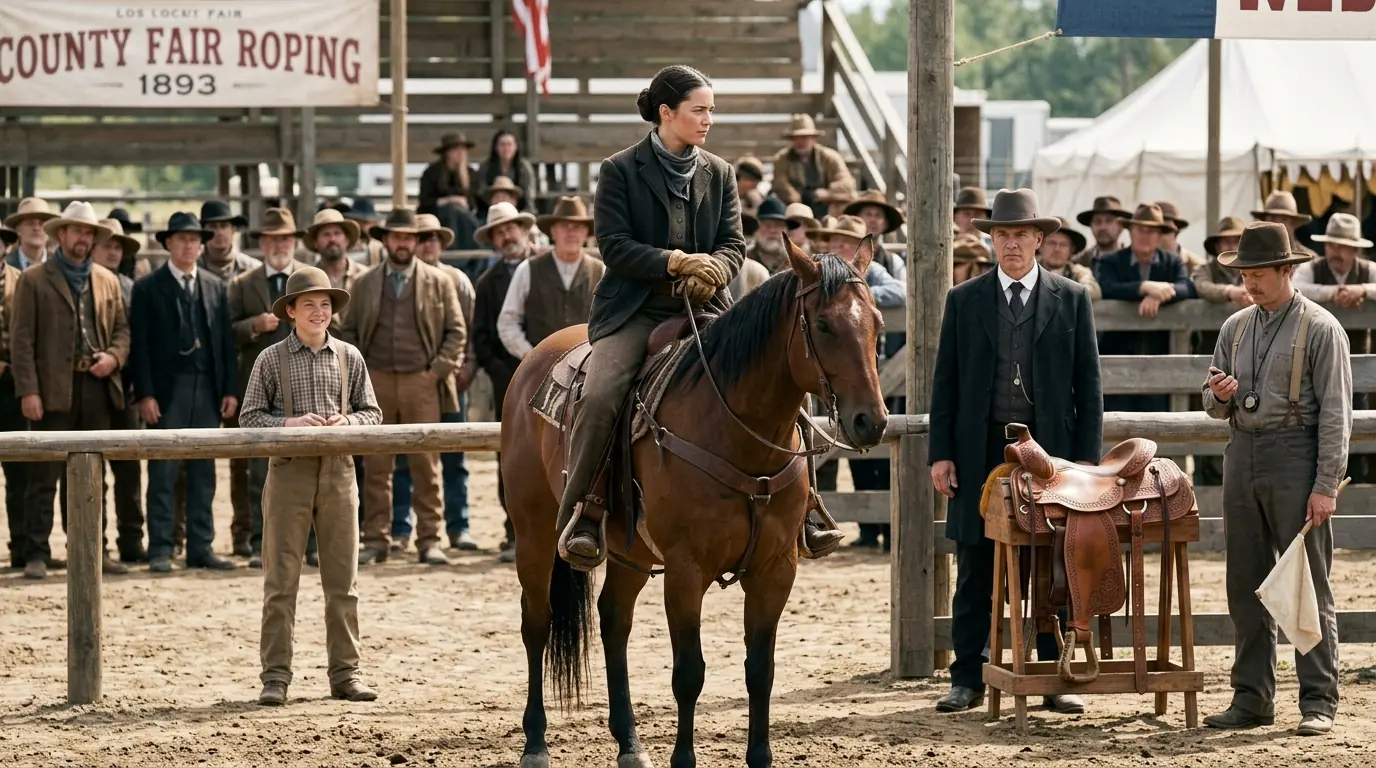
He needed one steady hand, and McKaja, broad-shouldered and quiet, looked exactly like what a ranch needed. He did not expect the wagon that rolled up the Anvil Fork lane in July. It carried six more Winder brothers, ranging from 22 down to 10. Thaxter, Onslow, Garvey, Purdon, Marceline, and little Fennel. And sitting straight-backed on the buckboard seat beside them with a hen coop on her lap and a rifle across her knees, their sister Palmyra, 17 years old, the second oldest of the eight.
"I hired a hand," he said, "not a household. " "Then hire the household, too," Palmyra said before Micajah could answer for her, "and you'll come out ahead on the deal. " She said it without heat, the way a person states a fact about the weather, and climbed down off the wagon before anyone could tell her not to. Boaz did not hire the household. He fed it. He gave the boys the old bunkhouse and told them plainly they'd earn their keep or move on come fall, and he told Palmyra, not unkindly, that the kitchen was hers if she wanted it, since a ranch this size hadn't had a woman's hand in it for 11 years and could use one. She thanked him for it, set down her hen coop on his porch step, and asked, before she so much as unpacked a single trunk, whether the branding irons hanging by the barn door were kept sharp or just kept.
Boaz said he honestly didn't know. Palmyra walked out to look for herself and came back an hour later having sharpened three of them on his own grindstone, her sleeves rolled to the elbow and a smear of soot across one cheekbone, and set a plate of cornbread in front of him as though the two things belonged in the same afternoon, because to her they did. Palmyra took the kitchen. She also, within her first month, took to slipping out before sunup to help Hurden and Marceline with the milking, then the mending, then, because nobody had told her plainly enough that she couldn't, the breaking of a green colt in the round pen that had thrown every one of her brothers twice a piece. She did not ask permission.
She simply appeared again and again wherever the hardest job of the day happened to be and did it a little better than whoever had tried it first. By the second year, nobody at the Anvil Fork bothered pretending Palmyra Winder belonged in the kitchen alone. She still cooked because eight people had to eat and she was good at it, but she also doctored a screwworm outbreak in the spring calves with a mixture she'd learned from her mother, rode fence line in weather that kept the brothers close to the stove and kept a running tally in a cloth-bound ledger of every animal, every debt, every dollar that crossed the Anvil Fork books, a tally more accurate, Boaz found more than once, than his own. He did not say so out loud. Not yet.
The town, when it noticed her at all, noticed with the particular unkindness small towns save for anyone who does not stay where she's put. There was talk in the mercantile and after church about the Winder girl who dressed for work instead of for looking at, who could out-rope her own brothers, who had no business at a stockyard scale where men did business. The man who ran that scale was Rutherford Nye, 55 years old, the cattle buyer and commission agent for three counties, and the hardest rule he carried was one he had written himself in his own hand and nailed above his own office door. No woman's mark stands at this scale. He had not always believed it.
20 years before, when he was a younger man building a partnership herd with a rancher named Pruitt, Pruitt had died sudden and sharp of a fall from a horse, gone before sundown, leaving his widow to settle accounts. A stranger had come through claiming to be the widow's late husband's agent carrying papers with her signature already on them. Forged, though Nye did not learn that until the herd and the money were both three states gone. He had trusted a signature he never once thought to verify simply because a grieving woman had put her name beside it. And the shame of having been so easily fooled had calcified over 20 years into a rule that punished every woman who came after for the sin of one forger Nye had never even met.
He told himself it was caution. It was, underneath, a wound he had never once let anybody look at. He would not let Palmyra Winder sign for a single head of Anvil Fork stock. Not that first year, not the third, not the fifth. Boaz signed.
Micajah signed when Boaz couldn't ride to town. Nye dealt with brothers, with hired men, with anyone at all who was not her. And every autumn Palmyra stood at the edge of his scale yard with her own tally book in hand, checking his weights against her own numbers. And every autumn he found a way not to look at her directly while he did it. She never once made a scene of it.
That, more than anything, unsettled him. A woman who argued could be dismissed as difficult. A woman who simply kept better books than he did year after year without ever once raising her voice about it left him nothing to dismiss at all. Micajah, for his part, never minded standing in as the name on the paper. He had come to the Anvil Fork meaning to be the one who saved his family.
And it took him the better part of those first years to understand that his sister had saved it before he'd finished unpacking the wagon. And that the truest thing he could do for her now was simply get out of the way of whatever she meant to do next. He said as much to Boaz once, plainly, over coffee, that he'd been hired as the oldest son and had spent 10 years watching the real head of the family walk right past him toward the barn every morning before he was even dressed. The years did what years do. Baxter married a Piney County schoolteacher and took a quarter section of his own in 1892.
Onslow set up as the county's best blacksmith the same year. Garvey and Perden partnered a small spread together in '94, running Anvil Fork stock on shares. Marcelan went east to an agricultural college on money the family had saved by then, meaning to come back and teach what he learned. Fennel, 10 years old the summer the wagon rolled in, was 20 by 1898 and the last of the brothers still drawing wages at the home ranch, mostly because he liked it there. Palmyra never left.
Not because nobody asked. A rancher's son from two counties over came calling twice in 1893 and once more in 1895, and each time she was cordial, and each time she said, plainly, that she had work here that wasn't finished. Boaz watched this happen and said nothing, though privately he had begun by then to dread the day some good man finally talked her into leaving. It was the county fair of 1893 that put the matter beyond any further arguing in the mercantile. The roping contest that year drew 40 entrants from three counties, every one of them a man, and the purse was $10 and a new saddle donated by Nye's own commission house.
Palmyra had not planned to enter. Fennel, 15 that summer and forever certain his sister could do anything, put her name on the list without asking, and by the time she found out, pulling out would have made a bigger spectacle than staying in. She roped a steer in 11 seconds flat, faster than any man on the ground that day, faster than Makaja, faster than the reigning champion, a hand from the Cross T outfit, who'd held the title four years running. The crowd went quiet before it went loud. Nye himself had to hand her the saddle in front of the whole county, his jaw set tight the entire time, and said not one word to her beyond the presentation itself.
It was the first time in five years he had looked at her directly at all. By 1895, seven years in, the Anvil Fork ran more head cleaner stock and fewer losses than it had in Boaz's whole working life, and every soul in three counties who bothered to look honestly at the ledgers knew exactly whose hand was on them. Boaz was 60 by then, his knees gone bad from 30 years in the saddle, and more of the actual running of the place passed to Palmyra with each season, not because he decided to hand it over, but because she simply did the next necessary thing before he'd finished thinking of it, the way she always had. It was the winter of 1897 that changed Rutherford Nye, and it did not happen the way anyone expected. A blizzard came down out of the Ozarks in late January and caught half the county's stock out on open range, Nye's own herd among them.
He ran a small personal herd alongside his commission business, 40 head he'd built up over years, the closest thing the man had to a family legacy. His hired hands were laid up with the same influenza going through the county that winter. Two of them bad enough that the doctor feared for their lives, and Nye himself, past 55 and half frozen already from one bad ride out to check the herd, had nobody left to send. Palmyra Winder heard of it from a passing rider on the second day of the storm. She did not ask Boaz's permission, and she did not wait for morning.
She and Fennel saddled two of the hardiest horses on the place before first light, wrapped their faces against a wind that had already dropped the county roads under 3 ft of drift, and rode out into weather no sensible person would have chosen. It took most of that first day just to find the fence line where Nye's 40 head had bunched and frozen in place, backs to the wind, three of the youngest already down and in danger of not getting up again. Palmyra worked the downed animals by hand, hauling them upright by main strength and a rope around the chest, while Fennel kept the rest of the herd from scattering, and the two of them spent 11 hours in all breaking that herd out of the snowbank and pushing it, one exhausted step at a time, to shelter in a neighbor's borrowed barn 3 mi distant. They lost not one animal, while Nye himself lay fevered in his own bed the entire time, unable to do a single thing about any of it, and not even certain, until the note came, whether his herd still existed at all. She did not send word ahead.
She did not wait for thanks. When the roads opened, she simply left a note nailed to his barn door with the tally of his own stock, every head accounted for by number and brand, in the same careful hand that had balanced the Anvil Fork books for 9 years, and rode home. Nye read that note standing in the snow in his nightshirt, and something in him that had been shut for 20 years came open. He rode to the Anvil Fork himself the following week, still weak from the fever, and asked to speak with her directly. Not through Boaz, not through Mikajah, but with Palmyra Winder herself, at last, face-to-face.
He told her, plainly, what he had never told anyone, about Pruitt's widow, about the forged papers, about the rule he had nailed above his own door out of a shame that had nothing to do with her and everything to do with a young man too proud to admit he'd been fooled. He did not ask her forgiveness so much as offer her the truth, unadorned, because she had earned that much and more. She gave it to him anyway. "You weren't wrong to be careful," she said. "You were only wrong about who needed watching. " That spring, at the county stockyard, in front of every rancher and buyer who had ever looked past her at a scale, Rutherford Nye took down the sign above his office door with his own hands and nailed up a new one in its place, nothing more than his own name and the words "All settled fair. " He signed Palmyra Winders mark himself that day, the first of many, and told any man who asked that the surest set of numbers in three counties belonged to the Winder girl, and had for years, and that any fool who hadn't noticed had been doing his own arithmetic wrong.
Boaz Ledford turned 70 that autumn of 1898, 10 years to the season since a wagon he hadn't asked for rolled up his lane. His knees would no longer take a full day's ride, and the hands he'd once used to break colts could barely close around a coffee cup on the cold mornings. He called Palmyra into the front room one evening in October, the same room where, a decade before, he'd stood on the porch outside and counted heads twice, certain of a mistake. There was no mistake in it now. "I hired your brother for a wage," Boaz told her, "and inside of 10 years his sister built the ranch he came here to save into something I never once managed alone in 20.
I had a boy once. I built all this thinking I was building it for him. " He set the deed to the Anvil Fork on the table between them, his name already struck through and a blank line waiting beneath it. "I've got no son left to leave it to, and I've come to understand I never needed one. I need the person who's already been running it. " Palmyra Winder signed her name beneath his on the deed to 11,000 acres, the same steady hand that had balanced his books, broken his colts, and once ridden 11 hours through a blizzard for a man who'd spent 9 years refusing to look at her. And this time, nobody in the county so much as blinked at the signature.
Fennel stayed on as her foreman. The brothers came back for Sunday suppers from their own places scattered across three counties, filling the old house the way it hadn't been filled since Adalicia was alive, and Boaz Ledford, 70 years old and finally at rest in a chair by the fire he no longer had to build himself, would tell anyone who asked that he had gone looking for one hired hand and found, in the sister nobody thought to hire at all, the whole of what a ranch and a family was ever supposed to be. He never did get a son. He got something he'd stopped believing existed, someone who showed up, did the next hard thing without being asked, and never once needed anybody's permission to be exactly as good as she was.
Fennel's own daughter, born on the Anvil Fork in 1911, and named Adalicia for the wife Boaz had lost so long before any of the Winders ever came up that lane, grew up hearing the story told a hundred different ways by a hundred different uncles, each one certain his version was the truest. She would say, decades later, that the only detail every single telling agreed on was the sharpened branding irons and the plate of cornbread set down in the same breath. Proof, her father always said, that nobody in this family had ever once believed work and welcome were two separate things. The saddle Palmyra won in 1893 hung in the tack room until the ranch itself passed out of Winder hands in the 1950s, and even then, the new owners kept it, unable to say quite why, only that it seemed wrong to move it.