The snow outside JFK Terminal 4 fell so thickly that the runway lights looked like they were burning behind a white curtain. Inside the terminal, travelers crowded every corner, sleeping against suitcases, arguing with gate agents, checking their phones, and watching the departure board flash delay after delay. It was New Year’s Eve, and everybody in the airport seemed to be trying to outrun the storm before midnight. Isaiah Grant stood near the glass wall of the Delta Sky Club, quietly watching the chaos with a bottle of sparkling water in his hand.
At thirty-five, Isaiah had built a habit of stillness that unsettled impatient people. He was tall, broad-shouldered, and dressed for comfort in a charcoal hoodie, dark jeans, and black travel shoes, with a worn leather weekender bag resting by his feet. To most strangers, he looked like a quiet passenger who had no interest in being noticed. They would not have guessed he was the founder and CEO of EtherLogic, the company finalizing an acquisition of Ventura Heavy Industries in London.
The deal was nearly complete, but Isaiah still wanted to meet the board in person before the public announcement. Ventura was old, powerful, and troubled, the kind of manufacturing giant with valuable bones and a diseased culture. Isaiah had reviewed enough internal reports to know the company needed more than money. It needed new leadership, and he was flying across the Atlantic to begin that change.
A lounge attendant named Jessica hurried toward him with a fresh boarding pass. “Mr. Grant,” she said, lowering her voice, “we got you on Flight 104. Last aircraft leaving tonight before they pause departures.” Isaiah took the pass and read the seat assignment: 1A. Jessica smiled with exhaustion and relief. “First class. They’re boarding immediately.”
“Thank you, Jessica,” Isaiah said. “Happy New Year.”
“You too, Mr. Grant. Please hurry.”
He moved through the terminal without rushing, because rushing rarely made chaos better. At the gate, the agent scanned his pass, nodded him through, and warned him that the aircraft was trying to leave before the next weather hold. Isaiah stepped onto the jet bridge, felt the cold air bite through the gaps, and hoped only for a quiet seat, a glass of water, and sleep. When he entered the aircraft and turned left into first class, that hope ended.
Someone was already sitting in seat 1A.
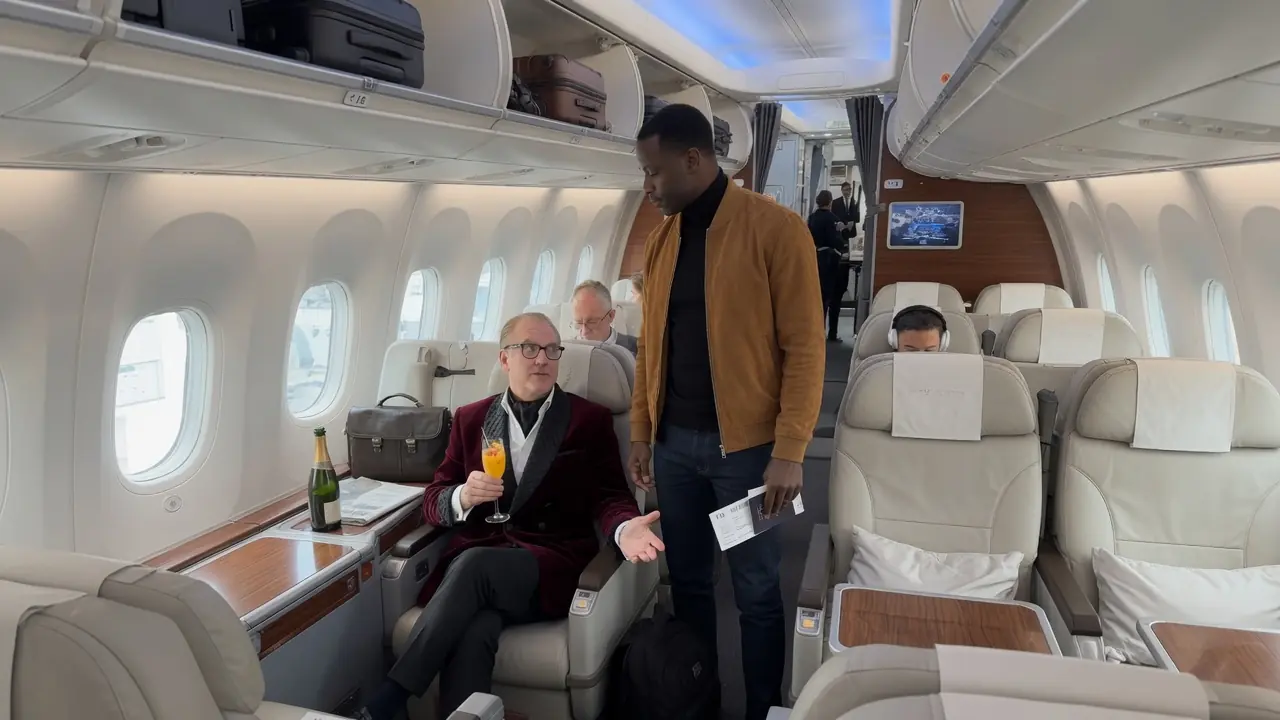
The man in the seat looked to be in his late forties, with slicked-back blond hair, black-framed glasses, and a wine-colored velvet blazer over a black turtleneck. A pale pocket square sat too carefully in his breast pocket, and a bright orange drink rested in his hand like a prop. His suitcase had been pushed into the overhead bin above Isaiah’s seat, and his posture said he had already decided the cabin belonged to him. Isaiah checked his boarding pass once more, then stepped forward.
“Excuse me,” Isaiah said calmly. “I believe you’re in my seat.”
The man did not look up right away. He lifted one finger as if silencing an assistant, finished tapping something into his tablet, then slowly raised his eyes. His gaze moved over Isaiah’s hoodie, jeans, travel shoes, and worn leather bag. A smile pulled at one corner of his mouth, not amused, but satisfied by what he thought he saw.
“First class is up here,” the man said. “Coach is behind the curtain.”
The man laughed, sharp and unpleasant. “That must be a mistake. I upgraded. I’m Preston Halloway, senior vice president of sales at Ventura Heavy Industries.” He leaned back, lifting his drink. “I don’t move for people who wander up front because they saw an empty-looking seat.”
Isaiah’s expression did not change, but his eyes grew colder. “Then check your boarding pass.”
Preston sighed theatrically and spread one hand toward the cabin. “Listen, buddy, I know travel can be confusing when you’re not used to this section. These seats are expensive. People who sit here usually know how the process works.” He pointed down the aisle. “Do yourself a favor and find where you actually belong.”
Several passengers nearby went silent. A flight attendant glanced over from the galley, sensing trouble. Across the aisle in seat 1B, an older man with silver hair lowered his newspaper and looked directly at Isaiah. Isaiah recognized him instantly: Harrison Clark, outgoing CEO of Ventura Heavy Industries, the very man Isaiah was flying to London to replace.
Harrison’s eyes widened with recognition. He started to speak, but Isaiah gave him the smallest shake of the head. Not yet. Harrison paused, then leaned back, watching with the sharp attention of a man who understood that some people reveal themselves best when they think nobody important is listening. Preston, unfortunately for himself, thought exactly that.
“Sir,” the flight attendant said carefully, approaching Preston, “may I see your boarding pass?”
Preston rolled his eyes. “I already told him. I’m upgraded.”
“I still need to verify the seat.”
He pulled out a crumpled boarding pass and slapped it into her hand. The flight attendant scanned it. Her device buzzed low and wrong. She looked at Preston, then at Isaiah’s ticket, then back at Preston.
“Mr. Halloway,” she said, “your assigned seat is 14B.”
The first-class cabin became painfully quiet. Preston’s face reddened, but embarrassment did not soften him. Instead, it sharpened his cruelty. “That is a system error,” he said. “The gate agent verbally upgraded me.”
“Verbal upgrades are not policy,” the attendant replied. “Seat 1A belongs to Mr. Grant.”
Preston looked Isaiah up and down again. “You want me to believe he paid for 1A?” His voice carried now, made louder by entitlement and the desire to humiliate. “A man in a hoodie standing there with a bargain bag? Come on. First class isn’t a waiting room for people trying their luck.”
Isaiah took one slow breath. “Preston, you’re making a very expensive mistake.”
That made Preston laugh harder. “My mistakes cost less than your whole trip, pal. I’m on my way to London to save a multi-million-dollar account. My time is worth five thousand dollars an hour. Yours looks like it belongs somewhere near baggage claim.”
The flight attendant’s face tightened, but the captain had already announced door closure. The plane was balancing on the edge of losing its departure slot. Isaiah saw the stress in her eyes, the fear that calling airport security would delay the flight long enough to cancel it. Hundreds of passengers would miss their connections, their holidays, and their New Year’s plans.
Isaiah looked at Harrison again. Harrison looked furious, but stayed silent at Isaiah’s signal. Then Isaiah turned back to the flight attendant. “It’s fine,” he said.
“It is not fine, Mr. Grant.”
“I know,” Isaiah answered. “But the plane needs to leave.”
Preston leaned back, victorious. “Smart decision. Go sit where the ticket printer probably meant to put you.”
Isaiah stepped closer, lowering his voice so only Preston and Harrison could hear clearly. “Enjoy the seat, Preston. It’s the most comfortable place you’ll be for a very long time.”
Then he picked up his weekender bag and walked to 14B.
The seat was narrow, stiff, and crowded by an overfilled overhead bin. Isaiah folded his tall frame into it, took out his phone, and sent a message to his chief legal officer in London. Begin draft termination package for Preston Halloway, VP Sales, Ventura Heavy Industries. Preserve all payroll, expense, and corporate device records. Also preserve Flight 104 passenger manifest.
He switched his phone to airplane mode as the aircraft pushed back. Up in 1A, Preston ordered another drink and laughed loudly enough for the first rows to hear. He believed he had won. He did not know he had just moved himself from an executive seat into the center of an investigation.
Two hours over the Atlantic, the cabin lights dimmed to a gentle blue. Most passengers tried to sleep while the aircraft hummed through the night. Isaiah stayed awake in 14B, reviewing Ventura financial reports on his laptop with the tray table pressed awkwardly against him. The Q4 numbers bothered him. Millions of dollars were hidden inside vague consulting costs, and the sales department appeared at the center of the pattern.
Up front, Preston was not sleeping either. His stolen seat had made him bold, and the drinks had made him careless. Harrison Clark sat beside him in 1B, pretending to read a biography while listening to every word Preston volunteered. Preston bragged about his sales numbers, mocked the incoming EtherLogic leadership, and boasted that the new owner would need him because he knew “where the bodies were buried.”
Harrison turned a page slowly. “That sounds risky with a new owner arriving.”
Preston smirked. “The new owner is some tech kid named Isaiah Grant. I Googled him. Diversity poster boy with software money. He doesn’t know manufacturing, logistics, or old-school sales.” He leaned closer, lowering his voice in a way that still carried. “I’ve already moved two million into a consulting shell company. Call it insurance.”
Harrison went completely still.
Preston kept talking. “If they keep me, I clean it up. If they fire me, I vanish with my severance before they even know what happened.”
Harrison’s fingers tightened around the edge of his book. He had suspected corruption in Preston’s department for months, but suspicion was one thing. A confession at thirty thousand feet was another. He took a small notebook from his breast pocket and began writing.
Then the fasten-seatbelt sign chimed.
The captain’s voice came through the speakers, sharper than before. “Ladies and gentlemen, we are entering unexpected clear-air turbulence. Please return to your seats and fasten your seatbelts immediately. Flight attendants, take your jump seats.”
Preston rolled his eyes and reached for his glass. “Overdramatic.”
The plane dropped.
The movement was sudden enough to throw screams through the cabin. Drinks jumped, bags shifted, and several passengers grabbed armrests with both hands. Preston, who had not buckled his belt properly, slammed hard against the seat and cried out about his face and suit. Across from him, Harrison clutched his chest, his breathing turning shallow and uneven.
“Help,” Harrison whispered. “My pills.”
Preston looked at him with irritation instead of concern. “Don’t lean on me, old man.”
Harrison’s hand trembled toward his bag. Preston pushed it away, more concerned with wiping his blazer than helping the man beside him. Jessica rushed forward from the galley as soon as the plane steadied enough for movement. She saw Preston complaining loudly, then Harrison slumped in visible distress.
“Medical emergency in first class,” she called. “Is there anyone with medical training on board?”
Isaiah was already standing.
He was not a doctor, but he had emergency response training from years of climbing and wilderness expeditions before boardrooms replaced mountains. He moved up the aisle with controlled urgency, one hand on the seatbacks as the plane shook again. When he reached first class, Preston stared at him in disbelief.
“Why is he back up here?” Preston snapped.
Isaiah ignored him and knelt beside Harrison. “Medication?”
Jessica searched the bag and handed him a small bottle. Isaiah checked the label, helped administer the medicine, and fitted an oxygen mask carefully over Harrison’s face. His voice became calm and commanding, giving instructions without wasting a word. Within minutes, Harrison’s color began to improve.
Preston muttered about his suit again.
Isaiah turned his head slowly. “Shut up.”
The words were low, but they carried more force than Preston’s shouting ever had. Preston closed his mouth. Jessica looked almost relieved.
When the turbulence finally eased, Harrison opened his eyes. He looked up at Isaiah, who was still bracing him carefully against the movement of the plane. “You saved me,” Harrison whispered.
“You’re stable,” Isaiah said. “Just breathe.”
Harrison’s eyes sharpened with recognition again. “Mr. Grant.”
Preston froze.
Isaiah stood slowly and adjusted his hoodie. Harrison turned toward Preston, his face pale but his voice clear. “Preston, since you were so eager to discuss the future of Ventura, allow me to introduce the man you displaced.” He gestured to Isaiah. “This is Isaiah Grant, founder and CEO of EtherLogic. As of this morning, he owns the company you work for.”
The first-class cabin went silent.
Preston looked from Harrison to Isaiah, then down at Isaiah’s hoodie as if the fabric itself had betrayed him. “No,” he whispered. “That can’t be.”
Isaiah folded his arms. “You told me to go sit where I belonged.”
Preston swallowed hard. “Mr. Grant, I didn’t realize—”
“That is the problem,” Isaiah said. “You needed to realize who I was before you treated me like a person.”
Preston’s voice broke into panic. “It was a misunderstanding. The storm, the boarding confusion, the stress—”
“You stole my seat,” Isaiah said. “You insulted me in front of passengers. You threatened crew. You ignored a medical emergency. And you confessed to moving company funds into a shell account.” He glanced at Harrison. “Did I miss anything?”
Harrison, still breathing through the oxygen mask, raised one finger. “Inventory manipulation.”
“Thank you,” Isaiah said.
Preston looked around, searching for sympathy and finding only disgust. Jessica stood nearby with water for Harrison, her face neutral but her eyes hard. The other first-class passengers had heard enough to understand the shape of the downfall. Preston sank back into the stolen seat that now felt less like a throne and more like a trap.
For the remaining hours, Isaiah stayed near Harrison in the jump seat. He sent messages over the onboard Wi-Fi, triggering preservation orders, device locks, and legal alerts. Preston tried to access his company phone, but the screen would not respond. His tablet became useless next. His laptop, locked in the overhead bin, had already been frozen remotely.
“You can’t do that,” Preston whispered.
“It’s company property,” Isaiah said. “You signed the policy.”
Preston pressed his palms together as if prayer might become negotiation. “Please. I have a family. I have obligations.”
“You had obligations to the company,” Harrison said. “You stole from it.”
Preston’s face twisted. “You don’t understand sales. You don’t understand pressure.”
Isaiah looked at him without anger now. “Pressure does not create character. It reveals it.”
As dawn spread pale light over the Atlantic, the plane began its descent into London. For every other passenger, the runway meant arrival. For Preston, it meant exposure. He sat in 1A gripping the armrests, his expensive blazer wrinkled, his confidence gone, his stolen seat now the most uncomfortable place on the aircraft.
When the plane reached the gate, passengers began unbuckling, but the lead flight attendant ordered everyone to remain seated. A murmur spread through the cabin. Then the front door opened, and two uniformed officers stepped inside with two serious-looking investigators in dark suits. They did not scan the cabin.
They walked straight to 1A.
“Preston Halloway,” one officer said. “Stand up, please. Keep your hands visible.”
Preston tried one last performance. “There must be a mistake. I’m vice president of sales for Ventura Heavy Industries.”
“We know,” said the investigator. “You are under arrest on suspicion of fraud, money laundering, and abuse of position.”
The cabin went absolutely quiet. Phones lifted. Preston’s mouth opened and closed, searching for words that might still have power. None did. The officer turned him gently but firmly into the aisle and secured his wrists.
Preston’s eyes landed on Isaiah. “He framed me. He’s the problem. He hacked my phone.”
The investigator glanced at Isaiah, then back at Preston. “Mr. Grant is the owner of the company you are accused of stealing from. He authorized preservation of evidence during the flight.”
A wave of whispers moved through the cabin. “That’s the owner?” someone said. “The man in the hoodie?”
Preston was marched past Harrison, who looked at him with tired disappointment. “I made you money,” Preston pleaded.
“You made yourself money,” Harrison replied. “And you cost us trust.”
As Preston passed Jessica at the aircraft door, she gave him the politest smile of the entire flight. “Thank you for flying with us, Mr. Halloway. Mind your head. Police vans have limited leg room.”
A few passengers laughed softly, not loudly enough to feel cruel, but clearly enough for Preston to hear. He disappeared into the jet bridge, no longer an executive, no longer a first-class passenger, no longer the loudest man in the cabin. Just a man who had mistaken a seat for status and prejudice for power.
Isaiah helped Harrison gather his bag before stepping off the plane. They walked together through the jet bridge, slower than usual because Harrison was still recovering. At the terminal, an investigator thanked Isaiah for the real-time evidence transfer and asked for formal statements. Isaiah agreed to go immediately.
Before they left, Isaiah’s phone reconnected and buzzed with a message from his mother in Chicago.
Happy New Year, baby. Did you make it safely? Did you get a good seat?
Isaiah looked back toward the gate, where passengers were still whispering about what they had witnessed. He thought of seat 1A, then of row 14, then of Harrison breathing again beside him. He smiled faintly and typed back.
Happy New Year, Ma. I made it safe. And don’t worry about the seat. I ended up exactly where I needed to be.
Four months later, Preston Halloway stood in court instead of a boardroom. His lawyers tried to describe his confession as drunken exaggeration and his conduct on the plane as stress. Harrison’s testimony destroyed that defense. Isaiah’s preserved records finished the job.
Preston was convicted of corporate fraud, and the stolen money was recovered. His assets were frozen, his title erased, and his reputation collapsed in the same public way he had tried to humiliate Isaiah. The videos from Flight 104 had already made him a warning story in business circles. He became the answer to a question whispered at conferences: “Did you hear about the man who stole his new boss’s seat?”
But Isaiah did not build his new leadership around Preston’s downfall. He built it around the people Preston had ignored. At the London town hall, Ventura employees expected layoffs and fear. Instead, Isaiah announced that recovered funds would be used for bonuses to factory workers, ethical compliance rebuilding, and leadership training that rewarded humility instead of swagger.
He also called Jessica personally after the flight. She received an official commendation from the airline, then an offer from EtherLogic to join its corporate travel and culture team. Six months later, she was no longer apologizing to arrogant passengers at thirty thousand feet. She was helping build policies that protected staff from men like Preston.
Harrison stayed on as chairman emeritus, not because Isaiah needed a symbol, but because he respected what Harrison had done in silence across the aisle. “You let him reveal himself,” Harrison said once. Isaiah shook his head. “No. He revealed himself because he thought I was nobody.”
That became the lesson Isaiah repeated most often.
Power does not always arrive in a suit. Sometimes it wears a hoodie, carries a worn leather bag, and waits quietly while arrogance writes its own termination letter. Preston thought first class was a seat he could steal. Isaiah knew it was a test of character.
Years later, when Isaiah told the story, he never began with the arrest. He began with the moment Preston pointed toward coach and said Isaiah did not belong. Because that was where the truth of the story lived. A man had judged another man by clothing, skin, and silence, and in doing so, exposed the poverty of his own character.
One stolen seat became a confession.
One quiet passenger became the new owner.
And at thirty thousand feet over the Atlantic, Preston Halloway learned that karma does not need a boarding pass.
It already knows exactly where you are sitting.