The hospital room smelled like bleach and old cotton, a harsh, clinical scent that I can still recall with sickening clarity over forty years later. It was late into the evening in the winter of 1983. Outside, a light snow was falling against the black windowpanes, but inside, my entire universe was collapsing down to the small, metal bed where my wife, Janet, lay. She was scheduled for a major surgery the next morning. The doctors had told us the odds were in her favor, but Janet had always been intuitive. She knew her own body, and that night, there was a quiet, terrifying resignation in her eyes.
She reached out and squeezed my hand. Her fingers felt so fragile, so incredibly cold. She made me lean in close and whispered a request that made my chest tighten. She asked me to make a promise. She told me that if she didn’t make it out of that operating room, I had to marry again. She said our girls, who were only four and six at the time, were going to need a mother. She didn't want them growing up in a house filled with nothing but grief and a sad, lonely father. I fought back tears, kissed her forehead, and told her she was being ridiculous. I promised her I would do it, just to ease her mind, fully believing we would laugh about her morbid panic the following afternoon.
She died the next morning on the operating table.
The days and months that followed were a blur of unimaginable pain. I had to go home and explain to two toddlers that mommy wasn't coming back. I had to learn how to braid hair, how to soothe night terrors, how to juggle a full-time job while completely drowning in my own sorrow. I raised our daughters alone. Every single milestone—every scraped knee, middle school graduation, first heartbreak, and college send-off—I was the only one in the audience.
When I was about twelve years into single fatherhood, the girls sat me down at the kitchen table. They were teenagers by then, perceptive and curious. Out of nowhere, my oldest asked me why I never dated. Why had I never brought anyone home? Why was our house always just the three of us?
I looked at them, taking in how much they looked like their mother, and I lied through my teeth. I put on a gentle, wistful smile and told them that I just hadn't met the right person yet. I told them that finding love again was hard, and my priority had always been them. They accepted that answer. It sounded noble. It sounded like the truth.
But it wasn't. The reality was that I had met three different women over those twelve years. Three intelligent, kind, patient women who would have moved mountains for me and my daughters.
There was Sarah, a local teacher who possessed a bottomless well of empathy. She used to help the girls with their math homework while I cooked dinner. Then there was Elaine, a nurse whose sharp sense of humor brought laughter back into our quiet house for the first time in years. And finally, there was Marie. Marie and I dated for almost two years when the girls were in high school. I even bought a ring. I kept it hidden in my sock drawer for months, trying to work up the nerve.
But every single time things crossed the threshold from casual dating into a genuine, permanent future, a suffocating wave of guilt would hit me. We would sit down for dinner, and I would look at the empty chair across from me—Janet's chair. The thought of another woman sitting there, living the life that Janet had been violently robbed of, made me physically sick. I would push them away. I would sabotage the relationships, citing bad timing or cold feet. I chose my loyalty to a ghost over the promise I made to my living, breathing wife on her deathbed. I felt like a coward, but I simply couldn't let her go.
Decades slipped by. The girls grew up, moved out, got married, and had children of their own. They are in their forties now, successful and happy, and I am incredibly proud of them. But the house is very quiet. I spend my days reading, working in the garden, and keeping the place exactly as it has always been.
Last week, the silence in the house felt a little too heavy. I decided to finally tune the old upright piano sitting in the corner of the living room. It was Janet's piano. She used to play it every Sunday morning. I hadn't touched the keys in years, let alone opened the bench where she kept her things.
I grabbed my tuning hammer and went to lift the heavy wooden seat of the bench. It was stuck at first, warped by decades of humidity. When I finally yanked it open, a cloud of dust kicked up into the afternoon sunlight. I reached in to move a thick stack of her old, yellowed sheet music out of the way.
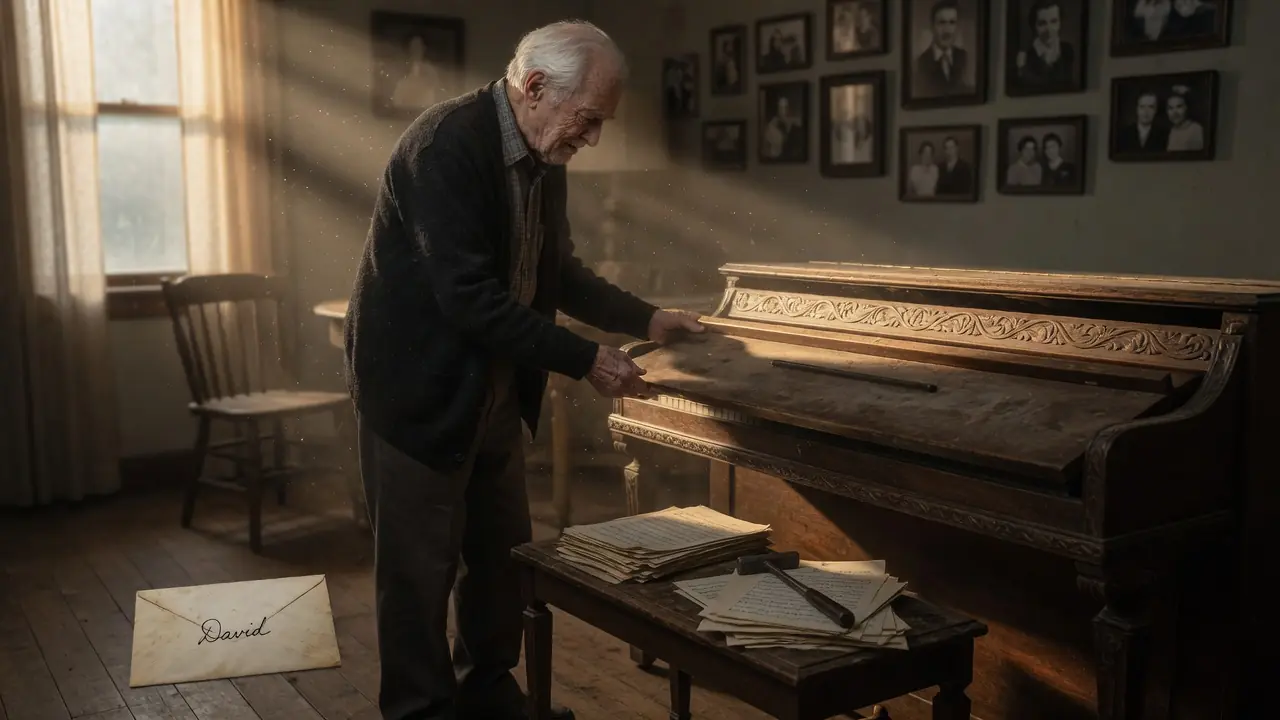 As I lifted a book of Chopin sonatas, something slipped out from between the pages and fluttered to the hardwood floor.
It was a standard white envelope, sealed shut, but the paper had aged and yellowed around the edges. I bent down to pick it up, and the moment my eyes registered the ink on the front, all the air left my lungs.
It was Janet’s handwriting. Neatly printed in her distinct, looping cursive, it was addressed simply to: David.
In the top right corner, she had written a date. It was the exact date of the night before her surgery. The night she made me promise.
My hands began to shake violently. I walked over to the armchair by the window, my knees feeling like they were about to give out. For forty years, I had held onto her final spoken words as if they were a sacred text, torturing myself over my inability to follow them. And now, out of nowhere, here was a physical piece of her, hidden away in a place she knew I would eventually find.
I slid my thumb under the brittle flap of the envelope and tore it open. Inside was a single piece of lined notebook paper. I unfolded it, blinking rapidly to clear the tears that were already blurring my vision.
The first line said: "I knew you were lying."
I let out a sound that was half-gasp, half-sob. I kept reading.
"My dearest David. If you are reading this, it means the worst has happened, and knowing how incredibly stubborn you are, it means it has probably been years and you are still sitting in a quiet house all by yourself. Tonight in the hospital, I made you promise to marry again. You looked me right in the eye and said you would. But David, you have always been a terrible liar."
"I saw the panic in your face. I know you. I know you will try to martyr yourself for my memory. You will think that staying alone is the greatest tribute you can pay to our love. You will think that giving my chair at the table to someone else is a betrayal. I am writing this and hiding it in the piano because I know you won't believe my words tonight, and you will need to hear them again later."
"Do not let our daughters grow up thinking that love is supposed to be a lonely endurance test. You were the best thing that ever happened to me, and you have so much left to give. If you have pushed good women away because of me, I want you to stop right now. I am releasing you. I am not in that dining room chair anymore. I am not in the walls of that house. The only place I want to be kept is in your heart, not in your daily life. Forgive yourself for living. Please, David. Go live."
I sat in that armchair for three hours, clutching the letter to my chest and weeping until I had absolutely nothing left in me. It felt like a physical weight, one I had been carrying for four decades, had been abruptly lifted off my shoulders. She had known all along. She had known my flaws, my stubbornness, my debilitating loyalty, and she had loved me through it anyway. She had reached across time to give me the absolution I could never give myself.
That evening, I called both of my daughters. I asked them to come over the following day. When they arrived, looking concerned by the urgency in my voice, we sat down at the dining room table. For the first time in forty years, I didn't sit at the head of the table. I sat right in Janet's chair.
I placed the yellowed letter in the center of the table and finally told them the absolute truth. I told them about Sarah, Elaine, and Marie. I told them about the promise, the guilt, and the cowardice. And then, we read the letter together, three generations of our family crying and healing over a piece of notebook paper.
I am seventy-one years old now. It might be too late for me to fulfill the promise of finding a mother for my girls—they are mothers themselves now. But it is not too late to stop guarding a ghost. Tomorrow, I am going to a community center to sign up for a local gardening club. It’s a small step, but for the first time in forty years, I’m finally looking forward to meeting someone new.