The rain came in from the moors without warning, the way most trouble did in North Yorkshire. It was the third week of November, 1818, and the lane between Hartwell Farm and Cavell Hall had turned to mud an hour before Cecily reached it. She had not planned to walk. She had planned to send another letter, a third letter in fact, more direct than the second, with the relevant clauses from the deed of conveyance copied out in her own hand, so that there could be no further confusion about what the sale of Marron Field would mean for her access to the lower pasture.
But the letter had not arrived in time. The solicitor's notice had. And so here she was on foot in November, because her brother Thomas had taken the horse to Harrogate three days ago, and had not yet seen fit to return it.
The gates of Cavell Hall appeared through the gray iron, tall, the kind of gates that were designed to make a visitor feel the distance between where they stood and where they were not yet permitted to be. Cecily had passed through them perhaps a dozen times in her life, twice as a girl, accompanying her father on estate business, once at a neighborhood dinner that her mother had dressed her for with unusual care, and several times in the years after that, during the period she did not name to herself anymore.
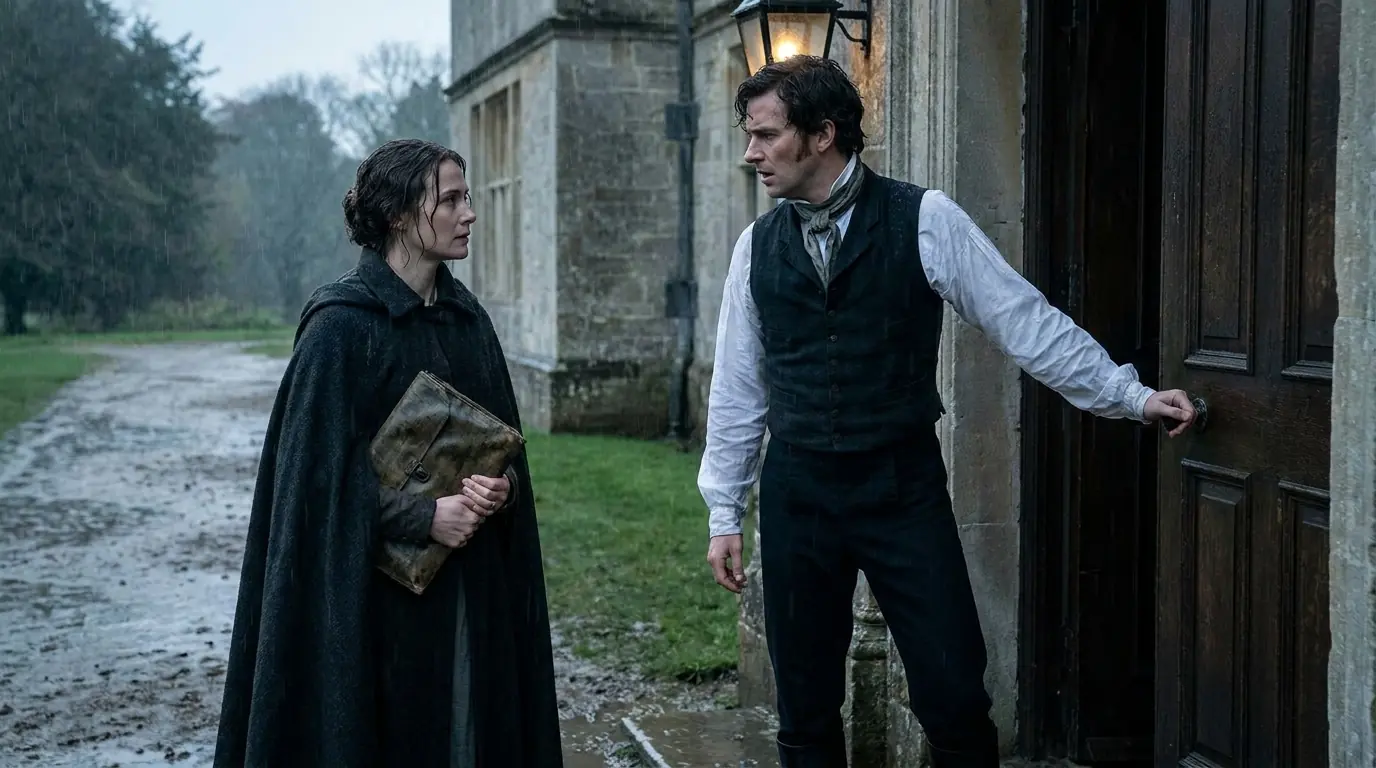
She pushed the left gate open. It swung easily, which surprised her. She had expected resistance. The drive was gravel, or had been. Leaves had gathered in the low places, and the rain was doing what rain did. She kept to the grass edge, where her boots had some chance of remaining intact, and walked the quarter mile to the front steps with her head down and her document case pressed against her side beneath her cloak.
The case was oilcloth. The documents inside it were dry. This was the most that could be said for the situation. She did not look at the house as she approached. She had decided on the walk over that she would look at the door and only the door, knock, state her business to whoever answered, and be shown into whatever room was designated for persons conducting estate matters.
She would conduct the matter. She would leave. She had managed three years without being in the same room as Edmund Cavell. One afternoon was entirely within her capability. She knocked. The door opened before she had fully lowered her hand.
It was not Mrs. Padgett. It was Edmund himself, which was wrong and impractical, and the first of several things that afternoon that refused to go as she had arranged them in her mind. He was in his shirt sleeves, which meant he had come from somewhere in the house rather than from out of doors, and he was holding a folded letter, which he lowered slowly as he registered who was standing on his step.
For a moment, neither of them spoke. The rain fell. Somewhere behind her a crow called once from the elm line and went quiet. Miss Hartwell, he said. Mr. Cavell.
She kept her voice level. She had practiced it on the walk. I apologize for arriving without notice. I wrote to Mrs. Padgett three days ago, but I believe the letter was delayed. May I come in?
It was not quite a question. He stepped back from the door. The entrance hall of Cavell Hall was exactly as she remembered it, which was irritating. The flagstone floor, the dark oak staircase, the portraits of Cavells going back to the reign of George II, all of them with the same set jaw and the same expression of mild dissatisfaction with everything in their immediate vicinity.
Edmund fit the portrait gallery well. He always had. She pushed her hood back. She was wetter than she had intended to be, and was aware of it with the particular discomfort of someone who had planned to arrive composed.
Are you walked? he said. He was still looking at her with the expression she did not want to catalog. Thomas has the horse.
You should have sent word. I would have sent the carriage.
I did not want the carriage.
She turned to face him directly, because looking away was not a thing she permitted herself. I want to discuss the sale of Marron Field. I understand the papers are to be signed at the end of the week, and I would like to present a formal objection before that occurs.
Something moved through his expression and settled. Come through to the study.
She followed him. She looked at the back of his head and the set of his shoulders, and thought with clinical precision that three years had not changed him in any way she could identify. This seemed unfair.
She had cut her hair. She had learned to manage a household budget. She had developed in the long months after he had made his choice a comprehensive theory of self-sufficiency that she had put into daily practice until it no longer required effort.
She had changed considerably. He had simply continued to exist in this house, in this county, looking exactly like Edmund Cavell.
The study was warm. A fire had been lit, and the room smelled of wood smoke and old paper, and she recognized the desk and the two leather chairs and the window that looked out over the kitchen garden, and all of it was unbearable in the quiet, manageable way that she had grown accustomed to.
She did not sit until he gestured to the chair across the desk. Then she sat, placed the document case on her knees, and opened it. The deed of conveyance for Marron Field, she said, drawing out the relevant pages, contains a covenant from 1791 establishing a right of way across the south boundary for the use of Hartwell Farm.
If the field is sold to Mr. Ashford, that covenant passes with the land. But Mr. Ashford has already indicated through his solicitor's letter, which I have here, that he intends to enclose the south boundary within the first season.
She placed the letters on the desk between them. He did not pick them up immediately. He was watching her with that particular stillness he had, the kind that other people sometimes mistook for indifference, and she had long since stopped making that mistake.
I am aware of the covenant, he said.
Then you are aware that enclosing the boundary would render it void.
Yes.
And you intend to sell regardless.
A pause. I had not yet signed. The weekend's Friday.
I am aware of when the weekend is, Miss Hartwell.
She held his gaze. He held hers. Outside the rain intensified against the window glass, which was the kind of thing North Yorkshire did when you least required its assistance.
The lower pasture, she said, keeping her voice even, accounts for a third of our grazing. If access is lost, we cannot sustain the flock through winter. Thomas is already
She stopped. She had not meant to mention Thomas.
Edmund waited.
The farm requires that access, she said. I'm asking you to either decline the sale or include a protective clause in the conveyance before you sign.
He picked up Mr. Ashford's solicitor's letter. He read it. He set it down and picked up the deed and read the relevant passage, and she watched his face while he did it, and tried to feel nothing in particular, which was only partly successful.
I did not see this letter, he said of the solicitor's correspondence.
Your estate agent handled the negotiations.
Dawson should have brought this to me.
Perhaps. She kept her tone neutral. Regardless, I am here now.
He set the papers down and looked at her, and she saw the moment he registered the full weight of what she had not said, that she had walked a mile in November rain rather than risk a delay of even a day, because the farm could not absorb the loss, and that she had done this without asking anyone for help, and that she had done it knowing full well whose door she was knocking on.
You are soaked, he said.
I am functional.
Cecily.
Miss Hartwell.
The correction came out cleanly without heat, which she considered one of her finer achievements of the afternoon. He was quiet for a moment, then will you permit Mrs. Padgett to bring you something warm while I review the full conveyance? This will take a quarter of an hour.
It was precisely the correct thing to offer, practical, unloaded. She could not refuse it without appearing petulant, and she was not petulant. She was competent and cold and here on legitimate business.
Thank you, she said. That would be acceptable.
He rose and went to pull the bell. She looked at the window and not at his desk, and specifically not at the left-hand drawer of his desk, which was closed, and which she had absolutely no reason to look at.
Mrs. Padgett arrived with tea and a dry shawl, and the expression of a woman who had been hoping for exactly this development, and was exercising considerable restraint about it.
Miss Hartwell, she said, settling the tray with the practiced efficiency of twenty years in this house. I am sorry about the letter. I only received it this morning.
It is no matter, Mrs. Padgett. The important thing is that it arrived.
Indeed. Mrs. Padgett poured the tea and set the shawl on the arm of Cecily's chair with a decisiveness that suggested it would be placed around her shoulders if she did not place it there herself.
And how is the farm? I heard the August shearing went well.
Tolerably well. Cecily accepted the tea, and after a moment picked up the shawl. It was warm and smelled of lavender and cedar, and she disliked how much she appreciated it. We have managed.
Mrs. Padgett's expression softened with something that was not quite pity and not quite admiration, but lived in the territory between them.
You always do, miss.
Edmund had taken the deed and the relevant correspondence to the window on the far side of the room, and was reading with his back to them. He did not participate in the exchange.
She was aware of this in the way she was aware of the fire, as a source of warmth she was not going to acknowledge.
The library has acquired two new volumes since your last visit, Mrs. Padgett offered. A natural history of the Yorkshire moors, and a collected letters of Mr. Gray.
I thought you might find them of interest.
Cecily glanced toward the library door, which stood ajar at the far end of the study. She had spent a considerable number of hours in that library in the period she did not name. She had read three of its histories and one of its atlases, and had borrowed, with permission, a volume of botanical illustrations that she had not yet returned.
That volume was currently on the shelf above her father's writing desk at Hartwell Farm. She had not thought about it in months. She thought about it now.
That is kind, she said, but I shan't be staying long enough.
From the window, Edmund turned a page. He said nothing. She drank her tea.
He returned to the desk ten minutes later and sat down and looked at her with the expression of a man who had arrived at a conclusion he did not entirely welcome.
The covenant is valid and enforceable, he said. Ashford's intention to enclose would constitute a clear breach if the sale proceeds without a protective clause. I should have caught this before it reached this stage.
Yes, she agreed.
I intend to instruct Dawson to draft a clause preserving the right of way in perpetuity before any sale proceeds.
And if Ashford declines the amended terms?
Then I do not sell the field.
She looked at him. He looked at her. She could not with any honesty fault the answer.
Thank you, she said.
She began to return the documents to her case.
Cecily. He said it quietly and without the correction he knew was coming.
She kept her hands moving, folding the letters, fitting them into the case, fastening the clasp.
I would like to speak with you.
But you have spoken with me, she said. The matter is resolved.
There is nothing else.
I think there is.
She stood. She placed the document case under her arm. She looked at him across the desk, at the set of his jaw, and the particular quality of his stillness, and the fact that he was watching her with something she could read perfectly well and had no intention of reading aloud.
It has been a long walk, she said, and it is still raining. Good afternoon, Mr. Cavell.
She left the study.
She found the entrance hall on her own and let herself out of the door and walked back down the gravel drive in the rain, which had not lessened, and kept her eyes on the gate and did not look back at the house.
She did not permit herself to feel anything about that until she was past the elm line and out of sight of the windows.
Then she walked faster.
The protective clause was drafted by Wednesday. Dawson delivered it to Hartwell Farm in person, which told Cecily that Edmund had impressed upon him the urgency of the matter with some force.
Dawson was a man who moved at his own geological pace under ordinary circumstances.
She read the clause twice, found it sound, signed her name as a witness to the acknowledgement, and returned it with a brief note of thanks addressed to Edmund's estate agent and not to Edmund.
This was the correct approach.
It was concluded. She could return to the ordinary business of winter. The accounts, the flock, the roof of the north barn that Thomas had been promising to repair since September.
Thomas returned from Harrogate on Thursday, cheerful and hoarse and full of news about a new acquaintance, a Mr. Fenwick, who had property near Ripon and was reportedly excellent company.
Cecily listened to the account of Mr. Fenwick's excellent company while she reviewed the feed accounts and said nothing about Monday's walk or its purpose or its outcome.
Thomas would have been horrified and then apologetic and then would have said something well-meaning and useless about Edmund Cavell that she would have had to quietly bury.
She had become expert at burying things quietly. It was one of her more transferable skills.
On Friday morning, Mrs. Padgett appeared at the door of Hartwell Farm with a basket of preserves and the manner of a woman who had invented an errand.
From the Cavell kitchen, she said, setting the basket on the entrance table as though this were an established custom and not the first time it had occurred in three years. Cook made rather too much quince this autumn.
That is very kind, said Cecily. Please thank her and please pass along our thanks.
Mrs. Padgett showed no sign of leaving. She looked around the entrance hall with the alert attention of a woman cataloging the state of things and filing it away for future reference.
The house is well, she observed. You have kept it very well, Miss Hartwell.
We manage.
Mr. Cavell wished me to inquire, that is, he thought you might.
Mrs. Padgett paused with the expression of someone abandoning a prepared speech for a more direct approach.
He has the natural history of the Yorkshire Moors if you would like to borrow it. He thought you might find it useful for the lower pasture question. There are chapters on drainage patterns.
Cecily looked at the basket of preserves. She looked at Mrs. Padgett. Mrs. Padgett looked back with the serene composure of a woman who had spent twenty years managing a difficult household and had no intention of being outmaneuvered by a twenty-eight-year-old in a farmhouse.
Tell him thank you, said Cecily. I have a sufficient understanding of the drainage patterns.
Mrs. Padgett accepted this without visible disappointment. She retrieved her coat and her basket, wished Miss Hartwell good morning, and departed down the lane at a pace that suggested she was in no great hurry to deliver any particular answer.
The book arrived the following Tuesday, delivered by one of the Cavell grooms with a note that said only, Chapter 7. The lower pasture's eastern edge sits on a drainage ridge I believe you may not have accounted for. EC.
She read Chapter 7 that evening by the fire with a glass of the inferior claret her brother had opened and left half finished on the sideboard.
The chapter was about Yorkshire drainage. It was also, on its face, a perfectly reasonable piece of agricultural correspondence between neighboring landowners.
She read the drainage ridge passage twice. He was correct. She had not accounted for it.
She sat with this information for some time, turning her wine glass slowly in her fingers.
Then she took a sheet of paper from the writing desk and composed a reply.
Mr. Cavell, you are correct about the eastern edge. I've examined the relevant survey maps and the ridge is precisely where you indicated. I will need to adjust the winter rotation accordingly.
I am returning your book with thanks. Chapter 9 was also of interest. C. Hartwell.
She sent it with the book the next morning and spent the rest of the day doing accounts and not thinking about Chapter 9, which had contained in the margins, in a hand she recognized, three small annotations in pencil about the botanical character of the moorland grass varieties.
He had read it. He had thought about it enough to annotate it. He had then sent it to her.
She was very busy and did not think about this.
The reply came Thursday.
Miss Hartwell, Chapter 9 was always the best chapter. The author is a Harrogate man and had access to specimens the London naturalists could only guess at.
If the eastern ridge presents difficulties this winter, I am happy to ride out and look at it. The drainage from the Cavell land may be contributing to the problem. EC.
She folded the letter and put it in the writing desk and closed the drawer.
She opened the drawer again and read it once more.
She put it back and closed the drawer and went to supervise the north barn repair, which Thomas had finally, under considerable pressure, begun to address.
You are distracted, Thomas observed from the top of the ladder.
I am watching to ensure you don't fall off the roof.
You're looking at the lane.
I am looking at the north field.
Thomas descended two rungs and looked at her with the particular expression of a younger brother who has spent a lifetime paying attention.
Has something happened?
Nothing has happened. There was a land matter which is now resolved. Nail the board.
Thomas nailed the board.
He did not ask further questions, which was the most intelligent thing he had done all week.
Edmund rode out to the eastern ridge on a Saturday morning because the drainage question was a legitimate one and could not be adequately addressed by correspondence.
And Cecily met him there because she was not going to send a farm hand to discuss her own land with her own neighbor.
She arrived first.
He arrived six minutes later on the gray mare she recognized from three years ago, which had apparently also declined to change.
Miss Hartwell, he said.
Mr. Cavell.
She had brought the survey maps. She spread the relevant section across the stone wall at the field's edge and weighted the corners with rocks because the wind on the moors did not care about property disputes or old acquaintances or the careful distance she was maintaining.
He dismounted and came to stand beside her at the wall. Not close, at the appropriate distance for two landowners examining maps together.
She was aware of the distance with more precision than she would have liked.
Here, she said, pointing, and here. The ridge runs northeast, which means the winter runoff from your upper field is feeding directly into my eastern pasture.
He leaned over the map. And you've seen standing water there?
Every November for two years.
I should have noticed this from my side. He said it without qualification or excuse, and this was one of the things about him that she had never successfully argued herself out of admiring.
He was honest about his failures in exactly the way that made them impossible to hold against him for long.
She concentrated on the map. If you were to redirect the drainage channel from your upper field here to the northwest, it would solve the problem entirely.
I could absorb the cost of the channel work on my side of the boundary.
There's no need for that. The source is on Cavell land. I'll have it dug before the end of the month.
I would prefer to share the cost.
Miss Hartwell.
I would prefer, she said quietly, not to be obligated.
He went still beside her.
She looked at the map and not at him, but she felt the quality of his stillness change, the recognition that she had said something more than she meant to say, or perhaps exactly what she meant to say, which was worse.
I understand, he said after a moment.
Good.
The wind lifted the corner of the map. They both reached for it.
Their hands arrived at the same stone at the same time, and she pulled back, and he waited the corner, and she looked at the moors to the north, where the sky was the particular pale gray of November that felt less like a color than an absence of one.
How is Thomas? he asked.
Well. He has a new friend in Harrogate.
And the farm?
Managing. She rolled the map and tucked it under her arm. As I said.
Cecily.
She did not correct him this time, and this was a concession she noticed and was annoyed by.
I would like to I want to say
Please, don't.
A silence. The wind.
Somewhere on the moor a curlew called its long descending note and was swallowed by the gray.
Not today, she said more quietly. The drainage is what matters today.
He looked at her for a long moment with an expression she could read the outline of and refused to fill in.
Then he nodded once, and she appreciated it. The absence of pressure, the acceptance of the boundary. In spite of herself.
I'll send Dawson's man before the month's end, he said.
Thank you.
She walked back toward the farm lane without looking behind her. She heard him remount. The sound of hooves on the frozen ground moved away in the opposite direction, back toward Cavell land.
And she walked and breathed the cold air and tried to feel only the cold.
November became December with the particular abruptness that Yorkshire specialized in.
The drainage channel was dug as promised, and the eastern pasture remained dry, and Cecily wrote a note acknowledging this that took four drafts to achieve the correct register of thanks without warmth.
She sent the third draft because the fourth had been too warm, and the second had been too cold, and she was not going to write a fifth.
He replied.
He always replied, brief, practical, precise, with the occasional observation that had nothing to do with farm business and everything to do with the fact that they were, despite all evidence to the contrary, people who had once read the same books and walked the same moors and spent a winter and a spring discovering they were more interested in each other than in anyone else they had ever met.
He mentioned in one letter that the elm at the east gate had come down in the November wind. She had watched that elm put out leaves every April for as long as she could remember.
She wrote back.
I am sorry about the elm. It was a good tree.
And then was immediately embarrassed by the sentiment and sent the note before she could reconsider because reconsidering was the enemy of honesty.
He wrote back. It was the best tree on the property. I've had the timber saved. I don't know yet what to do with it.
She read this standing in the entrance hall with her coat still on and did not know what to do with it either.
The neighborhood Christmas gathering was held at the Mercer house three miles east on the twenty-second of December.
Cecily attended because she always attended and because absence would generate more conversation than presence.
She wore her good blue wool and her mother's garnets and arrived with Thomas who immediately found someone to talk to about horses.
Edmund arrived an hour after she did.
She was in conversation with Mrs. Mercer about the spring planting calendar and saw him enter from across the room and returned her full attention to the spring planting calendar with the automatic precision of long practice.
She heard him working the room, the low voice, the measured pleasantries, the laugh that came rarely enough to mean something when it appeared.
She heard him speaking with old Dr. Weathers about the county road bill and with young Mercer about the hunting.
She heard him get closer.
Miss Hartwell.
He was at her elbow between the fireplace and the window with a glass of wine and the expression of a man who had navigated toward her with enough patience and indirection that she could not reasonably object to his arrival without making a scene.
Mr. Cavell.
She kept her voice pleasant and her eyes forward. Mrs. Mercer had retreated to speak with someone else with what Cecily considered suspiciously convenient timing.
I have been meaning to ask, he said. The winter rotation, did the adjustment work?
It did. The flock is in good condition.
I'm glad.
A pause.
Around them the room talked and laughed and did not pay them any particular attention, which was either fortunate or a fiction they were both maintaining.
The elm timber, she said because she had not meant to say it but found herself saying it anyway. You said you didn't know what to do with it.
I still don't.
My father had a table made from the oak that came down by the south lane. It's the best piece of furniture in the house.
He looked at her. She looked at the fire.
A table, he said. Or a desk, something that would last.
Yes.
He was quiet for a moment.
That's a good idea.
She nodded.
She picked up her glass and drank from it and thought about the fact that she was standing six inches from Edmund Cavell discussing furniture and it felt, against all the discipline she had invested in the past three years, entirely natural.
Cecily, he said.
And his voice had changed register, dropped below the social register, below the neighborly register, into the one she remembered and had spent three years forgetting.
Don't, she said quietly without heat.
I have wanted to
Edmund.
She said his name. She had not said his name since before.
It fell out of her mouth with the ease of something that had always been there, waiting. And she felt the betrayal of it immediately.
This is a dinner party. There are fourteen people in this room.
Then let me call tomorrow.
You are my neighbor.
Yes.
We are conducting neighborly business.
Are we?
She turned and looked at him then, which was a mistake because he was looking at her with the full weight of three years behind his expression, and she could not fault the expression.
She could read it perfectly. She had read it perfectly three years ago and had believed in it, and it had not been enough to keep him because a dying man's request had been enough to take him.
Not today, she said again.
He held her gaze. You keep saying that.
Because it is not today.
She stepped back just slightly.
Good night, Mr. Cavell.
She found Thomas and spent the rest of the evening on the far side of the room and went home before the dancing started, which was the only thing that could be said for the evening.
The garnets were her mother's. Her mother had worn them to every important occasion of her marriage. Cecily took them off in front of the mirror that night and put them in their box and closed it and held the box for a moment before she set it on the shelf.
Not today did not mean never. She had not said never.
She was aware of this. She was also aware that she had said his name and that he had heard her and that he would remember it the way she would remember it.
She put out the candle and lay in the dark and listened to the Yorkshire wind and thought about a letter she had not seen and would not think about yet.
January brought snow and a frozen pump and the news via Mrs. Mercer that Mr. Ashford had declined the amended sale terms for Marron Field and the sale had not proceeded.
Cecily heard this with the composed attention she brought to all neighborhood news and thanked Mrs. Mercer and said nothing further and spent the walk home turning over the fact that Edmund had declined to sell rather than remove the protective clause, which he could have done, which Ashford had presumably proposed.
She did not write to him about it.
She thought about writing to him about it and then thought about what writing to him about it would mean and put the paper away.
He wrote to her instead four days later, not about the field, about the snow, about the north road which was impassable, and a family in the village who had found themselves without fuel and a supply he had sent from the Cavell stores.
He mentioned it the way he mentioned most things he did quietly, briefly as a fact, not as a virtue.
He asked if there was anything the farm required.
She replied. The farm is well supplied. Thank you for the inquiry.
What you have done for the Hobson family is a kindness. C.H.
She looked at this note for a long time after she had written it. Then she added below the signature, I heard about Marron Field. Thank you.
She sent it before she could remove the last line.
He came to the farm on a Thursday in the second week of January.
She did not know he was coming.
She was in the barn checking the ewes because two of them had been off their feed and the weather made a veterinary call impractical, and she had learned enough in three years to manage most things herself.
She was in her oldest dress and her father's coat, and her boots were not the ones she would have chosen if she had known she was going to see anyone.
Thomas met him at the gate and brought him around because Thomas had no instinct for when his timing was catastrophic.
Edmund Cavell, said Thomas appearing at the barn door with the cheerful obliviousness that was his defining characteristic. Come to look at the drainage situation, he says.
Edmund stood in the barn doorway in the winter light. He looked at her. She looked at him from her position beside the larger ewe with straw in her hair and her father's coat buttoned wrong.
The drainage situation, she said.
The eastern channel. I wanted to see how it performed after the freeze.
He said it with a straight face. He was a good liar. She had not known that about him until this moment and filed it away with the other things.
Thomas, she said without looking away from Edmund. Weren't you going to check the north fence?
I checked it yesterday.
Check it again.
A pause.
Right, said Thomas.
He retreated with the good-natured incomprehension of a man who understood that he was being removed from a conversation without understanding why.
His footsteps crunched away across the frozen yard.
She looked at Edmund. He looked at her.
The drainage, she said.
I came to see you, he said. I will look at the drainage as well, but I came to see you.
She stood and brushed the straw from her coat and said nothing, which was not agreement and not refusal.
He came further into the barn.
He stopped a proper distance away, which she both appreciated and resented.
I have been writing to you about farm business, he said, for two months.
Yes.
And you have been writing back.
Neighbors write to one another about farm business.
Cecily.
Edmund.
His name again.
She could not seem to stop saying it, which was a failure she acknowledged and moved past.
What do you want me to say?
I want you to say what you think.
I think, she said carefully, that you are a man who made a promise and kept it, and that I respect you for it, and that it cost me considerably, and that the cost does not disappear because the circumstances changed.
He was quiet for a moment.
No, it doesn't.
Then you understand why I cannot simply
She stopped. She turned and checked the ewes' water, which did not need checking.
You spent three years as an engaged man, and I spent three years watching you be one.
I know.
You chose it.
I chose to honor my father.
His voice was even, but she heard what was underneath it.
I would not have chosen to lose you.
You chose both.
He did not deny it. This was again the thing about him that she could not argue with.
The honesty about what he had done and what it had cost and what he did not pretend otherwise.
She had spent three years being angry at him, and the anger had always run up against this.
He was not a man who made excuses.
I know, he said again.
I am not asking you to forgive it. I am asking you to
He stopped.
He looked at the hay-strewn floor of her barn, which was probably not what he had imagined for this conversation, and she saw the corner of his mouth move in something that was not quite a smile.
I'm asking you to say his name again.
She looked at him.
I have said it twice, he said, at the Mercer dinner and just now, and both times you've looked as though you hadn't meant to.
I hadn't.
But you did.
The ewe shifted behind her.
Outside the wind moved across the frozen yard and rattled the barn door.
Edmund, she said deliberately this time, looking directly at him, and watched him receive it.
I have been angry at you for three years, and for three years I have also known precisely why you did what you did, and I have not been able to entirely hold it against you, and that has made me angrier.
She paused.
I am very tired of being angry.
He took one step toward her, then stopped.
It is not a decision one makes.
Isn't it?
She looked at him.
He looked at her.
The space between them was cold and full of hay dust and the breath of two ewes and three years of deliberate distance.
I need to think, she said.
Take all the time you need.
I may need a great deal of it.
Cecily.
He said her name the way he used to say it, not as a summons, but as a fact, as the name of a specific person he was glad existed.
I have the elm timber in the workshop. I have been thinking about what to make from it for six weeks.
Every time I think of it, I think of you.
He paused.
That is all I wanted to say.
He turned and left the barn, and she stood in the cold and the straw and listened to his footsteps cross the yard and heard Thomas's voice, and then the sound of a horse, and then only the wind.
She put her hand on the ewe's warm flank and stood there for a moment.
Then she went inside, took off her father's coat, and sat down at the writing desk.
She did not take out paper.
She opened the left-hand drawer instead and looked at what was inside it.
There was nothing there that should have troubled her.
A spare nib, a stub of sealing wax, a letter from Thomas's school, six years old, that had somehow never been cleared out.
She thought about the left-hand drawer of Edmund's desk.
She had not looked at it on Monday in November when she had sat in his study and presented her objection about the field.
She had looked at it for one moment with the peripheral attention of someone cataloging a room they had not been inside for three years and had noted that the drawer was closed and had not opened it with her eyes again after that.
She thought now about why she had looked at it at all.
She thought about what might be inside it.
She closed her own drawer.
She sat for a long time with her hands in her lap and listened to the January wind and thought about a man standing in a barn doorway in winter light saying that every time he thought of the timber from a fallen elm he thought of her.
Then she stood up, put on a better coat than her father's, and walked out the door.
She had not planned to go to the library.
She had planned, if she examined the plan honestly, to walk far enough to be away from the house and then turn around and return and do nothing further today.
But it was cold, and the lane to Cavell Hall was the lane that went toward the moors, and her feet had a long memory, and she arrived at the gates before the argument with herself had reached any conclusion.
Edmund was in the stable yard when she came through the back gate, the way she always used to come, unbuckling the gray mare's bridle and handing it to the groom.
He turned when he heard the gate and looked at her with an expression that was perfectly controlled except for his eyes.
I want to see the study, she said.
He paused. Why?
She had not prepared an answer to this because she had not admitted to herself that this was what she was doing until she was standing in his stable yard asking for it.
Because I want to see it, she said.
He handed the groom the rest of the tack and led her through the kitchen entrance past Mrs. Padgett, who saw them and said absolutely nothing, which was the loudest thing she had said in twenty years.
Down the corridor and through the door and into the study, which was warm and firelit and exactly the same.
She walked to the desk. She stood in front of it.
She looked at the left-hand drawer.
Cecily, he said from behind her.
She opened the drawer.
Inside it was a letter, folded once.
The paper had yellowed slightly at the edges, which happened to paper kept for three years in a wooden drawer.
Her name was written on the outside in his hand, not Miss Hartwell, her name.
She picked it up. She turned around.
He was standing just inside the door with the expression of a man watching something he cannot stop, which is different from the expression of a man who wants to stop it.
When? she said.
The week before my father died.
His voice was even.
I wrote it the night he told me about the promise. I never sent it.
She looked down at her name in his writing.
She looked up at him.
What does it say?
A long pause.
Everything, he said, that I should have said then.
She held the letter. She did not open it.
She looked at the man who had written it three years ago and kept it in a drawer for three years and had told her today in a freezing barn that the elm made him think of her,
and she thought about all the versions of this moment she had imagined and then refused to imagine and then imagined again,
and she thought about being tired, and she thought about three years, and she thought about the particular quality of his expression.
If I read it, she said, and it says what I think it says,
it does.
Then I will be very angry, she said, about the three years.
I know.
And I will need you to sit there.
She pointed to the chair across the desk.
And let me be angry about it without defending yourself because there is no defense, and we both know it.
Something moved through his face, grief and relief and something that was neither.
Yes, he said.
She sat down in the chair on her side of the desk. He sat down in the chair on his.
The fire burned. The snow pressed at the window.
She unfolded the letter.
She read it.
She read it twice.
Outside, the January wind moved across the moors of North Yorkshire, indifferent and ancient and entirely unaware that inside a study in Cavell Hall a woman was sitting with a three-year-old letter in her hands and crying with the controlled, furious precision of someone who has been right about everything and is now faced with proof of it.
Edmund sat across from her and said nothing, which was exactly what she had asked him to do, and was the correct thing, and she hated him for it a little and was grateful and was very, very tired of the past three years.
She folded the letter. She set it on the desk between them.
She pressed her hands flat on the surface and breathed.
Well, she said.
Well, he said.
The fire cracked. The snow fell.
Mrs. Padgett in the kitchen corridor found something to organize at considerable volume and found it took rather a long time.
The letter stayed on the desk between them.
Cecily did not touch it again.
She had read it twice, and that was sufficient.
She knew what it said, and she knew what it meant, and she knew, sitting in the leather chair across from Edmund Cavell with her hands pressed flat on the desk surface, that she was going to have to decide what to do with all of it,
the knowledge, the three years, the fact that he had written every word of it and folded it and put it in a drawer and left it there while he went and did what his father had asked him to do.
She looked at the fire.
Tell me, she said. Tell me what he said to you, your father.
Edmund was quiet for a moment.
Then he called me in on a Tuesday evening. He had been ill for three weeks, and we all knew it was close. He asked me to sit down.
He paused.
He told me that the estate was in worse condition than I knew, that there were debts I hadn't been told about accumulated over ten years, kept out of the accounts I was shown.
He told me the Ashford family had approached him two years prior about a consolidation of the landholdings, and that he had refused it then, but that the situation had changed, and that a marriage to Charlotte Ashford would settle the debt and secure the tenants and the farms.
And you said yes, Cecily said.
I said I would think about it.
And then?
And then he died four days later.
He said it flatly, without self-pity.
He died on the Saturday, and I was his executor, and I had four days of knowing what he had asked and not having given him an answer.
Cecily looked at him.
She understood the logic. She had always understood the logic.
Understanding it had never made it easier.
You could have come to me, she said.
Yes.
Before, in those four days?
Yes.
You didn't.
No.
He looked at the fire.
I told myself it wasn't fair to ask you to wait for an outcome I couldn't promise. That the honorable thing was to make the decision before I spoke to you again.
He paused.
That was not the real reason.
She waited.
The real reason, he said, was that if I had come to you and told you what I was considering, you would have said something that made it impossible to choose duty.
And I knew it.
And so I chose not to give you the opportunity.
The fire cracked. The snow at the window had thickened to a steady fall, the kind that settled in and meant business.
That is the most honest thing you have ever said to me, she said.
I have been working up to it for three years.
She looked at him, at the set of his jaw and the quality of his stillness, and the fact that he was watching her with an expression that held nothing back, no performance of composure, no careful management of what she was permitted to see.
I was not given the chance to choose, she said. You made the choice for me about my own life, and then sent me a very correct letter about how you hoped I would understand, and wished me every happiness.
She heard the edge in her own voice, and did not moderate it.
Do you know how many times I read that letter?
No.
Twice, she said, and then I burned it because reading it more than twice would have been a form of self-destruction I wasn't willing to permit.
He closed his eyes for a moment, opened them.
I know, he said. I knew it was wrong. I knew it the moment I sent it.
I wrote the letter in the drawer the same night when I understood what I had done, and then kept it.
And then kept it.
He held her gaze.
Because sending it would have been worse.
You had already received the correct letter.
Sending the real one afterward, asking you to carry the weight of what I felt while I went and honored the engagement, that would have been cruelty, not honesty.
She sat with this.
It was, she acknowledged silently, the conclusion she would have reached herself.
It did not make her less angry.
It did make him less of a villain, and she had never quite managed to make him a villain, which had been one of the central frustrations of the past three years.
I need you to understand, she said, that while you were engaged to Charlotte Ashford, I ran a farm.
I managed an estate in debt. I buried my father. I learned to do every single thing that needed doing without asking anyone for help, because asking for help required trusting that help would remain.
And I had recent evidence that it didn't.
His expression did not shift, but something behind it did.
I know, he said quietly.
You don't.
You know the surface of it.
You don't know what it costs to be that capable.
A long pause.
Tell me, he said.
She had not expected that.
She looked at him.
The directness of it, the willingness to receive what she had to say without flinching,
and felt the anger she'd been carrying shift in her chest, not disappear, but change shape, the way ice changes when you bring it into a warm room.
It costs, she said, the ability to let anyone in.
Because if you are relying on yourself entirely, the moment you let someone else carry part of the weight, you remember that they can put it down, and you cannot put it down.
So you stop letting anyone pick it up.
She paused.
I am very good at managing alone.
I am less good at believing it won't always be necessary.
He was quiet for a long time.
I did that, he said.
You contributed to it.
Yes.
He did not look away from her.
And I am asking not for forgiveness, because that's yours to give or not give as you see fit, and at whatever speed you require.
But I am asking whether it is possible, whether I am not too late.
She looked at the letter on the desk between them.
She thought about the Eastern Ridge and chapter seven, and the elm he hadn't yet decided what to do with.
She thought about Mrs. Padgett's basket of quince preserves, and the annotations in the margins of the natural history.
She thought about standing in a freezing barn with straw in her hair and saying his name.
I don't know yet, she said honestly.
That's not a no.
It is not a no.
She stood up.
She picked up the letter from the desk.
She held it for a moment, looking down at her name in his handwriting, and then she folded it and placed it inside her coat against her chest.
I'm keeping this.
He watched her do it and said nothing.
I need to think, she said, without you in the room.
Of course.
I may need several days.
Take them.
She looked at him one more time.
This man who had written her a letter and kept it for three years, and who had the elm timber in his workshop, and who sat very still across a desk and told the truth even when it did not help his case,
and she felt something settle in her chest that was not resolution, and was not forgiveness, but was something quieter and more fundamental.
The beginning of a decision that she was going to make herself, in her own time, without being rushed.
Good afternoon, Mr. Cavell, she said.
Good afternoon, Miss Hartwell.
She walked out of the study, through the entrance hall, past Mrs. Padgett, who was doing absolutely nothing in the corridor with tremendous concentration, and out into the January snow.
She walked home.
The letter pressed against her chest through the whole mile.
She read it again that evening by the fire, after Thomas had gone to bed.
It was eight paragraphs.
The handwriting was less controlled than his usual hand, which she noticed and cataloged.
He had written it in one sitting, probably late, almost certainly in the hours after his father's death, and he had said everything she had always thought he felt, and had never said aloud.
And he had said it with the particular clarity of a man who believes he is writing something that will never be read.
Those were, she had always found, the most honest documents in existence.
She read the sixth paragraph three times.
The sixth paragraph was about the morning in early spring, two years before his father died, when they had walked the boundary of the north field together, after a meeting between their fathers about the drainage covenant.
And he had watched her identify three different species of moorland grass by name, and had thought, he wrote, that I had never in my life met anyone I would less willingly live without, and that I did not know what to do with this thought, and that I carried it home, and have carried it since.
She set the letter down.
She sat for a long time.
Then she went to the writing desk and took out a sheet of paper, and picked up her pen and wrote, Edmund.
She stopped.
She looked at what she had written.
She put down the pen.
Not because she did not know what to say, but because she knew exactly what to say, and she was going to say it to his face, not on paper.
She had spent enough of this relationship corresponding at a distance.
She folded the blank sheet and set it aside and went to bed.
She slept well, which surprised her.
She had expected to lie awake with the letter and the sixth paragraph, and the weight of everything unsettled.
Instead, she fell asleep quickly, and woke in the cold January morning with the particular clarity that comes after a decision has been made below the level of conscious thought while you were sleeping.
She lay still for a moment, and acknowledged the clarity and what it meant.
Then she got up and made the bed, and went downstairs and told Thomas, who was eating toast at the kitchen table, that she was going to Cavell Hall and would be back by noon.
Thomas looked up from his toast.
He looked at her expression.
He looked at her coat, which was the good one.
Right, he said, in the tone of a man who has understood something and is choosing not to embarrass anyone by acknowledging it.
I'll see to the feed.
Thank you, she said.
She walked out into the January morning.
The snow had frozen overnight, and the lane crunched under her boots, each step precise and loud in the cold air.
The sky was the hard pale blue that came after a Yorkshire snowfall, the kind that looked almost warm until you were standing in it.
The fields on either side of the lane were white and undisturbed, except for a line of rabbit prints running along the Cavell boundary wall, which she noted with the automatic attention of a woman who had spent three years looking at this landscape and learning it by necessity.
She had thought on the walk over about what she wanted to say.
She had thought about it in the organized, methodical way she brought to difficult problems, identifying the component parts, determining their order, anticipating the responses.
She had then discarded all of it at the gate, because this was not a land dispute, and it did not benefit from the same approach.
She went in through the kitchen entrance again.
Mrs. Padgett was there at the range, and looked up when the door opened with an expression of someone who had been quietly hoping for exactly this development since approximately 1815.
Miss Hartwell, she said with a composure that cost her something.
Good morning, Mrs. Padgett. Is he in the study?
The workshop, said Mrs. Padgett, at the back of the stable yard, the old grain store.
Cecily thanked her, and went back out into the cold.
The workshop door was ajar.
She could hear from outside the sound of work, the steady passage of a plane along a wood surface, the grain giving way in long strokes.
She stood in the doorway for a moment before he heard her.
The elm was on the workbench.
He had begun to surface it.
The first planks cut and laid flat, the heartwood dark and figured, the grain running in the long lines of a tree that had grown for sixty years before the November wind took it.
He was working one of the planks with a smoothing plane, his coat off, his sleeves rolled, and he had not yet looked up.
She knocked on the door frame.
He stopped.
He turned.
He looked at her standing in his workshop doorway in the hard January light, and she saw what happened to his face when he saw her, and she thought, there it is.
You came back, he said.
I told you I needed to think.
I thought you meant several days.
I am faster than I indicated.
She stepped into the workshop.
It was warm, a small stove in the corner, the smell of fresh wood and sawdust, and the faint mineral smell of cold stone.
She looked at the elm on the workbench.
You've started.
This morning.
He set the plane down.
I decided it was a table.
She ran her hand along the surfaced plank.
The wood was smooth and cool, the grain visible in long parallel waves, dark at the heart and pale at the edge.
It was a beautiful piece of timber.
It'll be a good table, she said.
Yes.
He was watching her hand on the wood with an expression she had no desire to catalog, and every desire to look at.
She turned to face him.
I have been thinking, she said, about what you said yesterday.
About not giving me the chance to choose.
She paused.
You were right that it was wrong.
You were right that it was not the real reason.
And you were right that sending the real letter afterward would have been a different kind of cruelty.
She held his gaze.
I have decided that I cannot hold against you the fact that you acted from the only code you had.
Your father was dying.
You had made a promise in the way men of your character make promises, which is to say irrevocably.
And you kept it, and it cost you.
I know it cost you.
He did not speak.
The letter, she said, told me the things I suspected and did not permit myself to know.
And I spent a long time last night being angry about the three years, which I am still angry about.
And I suspect I will be intermittently angry about it for some time to come.
And I need you to understand that the anger will not be a retraction.
It will just be the anger.
I understand, he said.
I am not finished.
I know.
I'm not moving.
She looked at him, standing in his workshop with sawdust on his sleeves and the elm between them,
and thought about the sixth paragraph and the morning on the boundary, and what he had written about carrying it home and carrying it since.
I am also tired, she said.
I told you yesterday I am tired of managing alone.
I am tired of the discipline of it.
I am very good at it, and I would like to be very good at other things as well.
She paused.
I would like to choose.
He was very still.
I would like to choose, she said again more quietly, if you are asking.
He crossed the workshop in three steps and stopped just in front of her.
And she tipped her chin up and looked at him and thought that she had been this close to him in the barn and at the boundary wall and at the Mercer dinner.
And it had never been possible to be this close before now, because before now neither of them had said the true thing.
He lifted his hand and took hers, which was on the elm plank, and held it, and that was all, just held it.
And it was the simplest and most devastating thing that had happened to her in three years.
I am asking, he said.
Then I am choosing, she said.
He raised her hand and pressed his lips to her fingers once.
And she felt it in her chest and did not analyze it.
Cecily, he said against her hand.
Her name, the specific, plain, irreplaceable fact of it.
Edmund, she said back.
And this time she had meant to say it entirely.
They stood in the workshop for a while with the cold outside and the stove warm and the elm on the bench between them.
And she told him about the sixth paragraph, and he said he had written it last and almost cut it.
And she said it was the best paragraph.
And he said she was the only person who had ever made botanical taxonomy feel like a declaration.
And she told him she had identified those grass varieties with extreme deliberateness because she had known he was watching.
And he looked at her and said, I know.
And she said, You did not know.
And he said, I knew.
And she said, You might have said something.
And he said, I did.
I invited you to walk the boundary.
And she said, That was your idea of courtship.
And he said, It resulted in you knowing the eastern ridge better than I do, so I believe it worked.
She laughed.
She hadn't expected to laugh.
It came out as a small, real thing, the kind that couldn't be managed, and he heard it.
And it did what it always did when she laughed, which was the same thing it had always done, which was to change the quality of his stillness entirely.
You might have simply told me, she said, composing herself.
I told you everything, he said, in the letter.
Three years late.
Yes.
She looked at their joined hands on the elm.
She thought about the table it was going to be, solid, long-grained, made from a tree that had stood on this land for sixty years, and come down in a single night.
She thought about things that lasted.
Where will you put it? she said.
Wherever you think it should go, he said.
She looked up at him.
He was watching her with the expression that was no longer held back, the full weight of it, and she met it steadily.
We will discuss it, she said.
Yes, he said, we will.
Mrs. Padgett, informed of the development by the simple fact that they came in through the kitchen door together, and Miss Hartwell accepted a cup of tea without any qualification, received the news with the equanimity of a woman who had never doubted the outcome.
She said nothing direct.
She was too well trained for that.
She did, however, make the good biscuits.
Thomas was told that afternoon.
He sat across the kitchen table from Cecily with his toast going cold, and listened to the account with the expression of a man receiving information he had suspected for three years, and had given up expecting to be delivered.
Edmund Cavell, he said.
Yes.
Edmund Cavell, who
Yes.
Right.
He absorbed this for a moment.
Are you happy?
I'm cautiously in the process of becoming so.
That's the most you in the world, he said.
That sentence.
She looked at him.
He was smiling.
Not the oblivious smile, not the horseback smile, but the real one, the one that belonged to her brother who had watched her manage alone for three years and had known what it cost and had never known what to do about it.
It's going to be all right, she said, which she did not often say and only when she meant it.
Yes, said Thomas, I rather thought it was.
He ate his toast.
She drank her tea.
Outside the window the snow was white and undisturbed, and the lane to Cavell Hall ran straight between the walls, visible from where she sat.
Gray stone and frozen ground, and the particular quiet of a Yorkshire winter that had, as of this morning, changed its character entirely.
Edmund came the following day formally, in the sense that he sent word ahead and arrived at a proper hour, and sat in the Hartwell drawing room, and spoke with Thomas, who managed the whole thing with more dignity than Cecily had credited him with, and only knocked over one candlestick.
He brought the natural history of the Yorkshire Moors, which he had re-annotated in the chapters on eastern drainage,
and which Thomas received with polite confusion, and Cecily received with the private recognition of a woman who understands that some people express themselves best in the margins.
She walked with Edmund to the gate when he left.
The snow had softened in the afternoon, and the lane was quiet, and the early dark of January was coming in from the moors.
The protective clause, she said at the gate, for Marron Field.
Yes.
Did you always intend to include it before I came?
He considered this with the honesty that was his defining characteristic and his most inconvenient quality.
I reviewed the conveyance for the first time the morning after Dawson brought it.
I had not seen Ashford's solicitor's letter before.
When I read it, he paused.
No, I would have caught it.
But you hadn't looked.
I had not looked.
He met her eyes.
I'm sorry for that.
I know, she said.
I believe you.
She put her hand on the gate.
He put his hand over hers briefly, the way he had in the workshop, and she let it stay there for a moment before she opened the gate and let him through.
He walked down the lane toward Cavell Hall through the last of the January light,
and she watched until the line of the wall took him from view.
She stood at the gate for a moment longer.
The elm would be a table.
It would take three months, he had told her, to do it properly, to let the wood settle and surface and finish, to do it the way it deserved to be done.
Three months was not a long time measured against three years.
She found, standing at the gate in the cold, that she had a considerable tolerance for patience when patience was in the service of something real.
She went back inside.
They were married in April, in the church at the edge of the village on a day that could not decide between rain and sun, and eventually settled on both, which Thomas said was typical of Yorkshire, and Edmund said was appropriate.
Cecily wore her mother's garnets.
She had taken them out of the box in early March, when the question of the wedding had moved from abstract to practical, and had looked at them for a long time in the mirror before putting them on.
Her mother had worn them to every important occasion of her marriage.
They had sat in their box for three years, worn only twice since her mother's death, to the Mercer Christmas dinner and to one other occasion before that, which she remembered clearly during a period she now permitted herself to name.
She wore them.
They suited her.
They had always suited her.
The church was small, and the congregation was the neighborhood, the Mercers and the Weathers and the tenant families from both estates, and Mrs. Padgett, who sat in the third pew and maintained an expression of composed satisfaction that she had clearly been practicing since November.
Thomas stood up with Edmund.
He knocked nothing over.
Cecily walked in alone because her father was gone, and she did not require a proxy,
and stood at the front of the church and looked at Edmund Cavell,
who was looking at her with the expression she had read correctly three years ago and had been right about,
and said the words she had decided on in the full knowledge of what they cost and what they were worth.
He said his words back in his even voice, and she heard what was underneath them.
After, in the small gathering at Cavell Hall,
she stood in the drawing room with a glass of wine and watched Edmund speaking with Dr. Weathers across the room, and found that she was not cataloging the distance or managing the proximity, or maintaining any particular discipline about what she was permitted to feel.
She was simply standing in a room in her mother's garnets, watching a man she had chosen across a distance that had never been as wide as she had required it to be.
Mrs. Padgett appeared at her elbow with the expression of a woman who has something to say and has decided to say it now.
I never doubted, she said without preamble.
I know, said Cecily.
He kept the letter for three years.
I know that, too.
Men like him
Mrs. Padgett paused and straightened a small unnecessary adjustment to the tray she was carrying, which was a way of not looking too direct.
They do not keep letters they don't intend to send.
They burn them, or they don't write them.
He wrote it and kept it.
That tells you a great deal.
It tells me everything, said Cecily.
Mrs. Padgett nodded once, with the satisfaction of a woman who has been waiting twenty years to dispense this particular wisdom.
The letter was in the writing desk at Hartwell Farm in the left-hand drawer.
Cecily had returned it to her own keeping, which had seemed appropriate.
He had kept it long enough.
The elm table was in the study at Cavell Hall, surfaced and oiled and finished three weeks ago.
The heartwood darker than the rest.
The grain running long and short.
Edmund had put it beneath the north window where the light fell best.
She had told him it was the right place.
He had said he had thought so, too.
Across the room, Edmund looked up from his conversation with Dr. Weathers and found her.
She held his gaze.
He held hers.
The garnets were warm at her throat.
Outside the windows of Cavell Hall, the April light was moving through the rain, the way light moved across the Yorkshire moors in every season, briefly, with no promises, and entirely worth watching.
She raised her glass slightly toward him across the room.
He inclined his head once with the economy of expression that had always told her more than other men's speeches.
She turned back to the gathering and the wine and the noise of the neighborhood, doing what neighborhoods do on such occasions.
Beside her, Mrs. Padgett was already finding someone else to see to.
The letter was in the drawer.
The table was under the window.
The elm was a table and the three years were behind her, and there was a great deal of ordinary life ahead, which was the best and least manageable thing she could imagine.
She was not afraid of it, not even a little.