The slap echoed through the boardroom before Evelyn even registered the pain. One moment she was standing, her hand resting protectively over the small curve of her pregnant belly. The next her cheek was burning, her vision blurred, and every single person in that room—investors worth billions, executives who controlled markets, and analysts who could destroy companies with a single report—had gone completely silent. Jonathan's hand was still raised, his face twisted with rage and something else. Desperation perhaps, or fear disguised as authority.
"You’re embarrassing me," he snapped, loud enough for the microphones to catch every word. Loud enough for the live stream broadcasting to elite financial networks across three continents to capture perfectly. "Walking out in the middle of my presentation like some entitled—" He barely stopped himself. His mistress, seated on the edge of the conference table where Evelyn should have been sitting, looked away. Evelyn did not move.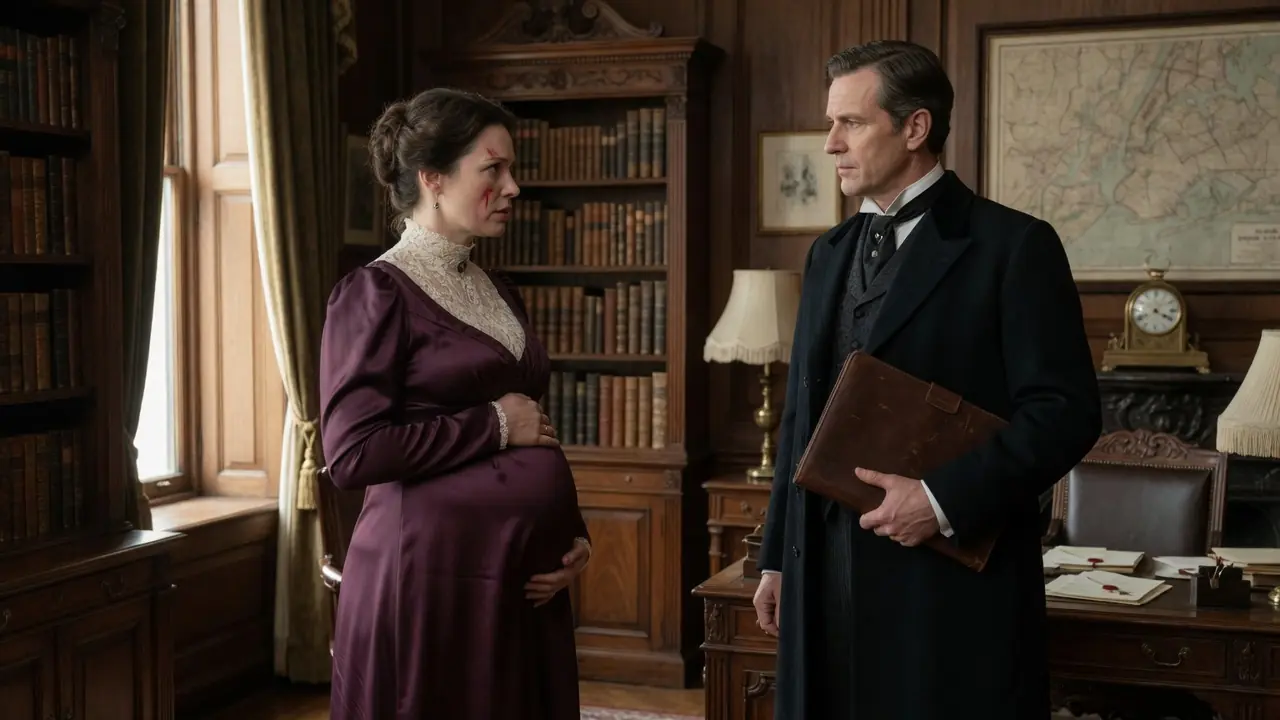
She did not cry. She did not even lift her hand to touch her burning face. She simply stood there, one hand still resting protectively over her unborn child, and watched her husband of eighteen years realize what he had just done. But here is what Jonathan did not know, what none of them knew, what Evelyn had spent nearly two decades concealing with the precision of a masterclass in patience and strategic silence. This exact moment was the one her mother had prepared her for since she was sixteen years old.
Twenty-eight years earlier, Evelyn Marlowe had sat in the library of her family estate staring at her mother across a mahogany desk that had witnessed three generations of wealth, power, and carefully guarded secrets. Her father had been dead for exactly one day. The funeral was over. The mourners had departed. And now her mother, eyes dry but voice edged with something Evelyn would later recognize as controlled fury, was teaching her the most important lesson she would ever learn.
"Your father almost destroyed everything," her mother said, sliding a leather portfolio across the desk. "He was brilliant, charismatic, loved by everyone who encountered him. And he was reckless. He gambled with our legacy like it was a plaything. He trusted the wrong people, made promises he could not keep, and nearly bankrupted us three times before I intervened."
Evelyn had opened the portfolio carefully. Inside were documents she did not fully understand yet. Trust structures, ownership clauses, legal frameworks so intricate they resembled blueprints for invisible buildings. "This is your true inheritance," her mother continued. "Not the houses or the cars or the paintings everyone will see at the estate sale.
This is the real empire. The Marlowe industrial dynasty your grandfather built with his own hands and your father nearly destroyed with his ego. She leaned forward and Evelyn would never forget the intensity in her eyes. You will inherit everything, Evelyn. Every share, every vote, every decision.
But you will do it quietly. You will marry strategically. You will observe, endure, and correct from the shadows because the world does not respect quiet women, but it severely underestimates them. And underestimation is the greatest advantage you will ever possess. Evelyn absorbed those words like they were oxygen.
She studied business not in classrooms, but in silence, learning markets through observation rather than participation. She watched powerful men at her mother's dinner parties, noticed how the loudest ones always fell first, how arrogance was nothing more than insecurity wearing expensive suits. By the time she met Jonathan Kincaid at a charity gala when she was twenty-three, she could read men like him in under 5 minutes. Brilliant, yes. Charismatic, absolutely.
Ambitious to the point of obsession. But underneath all that charm was a deep fragility, a desperate need for validation that made him dangerous and predictable in equal measure. He approached her that night with champagne and that smile everyone seemed to fall for, the one that promised he saw you as special, as different from everyone else in the room. "Evelyn Marlowe," he said as though her name were a secret he had personally uncovered. "I have been trying to meet you for months."
She smiled politely, already cataloging his behaviors. The way he angled his body to ensure others could see them talking, the way his eyes flicked around to check who was watching, the way he needed an audience even for a private conversation. "And you are Jonathan Kincaid," she replied, "the self-made genius everyone keeps discussing. The phrase self-made had lit him up like fireworks. That was when Evelyn knew exactly what kind of man he was and exactly how she would use him.
Three months later when he proposed, Evelyn said yes. Not because she loved him, but because she understood what he could become with the right invisible hand guiding him. Jonathan had vision, but no discipline. Ambition, but no patience. Charm, but no depth.
He was perfect. Perfect for what her mother had trained her to accomplish building an empire in the shadows while someone else took the spotlight and all the credit. Their wedding was elegant, expensive, and exactly what Jonathan wanted, a performance. What he did not know, what he would never discover until it was far too late, was that the company he was about to build, the empire he would claim as proof of his genius, the success story that would make him famous, was funded entirely by Marlowe Capital, filtered through shell corporations so complex that even the attorneys managing them barely understood the full structure. Every investor Jonathan impressed, relationships Evelyn had cultivated through her family's network.
Every board member who approved his decisions appointed through voting proxies she controlled but never publicly exercised. Every successful deal, every market victory, every celebrated moment of glory built on foundations Evelyn constructed in absolute silence. She was the invisible architect of everything he believed he had built himself. Her mother had passed away two years into the marriage, but not before adding one final safeguard to the trust documents. One clause Evelyn had memorized word for word.
If your husband ever violates the moral conduct standards outlined in Section 7, Subsection 3, all conditional ownership reverts immediately and irrevocably to the primary beneficiary. No negotiation, no appeals, only consequences. Evelyn had asked what would trigger it. Her mother's response was simple, public cruelty, undeniable humiliation, the kind of behavior that reveals character so completely that no one could defend it. At the time, Evelyn had considered it theoretical or legal safeguard that would never actually be activated.
Then came the first miscarriage. fourteen weeks pregnant, excited, preparing a nursery, imagining that Jonathan might soften into fatherhood. Instead, when she told him she had lost the baby, his first words were, "We need to keep this quiet. The merger announcement is next week. I cannot have investors thinking I am distracted." She had stared at him, grief turning to ice.
"Our baby just died." He did not even look up from his laptop. "And I am sorry, but we have responsibilities. You understand that, do you not?" She understood perfectly.
She understood she had married exactly who her mother had warned her about. The second miscarriage came four years later, and this time Jonathan barely acknowledged it. "Maybe it is for the best," he said, checking his reflection before a conference where he was receiving an innovation award for work Evelyn had actually designed. "Children complicate things." That was when Evelyn stopped expecting empathy and started documenting everything.
Every careless remark, every public slight, every reckless decision that nearly destroyed the company before she quietly intervened and saved it without leaving a trace. She became a ghost in her own life, present everywhere, controlling everything, but never seen, never credited, never acknowledged. And the strangest thing she realized this invisibility was power. Jonathan needed applause. He needed validation.
He needed the world to confirm that he mattered. Evelyn needed none of that because she already knew the truth. Every move he made, every success he celebrated, existed only because she had built the foundation beneath him. eighteen years passed this way. eighteen years of watching him perform while she orchestrated. eighteen years of enduring condescension while running an empire he did not even know existed. And then at forty-four, Evelyn became pregnant again. This time she waited past the first trimester before telling him.
Waited until she was safe. His reaction over dinner, "Are you sure that is a wise idea at your age?" She placed her hand over her stomach, protective already fierce. "Yes, I am sure." He shrugged, cutting into a steak.
"Well, do not expect me to slow down. The investor summit is 6 months away. The most important presentation of my career." Of course it was that summit. The one happening right now.
The one where Jonathan had just struck his pregnant wife in front of everyone who mattered. The one being broadcast live across financial networks. The one where Evelyn stood, hand on her belly, face burning, and felt the final piece of her mother's strategy click perfectly into place. Because Jonathan had just crossed the line publicly, undeniably, in front of witnesses whose testimony would be irrefutable, and cameras that captured every second. The moral conduct clause had just been activated.
Every conditional share he believed he owned gone. Every position he held reverted. Every bit of power he had performed with for eighteen years about to dissolve like smoke. And Evelyn, the quiet woman everyone had underestimated, the invisible architect everyone had ignored, was about to teach her husband and everyone watching the most devastating lesson in patience, power, and perfectly timed justice the corporate world had ever witnessed. But she said none of that.
Jonathan was on his third phone call of the morning, pacing back and forth while talking to investors about a deal that would not close for another 6 months. Evelyn sat at the table, untouched fruit in front of her, watching him perform even when there was no audience except her. When he finally hung up, he sat down with that smile, the one that had once made her feel seen, and said, "Sorry about that, but you understand, right?" "This is what building an empire looks like." She nodded, sipped her coffee, and said nothing because she already understood something he never would.
He was not building anything. She was. Every contact he had just impressed on that call, relationships, Evelyn had quietly arranged through her family's network before the wedding. Every investor eager to fund his vision connected through trust structures and financial channels that led back to Marlow Capital, filtered so carefully that even the most experienced analysts missed the source. Jonathan believed he was a genius making brilliant moves.
Evelyn knew she was a strategist playing chess while he played checkers. The realization should have devastated her. Instead, it clarified her role with absolute precision. Her mother had prepared her for exactly this, a marriage built not on romance, but on strategic necessity, where love might exist in small moments, but purpose always came first. "You will marry someone who needs managing." her mother had said during one of their final conversations before cancer took her.
"Someone brilliant enough to be useful, but flawed enough to need invisible guidance. And you will spend years correcting his mistakes, absorbing his failures, and ensuring the empire survives despite him, not because of him." Evelyn had once thought it sounded cold, almost cruel, until she understood the alternative, watching everything her grandfather built and her mother protected crumble under someone's unchecked ego. Marriage is strategy, was not romance, but it was protection. It was legacy.
It was the difference between sentiment and survival. So, when Jonathan dismissed their honeymoon to chase deals Evelyn had already secured for him, she did not complain. She observed. She documented. She began the long, careful process of becoming invisible while remaining indispensable.
The pattern established itself quickly. Jonathan would announce bold new directions for the company, directions that sounded visionary in boardrooms, but would have bankrupted them within months if Evelyn had not quietly intervened. She learned to work through intermediaries. A carefully timed call to a contact who would then suggest modifications Jonathan could claim as his own refinement. A strategic introduction that redirected his attention from disaster to opportunity.
A midnight review of contracts where she caught fatal errors that his legal team had missed because they were too busy praising his genius to actually read the terms. Every correction, every intervention, every moment of invisible crisis management happened in the shadows while Jonathan collected awards, gave interviews, and built a public persona as the self-made visionary who had revolutionized three industries before turning 35. The world consumed it eagerly. Business magazines put him on covers. Conference organizers fought to book him as keynote speaker.
Investors called him the next great American entrepreneur. And through it all, Evelyn sat in the background at events, smiled when appropriate, said almost nothing, and quietly ran the entire operation through channels so carefully concealed that even Jonathan's own CFO had no idea who was truly making the decisions that saved them. But the invisibility came with costs she had not fully anticipated. The first miscarriage struck her like a physical blow, not just the loss itself, but Jonathan's reaction to it. The way he calculated how it might affect investor confidence before he had even asked if she was all right.
She had been 14 weeks along, had already begun imagining the nursery, had allowed herself to hope that motherhood might soften him, might give him something to care about beyond market share and public perception. When the cramping began during a company dinner, she excused herself, drove herself to the hospital, and sat alone in the emergency room for 6 hours before calling him. His response when he finally answered, "This is not a good time, Evelyn. I am closing the Riverside deal tonight." She hung up, delivered the baby she would never hold in a sterile room that smelled of disinfectant and grief, and made a decision that would define the next eighteen years.
She would stop expecting Jonathan to be someone he was not, and start documenting exactly who he was. Every call he did not take. Every moment he chose optics over humanity. Every instance where his mask slipped and revealed the cold calculation beneath. She kept records the way archaeologists preserve artifacts, careful documentation of evidence that would matter someday, even if she could not yet see exactly how.
The second miscarriage came four years later, and this time Evelyn knew better than to expect anything from Jonathan except exactly what he delivered. Dismissal dressed as practicality. "Maybe it is for the best." He had said, straightening his tie before a conference where he was receiving an innovation award for work Evelyn had actually designed. "Children would complicate things right now.
We are at a critical growth phase." She watched him check his reflection, adjust his cufflinks, and walk out without once asking if she needed anything. And something fundamental shifted inside her. Not heartbreak, she had already survived that. This was colder, more precise.
This was acceptance. She had married a man incapable of genuine empathy, and instead of destroying her, that knowledge would become her greatest strategic advantage. Because Jonathan's inability to see past his own reflection meant he would never see her working behind it. He would never suspect that the wife he had trained to be quiet, to be supportive, to be essentially invisible was the only reason his empire existed at all. And more importantly, he would never imagine that she had spent years building safeguards into that empire, safeguards that could strip everything from him the moment he crossed a line too far.
Her mother's moral conduct clause became Evelyn's insurance policy, her exit strategy, and her ultimate weapon all contained in one carefully drafted paragraph. "If your husband engages in public behavior that demonstrates moral unfitness as defined in section 7, subsection 3, including but not limited to documented cruelty, public humiliation of family members, or conduct unbecoming of fiduciary responsibility, all conditional ownership transfers immediately and irrevocably to the primary beneficiary without requirement of legal proceeding or formal notification." Evelyn had read the clause so many times she had memorized the punctuation. She understood every implication, every trigger, every consequence. And over the years, as Jonathan's arrogance grew in direct proportion to the success Evelyn kept engineering for him, she wondered what it would take to activate it.
Would he humiliate her at a company event? Would he publicly dismiss her contribution in front of people who mattered? Would there be one undeniable moment that even his charm could not spin, could not reduce to a misunderstanding or someone else's over-sensitivity? She did not know, but she prepared for it anyway because preparation was what she did best. The preparation took forms Jonathan never noticed because he had stopped truly noticing her years ago except as a prop for the image he needed to maintain.
She documented every major decision, every investor relationship, every financial structure, building a paper trail so comprehensive that anyone who looked would understand exactly who had built what. She cultivated relationships with key board members, not through obvious networking, but through quiet competence, the kind where people remembered her as insightful, as someone who understood the business better than most executives. She maintained the trust structures her mother had established, ensuring every share Jonathan believed he owned was actually conditional, tied to performance standards and behavioral clauses he had never read carefully enough to understand. And she watched him become exactly what her mother had predicted, a man so consumed by his own legend that he could no longer distinguish between his performance and reality, between the empire he believed he had built and the foundation someone else had constructed beneath him. Jonathan needed validation the way other people needed oxygen.
He needed recognition, constant reassurance that he was brilliant, visionary, important. Evelyn needed none of that, because she knew something he never would. Real power does not require an audience. eighteen years passed this way, years where Evelyn perfected the art of invisible influence, years where she absorbed his casual cruelties like someone building immunity to poison, years where she corrected his disasters and secured his victories while he collected credit and grew more insufferable with each award, each magazine cover, each speaking engagement, where crowds treated him like a visionary prophet. Did anyone ever wonder how a self-made genius had never truly failed at anything significant? Did investors ever question how his boldest risks always somehow worked out?
Did journalists ever investigate the curious pattern of crises resolving themselves right before they became catastrophic? Because Jonathan was charming and confident and told a compelling story. And people wanted to believe in self-made geniuses far more than they wanted to investigate them. So Evelyn let them believe. She played the role of supportive wife, appeared at events when required, smiled in photographs, and said almost nothing while running an empire from the shadows.
Until the day she discovered she was pregnant again at forty-four and something shifted. This pregnancy felt different, not just physically, but strategically. Like the universe was offering her one final test. One last opportunity to see whether Jonathan could be redeemed or whether he would confirm everything her mother had warned her about. She waited to tell him.
Waited until she was safely past the danger zone where her body had failed her before. Waited until she was certain. When she finally shared the news over dinner at a restaurant he had chosen to impress clients who were not even present, his reaction was so perfectly, precisely Jonathan that it almost made her laugh. "Are you sure that is a wise decision?" he asked, cutting his steak with a precision that somehow felt violent. "At your age?
With the investor summit approaching?" She placed her hand over the small curve of her stomach, already protective, and said simply, "Yes. I am sure." He shrugged, returned to his meal, and immediately began discussing the summit as though it were the only thing that mattered, as though his pregnant wife sitting across from him were simply scenery. Just another prop in the endless performance of his life.
And that was when Evelyn knew with absolute certainty the moral conduct clause would activate. Perhaps not that day, perhaps not that month, but soon. Because Jonathan had spent eighteen years proving he was exactly who her mother said he would be. And men like that always push This audio was created with acing.com. who her mother said he would be. And men like that always push too far eventually.
They always mistook patience for weakness. They always confused silence with consent. And they always revealed themselves when they believed no one was truly watching. Except Evelyn was always watching. She had been watching for eighteen years.
And she was about to show Jonathan and everyone else what happened when the quietest person in the room finally decided it was time to speak. The crisis came on a Tuesday morning 3 years into their marriage. The kind of crisis that would have destroyed most companies, but barely made the news. Because Evelyn fixed it before anyone outside the executive suite even knew it existed. Jonathan had approved a merger with a technology startup that looked brilliant on paper.
Innovative product, young talented team, projections that promised to triple their market share within 18 months. The problem? The startup's financials were complete fiction. An elaborate construction of inflated user numbers and fabricated revenue streams that would have collapsed the moment due diligence went beyond the surface. Evelyn discovered it at 2:00 in the morning while reviewing contracts Jonathan's legal team had already approved.
She found the discrepancies buried in footnotes and appendices that no one had bothered to read carefully because Jonathan's enthusiasm had convinced everyone this was the deal of the decade. She sat at her desk, coffee going cold beside her, and made 17 phone calls before sunrise to kill the merger without Jonathan ever knowing how close he had come to destroying everything. By the time he woke up, the startup had mysteriously withdrawn from negotiations, citing strategic differences, and Jonathan had moved on to his next brilliant idea without ever understanding that his wife had just saved him from catastrophic failure. That became the pattern. Jonathan would charge forward with vision and charisma, while Evelyn worked through the night fixing the structural problems his confidence created, redirecting disasters, managing the consequences of decisions made with more ego than analysis.
The invisible labor exhausted her in ways she could not articulate to anyone because admitting it would require explaining what she actually did. And the entire strategy depended on no one knowing. She became expert at working through intermediaries, at planting ideas with board members who would present them as their own, at engineering solutions that appeared to emerge spontaneously from Jonathan's team, rather than from midnight phone calls Evelyn made to consultants and analysts who owed her family decades of accumulated favors. One memorable disaster involved a manufacturing partnership in Southeast Asia that Jonathan had negotiated personally, convinced he had secured better terms than anyone thought possible. Evelyn reviewed the contract and immediately recognized a profound cultural misunderstanding embedded in the language.
What Jonathan interpreted as agreement was actually polite rejection in a business culture that valued harmony over directness. If they had proceeded, they would have arrived at factories that did not exist, partnerships that had never actually been confirmed, and losses that would have bankrupted their manufacturing division. Evelyn fixed it through a contact her mother had cultivated 20 years earlier, a diplomatic consultant who understood both cultures and could renegotiate without making Jonathan appear incompetent. The final deal was actually less favorable than the original terms, but it was real, functional, and sustainable. Jonathan announced it as a triumph of his negotiating skill.
Evelyn said nothing and added another entry to her growing archive of catastrophes prevented. But the invisible labor was not only professional. It was personal, intimate, the kind of endurance that wore down her soul in ways she could not name even to herself. Jonathan demanded perfection not just in business, but in image. And that meant Evelyn had to perform flawlessly at every company event, every investor dinner, every public appearance where she existed as an accessory to his success.
She learned to smile through condescension disguised as compliments, to nod through conversations where men explained her own family's business history to her, to occupy rooms where she knew more than everyone present, but was expected to contribute nothing beyond decoration. The performance became second nature, so automatic that she sometimes forgot it was performance, until moments when Jonathan's mask slipped and reminded her exactly what she was enduring. Like the company anniversary gala where he had introduced her to a major investor by saying, "This is my wife, Evelyn. She keeps the home fires burning while I build the empire." The investor laughed.
Everyone laughed. Evelyn smiled and excused herself to the restroom, where she stood gripping the marble counter and reminded herself why she was doing this. Legacy, strategy, the long game her mother had trained her for. She returned to the gala, finished the evening, and added another entry to her documentation. The documentation became her refuge, her evidence, her insurance policy for the day when patience would transform into action.
She kept detailed records of every significant decision Jonathan made, every crisis she prevented, every relationship she maintained that he claimed as his own achievement. She cataloged his casual cruelties, the way he dismissed her input in meetings, the way he introduced her to new executives as though she were relevant to the company's success, the way he scheduled business trips on their anniversary 3 years running without apology or acknowledgement. She also noted the pattern of his affairs not out of jealousy, but because they revealed character. They showed how he valued loyalty and discretion, demonstrated the gap between his public persona as devoted husband and private reality as a serial cheater who assumed his charm exempted him from consequences. Each affair followed the same trajectory: intense pursuit, reckless indiscretion, then careless disposal when the woman became inconvenient or demanding.
She watched them cycle through young women dazzled by his attention and status, used for validation and variety, then discarded without ceremony. She felt something resembling pity for them. These women who believed Jonathan truly saw them as special, when in reality he saw everyone as either useful or irrelevant. But she did not intervene. She documented and waited because every affair, every betrayal, every moment of careless cruelty was evidence that would matter when the time finally came.
The waiting taught her things about power that no business school could have conveyed. Real power was not about commanding attention or making bold declarations. Real power was the ability to act without requiring permission, to influence without attribution, to shape outcomes while remaining completely invisible to those being affected. Jonathan performed power, the dramatic announcements, the commanding presence, the public victories that required audiences and applause. Evelyn exercised power, the quiet phone call that redirected capital, the strategic introduction that opened markets, the carefully worded suggestion that prevented disaster.
His power was theatrical, temporary, dependent on constant reinforcement from others. Hers was structural, permanent, embedded so deeply in the company's foundations that removing it would collapse everything. And the beautiful irony that sustained her through eighteen years of endurance was this: Jonathan had absolutely no idea. He believed he had built an empire through brilliance and hard work, when in reality he had been handed a stage, given a script, and directed through every scene by someone he had trained himself not to see. The very invisibility that humiliated her in public was the same invisibility that protected her power in private.
Every time Jonathan took credit for her work, he reinforced the illusion that allowed her to work without interference. Every time he dismissed her as simply the supportive wife, he guaranteed she could continue operating the machinery that kept him relevant. But endurance has limits, and Evelyn felt herself approaching hers as the pregnancy progressed into the second trimester. The physical vulnerability amplified every slight, every casual cruelty, every moment where Jonathan demonstrated that even impending fatherhood could not make him prioritize anything beyond his own ego. He had missed the first ultrasound because of a conference call that could have been rescheduled.
He had forgotten to ask about her doctor's appointments three times in a single week. When she mentioned feeling anxious about pregnancy at her age, his response was, "I am sure it will be fine. You worry too much." The dismissal stung, not because she needed his reassurance, but because it confirmed what she already knew. Jonathan was incapable of seeing past his own concerns, incapable of empathy that required genuine effort, incapable of becoming the partner or father she had briefly hoped he might be.
And that confirmation, painful as it was, gave her extraordinary clarity. This pregnancy was not going to redeem him. It was going to reveal him. Because men like Jonathan always push too far eventually, always mistook patience for weakness, always confused quiet endurance with permanent submission. The investor summit was 6 weeks away, and Jonathan talked about it constantly, obsessed with making it his defining moment, the presentation that would cement his legend.
He wanted everything perfect, the venue, the guest list, the presentation materials, even Evelyn's appearance, which he critiqued with increasing frequency as her pregnancy became more visible. "Perhaps wear something that does not emphasize the stomach," he suggested one evening. "We want the focus on the business, not personal matters." Evelyn looked at him and saw exactly what her mother had warned her about eighteen years earlier. A man so consumed by image that he would sacrifice everything real to maintain the performance.
She nodded, said nothing, and made a mental note. The summit would be decisive one way or another. Either Jonathan would surprise her, would demonstrate some capacity for decency she had somehow missed in eighteen years of careful observation, or he would confirm everything and activate the consequences her mother had built into the trust. Evelyn was finished hoping for redemption. She was preparing for revelation.
And in 6 weeks, the world would finally see what she had truly been building all along. Not an empire for Jonathan's ego, but a legacy that would survive his inevitable collapse. A structure so carefully designed that removing him would actually strengthen it, rather than weaken it. The quiet woman everyone had underestimated was about to teach everyone watching the most important lesson in power, patience, and perfectly timed justice. But first, she had to endure 6 more weeks. 6 more weeks of invisibility. 6 more weeks of watching Jonathan perform while she orchestrated. 6 more weeks until the moment when silence would transform into the loudest statement anyone had ever heard.
The morning Evelyn felt the baby move for the first time, she was sitting in Jonathan's office reviewing quarterly reports he had asked her to look over before the board meeting, his way of having her do the actual analysis while he received credit for the insights. The flutter was subtle, barely perceptible, like a whisper against her ribs. And for a moment, she forgot about the spreadsheets, forgot about Jonathan's upcoming presentation, forgot about everything except this tiny life growing inside her, which represented something she had nearly stopped believing in, hope. Not hope that Jonathan would change, she had abandoned that fantasy years ago, but hope that she could build something pure and uncomplicated in the middle of all this strategic complexity. Someone to inherit not just wealth, but the moral clarity her mother had passed to her.
She placed her hand over her stomach, felt another small movement, and made a decision that would define everything that followed. This child would never wonder whether she was truly valued. This child would never question whether she mattered more than optics or investor confidence. This child would inherit an empire, yes, but more importantly, she would inherit the truth about how it was built, who built it, and what real power actually looked like. And if protecting that inheritance meant finally revealing everything Evelyn had hidden for eighteen years, then that was exactly what would happen.
The pregnancy intensified everything, made every interaction with Jonathan feel more significant, more loaded, as though each moment were a test she was carefully recording for future judgment. When he complained that her growing belly was becoming conspicuous and suggested she skip the next investor dinner, Evelyn looked at him with something approaching pity. I am pregnant, Jonathan. It is supposed to be noticeable. He waved his hand dismissively.
I know that. I simply mean we do not need to make it the centerpiece. This is a critical growth period for the company. We cannot afford unnecessary distractions. She added that conversation to her records.
Another data point in the pattern she had been tracking for nearly two decades. Another piece of evidence that would matter when everything finally came to light. But what struck her most was not the callousness she had long since come to expect. It was the genuine confusion in his eyes when she did not immediately agree. Jonathan truly believed that company optics should take priority over everything, including the physical reality of his pregnant wife.
And he genuinely could not understand why anyone would think differently. That level of self-absorption would have been almost impressive if it were not so profoundly destructive. The real shift came 3 weeks later when Evelyn discovered Jonathan had hired a new strategic advisor named Madison Pierce. A 26-year-old with an MBA from a respectable program and the kind of polished presentation that photographed well at corporate events. Evelyn recognized the pattern immediately.
This was not about strategy. This was about ego, validation, and Jonathan's compulsive need to surround himself with people who reflected the image he wanted to project. She had seen it before with his previous affairs, the way he positioned these women as professional necessities while conducting relationships that were anything but professional. What made this different, what made it genuinely dangerous, was the timing. The investor summit was 4 weeks away.
Jonathan's obsession with making it perfect had reached near manic levels. And now he had someone young and eager feeding his ego at precisely the moment he most needed to be careful about appearances and judgment. Evelyn observed Madison at the first strategy meeting. She noticed how Madison laughed at Jonathan's remarks just slightly too enthusiastically. How she positioned herself constantly within his line of sight.
How she managed to agree with every suggestion he made while making it sound like independent analysis. The performance was transparent to anyone paying genuine attention, but Jonathan was not paying attention to anything except his own reflection in this young woman's undisguised admiration. 2 weeks before the summit, Evelyn walked into Jonathan's office unannounced, something she rarely did because she had learned years ago that respecting his space meant he respected hers, or at least ignored hers, which served the same strategic purpose. But that afternoon, she needed him to review legal documents that genuinely required his signature documents that could not be handled through intermediaries. She opened the door and found Jonathan and Madison standing close together over his desk, her hand resting on his arm, both laughing at something on his computer screen. They jumped apart like teenagers caught by a parent.
And the guilt on Jonathan's face confirmed what Evelyn already knew. This was no longer purely professional, if it ever had been. "I need your signature on the supplier contracts," Evelyn said calmly, extending the folder. Jonathan recovered quickly, slipping back into the smooth confidence that had deceived so many people for so long. "Of course.
Madison, we will continue this later." Madison gathered her materials, avoided eye contact with Evelyn, and left the office with practiced efficiency. Jonathan signed the contracts without reading them, which was entirely typical, and handed them back. "You should knock," he said, not quite meeting her eyes. Evelyn took the folder, placed her free hand protectively over her stomach, and said something she had been holding back for months.
"I am your wife, Jonathan. I am pregnant with your child. And I just walked in on you with your mistress. Which part of that situation do you believe requires me to knock?" The silence that followed felt enormous, as though the air itself had thickened.
Jonathan stared at her, visibly calculating which approach might work. Denial, deflection, or attack. He chose attack. "That is completely inappropriate, Evelyn. Madison is a valued member of my team.
If you are going to make paranoid accusations based on nothing, then perhaps you should stay home until after the summit. You are clearly under stress, and stress is not good for the baby." The gaslighting was so practiced, so seamless, that Evelyn almost admired the technique even as she cataloged it for her records. "I am not stressed," she said quietly. "I am observant.
There is a difference." She left before he could respond, returned to her own office, and added detailed notes to the file she had been maintaining. The affair itself did not surprise her. Jonathan had demonstrated repeatedly that loyalty meant nothing to him compared to ego gratification. What mattered was the timing, the recklessness, the way he was positioning Madison so conspicuously right before the most consequential presentation of his career.
Men like Jonathan always self-destruct eventually. The only variable was whether the destruction happened privately, where it could be contained and managed, or publicly, where it triggered consequences that could never be reversed. Jonathan was choosing public destruction. He simply did not know it yet. The final 2 weeks before the summit felt like watching a train approach a collapsed bridge, knowing precisely what would happen, but no longer wanting to prevent it.
She watched him rehearse his presentation obsessively, watched Madison's role expand from advisor to what Jonathan began calling co-presenter, watched him make decisions that prioritized spectacle over substance because he needed this summit to be his coronation, his moment of ultimate validation. And through it all, Evelyn maintained perfect composure, attended planning meetings when required, offered feedback that Jonathan immediately dismissed, and prepared for the moment when his arrogance would finally cross the line that activated her mother's moral conduct clause. She did not know exactly how it would happen, but she knew it was coming with the same certainty she knew the sun would rise. Because Jonathan had spent eighteen years proving he was incapable of restraint when his ego was in play. Three days before the summit, Evelyn had her final prenatal checkup.
The doctor confirmed everything was progressing normally. The baby was healthy, and Evelyn should avoid stress when possible. She had almost laughed at that last instruction. Avoid stress? As if stress were something she could control when married to a man who generated chaos as naturally as breathing.
"Any concerns?" the doctor asked, reviewing the charts. Evelyn looked at the ultrasound image, at the small life depending on her to make decisions that would protect their future, and made her final calculation. "No concern," she said. "Everything is exactly as it should be." Because it was.
Jonathan was going to self-destruct at the investors summit. The moral conduct clause was going to activate. eighteen years of invisible power was about to become undeniably visible. And Evelyn's daughter, the ultrasound had confirmed it was a girl, would inherit an empire built on patience, strategic brilliance, and the kind of moral clarity that Jonathan could not even begin to comprehend. All Evelyn had to do was show up, observe, and allow Jonathan to be exactly who he had always been. The man who valued performance over substance, image over reality, ego over everything, including his pregnant wife and their unborn child.
Some people might have felt sadness watching a marriage end this way. Evelyn felt relief. Relief that the performance was nearly over. Relief that justice was three days away. Relief that her daughter would never need to wonder whether patience and strategy could overcome cruelty and arrogance because she would witness the proof herself.
The pregnancy had changed everything, but not in the way Jonathan assumed. It had not made Evelyn vulnerable. It had made her absolutely certain. And certainty, Evelyn had learned through eighteen years of invisible power, was the most devastating weapon anyone could wield. The morning of the investor's summit, Evelyn stood before her closet choosing what to wear to her own reckoning.
The absurdity of the moment was not lost on her. Jonathan had left the house before dawn without saying goodbye too consumed with final preparations to acknowledge his pregnant wife, which was perfect because Evelyn needed silence to prepare for what was coming. She chose a navy dress elegant but understated, the kind that would not distract from her face when cameras captured her reaction to whatever Jonathan was about to do. Because he was going to do something. Evelyn could feel it with the same certainty she felt her daughter moving inside her, that restless flutter reminding her exactly what she was protecting and why patience was about to transform into action.
She placed her hand over her stomach, felt a small kick, and spoke quietly to the life she was carrying. Today you are going to learn what happens when someone mistakes kindness for weakness. Watch carefully because this is the lesson your grandmother spent her entire life teaching me. And I am about to show you how it ends. Then she got into her car and drove to the conference center where America's most powerful investors were gathering to witness what they believed would be Jonathan Kincaid's greatest triumph, but what Evelyn knew would be his complete and total destruction.
The venue was extraordinary. Jonathan had spared no expense because this summit was intended to be his coronation, the moment when he cemented his reputation as the visionary genius who had revolutionized three industries before 40. The main hall could seat 200 people, but Jonathan had deliberately kept the guest list to 75, the most elite investors and financial analysts in the country because exclusivity was part of the performance. Evelyn arrived early, watched the setup crew making final adjustments to lighting and sound, and noted the camera positions. Three broadcast cameras for the live stream reaching financial This audio was created with a sync.com.
Three broadcast cameras for the live stream reaching financial networks across three continents, plus multiple fixed positions for recording. Jonathan had wanted maximum coverage. He had wanted this presentation preserved and distributed. He wanted proof of his genius available to anyone who doubted him. He was building his own evidence collection without realizing it.
Evelyn found her assigned seat, third row center, visible but not prominent, exactly where Jonathan wanted her. Close enough to suggest a devoted wife, but far enough back that she would not distract from his performance. She sat down, crossed her hands over her stomach, and waited for the room to fill with people who had no idea they were about to witness the most dramatic transfer of power the corporate world had ever seen. Jonathan entered at exactly 9:00, Madison Pierce at his side. Both of them dressed as though accepting an award rather than delivering a business presentation.
The atmosphere in the room shifted immediately. Investors whispering to one another, analysts reviewing their notes. Everyone trying to understand why Jonathan had brought a junior advisor to what was supposed to be his solo moment. Evelyn watched their confusion, watched Jonathan absorb the attention with that familiar smile, and knew he was about to make everything considerably worse. He took the stage, adjusted his microphone, and opened with the kind of confidence that comes from eighteen years of never facing real consequences.
Thank you all for being here. What you are about to witness will change how you think about innovation, about leadership, and about the future of American business. The applause was polite but restrained. These were experienced investors who had heard promises before and learned to wait for substance. Jonathan did not notice the reserve.
He was too busy performing. But before we begin, I want to introduce someone who represents the future of this company. Madison Pierce, who many of you know as our strategic advisor, will be taking a considerably more prominent role going forward. Madison represents everything this company values: youth, innovation, fresh perspectives unburdened by outdated thinking. The words struck Evelyn like physical blows, not because they caused her pain, but because they were so perfectly, precisely Jonathan.
So exactly the kind of casual cruelty disguised as forward-thinking rhetoric that he had perfected over eighteen years. Outdated thinking. He was referring to her. Everyone in the room understood the subtext. The way Jonathan was positioning this young woman as the future while implicitly declaring his pregnant wife the past.
Evelyn felt the eyes of several investors shift toward her, watching for her reaction. She gave them nothing. No anger, no embarrassment, only calm observation, one hand resting protectively over her daughter. She watched Madison take the stage beside Jonathan, watched them stand too close together, watched the presentation unfold with all the subtlety of a man who had convinced himself that charisma could override judgment. They discussed innovation metrics Evelyn knew were inflated, market projections that relied on assumptions no serious analyst would accept, revolutionary changes that were actually incremental improvements Evelyn had engineered through her network while Jonathan claimed all the credit.
And throughout, Madison gazed at Jonathan with open admiration while he absorbed it like validation was oxygen. 40 minutes into the presentation, Evelyn stood up. She did not announce it. She did not make a scene. She simply rose from her seat, one hand supporting her back, the other protective over her stomach, and began walking toward the exit because she was done witnessing this performance, done enabling Jonathan's delusion, done sitting quietly while he publicly humiliated her in front of everyone who mattered. The movement caught Jonathan's attention immediately, pulling his focus from the slides to his wife walking out during the most important presentation of his career.
For a split second, Evelyn saw something like panic cross his face. The realization that this looked bad, that his pregnant wife leaving mid-summit sent a message he could not control. Then the panic transformed into anger, into the desperate need to reassert authority and control the narrative before it spiraled. "Evelyn," he called out, his voice amplified by the microphone, echoing through the suddenly silent hall. "Where are you going?"
She paused, turned slowly, and met his eyes across the distance. "I am tired, Jonathan. I need to rest." It was entirely reasonable, exactly what a pregnant woman might say. But Jonathan heard it as challenge, as defiance, as a direct threat to the image he was so carefully constructing.
He stepped away from Madison, walked to the edge of the stage, and said something that would have been almost darkly comic if it were not so revealing. "You are embarrassing me." Not, "Are you all right?" Not, "Do you need help?" Just, "You are embarrassing me."
Because in Jonathan's world, everything was about appearance. Everything was performance. And his pregnant wife's comfort mattered less than how her departure would look to investors. Evelyn did not respond. She turned back toward the exit.
And that was when Jonathan made the decision that would destroy him. He came off the stage, crossed the distance between them in angry strides that the cameras captured perfectly, and grabbed her arm. "You cannot simply walk out in the middle of my presentation," he hissed, loud enough for the front rows to hear every word. "Do you understand what this looks like? I am trying to secure our future here, and you are behaving like a child."
Evelyn looked down at his hand gripping her arm, then back at his face, and said quietly, "Let go of me, Jonathan." He did not. Instead, he leaned closer, his voice dropping to a harsh whisper that the microphone still caught. "You are making me look weak. You are making me look old, like I cannot even manage my own wife."
That was when Evelyn understood with absolute clarity. This was not about her leaving. This was about Madison watching. About investors witnessing a younger woman standing where his wife should be. About Jonathan's desperate need to prove he was still vital, still powerful, still deserving of the admiration he so desperately craved.
"You have aged me," he said, his voice rising now, control slipping. "Walking out like this, making a scene, you are aging me in front of everyone who matters." Evelyn felt her daughter kick, felt the life inside her responding to the stress and anger. And something fundamental shifted. She had endured eighteen years of Jonathan's cruelty, absorbed countless humiliations, corrected endless mistakes, all while maintaining the patience and strategy her mother had taught her.
But this moment, this public accusation while he gripped her arm in front of cameras, broadcasting to three continents, this crossed a line that could never be uncrossed. "Let go of me," she repeated, calm and clear despite the fury building in her chest. Jonathan looked around, saw everyone watching, saw Madison frozen on stage, saw investors with phones out recording every second, and made his final catastrophic decision. He raised his hand and struck Evelyn across the face. The sound echoed through the hall like a gunshot, absolute, unmistakable, and irreversible.
Evelyn's head turned with the force of the blow, her cheek burning. And for one suspended moment, no one moved, no one breathed. The cameras captured everything, the shock on investor faces, Madison's horror, Jonathan's immediate realization of what he had done, and Evelyn's absolute stillness standing there, one hand against her burning cheek, the other still protective over her daughter. Then the room erupted into chaos. Investors stood, analysts typed frantically, Security moved toward the stage.
And Evelyn, calm despite the burning in her face, despite the ringing in her ears, despite the protective fury flooding her system, looked directly at her husband and spoke words only he could hear. "You just activated the clause, Jonathan. Everything you believe you own it is gone. Every share, every position, every bit of power you have performed with for eighteen years, it was always conditional. And you just violated every condition."
She watched comprehension slowly dawn on his face. Watched him remember the trust documents he had signed without reading carefully. Watched him understand that the wife he had just struck in front of America's most powerful investors was not simply a spouse. She was the owner of everything he had believed was his. Evelyn turned, walked out of that boardroom with her head held high and her dignity entirely intact, leaving behind a silence so complete you could hear the exact moment Jonathan Kincaid's world began to end.
And as she pushed through the exit doors, feeling her daughter kick with what felt almost like approval, Evelyn thought about her mother's final words. "Patience is the sharpest weapon of all, but you must know when to stop waiting and start cutting." Today, after eighteen years of patience, Evelyn had finally stopped waiting. Evelyn sat in her car in the parking garage beneath the conference center, hands resting on the steering wheel, cheeks still burning from Jonathan's strike, and felt her phone begin to vibrate with incoming messages that would continue without pause for the next seventy-two hours. She had not checked them yet.
Instead, she closed her eyes and focused on her breathing, on the small movements of her daughter inside her, on the moment she had spent eighteen years preparing for, finally arriving exactly as her mother had predicted it would. The moral conduct clause was not merely words on paper. It was a mechanism her mother had engineered with the precision of someone who understood that powerful men eventually revealed themselves through their own arrogance. And when they did, consequences needed to be automatic, immediate, and absolutely irreversible. Evelyn had memorized every word of that clause over the years.
Understood every implication. But knowing something intellectually was entirely different from feeling it activated in real time. Right now, in offices across three time zones, lawyers were opening encrypted emails triggered automatically by biometric sensors Evelyn had activated the moment Jonathan raised his hand. Right now, trust administrators were executing predetermined protocols that transferred voting rights, board positions, and operational control according to documents signed eighteen years ago, but enforceable immediately upon violation. Right now, the empire Jonathan believed he had built was being systematically stripped from him while he stood in that conference hall attempting to explain to horrified investors why he had just struck his pregnant wife on camera.
The first call came from Richard Rowan, senior partner at the law firm managing the Marlowe family trust. His voice tight with controlled urgency. Evelyn, I just received the automated notification. The moral conduct protocols have been activated. Are you safe?
She opened her eyes, stared at the concrete walls of the parking garage, and felt something like calm wash over her. I am safe, Richard. My husband struck me in front of 75 investors and multiple cameras broadcasting live to financial networks. The evidence is irrefutable. A pause, then Richard's voice came back steady, professional.
The trust documents are clear. All conditional ownership transfers to you immediately. Jonathan's voting rights, board positions, and operational authority are revoked as of the moment of violation. I am coordinating with the other trustees now. Within the hour, every relevant party will be notified of the ownership change.
Evelyn felt her daughter kick strong and insistent and smiled despite everything. Good. Make sure the notification includes copies of the video evidence. I want no ambiguity about why this is happening. She ended the call and finally looked at her phone, watching messages flood in from board members, investors, executives, and analysts, all attempting to understand what they had just witnessed and what it meant for the company they believed they understood.
Back in the conference hall, Jonathan was experiencing what happens when carefully constructed illusions collapse in real time, and there is no one left to reconstruct them. The moment Evelyn walked out, the room erupted into chaos that his charisma could not charm away. His confidence could not control, and his performance could not redirect. Investors were making urgent calls to their legal teams. Analysts were revising position papers in real time.
Board members who had received the automated trust notifications were staring at their phones in disbelief, connecting dots they had somehow missed for eighteen years. And Madison Pierce, the young woman Jonathan had positioned as the future of the company, had quietly gathered her materials and slipped out through a side exit. Because whatever power Jonathan had promised her had evaporated the moment his hand connected with Evelyn's face. One of the senior investors, a woman named Patricia Morrison who had built her fortune through careful analysis of risk and character, stood and addressed Jonathan directly. I just received notification that ownership of this company has been transferred.
Would you care to explain what is happening? Jonathan stood frozen on stage, microphone still active, camera still rolling. And for perhaps the first time in his adult life, he had absolutely no idea what to say that would fix this. He tried anyway because men like Jonathan always attempted to perform their way out of consequences. There has been a misunderstanding.
My wife is pregnant and emotional and she created a scene that I perhaps reacted to inappropriately. But this has nothing to do with the business fundamentals we are here to discuss. Patricia Morrison's expression did not change. Mr. Kincaid, I do not think you fully understand. The notification I received was not from your wife.
It was from the Marlowe family trust indicating that conditional ownership of this company has reverted to Evelyn Marlowe pursuant to violation of moral conduct standards. Are you telling me you were not aware that your ownership was conditional? The question landed like a bomb in the silent room because it revealed what Evelyn had concealed for eighteen years. Jonathan did not own anything. He never had.
He had been operating under conditions he had never bothered to read carefully. Performing with authority that existed only as long as he met standards he had just spectacularly violated. Another investor, Marcus Webb, who had invested heavily based on Jonathan's personal reputation, stood with his phone in hand. I am looking at the trust documents now. They are public record and have been for decades.
Every share you claim to own was conditional on maintaining behavioral and ethical standards outlined in section 7 subsection 3. Did you not read these documents before operating as though you had unconditional authority? Jonathan's face cycled through several expressions. Confusion, then dawning understanding, then panic, then the desperate anger of a man searching for a target. This is Evelyn's manipulation.
She has been planning this, setting me up, waiting for a moment to take what I built. But even as he said it, investors were shaking their heads. Analysts were pulling up historical documents. And the truth was emerging organically, exactly as Evelyn had designed it to. Every successful deal Jonathan had celebrated traced back to Marlowe Capital and relationships.
Every crisis he had claimed to resolve fixed by interventions originating from networks Evelyn controlled. Every bold decision that had somehow worked out despite apparent risk managed and mitigated by someone working behind the scenes with resources Jonathan had never generated himself. The empire was not his. It had never been his. He had been given a stage, handed a script, and directed through every scene by the woman he had just humiliated in front of everyone who mattered.
And now that the curtain had finally dropped, the audience could see the machinery that had been running the show all along. Patricia Morrison stood again. Her voice cutting through the noise with the authority of someone who had spent 40 years evaluating companies and the people who ran them. I think we need to adjourn this summit. Mr. Kincaid clearly does not have the authority to make the presentations or promises he came here to make.
I will be reaching out to Ms. Marlowe directly to understand the actual ownership structure and leadership going forward. She walked out and that was the signal everyone else needed. Within minutes, the conference hall was emptying. Investors departing individually or in small clusters, all of them making calls, revising assessments, and fundamentally reconsidering everything they had believed about Jonathan Kincaid and the company he had claimed to build. Jonathan stood alone on stage.
Madison gone. Audience dispersing. Camera still recording his complete collapse. And for the first time in eighteen years, he had to face reality without anyone there to fix it for him. His phone began ringing with calls from board members, partners, and media outlets who had already seen the video circulating across financial networks.
And he finally understood what Evelyn had told him in those last words before she walked out. Everything he believed he owned was gone. Not through hostile takeover or business failure, but through the consequences of his own cruelty triggered by behavioral standards he had agreed to eighteen years ago and violated spectacularly on camera. 20 minutes away, Evelyn was in her lawyer's office reviewing the cascade of automated protocols that had activated the moment Jonathan's hand made contact with her face. Richard Rowan sat across from her. Multiple screens displaying real-time updates as ownership transferred, board positions revoked, and operational control shifted according to documents that had been waiting patiently for this exact moment.
"The trust structure your mother created was remarkable," Richard said with genuine admiration. "Every possible scenario anticipated, every transition mechanism automated, every contingency planned for. The moment you activated the biometric trigger, everything happened exactly as designed. Jonathan literally cannot stop this even if he wanted to because it is not a legal proceeding. It is the execution of agreements he already signed.
Evelyn watched the screens. Watched her name appear in ownership registries that had listed Jonathan for eighteen years. Watched voting rights transfer and board positions update. My mother understood men like my father, like Jonathan. She knew they would eventually reveal themselves and she wanted to ensure that when they did, justice would be immediate and unavoidable.
She placed her hand over her stomach, protective and purposeful. This is not revenge, Richard. This is restoration. Putting things back the way they should have been from the very beginning. Richard nodded, then pulled up another screen showing media coverage already exploding across financial networks.
The video of Jonathan striking Evelyn had gone viral in the financial world. Analysts were dissecting the ownership structure in real time. And the narrative was writing itself exactly as Evelyn had always known it would, not as a vindictive wife destroying her husband, but as the revelation of a truth that had existed all along, hidden by performance and protected by patience until the moment when exposure became inevitable. What do you want me to tell the media when they ask for your statement? Richard asked.
Evelyn thought about her mother's final lesson about patience as the sharpest weapon of all, about power that worked best when invisible but revealed itself perfectly when timing was right. Tell them the truth, she said simply. That the Marlowe family trust has operated consistently with its founding documents, that behavioral standards are enforced automatically when violated, and that I look forward to leading the company my family built with the same integrity and strategic vision that has sustained it for three generations. She stood, one hand supporting her back, the other protective over her daughter. And Richard made sure they understand this was not about revenge.
This was about consequences. There is a difference. She walked out of the office into a future she had spent eighteen years preparing for leaving behind the wreckage of Jonathan's illusions and carrying forward the legacy her mother had trusted her to protect. Jonathan's phone rang 47 times in the first hour after Evelyn walked out of the conference hall. And with each unanswered call, each voicemail from panicking executives, each message from confused board members, the reality of his situation became more undeniable and more devastating.
He sat alone in his corner office, the same office where he had made bold declarations about the future, where he had celebrated deals Evelyn had actually secured, where he had convinced himself he was the genius everyone said he was, and stared at his computer screen displaying the automated email that had just dismantled his entire existence. Pursuant to violation of moral conduct standards outlined in section seven, subsection three of the Marlowe family trust, all conditional voting rights, board positions, and operational authority previously granted to Jonathan Kincaid are hereby revoked effective immediately. Primary ownership and control revert to Evelyn Marlowe as sole beneficiary of the trust. He had read those words five times, each reading making them more real, more final, more absolutely crushing. He had signed those trust documents eighteen years ago during the whirlwind of wedding planning and business launches.
Signed them because his lawyers had assured him they were standard prenuptial formalities. Signed them without reading carefully because he had been too excited about access to Marlow Capital and connections to worry about fine print. That carelessness was now destroying him in real time. His office door opened without a knock. David Park, the company's CFO and one of the few executives Jonathan had genuinely trusted, walked in with an expression that was equal parts shock and barely concealed anger.
I just got off the phone with three board members, two major investors, and our legal team. Jonathan, what did you do? It was the first time in 12 years that David had addressed him without careful deference. That shift in dynamic communicated everything about how completely the power structure had changed. It was a misunderstanding that escalated, Jonathan said, reaching for the explanation he had been rehearsing.
Evelyn was emotional. I reacted poorly. But this does not change the fundament This audio was created with Acing.com. I reacted poorly. But this does not change the fundamentals of what we have built here.
David stared at him with something approaching disbelief. You struck your pregnant wife on camera in front of the most important investors in the country. That is not a misunderstanding. That is a character revelation. And now we are discovering that you never actually owned this company in the first place.
That everything you have been taking credit for was built on Marlow Capital and relationships that Evelyn managed. The accusation hung in the air like smoke. And Jonathan felt something close to genuine panic because David was not supposed to question him. Was not supposed to connect these dots. Was not supposed to see past the performance to the reality beneath.
I built this company, Jonathan said, but his voice lacked conviction even to his own ears. I made the decisions. I closed the deals. I created the strategy that grew us from nothing to what we are today. David pulled out his tablet and turned it toward Jonathan, displaying a document that made his stomach drop.
This is a memo from Evelyn to Richard Rowan dated six years ago, detailing how she redirected capital to save the Patterson merger after you had structured it in a way that would have bankrupted our manufacturing division. Would you like to explain how you claim credit for that deal when she is the one who actually made it work? Jonathan stared at the memo, recognized his own mistakes outlined in Evelyn's precise handwriting, saw the corrections she had made invisibly while he had accepted public credit, and felt the foundation of his identity beginning to crumble. Where did you get that? He asked, though he already knew the answer.
David's expression hardened. The trust administrators released eighteen years of documentation this morning. Memos, emails, financial transfers, decision logs, all of it showing a consistent pattern of Evelyn correcting your mistakes and securing relationships you claimed as your own. The entire executive team has access now. Everyone knows, Jonathan.
Everyone knows you were performing while she was actually running things. The humiliation of that revelation was more devastating than losing the company, more crushing than financial implications, because it destroyed the narrative Jonathan had built his entire identity around. He was not a self-made genius. He was a performer given a stage by someone else, handed success by invisible support, celebrated for brilliance that was borrowed. And now everyone who had admired him, everyone who had believed in his vision, everyone who had treated him as a transformative leader, was discovering the truth simultaneously.
His phone buzzed with another call from a board member, another email from a withdrawing investor, another message from a media outlet requesting comment on the ownership scandal dominating financial news coverage. David watched him ignore the calls and said something that felt like a final judgment. "I am resigning effective immediately. I cannot work for someone who built their career on deception and domestic violence." He walked out without waiting for a response, and Jonathan was left alone with the wreckage of everything he had believed he had built.
The collapse accelerated through the afternoon with a speed that would have been impressive if it were not so personally catastrophic. By 3:00, Jonathan's corporate credit cards had been declined, his access to company accounts frozen, his email credentials deactivated. By 4:00, the board had issued a statement confirming Evelyn as sole owner and announcing an immediate leadership transition. By 5:00, Madison Pierce had released her own statement through a lawyer claiming she had been misled about Jonathan's authority and had resigned from all positions effective immediately. The mistress who had gazed at him with such obvious admiration just hours earlier had evaporated the moment his power dissolved, proving what Evelyn had always known.
Loyalty built on ego and status was worthless the moment the status disappeared. Jonathan tried calling Madison three times. Each call went straight to voicemail before he realized she had blocked his number entirely. The rejection should not have stung. He had always known the relationship was transactional, but it crystallized just how completely isolated he had become in a single day.
Every ally, every supporter, every person who had benefited from association with his success had disappeared. And the only person remaining was the wife he had publicly humiliated, the woman who had spent eighteen years propping up his performance and was now watching it collapse without lifting a finger to stop it. At 6:00, Jonathan's personal lawyer called with news that made the financial and professional devastation seem almost trivial by comparison. "The District Attorney's office is reviewing the video. There is discussion of criminal assault charges.
Jonathan, you struck your pregnant wife in front of witnesses and cameras. Even if Evelyn does not press charges personally, the prosecutor may proceed based on public interest." Jonathan felt the last piece of ground beneath him give way. He had somehow convinced himself this was merely a business problem, a matter of restructuring, an explanation, and eventual recovery. But criminal charges would transform this from a career setback into the permanent destruction of his entire life.
"What are my options?" he asked, hearing the desperation in his own voice. His lawyer was quiet for a moment, then spoke with careful professional distance. "Realistically, hope that Evelyn does not want you prosecuted, because everything else, the company, the money, the reputation, that is already gone. The only question now is whether you end up facing criminal prosecution." The call ended.
Jonathan sat in the growing darkness of his office, surrounded by awards and photographs commemorating achievements that now felt profoundly hollow. Monuments to a performance that had finally been revealed as exactly that performance without substance, charm without character, success without foundation. Then his phone rang once more. And the number on the screen was Evelyn's. He answered immediately.
Her voice was calm, composed, the voice of someone who had arrived exactly where they had always been heading. "I need you to understand something, Jonathan. This is not about revenge. This is about restoration. For eighteen years, I protected you from the consequences of your own arrogance.
I corrected your mistakes, secured your victories, and built the empire you claimed as yours. I did it because I believed in the legacy my mother left me. And because I thought that perhaps, somewhere beneath the performance, you had the capacity to become the partner you pretended to be." Her voice did not waver, did not reveal anger or satisfaction, only calm finality. "You proved today that I was wrong.
So now the world gets to see what happens when invisible support disappears. You are not being destroyed, Jonathan. You are being revealed. There is a difference." He wanted to argue, wanted to defend himself, wanted to somehow perform his way back into her good graces.
But before he could speak, she continued. "The company will survive this transition because it was never built on you in the first place. The employees will be fine because their positions depended on actual value creation, not your reputation. The investors will adjust because they understand that ownership was always with the Marlowe family trust. The only person who loses everything is you, because you were the only one whose position was built entirely on performance rather than substance."
She paused, and Jonathan heard something in the background, a small sound that took him a moment to identify. His daughter moving inside Evelyn. Reminding him of everything he had traded for ego and empty validation. "Our daughter will inherit this company someday." Evelyn said quietly.
"And she will know exactly how it was built, who built it, and what happens when someone confuses patience with weakness. That is the legacy you have left, Jonathan. Not genius or vision or innovation. Just a perfect demonstration of how arrogance eventually destroys itself." She ended the call before he could respond.
And Jonathan sat alone in the office that was no longer his, surrounded by awards for achievements that had never truly been his. Facing a future that would forever be defined by the moment when his performance finally collapsed under the weight of his own cruelty. The self-made genius had been revealed as a carefully managed illusion. And the quiet woman everyone had underestimated had just taught the entire business world the most devastating lesson in patience, power, and perfectly timed justice that anyone had ever witnessed. The morning after the investor summit, Evelyn walked into the corporate headquarters she had built in the shadows for eighteen years.
And for the first time in her adult life, walked through doors that opened to her own authority rather than her husband's borrowed status. Security nodded with new respect. Executives who had barely acknowledged her existence now stood straighter when she passed. And the receptionist who had always directed her to wait for Mr. Kincaid now said simply, "Good morning, Ms. Marlow. The senior leadership team is assembled in the main conference room."
Evelyn rode the elevator to the top floor, one hand resting on her stomach where her daughter moved with what felt like anticipation, and felt the weight of eighteen years of invisible labor about to become undeniably visible. Richard Rowan was waiting at the elevator doors, tablet in hand, expression mixing professional composure with barely concealed satisfaction. The documentation release was completed overnight. Every board member, every major investor, every analyst covering the company now has access to the complete archive. Emails, memos, financial transfers, decision logs, all of it.
The narrative is writing itself exactly as you knew it would. Evelyn took the tablet, scrolled through media coverage that had exploded across financial networks worldwide, and read headlines that transformed eighteen years of silence into unavoidable truth. Self-made genius revealed as front for wife's empire. Marlow Harris spent two decades running company husband claimed to build. The most patient takedown in corporate history.
She handed the tablet back to Richard and said something that surprised even herself with its clarity. I do not want this framed as a takedown. That implies aggression, implies I was seeking revenge. The truth is simpler and more important. I was protecting what my family built.
And when my husband violated the behavioral standards required to steward that legacy, the consequences activated automatically. This is not personal vindication. This is institutional integrity. Richard nodded, making notes. I will ensure all communications emphasize that framing.
The trust document supported completely. Your mother designed this system specifically to protect the company from individuals who prioritized ego over ethics, regardless of who those individuals were. He paused, then added with visible respect, "She would be proud of how you executed this, Evelyn. The patience, the precision, the refusal to act until the moment was absolutely irrefutable. Strategic brilliance of the highest order.
Evelyn thought about her mother's final words about sharpening weapons through patience and knowing exactly when to stop waiting and start cutting. My mother understood that power reveals itself most effectively when the audience discovers it organically, rather than being told about it. Jonathan destroyed himself. I simply documented the process and allowed the consequences to unfold according to structures that were always in place. The conference room was silent when Evelyn entered. 12 senior executives and board members seated around the table where Jonathan had commanded so many meetings with charismatic performance.
And now Evelyn stood at the head of that same table with quiet authority that needed no performance to justify itself. Patricia Morrison spoke first with the directness Evelyn had come to appreciate. Ms. Marlowe, I think we would all benefit from understanding exactly what occurred yesterday and what it means for the company's future. Evelyn took her seat, folded her hands on the table, and began speaking with the calm precision of someone who had spent eighteen years preparing for this exact conversation. What happened yesterday was the activation of behavioral safeguards my mother built into the Marlowe family trust when it was established 35 years ago.
Those safeguards required anyone exercising operational authority to maintain ethical standards explicitly outlined in the trust documents. My husband violated those standards publicly and irrefutably, triggering automatic consequences that were always part of the company's legal foundation. Marcus Webb leaned forward. Ms. Marlowe, with respect, many of us invested heavily based on Jonathan's track record, his vision, his demonstrated ability to execute. If that was actually your work, we deserve to understand the full scope of the situation.
Evelyn met his eyes steadily, refusing to accept the framing. Mr. Webb, there was no deception about the company's performance or operational reality. Every financial report was accurate. Every strategic decision was sound. Every success you invested in was genuine.
The only thing that was inaccurate was the attribution of credit, and that was Jonathan's choice, not mine. I never claimed to be powerless. I simply chose not to correct his claims publicly because doing so would have created instability that served no one's interests. She pulled up a document on the conference room screen, a memo she had written to the trust administrators 7 years earlier. This details how I restructured the European expansion after Jonathan had negotiated terms that would have resulted in regulatory violations in three countries.
I corrected it quietly. The expansion succeeded, and Jonathan received recognition for strategic vision. That pattern repeated across hundreds of decisions over eighteen years. David Park, the CFO who had resigned the previous day but had been invited back for this meeting because his financial expertise was genuinely valuable, spoke with a mix of residual anger and grudging respect. Why did you never say anything?
Why allow him to take credit for your work for nearly two decades? The question hung in the air. And Evelyn knew her answer would define how this transition was perceived by everyone watching. Because the company's success mattered more than my ego, Mr. Park. My mother taught me that real power does not require recognition.
It requires effectiveness. Jonathan needed validation and applause to function. I needed neither. So, I made a calculation. Allow him to perform publicly while I managed operationally.
Preserve stability, protect employee positions and investor returns, and maintain institutional integrity regardless of who received credit. That calculation served this company well for eighteen years. It only became untenable when Jonathan crossed ethical lines that violated the trust's behavioral standards. She advanced to another slide, the moral conduct clause her mother had drafted. This clause exists because my mother understood that charismatic leaders sometimes confuse admiration with permission to behave badly.
She built automatic consequences into the ownership structure so that if someone prioritized ego over ethics, the company would survive their removal. Patricia Morrison studied the clause carefully, then looked at Evelyn with new understanding. This is remarkable legal architecture. It essentially makes the company's ownership conditional on the leader's character, not just their business performance. Evelyn nodded.
Exactly. Because business performance without ethical foundation is temporary at best and destructive at worst. My grandfather built this company on principles that valued people, integrity, and long-term sustainability. My mother protected those principles through legal structures. And I maintained them through operational decisions that Jonathan claimed as his own, but which actually reflected values he never truly understood.
She stood, walked to the window overlooking the city where three generations of Marlow had built their legacy, and felt her daughter kick as if encouraging her to continue. Going forward, this company will operate with the same strategic vision and ethical standards that have sustained it for three generations. The only difference is that those standards will now be attributed to their actual source, rather than to someone who borrowed them for performance purposes. She turned back to face the room. I am not interested in revenge against Jonathan.
I am interested in ensuring this company continues to create genuine value for employees, investors, and communities while maintaining the integrity that has always been its true foundation. Marcus Webb spoke again, this time without accusation. Ms. Marlowe, what is your vision for leadership going forward? Will you be taking an active operational role, or will you appoint someone to manage day-to-day operations? Evelyn had anticipated this question, had spent the previous night considering options while feeling her daughter's movements remind her that she was making decisions not just for herself, but for the next generation.
I will be taking direct operational control for the transition period, with support from executives whose competence and ethics I have observed over the years. Once stability is assured and my daughter is born, I will evaluate whether to continue hands-on management or appoint leadership that shares the values this company was built on. But make no mistake, I will never again allow someone to exercise authority without accountability, or to confuse performance with substance. She pulled up one final document, the strategic plan she had been drafting for eighteen years, refined constantly as she observed markets and opportunities that Jonathan had either missed or mismanaged. This is the actual strategic direction I have been implementing quietly while Jonathan focused on optics.
It prioritizes sustainable growth over dramatic announcements, employee development over cost-cutting headlines, and long-term market position over quarterly performance theater. Every analyst in this room will recognize these patterns. These strategies are what actually drove our success, not Jonathan's bold proclamations. David Park studied the document, and Evelyn watched recognition dawn on his face. This explains so many decisions that seemed to contradict Jonathan's announced strategy, but somehow worked out anyway.
You were running a parallel operation the entire time. Evelyn allowed herself a small smile. Not parallel, Mr. Park. I was running the actual operation. Jonathan was running the performance.
The tragedy is that he convinced himself the performance was the operation. And when the gap between his self-perception and reality became undeniable, he responded with cruelty that triggered his own removal. She returned to her seat, feeling the fatigue of pregnancy and eighteen years of invisible labor beginning to catch up with her, but also feeling something she had not experienced in nearly two decades. The relief of operating openly rather than from the shadows. I want to be clear with everyone in this room and everyone watching this company.
I did not orchestrate Jonathan's downfall. I documented his behavior and built safeguards that would activate if he violated ethical standards. He chose to violate those standards publicly and irrefutably. The consequences that followed were automatic, not vindictive. That distinction matters because it reflects the difference between revenge and justice, between personal vendetta and institutional integrity.
Patricia Morrison stood, and the rest of the room followed her lead in what felt like a wordless acknowledgement of transferred authority. Ms. Marlowe, speaking for the investor community, I want to say that the revelation of the company's actual operational structure does not diminish our confidence. It increases it. We invested in results, and those results were genuine because you were ensuring they were genuine. The only thing that has changed is our understanding of who deserves credit.
And frankly, learning that this company has been run by someone with your patience and strategic discipline makes it a considerably safer investment than we realized. She extended her hand. Evelyn shook it, feeling the weight of recognition she had neither sought nor avoided, but had simply allowed to emerge when timing made it inevitable. Thank you, Ms. Morrison. I look forward to continuing to deliver the results you have invested in, with the added benefit of full transparency about how those results are actually achieved.
The meeting adjourned. Executives filed out with new understanding of the company they worked for and the woman who had been running it all along. And Evelyn stood alone in the conference room where Jonathan had performed for so many years, feeling her daughter move inside her, and knowing that this child would inherit not just wealth, but the truth about how real power operated. Quietly, patiently, and with devastating effectiveness when timing was finally right. Three days after the summit, Evelyn received a call from the district attorney's office.
And the conversation that followed would determine not just Jonathan's future, but the moral framework her daughter would inherit. Assistant District Attorney Sarah Rowan spoke with the careful formality of someone handling a case that had become international news. Ms. Marlowe, I am calling because our office has reviewed the video evidence from the investor summit and we are prepared to file assault charges against your husband regardless of whether you press charges personally. The incident was public, recorded from multiple angles, and meets clear standards for domestic violence prosecution. Evelyn sat in her home office, hand resting on her stomach where her daughter had been particularly active that morning, and considered a decision that would teach everyone watching the difference between revenge and restoration.
Ms. Rowan, I appreciate your office's concern and diligence, but I need to understand something before I respond. If you prosecute Jonathan, what outcome are you seeking? Justice for me or a high-profile conviction that serves institutional interests? The question clearly surprised Sarah Rowan. There was a pause before she answered with unexpected honesty.
Both, if I am being transparent. You deserve justice for what happened to you, and the public deserves to see that powerful men face consequences for violence regardless of their status. But you are right that this case would also serve institutional purposes. It would send a message about accountability. Evelyn appreciated the candor and responded with equal directness.
Then let me tell you what justice actually looks like from my perspective, and you can decide whether prosecution serves that vision or contradicts it. She pulled up documents on her screen. eighteen years of consequences This audio was created with Aysnc.com. documents on her screen. eighteen years of consequences she had been engineering quietly while Jonathan performed publicly. Jonathan lost everything that mattered to him the moment he struck me. His company, his reputation, his identity as a self-made genius, his public persona, his future prospects, all of it dissolved in less than 72 hours. He is facing bankruptcy because the assets he believed he owned were always conditionally granted.
He is unemployable in the industry he claimed to dominate because everyone now knows his success was borrowed. He is publicly humiliated in ways that will follow him permanently because the internet never forgets and business networks have long memories. She felt her daughter kick strong and insistent. That is not revenge, Ms. Rowan. That is the natural consequence of violating ethical standards he agreed to maintain.
Adding criminal prosecution would not increase accountability. It would simply add punishment for the sake of punishment, and I am not interested in punishment. I am interested in my daughter understanding that justice means restoring moral order, not inflicting maximum pain. Sarah Rowan was quiet for a long moment. When she spoke again, her voice carried a different quality, less prosecutorial, more reflective.
Ms. Marlowe, in 20 years of prosecuting domestic violence cases, I have never heard a victim frame the question this way. Most people in your position want maximum consequences, and they are entirely entitled to that. Are you certain you have thought through the implications of not pursuing prosecution? Evelyn had spent three sleepless nights thinking through exactly these implications, weighing her daughter's future against Jonathan's destruction, considering what kind of legacy she wanted to build beyond mere retribution. I am absolutely certain, Ms. Rowan.
My mother taught me that power exercised without moral clarity becomes indistinguishable from cruelty. Jonathan crossed a line, and he is paying for it through the loss of everything he valued. Adding prison time would not teach him anything he is not already learned through public humiliation and complete financial ruin. It would only satisfy observers desire to see punishment and I am not interested in performing justice for an audience. I am interested in actually achieving it.
She paused then added something that had crystallized in her mind during the previous night's contemplation. Besides my daughter will inherit this story. I want her to learn that strength is not measured by how much damage you can inflict on someone who wronged you, but by your capacity to restore moral order without descending to the level of cruelty that created the problem in the first place. Sarah Rowan sighed and Evelyn could hear both disappointment and respect in the sound. I understand your reasoning and I will close the investigation based on your wishes as the victim.
But Ms. Marlowe, I hope you know that your decision will be criticized by people who believe powerful men need to face criminal consequences to deter future behavior. Evelyn felt her daughter settle into a calmer position as if approving the decision. Let them criticize, Ms. Rowan. I have spent eighteen years being criticized, dismissed, and underestimated while quietly running an empire. Other people's opinions about my choices stopped mattering to me a long time ago.
What matters is whether my daughter grows up understanding the difference between power and cruelty, between justice and revenge, between consequences that restore moral order and punishment that simply inflicts pain. She thanked Sarah Rowan and ended the call then sat quietly feeling her daughter's movements and thinking about the conversation she had just concluded. This decision would define her daughter's inheritance as much as the company itself, not just wealth and power, but the ethical framework for wielding both without becoming the kind of person who confused authority with permission to be cruel. The following morning, Evelyn called a press conference, her first public statement since the investor summit. The media turnout was extraordinary.
Every major financial network, every business publication, dozens of journalists who had covered Jonathan's rise and were now documenting his fall, all assembled in the conference room where she had spent eighteen years invisible and was now undeniably visible. She walked to the podium eight months pregnant, radiating calm authority that needed no performance to justify itself, and addressed the cameras with words she had considered until they felt like truth rather than prepared remarks. Thank you for being here. I am making this statement to address speculation about criminal prosecution and to clarify the moral framework guiding my decisions going forward. She paused, then continued with deliberate precision.
I will not be pursuing criminal charges against Jonathan Kincaid. This decision is not about forgiveness or weakness. It is about understanding that justice means restoring moral order, not inflicting maximum punishment. Jonathan violated ethical standards outlined in legal documents he signed eighteen years ago. Those violations triggered automatic consequences that stripped him of authority he held conditionally.
He has lost everything that mattered to him through natural accountability rather than vindictive prosecution. That is sufficient. The room erupted with questions, but Evelyn raised her hand and the noise subsided with the respect Jonathan had never genuinely commanded. I know many people believe powerful men should face criminal consequences as a deterrent and a form of accountability. I respect that perspective.
But I am not interested in performing justice for public consumption. I am interested in teaching my daughter that strength means knowing when consequences serve restoration and when they simply serve ego. She placed her hand on her stomach and several cameras zoomed in on the gesture. This company will continue operating according to the ethical standards my family established three generations ago. Those standards value integrity over optics, long-term sustainability over short-term performance, and moral clarity over convenient narratives.
Jonathan violated those standards and paid the price. Adding criminal prosecution would not increase accountability, it would only satisfy observer's desire for spectacle. She stepped back from the podium, ignoring shouted questions, and walked out of the conference room feeling lighter than she had in eighteen years because she had finally spoken publicly in her own voice rather than through carefully constructed invisibility. That evening, Evelyn sat in the nursery she had been preparing when her phone rang with a number she recognized immediately, her sister Claire, who had watched Evelyn's marriage from a distance with increasing concern. I just watched your press conference.
Eve, are you absolutely certain about not prosecuting? He struck you on camera. He deserves prison. Evelyn rocked gently in the chair she had bought for late-night feedings, feeling her daughter's movements slow toward sleep. He deserves consequences, Claire, and he is receiving them.
But prison would not teach him anything except how to be more careful about getting caught. What is happening now is teaching him that performance without substance eventually collapses. That borrowed authority disappears when the lender withdraws support. That cruelty triggers consequences even when you believe you are untouchable. Claire was quiet, then said something Evelyn had not expected.
Mom would be proud of you. Not for destroying Jonathan, but for knowing exactly how much force to use and precisely when to stop. That was the lesson she spent her whole life trying to teach you. Evelyn felt tears sting her eyes for the first time since the summit. Not from sadness, but from recognition that her mother's legacy was secure.
Protected not through vengeance, but through the kind of strategic moral clarity that actually changes systems rather than merely punishing individuals. "I keep thinking about what I want my daughter to learn from all of this." Evelyn said, one hand on her stomach. "And I realized that if I pursued maximum punishment against Jonathan, I would be teaching her that power means crushing anyone who wrongs you. But that is exactly what Jonathan did.
He used his perceived power to crush anyone who threatened his ego. I do not want to become the thing I am opposing. I want to teach her that real power means knowing when consequences have achieved their purpose and when additional punishment simply becomes cruelty wearing justice's clothing." Claire laughed softly. "You sound exactly like Mom.
She used to say that knowing when to stop was harder than knowing when to start and that most people failed at power because they could not tell the difference." They talked for another hour. Two sisters processing a lifetime of watching their mother protect a legacy while their father nearly destroyed it. Understanding now how those lessons had prepared Evelyn for precisely this moment. When Evelyn finally ended the call, she sat in the quiet nursery, feeling her daughter settle into stillness, and thought about the moral reckoning that had just concluded.
Jonathan had been exposed, stripped of borrowed authority, and left to face the truth of who he was without performance or protection. That was justice. That was restoration. That was the lesson Evelyn wanted her daughter to inherit. Not that power meant inflicting maximum damage, but that it meant using exactly enough force to restore moral order, and then stopping.
Because anything beyond that point was no longer justice. It was simply cruelty pretending to serve higher purposes. And Evelyn Marlowe, after eighteen years of invisible power and 3 days of undeniable authority, was done with pretending anything. Six weeks after the investor summit, Evelyn stood at the floor-to-ceiling windows of her office, the office that had always been hers in function, but was now hers in title, watching the city wake up beneath a sky painted gold and pink by the rising sun. Her daughter had arrived 3 days earlier, delivered healthy and perfect after 18 hours of labor that Evelyn had faced alone, because Jonathan was no longer part of her life in any meaningful way.
And holding that tiny life in her arms had crystallized everything she had spent eighteen years building toward. This was not about revenge against a man who had betrayed her. This was about ensuring her daughter inherited not just wealth, but the truth about how real power operated, how patience could be weaponized without becoming cruelty, and how justice meant restoration rather than destruction. She had named her daughter Grace Marlow, no hyphen, no connection to Jonathan's family name because this child would carry forward a legacy that had nothing to do with a man who had provided biology but forfeited any claim to fatherhood the moment his hand connected with Evelyn's face. Grace was sleeping in the nursery Evelyn had prepared during those final months of pregnancy surrounded by books about strong women and quiet power.
And Evelyn had already begun writing letters her daughter would read someday explaining exactly how the empire she would inherit had been protected, nearly lost, and ultimately reclaimed through strategic patience rather than spectacular confrontation. Richard Rowan knocked softly on the office door, then entered with a morning briefing that had become their daily ritual. The board meeting is in an hour. Final vote on the restructuring plan you proposed. Based on conversations I have had with individual members, you should expect unanimous approval.
Evelyn turned from the window feeling the familiar ache of recent childbirth mixed with the deeper satisfaction of watching plans eighteen years in development finally reach completion. Good. And Jonathan's settlement? Richard's expression shifted to something more guarded. His lawyers accepted the final terms yesterday.
He receives nothing from the company, nothing from the marriage beyond what he brought into it, which was effectively nothing since all major assets were Marlowe family holdings. He is filing for bankruptcy next week because the lifestyle he maintained was funded entirely by corporate accounts he no longer has access to. His lawyer indicated he is leaving the country because the humiliation here is too complete to recover from. The news should have brought satisfaction. Evelyn felt only tired relief that this chapter was finally closing.
Make sure the settlement includes permanent non-disclosure about company operations and absolute prohibition on using the Marlow name in any professional capacity. I do not want him trading on association with this company or my family even indirectly. Richard made notes then looked up with visible curiosity. Evelyn, can I ask you something personal? Do you feel vindicated now that everything is resolved?
Does watching Jonathan lose everything bring you satisfaction? She thought about it carefully. Thought about the woman she had been eighteen years ago marrying a man she had hoped might become a true partner. Thought about the decades of invisible labor and casual humiliation. Thought about the moment Jonathan's hand had struck her face in front of cameras broadcasting to the world.
I do not feel vindicated, Richard. I feel restored. There is a difference. She pulled up the strategic plan on her screen, the one she had been implementing quietly for eighteen years and could now execute openly. Vindication would mean I needed the world to confirm I was right.
Restoration means the world finally sees what was always true. I built this. I maintained this and I protected this despite someone claiming credit for my work. The truth does not need vindication. It just needs exposure.
The board meeting began at 9:00 and Evelyn walked into the conference room where she had spent so many years silent and invisible. Now entering as the undisputed authority everyone acknowledged without question. The restructuring plan she presented was comprehensive addressing everything from executive compensation tied to ethical standards rather than just financial performance to employee development programs that prioritized long-term career growth, to community investment initiatives that build sustainable relationships rather than performed corporate responsibility for publicity purposes. Every proposal reflected the values her grandfather had founded the company on, values her mother had protected through legal structures, and values Evelyn had maintained invisibly while Jonathan performed publicly. Patricia Morrison spoke first when Evelyn finished.
Ms. Marlowe, this plan represents everything we should have been doing for the past two decades instead of chasing quarterly performance theater. I move for unanimous approval. The vote was exactly that, unanimous, decisive, and accompanied by something Evelyn had never experienced in this room during Jonathan's tenure, genuine respect rather than performed deference. After the meeting, Marcus Webb approached Evelyn with the visible discomfort of someone who needed to apologize but was not quite sure how. Ms. Marlowe, I owe you an apology.
I invested heavily in this company based on Jonathan's reputation, and I never questioned whether that reputation was deserved. I should have conducted better due diligence. Evelyn appreciated the honesty and responded with grace that came from operating without the weight of resentment. Mr. Webb, you invested based on results. And those results were genuine.
The only thing that was inaccurate was the attribution. Jonathan was very good at performance, and I was very effective at remaining invisible. You were not responsible for seeing through a situation I deliberately maintained for strategic reasons. Marcus shook his head. But you maintained it at enormous personal cost. eighteen years of your work credited to someone else. eighteen years of watching him collect awards for your achievements. eighteen years of enduring humiliation while protecting everyone's investments, including mine.
That is not just strategic patience. That is extraordinary sacrifice. Evelyn thought about her daughter sleeping in the nursery at home, thought about the legacy this child would inherit not just in wealth, but in understanding and said something that surprised her with its clarity. It was not sacrifice, Mr. Webb. It was investment.
I invested eighteen years in proving that patience and strategic discipline can overcome arrogance and entitlement. My daughter will inherit that proof along with the company. That is worth more than any recognition I might have received along the way. That evening, Evelyn sat in the nursery holding Grace. Feeling the weight of this tiny life that represented everything she had protected and everything she had built.
And thought about the conversation she would have with her daughter someday when Grace was old enough to understand. She would tell her about the grandmother who had built legal protections that saved the family empire. About the mother who had spent eighteen years invisible while running that empire. About the father who had confused performance with substance and paid the ultimate price when that confusion became public. But more importantly, she would tell Grace about the real lesson in all of this.
That power wielded with patience and moral clarity was more devastating than any performance. That consequences administered through systems rather than personal vendettas were more effective than revenge. And that knowing when to stop applying force was harder and more important than knowing when to begin. These lessons would define Grace's inheritance as much as the wealth and corporate authority. Because Evelyn understood now what her mother had always known.
Legacy was not about accumulating power. It was about using power to protect what mattered and teaching the next generation to do the same. Two months later, Evelyn received one final communication from Jonathan. A letter forwarded through lawyers because direct contact was prohibited by the settlement terms. She opened it in her office late one evening, Grace sleeping in a carrier beside her desk, and read words that felt simultaneously like apology and excuse.
Evelyn, I know I destroyed everything through my own arrogance and cruelty. I know I have no right to ask anything of you. But I need you to understand that I genuinely believed I had built that company, genuinely believed my vision and leadership were what made it successful. I was wrong, and the consequences you have allowed to unfold have taught me more about humility than any punishment could have. I am not writing to ask for forgiveness because I do not deserve it.
But I ask one thing. Please make sure our daughter knows I loved her, even if I never demonstrated it in any way that truly mattered. I failed you completely, but I hope I have not entirely forfeited the possibility that Grace might someday know her father was not entirely without worth. Evelyn read the letter three times, felt her daughter stir in the carrier, and made a decision that would define the final chapter of this story. She wrote back through the lawyers with words carefully chosen to close this chapter without cruelty, but without false reconciliation.
Jonathan, Grace will know the truth about who you were and what you did. She will know you were charismatic and charming, that people believed in your vision, and that for eighteen years you claimed credit for work you did not do. She will also know that when confronted with the reality of impending fatherhood, you chose ego over responsibility. And when your wife needed support, you offered humiliation instead. But most importantly, she will know that consequences are not punishment.
They are feedback. You lost everything because you violated standards you agreed to maintain. And that loss taught you lessons you refused to learn any other way. I will not poison her against you. But I will not lie to protect your memory, either.
She will inherit the truth. And what she does with that truth will be her choice, not mine or yours. That is the only grace I have left to offer you. She sent the letter, closed the chapter permanently, and returned to the work of building the future her daughter would inherit. The company thrived under Evelyn’s open leadership in ways it never had under Jonathan’s performance because those who had spent years watching Evelyn quietly fix problems now understood they were working for someone who valued substance over spectacle.
Someone who had proven that quiet competence eventually outperforms loud mediocrity. Five years later, when Grace asked her first questions about why she did not have a father like other children, Evelyn told her a story that would become family legend. A story about patience and power and knowing the difference between revenge and restoration. Your father was someone who confused attention with authority, who believed that if people applauded him, he must deserve their applause. And for a long time, I allowed him to believe that because protecting what your grandmother built mattered more to me than being recognized for building it.
But eventually, he crossed a line that triggered consequences built into the very foundation of what he believed he owned. And when those consequences activated, the whole world learned what I had always known. Real power does not need applause. It simply needs to be effective. Grace listened with the serious attention of a child trying to comprehend complicated adult truths, then asked the question Evelyn had been waiting for.
"Was he a bad man, Mama?" Evelyn thought carefully before answering. Because this was the moment that would define how her daughter understood justice, consequences, and the moral framework that would guide her own life. "He was a man who made bad choices, sweetheart.
And those choices had consequences that taught him and everyone watching that performance eventually fails when it is not supported by substance. The lesson is not that he was bad. The lesson is that character matters more than charisma. And that patience and preparation can overcome almost any disadvantage if you are willing to wait for the right moment."
Grace nodded as though she understood even though Evelyn knew the full meaning would take years to fully comprehend. But that was fine, because Evelyn had time now. Time to teach, time to build, time to prepare her daughter for inheriting an empire built not on performance but on the kind of quiet, patient, strategically brilliant power that her grandmother had protected, her mother had maintained, and Grace would carry forward into whatever future she chose to create. The story had ended exactly as it should have, not with spectacular revenge or dramatic confrontation, but with the restoration of truth, accountability for choices, and a legacy that would teach generations that the quietest person in the room often wielded the most devastating authority, and that justice, when executed with patience and moral clarity, was unstoppable, transformative, and eternal.