The first sign was not the mold on the bread, the gray chicken, or even the sentence that would eventually be replayed in front of airline executives, union representatives, and investigators.
The first sign was much smaller.
A successful Black man sat down in First Class seat 2A, and senior flight attendant Sandra Keene walked past him as if the seat were empty.
Byron Mitchell noticed.
He simply did not know yet how much that small decision was going to matter.
At fifty-two, Byron had spent enough time in airports to understand that service was rarely perfectly equal. Flight attendants got busy. Passengers were overlooked. Coffee was forgotten. Meals ran out. People had bad mornings. One moment by itself meant almost nothing, and Byron had trained himself over decades not to transform irritation into certainty before he had enough facts.
That habit had served him well in the Air Force. It served him even better in business.
The morning had begun before sunrise in a hotel suite in Buckhead, Atlanta. Byron packed his own suitcase, checked out without assistance, and reviewed emails during the drive to Hartsfield-Jackson International Airport. The conference badge from the previous day remained in a side pocket of his backpack. It identified him as the closing keynote speaker at the National Aerospace Manufacturing Summit, where he had addressed senior military procurement officers, major defense contractors, airline engineers, and government representatives.
Most people in the terminal would never have guessed any of that by looking at him.
He wore jeans, white sneakers, and a plain black T-shirt beneath a lightweight jacket. His watch cost more than some new cars, but there was no oversized logo on it. His carry-on was five years old. He traveled without an assistant whenever possible.
Byron liked disappearing into ordinary life.
He had spent twenty years in the United States Air Force, much of it around avionics systems and aircraft maintenance programs, before leaving active service and building Mitchell Aerospace Industries with eleven employees in a rented industrial unit outside Dayton. Three decades later, the company employed nearly four thousand people and supplied navigation interfaces, cockpit display components, emergency lighting modules, and specialized electronics to military and commercial aviation customers.
Some Mitchell-manufactured components were installed on Crestline Airways aircraft.
Including systems on the Boeing 787 that would carry him from Atlanta to Los Angeles that morning.
He did not mention that when he boarded.
There was no reason to.
His boarding pass said First Class.
Seat 2A.
That should have been enough.
Sandra Keene had worked for Crestline Airways for eighteen years. She was fifty-one, a senior international-qualified flight attendant, and widely regarded as competent during emergencies. Her file contained praise for handling a severe turbulence injury over the Atlantic, assisting a passenger during a cardiac episode, and taking command of a cabin evacuation exercise during annual training.
She also believed eighteen years in premium cabins had given her a nearly infallible ability to read people quickly.
That belief had slowly hardened into something else.
She looked at luggage and guessed whether passengers traveled often. She looked at clothing and guessed whether they had purchased their ticket themselves. She looked at age, accents, confidence, jewelry, boarding order, and loyalty indicators. Most of those judgments remained inside her own head.
On Flight 320, one of them did not.
Sandra reviewed the premium manifest during boarding preparation. The passengers around seat 2A included two high-tier Crestline loyalty members, a law-firm partner traveling on a corporate account, a real-estate executive, and a retired surgeon. Seat 2A displayed no elite status, no special meal order, and no stored preference notes.
Then Byron boarded.
Black man.
Jeans.
T-shirt.
Small backpack.
No visible business attire.
No assistant.
No Crestline status banner.
Sandra looked at him for perhaps two seconds.
That was enough.
“Morning, Mr. Pratt,” she said warmly to the passenger in 2D. “Champagne or sparkling water?”
“Sparkling, please.”
“Of course.”
She greeted the woman in 3C.
“Welcome back, Mrs. Brooks.”
Then the man in 1A.
“Good morning, sir. Can I hang that jacket?”
She reached seat 2A.
And continued walking.
Byron looked up.
He watched her disappear into the galley.
Then he returned to his phone.
Across the aisle, Nathan Pratt noticed too, though he did not yet attach meaning to it. Nathan was fifty-eight, white, a commercial real-estate broker from Atlanta, and the kind of frequent traveler who noticed service patterns because he spent half his life inside airplanes.
“Maybe she forgot you,” he said lightly.
Byron smiled.
“Probably.”
The aircraft pushed back.
Safety demonstration.
Taxi.
Takeoff.
Atlanta disappeared beneath morning cloud.
At cruising altitude, Sandra began beverage service.
Again, she greeted almost everyone by name.
Byron waited.
Ten minutes.
Fifteen.
Twenty.
Eventually he pressed the call button.
Sandra came from the forward galley.
“Yes?”
“Could I get some water, please?”
Her expression remained neutral.
“We’ll be doing beverage service shortly.”
Byron looked toward the half-empty glasses already sitting on several tray tables.
“All right.”
She walked away.
Less than a minute later, Nathan pressed his call button because he wanted coffee.
Sandra appeared with a smile.
“Of course, Mr. Pratt. Cream?”
“Black.”
“I’ll bring it right out.”
Nathan watched her go.
Then looked at Byron.
“That was strange.”
Byron opened the Notes application on his phone.
“What are you doing?”
“Writing down the time.”
Nathan raised an eyebrow.
“You think something’s happening?”
“I think I don’t know yet.”
That answer stayed with Nathan.
Byron had spent too many years in aerospace manufacturing to rely on impressions when records were available. If a navigation system failed during testing, nobody wrote, It acted weird around noon. They wrote exact time, conditions, configuration, sequence, and observed behavior.
So Byron did the same.
8:42 a.m. local departure time adjusted in flight. Requested water. Told service coming shortly. Other passenger request answered immediately.
Then he put the phone away.
Meal service began approximately ninety minutes later.
The scent of warm bread and seared beef spread through First Class. Crestline’s transcontinental premium menu offered filet mignon with rosemary potatoes or grilled salmon with citrus rice. There was also a vegetarian pasta option.
Sandra moved from row to row.
“Filet or salmon?”
“Wonderful choice.”
“Fresh bread?”
“Can I refresh your wine?”
Byron waited.
When she reached him, she did not offer a choice.
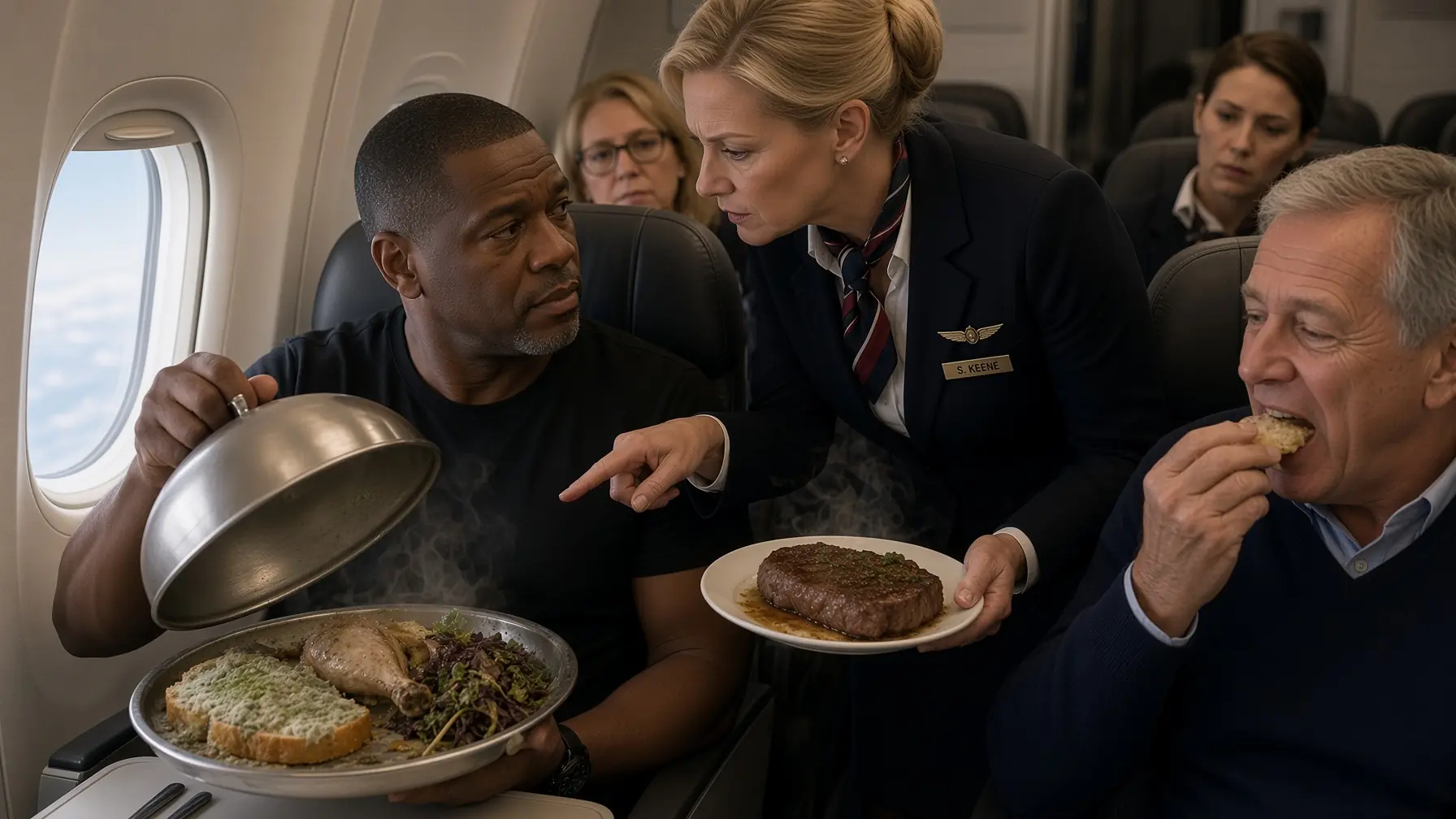
She placed a covered tray on his table.
“Here you are.”
Byron looked at it.
“I thought we had meal choices.”
“We had inventory constraints.”
“What is this?”
“Chicken.”
He lifted the silver-colored lid.
The smell arrived before his eyes completely understood what he was seeing.
Sour.
Stale.
Something sweet and decaying beneath it.
The chicken had turned gray at the edges. Lettuce in the side salad had gone translucent and brown. One piece of bread carried green-black spotting near its crust.
Byron stared.
For several seconds, he honestly thought somebody had made an astonishing catering mistake.
Then he noticed a small piece of red adhesive residue near the bottom of the tray.
Not a normal service label.
A removed tag.
He pressed his call button.
Junior flight attendant Jill Harmon arrived first.
She was twenty-six and had been flying for Crestline for eight months.
“Can I help you, sir?”
Byron pointed.
Jill looked down.
Her face lost color.
“Sir…”
She bent slightly closer without touching anything.
“Oh my God.”
Sandra appeared behind her.
“What’s the problem?”
Jill looked toward Sandra.
“This is—”
Sandra cut her off.
“It looks fine.”
Jill stared at her.
Byron looked from one woman to the other.
“No,” he said calmly. “It doesn’t.”
Sandra folded her hands.
“What would you like?”
“The same meal everybody else received.”
“We’re out.”
Nathan looked at his filet.
Then toward Byron’s tray.
“You were just carrying another steak.”
Sandra turned toward him.
“Mr. Pratt, I’m handling this.”
Byron asked, “Was there enough food loaded for every occupied First Class seat?”
Sandra looked back.
“I don’t discuss catering inventory with passengers.”
“Fair enough. Then please replace this with anything safe.”
For a moment, Byron thought she would.
Instead, Sandra looked toward the galley, then at Jill, then back at him.
Something in her expression hardened.
She stepped into the empty seat beside him.
Jill remained standing in the aisle.
Several nearby passengers went quiet.
Sandra lowered her voice.
“Let me explain something.”
Byron waited.
“I’ve worked First Class for eighteen years.”
She paused.
“I know who belongs here.”
Byron’s face did not change.
Sandra continued.
“And you don’t.”
The sentence hung between them.
Jill’s eyes widened.
Nathan slowly put down his fork.
The woman in 3C turned completely around.
Sandra glanced at the spoiled tray.
“Eat it or don’t.”
Her voice became colder.
“I really don’t care.”
Then she stood.
Byron said nothing.
Sandra returned to the galley.
A moment later she emerged carrying an untouched filet plate.
She walked past Byron.
The smell of fresh beef and rosemary potatoes crossed his seat.
She stopped beside Nathan.
“Last one, Mr. Pratt. I saved it for you.”
Nathan looked at the second plate.
Then at his first.
Then at Byron’s mold-covered bread.
He did not touch either.
Sandra walked away.
The cabin went quiet enough that the engine hum suddenly seemed louder.
Byron reached for his phone.
He took one photograph of the bread.
Another of the chicken.
A third showing the whole tray.
Then he photographed the small catering code printed beneath the dish.
Nathan watched.
“You always this calm?”
“No.”
“What are you feeling?”
Byron adjusted the angle and took another picture.
“Very angry.”
“You hide it well.”
“Anger is information.”
Nathan frowned.
Byron looked toward the galley.
“It isn’t an instruction.”
That was the moment Nathan decided he was going to remember everything too.
Jill came back several minutes later.
She carried two sealed bottles of water.
“Mr. Mitchell…”
Byron noticed she knew his name now.
“Yes?”
“I’m extremely sorry.”
“Was this tray supposed to be served?”
Jill looked toward the front galley.
She hesitated.
Sandra was not visible.
Jill leaned slightly closer.
“No.”
Nathan heard.
Byron’s voice remained quiet.
“What was it?”
“It had been rejected during catering.”
“Why?”
“I don’t know every detail. Broken seal, I think. Maybe temperature control.”