Jane Porter arrived at the mining settlement with eleven cents in her palm and a dress that had not seen clean water in two weeks. The road beneath her boots was mud, packed clay, and wagon tracks, with frozen ruts holding yesterday’s rain like dull glass. On both sides of the street, timber buildings leaned into the cold wind as if the whole town had been built by tired hands and kept standing by stubbornness alone. At the far end, a mule stood hitched near a trough, blinking slowly while men in dust-stained coats passed without looking twice at the young woman who had just walked into town with nowhere else to go.
The boarding house stood near the middle of the settlement, plain, square, and practical, with smoke rising from its chimney and a narrow porch swept cleaner than the rest of the street. A man stood there with a broom in his hands, working the bristles into the corners with a kind of quiet attention that made Jane pause before speaking. He was not young like the miners who laughed too loudly outside the saloon, and not old like the men who had given up expecting comfort. He looked like someone who had learned to save every movement for something useful.
Jane closed her fingers over the coins in her hand before he looked up. When his gray eyes settled on her, she felt the old fear rise in her chest, the fear of being judged before she could explain herself. Still, she kept her back straight because she had learned long ago that stillness looked like strength, even when it was only hunger standing very carefully. “I can cook and clean, sir,” she said, and her voice sounded smaller than she wanted it to.
The man set the broom against the porch railing and studied her without cruelty, but without any softness either. “You have experience?” he asked. Jane nodded once and told him she had worked in a proper household before, with a real kitchen, a wood stove, and a mistress who had taught her how to bake bread, render lard, put up preserves, and make a meal stretch farther than anyone expected. She did not tell him that the mistress had died, or that the household had broken apart afterward, or that Jane had left before anyone could decide what to do with a girl who no longer belonged anywhere.
He listened without interrupting, then picked up the broom again and finished the last corner of the porch. Jane stood in the cold, waiting, careful not to shift from one foot to the other. Finally, he opened the door and held it wide. “Name?” he asked, and when she said, “Jane Porter,” he nodded as if the matter had been entered into some invisible ledger.
“Daniel Harper,” he said, stepping aside to let her in. “The woman who cooked here left two weeks ago. Meals are at six and noon, rooms stay clean, and boarders complain whether they have reason or not.” Jane followed him into the house and felt the warmth of the stove reach her before she saw it. For the first time in many days, the air smelled not like mud and cold travel, but coffee, woodsmoke, and bread crust.
He showed her a narrow room at the back with a bed, a hook on the wall, and a window facing the alley. It was not much, but it was more than she had expected, and the sight of the blanket folded at the foot of the bed made her throat tighten. Daniel placed a few coins on the window sill and looked at the glass instead of her face. “General store is two buildings down,” he said. “Ask the woman there for a working dress.”
Jane looked at the coins, then at him, trying to understand whether kindness always arrived so plainly in this town. “I will pay it back,” she said. Daniel’s expression did not change, but something in his eyes seemed to settle. “Just be back before supper,” he answered, and left her alone with the room, the coins, and the strange ache of being helped without being made small.
The woman at the general store took one look at Jane and walked to the back without asking questions. She returned with a dark gray cotton dress, sturdy and plain, then added a heavy apron from a hook beside the shelves. “You are at Harper’s boarding house,” she said, not as a question, and Jane answered yes. The woman told her the gray would last through winter if she washed it carefully and said there was a brown one waiting when Jane had more coin.
By supper, Jane had changed into the new dress and tied the apron tight at her waist. She stood in Daniel Harper’s kitchen, studying the stove, the pans, the flour barrel, the salt pork, the coffee tin, and every item placed exactly where a practical person would leave it. The kitchen was not fancy, but it was honest, and honest kitchens could be worked with. Before the men came down, Jane had coffee boiling, biscuits cut, pork frying, and beans warming in a pot that had clearly been scraped too many times by impatient hands.
The boarders watched her when she carried in the first plates. There were eight of them, mostly miners, with one man who called himself a surveyor though his instruments seemed to remain upstairs more often than not. They were not cruel, but they had the wary look of men who had occupied a room for too long and distrusted anything new inside it. Jane moved around them quietly, refilling cups, setting plates down, and pretending not to notice every glance.
The biscuits changed the room before the meal was over. One miner broke his open, paused, and looked at the layered inside as if he had discovered something valuable in the dough. “Better than my mother’s,” he muttered, and two men turned on him at once, offended on behalf of women they had not seen in years. Jane kept her back to them at the sideboard and allowed herself one small smile only while no one could see her face.
Daniel saw it anyway. He was seated at the far end of the table with his coffee, watching quietly, his expression unreadable. When Jane turned and met his eyes, he looked down at his cup, and she turned away quickly. It was the first thing that passed between them, small and uninvited, like a spark beneath ash.
The days took shape after that. Jane rose before dawn, lit the stove, made coffee, cut meat, swept floors, and learned the different sounds of the house waking one boarder at a time. She discovered that Daniel’s boots made one heavier sound two steps from the bottom because the stair tread gave slightly there. She learned that he gave instructions only once, paid accounts carefully, and left the ledger open on the desk as if he had nothing in the world worth hiding.
At first, they spoke only of work. Daniel told her when provisions were low, which rooms needed cleaning first, and which boarders had paid late but would pay eventually. Jane answered with short, useful words, because short words were safer than loose ones. Yet the quiet between them did not feel empty for long; it began to feel like something being built without either of them calling attention to it.
One evening in October, Daniel came in from the stable yard favoring his left shoulder. He washed his hands at the basin, sat down at the kitchen table, and opened the ledger as if pain could be ignored into leaving. Jane watched him turn the pages with his right hand only, his jaw set in the stubborn line of a man determined not to ask for help. She took the liniment from the shelf and placed it beside his elbow without a word.
Daniel looked at the bottle, then at her, but she had already turned back to the stove. For a long moment, there was no sound except the pot moving over the fire. Then she heard the small pop of the stopper being pulled free. “Thank you,” he said quietly, and Jane answered that it was on the shelf if he needed it again.
Something changed in the kitchen after that. Not loudly, not all at once, but in the way Daniel’s coffee cup began appearing closer to Jane’s side of the table in the mornings. At first, she thought he had placed it there by accident, then by convenience, then perhaps by habit. Eventually, she began setting it there herself, and when he sat down without remark, the silence around them grew warmer.
Winter moved down from the mountains and settled over the mining camp like a heavy blanket. Snow gathered on the roof edges, froze in the wagon tracks, and turned every morning into a test of who could work through cold without complaint. The boarders stayed inside longer, crowding the common room with card games, arguments, and laughter that went on past the point of humor. Jane moved through it all with coffee pots and clean plates, learning how to belong in a house without asking permission.
Daniel began leaving small things for her. A sharper paring knife appeared on the kitchen block one morning, better balanced than the old one that had bruised her palm. A dark green wool shawl was folded over the back of her chair on the day the wind came through the walls sharp enough to make her fingers stiff. Jane wore it without comment, used the knife without comment, and understood that Daniel was a man who trusted actions more than declarations.
Then Mr. Sherman came on a Thursday during the noon meal. He entered without knocking, wearing a fine coat and a smile that did not reach his eyes. The miners lowered their voices, and even the surveyor stopped pretending to study his papers. Jane knew men like Sherman before he spoke, men who treated every room as if it owed them space.
Sherman wanted two front rooms held on rotation for his crew from the mine. He explained it as if he were offering Daniel an honor rather than demanding control. The boarding house did well because of the mine, he said, and it was only reasonable for Daniel to accommodate the company that fed the settlement. His gaze slid toward Jane once, careless and cold, as if she were furniture in the background of a more important conversation.
Daniel listened until Sherman finished. Then he set his cup down with quiet precision. “I run this house on settled accounts,” he said. Sherman smiled wider, the patient smile of a man who believed pressure was only another form of politeness. “That is a fine principle for ordinary times,” he answered.
“These are ordinary times,” Daniel said. His voice did not rise, and that made the refusal sharper. Sherman’s smile flattened, and the room held its breath. “The company remembers its friends come spring,” he said, standing, and Daniel picked up his cup again. “I hope so,” he replied.
After Sherman left, the room stayed shaped around his threat. Jane carried plates into the kitchen and set them in the basin, then stood with her hands in the warm water until the tightness in her chest eased. She had been looked through before, measured as something useful but unimportant, and it had never surprised her. What did surprise her was Daniel’s refusal, steady and plain, not performed for her, but somehow protecting the dignity of the whole house with three quiet sentences.
That night, she made dried apple pie from the little she had been saving. She did not announce it, only placed it on the table after supper and went back to the kitchen. A few minutes later, the common room fell into that special silence made by men encountering something unexpectedly good. Daniel came to the kitchen doorway while she washed the pan and said, “That was well done.”
“It needed using,” Jane replied, keeping her hands in the water. Daniel remained there a moment longer than necessary, then went back to the table. Jane listened to his footsteps and found that her hands had gone completely still. The compliment was nothing grand, yet it settled in her chest like a warm coal.
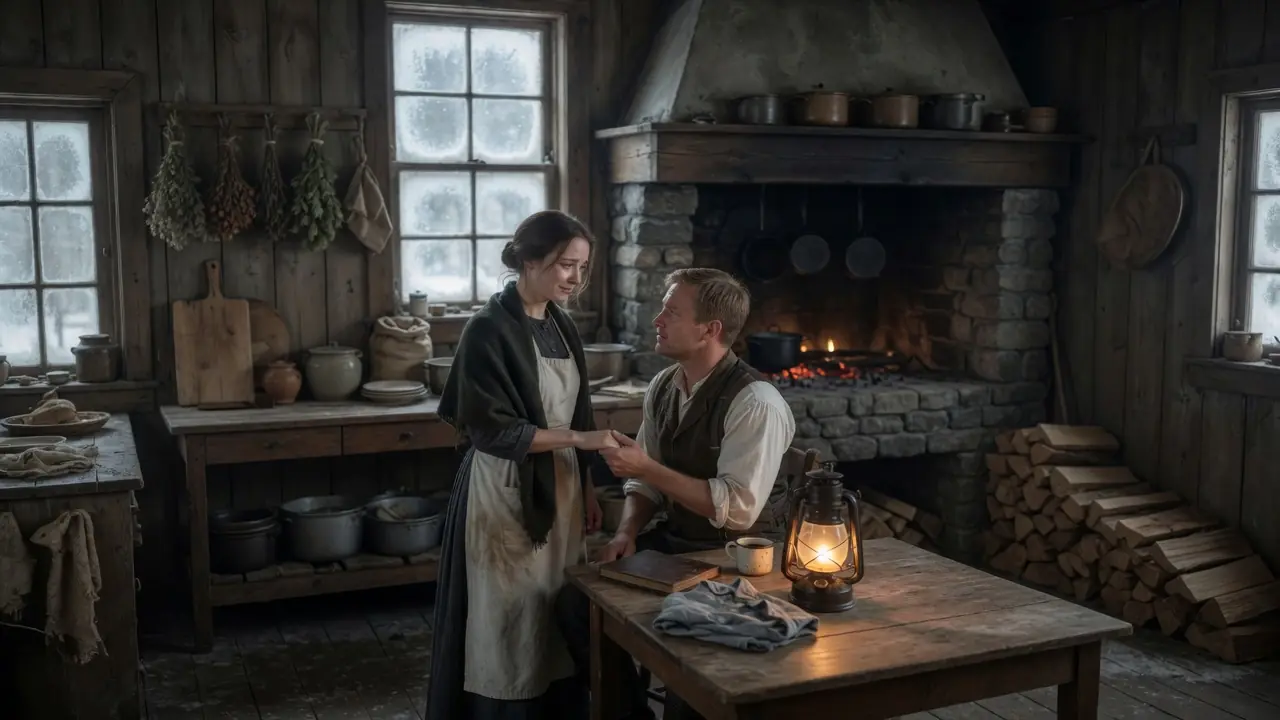
By December, the evenings had changed into something neither of them named. Daniel brought the ledger to the kitchen table instead of working alone in the office. Jane mended shirts, counted provisions, or worked dough while he added figures by lamplight. Sometimes they spoke of flour, roof boards, firewood, and accounts, but sometimes the quiet itself felt like conversation.
One night, Daniel looked up while Jane threaded a needle near the lamp. She held the thread close to the flame, eased it through on the second try, and tied the knot with practiced fingers. “My mother used to do that the same way,” he said, almost by accident. Jane looked up, but he had already lowered his eyes to the ledger, and she understood she had been trusted with something without being asked to hold it.
After that, Daniel’s loneliness became visible to her in pieces. It was there in the way he kept everything orderly but owned almost nothing soft. It was there in the way he worked too late and rose too early, as if rest had to be earned every day and never quite was. It was there in the careful distance he kept from kindness, like a man who feared needing it.
Jane’s own loneliness met his quietly. She had come to the settlement with no family left, no home behind her, and no future she could name beyond the next meal served properly. Yet in that kitchen, with the stove breathing heat and Daniel’s ledger open across from her, she began to feel the shape of days that did not frighten her. The thought scared her more than hunger had, because hope was harder to survive losing.
In January, a storm held the settlement for three days. Snow pressed against the walls, wind rattled the windows, and the men stayed close to the common room fire with boots steaming near the hearth. Jane worked from before sunrise until long after dark, baking extra bread, stretching stew, and keeping coffee hot enough to make tired men grateful. Daniel carried wood, checked the roof, and came in each time with his hair damp from melted snow.
On the third night, Jane nearly slipped near the back door while bringing in a basket of kindling. Daniel caught her by the arm before she fell, his hand firm but careful. For a moment, they stood too close, breath visible in the cold entryway, the basket tilted between them. Jane looked at his hand on her sleeve, and Daniel released her slowly, as if the effort cost him something.
“You work past sense,” he said. Jane almost smiled. “So do you.” He looked at her then, really looked, and something unspoken moved between them like the first crack in river ice. Neither reached for it, but neither could pretend it had not happened.
The next morning, Jane found Daniel already awake, sitting at the kitchen table before the lamp had burned out. The storm had passed, and pale light spread thinly over the snow outside. He held his coffee but had not drunk from it, and the ledger was closed in front of him. When she entered, he stood too quickly, then sat again, and Jane knew from the weight of his silence that something had changed.
She moved to the stove and checked the coals, giving him time because he was the kind of man who deserved it. Behind her, the chair shifted, and she heard him fold his hands on the table. “Jane,” he said, and her name in his voice made her turn. His face was calm, but his eyes were not.
“I have been thinking you should stay on permanently,” he said. Jane’s heart tightened with a sudden fear she did not understand. Permanently could mean steady wages, a room, a place secure enough to stop watching every door. Then Daniel drew a careful breath, looked at his hands once, and added, “As my wife, if that suits you.”
The kitchen seemed to become very still. The fire moved softly in the grate, and somewhere outside, a horse shifted against frozen ground. Jane stared at him, unable to answer, because the words had gone into her too deeply and touched every place she had trained herself not to expose. Daniel did not move toward her or press her, only waited with the patience of a man offering something he meant to honor.
Jane stood and walked to the window. The mountains beyond the settlement were pale beneath the morning, with snow resting on their ridges and smoke rising from chimneys below. She thought of the road that had brought her here, the eleven cents in her palm, the dress stiff with dirt, the porch swept clean, and the man who had given her coins without looking at her shame. She thought of the knife, the shawl, the liniment, the coffee cup moved closer by inches, and all the love Daniel had spoken before he had ever used the word.
When she turned back, Daniel was still seated, still waiting. Jane crossed the room slowly and stood beside him with one hand held open, palm up. It trembled, but she did not pull it back. Daniel looked at her hand as if it were something precious, then took it gently in both of his.
Jane felt the warmth of his fingers close around hers, and tears rose before she could stop them. Daniel’s thumb moved once over the back of her hand, not claiming, only comforting. “I came here with nothing,” she whispered. “I do not know how to be wanted without working for it.”
Daniel’s face changed then, and the restraint he had worn for months softened into something that made her breath catch. “Jane,” he said, “you made this house alive before I knew how empty it had become.” He stood, still holding her hand, and she did not step away. “I am not offering work,” he said. “I am offering my name, my home, and whatever peace I can give you.”
She looked down at their joined hands, then up at his face. The answer had been growing in her for weeks, perhaps longer, in every quiet meal and every unspoken kindness. “Yes,” she said, so softly the fire nearly swallowed it. Daniel closed his eyes for one second, as if the word had struck him harder than any refusal could have.
He lifted her hand and kissed her fingers with such reverence that Jane nearly broke apart from the tenderness of it. Then he stepped closer, slowly enough that she could stop him if fear rose again. It did not. When he bent and pressed a gentle kiss to her forehead, Jane closed her eyes and let herself lean into the warmth of him.
For the first time in her life, she was not being measured by what she could carry, clean, bake, mend, or endure. She was simply held. Daniel’s arm came around her carefully, and she rested her forehead against his chest, listening to the steady beat beneath his shirt. Outside, the mining settlement began its hard morning, but inside the kitchen, time seemed to wait with them.
They married in early spring when the snow softened and the mud returned to the road. There was no grand ceremony, only a preacher, two witnesses from the boarding house, the woman from the general store, and a clean blue ribbon Jane had bought with money she earned herself. Daniel wore his best coat, brushed until the seams looked almost new, and Jane wore the brown dress the store woman had once promised to hold for her. When Daniel took her hands before the preacher, he looked at her the same way he had in the kitchen, steady, patient, and full of a feeling too deep for display.
The boarders pretended not to care, but they polished their boots and stood straighter than usual. One miner cried and blamed the stove smoke, though they were not near the stove. The surveyor gave them a compass he had never used properly and said every household needed direction. Jane laughed for the first time without hiding it, and Daniel looked at her as though that sound alone had repaid every difficult year behind him.
Marriage did not make life easy, but it made the burdens shared. Jane still rose early, and Daniel still worked too late, but now there were moments between the labor that belonged only to them. He would touch her hand when passing behind her in the kitchen, quick and gentle, as if reminding himself she was real. She would smooth his collar before he stepped onto the porch and sometimes, when no one was looking, press her palm briefly against his heart.
Mr. Sherman returned after thaw with a softer voice and harder intentions. He found Daniel and Jane at the front desk, the ledger open between them, and spoke as if the marriage had only made Daniel easier to pressure. Jane stood beside her husband, no longer a silent worker in the margin of the room. When Sherman looked at her as if she did not belong in the conversation, Daniel turned the ledger toward her and said, “Mrs. Harper keeps the accounts with me.”
Sherman’s expression tightened. Jane dipped the pen, checked the page, and named the exact amount the mining company already owed for late meals and unpaid rooms. Her voice was calm, but every boarder in the room went silent. Daniel stood beside her, not speaking for her, not standing in front of her, and Jane understood then that being cherished did not mean being hidden.
Sherman left with less dignity than he had arrived. By evening, word had gone around the settlement that Mrs. Harper could count faster than the mine office and that Daniel Harper had married a woman with a spine made of iron. Jane heard it from the general store woman, who said it while cutting cloth and trying not to smile. Jane carried the news home beneath her shawl like a private flame.
Years later, people would say Jane had saved the boarding house. Others would say Daniel had saved Jane when she came to town with eleven cents and no place to sleep. Neither version was quite true, though both held a piece of it. The truth was quieter and stronger: they had found each other at the edge of loneliness and built a life one ordinary kindness at a time.
Their daughter was born on a cold evening three years after Jane first stepped into the settlement. The difficulty of her arrival frightened them both, but then the child cried, small and fierce, and every fear in the room changed shape. Jane sat by the hearth afterward with the baby against her chest, exhausted, pale, and smiling as if she had seen the whole world remade. Daniel sat on the low stool beside her, reaching out one careful finger to touch the back of the baby’s hand.
The child curled her tiny fingers around him, and Daniel’s face broke open with wonder. Jane watched him, this strong, quiet man undone by something smaller than his palm, and felt love rise so large in her that naming it would have made it smaller. The fire burned low, the boarding house settled around them, and outside the settlement moved into night with the usual sounds of horses, doors, and tired men going home. Inside, Jane held their daughter and knew she had finally arrived somewhere she did not have to earn the right to stay.
Sometimes, when the kitchen was quiet before dawn, Jane remembered the girl she had been on the road into town. She could still feel the eleven cents in her palm, still smell the mud, still see Daniel sweeping the porch with patient hands. That girl had believed survival was the best life could offer her. She had not known that one day a man would take her trembling hand, kiss her forehead, and ask her to stay because the house had become home only after she entered it.
Daniel would come downstairs then, the same stair still sounding heavier two steps from the bottom. He would find Jane at the stove, their daughter half asleep in a cradle nearby, and his coffee waiting near her side of the table. He would touch Jane’s shoulder as he passed, and she would lean into his hand for one brief second before the day began. It was not a grand love by storybook standards, but it was steady, faithful, and lived in every small act that made the world less cold.
And in that mining settlement, where men came and went chasing ore, wages, and luck, Jane Porter Harper became something more enduring than a poor girl hired to cook. She became the heart of a house, the keeper of its warmth, the woman who could make bread rise, accounts balance, and a lonely man believe in tenderness again. Daniel never forgot the morning she held out her hand, and Jane never forgot the way he took it with both of his. They had not found fortune in the mountains, but they found something rarer: a place to stand, a love to trust, and a future brave enough to begin with one quiet yes.