In the spring of 1962, Walter Greer drove his old Ford pickup down Route 44 with forty-two gallons of white latex paint rattling in the bed. Beside the paint cans were twelve wide brushes, a box of rubber gloves, and a folded letter from an Iowa State pomologist he had already read so many times the paper had softened at the creases. Harlan, Iowa, was still gray with March cold, the fields flat and wind-scraped, the sky hanging low over the county road. Walter did not stop at the diner, did not wave at the men outside the feed store, and did not explain why an apple grower needed enough paint to cover a barn.
By Monday morning, every trunk in his twelve-acre orchard had turned white from the ground to the first major branch. Two hundred thirty-one apple trees stood in rows like pale posts in the early light, their lower bark coated clean and bright against the black soil. From the road, it looked strange enough to stop traffic. Men slowed their trucks, boys leaned out of windows, and one woman from town crossed herself as if Walter had invited some kind of farmyard curse.
Walter kept painting. He moved from tree to tree with a steady hand, dipping the brush, scraping off the extra paint, and laying each stroke over the rough bark with careful pressure. His hired hand, Tommy Briggs, painted two rows behind him, though Tommy’s face showed more confusion with every hour. Walter said nothing except when he corrected the height of a brush stroke or told Tommy to cover the southwest face twice.
The first laugh came from Harold Deets, the largest grain farmer in the county. Harold stopped his clean green truck at the gate, crossed his arms, and stared at the orchard as if he had discovered evidence of madness. “Walt,” he called, “you planning to paint the apples next?” Tommy lowered his brush and looked toward Walter, waiting to see whether the old orchardist would answer.
Walter did not look up at first. He finished painting the full curve of one trunk, smoothing white into a deep split where the bark had cracked the previous winter. Only then did he turn toward Harold. “No,” he said. Harold waited for more, but Walter had already bent over the next tree.
By supper, the whole town had the story. At the diner on Main Street, farmers laughed over coffee while the waitress refilled cups and shook her head. The local paper ran a joke in the community notes column saying Walter Greer had decided his apple trees needed a fresh coat. Someone clipped it out and left it beside the register, where men picked it up all week and read it aloud as if it grew funnier each time.
Walter saw the clipping on Wednesday when he came into town for fuel. He read it once, folded it neatly, and placed it back where it had been. The men at the counter went quiet, waiting for him to defend himself or show embarrassment. Walter only paid for his fuel and left, carrying their silence behind him like something too small to set down.
The truth was that Walter Greer had not painted his trees because he was lonely, strange, or bored. He had painted them because he had been losing apple trees for three winters and could no longer accept the explanations people offered him. The county extension agent had told him to improve drainage and spray for fungus. Harold Deets had told him to fertilize harder, as if nitrogen could heal dead bark.
Walter had studied the wounds himself. He had found long vertical cracks on the southwest sides of trunks, dead cambium beneath bark that looked fine until summer, and dark patches where disease had entered after winter injury. Eleven trees had failed in 1959, three more the next year, and several others carried hidden damage. To Walter, every dead trunk felt like a sentence he had not yet learned how to read.
So he wrote letters. He wrote to Iowa State, to an orchard bulletin office in Ames, and to a pomologist named Dr. Edgar Hollman, who replied with more patience than Walter expected. Hollman described sunscald, the way winter sunlight could warm dark bark on one side of a tree during the day, tricking the tissue awake before night froze it again. White paint, Hollman explained, reflected that sunlight and kept the trunk closer to air temperature, preventing the sudden thaw and freeze that killed the living layer under the bark.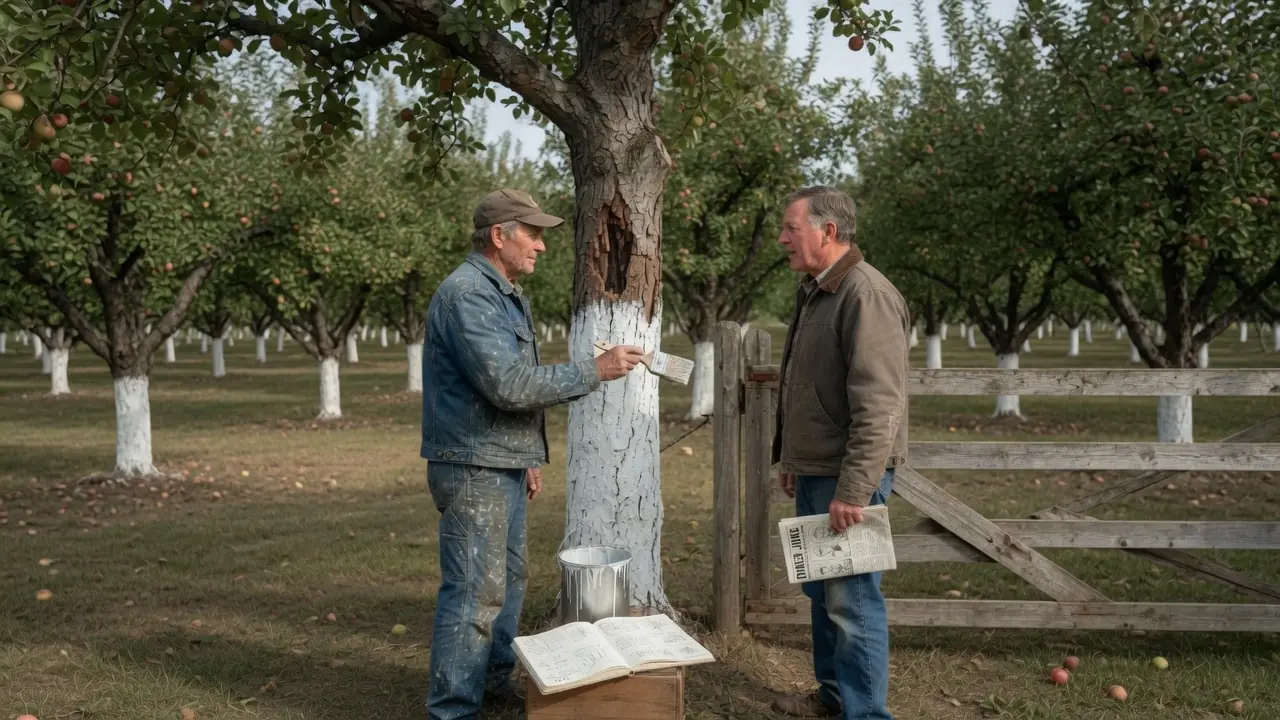
Walter read the letter at his kitchen table until the logic settled in his bones. It was not decoration. It was protection. It was not madness. It was a cheap shield against a silent winter injury that had been killing his orchard from the inside while neighbors blamed age, soil, and bad luck.
The next morning, Harold Deets came back, this time carrying the newspaper clipping between two fingers. He walked through the gate without asking, boots clean, jacket buttoned, smile sharpened for an audience even though no crowd stood behind him. Walter was kneeling beside a Winesap tree, brushing white paint into a scarred groove where old bark had peeled away. Tommy stood a few rows back, pretending not to listen.
Harold waved the clipping. “Whole town’s laughing, Walt,” he said. “They think you’ve finally let those apples cook your brain.” Walter dipped his brush again and painted upward with slow strokes. “The town has laughed at cheaper things than truth,” he said.
Harold’s smile tightened. “Paint won’t grow apples. Fertilizer does that.” Walter stood and tapped the scarred bark with the wooden end of his brush. “Fertilizer feeds roots,” he said. “This keeps death out of bark.” Harold looked at the white trunk, then at Walter’s face, and for the first time his confidence hesitated.
Walter turned the tree slightly by walking around it, pointing at the southwest side where the bark had cracked in a long thin wound. “Sun warms this side in February,” he said. “Tissue wakes up. Night freezes it. By July, the damage opens and rot walks in.” Harold frowned as if the explanation offended him by being possible. “You get that from a book?” he asked.
“From dead trees,” Walter said. Then he bent and continued painting. Harold stood there a moment longer, the clipping limp in his hand. He had come to laugh in person, but the joke did not feel as solid now that Walter had given it a reason.
Still, Harlan did not stop laughing. Men who drove past the orchard called the trees ghost trunks, funeral posts, and Walter’s white army. Children made up stories about haunted apples. Even the mailman said one morning that Walter ought to hang curtains on them if he was decorating for spring.
Walter answered none of it. He kept a notebook with a hand-drawn grid of the orchard, each tree numbered, each coat recorded, each wound described. Young trees got diluted paint so the bark could breathe. Mature trees got stronger coats, especially on the southwest side, though Walter painted all the way around because snow glare could wound from more than one direction.
April came with wet winds and hard mornings. The white trunks glowed in the orchard rows whenever sunlight broke through the clouds. Walter checked each tree before breakfast, touching bark, scraping lightly where old cracks had formed, and making notes with a stub pencil. He found seven trees he had nearly marked for removal but now believed had been injured by sunscald rather than age.
By May, blossoms opened across the orchard. Pale pink and white flowers covered the branches until the rows looked soft above their strange painted bases. Bees came in a low moving hum, and Walter walked beneath them with his clipboard, counting fruit set and checking the old damaged trees. Several of those trees pushed new green growth so strong that he stopped beside them longer than usual, pressing one hand to the trunk as if greeting a patient who had survived the night.
The town noticed, but pride kept people from saying much. Harold slowed his truck twice in one week, always pretending he was looking at the road ditch or a loose fence line. Walter saw him both times. He did not wave, because he understood that curiosity sometimes needed privacy before it became honesty.
Summer warmed and steadied. Walter thinned fruit by hand, sprayed when necessary, and kept his rows mowed clean. The apples set heavier than he expected, not a miracle harvest, but strong enough to make his pencil pause at the numbers. The damaged trees that should have weakened now carried fruit evenly, their leaves full and deep green.
Then came a storm in late July. Hail fell north of Harlan and missed Walter’s farm by less than two miles. The men at the diner spent the next morning talking about damage, luck, and insurance. Nobody mentioned the white trees. Walter sat at his kitchen table that same morning, writing in his notebook that protection did not make a farmer safe, only prepared for one danger at a time.
By September, the apples had taken color. Winesap blushed red and dark, Golden Delicious warmed yellow, and the orchard smelled faintly sweet in the cool mornings. Walter ordered extra crates from Omaha, telling himself not to trust hope too early. He had been a farmer too long to count a harvest while it still hung on branches.
The first picking day came clear and bright. Walter climbed a ladder in the third row and dropped clean apples into his canvas shoulder bag one by one. Their skins were smooth, the sizing consistent, the blemishes fewer than any year he had measured. Tommy, who had returned to help during harvest, whistled when the first crates filled.
By noon, a truck from the Omaha packer rolled into the lane. The buyer, Mr. Leland, walked through the rows with Walter and lifted apples from three crates at random. He turned them in his hand, inspected the skin, and nodded slowly. “These are cleaner than last year,” he said. Walter only answered, “They held.”
That afternoon, Harold Deets arrived without a joke clipping. He parked at the gate and walked into the orchard slowly, his eyes moving from the white trunks to the full crates stacked under the trees. Walter was on a ladder, picking from a branch heavy enough to bow. Harold stood below and waited until Walter came down.
“I’ve been meaning to ask you something,” Harold said. Walter set his apple bag on the ground and looked at him. Harold cleared his throat, but his gaze kept drifting to the crates. “The paint,” he said. “Is it the brand, or does it not matter?”
Walter studied him for a moment. Around them, the harvest crew worked quietly, and the orchard smelled of apples, grass, and latex that had long since dried into the bark. The same man who had waved a joke clipping months earlier now held a small notebook in his hand. Walter could have reminded him. He could have let the silence punish him. Instead, he reached into a crate, chose one perfect apple, and handed it to Harold.
“Any white latex,” Walter said. “Water it down for young trees.” Harold accepted the apple but did not bite into it. He looked at the skin, clean and unscarred, then at the white trunk beside him. His face changed in a way Walter had not seen before. It was not shame exactly, but the beginning of respect fighting through old pride.
“How did you know?” Harold asked. Walter tapped his notebook, the one stained with dirt, paint, and years of corrections. “I stopped asking what would make people nod,” he said. “I started asking what was killing the trees.” Harold lowered his eyes. For once, he had no clever answer.
The climax came later that same afternoon when the packer finished grading Walter’s apples. Mr. Leland stood beside the loaded truck and read the numbers from his form while Harold still stood nearby. The field loss rate was lower than any orchard in the county that season, and the price would be premium grade. The crates were so clean and consistent that the packer agreed to extend Walter’s contract for the next harvest before the truck even left the lane.
Harold stared at the loaded truck as if it had spoken against him. “The whole town laughed,” he said quietly. Walter wiped his hands on a cloth and looked across the rows of white trunks glowing beneath heavy branches. “The whole town laughed from the road,” he said. “The trees were speaking in the bark.”
That line traveled faster through Harlan than the joke had. By the next morning, the diner was quieter when Walter’s name came up. Men who had called the orchard haunted now asked whether sunscald was real. The same newspaper that had joked about wallpapering the barn printed a small harvest note about Walter Greer’s premium apple contract, though it made no apology for the earlier clipping.
Walter did not need one. He had never painted the trees to prove the town wrong. He had painted them because the evidence was there, because the answer was affordable, and because ridicule cost less than losing another tree. Every white trunk in the orchard stood as a quiet argument for paying attention.
Winter tested him again in later years. One season brought an early warm spell followed by a brutal freeze, and Walter learned that paint alone could not solve every kind of injury. He wrapped trunks with burlap after that, noting the difference between sunlight damage and deep ambient cold. Farming kept correcting him, and he kept letting it.
That became the real lesson of Walter Greer’s orchard. He did not become wise because he was right once. He became wise because every wrong answer made him sharpen the next one. His notebooks filled with adjustments, failures, dates, weather, paint ratios, wrapping heights, and plain sentences that sounded almost like prayers.
Over time, other orchards in the county began to show white trunks in March. At first, only one or two farmers tried it, pretending they had heard about the method from Iowa State rather than from Walter. Then more did, especially after bad winters left unpainted trees cracked and weakened. Harlan slowly forgot how loudly it had laughed.
Walter remembered, but not bitterly. Bitterness, like rot, entered through wounds if a man kept them open too long. He preferred correction. He preferred harvest. He preferred clean apples coming off healthy branches while the wind moved over white trunks that had once made the whole town laugh.
Years later, when Walter sold the orchard to a young couple from Ames, he walked them row by row through every painted trunk. He showed them where the old scars had healed, where burlap needed to sit in January, and which trees faced the worst southwest sun. Then he gave them seven notebooks tied with baling twine. The young woman held them like an inheritance.
“These are worth more than the tractor,” she said. Walter looked at the orchard and shook his head. “They’re worth what you correct after reading them,” he said. The couple kept painting every March. They kept wrapping every January. The orchard kept producing apples with clean skin and firm flesh long after the original laughter had faded from town memory.
Walter Greer died in 1987 in the same farmhouse where he had first read Dr. Hollman’s letter by lamplight. His obituary said he was known locally for apple growing, to which he brought patience and care. It did not mention the joke clipping, the gate where Harold Deets laughed, or the white trunks that had once made people slow their cars to stare. Maybe it did not need to.
The orchard told the fuller story every spring. When the lower trunks turned white against the thawing black soil, anyone who knew the history could still see Walter moving row by row with his brush. They could see a man mocked by neighbors, steadied by evidence, and brave enough to look ridiculous until the truth ripened. The town had laughed at white paint, but the harvest had answered in apples.