The first sound Jed Halverson heard when he rode into Cedar Ridge that August was laughter sharp enough to scrape bone. It rolled across the courthouse square through coal smoke, horse sweat, and thawing mud left behind by a week of mountain rain, the kind of laughter men made when they had found somebody too helpless to strike back. Jed reined his bay gelding beside the feed store and saw nearly forty people gathered around the courthouse steps, with boys standing on hitching rails and two saloon girls watching from beneath bright parasols. At the center of them stood a woman holding a battered carpetbag while a red-faced boardinghouse owner waved a ten-dollar account book over her head.
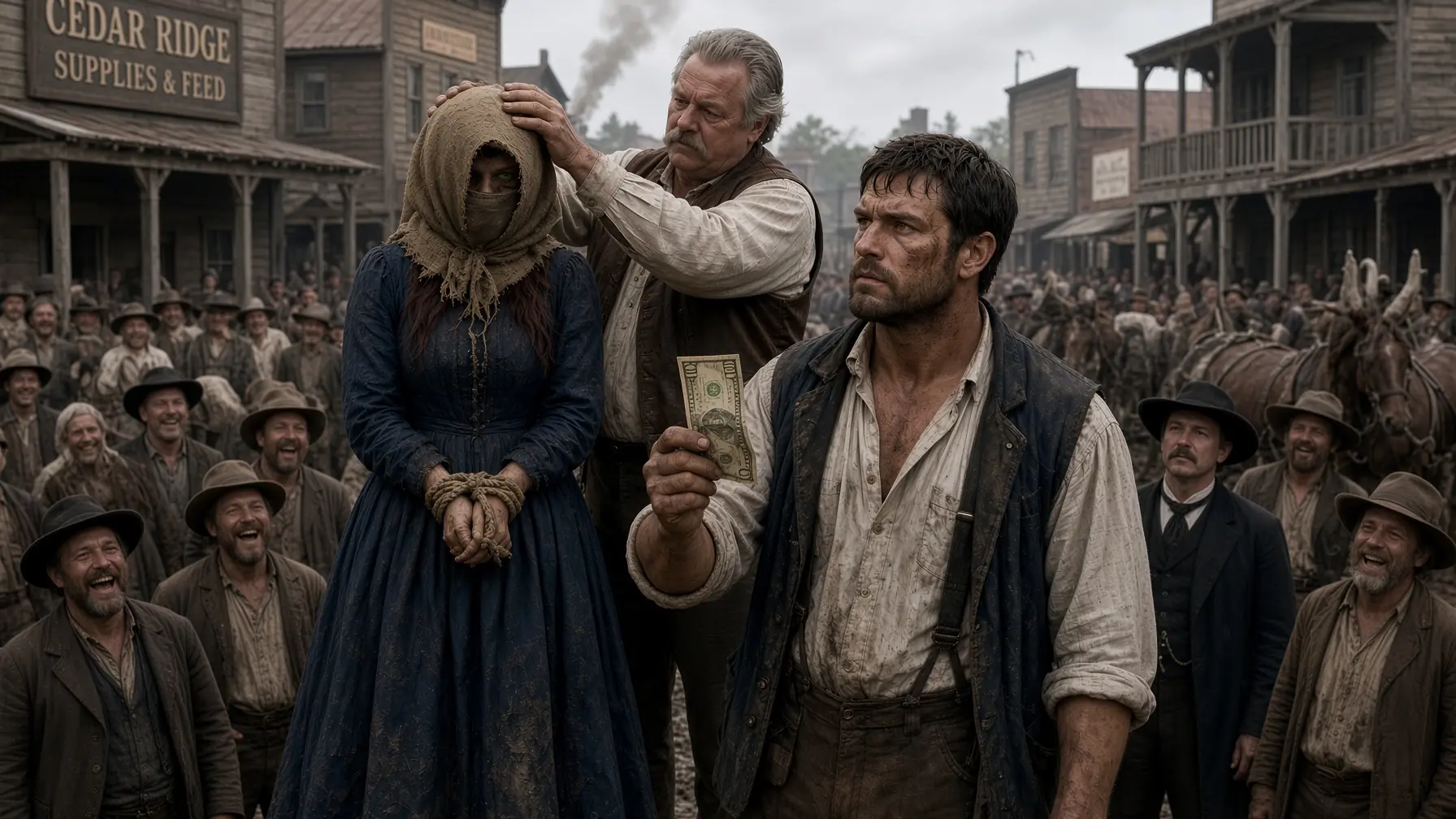
Jed was thirty-seven, broad through the shoulders, quiet by habit, and sufficiently familiar with Cedar Ridge to know that crowds rarely gathered there for kindness. He owned a small horse ranch six miles north of town, repaired wagons through winter, and had learned during twelve years in Colorado that public entertainment usually cost somebody dignity even when nobody paid admission. The woman on the courthouse steps was perhaps thirty, tall and thin from travel, wearing a plain brown dress patched neatly at one sleeve and a dark green coat much too heavy for August. A pale scar curved from beneath her left ear toward her collar, but what Jed noticed first was not the scar; it was the way she stood completely still while everyone around her tried to make her smaller.
The boardinghouse owner was Lottie Crowe, a widow who ran the Cedar House with three daughters, eleven rooms, and a conviction that unpaid bills were personal insults. Beside her stood Amos Prentiss, owner of the general store, serving that year as acting justice of the peace whenever the elected magistrate drank too much to sign his own name. Lottie slapped the account book against her palm and announced that Miss Mara Whitcomb owed ten dollars and eighty cents for three nights’ lodging, two meals, laundry, and the stage driver’s fee Lottie had advanced when Mara arrived without enough cash. Somebody near the saloon shouted that ten dollars ought to buy a man a wife and supper besides, and the square erupted again.
Mara did not laugh. She looked at Lottie and said, “I told you I could pay when the bank opens my draft,” but Lottie immediately replied that the bank had already refused the paper because it carried an out-of-town endorsement nobody recognized. Amos Prentiss lifted both hands and declared that Cedar Ridge had a long tradition of helping unattached women find respectable households, which was a generous description of an ugly local custom sometimes used to turn stranded travelers into entertainment. He suggested that any unmarried man willing to settle Mara’s debt could escort her to Reverend Dobb’s church and “see whether Providence favored an arrangement.”
Jed felt something inside him harden. The crowd began calling amounts as jokes even though no legal auction had been declared, with one cattle hand offering two dollars, another offering five if Mara could cook, and a third shouting that he would pay nothing until she smiled. Mara’s jaw tightened but her eyes did not drop. Then a voice from the far side of the square said, “Wouldn’t take her free after what Mr. Rourke says she’s been asking about.”
That changed the crowd. Men who had been laughing turned toward the speaker, a Black Spur Ranch rider named Cal Haskins, and even Amos Prentiss lowered his hands. Silas Rourke owned more cattle than anyone within eighty miles, controlled the local bank through a partnership nobody discussed openly, financed half the town’s commercial mortgages, and behaved as though the county line had been surveyed for his convenience. If Rourke had told people Mara Whitcomb was trouble, then ten dollars had suddenly become more expensive.
Lottie attempted another joke, but it landed badly. “There you are, Miss Whitcomb,” she said, “seems you’ve frightened off the bachelors already,” and several people laughed without conviction. Mara turned toward Cal Haskins and asked, “What exactly did Mr. Rourke say about me?” Cal smiled and answered, “Said decent folks ought not help a woman who sticks her nose into matters that don’t belong to her.”
Jed stepped down from his horse. He tied the reins to the rail, crossed the square, and reached into the inside pocket of his work coat while the laughter weakened behind him. Ten dollars represented more than a week of groceries, a pair of decent boots, or enough feed to carry two horses through several weeks, but Jed put a ten-dollar gold eagle on Lottie’s account book anyway. “Her bill is paid,” he said.
Lottie blinked. Amos Prentiss smiled in immediate relief and announced, “Well, Mr. Halverson, looks like Providence has spoken,” but Jed turned toward him before the sentence finished. “No,” Jed said, “a debt got paid, and Providence can mind its own business.” Then he looked at Mara and added, “You don’t owe me marriage, work, gratitude, or anything else because I settled ten dollars.”
For the first time, Mara’s expression changed. Not dramatically, but enough that the tension around her eyes loosened while the crowd went unusually quiet. She asked, “Then why did you pay it?” and Jed answered, “Because I was tired of listening to forty people pretend humiliation was entertainment.” Lottie closed her account book, muttered something about ungrateful strangers, and walked back toward the boardinghouse.
Amos Prentiss attempted to recover the festive mood by saying the matter was resolved, but nobody knew whether to leave. Mara bent, lifted her carpetbag, and asked Jed where she might find another place to sleep because Lottie had already told her the Cedar House no longer had a room available. Jed considered the question long enough to feel twenty people watching him. “I have a spare room,” he said, “but if that sounds worse than the hotel, Reverend Dobb’s wife sometimes takes women in.”
Mara studied his face. “You live alone?” she asked, and Jed said yes. “How far from town?” she asked, and Jed told her six miles. Then Mara did something that surprised everyone, including Jed, by asking, “Is the offer of marriage also still available if I choose it instead of owing it?”
The square went completely still. Jed glanced toward Reverend Dobb, who happened to be standing beside the undertaker with his mouth open, then looked back at Mara and said, “I didn’t make one.” Mara nodded once and replied, “Then I’m making the question plain, Mr. Halverson.”
Jed had known her for perhaps four minutes. He knew she was stranded, short of money, disliked by Silas Rourke, and calm enough to face public ridicule without giving the crowd the pleasure of watching her break. Those were not reasons to marry anyone. Jed said, “Before I answer, I’d like to know why a woman who doesn’t know me would ask.”
Mara looked across the square toward Cal Haskins. “Because Silas Rourke has already made it difficult for me to obtain lodging, transportation, access to county records, and credit, and I suspect he will make tomorrow worse.” She lowered her voice before adding, “A married woman staying on her husband’s property is harder to chase out of town without attracting questions.” Jed heard the calculation immediately, and strangely, calculation reassured him more than romance would have.
“What happens when you finish whatever brought you here?” Jed asked. Mara answered, “We decide whether to remain married, obtain an annulment if legally available to us, or separate by whatever lawful method applies, and I will make no claim to your ranch because you paid ten dollars.” Jed almost smiled. “That last part sounded rehearsed.”
“It became necessary approximately three minutes ago.” Jed looked around the square one final time, saw Cal Haskins already moving toward the saloon as though carrying news, and understood that saying no would leave Mara exactly where Rourke wanted her. “All right,” Jed said, “but the first condition is that you never say I bought you.” Mara held out her hand and replied, “Agreed.”
Reverend Dobb married them that afternoon inside his small church with his wife, Ada, and Jed’s friend Samuel Pike as witnesses. The ceremony lasted six minutes because neither bride nor groom had requested scripture beyond what the reverend considered unavoidable. Mara used her full name, Mara Ellen Whitcomb, and spoke the vows without trembling. When Reverend Dobb finally said they were husband and wife, Jed felt less like a newlywed than a man who had signed a contract whose missing pages had not yet been delivered.
They rode north in Jed’s wagon because Mara’s carpetbag was heavier than it looked. Cedar Ridge fell behind them while cottonwoods followed the creek through low country burned yellow by summer, and for almost two miles neither spoke. Jed eventually asked whether Silas Rourke knew why she had come to town. Mara answered, “He knows enough to be afraid, but not enough to know what I have.”
Jed looked toward her. “What do you have?” Mara rested one hand on the carpetbag between her boots. “Not enough yet.”
The Halverson ranch consisted of one hundred sixty acres, a weathered house, a barn built from pine hauled down from the foothills, three fenced pastures, a spring-fed creek, twelve saddle horses, and a workshop full of wagon parts Jed repaired through winter. It was not impressive beside Black Spur Ranch, which stretched across valleys through deeds, leases, purchases, and several claims people privately questioned but publicly accepted. Jed’s place mattered to him precisely because nobody had given it to him. He had homesteaded the first eighty acres, purchased another forty from a retiring couple, and spent nine years clearing the debt on the rest.
Mara noticed the boundary stones before she noticed the house. She asked Jed to stop the wagon beside a weathered marker near the southern pasture and climbed down before he could ask why. Kneeling in the grass, she brushed soil from the stone until a worn survey mark appeared. “Who set this?” she asked.
“Federal survey crew, before my time.” Mara took a small notebook from her coat and copied the mark. Jed watched her and said, “Most new brides ask where the kitchen is first.” Mara replied, “Most new brides probably intend to remain married longer than three days.”
The house had two bedrooms separated by a narrow hallway. Jed showed her the smaller room, placed clean linens on the bed, and apologized for the dust. Mara looked through the window toward the southern pasture and asked whether Black Spur cattle ever crossed his fence.
“Sometimes.” Jed set her carpetbag beside the bed. “Their foreman says cattle can’t read deeds.”
“Can Silas Rourke?”
Jed looked at her. “You really came here because of him.”
Mara unbuttoned her coat but did not remove it. “My father’s name was Henry Whitcomb.” Jed knew the name, though it took several seconds to understand why. Henry Whitcomb had been a surveyor and deputy county recorder who died four years earlier when his wagon went over a ravine road outside Cedar Ridge.
“Accident,” Jed said. Mara’s face remained still. “That is what Sheriff Cullen wrote.”
Jed waited. Mara finally removed the coat and folded it carefully over a chair. “My father spent his final year reviewing land transfers involving Silas Rourke, the county recorder’s office, and several homesteads that disappeared into Black Spur ownership after their owners supposedly defaulted.”
Jed sat on the edge of a second chair. “Supposedly?” Mara opened the carpetbag. She removed two dresses, a wrapped bundle of documents, one small wooden box, and a ledger whose cracked black cover had been repaired with thread. “My father believed signatures were being forged, taxes were being falsely reported as unpaid, and water rights were being reassigned through deeds filed after landowners had already challenged them.”
Jed stared at the ledger. Mara placed her palm over it. “This contains copies of his field notes, but not the evidence I need to prove the courthouse records were altered.”
“Why come here alone?” Jed asked. Mara gave him a tired smile. “Because everybody else who tried publicly became either poor, frightened, discredited, or dead.”
That answer followed Jed through dinner. He fried salt pork, warmed beans, cut bread, and listened while Mara explained that she had worked in the territorial land office in Denver for nearly six years after her father’s death. She was not an attorney, a marshal, or a federal agent, despite what Jed briefly hoped might simplify things. She was a senior records clerk who had become very good at recognizing when land documents failed to agree with one another.
Her father had trained her young. Henry Whitcomb believed measurements were stories written in numbers, and as a girl Mara spent summers carrying survey stakes, copying field notes, and listening to arguments over creeks that moved more slowly than property lines. When Henry died, Sheriff Nash Cullen ruled the wagon accident unfortunate before any meaningful investigation occurred. Mara accepted that conclusion until a sealed package arrived months later containing duplicate survey notes and a letter in her father’s hand.
The letter did not accuse Rourke of murder. Henry wrote that he had discovered discrepancies involving Black Spur land acquisitions, suspected cooperation inside the courthouse, and feared certain originals might be replaced if he confronted the wrong people too early. He asked Mara to preserve his duplicate notes and contact a federal land examiner named Horace Bell if anything happened to him. Mara did exactly that.
Horace Bell had since spent years building a broader investigation. Federal jurisdiction was complicated because some disputed parcels involved homestead patents and land-office filings while others were entirely private transactions belonging in county court. Bell could not arrest a powerful rancher because a dead surveyor had been suspicious. He needed altered documents, false federal filings, witness testimony, and a chain showing who benefited.
Mara had provided the first pieces. Several original federal filings did not match copies preserved in Cedar Ridge’s county books. A widow in Pueblo swore that a deed supposedly bearing her late husband’s signature had been executed eight months after his death. Two former Black Spur hands described being paid to remove survey stakes from contested creek ground, but neither knew whether Rourke personally ordered it.
“What’s missing?” Jed asked. Mara answered, “The county transfer ledger from eighteen eighty-two through eighty-four and the associated acknowledgment book.” Jed frowned because he had no idea what an acknowledgment book was.
“It records who appeared before a notary or officer to acknowledge signatures on deeds.” Mara broke bread into her beans. “If the courthouse copy still shows the original dates, it may prove several deeds were backdated or acknowledged by people who could not possibly have appeared.”
“And if the books have been changed?” Jed asked. Mara looked toward the wrapped documents. “Then I need to know how.”
Jed leaned back. “Why not simply walk into the courthouse yesterday?” Mara said, “I did, and Amos Prentiss told me records involving Black Spur interests were temporarily unavailable for inventory.” Jed understood then why Cal Haskins knew her name.
She had asked questions. Somebody had told Rourke. By nightfall her bank draft was being questioned, the stable refused to rent her a horse, and Lottie Crowe suddenly wanted immediate payment from a woman she had previously agreed could settle her room at the end of the week. “You think Rourke arranged all that?” Jed asked.
“I think powerful men rarely need to issue direct orders once enough people understand what keeps them comfortable.” Mara’s answer was so calm that Jed believed she had been thinking about power longer than most politicians. Then she asked if he owned a Bible.
Jed laughed despite himself. “That’s a strange change of subject.” Mara explained that the marriage certificate Reverend Dobb would file the following morning might give her a lawful reason to examine records connected to Jed’s property if she claimed concerns about her new marital interest. “I told you I won’t claim your land,” she added, “but there is no law against worrying that my husband’s deed is defective.”
Jed stopped laughing. “Is it defective?” Mara said, “I don’t know yet.”
He slept badly. Around midnight Jed heard Mara walking in the hallway, then the back door opened. He pulled on boots and found her standing beyond the porch looking south toward the dark outline of Black Spur country.
“You all right?” he asked. Mara nodded.
“You don’t sound all right.” She folded her arms against the night air. “I did not expect the town to turn on me before I reached the courthouse.”
“You also didn’t expect to get married.” Mara glanced at him. “That was not in Horace Bell’s plan.”
Jed leaned against the porch post. “You trust this Bell?” Mara answered yes without hesitation.
“Do you trust me?” he asked. That took longer. “I trust that you paid a debt without using it to purchase obedience,” she finally said.
“That’s not the same thing.” Mara looked back toward the darkness. “It is enough for tonight.”
At sunrise, Jed found two Black Spur riders outside his gate. Cal Haskins sat on a gray gelding beside a younger man named Barlow Fitch, both wearing revolvers openly though neither had drawn them. Jed stepped onto the porch carrying coffee and asked whether they were lost.
Cal smiled. “Mr. Rourke heard you got married.” Jed took a drink. “News travels.”
“Real sudden wedding.” Cal looked toward the house. “Sometimes a man should know what he’s taking home.”
Mara appeared in the doorway behind Jed. “Sometimes a rancher should know what he’s filing at the courthouse,” she said. Cal’s smile vanished.
“That kind of mouth is why nobody wanted you.” Mara replied, “No, Mr. Haskins, nobody wanted the trouble your employer promised them.” Cal rested one hand casually near his saddle horn and said Rourke wished to speak with her.
“Tell him he knows where the courthouse is,” Mara said. Cal looked at Jed instead.
“You sure this is the wife you want?” Jed answered, “She’s been my wife one night and already improved breakfast conversation.”
Barlow laughed before catching himself. Cal shot him a look, turned his horse, and said, “Mr. Rourke doesn’t enjoy being embarrassed.” Jed replied, “Then Cedar Ridge seems like a poor place for him to live.”
After the riders disappeared, Mara said, “That was unwise.” Jed finished his coffee. “The breakfast line?”
“The entire conversation.” Jed nodded. “Probably.”
They rode into Cedar Ridge at eight thirty. Reverend Dobb had already filed the marriage certificate, and Mara carried a copy with Jed’s deed folded beneath it. She wore the same brown dress, but her hair was pinned more carefully and the tired traveler from the courthouse square had been replaced by somebody who looked as if she belonged behind an official desk.
The county recorder, Martin Vale, occupied two rooms on the courthouse’s first floor. Martin was a narrow man in his fifties with nicotine-yellow fingers, an expensive watch, and the nervous courtesy of someone whose employment depended on several people being pleased simultaneously. When Mara introduced herself as Mrs. Halverson and requested the chain of title affecting Jed’s southern boundary, Martin’s expression changed only slightly. “Those books are undergoing review.”
“By whom?” Mara asked. Martin replied, “County business.”
Jed leaned on the counter. “My deed is county business.”
Martin looked toward him. “You never cared before.”
Mara smiled. “Then marriage has improved him.”
Martin did not appreciate the joke. He said records would become available after inventory, perhaps next week. Mara placed the marriage certificate and deed on the counter and calmly requested written confirmation that public records affecting a landowner’s title were being withheld, along with the statutory reason and the name of the officer ordering the restriction.
Martin stared at her. “You’re making trouble.”
“No.” Mara reached for the papers. “I am asking you to record yours.”
The door opened behind them. Silas Rourke entered without knocking.
Jed had seen Rourke dozens of times but had never stood close enough to smell his expensive shaving soap. He was fifty-eight, tall, silver-haired, broad in a way that expensive meals maintained better than ranch work, and dressed in dark wool despite the heat. People described him as handsome because wealth altered adjectives. His eyes went directly to Mara.
“Miss Whitcomb.” Mara held up her left hand enough for the new ring Jed had purchased from Reverend Dobb’s wife to catch the light. “Mrs. Halverson.”
Rourke looked at Jed. “That was quick.”
Jed answered, “She’s decisive.”
Rourke smiled without warmth. “Mr. Halverson, your father had a reputation for being practical.”
“You never knew my father.” Rourke’s smile remained. “I knew enough.”
Mara stepped slightly forward. “Why are county records connected to Black Spur unavailable?” Rourke’s eyes returned to her. “Because a grieving daughter has spent years trying to turn her father’s accident into a conspiracy.”
“My father never accused you of causing his death.” That answer surprised him.
Rourke recovered quickly. “Then perhaps you possess more sense than he did near the end.” Mara looked at him for several seconds. “I said he never accused you.”
The recorder’s office became very quiet. Martin Vale stared down at his desk. Jed saw a pulse move once in Rourke’s jaw.
“You should leave Cedar Ridge,” Rourke said. Mara answered, “I only arrived two days ago.”
“That is why leaving should be easy.” Rourke turned toward Jed. “I will reimburse your ten dollars and pay another hundred for inconvenience if you put her on tomorrow’s stage.”
Jed almost laughed. “You think she came with a return policy?”
Rourke’s face hardened. “I think a man with one hundred sixty acres should be careful before borrowing another man’s trouble.”
Jed knew exactly what the sentence meant. Black Spur cattle had crossed his southern fence before, water rights had been disputed during dry years, and Jed’s small ranch existed beside a property large enough to exhaust him legally even if he were entirely right. Fear arrived not as panic but as arithmetic. Rourke possessed more lawyers, more riders, more credit, more friends, and more time than Jed could afford to fight.
Mara noticed his silence. She gathered the documents and said, “We’ll return with a formal request.”
Rourke stepped aside theatrically. “Return with the governor if you like.”
Mara smiled. “I asked him for somebody smaller.”
For the first time, Rourke genuinely looked uncertain.
They left the courthouse before he could ask what she meant. Jed waited until they crossed the square before saying, “Who exactly did you ask?” Mara replied, “Horace Bell.”
“And who is Horace Bell bringing?” Mara looked toward the railway station. “If my telegram arrived yesterday, a deputy United States marshal and a federal land examiner should reach Cedar Ridge tomorrow morning.”
Jed stopped walking. “Tomorrow?”
“Yes.”
“You might have mentioned that before I married you.” Mara looked at him calmly. “Would it have changed your answer?”
Jed considered lying. “Possibly.”
“That is why I did not.”
He stared at her. Mara’s expression finally softened. “You have every right to be angry.”
“I’m not angry.” Jed resumed walking. “I’m deciding which kind.”
Mara followed him. “There are kinds?”
“The useless kind and the useful kind.”
They spent the afternoon at Jed’s ranch examining his deed, tax receipts, purchase contract, and old boundary notes. Mara discovered that the southern forty acres he had purchased seven years earlier had once belonged to William and Esther Bellamy, both deceased. Jed’s copy of the deed showed a creek access right extending to a stone marker that now sat nearly eighty yards inside Black Spur’s fence.
“I always thought the fence had drifted.” Jed looked out the window.
“Fences don’t drift.” Mara laid an older survey sketch beside his deed. “Men move them.”
Jed frowned. “Eighty yards doesn’t matter much to Rourke.”
“It matters if the boundary is part of a pattern.” Mara showed him a notation indicating the Bellamy parcel shared an old survey line with two neighboring homesteads later acquired by Black Spur. “Your land may be one surviving piece of a larger strip he absorbed.”
Jed felt anger becoming useful. “How much land?”
“I don’t know.”
“Guess.”
Mara hesitated. “Perhaps several thousand acres if my father’s notes are correct.”
Jed whistled softly.
That evening Seth Dobb, the reverend’s seventeen-year-old son, rode out with a message. A telegram had arrived for Mara at the station because Lottie Crowe refused to accept anything addressed to her. Mara unfolded it beneath the porch lantern.
BELL ARRIVES 8:10 WEDNESDAY WITH DEPUTY MARSHAL ELIAS BOONE. SECURE ACKNOWLEDGMENT BOOK IF POSSIBLE. DO NOT CONFRONT ROURKE ALONE.
Jed read the final sentence twice. “We’ve done poorly on that instruction.”
Mara folded the telegram. “Tomorrow will improve our record.”
It did not. At two in the morning, horses screamed from the south pasture.
Jed came out with his rifle and saw flames moving along the dry grass beside the fence. Somebody had poured lamp oil across a narrow strip and lit it where wind would push the fire toward his barn. Jed shouted for Mara, ran toward the well, and began dragging water while she raced to release horses from the closest enclosure.
The fire moved faster than either of them. Mara soaked feed sacks and beat flames away from fence posts while Jed used a shovel to throw dirt across the advancing edge. Neighbors eventually saw the glow and arrived with barrels, blankets, and tools. By four thirty the fire was contained.
They lost ninety yards of fence, a stack of hay, and one small shed. The barn survived. No animals were killed.
Sheriff Nash Cullen arrived after sunrise looking annoyed that the fire had created paperwork. Cullen was forty-six, thick around the middle, with a blond mustache and a badge that never seemed to appear when Black Spur riders were the cause of trouble. He examined the charred ground for six minutes and declared that sparks from passing freight could have carried from the railway line.
“The railway is two miles east,” Jed said. Cullen shrugged. “Wind travels.”
“Against last night’s wind?” Mara asked.
Cullen looked at her. “You the new wife?”
“Mara Halverson.”
“I heard you came here calling respectable people criminals.”
“I asked for public records.”
Cullen smiled. “Around here, those can be the same thing.”
Jed stepped between them before Mara answered. Cullen’s smile widened because he recognized the movement as protective and therefore, in his mind, weak. “Careful, Halverson,” he said, “women like this get men hurt.”
Mara moved around Jed. “Did Silas Rourke teach you that before or after you wrote my father’s death report?”
The sheriff’s expression changed instantly. Jed saw it.
“What do you mean?” Cullen asked. Mara said, “Nothing yet.”
Cullen stared at her long enough to become uncomfortable. “You’re making accusations.”
“No.” Mara looked toward the burned fence. “I am waiting until I can prove them.”
Sheriff Cullen rode away without taking samples, interviewing neighbors, or asking why a broken kerosene bottle lay near the southern fence. Jed picked up the bottle after the sheriff left and wrapped it in cloth. Mara watched him.
“Useful anger?” she asked.
“Getting there.”
At seven fifteen they rode toward town. Jed carried the broken bottle beneath his coat, Mara carried the black ledger and her father’s papers, and neither mentioned the possibility that somebody might be waiting on the road. A mile from Cedar Ridge, they found Samuel Pike beside his wagon.
Samuel was fifty-two, Black, broad-faced, and one of the best farriers between Cedar Ridge and the rail junction. He had known Jed since both men worked freight routes out of Denver and was among the few people who could insult Jed without first checking whether Jed was armed. “Town’s boiling,” Samuel said.
“What happened?” Jed asked.
“Rourke says you burned your own fence to make trouble.” Mara almost laughed.
Samuel continued, “Sheriff says federal men coming this morning are chasing forged complaints written by a hysterical woman.”
Mara’s smile disappeared. “He knows they’re coming.”
“Whole town knows.” Samuel looked toward her. “Which means somebody at the telegraph office talks.”
Jed asked whether the train had arrived. Samuel shook his head.
“Eight ten if it’s on time.”
Mara checked the sun. “Then we go directly to the station.”
Samuel looked at the rifle in Jed’s saddle scabbard. “And if Black Spur decides otherwise?”
Jed answered, “Then we’ll be grateful you brought that shotgun.”
Samuel smiled. “Knew I liked marriage on you.”
The train arrived twelve minutes late. Cedar Ridge’s platform held twenty spectators, Sheriff Cullen, Amos Prentiss, Martin Vale, two Black Spur riders, and Silas Rourke himself. Rourke stood beneath the station awning holding a cane he did not need.
Mara stepped onto the platform beside Jed. “He wants to see who comes.”
“He’ll see.”
The locomotive hissed. Three passengers descended before a short man in a brown suit appeared carrying a leather document case.
Horace Bell was sixty, bald except for a gray fringe above his ears, and looked more like an accountant than somebody responsible for making Silas Rourke uneasy. Behind him came a taller man wearing a black coat, boots dusty from travel, and a revolver carried openly beneath a brass badge. Deputy United States Marshal Elias Boone scanned the platform once before stepping down.
Rourke’s smile returned. “Mr. Bell.”
Horace stopped. “Mr. Rourke.”
“You’ve traveled far for local gossip.”
Horace looked toward Mara. “Mrs. Halverson, I hear.”
Mara nodded. “Unexpected administrative development.”
Horace nearly smiled. “I gathered.”
Boone looked between them. “Could we discuss marriages after I find out whether anyone intends to shoot at me?”
Samuel said, “Depends who you ask.”
Nobody laughed except Jed.
They moved to the courthouse together. Rourke followed with Sheriff Cullen and several townspeople, while more residents joined until the hallway outside the recorder’s office filled. Horace Bell presented Martin Vale with a written federal demand for access to county records connected to specified federal land filings under investigation.
Martin read it. “I need county counsel.”
Boone said, “Call whoever you need.”
Rourke stepped forward. “This is harassment.”
Horace opened his case. “Then compliance should end it quickly.”
Martin looked toward Sheriff Cullen. Cullen looked toward Rourke.
That was the moment Mara understood where the actual chain of command had been living.
Martin finally unlocked the records room. The acknowledgment book was missing.
He claimed it had been sent to storage. Mara asked where.
“County annex.”
“There is no county annex,” she said.
Martin’s face lost color.
Horace Bell looked toward Boone. Boone asked Martin whether he wanted to reconsider his answer before the conversation became part of a sworn obstruction statement.
Martin sat down.
For nearly fifteen seconds, nobody spoke.
Then he said, “Mr. Rourke told me to remove it Monday.”
The hallway erupted. Rourke stepped forward shouting that Martin was lying, while Sheriff Cullen ordered everybody to leave the courthouse.
Boone turned toward the sheriff. “You can clear spectators if you want, Sheriff, but you will not interfere with a federal records inquiry.”
Cullen’s hand hovered near his belt. Samuel shifted beside Jed.
Mara remained perfectly still.