Jake Mercer discovered where he stood in his family because his father could not figure out how to scan a stack of documents. There was no family meeting, no solemn conversation about death, no attorney explaining difficult choices around a polished conference table. There was only Jake at the dining room table on a rainy Saturday afternoon, feeding pages into a small scanner while his father complained that technology had made simple things complicated. Then Jake reached a folder labeled ESTATE PLAN — MARTIN AND ELAINE MERCER, opened it without thinking, and saw his younger brother’s name on nearly everything.
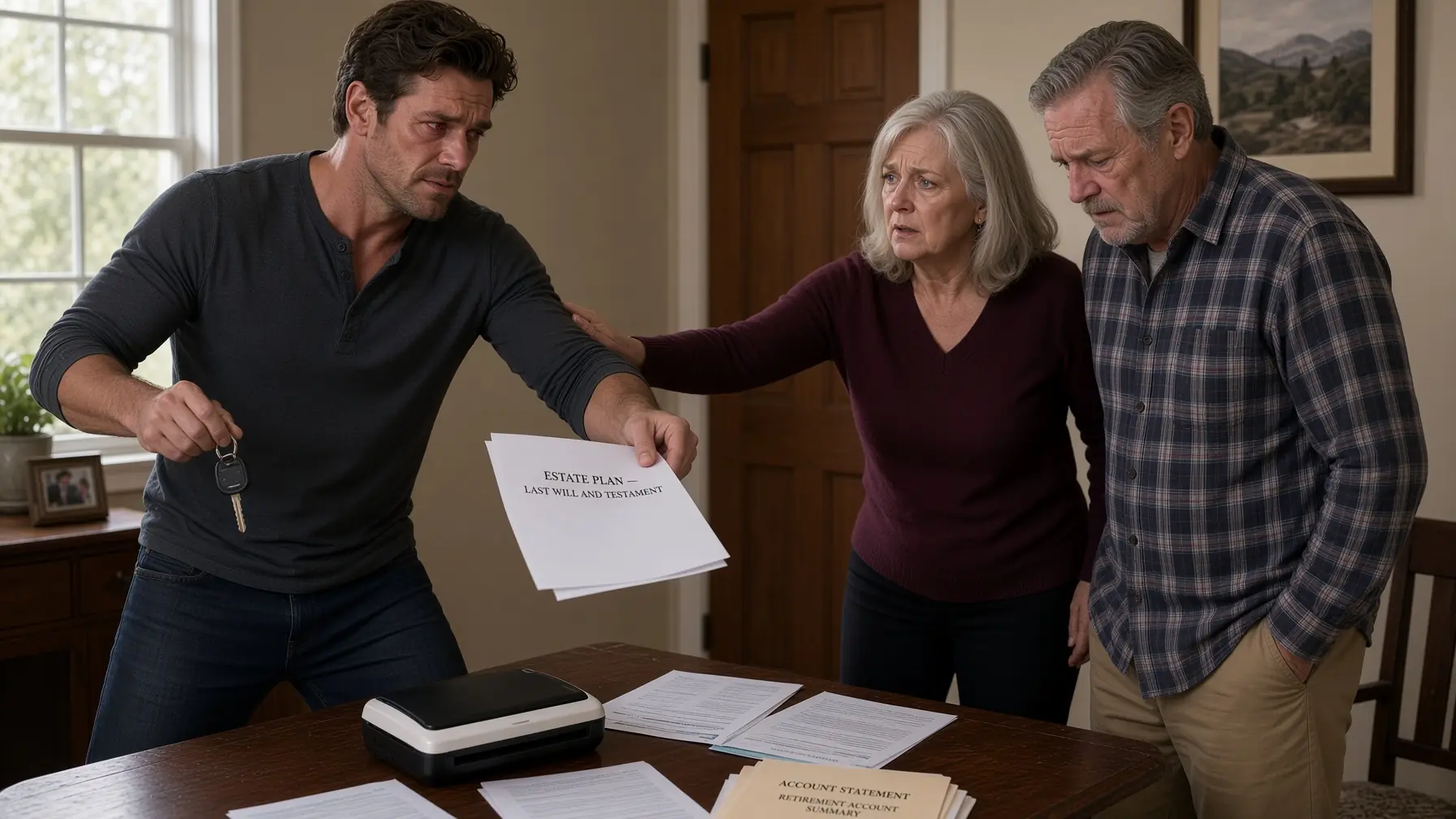
Jake was forty-three years old, worked as a commercial construction estimator outside Columbus, Ohio, and had spent most of his adult life being described by relatives as “the dependable one.” He was the person people called when a basement flooded, a car would not start, a contractor seemed dishonest, or a bill arrived with numbers nobody understood. Reliability had become so much a part of his identity that he rarely stopped to ask whether the people depending on him were also capable of standing without him. That question became unavoidable when he read his parents’ will.
Their house on Coventry Lane was to pass entirely to Eric. Their remaining checking and savings accounts would also go to Eric, as would Martin’s tools, Elaine’s small investment account, and almost every piece of personal property not specifically listed elsewhere. Jake appeared once in the document, inside a paragraph stating that Martin and Elaine loved both sons equally and had made their distributions intentionally after careful consideration. He read that paragraph three times because the word equally seemed almost insulting sitting beside a plan that left him nothing.
The house mattered more than its market value. Jake had been helping pay for it for five years, ever since Martin’s heart surgery had forced him to retire early from a warehouse supervisor position and Elaine’s part-time bookkeeping income had dried up. The mortgage payment was $1,487 a month, and Jake had quietly transferred $850 on the first of nearly every month so his parents could remain in the home where they had lived for thirty-two years. He had also covered a water heater, half a roof repair, two property-tax shortfalls, a furnace service contract, and enough grocery runs that he stopped keeping receipts years earlier.
Eric contributed nothing. At thirty-five, he lived in the finished basement, drove a ten-year-old Chevrolet his parents insured, and had not held steady employment in almost four years. He occasionally did delivery work, helped a friend with landscaping jobs, and spent weeks claiming a better opportunity was coming, but somehow every opportunity disappeared before rent or utility money materialized.
Jake had tried to push him. Martin and Elaine always stopped him.
“Eric’s had a rough time,” Elaine would say.
“He’s figuring things out,” Martin would add.
“He needs encouragement, not pressure.”
Years of encouragement had produced a man who slept until ten, played video games until two in the morning, and became mysteriously unavailable whenever someone mentioned household expenses. Jake resented him, though he rarely admitted how deeply. Resentment felt petty when compared with his parents’ age and health problems, so Jake kept paying.
That Saturday, the numbers on the will made every old irritation rearrange itself into something much larger. Jake calculated almost automatically, because estimating was what his mind did when emotion became difficult. Five years of $850 monthly support alone came to more than fifty thousand dollars, and repairs, taxes, appliances, food, and emergencies probably pushed his total assistance past ninety thousand. He had never considered any of that an investment until he saw a document treating the asset he had helped preserve as somebody else’s future.
His hands began shaking. He hated that because anger always felt more dangerous when it produced visible symptoms. Jake placed the will flat on the table and stared at Eric’s name until the letters blurred.
Martin walked back into the dining room carrying two coffee mugs. “What’s taking so long?” he asked, then stopped when he saw the open folder. His face changed just enough to tell Jake the document was not an old draft or something his parents had forgotten existed.
Jake lifted the first page. “So this is how it is?”
Martin set the mugs down carefully. “Jake.”
“Everything goes to Eric?”
His father exhaled. “It’s complicated.”
Jake almost laughed. Of all the explanations Martin could have chosen, those two words were the worst possible ones. They sounded like the verbal equivalent of closing a door and expecting Jake to return to scanning.
“Complicated how?” Jake asked. “Because from here it looks simple.”
Martin sat across from him. “Your mother and I made decisions based on what each of you needs.”
“What each of us needs?”
“You’re doing well.”
Jake waited.
Martin continued, “You own your condo, you make good money, you have retirement accounts, and you’re stable.”
“And Eric?”
Martin rubbed one hand over his face. “Eric struggles.”
Jake looked toward the basement door. “Eric avoids.”
“That’s not fair.”
“Neither is pretending those are the same thing.”
Elaine entered from the kitchen after hearing their voices. She was sixty-nine, small, carefully dressed even on Saturdays, and still wore the reading glasses Jake bought her three Christmases earlier. She saw the will and immediately looked toward Martin.
Jake noticed the glance. They had discussed this many times.
“You both knew,” he said.
Elaine approached slowly. “Of course we knew, sweetheart.”
“Don’t call me sweetheart right now.”
She stopped.
Jake tapped the document. “I’ve been paying this mortgage for five years.”
“We know.”
“I paid sixteen thousand toward the roof.”
“We know.”
“I replaced your furnace blower, bought the refrigerator, covered the tax shortage twice, and pay half your groceries whenever Dad’s prescriptions get expensive.”
Elaine’s eyes filled slightly. “And we appreciate every bit of it.”
Jake stared at her. “Apparently not enough to even mention me.”
“You don’t need an inheritance,” she said.
The sentence changed everything.
Elaine clearly intended it as reassurance. She said it gently, almost proudly, the way a mother might tell a successful child he had become strong enough to survive without help. Jake heard something else entirely.
“You don’t need it,” she repeated. “You built a life for yourself.”
He leaned back.
“And because Eric didn’t?”
“He needs security.”
“Then I should have failed more?”
“That’s not what I said.”
“It’s what the plan rewards.”
Martin stood. “Watch how you talk to your mother.”
Jake looked at him. “I’m forty-three, Dad.”
“That doesn’t mean you get disrespectful.”
Jake looked at the mortgage statement sitting in the same stack he had been scanning. His own name was nowhere on the loan. His money appeared nowhere on the deed.
Something became clear.
He had voluntarily spent years helping preserve an asset his parents considered necessary protection for the son who had never helped preserve it himself. Maybe they were legally entitled to do that. Maybe they even believed they were being compassionate.
Jake was equally entitled to stop financing it.
He closed the folder.
“Okay.”
Elaine looked frightened. “Okay what?”
“Now I understand.”
Martin frowned. “Jake, don’t turn this into something ugly.”
Jake stood.
“I’m not changing the will.”
“We’re trying to explain.”
“You explained.”
“No, you’re angry.”
“Yes.”
Elaine reached for his arm. “Please sit down.”
Jake stepped away without touching her.
“You have every right to leave your property to whoever you want.”
They both became quiet.
He continued, “And I have every right to decide what I do with my money while you’re alive.”
Martin’s expression hardened. “So that’s what this is?”
“What?”
“You only helped because you expected to inherit the house?”
The accusation landed hard.
Jake looked at his father for a long moment.
“No.”
“Sounds like it.”
“I helped because you needed help.”
“Then why should the will change that?”
Jake nodded slowly.
“That’s actually a good question.”
Martin folded his arms.
Jake answered, “Because now I know you have a long-term plan for the house, and that plan is Eric.”
Elaine shook her head. “You’re punishing us.”
“No.”
Jake picked up his jacket.
“I’m stepping out of a responsibility you already assigned to someone else.”
He left before either parent could answer.
The drive home took thirty-one minutes. Jake remembered almost none of it. He remembered stopping at a red light and realizing his jaw hurt because he had been clenching it.
His condo felt different when he entered. For years, the second bedroom contained spare tools and paperwork from repairs he was always doing at Coventry Lane. Jake stared at three unopened boxes of furnace filters he had purchased in bulk for his parents’ house.
He laughed once.
It sounded terrible.
Then he sat on the couch and did something that would eventually save him from turning justified anger into inaccurate accusations.
He calculated.
Jake opened five years of bank statements and began marking transfers. Regular monthly payments. Property-tax contributions. Repair reimbursements. Groceries.
The total support was substantial but lower than his anger had immediately told him.
Jake had not paid the entire mortgage.
He had paid roughly half.
Several large repairs had been split with Martin and Elaine.
Some grocery purchases were for family gatherings Jake attended too.
After two hours, he arrived at a defensible number of approximately $87,400 in direct assistance over five years.
He stared at the total.
It was still more money than he had saved toward his own retirement during the same period.
Another realization followed.
Almost none of it was documented as a loan.
Jake had written Mom & Dad in transfer memos.
Sometimes mortgage help.
Sometimes nothing.
Legally, much of it would almost certainly look like gifts or voluntary family support unless evidence showed some repayment agreement.
That mattered because part of Jake wanted to demand every dollar back.
The numbers told him anger did not create a contract retroactively.
He opened a blank document.
The first sentence took twenty minutes.
Effective next month, I will no longer make regular financial contributions toward the mortgage, taxes, household utilities, groceries, repairs, or expenses at 41 Coventry Lane.
He read it aloud.
It sounded cold.
Jake left it.
The next paragraph explained that his decision was not a demand for inheritance. Martin and Elaine remained free to arrange their estate however they wished. Jake was equally free to stop making open-ended contributions to a property from which his parents had explicitly decided Eric should receive the entire future benefit.
He included one offer.
Jake would pay for an appointment with a fee-only financial planner who could help Martin and Elaine build a budget based on their own income, savings, debts, and housing choices.
He would not provide additional money before that meeting.
Jake emailed it.
Then he turned off his phone.
The first response came from Elaine eleven minutes later. He did not see it until morning.
I cannot believe you would put this in writing like we’re strangers.
Martin wrote twenty minutes after her.
Family doesn’t send legal-sounding notices to family.
Eric sent nothing.
Jake slept badly.
Monday morning brought work, which helped because commercial estimating rewarded concentration. Jake spent eight hours reviewing bids for a hospital renovation and managed not to check his personal phone until lunch.
There were fourteen messages.
Most came from Elaine.
One stood out.
You know your father’s pension doesn’t cover everything.
Jake responded with one question.
How much are you short each month without me?
Elaine did not answer.
Instead she called.
Jake declined because he was sitting beside two project managers.
She texted.
This is not something to discuss over text.
Jake replied that he was available at seven.
At 7:03 that evening, both parents joined a speakerphone call.
Martin started immediately.
“You’ve made your point.”
Jake sat at his kitchen table.
“What point?”
“That you’re angry.”
“I’m not trying to make a point.”
“Then keep helping like you have been.”
“No.”
Silence.
Elaine said, “Jake, please.”
He waited.
“We have bills.”
“So let’s talk numbers.”
Martin became irritated. “We don’t need you auditing us.”
Jake looked at the spreadsheet on his laptop.
“You need me paying you, but you don’t want me knowing what you need?”
“That’s not what I said.”
“Then what is the monthly shortfall?”
Neither answered.
Jake repeated the question.
Elaine finally said, “Around eight hundred.”
Almost exactly what Jake transferred.
“What income do you have?”
Martin snapped, “You know what we have.”
“I know what you had three years ago.”
Jake learned they received Social Security, a small pension, and required distributions from a modest retirement account. Their combined after-tax income was approximately $4,300 a month. Their mortgage, property tax, insurance, utilities, groceries, prescriptions, vehicle expenses, and other recurring costs totaled closer to $5,000.
The shortage was real.
It was not catastrophic.
Jake asked about savings.
Martin became quiet.
“How much?”
“That’s private.”
Jake nearly ended the conversation.
Then Elaine said, “About ninety thousand.”
Jake blinked.
“Ninety thousand?”
“That’s retirement money.”
“You are retired.”
Martin said, “We can’t drain everything.”
Jake agreed.
“You shouldn’t.”
That surprised them.
He continued, “You also shouldn’t build your retirement budget around me sending ten thousand dollars every year indefinitely.”
Elaine said, “We thought you didn’t mind.”
Jake closed his eyes.
That sentence hurt because it was partly true.
He had never said he minded.
He had occasionally complained about repairs, but he always paid.
Silence had created its own agreement.
“I mind now.”
Elaine began crying.
Jake hated hearing it.
“I’m not asking you to spend every dollar you have.”
“Then what are you asking?”
“To make a real plan.”
Martin said, “We already have a plan.”
Jake looked at the will on the scanned image saved to his laptop.
“Yes.”
“That’s not what I meant.”
“I know.”
The conversation ended without resolution.
Jake sent the financial planner’s contact information anyway.
His parents did not schedule an appointment.
The first automatic mortgage transfer Jake had historically made would have occurred eleven days later.
He canceled it.
Nothing happened.
No emergency.
No foreclosure notice.
No sheriff appeared.
The house remained standing.
Two weeks passed.
Jake did not visit Coventry Lane.
He missed his mother.
That irritated him too.
Boundaries were easier in stories where the people on the other side were monsters.
Martin and Elaine were not monsters.
They were parents who loved him and had also built a family system that depended on him giving more because he needed less.
Jake began recognizing how long that pattern had existed.
When he was seventeen and wanted a used Honda, Martin told him to get a summer job.
When Eric wanted a car at seventeen, Martin co-signed and paid half.
Jake worked through college.
Eric left community college after three semesters and moved home.
Jake’s first apartment came with secondhand furniture he collected himself.
Eric’s first apartment lasted eight months before his parents covered the unpaid rent and moved him back.
Every individual decision had an explanation.
Together they formed a structure.
Jake was rewarded with pride.
Eric was rewarded with rescue.
Pride was cheaper.
Three weeks after Jake stopped paying, Martin texted.
Property tax installment due Friday.
No greeting.
No question.
Jake stared at the message.
Then he typed, You have savings, and Eric is the future owner under your current estate plan. Please make whatever arrangement works for you.
Martin responded within one minute.
Unbelievable.
Jake put the phone away.
Elaine called next.
He answered.
“Jake, please don’t be like this.”
“Like what?”
“Vindictive.”
Jake leaned against his kitchen counter.
“Have you met with the planner?”
“No.”
“Why?”
“We don’t need some stranger telling us how to live.”
“Then I don’t know what you want from me.”
“We want our son.”
“I’m here.”
“No, we want the Jake we know.”
He understood the sentence immediately.
They wanted the version who solved problems before anyone else needed to change.
Jake said, “That version was tired.”
Elaine cried.
He almost apologized.
Then she said, “Your father is worried sick about the taxes.”
“How much?”
“Twenty-eight hundred.”
Jake knew they had ninety thousand in savings.
“Pay them.”
“We shouldn’t have to touch emergency money.”
“Taxes are predictable.”
Elaine became quiet.
Jake continued, “This is exactly why you need a budget.”
Then she said the sentence that finally clarified the whole dispute.
“We’re trying to preserve that money for Eric.”
Jake stopped breathing for a second.
“What?”
“He doesn’t have retirement.”
“He’s thirty-five.”
“You know what I mean.”
Jake laughed softly.
“No, Mom.”
“Jake.”
“No.”
He rubbed his forehead.
“You’re asking me to use my money so you can preserve your money for Eric.”
“That’s not how we see it.”
“How do you see it?”
“We’re trying to help both our children according to their needs.”
Jake stared at the wall.
“And my need is to keep paying?”
“You can afford it.”
There it was.
Not malice.
Arithmetic.
Because Jake had worked, saved, and stayed stable, his resources had become family infrastructure.
Because Eric had not, family resources had become his protection.
Jake said, “I’m done for tonight.”
“Please don’t hang up.”
“I love you.”
Elaine began crying harder.
Jake continued, “And the answer is still no.”
He ended the call.
Eric finally contacted him that evening.
Dude, can you stop making Mom cry?
Jake stared.
He responded, Can you pay the property tax?
Three dots appeared.
Then disappeared.
Then returned.
I don’t have that kind of money.
Jake replied, Can you contribute anything?
Eric wrote, That’s not the point.
Jake almost smiled.
What is the point?
You’ve always helped.
Jake typed, Exactly.
Eric called.
Jake answered.
“What is your problem?” Eric demanded.
“My problem?”
“You find one piece of paper and suddenly you’re acting like nobody loves you.”
Jake sat down.
“This isn’t about love.”
“Then what is it about?”
“Responsibility.”
Eric laughed.
“Here we go.”
“What does that mean?”
“You’ve always thought you’re better than me.”
Jake became quiet.
Eric continued. “Good job, condo, savings, whatever. Congratulations.”
“I don’t think I’m better than you.”
“You act like it.”
Jake thought of every lecture he had given Eric.
Maybe sometimes he had.
He said, “I think you should contribute if you’re going to inherit the asset they’re struggling to maintain.”
“I didn’t write the will.”
“No.”
“I didn’t ask for the house.”
“Would you refuse it?”
Silence.
Jake waited.
Eric finally said, “That’s different.”
“How?”
“They want me to have it.”
“Then start helping them keep it.”
“I’m between things right now.”
“You’ve been between things for four years.”
Eric swore.
Jake did not respond.
“You don’t know what it’s been like for me.”
“Then tell me.”
The invitation surprised both of them.
Eric became quiet.
Eventually he said, “You think I enjoy being thirty-five and living in Mom and Dad’s basement?”
Jake did not answer.
“You think I wake up proud of this?”
“No.”
“Then stop talking like I picked some perfect life.”
Jake looked toward the window.
“What happened to the warehouse job?”
“My back.”
“You said the doctor cleared you.”
“For light duty.”
“And?”
“I hated it.”
Jake almost snapped.
Instead he waited.
Eric continued.
“After they moved me off loading, everybody treated me like I was useless.”
“That was three years ago.”
“I know.”
“What about therapy?”
“Mom thinks I don’t need it.”
Jake closed his eyes.
There it was again.
Rescue.
Protection.
Avoidance.
Eric said, “I’ve applied places.”
“How many this month?”
Silence.
Jake asked again.
“Two.”
That was more than Jake expected.
“What kind?”
“Dispatcher job and parts counter.”
“Good.”
Eric became defensive. “Don’t patronize me.”
“I’m not.”
“Yes, you are.”
Jake let that go.
Then Eric said something that stayed with him.
“They’ve told me since I was twenty that the house would be mine someday.”
Jake sat very still.
“What?”
“Dad always said you’d be fine.”
The phrase sounded exactly like Martin.
Eric continued, “He said you were building your own life and the house would keep me from ending up with nothing.”
Jake felt anger rearrange itself again.
“How long have you known?”
“Not about the actual will.”
“But about the plan?”
“Years.”
“Why didn’t you tell me?”
Eric sounded genuinely confused.
“Why would I?”
Jake had no answer.
From Eric’s perspective, the arrangement was normal.
He had been raised inside it.
The house was future security.
Jake was present security.
Neither brother had written those roles.
Both had accepted them longer than they should have.
Jake said, “The taxes are due.”
Eric sighed.
“I know.”
“Can you contribute five hundred?”
“I don’t have five hundred.”
“What do you have?”
“Maybe two.”
“Give them two.”
“You’re serious?”
“Yes.”
“That doesn’t solve it.”
“It changes something.”
Eric was quiet.
Jake added, “You keep saying you didn’t choose the will.”
“I didn’t.”
“Then choose something now.”
The call ended.
Two days later, Elaine texted Jake that Eric had given them two hundred dollars.
Her message included a heart.
Jake stared at it.
He did not know whether to laugh or cry.
The taxes were paid from Martin and Elaine’s savings.
The house remained theirs.
The world did not collapse.
Then Elaine sent Jake a payment request through the family’s money-transfer app.
$3,500.
No explanation appeared.
Jake declined.
Five minutes later she called.
“I know you saw it.”
“Yes.”
“Why did you decline?”
“Because you didn’t even tell me what it’s for.”
“The mortgage and utilities.”
“Mom.”
“We’re behind.”
“How behind?”
“One month.”
“That is not the same thing as losing the house.”
“You don’t understand how frightening this is at our age.”
That sentence reached him.
Jake softened.
“I do understand.”
“Then help.”
“No.”
Elaine became silent.
Jake continued, “I’ll pay the planner directly.”
“We don’t want the planner.”
“Then I’ll help you compare mortgage options, downsizing, or a reverse mortgage with an independent professional if appropriate.”
“Absolutely not.”
“Then what solution are you willing to consider?”
“You helping.”
Jake closed his eyes.
“No.”
“Your father was right.”
“About what?”
“You are doing this to punish us over the will.”
Jake exhaled.
“I am doing this because I will not finance a system where everybody’s plan is that I keep giving and Eric eventually receives what I helped preserve.”
“He’s your brother.”
“I know.”
“Family takes care of family.”
Jake paused.
“Then why is the definition of family always me taking care of everyone else?”
Elaine hung up.
That hurt.
Jake went to work anyway.
The following afternoon, the front desk of Jake’s condominium building called.
“Mr. Mercer, your parents are downstairs.”
Jake stared at his computer.
“Did they say why?”
“They said family emergency.”
Jake’s heart jumped.
“Is somebody hurt?”
The receptionist hesitated.
“No.”
“Then please don’t send them up.”
Another pause.
“They’re being pretty insistent.”
“I’m sorry.”
Jake rubbed his forehead.
“Tell them I’m at work and they need to leave.”
Eric was with them.
Jake learned because his phone lit up with a photograph from Eric showing Martin and Elaine seated in the condo lobby.
This is ridiculous. Come talk to them.
Jake responded, Not at my home unannounced.
Eric wrote, They’re your parents.
Jake typed, Exactly why they should respect my front door.
Martin called from Elaine’s phone because Jake had stopped answering his.
Jake eventually picked up.
“You’re making your mother sit in a lobby like a criminal.”
Jake stood and walked into an empty conference room.
“I didn’t invite you there.”
“We’re trying to save our house.”
“You have savings.”
“We’re not draining our retirement because you’re throwing a tantrum.”
Jake stared through the conference-room glass.
“Dad, listen carefully.”
Martin breathed heavily.
“I am not paying the mortgage today.”
“You selfish—”
Jake cut him off.
“If you want a meeting, I will meet you Saturday at a neutral place.”
“This is family.”
“Saturday.”
“We’re already here.”