By the time the auctioneer called the final lot that morning, the November cold had worked its way through every coat on the grounds.
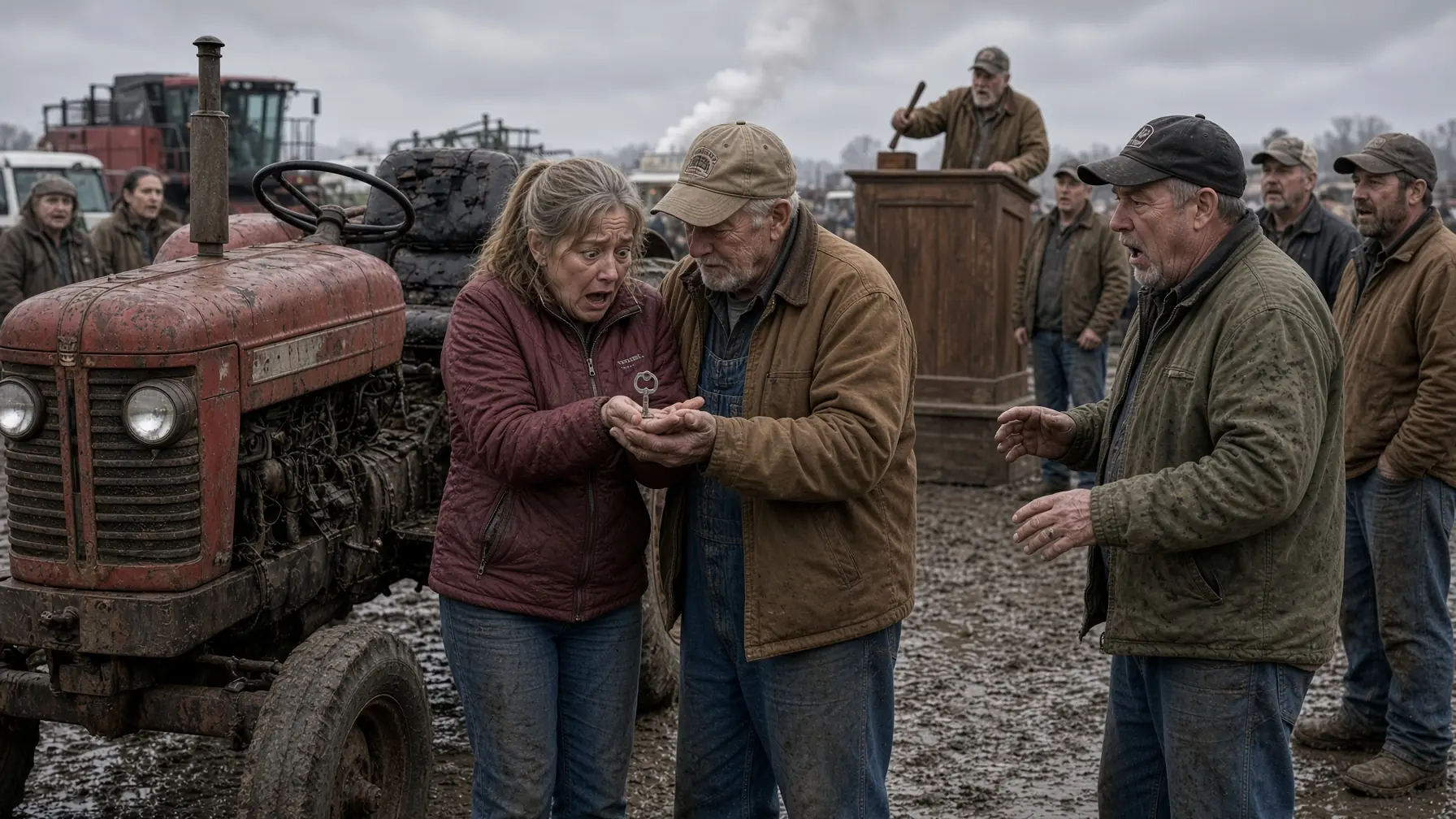
Miller County’s farm equipment auction always looked the same that time of year. Gray sky hanging low. Mud so thick it clung to boots in heavy clumps. Diesel smell mixing with wet hay, burnt coffee, and concession smoke drifting crooked through the damp air. Rows of worn-out machinery sat across the lot like a graveyard of hard seasons—old combines with faded paint, rusted plows, trailers with bent rails, and tractors that had spent more years working than resting.
At the center of one of the last rows sat the red tractor.
It was nothing special to anybody passing by.
A faded, scratched-up old machine with a hood eaten by rust in patches. One rear tire slightly bigger than the other. Seat cracked and repaired with black tape. Mud dried so deep in the treads it looked permanent. Grease dark around the engine panels. Even the headlights looked tired.
But to Clara Bennett, it was not just another machine waiting for a number.
It was the last thing on the farm that still sounded like her husband.
She stood beside it with one gloved hand pressed against the cold metal hood, her lips tight, eyes lowered, trying not to let the crowd see her break. She was fifty-eight, but grief had a way of adding years to a face, especially when it arrived with paperwork. Her light-brown hair, streaked gray and tied loosely back, had come half free in the wind. The burgundy quilted jacket she wore was the same one she had thrown on for morning chores every winter for years. Only now there were no chores left that truly belonged to her.
Not after the hospital bills.
Not after the feed debt.
Not after the second year of bad hay and the first year without Tom.
Tom Bennett had been gone eleven months.
The cancer took him quickly.
The bills took the rest more slowly.
First the cattle herd had gone, then two hay wagons, then the grain drill, then the old pickup Tom used only for back roads and fence posts. Clara had managed to hold the line for longer than most people expected, but farms did not care about pride. Neither did debt. By late autumn, the lender wanted numbers, not memories.
So she had brought the equipment in.
All of it except the red tractor.
Until this week.
Even then, she had almost turned the truck around twice on the way to the auction yard.
Because everyone in Miller County knew that tractor.
Tom had farmed with it for decades. He had planted with it, raked hay with it, pulled calves with it, dragged wagons out of spring mud with it, and once—famously—used it to haul three separate pickups out of a ditch during a freezing storm when the road crew could not get through. The tractor had been old even then, but it had kept showing up, season after season, like a stubborn hired hand who refused to retire.
It was not worth much on paper.
That was the problem.
People would bid on useful machinery. They would bid on low-hour equipment. They would bid on clean late-model tractors with sharp tires and no leaks.
They would not bid much on sentiment.
And sentiment was all Clara had left in that machine.
A few yards away stood Samuel Carter.
At eighty-two, Samuel looked like one more tired farmer out to watch somebody else’s troubles become bargains. He was lean and slightly stooped, with the lined face of a man the sun had carved on slowly over decades. Sparse white hair slipped out beneath a sun-bleached cap. He wore faded overalls under an old canvas jacket, boots scratched and crusted in mud, and he held a bidder card so casually that no one paid much attention to him at first.
But Samuel was paying attention.
Not to the tractor.
To Clara.
He had been watching her since she stepped off the trailer.
Watching the way she kept her hand on the hood.
Watching the way she looked away when two men nearby started speculating how little the old machine would bring.
Watching the way she flinched whenever somebody kicked a tire or lifted the hood with the detached curiosity of a man pricing junk.
Samuel had known Tom Bennett.
Not as a best friend.
Not the kind you call every Sunday.
But the kind you never forget owing.
Years earlier, when Samuel’s youngest son had been hurt in a grain auger accident and Samuel had to leave his own hay cut and drying with rain coming, Tom Bennett had shown up without being asked. He brought that same red tractor, hitched Samuel’s rake and baler, and worked until after dark. He never sent a bill. Never even mentioned it again.
That was how men of that generation often handled the deepest things they did for each other.
Quietly.
As if decency should not need an audience.
Samuel remembered it because he also remembered what Tom said when he thanked him.
“Someday it’ll come back around.”
That had been twenty-three years ago.
Now Samuel stood in the mud watching Tom’s widow try not to cry beside the last machine that still carried his handprints.
The auctioneer climbed onto the hay wagon platform and started the lot.
“Alright, folks, next up—older red utility tractor, runs, comes as-is, where-is. Who’ll start me at fifteen hundred?”
Silence.
A few men shifted.
Somebody coughed.
One bidder finally lifted two fingers.
“Twelve.”
“Got twelve. Need fifteen.”