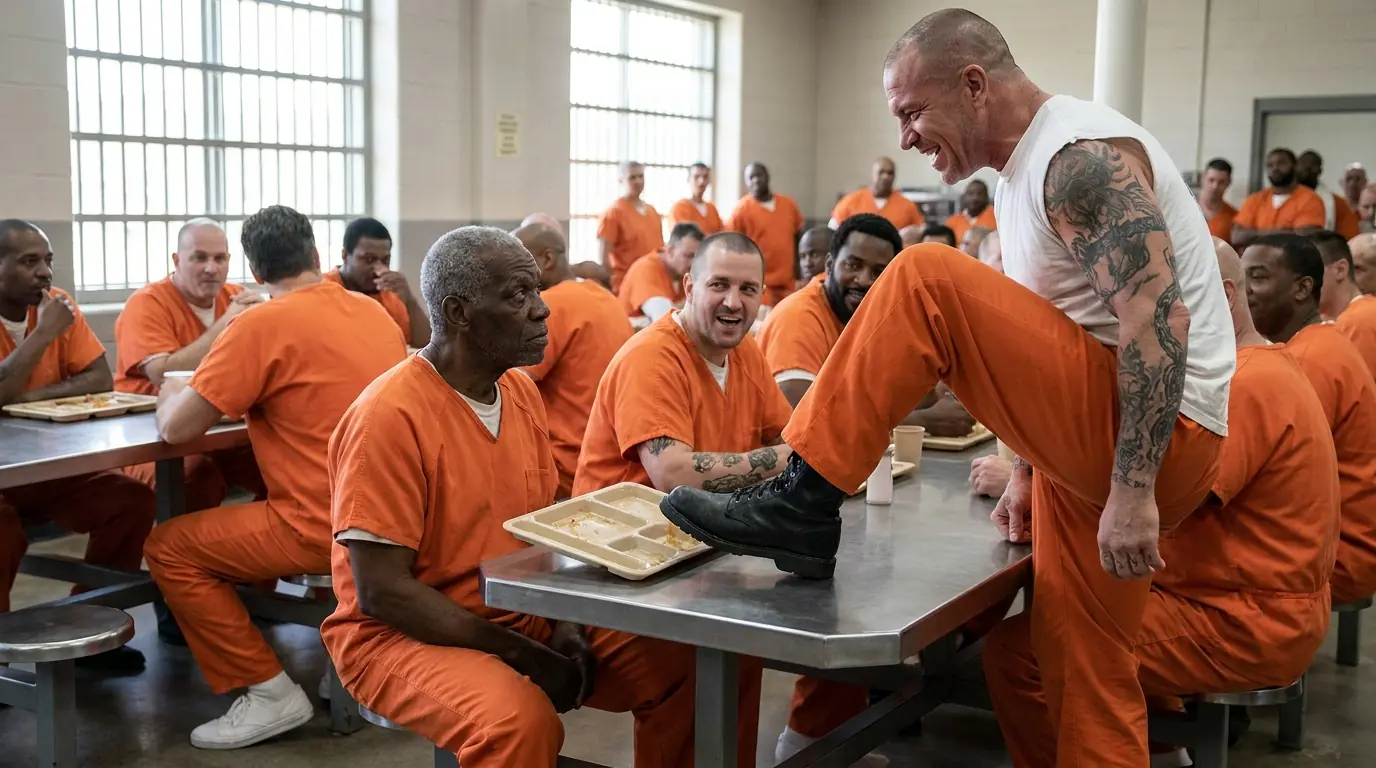
By the time Razor Kane crossed the cafeteria floor, most of the room had already noticed.
Not because he was quiet.
Razor was never quiet.
He was the kind of inmate who needed witnesses for everything. If he laughed, he laughed loud enough to turn heads. If he threatened someone, he made sure three tables heard it. If he hit a man, he wanted the whole block talking about it by lockdown.
That afternoon, the prison cafeteria was packed with the usual noise of plastic trays scraping metal, boots dragging over concrete, guards barking short orders from the wall, and a hundred men eating fast because in a place like that, nobody ever really relaxed enough to enjoy a meal.
At a table near the far end of the room sat Leon Carter.
Sixty-seven years old.
Lean.
Gray at the temples.
Face cut with the kind of hard lines life puts on a man instead of age alone.
He wore the same orange uniform as everybody else, but somehow it sat on him differently. His back stayed straight. His hands moved with economy. His eyes never wandered. He ate slowly, calmly, like noise had to ask permission before it could reach him.
Most men in that cafeteria knew two things about Leon Carter.
The first was that he kept to himself.
The second was that nobody knew much else.
That uncertainty irritated men like Razor Kane.
Razor was thirty-nine, heavily muscled, scalp shaved smooth, arms crowded with faded ink and prison-made tattoos. He had a cruel grin that always seemed half a second away from violence. He enjoyed picking targets that looked weak, old, slow, or alone.
Leon checked all four boxes.
So Razor made his move.
He walked up with that swagger men use when they’ve mistaken fear for respect, stopped beside Leon’s table, and planted one heavy black boot on the edge of Leon’s tray.
A few nearby inmates went silent immediately.
Others kept eating but angled their heads just enough to watch.
Razor looked around once, making sure he had an audience, then down at Leon.
“Pick that up, old man,” he said, his voice carrying over the room, “or I’ll put you down with it.”
A few men laughed nervously.
Leon didn’t look up right away.
He set down his plastic fork with deliberate care, wiped his fingers on a napkin, and then raised his eyes to Razor’s face.
They were steady brown eyes. Calm. Clear.
Not the eyes of a frightened old inmate.
Not the eyes of a man trying to act brave.
Just… still.
“You should move your boot,” Leon said.
The answer got a reaction.
Not loud. Just a brief tightening through the surrounding tables. Men who understood prison heard the tone immediately. Leon had not pleaded. He had not apologized. He had not tried to avoid trouble.
He had given a warning.
Razor heard it too.
And because men like him mistake calm for disrespect, his grin widened.
“You hear that?” he said, glancing over his shoulder to the room. “Grandpa thinks he’s giving orders.”
He shoved harder with his boot.
The tray tipped sharply.
Leon’s cup rolled first, spilling weak tea across the table. Then the tray slid off the edge.
Most men would have flinched.
Some would have scrambled.
Some would have let it hit the floor and waited for the laughter.
Leon did none of those things.
The tray dropped only a foot before his left leg moved.
A quick, precise lift of his shin trapped it cleanly before it hit the ground. In the same motion, his foot flicked upward. The tray rose flat through the air as if it had been tossed by a practiced hand.
Leon caught it one-handed.
Perfectly level.
No rattle.
No spill.
No wasted motion.
For one full second, the cafeteria forgot how to sound.
Then even the men at the far tables turned.
Razor’s grin held for a beat too long, because his face had not yet caught up to what his eyes had seen.
Leon remained seated.
Tray in one hand.
His gaze on Razor.
Then he slowly placed the tray back onto the table.
No rush.
No showmanship.
Just control.
And somehow that made it worse.
At the next table over, an older inmate named Curtis Wells froze with his spoon halfway to his mouth.
Curtis had been down twenty-two years. He rarely reacted to anything. Men respected him because he had outlasted too many troublemakers to be impressed by theatrics.
Now he stood up so fast his chair legs screeched across the floor.
His eyes were fixed on Leon.
Not in surprise.
In recognition.
Razor noticed it and frowned.
“What?” he snapped.
Curtis didn’t answer him.
Leon pushed back his bench and rose to his feet.
He wasn’t large the way Razor was large. Age had stripped away bulk and left something tighter behind. But when he stood, men suddenly saw what sitting had hidden: the balance, the alignment, the way his weight settled evenly and lightly, the relaxed shoulders, the hands loose at his sides, the center of gravity placed exactly where it needed to be.
It was not a brawler’s stance.
It was not a scared man bracing.
It was something trained.
Something old.
Something dangerous.
Leon set the tray down.
Then he took one half-step away from the table.
Not back.
Not sideways.
Into space.
Into position.
Razor’s face changed.
Only a little.
But the grin was gone.
“What mistake?” Razor said, trying to recover the room with his voice.
Leon looked straight at him.
“You decided I was old before you decided I was harmless.”