Boaz Ledford hired one man in the spring of 1888. By July, he had eight extra mouths to feed, seven strange beds to build, and a girl of 16 standing in his kitchen doorway with her chin up telling him she hadn't come to cook. He was 52 years old, a widower 11 years, and the Anvil Fork range had been carrying him alone since the fever took his wife Adelicia in the spring of 1877. And six years before that, his only boy Rufus at the age of six. Boaz had built the ranch for a son who never grew tall enough to run it.
And he had never once in all the years since imagined it run by anyone but a son. That was the shape of the man who answered the newspaper notice from a family named Winder. The notice had been placed by McKaja Winder, 24, the oldest of eight children left to fend for themselves when their father Josephus Winder died of lung fever that January, and the bank took the home place in Piney County three weeks later. McKaja wrote plainly, he could ride, rope, mend fence, and would work for board and $10 a month. Boaz wrote back the same week.
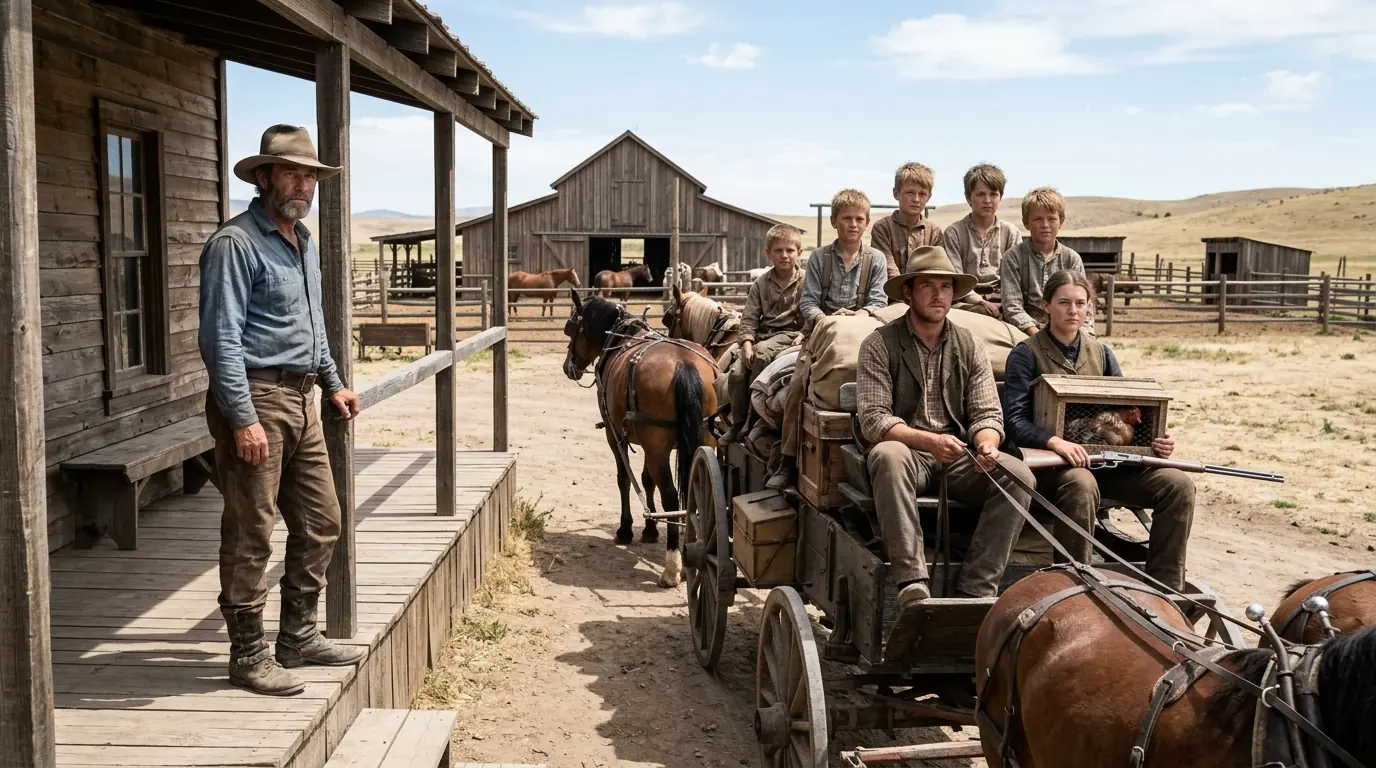
He needed one steady hand, and McKaja, broad-shouldered and quiet, looked exactly like what a ranch needed. He did not expect the wagon that rolled up the Anvil Fork lane in July. It carried six more Winder brothers, ranging from 22 down to 10. Thaxter, Onslow, Garvey, Purdon, Marceline, and little Fennel. And sitting straight-backed on the buckboard seat beside them with a hen coop on her lap and a rifle across her knees, their sister Palmyra, 17 years old, the second oldest of the eight.
And, as it turned out, the one who had kept the family fed through the whole hard winter while the boys buried their father and argued about what came next. There had been no other place for them to go. An aunt in Portsmouth had room for one, not eight. Micajah had written home saying there was work and a roof, and the Winders, being the kind of family that did not split apart when it could be helped, had come together or not at all. Boaz stood on his porch and counted heads twice, certain he'd miscounted the first time.
"I hired a hand," he said, "not a household. " "Then hire the household, too," Palmyra said before Micajah could answer for her, "and you'll come out ahead on the deal. " She said it without heat, the way a person states a fact about the weather, and climbed down off the wagon before anyone could tell her not to. Boaz did not hire the household. He fed it. He gave the boys the old bunkhouse and told them plainly they'd earn their keep or move on come fall, and he told Palmyra, not unkindly, that the kitchen was hers if she wanted it, since a ranch this size hadn't had a woman's hand in it for 11 years and could use one. She thanked him for it, set down her hen coop on his porch step, and asked, before she so much as unpacked a single trunk, whether the branding irons hanging by the barn door were kept sharp or just kept.
Boaz said he honestly didn't know. Palmyra walked out to look for herself and came back an hour later having sharpened three of them on his own grindstone, her sleeves rolled to the elbow and a smear of soot across one cheekbone, and set a plate of cornbread in front of him as though the two things belonged in the same afternoon, because to her they did. Palmyra took the kitchen. She also, within her first month, took to slipping out before sunup to help Hurden and Marceline with the milking, then the mending, then, because nobody had told her plainly enough that she couldn't, the breaking of a green colt in the round pen that had thrown every one of her brothers twice a piece. She did not ask permission.
She simply appeared again and again wherever the hardest job of the day happened to be and did it a little better than whoever had tried it first. By the second year, nobody at the Anvil Fork bothered pretending Palmyra Winder belonged in the kitchen alone. She still cooked because eight people had to eat and she was good at it, but she also doctored a screwworm outbreak in the spring calves with a mixture she'd learned from her mother, rode fence line in weather that kept the brothers close to the stove and kept a running tally in a cloth-bound ledger of every animal, every debt, every dollar that crossed the Anvil Fork books, a tally more accurate, Boaz found more than once, than his own. He did not say so out loud. Not yet.
The town, when it noticed her at all, noticed with the particular unkindness small towns save for anyone who does not stay where she's put. There was talk in the mercantile and after church about the Winder girl who dressed for work instead of for looking at, who could out-rope her own brothers, who had no business at a stockyard scale where men did business. The man who ran that scale was Rutherford Nye, 55 years old, the cattle buyer and commission agent for three counties, and the hardest rule he carried was one he had written himself in his own hand and nailed above his own office door. No woman's mark stands at this scale. He had not always believed it.