The notice had been posted to the board outside the land office in Sheridan for 11 days before she read it. On a Thursday in mid-October when the cottonwoods along the creek had gone the color of old brass and the sky was the particular gray that means snow is thinking about it but hasn't decided yet. She read it twice. Neat handwriting which she noticed. A man needed someone to manage household accounts and keep books for a horse operation outside of Dunmore Crossing 9 miles.
Room and board provided. Honest work, fair arrangement. At the bottom in the same careful hand, experience with livestock preferred but not required. She folded the notice along its center and put it in her coat pocket. She had been in Sheridan 3 weeks taking in mending from a dressmaker on the main street who paid her by the piece and had not asked questions about where she'd come from or what she'd left behind which she had appreciated more than she could say.
She was 29 years old. She had buried a husband the previous winter not from violence or illness but from a slow unlucky thing that had no good name. The kind of dying that takes a year and leaves the surviving person feeling not so much grief as a strange exhausted clarity like a room emptied of furniture where you can finally see how the light moves across the floor. She had spent the 8 months since becoming very careful about what she agreed to and very honest with herself about why. The notice said experience with livestock preferred.
Her father had been a veterinarian in Missouri for 32 years. She had grown up watching him work. She wrote back that evening. The reply came in a week. Short, plain the way the notice had been.
He would meet her stage at Dunmore Crossing on the 21st. The room was small but had a window. He hoped the arrangement would suit them both. She arrived on the 21st carrying a carpet bag and her father's old veterinary manual. The leather cover worn pale at the corners from 30 years of being carried by someone and then another 10 years of being carried by her.
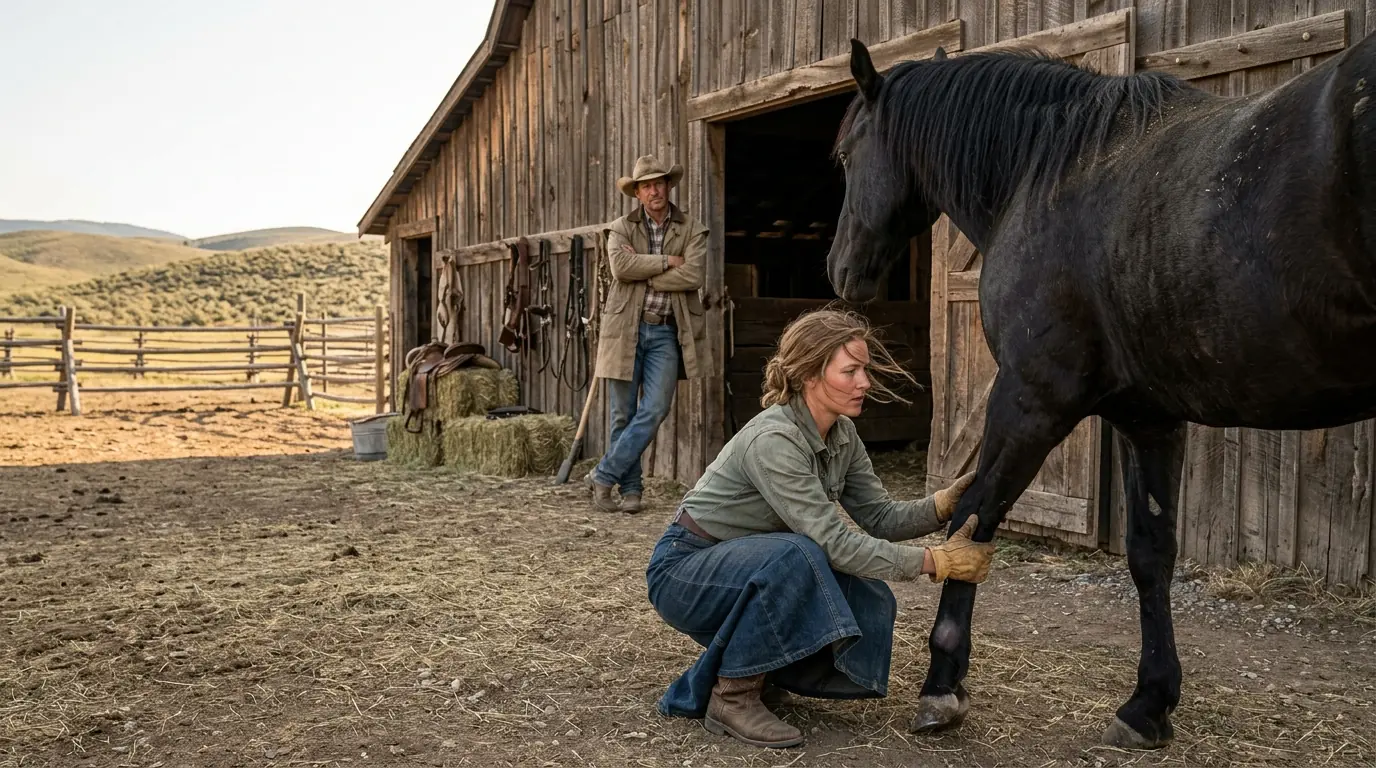
The town was small, one street of board-fronted buildings, a general store, a post office the size of a closet, a livery at the far end. She stepped down from the stage and stood on the plank sidewalk and looked up the street. A man was standing outside the livery with a horse on a lead, a grey mare standing with one hind leg cocked at an angle that was not quite right. She noticed the mare first, then she noticed the man. Lean, perhaps 40, wearing a canvas coat dark at the elbows and a hat that had seen better weather.
He was doing nothing in particular with the horse, just standing beside her the way a man stands beside something he is worried about and does not know how to fix. He looked up and saw her coming and said her name, the one from the letter. She said, "Yes. " He said he was glad she'd made it and he said it plainly, the way you say a practical truth when you are not in the habit of dressing things up. He took her carpet bag without asking and tied the mare to the post and went around the side of the livery for his wagon. She stayed with the horse.
She ran her hand down the mare's neck feeling the way the animal turned her head slowly with the patience of something that had been patient for a long time already. She looked at the leg, not lame, something else. When he came back with the wagon, she said, "How far along is she? " He looked at the mare. He looked at her. He said, "I thought she might be in foal, but I wasn't certain. " She said, "She's certain.
Maybe 7 weeks from her time, maybe less. She's carrying it differently than she should be. " He was quiet for a moment. Then he said they ought to get moving before the light went. She stepped up onto the wagon and the manual on her lap and they drove out of Dunmore into the wide flat country that spread in every direction like something that had been there a long time and did not intend to change. She watched the land and said nothing.
The grass was dormant, the color of old straw, and the ridge to the west caught the last orange light for about 3 minutes before it was gone. She noted the soil at the road's edge, heavy clay in the lowland sections, better as the elevation lifted slightly. She noted the fence line along the east pasture, good wire, newer posts. She noted that when the road crested a low rise and the ranch came visible below them, there were horses in the near corral, eight or nine of them, and the corral was built to hold 30. He did not say anything when the ranch came into view.
She did not either. A man came out of the barn when they rolled in. Big through the shoulders, gray at the temples, with a way of walking that said his joints had developed opinions. His name was Duff. And he'd been at the ranch 4 years, she would learn later, and he understood horses the way you understand something you have lived alongside for a long time without studying, in your hands and your instincts rather than your head.
He looked at her when she climbed down from the wagon without waiting for help and something in his expression settled as if a question he had not asked out loud had just been answered. He said to the man, "You bring Molly back? " The man said he'd left her at the livery overnight for the warmth. Duff nodded, the nod of a man who expected that answer but would have preferred a different one, and went back into the barn. Her room was off the kitchen, small, a cot, a window that faced the corral. Not a romantic view.
She could watch the horses from her pillow, which was better. She set her bag on the cot and the manual on the window sill and stood a moment in the quiet. Outside she could hear the horses moving at the water trough, hear the low sound of Duff and the man talking in the barn, hear the wind moving along the underside of the eaves. She counted the horses from the window, eight mares, no stallion visible anywhere. When she came into the kitchen, the stove was cold.
She found wood and kindling and built the fire without asking. She found dried beans and salt pork and put both on to cook and made cornbread in a pan she located on the shelf above the stove. She was not trying to make a statement. The fire needed to be built. The men would need to eat.
She was there. He came in from the barn when the cornbread smell had gotten into the corners of the house. He stopped in the doorway and looked at the stove and then at her. He said she didn't need to do that tonight. She said it would take an hour for the beans.
She had the hour regardless. Hal washed his hands and sat at the table. Duff came in a few minutes later, smelled the air, and sat across from him without ceremony. She ate standing at the counter. She was not sure yet where she fit at that table and she preferred to observe before she assumed.