The train from Denver pulled into Cheyenne thirteen minutes late, and by then Fletcher Dawes had been standing on the platform long enough for the September cold to work through the soles of his boots. He owned a cattle ranch twelve miles outside town, a bunkhouse full of men who needed feeding, and a kitchen that had been little more than a place to boil coffee since his cook left in March. Fletcher was forty-one, widowed, stubborn, and accustomed to solving problems with his own hands, which was why it had taken him four months to admit that this particular problem required another person.
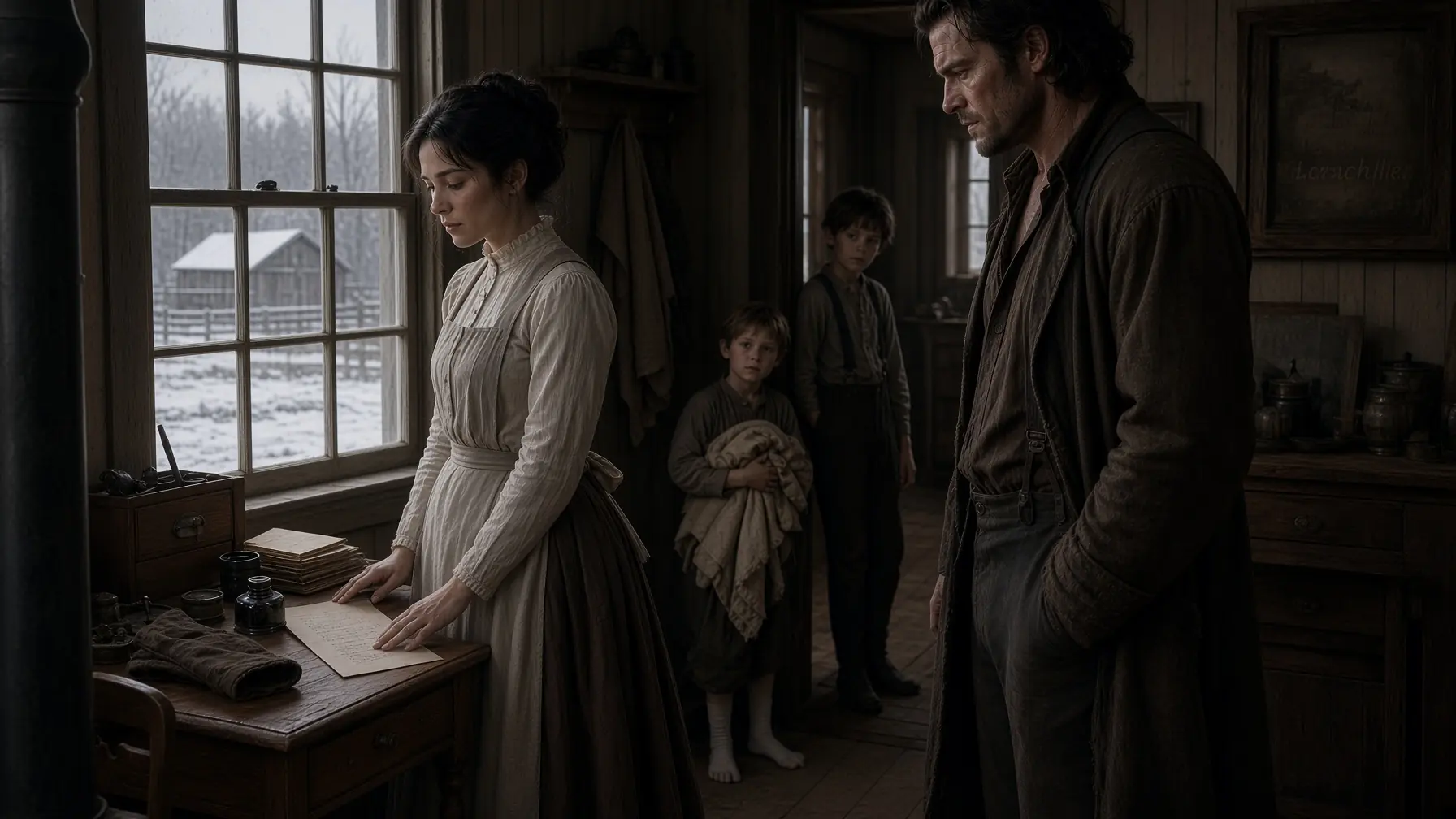
His letter to the Denver placement office had been brief. He requested an experienced housekeeper, preferably a widow accustomed to rural life, willing to relocate for fair wages, room, and board. Fletcher had not written that the main house had felt hollow since his wife died, nor that he had begun eating supper in the bunkhouse simply because sitting alone at the large kitchen table had become unbearable.
People who operated placement agencies apparently knew how to read things men did not write. Two weeks after Fletcher mailed his request, a reply arrived stating that they had located a suitable widow named May Callum who was experienced in cooking, household management, and farm life. Fletcher read the letter four times, carried it in his coat for three days, and nearly burned it before finally sending the required travel money.
Now the train emptied around him. A traveling salesman descended with two cases, three ranchers Fletcher recognized headed toward the freight office, and a young attorney in a city coat immediately began complaining about the wind. Then a woman stepped down carrying one carpetbag while four boys appeared around her like a small migrating army.
Fletcher stared. The woman looked to be somewhere in her mid-thirties, with dark hair pulled firmly behind her head and gray-green eyes that examined him before he had time to decide what he thought of her. One boy was nearly grown, another perhaps twelve, a third around nine, and the smallest had a gap between his front teeth and was dragging a blanket behind him despite being very much awake.
“Mr. Dawes?” the woman asked.
“Mrs. Callum.”
“These are my sons.”
Fletcher looked at the boys again. “The agency didn’t mention four.”
May’s expression barely changed. “I mentioned four to the agency. What they decided to mention to you is between you and them.”
For several seconds Fletcher considered this information. Then he asked, “Can you cook for eight ranch hands?”
“Twelve if they wash their hands before touching my table.”
Fletcher picked up one carpetbag. “Wagon’s out front.”
May reached for the second before he could. “I can carry this one.”
Neither of them asked the question that would have prevented three weeks of confusion. Fletcher believed he had hired a housekeeper who happened to arrive with four sons, while May had boarded the train believing the placement agency had matched her with a Wyoming widower seeking a woman willing to build a household with him. The agency, through negligence, optimism, or a clerk who confused two forms, had described the same arrangement very differently to each of them.
The ride to the Dawes ranch took nearly two hours. Nine-year-old Will talked through most of it, beginning with a parrot he had seen aboard the train and somehow reaching a detailed explanation of why Colorado conductors were inferior to Kansas conductors before May finally told him to let Mr. Dawes hear himself think. Fletcher said, “He’s all right,” and Will took that as authorization to continue.
Fifteen-year-old Eli sat in the back of the wagon watching Fletcher with the quiet distrust of a boy who had been forced to become responsible too early. Twelve-year-old Nate watched everything else, saying almost nothing, while six-year-old Tommy fell asleep against his mother before they reached the county road. Fletcher noticed the differences without commenting on them.
May sat beside him studying the land. Late September had turned the Wyoming grass brown and brittle, while the mountains west of them already held white along their upper ridges. “Winter comes quickly here,” Fletcher said, and May answered, “Winter came quickly in Kansas too,” with the tone of a woman who did not require weather to be explained to her.
He told her about the ranch. There were cattle, some horses, seven regular hands, and a seventeen-year-old helper named Hob who seemed capable of being everywhere except the place Fletcher had sent him. The main house had one unused bedroom besides Fletcher’s, and there was a small room off the barn where the boys could sleep if necessary.
“The boys stay with me,” May said.
Fletcher glanced at her. “There’s only one extra room.”
“Then there will be five of us in it.”
“It’ll be crowded.”
“We have been crowded before.”
He nodded. “All right.”
May would learn over the following weeks that Fletcher rarely argued after discovering someone had actually made a decision. Fletcher would learn that trying to push May after she had made one was much like pushing a fence post. The fence post did not move, and eventually the person pushing it looked foolish.
They reached the ranch shortly before sunset. The property appeared over a low rise: a sturdy two-story house, barn, bunkhouse, holding pens, smokehouse, and a water tower Fletcher had built himself two summers earlier. Nothing about it was elegant, but everything seemed solid enough to survive weather that did not care whether people were comfortable.
Tommy woke when the wagon stopped. He stared at the house, then at Fletcher, and asked, “Is this ours now?”
May’s jaw tightened. “It belongs to Mr. Dawes.”
Tommy considered that. “Can I see the horses?”
“After supper,” Fletcher said.
Tommy nodded seriously, then lifted both arms toward him. Fletcher hesitated before realizing the child expected to be helped down, so he placed both hands under Tommy’s arms and lowered him to the ground.
It was nothing. A six-year-old boy wanted help climbing from a wagon and a grown man provided it. Yet years later, Fletcher would remember the complete certainty in Tommy’s face, as though there had never been any possibility Fletcher might refuse.
The kitchen nearly sent May back to Cheyenne. Grease coated the stovetop, flour had been left open long enough to acquire insects, and the best cast-iron skillet was underneath the kitchen table for reasons Fletcher could not explain. Three chipped cups sat in the sink beside a knife that appeared to have been used for cutting both bacon and leather.
May stood in the doorway the following morning and rolled up her sleeves. Nate appeared beside her, looked at the kitchen with the same expression, and said, “I’ll take the grease pan outside,” before she could assign him anything.
“Get Will to help.”
“He’ll complain.”
“Tell him he can talk while he does it.”
Nate smiled slightly. “That’ll work.”
By the second morning, May had conquered enough of the kitchen to put breakfast on the table at five forty-five. Eggs, fried salt pork, biscuits, gravy, and coffee appeared before the ranch hands, who approached the meal with the caution of men accustomed to culinary disappointment.
Dale Peterson took one drink of coffee and stared into the cup. “Lord Almighty.”
Sorenson, seated across from him, said, “Don’t blaspheme before sunrise.”
“That was a prayer.”
By the end of breakfast, every ranch hand considered May Callum the finest development on the Dawes ranch since indoor plumbing. They began wiping their boots before entering her kitchen without being asked twice, and Hob learned quickly that leaving an empty plate on the table instead of carrying it to the wash area could produce a look from May more effective than any lecture Fletcher had ever delivered.
The boys changed the ranch differently. Eli distrusted Fletcher and made no effort to conceal it, which Fletcher accepted without taking offense. The boy’s father, William Callum, had died two years earlier after a farming accident, and Eli had apparently spent those two years believing responsibility for the family had transferred automatically to him.
Fletcher did not try to replace anybody. On the third day, Eli appeared in the barn while Fletcher repaired a wagon axle and stood watching for nearly ten minutes without speaking. Fletcher finally said, “Hand me that wrench on the left,” and Eli did.
They worked for an hour. Fletcher explained nothing unless Eli asked and offered no sentimental speech about teaching him man’s work. When they finished, Fletcher wiped his hands and said, “You’re good at keeping things level,” and Eli returned the next morning.
Nate was different. He observed people with the unsettling concentration of someone collecting information for later use, and Fletcher discovered this when the boy followed him to the water tower. Fletcher reached for the measuring stick without looking, and Nate placed it in his hand before he asked.
“You watch things,” Fletcher said.
“Yes, sir.”
“What do you see?”
Nate considered the question. “You check the water before anybody else wakes up. You walk the east fence after supper. And you haven’t opened the last door upstairs since we got here.”
Fletcher looked at him.
Nate continued quietly, “I think it was your wife’s room.”
For several seconds Fletcher said nothing. Then he fitted the cap back onto the water line and answered, “It was.”
“My mother doesn’t go into my father’s workshop anymore.”
“Why?”
“She says some rooms need time.”
Fletcher looked toward the mountains. “Your mother sounds sensible.”
“She usually is.”
Nate climbed down.
Fletcher remained on the tower longer than necessary.
Will filled whatever space remained. He asked questions while horses were being fed, while fences were repaired, while supper was being served, and once while Fletcher was standing waist-deep in an irrigation ditch trying to remove a broken board. Fletcher discovered that it was almost impossible to feel alone when Will was within fifty yards.
Tommy was the complication nobody had anticipated. He followed Fletcher everywhere, not because Fletcher encouraged him, but because six-year-olds occasionally choose a person with the irrational certainty of a duckling. Fletcher would leave the house for the barn and hear small boots behind him three seconds later.
Sometimes Tommy carried something useful. More often he provided information no one needed, such as the location of a barn cat, Will’s opinion of turnips, or the fact that his missing boot had finally been discovered beneath the bed. Fletcher never told him to go away.
On the fifth evening, Tommy fell asleep at the supper table. May began to rise, but Fletcher said, “I’ll carry him.”
She stopped.
Fletcher wondered whether he had overstepped.
Then May sat down again. “Second door on the left.”
He lifted the child carefully. Tommy’s head settled against Fletcher’s shoulder and remained there while Fletcher carried him down the hallway, laid him beside his brothers, and pulled the blanket over him.
As Fletcher turned to leave, Tommy’s hand closed around his thumb in sleep.
Fletcher stood beside the bed.
The grip lasted perhaps three seconds.
It disturbed him for the rest of the week.
May noticed the boys settling. Will stopped asking when they would move again, Nate began leaving small possessions on shelves instead of keeping everything inside his traveling bag, and Eli started referring to chores as things “we” needed to do. Most surprising was Tommy, who began talking about spring as if there were no question they would still be there when it arrived.
May should have been pleased.
Instead, the growing sense of permanence frightened her.
The Denver agency had told her Fletcher Dawes was a widower seeking “a domestic partner with marriage intended if both parties found the arrangement suitable.” May had not expected romance upon arrival, nor had she expected Fletcher to marry a stranger immediately. She believed they were supposed to spend months learning whether a marriage made sense.
Fletcher behaved nothing like a man considering her as a wife.
He was respectful.
Fair.
Sometimes unexpectedly kind.
But he paid her wages every Saturday.
That detail increasingly troubled her.
On the eleventh day, Fletcher returned from the barn and found an envelope sitting on his office desk. It was addressed to May and already opened, apparently delivered with the morning post and carried inside by one of the boys.
He did not read it.
Fletcher carried it into the kitchen.
“There’s a letter for you.”
May turned from the stove, dried her hands, and took it. She recognized the Denver agency seal immediately.
She read the page.
Her face remained still.
Fletcher waited.
Finally May said, “Mr. Dawes, when you contacted the Denver office, what exactly did you request?”
“A housekeeper.”
May looked at him.
“A widowed housekeeper,” Fletcher added. “Experienced. Room and board. Wages.”
Nothing moved in May’s face, but Fletcher suddenly understood that something had gone very wrong.
She handed him the letter.
He read it.
The agency apologized for confusion concerning the “marital placement arrangement” and asked whether May Callum and Fletcher Dawes intended to formalize their domestic union before winter. The language was unmistakable.
Fletcher read the paragraph twice.
“I never asked them for a wife.”
May looked toward the window.
“They told me you did.”
Silence filled the office.
“I told my boys we were coming to a home,” May said. “I told them there was a man here who needed a family.”
Fletcher’s stomach tightened.
May continued, “I told Tommy this might be where he grew up.”
Fletcher looked at the letter.
“I’ll write to the agency.”
“Yes.”
It was the correct answer.
It was also the worst answer he could have given.
May returned to the kitchen.
That evening she sat her sons down and explained the mistake. She told them nobody had deceived them intentionally, Mr. Dawes had hired her honestly, and they could remain through winter while she saved wages and arranged somewhere else to go in spring.
Will asked whether they had to give back the horses they had been helping feed.
Nate asked whether they would remain through Christmas.
Eli stared at the table.
Tommy asked, “Does Mr. Dawes want us to leave?”
May said, “This is his ranch.”
“That isn’t what I asked.”
“Tommy.”
The boy frowned with intense concentration. “Did you ask him what he wants?”
May did not answer.
Tommy said, “I don’t think he wants us to go.”
Fletcher came in from the east fence fifteen minutes later, shook cold dust from his coat, and sat down for supper as if nothing had changed. May watched him across the table and hated the fact that her six-year-old might understand the man better than she did.
Three days later another letter arrived.
This one came from a school in Laramie.
May had applied months earlier, before the Denver agency answered her inquiry. Before marrying William, she had trained to teach primary grades, and after his death she had sent applications anywhere that might provide housing along with wages.
Laramie offered exactly that.
The school needed a teacher.
A small residence came with the position.
The salary exceeded what Fletcher paid.
There were two rooms, enough for May and four boys if they lived carefully.
They needed an answer within eleven days.
May folded the letter and placed it beneath the winter stockings inside her carpetbag.
It should have been an easy decision.
Instead, it became the most difficult decision she had made since William died.
The problem was not simply Fletcher. She tried repeatedly to convince herself of that. The problem was the kitchen she had restored, the hands who now called her Mrs. Callum with genuine respect, the mountains turning purple at sunset, and the peculiar quiet of the ranch after supper.
The problem was Eli.
He looked fifteen instead of thirty now.
The problem was Nate, who had found shelves for his books.
The problem was Will, who already knew the name of every horse.
The problem was Tommy.
And underneath all of those problems was something May did not want to admit.
She liked Fletcher.
Not because he had rescued her.
He had not.
Not because he needed her cooking.
Seven hungry cowboys could have made almost anyone seem indispensable.
She liked the way he listened before answering.
She liked that he never touched her possessions without asking.
She liked watching him with her children.
Worst of all, she had begun wanting him to look at her as something other than an employee.
Wanting things for herself had become unfamiliar.
For two years, every decision May made concerned keeping four boys fed, housed, educated, and emotionally intact. Wanting was dangerous because wanting created another thing the world could take.
Fletcher noticed the second letter without reading it.
He saw May become quieter.
Not unhappy.
Occupied.
He wanted to ask.
He did not because she was his employee.
That word increasingly felt absurd.
Tommy eventually appeared beside him while Fletcher repaired a section of pasture fence.
“Mama got a letter.”
“I know.”
“She put it under the stockings.”
Fletcher looked at him. “How do you know that?”
“I was looking for my boot.”
“You lose boots often.”
“Yes.”
Tommy kicked at the dirt.
“Are you going to ask her?”
“No.”
“Why?”
“It’s her letter.”
Tommy thought about that. “Mr. Dawes, I think you’re a stubborn man.”
Fletcher drove another nail into the rail. “That’s possible.”
Tommy nodded as though pleased by the confession and walked away.
Three days passed.
Then Eli found Fletcher in the barn.
He sat on a hay bale and watched him repair harness for several minutes before saying, “Mama’s writing a letter back.”
Fletcher kept working. “All right.”
“She wrote it twice.”
The leather stopped moving through Fletcher’s hands.
Eli looked down. “She cried last night.”
Fletcher raised his head.
“She doesn’t cry where we can see,” Eli continued. “I was awake.”
Neither spoke for a moment.
Then Eli said, “She’s going to leave.”
Fletcher set the harness down.
“What do you think?”
Eli stared at his hands.
“I think Will stopped wetting the bed.”
Fletcher blinked.
“At the last two places, he did it almost every night. Mama thought something was wrong with him.”
Eli looked toward the barn door.
“He hasn’t done it once here.”
Fletcher had no answer.
Eli stood.
“I’m not asking you to fix anything.”
He walked toward the door.
Then stopped.
“She’s going to Laramie.”
He left.
Fletcher remained alone in the barn.
Outside, clouds were gathering along the mountains, promising the first serious snow before morning. There were cattle to move, fence sections to check, and enough work waiting that Fletcher had no reasonable excuse to stand motionless.
He stood anyway.
Tommy’s hand around his thumb.
Eli beside the wagon axle.
Nate on the water tower.
Will talking about absolutely nothing for twenty uninterrupted minutes.
May standing at the kitchen window before dawn.
Somewhere during those weeks, five temporary residents had stopped feeling temporary.
Fletcher walked into the house.
May sat at the writing desk.
A sheet of paper lay in front of her.
“May.”
She turned.
Fletcher had faced blizzards, stampeding cattle, a broken leg forty miles from town, and the death of a woman he once believed would grow old beside him. None of those experiences prepared him adequately for speaking honestly inside his own kitchen.
“The agency made a mistake.”
“Yes.”
He swallowed.
“But they weren’t wrong about everything.”
May’s expression changed slightly.
“I asked for a housekeeper because that was the thing I could admit I needed.”
He looked toward the hallway.
“This house hasn’t felt right since Margaret died.”
May waited.
“You made it feel like a home again.”
Her face closed slightly.
Fletcher shook his head. “No. That came out wrong.”
He rubbed one hand across his jaw.
“I’m not talking about the cooking.”
May said nothing.
“I mean you.”
The kitchen became very quiet.
“And the boys.”
May lowered her eyes.
Fletcher continued, “I should have said something when we found out about the agency. Instead, I said I’d write to them because it was the safest thing to say.”
“Safe for whom?”
“Me.”
May looked back at him.
“That wasn’t fair.”
“No.”
Fletcher accepted the answer.
He took another breath.
“If you have somewhere better to go, I won’t stop you.”
May’s eyes moved toward the carpetbag in the other room.
“But I need to ask you something before you decide.”
“What?”
“What do you want?”
She stared at him.
“Not what pays more. Not what is safest. Not what you think your boys need.”
Fletcher stepped closer but kept the table between them.
“What do you want, May?”
For several seconds she could not answer.
Then she asked, “What do you want?”
He almost laughed.
“You know.”
“I want to hear you say it.”
Fletcher looked at her.
“I want you to stay.”
May’s eyes filled.
“All five of you.”
He continued before courage abandoned him.
“I want Eli in my barn irritating me by checking whether I’m doing things properly. I want Nate knowing what I’m about to ask for before I ask. I want Will talking until my ears hurt.”
May covered her mouth.
“And Tommy?”
Fletcher looked toward the hallway.
“I don’t know what happened with Tommy.”
May laughed through her tears.
Fletcher smiled.
“I only know the ranch feels wrong when I can’t hear him following me.”
He looked back at May.
“I want you here as family.”
The word hung between them.
May asked, “Wife?”
Fletcher nodded.
“If that’s what you want too.”
“You’re asking me now?”
“Yes.”
“Not the agency?”
“No.”
“Not because you need someone to feed the bunkhouse?”
“I can hire a cook.”
“Not because the boys need a father?”
Fletcher shook his head.
“They had a father.”
May’s breath caught.
“I’m not replacing him.”
That decided something inside her.
Not everything.
Enough.
“Give me tonight.”
Fletcher nodded.
He returned to the barn.
May sat alone.
She took out the Laramie letter.
Then she unfolded the reply she had been writing.
She had begun with Dear Superintendent Howard, I am pleased to accept...
May stared at those words.
Laramie represented safety.
A salary.
A profession.
A home not dependent upon a man’s feelings.
It was everything a sensible widow should choose.
Then she thought about the previous two years.
She had made every sensible choice available.
She had survived them all.
Survival mattered.
But perhaps there came a moment when survival stopped being the only measurement.
May wrote until nearly midnight.
Fletcher entered the kitchen before dawn the following morning.
Coffee was ready.
Biscuits were in the oven.
May was not there.
He poured a cup and stood beside the window, looking toward a horizon beginning to turn gray.
The back door opened.
May entered wearing her shawl.
Cold had reddened her cheeks.
She removed her gloves.
“I mailed the Laramie letter.”
Fletcher placed his cup down.
“I thanked them for the offer.”
He waited.
“And declined.”
Fletcher exhaled slowly.
May walked to the oven.
“I also wrote to Denver.”
“What did you tell them?”
“That their bookkeeping is atrocious.”
Fletcher smiled.
May opened the oven and checked the biscuits.
“And that despite their incompetence, the arrangement appears to have worked.”
Fletcher stared at her.
May closed the oven.
He crossed the kitchen.
Then stopped in front of her.
“Can I kiss you?”
May blinked.
Of all the things Fletcher Dawes might have said, that was apparently not among those she expected.
“Yes.”
He kissed her.
Not dramatically.
Not like some romantic hero in a dime novel.
It was a quiet kiss between two adults who had both lost enough to understand that beginnings could be frightening.
When they separated, Fletcher said, “I’ve forgotten what comes next.”
“Breakfast.”
“That I can manage.”
“Twenty minutes.”
“Fifteen.”
May narrowed her eyes.
Fletcher immediately corrected himself. “Twenty.”
Small feet sounded in the hallway.
Tommy appeared dragging his blanket behind him, his hair pointing in several directions. He looked first at May, then Fletcher, then at the distance between them.
“Are we staying?”
May looked at Fletcher.
Fletcher looked at Tommy.
“Yes.”
The child’s face opened completely.
“Forever?”
May answered this time. “That’s the plan.”
Tommy dropped the blanket.
Then he ran toward Fletcher and held up his arms.
Fletcher lifted him.
Tommy wrapped both arms around his neck and announced, “I knew it.”
May laughed.
“You knew what?”
“That he wanted us.”
Fletcher looked over Tommy’s shoulder.
May met his eyes.
Neither corrected the boy.
Winter arrived that afternoon.
Snow covered the east pasture before supper, and by morning the mountains disappeared behind white cloud. The ranch settled into the long work of cold months, but something had changed inside the main house.
May continued receiving wages through the winter because Fletcher insisted that marriage did not erase the value of her work. She used part for household expenses and deposited part under her own name with the Cheyenne bank, an arrangement that confused the clerk and pleased May considerably.
Eli began working regular hours beside Fletcher but remained in schoolwork every evening because May refused to let ranch labor become an excuse for abandoning education. Nate became responsible for water records, Will somehow acquired three chickens he claimed were “personal business assets,” and Tommy developed the belief that every horse on the ranch belonged to him spiritually.
The ranch hands adapted.
Dale asked Fletcher one morning whether they should call May Mrs. Dawes now.
May overheard.
“You’ll call me whatever gets you to breakfast on time.”
Dale answered, “Yes, ma’am.”
That settled it.
Fletcher and May married properly in December.
Not through Denver.
Not through an agency.
They traveled into Cheyenne with all four boys and two ranch hands as witnesses. May wore a dark blue wool dress, Fletcher wore the only suit he owned, and Tommy interrupted the ceremony to ask whether being married meant Mr. Dawes was legally required to take him fishing.
The justice of the peace laughed.
Fletcher said, “Apparently.”
Eli did not call him Father.
Not that year.
Maybe he never needed to.
What changed instead was smaller.
The first time somebody in Cheyenne referred to him as “one of Mrs. Dawes’s boys,” Eli did not correct them.
Nate continued observing everything.
One morning Fletcher found him standing outside the closed room at the end of the upstairs hall.
“You going in?”
Fletcher looked at the door.
Margaret’s room.
For almost four years he had kept it exactly as she left it.
“I think so.”
Nate nodded.
“Some rooms need time.”
Fletcher looked at him.
“Yes.”
He opened the door.
Dust covered everything.
May helped him sort the room over three days.
They kept some things.
Gave others away.
Nothing terrible happened.
By spring, the room belonged to Eli and Nate.
Years passed.
The boys grew.
Eli eventually purchased cattle of his own but remained on the Dawes ranch as Fletcher’s partner. Nate became a surveyor, Will opened a feed business in Cheyenne, and Tommy—the boy who had chosen Fletcher before anyone else understood what was happening—became a veterinarian.
May returned to teaching eventually.
Not because she regretted turning down Laramie.
When a small school opened six miles from the ranch, she taught there three mornings a week while another woman handled the ranch kitchen. Fletcher never complained about losing biscuits because he understood what the classroom gave her.
The Denver placement agency closed years later.
Before it did, May received an apology from a new manager who had discovered old correspondence documenting the mistake. Apparently one clerk had placed Fletcher’s request into a widower-family file despite his form clearly saying housekeeper, while another had described the arrangement to May using standard marital-placement language.
The manager offered a refund of the placement fee.
Fletcher accepted.
May objected.
Then Fletcher bought her a new teaching desk with the money.
She stopped objecting.
People occasionally told the story as though fate had brought them together.
May disliked that version.
Fate gave too much credit to clerical incompetence.
The agency made a mistake.
May and Fletcher did the rest.
They had to decide whether affection was genuine once misunderstanding disappeared. Fletcher had to ask for what he wanted instead of pretending wanting nothing made him strong, while May had to distinguish between a safe opportunity and a life she actually desired.
Even the boys had choices.
Nobody became a family because paperwork declared them one.
They became a family because Fletcher kept carrying Tommy when the boy raised his arms.
Because Eli kept returning to the barn.
Because Nate noticed rooms nobody discussed.
Because Will filled silence nobody realized had become unbearable.
Because May woke before dawn one morning, walked into the cold with a letter in her hand, and chose which future she wanted.
Years later, Fletcher still woke first.
He would make coffee badly, stand beside the kitchen window, and watch Wyoming turn slowly from black to gray.
Sometimes May joined him.
One morning, well into their sixties, she asked, “Do you ever wonder what would have happened if the agency had sent the correct letters?”
Fletcher considered that.
“You’d have arrived knowing you were hired.”
“Yes.”
“And I’d have known you weren’t expecting marriage.”
“Yes.”
He drank his coffee.
May waited.
Finally Fletcher said, “Tommy still would’ve held up his arms.”
May smiled.
“That’s your answer?”
“Yep.”
She leaned against him.
Outside, the windmill turned above pastures Fletcher had walked for most of his adult life. The mountains still held snow, cattle were beginning to move toward the water, and somewhere in the distance a door slammed as one of their grown sons arrived far earlier than invited.
The placement agency had sent two different letters.
One promised Fletcher a housekeeper.
The other promised May the possibility of a husband.
Both letters were wrong.
Neither had mentioned four boys.
Neither had mentioned grief.
Neither had mentioned the way a house could slowly become a home before the adults living inside it understood what was happening.
And neither could have explained the moment that really decided everything.
A little boy stood beside a wagon on a cold Wyoming evening, raised both arms toward a stranger, and trusted him to catch him.
Fletcher did.
Years later, when the rest of them finally caught up, they understood that Tommy had simply gotten there first.