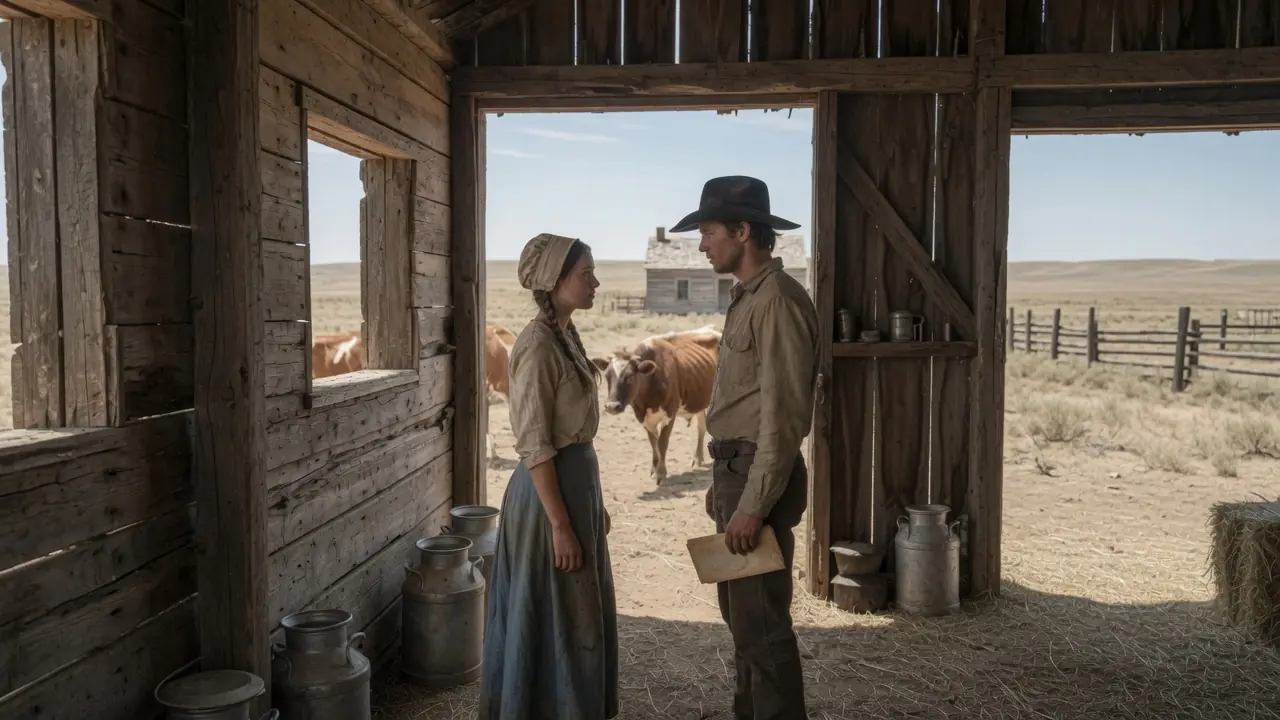
Caleb Turner stood beneath the rough wooden shade of his barn doorway with a folded paper clenched in one hand and shame burning behind his eyes. Two metal milk cans sat in the dirt between him and the woman who had just arrived, catching the pale Wyoming daylight like dull silver. Behind her, a brown-and-white cow flicked its tail near the fence, and beyond the yard, Caleb’s small farmhouse leaned against the wind as if it was tired of standing. Clara Bennett stood across from him in a cream frontier blouse, faded blue skirt, and plain bonnet, looking at the ruined homestead with calm eyes instead of the panic he expected.
He had paid for her passage with the last money he could scrape together, and every mile of her journey west had felt to him like one more proof of his failure. Caleb was twenty-eight, the son of a man who had once believed this land could become a working ranch, but all he had inherited was debt, broken fencing, two stubborn cows, and a claim the land office was beginning to question. The advertisement he sent east had been honest in the ugliest way: homesteader seeks wife, must be strong, willing to work, passage paid. He had not written that he was lonely, proud, afraid, and desperate enough to ask a stranger to help save what he could not save alone.
Clara was not what he had imagined. He had expected an older widow with hard eyes and hands already shaped by farm labor, someone who would see the arrangement clearly and demand no tenderness from him. Instead, the woman standing beside the milk cans looked young, composed, and almost too quiet for the wildness around them. Her brown hair was braided beneath her bonnet, her face was sun-touched but delicate, and her hands, though steady, looked finer than the hands of women who had spent years wrestling with cows and fence wire.
Caleb held the folded advertisement as if it might explain his embarrassment for him. “I told them I needed someone who could work,” he said, his voice rough. “Not someone I would have to protect.” Clara looked from him to the milk cans, then toward the cow shifting impatiently in the yard. “Then stop worrying about protecting me,” she said, “and show me what needs saving.”
The answer struck him harder than any complaint would have. He glanced toward the farmhouse with its warped porch boards, the barn roof patched in three different colors of wood, and the fence posts leaning like old men in a hard winter. “This place is in worse shape than I let on,” he admitted. Clara held his gaze, and there was no softness in it, only something steadier. “Then we start before the sun goes down.”
That was how their marriage began, not with a kiss, not with a proper supper, not with laughter or romance, but with work. Clara took the milk pail from Caleb before he could show her how Bess liked to kick, then approached the cow with a quietness that made even the animal pause. She did not yank, scold, or hurry. She rested one hand against Bess’s flank, murmured low words Caleb could not catch, and within minutes the first clean streams of milk rang against the bottom of the pail.
Caleb watched from the doorway like a man witnessing a trick he had no right to question. He had wrestled that cow twice a day for months, cursing under his breath while she shifted, kicked, and made him feel like a fool. Clara milked her like she had known the animal all her life. When she stood with the pail half full, she looked at Caleb and said, “She is not mean. She is tired of rough hands.”
The first week passed in a rhythm Caleb did not know how to name. Clara rose before dawn, milked the cows, swept the kitchen, cleaned the milk cans, checked the root cellar, and studied every corner of the homestead as if it were a puzzle she intended to solve. She asked very few questions, but the ones she asked cut straight to the point. Where does the spring run after a storm? Which fence breaks first? How much hay is left? Which acre grows best after rain?
Caleb answered because he had no reason not to, but with each answer he heard his father’s voice and his own failure tangled together. His father, Daniel Turner, had believed the land would reward patience, but Caleb had never possessed that kind of faith. He was a rider by nature, more comfortable in a saddle than behind a plow, more skilled with a rope than with a milk pail. After Daniel died, Caleb tried to hold the claim together because leaving felt like betraying the dead, but staying had slowly turned into punishment.
Clara seemed to understand the land differently. She did not look at the dry yard and see defeat. She looked at the slope behind the barn and said water could be guided there. She looked at the cracked garden plot and said it needed manure and shade, not abandonment. She looked at the broken chicken coop and said, “That can be made useful by Friday.”
Caleb almost laughed at that, not because it was funny, but because hope sounded strange in her voice. “You talk like this place is waiting to be fixed,” he said. Clara was kneeling beside the coop, examining a loose hinge. “No,” she replied. “It is waiting for someone to stop apologizing to it.”
By the second week, the neighbors had begun to talk. Rock Creek was small enough that any new arrival became common property by sundown, and Clara Bennett was the most interesting thing the town had seen since a stagecoach lost a wheel outside the mercantile. Mrs. Gable from the general store told three women that Caleb had bought himself a wife because no sensible woman would have chosen him otherwise. The men at the saloon laughed and said if a bride could not bring money, she had better bring strong wrists and a quiet mouth.
Caleb heard enough of it to taste anger whenever he rode into town. Clara heard enough too, though she never said so. He noticed the way conversations stopped when she entered the store, the way women examined her dress, and the way men looked at Caleb with smirking pity. He expected Clara to shrink under it, but she walked through Rock Creek with the same straight back she had carried from the first day.
One morning, Jedediah Stone rode up while Caleb was trying to repair the north fence. Stone owned the largest ranch in the valley, a sprawling spread of cattle, hired hands, and water rights that made him dangerous in ways law could not always touch. He wanted Caleb’s claim because the spring on Turner land never ran dry. For two years, he had made offers that sounded polite until the price revealed the insult beneath them.
“Morning, Turner,” Stone called from his bay horse. His saddle shone with silver, and his mustache was trimmed as neatly as a banker’s signature. He looked at the broken fence, the tired barn, and then toward Clara, who was carrying a basket of clean cloths from the house. “Heard you brought in a bride to save the cows. That true, or did you just hire yourself a pretty farmhand?”
Caleb’s jaw tightened. “Watch your tongue.” Stone smiled wider. “No offense meant. I admire a man who knows when he needs help.” His eyes slid back to Clara. “Though if I were that girl, I would wonder why a man who cannot hold up a fence thinks he can hold up a marriage.”
Before Caleb could answer, Clara set the basket down and walked toward the fence. She did not look at Stone. She crouched beside the snapped post, tested the pull of the wire, and examined the soil around the break. Then she held out her hand toward Caleb without a word. “What?” he asked, confused.
She pointed to the coil of spare wire hanging from his belt. Caleb handed it to her, still feeling Stone’s amused gaze on both of them. Clara found two straight branches from a nearby stand of aspen, stripped them quickly, and began bracing the broken post. Her hands moved with such calm precision that even Stone stopped talking.
She wrapped the wire in a pattern Caleb had never seen, not just twisting but locking each turn beneath the next until the brace tightened on itself. When she finished, the repaired post held firm. Clara stood, brushed dirt from her skirt, and finally looked at Stone. “A fence does not need pride,” she said. “It needs support where it is weakest.”
Stone’s smile faded. Caleb felt the words settle between all three of them, clear as a bell. Clara picked up her basket and walked back to the house, leaving the men beside the repaired fence. Stone looked at Caleb now with less amusement and more calculation.
“She is clever,” Stone said quietly. “Clever women make men think they are safe.” Caleb stepped closer to the fence. “My wife is none of your concern.” Stone touched the brim of his hat, but there was no respect in the gesture. “Everything touching my borders becomes my concern sooner or later.”
That evening, Caleb sat across from Clara at the small kitchen table while the smell of beans and fresh milk filled the room. He had not known how to speak to her after what happened, and the silence between them felt heavier than usual. Clara ate slowly, as if nothing had changed. At last, he set down his fork.
“Where did you learn to mend wire like that?” he asked. Clara looked at her hands. “My father mended wagons, gates, harness, anything folks paid him to fix.” Her voice softened with memory. “He said a broken thing always tells you how it wants to be held together.” Caleb leaned back, struck by the sentence.
“Is he still living?” Caleb asked before he could stop himself. Clara’s face lowered slightly. “No.” The single word closed part of the room. “My mother died first, then him. My aunt took me in until she married again, and after that I became one more mouth in a house that already had too many.”
Caleb felt shame rise again, but this time it was different. He had thought of Clara as an answer to his need, not a person carrying her own losses west. He had brought her to a broken homestead and expected her to fit inside the cracks without asking what cracks she carried. “I am sorry,” he said.
Clara looked up, surprised by the gentleness in his voice. “Do not be sorry for what you did not do.” Caleb swallowed. “I am sorry for what I did. I asked for a wife like I was ordering a tool.” Her eyes stayed on him for a long moment. “Then stop treating me like one.”
From that night on, something shifted. Caleb still stumbled over tenderness, but he began asking Clara what she thought before making decisions. He asked where the garden should go, which cow needed better feed, how to keep hens safe from coyotes, and where the drainage ditch should be dug. Sometimes she answered at once, sometimes she only walked the land in silence before speaking.
The homestead began to change. The porch posts were replaced with straight timber. The barn roof was patched properly, not with scraps and curses but with measured boards laid tight against the weather. The cows grew calmer under Clara’s care, and the milk she sold to Mrs. Gable was richer than anything the store had stocked before.
The garden was Clara’s first true victory. She marked rows with twine, mixed manure into the soil, moved stones to build a windbreak, and planted beans, squash, onions, and lettuce in neat beds. Caleb doubted half of it would survive the dry wind, but Clara carried water at dawn and dusk without complaint. By summer, green leaves spread beside the house like a miracle too humble to boast.
People in town noticed. Mrs. Gable stopped calling Clara “that bride” and began asking for extra eggs. The blacksmith’s wife sent word that Clara’s butter was the best in the county. Even the men at the saloon stopped laughing as loudly when Caleb came in, though Jedediah Stone watched from his corner table with colder eyes each week.
Stone’s next move came in the form of a complaint from the land office. A deputy delivered it at sunset, his horse blowing dust in the yard while Caleb broke the seal with stiff fingers. The accusation was brutal: Calvin, or rather Caleb Turner, had entered a false marriage to secure labor and maintain a claim he could not properly improve. It also claimed the property remained insufficiently developed and should be forfeited for review.
Clara stood beside the table while Caleb read the notice aloud. Her face did not change, but her fingers tightened around the edge of a flour sack. A federal marshal would inspect the homestead in one month. If he found the claim lacking, Caleb would lose the land.
For the first time since Clara arrived, Caleb looked truly defeated. He sat down heavily, the paper hanging from his hand. “Stone finally found a clean way to take it,” he said. “He will say you are not my wife, just hired help. He will say this place is failing, and there is enough truth in it to make the lie strong.”
Clara stepped closer. “Then we make the truth stronger.” Caleb looked up. “You do not understand what he can do.” Her eyes flashed, not with fear but with something fierce. “I understand men who think a quiet woman is evidence of weakness.”
The next month became the hardest labor Caleb had ever known. They rose before dawn and worked until their hands ached too much to close. Caleb set fence posts while Clara measured spacing and braced weak corners. Together, they dug a drainage ditch near the barn, repaired the coop, whitewashed the house, and built shelves in the root cellar for the vegetables Clara was already preserving.
Clara did not simply work hard. She worked intelligently. She used broken barrel staves for garden edging, old flour sacks for shade cloth, and bent nails straightened carefully by lantern light. She traded butter for seed, eggs for lamp oil, and two jars of preserved beans for a good rooster from Mrs. Gable.
Caleb found himself watching her with a feeling that frightened him more than Stone ever had. It was not gratitude anymore, though gratitude was there. It was not admiration only, though he admired her more each day. It was the slow, dangerous recognition that the woman he had hired for survival had become the person whose opinion mattered most to him.
One evening, after they finished shingling the last section of the barn roof, Clara nearly stumbled from exhaustion. Caleb caught her by the elbow before she fell. She looked up at him, and for once her guard was too tired to rise. Dust streaked her cheek, and there was a raw blister across one palm.
“You should rest,” Caleb said. Clara gave a weary laugh. “So should you.” He kept his hand on her arm a moment longer than necessary. “Clara, if I lose this land, I do not know what I can give you.”
Her face softened. “You still think I came here for what you could give me?” Caleb looked away, ashamed. “I do not know why you stayed.” Clara reached up and touched the edge of his dusty shirt, not quite holding him, just reminding him she was there. “Because for the first time in years, something broken looked at me and did not ask me to disappear.”
The words nearly undid him. Caleb stepped closer, his voice low. “I brought you into a dying dream.” Clara met his eyes. “Then let me stand in it with you before you bury it.” The space between them became very still, filled with the smell of fresh-cut wood and summer dust.
He touched her cheek with the rough backs of his fingers, giving her every chance to pull away. She did not. The kiss that followed was quiet, uncertain, and full of all the words they had not trusted themselves to speak. It was not the solution to anything, but it was a promise that the fight no longer belonged to Caleb alone.
The marshal arrived on a bright morning with Jedediah Stone riding behind him like a man already counting someone else’s acres. The marshal was a lean older man with a gray beard and eyes that missed little. He dismounted, shook Caleb’s hand, and tipped his hat to Clara. “I am here to inspect the claim,” he said.
Caleb walked him first to the fences. Every post stood straight, every wire pulled firm, and each gate swung clean on its hinges. Stone muttered that new repairs did not prove permanence, but the marshal ignored him. Clara stood beside Caleb, hands folded, letting the work answer for her.
They moved to the barn. The roof was sealed, the stalls were clean, hay was stacked neatly, and the milk cows looked healthy and calm. The marshal examined the milk cans, the churn, the root cellar, and the shelves of preserved vegetables. He paused at the garden, where beans climbed poles and squash vines spread in healthy green waves.
“Who planned this?” he asked. Caleb looked at Clara. “My wife.” The words came easily now. Clara looked down, but a small smile touched her mouth.
Stone stepped forward. “A garden and a repaired fence do not prove a marriage,” he snapped. The marshal turned slowly. “No, but a working home usually does.” Stone’s face darkened. “The complaint concerns fraud.” The marshal looked from Caleb to Clara, then around the yard. “Fraud does not generally milk cows, mend roofs, preserve food, improve fencing, and build a farm in one month.”
Stone’s mouth tightened. “You are making a mistake.” The marshal’s eyes cooled. “The only mistake here appears to be wasting government time to settle a neighbor’s greed.” He closed his notebook. “The claim stands.”
For a moment, Caleb could not breathe. Clara’s hand found his, and he held it so tightly he feared he might hurt her. Stone wheeled his horse around, humiliation burning through his posture, and rode away without another word. The sound of his horse fading down the road felt like a door closing on the old fear.
After that day, Rock Creek changed its tone. Not all at once, and not perfectly, but enough. Mrs. Gable asked Clara to teach her niece how to preserve vegetables properly. The blacksmith offered Caleb a fair price on hinges without smirking. Even the station master, who had stared at Clara like a bad omen the day she arrived, began tipping his hat when she passed.
By autumn, the Turner homestead no longer looked like a place waiting to collapse. The house stood straight, the barn roof held against rain, the cows gave steady milk, and the garden produced more than they could eat. Clara sold butter, eggs, and vegetables in town, and Caleb took work mending fences for neighbors who had once whispered that he could not manage his own. Money came slowly, but it came honestly.
One evening, as the sky turned rose-colored over the Laramie Mountains, Caleb found Clara standing near the milk cans where they had first faced each other. The cow grazed quietly behind the barn, and the house glowed with lamplight in the distance. He walked to her side and followed her gaze across the yard. “Hard to believe you did all this,” he said.
Clara shook her head. “We did this.” Caleb smiled faintly. “I mostly carried what you pointed at.” She looked at him then, and this time her smile was open, warm, and easy. “That is useful in a husband.”
He laughed, surprised by the sound. Months earlier, laughter had felt like something belonging to other men in better circumstances. Now it rose from him without permission. “Clara Turner,” he said, testing the name with quiet wonder. “You came here with one trunk and turned my failure into a home.”
She took his hand, her fingers still marked by work, fine calluses and rough new ones mingled together. “No,” she said softly. “I found a man who thought he was already beaten and made him look again.” Caleb looked toward the repaired fences, the garden, the barn, and the house. Then he looked at her. “And what did you see?”
Clara leaned closer, her bonnet ribbon moving in the evening wind. “A place worth staying.” Caleb bowed his head until their foreheads touched. For once, no shame rose in him, no fear, no old voice telling him he had failed his father. Only peace.
The advertisement had asked for a strong woman willing to work. Caleb had thought strength meant muscle, endurance, and silence under hardship. Clara taught him that strength could be patience, clever hands, honest words, and the courage to build where others only saw ruin. She did not merely save his claim. She taught him how to belong to it.
Years later, travelers passing through Rock Creek would point toward the Turner place and call it the jewel of the frontier. They would speak of the clean fences, the bright garden, the good butter, the steady cattle, and the woman whose quiet hands had brought order to a broken homestead. Some would say Caleb Turner had been lucky.
Caleb always corrected them. “No,” he would say, looking toward Clara with the same wonder he felt the day she stood beside the milk cans and asked where to begin. “I was saved by a woman everyone underestimated, including me.”
And every evening, when the cows came in and the metal milk cans caught the last light, Caleb remembered the first words Clara gave him on that broken place. Then we start before the sun goes down. It had been more than a command. It had been the beginning of their whole life.