The morning she arrived, the wind was doing what wind does in the Panhandle in March. It was not blowing so much as pushing, a flat and steady hand against everything vertical. The stage had let her off at the edge of town, and the driver had not waited. She stood with a canvas sack over one shoulder and her father’s Winchester laid across the other, looking east toward the homestead she had agreed to occupy without ever having seen it.
The man who placed the advertisement had described it as a working cattle operation. He had written those exact words in the Amarillo Weekly Courier in January of 1887, and she had read them three times by lamplight in a boarding house in Dodge City, where she owed two weeks of rent. “Working cattle operation seeks capable woman. Arrangements negotiable.” She had folded the paper once, tucked it into the front of her coat, and decided that negotiable was the most honest word she had seen in months.
He was waiting at the livery, which surprised her. She had expected to be met by a hired hand, or not met at all. Instead, he stood beside a mule-drawn buckboard, not a horse, a mule, which told her something. He was younger than the advertisement had suggested, not young in the way that means hopeful, but young in the way that means recently defeated.
He looked at the Winchester first, then at her. She let him look. He said the arrangement was simple. She would manage the house, help with the dairy work, and tend the kitchen garden when the ground thawed. In exchange, he would provide room, board, and a wage she could negotiate at the end of ninety days, if both parties were satisfied.
He did not say the word wife. He also did not say not wife. He handed her up onto the buckboard without being asked to. She decided to let that pass for now. The drive out took forty minutes, and she counted fence posts along the way.
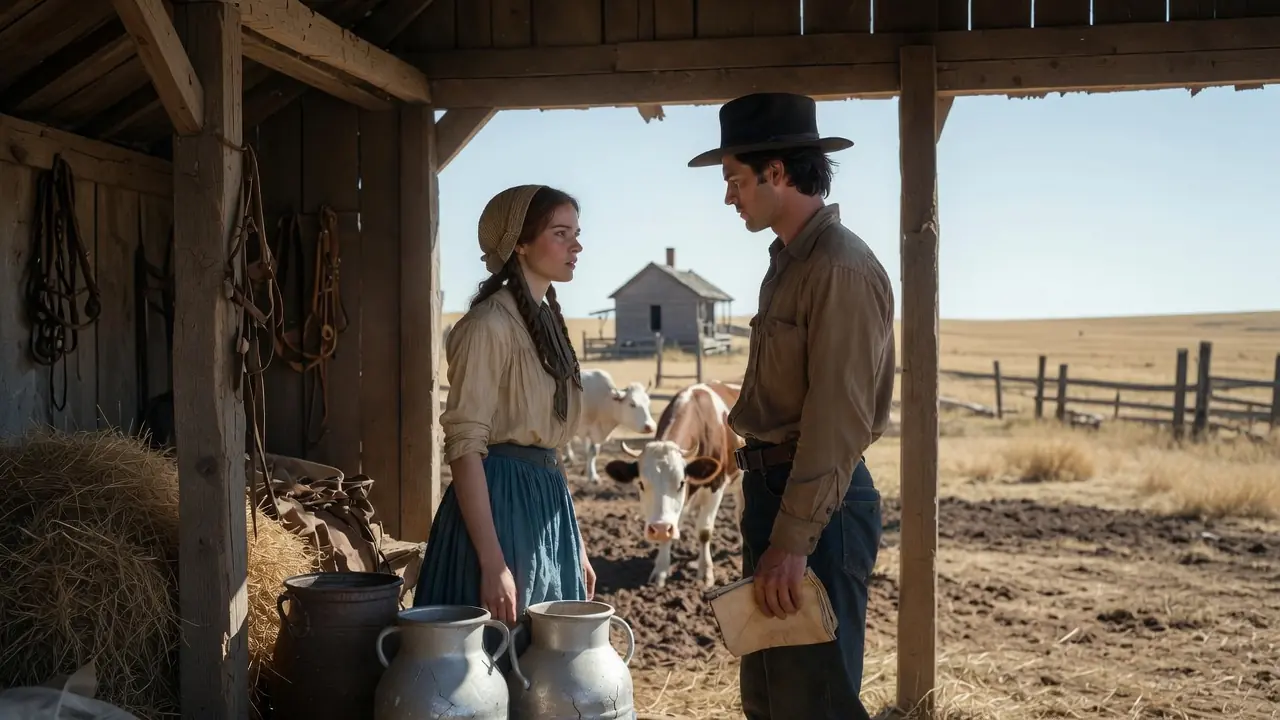
Forty-seven were standing, eleven were leaning, and six were missing entirely. The pasture to the north was winter-bare and carrying about a third of the cattle it could have supported. She could see that from the road, but she did not say so. The house was sawed plank, which she expected, with an addition on the east side that someone had started and never finished.
The roof on the addition had one corner open to the sky. A milk cow stood in the yard like she owned it, which she probably believed she did. There were three things she noticed before she stepped down from the buckboard. The vegetable garden had been attempted and abandoned, with dead cornstalks still standing from the previous summer, gray as old bone.
The barn door was hanging on one hinge. There was also a grave marker visible at the western edge of the property, a simple wooden cross newer than the house. She did not ask about it. She picked up her canvas sack and walked toward the door.
The inside of the house smelled like lard, wood ash, and something underneath both. It was the closed and stale smell that comes from a space where a person has been alone too long. She stood in the doorway for a moment, letting her eyes adjust. It was essentially one room, with a cookstove on the north wall, a plank table with two chairs, and a rope bed in the corner with a blanket folded across it with military precision.
The two chairs struck her as deliberate. Two chairs still, after whatever the cross in the yard represented. The blanket was the only thing in the room that had been truly tended to. Above the stove were shelves holding four tins and a clay jug, and by the door a rifle rested on pegs, a well-oiled Winchester.
He came in behind her and set her sack on the table without being asked to do that either. She crossed to the stove and opened the firebox. Cold iron, gray ash, nothing banked. “When did you last run this?” she asked.
“This morning,” he said. She looked at the ash, and it had not been that morning. She did not say so. Instead, she asked for the woodpile, and he showed her around the east side of the house, the unfinished addition side.
The wood was stacked half-hazardly and partly wet from where the eaves did not cover it properly. Maybe a cord and a half, not enough for deep winter, but enough for now. She carried three armloads in herself before he moved to help. She noticed he favored his left side slightly when he lifted, a catch in the shoulder he tried not to show, and she filed that away.
The fire took hold on the second attempt. She had the stove heating and a pot of water on before he said much of anything else. He stood near the door as though not entirely sure whether he was a guest in his own home. She understood that feeling, the way a space that has held grief starts to feel like it belongs to the grief more than to the living.
She opened two of the four tins, salt pork and dried beans, and began to work. “The cow,” she said without turning around. “What about her?” he asked. “She has not been milked today.”
There was a pause. “No.” “And yesterday?” A longer pause followed. “I have been managing.”
She turned then and looked at him directly for the first time since the yard. He was perhaps thirty, possibly younger beneath the weathering. His jaw was set with the particular stubbornness of a man who had been failing at something for months and was deeply tired of knowing it. There was flour on his sleeve from a baking attempt he had not mentioned.
There was something around his eyes, not grief exactly, but the place grief goes after a long time without resolution. She turned back to the stove. “I will do the milking after supper,” she said. “We should talk about what else needs doing and in what order.”
He said nothing, but she heard him pull out a chair. She set supper without ceremony: salt pork, beans, and a heel of cornbread she found wrapped in cloth near the window. She poured water from the bucket into two tin cups and placed one at his side of the table without asking whether he wanted it. He watched her do these things the way a man watches someone rearrange furniture he had forgotten was supposed to be arranged.
They ate while the wind pushed at the door in slow, testing pulses. The candle on the table leaned and straightened, leaned and straightened. “The south fence,” she said. He looked up.
“Three posts down between the creek bend and the cottonwood,” she continued. “I saw it coming in.” He set his fork down. “The cattle have not found it yet.”
“They will.” He did not argue. That was the first useful thing she noticed about him. He did not argue with true things just to defend himself. He let true things land.
“What else did you see?” he asked, not exactly a question, more like a man bracing for an inventory of his failures. She kept her voice flat and practical. “The well cover is warped. It will not seal right come a hard freeze. The barn roof has a gap on the northwest corner.”
“You can see sky through it from inside,” she said, “which means you are losing heat every night with those animals in there. The kitchen garden has been left too long. Nothing is worth saving there, but the bed itself is good. You have enough soil if you turn it before November.”
He was quiet for a moment. “You noticed all that in the time it took you to walk from the road?” “I notice what I see.” He picked his fork back up, then set it down again. “I had a hand through August. He left.”
She did not ask why. She had learned that asking why a man left a struggling homestead was like asking why water ran downhill. It was almost never one reason. “I will do the milking,” she said, and pushed back from the table. The barn was cold in the particular way of barns that have not held enough body heat for too long.
It was not the clean cold of open air, but a still, abandoned cold that settled in the corners. The cow was a good-sized roan, a little ribby, her bag tight and uncomfortable. She made a low suffering sound when she heard boots on the straw. The woman set the pail, pulled the stool close, and began.
Her hands remembered. The rhythm came back like a hymn she had not sung in a year but still knew every word of. Above her, through the gap in the northwest corner of the roof, she could see exactly one star. She finished the milking, covered the pail, and stood.
She put her hand flat against the cow’s flank for a moment. Not tenderness exactly, but acknowledgment. Then she picked up the lantern and looked at what else the barn was hiding. The lantern threw a long shadow behind her as she moved deeper into the barn.
She held the lantern high and turned slowly, the way her father had taught her to look at a new piece of country. Not searching for anything in particular, but letting what was wrong announce itself. The loft was half collapsed on the south end, a section of planking gone entirely. The hay that remained was dark with old moisture and shot through with mouse runs.
The stalls on the near wall held a rusted cultivator, a single tree with the chains missing, and a buckboard that had lost its front axle and been pushed against the boards to die. Along the far wall, hanging from square nails driven into the uprights, were three horse collars, a leather trace worn through at both loops, and a bridle with the bit still in it. It was a plain O-ring snaffle, brown with oxidation but not broken. She unhooked the bridle and turned it in her hand.
Someone had cared about the stitching once. The work was fine, too fine for this barn, which suggested it had arrived from somewhere else, from a life that used to be better. She hung it back carefully. On the floor behind the buckboard, she found four fence posts still in their binding, a crock of axle grease sealed with a tin lid, and a coil of wire properly rolled and tied, not thrown.
That told her something about whoever had worked this place before August left. A man who coiled his wire was a man who expected to come back for it. She stood with the lantern and looked at what the barn was not rather than what it was. It was not burned, and it was not stripped of every usable thing the way a homestead stripped by desperation sometimes was.
It was only stopped, as if one morning everyone had put down their work in the middle of the motion and not returned. The crank of the grease crock was loose, but the crock was full. The bridle was dry but whole. The cow was thin but not ruined.
Things had stopped, not ended. That was a difference worth noting. She came back to the stall and latched it. She scratched the roan once behind the ear, more by instinct than intent, and the cow pressed into it briefly with the dumb trust of an animal that had not given up on people yet.
She took the covered pail back toward the house. The night had deepened while she was in the barn, and the cold had a different quality now. A true cold, a plains cold, the kind that came in flat and stayed. The lamp in the kitchen window made a yellow square in the darkness.
She watched it for a moment from the yard. It was a very small light against the size of everything around it. She walked toward it anyway and pushed open the door. He was at the table with paper and a stub of pencil.
She set the pail on the counter without speaking. He did not look up from the paper. The pencil moved in short strokes, mostly numbers and columns that did not appear to be adding up to anything encouraging. She could see that from across the room.
She had learned to read ledgers before she learned to read scripture. Her father’s idea of practical education had made the shape of bad arithmetic something she recognized at a glance, the way you recognize weather before it arrives. She hung her coat on the peg by the door. The kitchen smelled of burned coffee, wood ash, mouse, and the particular damp of a house that had been cold more often than warm.
She found a rag, wiped the outside of the pail, and set it on the shelf where the other crocks were. She did this without being asked because it was the right place for it. Leaving things in the wrong place overnight had a way of becoming permanent. He set the pencil down and looked at the paper in the way a man looks at something he cannot change by looking at it.
“The roan is thin but milking,” she said. “She will come back if she gets grain.” “I know,” he said. She waited. “There is not grain.”
She had assumed as much. She pulled out the chair across from him and sat down. The lamp was between them, a small one, kerosene, with the wick turned low to save oil. It threw the light upward and made the planes of his face unfamiliar in pure light, older or younger or simply strange.
He was not an old man. She had not fully registered that until this moment. Somewhere in his mid-thirties, she thought, though the last year or two had been unkind in the way plains years can be unkind. He had the hands of someone who had worked hard and the eyes of someone who had worked hard at the wrong things.
She looked at the columns on the paper. He did not cover them. “The note is the largest problem,” she said. It was not a question. “The note and the winter both,” he replied.
She thought about the roan pressing into her hand, the crank on the grease crock, and the bridle still whole. She thought about things that had stopped but not ended. “What do you have that is not listed here?” she asked. He looked at her.
“On the land,” she clarified. “What is on the land that you have not counted?” He was quiet for a moment. Then he said, “There are cattle, some of them. I do not know the exact number.”
“The south pasture still has grass if the snow has not taken it,” he continued. “I have not been out to check.” She pulled the lamp a quarter inch closer and looked at the paper again. “Tell me about the south pasture,” she said. He said the south pasture ran along a creek bed that had not gone completely dry since his father broke ground there twenty-some years back.
The creek came down from a shelf of higher land to the west. That high land caught snow, held it, and let it go slowly, which meant the creek ran longer into the dry months than most. The pasture itself was maybe eighty acres of mixed grass, bluestem and buffalo. In a good year, the cattle could graze it clean by October, and he would close the gate and let it rest until spring.
This had not been a good year. He had left the gate open because he did not have hands to move the animals and because he had not been sure how many animals were worth moving. She asked how many he had started the year with. He said forty-one head, three of them bulls.
One bull had been sold in September when the first note payment came due. She made a note of that in the margin of the paper. She asked what he had lost over the year, and he was quiet again. It was the kind of quiet that was not evasion, but arithmetic performed slowly and without confidence.
He said he believed he had lost seven to illness in the summer, possibly eight, and two in a bog crossing near the creek’s low point in August. “So you may have roughly thirty head,” she said. “Possibly,” he said. “Yes.” He said possibly as though it were a stone he was not sure would hold his weight.
She asked if he had ridden the south pasture recently. He said not in three weeks. He said the cold had set in fast and he had a cough he could not shake. She looked at him with the particular attention of someone who had watched illness arrive before it announced itself.
He did not look fevered, but he looked reduced in some way. The way a fire looks in the morning, still lit but smaller. She folded the paper once carefully along its original crease. “I will need to see the pasture tomorrow,” she said.
He looked at her across the table and said something that surprised her. He said he had not expected her to ask practical questions. She did not react to that. “What did you expect?” she asked.
He said he was not sure. He said the arrangement had come together quickly, and he had not thought clearly about what came after the arriving. She understood that. She had not thought clearly about it either, but she was thinking clearly now, with the lamp between them and the paper in her hand.
“The note is March,” she said. “That is eleven weeks.” “I know.” “Show me the rest of the property first thing tomorrow before the light changes.” He was up before she was, which surprised her.
When she came down the stairs, he was already at the stove, and the coffee was already black enough to smell from the landing. He had his coat on. Whatever else he was, he was not a man who moved slowly in the morning. They went out before full light, when the sky was the color of a bruise fading.
He walked the perimeter of the property with her in the order a man walks something he knows by heart. The north fence first, then down along the creek bank, then out to the far corner where the pasture opened into a long, gentle slope she had not seen from the road. She did not speak. She looked.
She counted fence posts and noted where the wire had been repaired and where it had only been tied, not properly mended. She looked at the grass, the soil, the bank meeting the water, and the cattle, thirty-one of them moving in the early cold with their breath rising in small white columns. He watched her look. At the far end of the pasture, there was a structure she had not been told about, half barn and half something else.
The roof had collapsed on one side, and the remaining wall was braced with two lengths of timber nailed there recently enough that the nail heads were still bright. She walked toward it, and he followed. She put her hand on the braced wall and pressed, not hard, just enough to feel the give. There was some.
She looked at the angle of the remaining roof beam. “Who did this?” she asked. “I did,” he said. She looked at the nail work. It was competent, not skilled, but competent, and she thought about that.
The creek was running low for February, which meant something about the snowpack above, and she noted that too without saying it. There was a place where the bank had been cut by something, probably cattle pushed to water too many times in the same narrow corridor. The grass was gone in a ten-foot stretch, and the mud there was dark, churned, and soft. She stepped back from it.
“You can ask questions if you want,” he said. “I am still looking,” she replied. By the time they completed the loop, the sun had come up fully, and the frost was beginning to lift from the grass in a thin shimmer. She stopped at the gate and turned back to look at the full sweep of it.
The slope, the cattle, the damaged barn, the creek, the fence with its tied wire and bright nail heads, and years of deferred intention lay before her. He stood beside her. “How long since you ran cattle through the summer properly?” she asked. He was quiet long enough that she had her answer before he gave it.
“Seven years,” he said. Then he corrected himself. “Eight, if you count the summer I lost the bull to bloat and kept the herd too small to make pasture rotation worth the effort.” She kept her eyes on the land while he talked. The way the slope ran south caught the afternoon light, and the way the creek bent created a soft floodplain at the base, where the soil would be deep and dark if you dug down past the crusted surface.
Eight years of underuse had done something to the land that was not entirely damage. The grass was taller than it should have been in the low areas. The creek bank, where cattle had not pushed through, had healed into a thick fringe of cottonwood and willow. There was more here than he knew he had.
She asked how many head he was carrying now. He said forty-three. She asked what the land would support. He did not answer right away, and she could tell by the pause that no one had asked him that question before, or that he had stopped asking himself.
“Maybe sixty,” he said. “More than that,” she said without looking at him, still watching the cattle move in their slow morning drift toward the lower pasture. She had been watching the cattle since they left the barn. The way they moved told her things.
They were calm, but not fat. They had been fed through winter, but not generously. The dominant animals were easy to pick out. They moved to the front of any drift without effort or aggression because the hierarchy had long since been settled.
The younger animals, born in the last two seasons, moved a little uncertainly. That told her about the calving conditions, the weaning, and what kind of attention the herd had received during critical windows. She stored all of it without writing it down. He asked what she meant by more than sixty.
She said the floodplain alone, managed right, would carry twenty additional animals through a dry summer if he moved them through in rotation and did not let them linger. The damaged section of the creek bank needed one season of rest, maybe a temporary fence, and it would come back. The south pasture looked like it had never been cross-fenced. If he ran his summer cattle in one continuous block, he was overgrazing the easy ground and leaving the harder ground untouched.
He was quiet. She could feel him recalibrating something. She said she needed to see the calving records, if he kept them. “I keep them,” he said.
Something in the way he said it told her he was relieved to be asked. Some men kept records out of pride. Some kept them out of discipline. She wanted to know which kind he was before she said anything else.
The calving records were better than she expected. He kept them in a ledger bound with brown canvas, the spine repaired twice with waxed thread, and the entries ran back nine years in two different hands. His father’s cramped, careful print stopped abruptly in the spring of 1889. His own looser script picked up that same April without a break in the sequence.
She noticed he had not left a blank page between them. She did not remark on it. She sat at the kitchen table while he stood near the stove, and she went through the records the way she had been taught to read range. Slowly, looking for the pattern beneath the pattern.
Birth dates, birth weights where he recorded them, cows that had needed pulling, cows that had rejected calves, and bulls that had thrown the strongest firstborns. The data was uneven in places, thinner in years she suspected had been hard. But the thread of it was intact. A man who kept records through a bad year understood that bad years were the ones most worth remembering.
She asked about the winter of 1891. He said they had lost eleven head to a cold snap in February. It came on in less than six hours, and the temperature dropped forty degrees before midnight. She asked if he had noted which animals had survived.
He leaned over her shoulder and pointed to a cluster of marks she had taken for smudges. A small symbol repeated itself, one he had invented for that purpose. She looked at those animals’ lineage going back three years. The pattern was there.
A specific cross, from a bull he traded for in 1888, had thrown calves that held weight and survived cold better than anything else in the herd. She told him he had been breeding toward something without knowing it. He was quiet long enough that she looked up. He said his father had started that cross intentionally and had written about it in a separate notebook she had not seen yet.
He went to the back room and came back with a smaller book, older, the cover gone and the pages soft with handling. She opened it to the first page and read three sentences in the cramped, careful hand she recognized from the ledger. The man had known exactly what he was doing. She set the book down.
There was a whole program of improvement here, started by one man and continued by another who had not fully understood he was continuing it. She asked how many of that bloodline he still had in the herd. He said fourteen cows and two bulls. She picked up the pencil from her coat pocket and began to write.
She wrote for the better part of an hour. He sat across the table and watched without interrupting, which she noted. Most men would have asked questions, offered opinions, or left the room because waiting made them restless. He poured coffee and set a cup beside her hand without being asked, then sat back down and waited some more.
What she built on the page was not a plan in the way he might have expected. It was closer to a map. She drew a rough column for each of the fourteen cows, noted what she remembered of their calves, and estimated each animal’s line from the original cross. The two bulls she treated separately, tracing their probable lineage from both books laid open beside each other.
The older book filled in what the newer one assumed without explanation. Together, they told a complete story. She did not write quickly. She crossed things out and turned back to the older pages three times to confirm dates.
When she set the pencil down, it was because she had reached a conclusion she had not expected. The cross his father had been working toward was not principally about weight. She had assumed that because weight was what the market rewarded, but the older notebook used different language. The words that appeared again and again were constitution and hardiness.
Once, in a margin note so small she had to tilt the page toward the lamp, she read the words, “Outlast the bad years.” His father had not been breeding for good years. He had been breeding for the years that would kill an ordinary herd. She told him this.
He was quiet again. Then he said his father had lost two-thirds of a herd to a single winter before he was born. She said that explained the notebook. He said he supposed it did.
She looked at the two bulls’ entries and told him the older of the two was the one to keep, regardless of what the other numbers suggested. He asked why. She said because of a single calving note from four years back that recorded a calf born in a late storm, with no shelter and a temperature she would not have wanted to ride in, yet the calf had been on its feet before noon. He nodded slowly.
Outside, the wind had come up again. She could hear it working at the corner of the house, looking for a way in the way wind always did on the plains. Patient, persistent, and indifferent to what it found on the other side. She pulled the page she had written toward him and told him what she thought they should do in spring.
He read the page slowly. She had written it in two columns, one for herd adjustments before summer and one for longer changes that would take two or three years to show. She had used his father’s notation system, the same abbreviations and the same way of indicating breeding pairs. She had been looking at the notebook long enough that it had become the language she thought in when she thought about his cattle.
He set the page down and asked if she believed any of it would work. She said she did not know what would work on land she had only been standing on for eight months. She only knew what the notebook told her, what she had seen with her eyes, and that both pointed in the same direction. That was as much certainty as she could honestly offer him.
He looked at the stove instead of her. The fire had burned lower while they sat, and the light in the room had shifted from amber to something closer to gray. He said his father had tried to find a hand who could read cattle the way she could. He had hired four men over twelve years, and none of them had lasted a full season.
They came in with their own ideas, and his father had not been a patient man with other people’s wrong ideas. She asked what happened to the fourth. He said the fourth had been the worst because he had been partially right. A man who is partially right is harder to argue with than a man who is entirely wrong.
She understood what he meant. She had met men like that. The partial rightness was the thing they used to justify all the damage the other half of them caused. Then he asked how long she thought she would want to stay.
The question landed differently than she expected. It was not the question of a man trying to hold on to a good worker. It was more careful than that, more exposed. The kind of question a person asks when he has already thought about the answer he is afraid of hearing.
She looked at the window. The wind was still working at the corner. Outside, the stars would be sharp tonight, the kind of cold clear that follows wind on the plains. Every star would be brittle and distinct, as if the sky had been swept clean.
She said she thought she would want to stay long enough to see whether she was right about the older bull. He looked at her then. She said that would be at least through the next calving season, maybe the one after. The fire ticked quietly in the stove.
He did not say anything for a long time after that. He looked at the fire instead, the way a man looks at something when he is trying to appear calm and mostly succeeding. She had not meant it as a declaration. She had meant it as an answer to his question.
But she understood, watching him sit with it, that it had landed as something more than an answer. It had landed as a decision, and decisions out there were the currency that mattered. A man could say many things, but what he did through a calving season told you who he truly was. She thought about her father’s saddle, the one she had ridden north with.
Her father had always said you could judge a piece of country the same way you judged a horse. Not by how it looked standing still in good light, but by what it did when the weather turned. She had judged this place through a hard winter, a harder spring, and a summer that tested every decision she made from the first week. The country had not broken, and neither had she.
The calving season she had promised through came, and the bull she had argued for proved what she believed he would prove. The calf numbers that spring were the best the homestead had seen in three years. She did not say, “I told you so.” She did not need to.
She stayed through the calving season after that too. By the third spring, there was no more talk of how long she intended to stay. The question had been answered by the accumulation of days, the way most real questions on the frontier were answered. Not with words, but with work, time, and the slow, particular trust that builds only when someone has seen you not quit.
Thirty years later, a man passing through on his way south stopped at the homestead to water his horse. He asked the old rancher who owned the place. The rancher pointed across the yard to where a woman, gray at the temples now, was working the fence line with the same economy of motion she had always had. Not one gesture was wasted, and the hammer fell exactly where she intended it to fall.
He told the traveler she had come to him in the spring of 1887 when the place was near done, and she had stayed. The traveler watched her work for a moment and asked if she had always been like that. The old rancher looked across the yard, at the woman who had read the land better than any man he had known. Then he said he supposed she had.
He said she had arrived with a canvas sack, a Winchester, and eyes that missed nothing. She found a homestead full of stopped things and saw that stopped did not mean finished. She found cattle others might have sold off, records others might have ignored, and land nobody had asked the right questions about in years. She found a dying place and made it useful again.
The traveler asked if she was his wife. The old rancher smiled faintly, looking at the fence line where she was still working. “She was hired to help with cows,” he said. “But she stayed long enough to become the reason the cows survived.”
The traveler looked again at the barns, the fences, the healthy herd, the garden rows, and the house with its finished addition and a porch that held the morning well. It did not look like a ruined homestead now. It looked like something built by patience and stubborn hands. It looked like a place that had learned how to outlast bad years.
The old rancher picked up the water bucket and carried it toward the horse trough. Across the yard, the woman looked up and saw him watching. She lifted her hammer once, not as a greeting exactly, but as acknowledgment. He nodded back.
The traveler did not know the history of the place, but he understood enough. Some homesteads are saved by money, some by luck, and some by the arrival of a person who notices what everyone else has stopped seeing. This one had been saved by a woman who came west with nothing soft left in her life and found a future in the ruins. She had not turned the homestead into a jewel with dreams or promises.
She had turned it with milk pails, ledgers, fence posts, cattle lines, hard questions, and the refusal to walk away when the work became ugly. That was the kind of jewel the frontier understood. Not polished, not delicate, and not made for display. It was useful, stubborn, and still standing after the weather had done its worst.