Officer Oliver Grant believed Courtroom 302 belonged to him in the particular way some men begin believing a place belongs to them after spending enough years enforcing rules inside it. The courtroom technically belonged to the city, the judge, the attorneys, the clerks, the defendants, the families sitting nervously on wooden benches, and every member of the public entitled to enter when proceedings were open, but Grant had worked courthouse security long enough that none of those distinctions felt especially important anymore. He knew which attorneys arrived late, which defendants tried hiding phones beneath their coats, which reporters pushed boundaries, and which nervous people could be made compliant with nothing more than a hard stare and a hand resting near his belt.
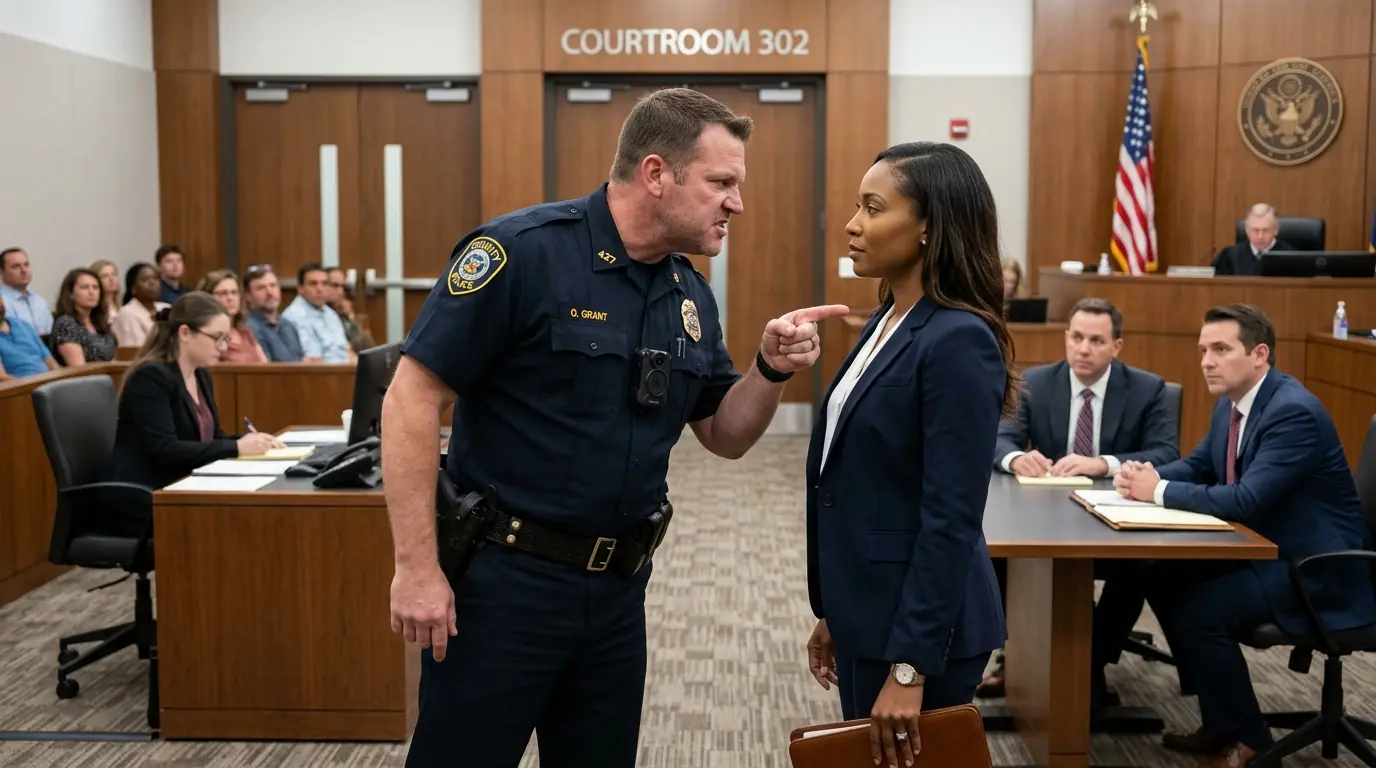
That Tuesday morning, twenty minutes before court was scheduled to begin, Grant noticed a woman standing near the front row.
She wore a tailored navy suit, low black heels, a plain leather briefcase resting beside one leg, and no visible courthouse identification. Her posture was straight, her dark hair pulled neatly away from her face, and while several attorneys whispered around the counsel tables, she simply watched.
Nothing about her behavior was disruptive.
That irritated Grant more than disruption might have.
People who belonged usually looked busy.
They carried files.
They greeted clerks.
They checked phones.
They displayed badges.
This woman merely stood there as if she had every right to.
Grant decided she did not.
His polished boots struck the marble floor as he crossed the room.
Conversations faded.
“You don’t belong here, sweetheart.”
The woman turned.
She was perhaps forty-two, with deep-brown skin, calm dark eyes, and the kind of expression Grant associated with people who had already decided not to be impressed by him.
“Step back,” Grant continued, “before I put you in bracelets.”
Her gaze moved downward.
Not toward his gun.
Toward his badge.
OLIVER GRANT.
Beneath it:
6142.
She studied the number for perhaps one second longer than necessary.
Grant noticed.
“What are you looking at?”
“Your badge number.”
“Why?”
“I like knowing who I’m speaking with.”
Several attorneys stopped pretending not to listen.
Grant stepped closer.
“You need to move back.”
“Why?”
“Because I told you.”
“That isn’t a legal reason.”
Something hot moved through Grant’s chest.
He had heard variations of that sentence before, usually from public defenders trying to impress clients or young law students who had discovered constitutional vocabulary and wanted somewhere to use it.
This woman said it differently.
Quietly.
Almost clinically.
Grant glanced toward the court clerk.
She had stopped organizing files.
“You’re interfering with court operations.”
The woman looked around.
Court was not in session.
The judge’s chair sat empty.
Nobody was attempting to pass her.
Nobody had asked her to move.
“I’m standing beside a bench.”
Grant’s jaw tightened.
“You think you’re smart?”
“I think you should reconsider what you’re about to do.”
That sentence changed the temperature in the room.
Not because it was threatening.
Because it wasn’t.
The woman sounded like someone warning a driver about a bridge being out.
Grant interpreted the calm as arrogance.
A defense attorney named Marcus Hale slowly placed his phone against a folder on the table, camera lens angled toward them.
Grant did not notice.
Above the courtroom doors, a fixed security camera continued recording.
He did not notice that either.
“I gave you an order.”
“No,” the woman replied. “You made a demand.”
Grant stepped so close she could smell the mint gum he chewed during morning shifts.
“Turn around.”
“On what charge?”
His face tightened.
For one brief second, uncertainty passed through him.
He could have stopped.
Asked her name.
Asked the clerk whether she had business there.
Called Sergeant Doyle.
Checked the courtroom access list.
Done almost anything.
Instead, Grant heard silence around him and understood it as an audience.
Pride made the decision.
He seized her left arm.
Gasps moved through the courtroom.
The woman did not pull away.
“Do not twist my shoulder.”
“Turn around.”
“I am not resisting.”
“Turn around.”
Grant forced her wrist behind her back.
The first cuff closed.
Metal clicked sharply in the quiet room.
Marcus Hale’s phone captured it.
Grant took the second wrist.
The woman winced when he pulled her arm too high.
“You are making a serious mistake.”
Grant laughed once.
“I hear that every day.”
The second cuff snapped shut.
She turned her head as far as the position allowed.
“You have never heard it from someone with the authority to examine everything you’ve built your career on.”
Grant smiled.
“There it is.”
“What?”
“The threat.”
“It wasn’t a threat.”
“Sure sounded like one.”
“It was information.”
He started guiding her toward the aisle.
Then the double doors behind him opened.
Judge Maribel Shaw entered first.
Behind her came Stonebridge Police Chief Alan Whitaker, City Attorney Leah Foster, two men Grant did not recognize, and a woman carrying a federal evidence case.
Every one of them stopped.
Judge Shaw’s eyes went immediately to the handcuffs.
Chief Whitaker looked at the woman.
Then at Grant.
The blood seemed to leave his face.
Grant felt his confidence slip for the first time.
“Officer Grant.”
Whitaker’s voice was nearly a whisper.
Grant straightened.
“Chief.”
“What are you doing?”
“Detaining an individual interfering with courtroom operations.”
Judge Shaw looked around her courtroom.
“What interference?”
Grant glanced toward the woman.
“She refused a lawful direction to move.”
“From where?”
“This area.”
Judge Shaw pointed toward the public bench.
“That area?”
“Yes.”
The chief stared at him.
“Take the cuffs off.”
Grant hesitated.
“Sir, she was—”
“Now.”
The woman spoke.
“No.”
Everybody turned toward her.
Grant blinked.
She remained cuffed.
Her voice was steady.
“Before he removes them, I want Officer Grant to state clearly why I am being detained.”
Chief Whitaker closed his eyes for half a second.
Grant looked around.
It felt suddenly as though the courtroom had rearranged itself while he stood in the center.
“I already explained.”
The woman looked at him.
“For the record.”
Grant’s face reddened.
“You refused a lawful order.”
“What law or court rule did I violate?”
“You were obstructing.”
“What did I obstruct?”
No answer.
She continued.
“Was I blocking the aisle?”
Grant looked.
“No.”
“Interrupting proceedings?”
Court had not begun.
“No.”
“Threatening anyone?”
“No.”
“Attempting to enter a restricted area?”
Grant’s jaw worked.
“No.”
“Then why am I in handcuffs?”
Grant looked toward Whitaker.
The chief did not help.
“Take them off,” Whitaker said.
Grant removed the cuffs.
The woman brought her hands forward.
Red marks circled both wrists.
She rubbed one slowly.
Nobody spoke.
Finally Grant looked toward Whitaker.
“Who is she?”
The chief stared at him.
Not angrily.
Worse.
With disbelief.
“Officer Grant, report to Sergeant Doyle’s office and surrender your weapon pending review.”
Grant’s face changed.