The last plate of food in Samuel Mercer’s diner belonged to someone who could not pay for it.
Samuel knew that before the man even sat down.
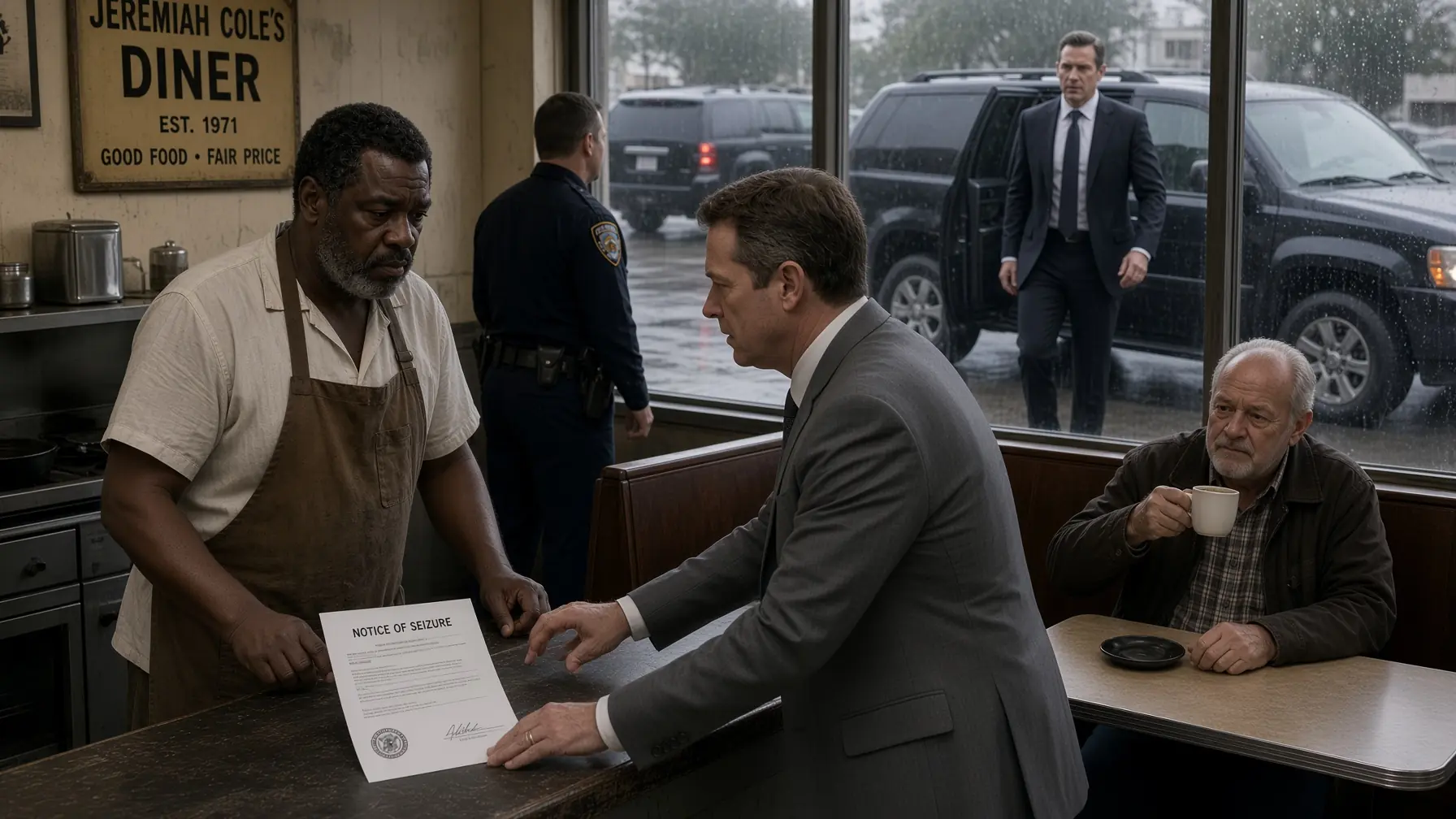
The stranger entered just after nine on a wet November night, bringing cold rain with him through the front door.
The bell above the frame gave one tired little jingle.
Samuel looked up from behind the counter.
The man was somewhere in his late sixties.
Thin.
Unshaven.
Gray hair hanging damp across his forehead.
His coat looked too large for him and too worn to stop much weather.
One sleeve had been repaired with black thread.
His shoes were soaked.
His hands trembled.
Not violently.
Just enough that Samuel noticed.
The diner was nearly empty.
Two men sat in the corner booth drinking coffee and stretching one piece of pie into an hour.
The grill had already been cleaned.
The soup pot contained one serving.
Samuel had planned to eat it himself.
He had not eaten since breakfast.
He looked at the stranger.
Then at the pot.
“Sit down.”
The man hesitated.
“I don’t have money.”
“I didn’t ask.”
“I’m serious.”
“So am I.”
Samuel pointed toward the counter.
“Sit before you fall.”
The man sat.
Samuel poured the last of the chicken soup into a bowl.
Added half a sandwich he had wrapped earlier.
Then coffee.
The stranger placed both hands around the mug but did not drink immediately.
Heat rose into his face.
Samuel noticed the man close his eyes.
From the corner booth, one of the regulars muttered:
“There he goes again.”
His friend chuckled.
“Giving away the last thing in the kitchen.”
Samuel heard.
He always heard.
The first man continued:
“Then he wonders why the bank’s taking the place.”
Samuel set a spoon beside the stranger.
“Eat.”
The stranger looked toward the two men.
Then back at Samuel.
“You hear that?”
“Yes.”
“They talking about you?”
“Yes.”
“Bank really taking this place?”
Samuel wiped the counter.
“Eat your soup.”
The man studied him.
“That means yes.”
Samuel looked at him.
“It means soup gets cold.”
For the first time, the stranger smiled.
Barely.
Then he began eating.
Slowly at first.
After the third spoonful, faster.
Samuel turned away so the man would not feel watched.
That was something he had learned from his wife.
Feed people without making them perform gratitude.
His wife had been dead four years.
Some evenings Samuel still expected to hear her in the kitchen.
“Don’t stand over him, Sam.”
“Give the man room.”
Her name was Helen.
She had started Mercer’s Diner with him thirty-two years earlier.
The neon sign outside still carried both their initials beneath the coffee cup.
S & H MERCER — HOME COOKING
The H flickered now.
Samuel could not afford to repair it.
He could barely afford onions.
Mercer’s Diner had once been busy from sunrise until after supper.
Truckers.
Factory workers.
Teachers.
Farm families on Saturdays.
Teenagers after football games.
When the paper mill closed, business dropped.
Then the highway interchange moved traffic farther east.
Then Helen got sick.
Cancer did not simply take her.
It took time.
Savings.
Attention.
Samuel closed early for appointments.
Opened late after hospital nights.
Customers found other places.
He did not blame them.
After Helen died, he reopened every day because he did not know what else to do.
The diner was the only place that still sounded like their marriage.
The grill popping.
Coffee pouring.
Plates hitting the pass.
Helen’s recipes taped inside the cabinet.
He told himself business would recover.
It never really did.
By November, Samuel owed the bank four months on the commercial note.
Three suppliers had put him on cash-only terms.
His gas bill was overdue.
Property taxes were behind.
A lien notice sat unopened in the office.
And he still gave away food.
Not constantly.
Not enough to bankrupt a successful restaurant.
But enough for people to notice in a failing one.
A mother short six dollars.
A veteran living in his truck.
A kid whose parents were fighting and who stayed until closing because home was worse.
Samuel never kept track.
Helen used to call it the invisible menu.
“If someone truly needs it,” she said, “the price is zero.”
Samuel had continued the rule.
People told him that was why he was broke.
They were wrong.
But not completely.
Generosity had not destroyed Mercer’s Diner.
It simply had not saved it.
The stranger returned the next afternoon.
Samuel looked up.
“Back again.”
The man stopped.
“I can leave.”
“I didn’t say that.”
Samuel pointed toward the counter.
“Eggs?”
The man sat.
“You don’t have to feed me.”
“No.”
Samuel cracked two eggs onto the grill.
“But I’m already doing it.”
The man watched.
Samuel added toast.
Potatoes.
Coffee.
“Name?”
The stranger hesitated.
“Arthur.”
“Samuel.”
“I know.”
Samuel turned.
“How?”
“Sign.”
Samuel looked toward the faded lettering on the wall.
SAMUEL & HELEN MERCER — 1993
“Right.”
Arthur ate.
He did not talk much.
That suited Samuel.
By the third day, Samuel learned only a few things.
Arthur had been married.
His wife was dead.
He had one son.
Something had happened to the son.
Arthur would not discuss it.
He slept wherever he could.
Sometimes a shelter.
Sometimes a church basement.
Sometimes in an old pickup parked outside town.
Samuel asked once:
“You got family?”
Arthur answered:
“Technically.”
That ended the subject.
But Arthur watched everything.
Not suspiciously.
Carefully.
Samuel greeting people by name.
Samuel slipping a free biscuit into an old widow’s takeout box.
Samuel pretending not to notice when a laid-off mechanic left two dollars short.
Samuel washing dishes because he could no longer afford evening help.
On Thursday, Arthur saw Samuel close the cash register and count the day.
Two hundred twelve dollars.
Samuel stared at the money.
Then divided it.
Supplier.
Utilities.
Payroll owed to his remaining waitress, Denise.
Nothing left for himself.
Arthur said:
“You should pay yourself.”
Samuel laughed.
“With what?”
“You work here.”
“That doesn’t create money.”
Arthur said:
“You could stop giving food away.”
Samuel closed the register.
“Yes.”
“Why don’t you?”
Samuel looked toward the empty booth Helen used to sit in during afternoon breaks.
“Because losing the diner would be painful.”
He turned back.
“Becoming someone Helen wouldn’t recognize would be worse.”
Arthur lowered his eyes.
He did not ask another question.
Friday morning, the notice came.
Certified.
Samuel signed.
Sat at the counter.
Opened it.
The words were written politely.
That almost made them crueler.
The lender had transferred the delinquent commercial loan into special servicing.
Unless a cure agreement was reached, enforcement would begin.
A separate county notice concerned taxes.
Another envelope contained a termination warning from his equipment lessor.
Samuel spread the papers in front of him.
Denise arrived at six thirty.
She was fifty-eight and had worked there for seventeen years.
She took one look at Samuel.
“How bad?”
He did not lie.
“Bad.”
“How long?”
“Maybe days before the bank moves formally.”
She sat beside him.
“Talk to them.”
“I have.”
“And?”
“They want money.”
“Very unreasonable of them.”
Samuel smiled.
Then his face fell.
“I owe you for last week.”
“I know.”
“I’ll pay you.”
“I know.”
“Denise—”
“Samuel.”
She pointed a finger at him.
“You do not spend the morning apologizing to me.”
“Coffee first.”
“Panic after seven.”
Helen had hired Denise.
Sometimes Samuel hated how much she sounded like her.
Mostly he was grateful.
Arthur arrived at eleven.
Samuel almost told him they were closed.
Instead:
“Sit.”
Arthur looked at the papers.
“That today?”
“Yes.”
“How much?”
Samuel laughed once.
“You planning to rob a bank?”
Arthur did not smile.
“How much?”
“Enough.”
“That isn’t a number.”
Samuel looked at him.
“About a hundred and eighty thousand between the note, arrears, tax issues, equipment, and supplier debt.”
Arthur remained still.
Samuel continued:
“The building’s worth more than that.”
“So why not sell?”
Samuel looked around.
Cracked booths.
Old counter.
Helen’s handwriting on a chalkboard near the kitchen.
“Because I’m stupid.”
Arthur shook his head.
“No.”
“You love it.”
“Same thing some days.”
Arthur stared toward the window.
Then asked:
“If someone gave you money, would that fix it?”
Samuel frowned.
“Probably temporarily.”
“Meaning?”
“The diner still doesn’t make enough.”
Arthur nodded.
“That is what I wanted to hear.”
Samuel laughed.
“What?”
“Most people would say yes.”
“To free money?”
“Of course they would.”
“I’m sixty-four, Arthur.”
“I’m too tired to lie for dramatic effect.”
Arthur smiled.
Then looked serious.
“What would fix it?”
Samuel sat across from him.
He had thought about that question for years.
“Breakfast still works.”
“Lunch mostly works.”
“Dinner doesn’t.”
“The kitchen needs refrigeration.”
“Roof needs work.”
“Sign needs replacing.”
“The back room could become a bakery counter.”
“We need delivery to the industrial park.”
“And I need someone who understands computers because our online presence is basically Denise posting the soup special from her personal Facebook account.”
From behind them, Denise shouted:
“It works.”
Samuel called back:
“You have seventeen followers.”
“Quality audience.”
Arthur smiled.
Samuel continued.
“The business could survive.”
“Maybe.”
“But not while I’m paying old debt and fixing thirty years of deferred maintenance.”
Arthur nodded.
Then:
“You ever written that down?”
“No.”
“Do it.”
“Why?”
Arthur looked at him.
“Because tomorrow you might need it.”
Samuel stared.
“For what?”
Arthur stood.
“Do you have paper?”
For three hours, they built a plan.
Not a polished business plan.
Numbers on yellow legal paper.
Average breakfast revenue.
Food costs.
Labor.
Repair needs.
Equipment.
Delivery radius.
What dishes sold.
What did not.
Which hours lost money.
What Samuel would change if fear were not deciding everything.
Arthur asked surprisingly good questions.
Too good.
Samuel noticed.
“You ever own a restaurant?”
Arthur’s hand stopped.
“Something like that.”
“What kind?”
“Several.”
Samuel stared.
Arthur corrected himself.
“A long time ago.”
“You were in food service?”
“Yes.”
“What did you do?”
Arthur looked toward the rain.
“Made mistakes with more zeros than yours.”
Samuel laughed.
That answer sounded believable.
Arthur did not come Saturday.
Or Sunday.
Samuel wondered if something happened.
Monday morning, he drove past the shelter.
No Arthur.
He checked the church basement.
Nothing.
By Tuesday, Samuel stopped asking.
People disappeared.
That was part of feeding strangers.
Sometimes you learned their stories.
Sometimes you only learned how they took their coffee.
Tuesday afternoon, Samuel received the final notice.
A court-authorized enforcement action regarding the commercial property would proceed unless the lender and Samuel reached an immediate agreement.
His attorney explained it more accurately than Samuel wanted to hear.
“They can’t just walk in tomorrow and own everything.”
“But you’re out of room.”
“There are procedures.”
“Not miracles.”
Samuel asked:
“How long?”
“Not long enough.”
That night, Samuel cooked the last chicken he had.
He considered closing early.
Then a mother and her teenage son came in.
Their card declined.
The mother’s face changed.
Samuel said:
“Machine’s been acting up.”
It had not.
He slid their plates across.
The teenager knew.
He looked at Samuel.
“Thank you.”
Samuel nodded.
“Eat.”
After they left, Denise stood beside him.
“Last chicken?”
“Yes.”
“Supplier tomorrow?”
“Cash only.”
“How much cash?”
Samuel opened the register.
Thirty-eight dollars.
Denise laughed.
Not because it was funny.
“What are we serving tomorrow?”
Samuel looked around.
“Coffee.”
Wednesday morning began with freezing rain.
At 8:15, a sedan stopped outside.
Two people entered.
A deputy sheriff.
And a court-appointed process officer carrying papers.
Samuel’s stomach dropped.
The deputy removed his hat.
“Mr. Mercer?”
“Yes.”
“We’re here regarding enforcement on the property.”
Samuel nodded.
Denise stood behind the counter.
Three customers watched.
The process officer explained that the lender had obtained authority to secure certain collateral and begin possession procedures.
Samuel would have time to remove personal property.
The building would not be physically emptied in five minutes.
But the diner could not continue operating as though nothing had happened.
Samuel listened.
Then asked:
“Can I finish breakfast?”
The process officer looked surprised.
“What?”
“Those three already ordered.”
The deputy looked toward the customers.
Then:
“I don’t see a reason you can’t finish what’s on the grill while we handle paperwork.”
Samuel nodded.
“Thank you.”
He turned back.
Eggs.
Bacon.
Toast.
His hands moved automatically.
One customer had been among those who mocked him.
The man looked down at his plate.
“Sam.”
Samuel did not answer.
The customer continued:
“I’m sorry.”
Samuel turned.
“For what?”
“You know.”
Samuel placed the eggs down.
“Eat before they get cold.”
At 8:42, the first black SUV stopped outside.
Then another.
Then a third.
The deputy looked through the window.
“What now?”
A woman in a gray suit stepped out first.
Then a man carrying a leather portfolio.
Then someone Samuel recognized.
Arthur.
Only Arthur did not look homeless.
His gray hair was trimmed.
Beard clean.
Dark navy suit.
White shirt.
No tie.
He stood straight.
Not like a frightened man seeking warmth.
Like someone accustomed to entering rooms where decisions waited for him.
Samuel stared.
Denise whispered:
“No way.”
Arthur came through the door.
The bell jingled.
Same sound as the first night.
Samuel looked at him.
“You own a tie?”
Arthur glanced at his shirt.
“I hate ties.”
The absurdity of the answer almost broke Samuel.
“What is this?”
Arthur approached the counter.
The woman beside him introduced herself.
“Rachel Monroe.”
“Counsel for Ashford Hospitality Foundation.”
Samuel looked at Arthur.
“Ashford?”
That name he knew.
Everyone in food service knew it.
Ashford Hospitality Group had owned hotels, restaurant properties, highway travel centers, and institutional kitchens across several states.
Its founder was Arthur Ashford.
Samuel looked at the man.
Then the old image in his memory.
Rain.
Torn coat.
Shaking hands.
“No.”
Arthur nodded.
“Yes.”
One of the customers whispered:
“That’s Arthur Ashford.”
Samuel looked at Arthur.
“You lied to me.”
Arthur’s face tightened.
“About my last name.”
“And being homeless?”
“No.”
That surprised Samuel.
Arthur continued.
“I have money.”
“But for most of this year, I have not had much of a home.”
The room remained quiet.
Arthur looked down.
“My son died fourteen months ago.”
Samuel said nothing.
“Overdose.”
Arthur’s voice was flat from repetition.
“He had been sober almost three years.”
“Then he wasn’t.”
“My wife died six years before that.”
“After my son…”
Arthur looked toward the window.
“I stopped going to the office.”
“Stopped answering people.”
“Started driving.”
“Hotels felt like places with my name on the wall.”
“My house felt worse.”
“I slept in my truck.”
“Shelters sometimes.”
“Churches.”
“I still had access to money.”
“I simply stopped caring whether I used it.”
Samuel felt his anger change shape.
Not disappear.
Change.
Arthur continued.
“The night I came in here, I had been outside most of the day.”
“I was cold.”
“I had not eaten.”
“That part was true.”
“You fed me.”
Samuel stared.
“You could have paid.”
“Yes.”
“Why didn’t you?”
Arthur looked ashamed.
“Because when you told me you didn’t care, something in me wanted to believe you.”
“That was selfish.”
Samuel said nothing.
Arthur did not defend himself.
“I came back because I wanted to pay.”
“Then I kept coming back because this place reminded me of something I had forgotten.”
“What?”
“My son.”
Samuel’s expression softened.
Arthur looked toward the booth where he had eaten.
“Not the way he died.”
“The years before.”
“He worked in one of our kitchens when he was nineteen.”
“Hated corporate offices.”
“Loved diners.”
“Said places like this mattered because lonely people could sit down without explaining why they were lonely.”
Arthur looked at Samuel.
“I thought he was being sentimental.”
“He was right.”
The attorney placed a folder on the counter.
Samuel did not touch it.
Rachel said:
“Mr. Mercer, the foundation learned yesterday that your lender had moved into enforcement.”
Samuel looked at Arthur.
“You told them?”
“Yes.”
“You had people investigate me?”
“I asked our staff to review the business.”
“Public records.”
“Financial information you provided voluntarily yesterday.”
“The lender only spoke to us after you authorized contact this morning through your attorney.”
Samuel frowned.
“I didn’t authorize—”
Denise cleared her throat.
Samuel turned.
She raised one hand.
“I may have called your lawyer.”
Samuel stared.
“When?”
“Six thirty.”
“You what?”
“I told him Arthur’s people wanted to discuss buying the note.”
Samuel turned back.
Arthur said:
“Your lawyer required proof we were real.”
“Smart man.”
Samuel looked at the folder.
“What did you do?”
Rachel answered carefully.
“We reached a conditional agreement with the lender this morning.”
“Not a gift.”
“Not a magic cancellation.”
“The foundation-associated investment entity will purchase the commercial note at its negotiated payoff amount if closing conditions are met.”
“The current enforcement action will be stayed during that process.”
The process officer looked at his phone.
Then said:
“I just received the notice.”
He showed the deputy.
“Lender has requested we suspend today’s action pending settlement.”
The deputy nodded.
Samuel gripped the counter.
The room suddenly felt unstable.
Arthur said:
“That gives us time.”
Samuel looked at him.
“For what?”
“To decide whether the diner is worth saving.”
Samuel’s face hardened.
“You came here with three SUVs to tell me maybe?”
Arthur smiled slightly.
“I came with three SUVs because lawyers apparently reproduce when threatened.”
Rachel did not smile.
Arthur continued.
“I will not pay off your debts and pretend the problem disappears.”
“You already told me the diner doesn’t work as it stands.”
Samuel nodded slowly.
“So.”
Arthur opened the folder.
“The proposal is an investment.”
“Roof.”
“Refrigeration.”
“Kitchen repairs.”
“Sign.”
“Working capital.”
“Six months of payroll reserve.”
“Delivery setup.”
“Accounting.”
“Website.”
“And debt restructuring.”
Samuel stared at the pages.
Arthur continued.
“You keep operating control.”
“The foundation receives a minority financial interest until repayment benchmarks are met.”
“Then part of that interest converts into a permanent community-meal fund.”
Samuel looked up.
“What?”
Arthur pointed toward the old chalkboard.
“Your free meals.”
Samuel frowned.
“We don’t call them that.”
“What do you call them?”
Samuel hesitated.
Then:
“The invisible menu.”
Arthur smiled.
“Good.”
“The investment would include an endowment-style fund dedicated to it.”
“Separate from operating cash.”
“Documented.”
“Budgeted.”
“No more pretending generosity costs nothing.”
Samuel’s eyes burned.
Arthur said quietly:
“Kindness needs infrastructure too.”
That sentence broke him.
Samuel sat down.
Right there behind the counter.
For the first time in years, he cried where customers could see him.
Not dramatically.
He simply covered his face with both hands.
Denise walked over and rested one hand on his shoulder.
Nobody laughed.
Nobody whispered.
Arthur waited.
Eventually Samuel looked up.
“I haven’t said yes.”
Arthur nodded.
“I know.”
“I want my lawyer to read everything.”
“He should.”
“I’m not putting your company name over my diner.”
“I don’t want you to.”
“Helen’s name stays on the sign.”
Arthur looked toward the flickering H outside.
“Yes.”
Samuel’s voice tightened.
“And I’m not opening twenty restaurants because you decided I’m inspirational.”
Arthur almost laughed.
“Thank God.”
“I’m too old for twenty.”
Samuel pointed toward the folder.
“What do you get out of this?”
There it was.
The important question.
Arthur looked around the diner.
“Financially?”
“Eventually, maybe a modest return.”
“If the turnaround works.”
“And if it doesn’t?”
“We lose money.”
“Why risk it?”
Arthur sat across from him.
“Because I spent forty years building restaurants designed to maximize how many people moved through a room.”
He looked toward the booth.
“You built one that made people stay.”
Samuel said nothing.
Arthur continued.
“I’m not buying your kindness.”
“I’m investing in a business that appears fixable because your relationship with this community has value.”
“Those are not the same thing.”
Samuel studied him.
That answer he respected.
The diner did not reopen the next day.
That would have made a better story.
Reality required three weeks.
Electrical inspection.
Roof work.
Refrigeration replacement.
Health-department review.
Licensing.
Supplier agreements.
Bank closing.
Accounting cleanup.
The old neon sign went to a repair shop.
Samuel refused a new one.
“Fix this one.”
The sign company said replacing it would be cheaper.
Samuel replied:
“Then charge me more.”
The H stopped flickering.
Denise received every dollar of back pay.
Suppliers were paid under negotiated agreements.
Samuel met with a restaurant accountant who told him, politely, that several menu items lost money every time he sold them.
Samuel argued for forty minutes.
Then removed two of them.
Breakfast stayed.
Lunch stayed.
Dinner reduced to three nights a week.
The back room became a small bakery and takeout counter.
Delivery began to the industrial park.
An online ordering system appeared.
Samuel hated it until orders started arriving.
Arthur came by during renovations wearing jeans.
Samuel pointed.
“Better.”
Arthur looked at himself.
“I own jeans.”
“Prove it more often.”
The invisible menu changed too.
Before, Samuel simply gave food away and absorbed the loss.
Now a small card near the register said:
IF YOU NEED A MEAL, ASK FOR HELEN’S SPECIAL.
No explanation.
No proof required.
People who wanted to contribute could add money to the fund.
Arthur’s foundation provided the initial backing.
Then something unexpected happened.
Customers began donating.
One dollar.
Five.
Twenty.
A retired teacher left two hundred at Christmas.
The mechanics from the garage down the road put a jar on their counter.
A high-school class raised eight hundred dollars.
Samuel hated being called charitable.
He preferred:
“Neighborly.”
Arthur let him have the word.
The two men who had mocked Samuel from the corner booth returned on reopening day.
They stood awkwardly near the counter.
One said:
“Looks good.”
Samuel nodded.
“Coffee?”
“Yes.”
They sat.
After a while, the other man called Samuel over.
“We were hard on you.”
“You were loud.”
He looked embarrassed.
“We thought you were going to lose everything because you gave too much away.”
Samuel wiped the counter.
“I almost lost everything because the business changed and I didn’t change with it.”
“That’s not as good a story.”
“No.”
Samuel looked toward Helen’s repaired sign.
“But it’s true.”
The man nodded.
Then placed fifty dollars beside the register.
“For Helen’s Special.”
Samuel looked at it.
“Coffee’s two dollars.”
“I know.”
Samuel took the money.
“Thank you.”
No lecture.
No humiliation.
People were allowed to become better without being forced to perform shame first.
Helen had believed that too.
Arthur became a regular.
Not every day.
Once a week.
Usually Thursday.
He sat in the same booth.
Paid full price.
Tipped too much.
Samuel complained.
Arthur ignored him.
One evening, six months after reopening, Samuel brought him chicken soup without asking.
Arthur looked at the bowl.
“You remember.”
“I run a diner.”
“That’s your excuse for everything.”
“It’s a good excuse.”
Arthur ate quietly.
Then said:
“I went home.”
Samuel looked up.
“To your house?”
“Yes.”
“How was it?”
“Awful.”
Samuel nodded.
“Good.”
Arthur frowned.
“Good?”
“Means you’re feeling it.”
Arthur considered.
“Therapist said something similar.”
“Probably charged more.”
“Significantly.”
Samuel smiled.
Arthur continued.
“I cleaned my son’s room.”
Samuel stopped.
“That took three days.”
“Find anything?”
“A jacket.”
“Concert tickets.”
“A receipt from this diner.”
Samuel stared.
Arthur reached into his wallet.
Pulled out an old faded receipt.
MERCER’S DINER
Nine years earlier.
Two coffees.
Cheeseburger.
Chicken soup.
Samuel looked at him.
“He came here?”
“Apparently.”
Arthur’s eyes filled.
“I had no idea.”
On the back of the receipt, someone had written:
Good place. Nobody bothers you.
Samuel sat down.
For a while, neither man spoke.
Then Arthur laughed softly.
“I thought I found this place.”
Samuel looked toward Helen’s photograph near the register.
“Maybe he sent you.”
Arthur smiled.
“You believe that?”
Samuel thought.
“No.”
Then:
“But Helen would.”
That was enough.
A year later, Mercer’s Diner was profitable.
Not wildly.
No franchise empire.
No television crews.
No miraculous line around the block.
Profitable meant the bills were current.
Samuel paid himself.
Denise had health coverage through a small-business plan.
The roof did not leak.
The refrigerator did not sound like a tractor.
And somewhere between fifteen and thirty Helen’s Specials were served each week.
Some to homeless people.
Some not.
A woman escaping domestic violence.
A college student waiting for financial aid.
An elderly man choosing between medication and groceries.
A family stranded after their transmission failed.
Nobody had to explain.
That was the rule.
One meal.
A seat.
Dignity.
Arthur eventually stepped away from day-to-day involvement in his old company.
He increased his foundation work instead.
Not because Samuel transformed him through one bowl of soup.
Life was not that tidy.
Arthur still grieved.
Still disappeared sometimes.
Still had terrible days around his son’s birthday.
But Thursday dinner at Mercer’s became part of his week.
Samuel noticed if he missed two.
The first time that happened, Samuel called.
Arthur answered:
“What?”
“You alive?”
“Yes.”
“You eating?”
Silence.
Samuel sighed.
“Come in.”
“I’m not hungry.”
“That’s not the question.”
Arthur became very quiet.
Then he laughed.
Samuel frowned.
“What?”
“Nothing.”
“Why are you laughing?”
Arthur said:
“You sound like someone.”
Samuel looked toward Helen’s photograph.
“So I’ve been told.”
Arthur came in twenty minutes later.
Years afterward, people told the story incorrectly.
They said a billionaire disguised himself as a homeless man to test a poor diner owner.
Samuel corrected them every time.
“He did not test me.”
“But he pretended to be homeless.”
“He was living homeless.”
“He had access to money.”
“Yes.”
“Then he wasn’t really homeless.”
Samuel would look at them.
“A bank account and a home are not always the same thing.”
Then:
“He was grieving.”
“He was lost.”
“He came in hungry.”
“I fed him.”
“That is the story.”
People preferred the magical version.
A secret millionaire.
A test of character.
A giant reward.
It made kindness sound like a lottery ticket.
Be good to strangers because one might secretly be rich.
Samuel hated that lesson.
If Arthur Ashford had been exactly what Samuel first believed—
a broke, nameless man with nowhere to sleep—
the soup would still have been worth giving.
That mattered.
On the tenth anniversary of Helen’s death, Samuel closed the diner for two hours in the afternoon.
He invited Denise.
Arthur.
A few regulars.
The sign outside was covered.
At three o’clock, Samuel pulled the cloth away.
A small bronze plate had been mounted beneath the repaired neon.
It read:
HELEN’S TABLE
No one should have to prove they are hungry enough to deserve a meal.
Arthur stood beside Samuel.
“Helen actually say that?”
“No.”
“You’re putting words in your dead wife’s mouth?”
Samuel smiled.
“She’d approve.”
Arthur laughed.
Then became quiet.
“She would’ve liked what you built.”
Samuel looked through the window.
At booths full of people.
At Denise arguing with a delivery driver.
At a child drawing on a paper placemat.
At a man eating soup alone without anyone staring.
“No.”
Samuel said.
“What?”
“We built it.”
Arthur looked at him.
Samuel pointed toward Helen’s photograph.
“All of us.”
Samuel eventually retired.
Mostly.
He sold his majority interest to a small employee ownership group led by Denise’s daughter and the kitchen manager.
The foundation kept only the limited rights necessary to protect the Helen’s Table fund.
Arthur insisted the documents make one thing permanent.
No future owner could use the fund as marketing money.
It existed for meals.
Nothing else.
Samuel approved.
On his final official day, he arrived at five in the morning.
Made coffee.
Turned on the grill.
Prepared biscuits.
At 6:02, the bell above the door jingled.
A young man entered.
Maybe twenty.
Backpack.
Wet jacket.
Eyes exhausted.
He approached the counter.
“Sir?”
Samuel looked up.
“I was told…”
The young man hesitated.
“That there’s something called Helen’s Special.”
Samuel smiled.
“Sit down.”
“I don’t have—”
“I know.”
He turned toward the grill.
“Eggs?”
The young man nodded.
Samuel cracked two onto the hot surface.
The sound filled the diner.
Simple.
Ordinary.
Exactly the way it had years earlier when Arthur walked in cold and shaking.
People later liked to say Samuel’s kindness saved the diner.
That was only partly true.
Kindness alone could not repair a roof.
It could not restructure debt.
It could not make bad restaurant margins disappear.
It could not replace broken refrigeration or pay taxes.
The diner survived because kindness met planning.
Generosity met structure.
Experience met humility.
Arthur brought capital.
Samuel brought trust.
Denise brought loyalty.
Customers returned.
Professionals fixed the business.
The community chose to support what it claimed to value.
That was less miraculous than a billionaire dropping a deed on the counter.
It was also more durable.
Samuel plated the eggs.
Added toast.
Slid the food toward the young stranger.
“Eat.”
The young man looked up.
“Why are you doing this?”
Samuel glanced toward the bronze plate beneath Helen’s name.
Then toward the old booth where Arthur still sat most Thursdays.
He smiled.
“Because I can cook.”
“And you can eat.”
For thirty years, that had been enough reason.
It still was.