Elias Ward had spent four years learning to prefer silence over conversation, cattle over crowds, and the empty stretch of his ranch over the noise of any town in Wyoming territory. So, when he climbed onto his wagon that October afternoon in Red Willow, all he wanted was to get home before dark. He had no idea that his entire life was about to change in the span of a single heartbeat. It started with a sound, a shift of fabric behind him, something moving where nothing should have been. He walked to the back of the wagon and pulled the canvas aside, and there she was, a young woman folded between the flour sacks and the blankets, her dark hair falling loose from its pins, her hands clutching a small bag like it was the only thing left in the world she could hold on to.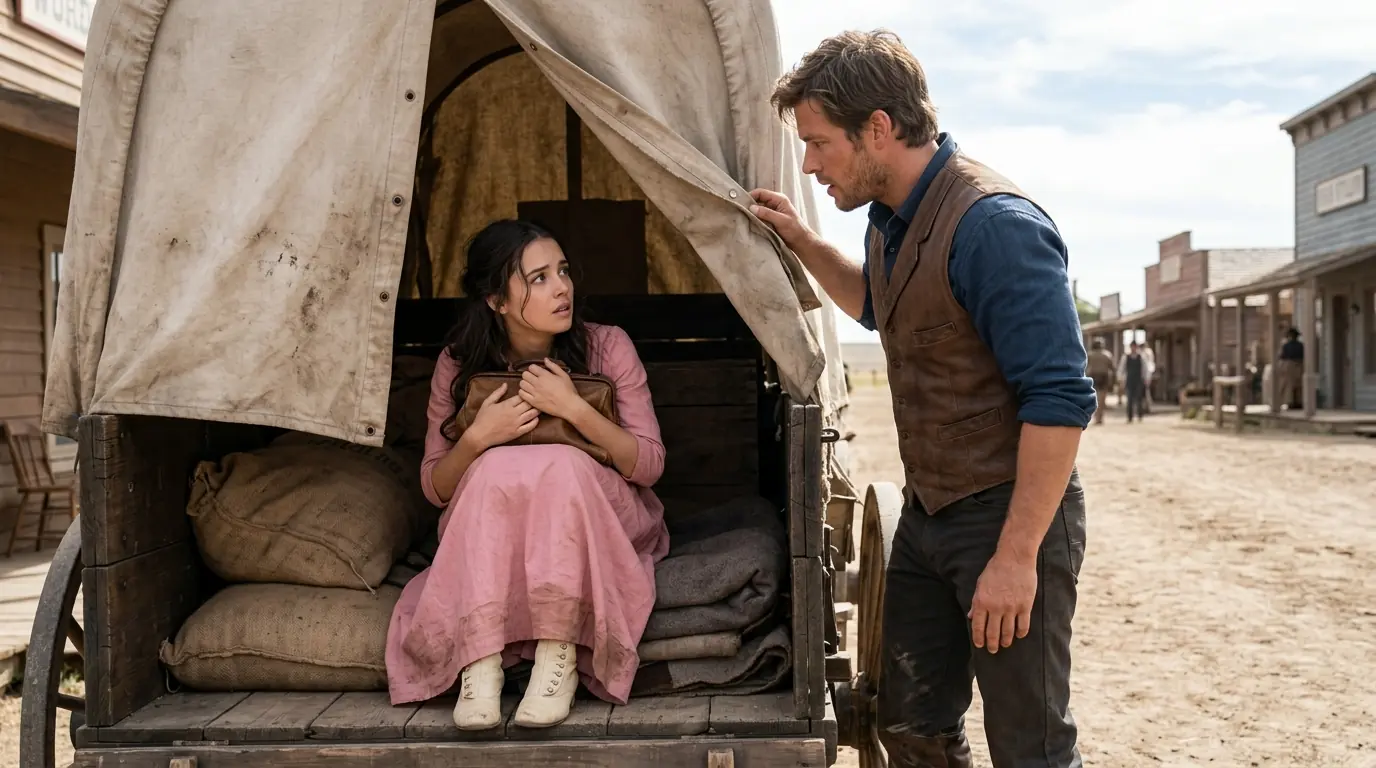
Her dress was pink, simple, still damp at the hem from running. She looked at him with the eyes of someone caught between fear and desperate hope, and before he could ask a single question, she whispered the words that would upend everything. "Pretend I'm your wife until we're out of town. " Outside, the unmistakable sound of horses moving with purpose was growing louder. Men searching block by block with the kind of patience that told him exactly who had sent them. Elias didn't know her name.
They asked if he'd seen a woman, dark hair, pink dress, and in the half second he had to decide, Elias chose to lie. "My wife's in the back," he said, "she's not feeling well. " And then, as if summoned by fate itself, Rosemary pulled back the canvas herself. Cheeks flushed from pinching them just moments before, playing the part of an unwell wife being needlessly delayed. For one breathless moment, it worked. Then a rider's eyes drifted down to her shoes, cream-colored, buttoned, clearly meant for a wedding, not a rough wagon ride, and the tension in the air turned razor sharp.
Elias didn't wait for the accusation to form. "She dressed before she felt it coming on," he said flatly, and snapped the reins before the rider could respond. The wagon lurched forward, and for 30 seconds, freedom felt possible. Then he heard them again, not chasing, but following, patient in a way that made his stomach tighten. He cut through the alley behind the mercantile onto a forgotten mill road no one used in October, and pushed his horse up into the mountains until the sound of pursuit finally faded into silence.
He had rescued a stranger on instinct alone, with no idea yet what kind of danger he had just invited into his life. Once the danger of Red Willow faded behind them, Rosemary Bell finally began to speak. Not all at once, but slowly, the way truth tends to surface when there's no audience left to perform for. Her mother had been a seamstress in town, a hard-working woman who died that past March, leaving behind more debt than Rosemary ever knew existed. The man holding those debts was Ambrose Pike, the same name that made grown men in the county lower their voices.
Elias didn't need to ask who Pike was. Everyone knew. What he didn't know yet was how deep the manipulation went. Rosemary explained that Pike had extended credit to her mother during a brutal winter when the sewing business had slowed to nothing. And the rates he quoted seemed reasonable, even generous.
But those weren't the real rates written into the actual notes. Pike hadn't extended a kindness. He'd built a trap. Stacking interest upon interest until a small manageable debt swelled into an amount no seamstress could ever hope to repay. It wasn't carelessness.
It was calculation, precise and merciless. Elias asked the only question that mattered. What was he really after? Rosemary's answer landed heavier than anything before it. Her mother owned a small piece of land on the edge of Red Willow, passed down from her grandfather, with a creek running straight through it.
Pike controlled everything on both sides of that water except her family's plot. And without it, he couldn't secure the rights he needed to expand his operation. The wedding scheduled for that very afternoon, the one Rosemary had fled in a stolen moment of courage, wasn't a rescue from debt at all. It was the final piece of Pike's plan. A legal shortcut to seize land he'd been quietly maneuvering toward for years.
Elias sat with that revelation as the wagon climbed higher into the mountains. The gold aspens and thin autumn sky offering no comfort against what he now understood. He asked whether the property was legally hers. Rosemary admitted uncertainty. Her mother's will named her as the rightful heir, but Pike claimed the debt transferred with the estate, that the land was the only asset large enough to settle what was owed.
She didn't know enough about the law to challenge him. Elias did. His late brother had once practiced law before choosing the frontier instead. And he remembered enough to know that for Pike's claim to hold, the original notes needed to specifically list the property as collateral at the time they were signed. If they didn't, Pike's entire scheme could collapse under real scrutiny.
There was only one problem. Rosemary had seen those notes in her mother's papers, but hadn't taken them. Not realizing then how badly she would need them later. Out here, Elias admitted the law is mostly whatever the richest man says it is. But if you can get something in front of a federal marshal, Washington's rules still carry weight, even against a man like Pike.
For the first time, Rosemary looked at him like his words actually mattered. Like hope wasn't entirely gone. Behind them, Pike's men were making calculations of their own. And neither Elias nor Rosemary yet realized that the real danger of the night wasn't riding on horseback at all. The storm arrived the way mountain storms in Wyoming always seem to, without warning and without mercy.
Rolling down from the north with an authority that made escape impossible. Elias saw the clouds building and pushed the horse as hard as he dared. But the ranch was still too far, and the mountains were closing in fast. Instead, he steered them toward an old line cabin he'd used years earlier during summer grazing season. A small, forgotten shelter with a stone fireplace and firewood stacked outside from habit.
A quiet testament to a man who always prepared for winter, even when he didn't expect to need it. They got the horse settled in the lean-to, pulled the wagon alongside the cabin, and stepped inside just as the sky truly broke open. Rosemary hadn't complained once during the entire journey. Not about the speed, not about the cold, not about her ruined wedding shoes, or the fact that she hadn't eaten a single bite since morning. She sat by the single chair in the cabin, taking in the sparse room with the calm expression of someone quietly determining that she could manage, that she had survived worse than this.
When Elias mentioned there was food waiting in the wagon, she was already moving before he could offer to get it himself. She returned through the storm with salt pork, flour, and coffee, cutting and preparing the meat before he even finished building the fire. A small but telling detail he noticed and chose not to comment on. They ate together as the storm raged outside, and Elias found himself waiting for something else to follow.
Tears, perhaps, or the flood of questions that usually comes once danger finally passes and the mind has room to process fear. Instead, Rosemary simply finished her meal, cleaned the pan with practiced efficiency, and looked into the fire before speaking. "Thank you for not asking questions on the road," she said quietly. "You were telling me," he replied, "on your own timeline. " She explained that her mother used to say the right person asks the right question at the right moment, while the wrong person asks everything all at once, desperate for answers they haven't earned.
When Elias asked what the right question actually was, Rosemary admitted her mother never told her, that she believed you simply know it when you hear it. Elias sat with that thought longer than he expected to, thinking of the years he'd spent alone in a house built for more than one person, the years he'd stopped asking questions because there was no longer anyone left to ask them of. Then, almost without meaning to, he looked across the fire and asked if she had eaten anything at all that morning. She admitted she hadn't.
That, he said, was the wrong question to ask six hours ago. And for the very first time since he'd found her hiding in his wagon, Rosemary Bell almost smiled. A small, hesitant expression that started, faltered, then fully bloomed into something that changed her entire face. Elias looked away into the fire because watching her smile directly felt like something he wasn't ready for yet.