Cooper Lang came home down the Cottonwood Road with a bad leg, a hollow stomach, and no hope left inside him. The horse beneath him was nearly as thin as he was, ribs showing under dusty hide, head hanging low from the long road south. Two years and three months had passed since Cooper rode away from the Lang place, and in all that time, he had imagined the homecoming so many ways that the pain of it had turned dull. He expected weeds, broken fences, an empty house, and a bank notice nailed to the front door like a final insult.
He had not come back because he believed anything could still be saved. He had come back because a man has to see with his own eyes what grief and failure have taken from him. His wife Annie was buried on the little rise behind the cabin, under a cottonwood tree she had loved, and if the bank had sold the land, then even that grave might be neglected or forgotten. Cooper told himself he only wanted to stand there once, remove his hat, say goodbye to the last thing that tied him to her, and then keep riding.
The trouble had started before the trail ever took him. Annie died of fever in a winter so bitter the water bucket froze inside the cabin, and after she was gone, Cooper could not seem to rise properly into the days. The note at Cedar Springs Bank came due anyway, because grief did not stop interest from gathering. He and Annie had borrowed to build the place, clear the field, fence the grazing land, and buy the first cattle. Alone, Cooper had no way to pay it.
Then a cattle outfit came through needing men for a dangerous northern drive. Two thousand head through mountain country, hard weather, and Indian Territory, all the way to the railhead, with wages high enough to clear a man’s debt if he survived the work. Cooper signed on because he had nothing left to lose but the land, and losing the land felt like losing Annie twice. He told the bank he would be back before the year turned, wages in hand, note paid clear.
He rode away in spring with Annie’s grave behind him and the house locked tight. He thought he would be gone four months, maybe five if weather slowed them. Instead, the mountains took them. The killing winter came early and cruel, burying the range, freezing cattle where they stood, scattering men across snow and ice until the drive became less a job than a slow dying.
Cooper broke his leg in two places after his horse slipped on ice above a narrow pass. The crew left him in a small settlement because they had no choice, and then the snow closed the world around him. He spent months on a cot beside a stove, feverish, angry, and half out of his mind, unable to send word home and too weak to ride. By the time spring came, the cattle drive was gone, the wages were gone, and Cooper Lang had become a man people spoke of in the past tense.
The second winter caught him before he could make it south. He worked odd jobs, slept in barns, limped through towns that did not know his name, and spent long nights wondering whether Cedar Springs had already forgotten him. A man can survive hunger, cold, and loneliness, but hope is harder. Hope has to be fed, and Cooper had nothing left to feed it with.
So when he finally reached the last bend before the Lang place, he expected ruin.
Instead, he saw smoke.
Cooper reined in so sharply the horse tossed its tired head. A thin gray line curled from the stone chimney of his cabin, rising into the late afternoon sky like a signal from a life that should have been dead. He stared so long his eyes began to burn. Then he looked at the fence along the road and saw that the broken rails had been mended.
He nudged the horse forward slowly, as if sudden movement might shatter whatever strange dream he had entered. The field to his left was not choked with weeds. It was green, tended, and alive, rows cut straight through the soil with a care Cooper recognized because he had once worked that earth beside Annie. The barn roof was patched. The yard was swept. Firewood was stacked neat against the wall.
Then he heard cattle.
Not the starving ghosts he had imagined. Real cattle, fat and healthy, shifting inside the corral with the slow contentment of animals well-fed and watched over. Cooper’s throat tightened until breathing hurt. He looked toward the rise where Annie lay and saw fresh wildflowers at her grave.
That nearly took him out of the saddle.
He rode into the yard like a man entering a church after believing God had burned it down. Every detail struck him with impossible force. The repaired latch on the gate. The clean porch boards. The wash basin near the door. The curtains in the window, patched but clean. Someone had not only lived here. Someone had cared.
The cabin door opened before Cooper could speak.
A woman stepped onto the porch, drying her hands on her apron, and stopped dead when she saw him. She was perhaps forty, plain in the way hard lives make people plain only to fools, with weathered skin, strong shoulders, and steady eyes that had seen enough sorrow not to startle easily. But she startled now. Her hands tightened around the apron, and her gaze moved from Cooper’s hat to his gaunt face to the exhausted horse beneath him.
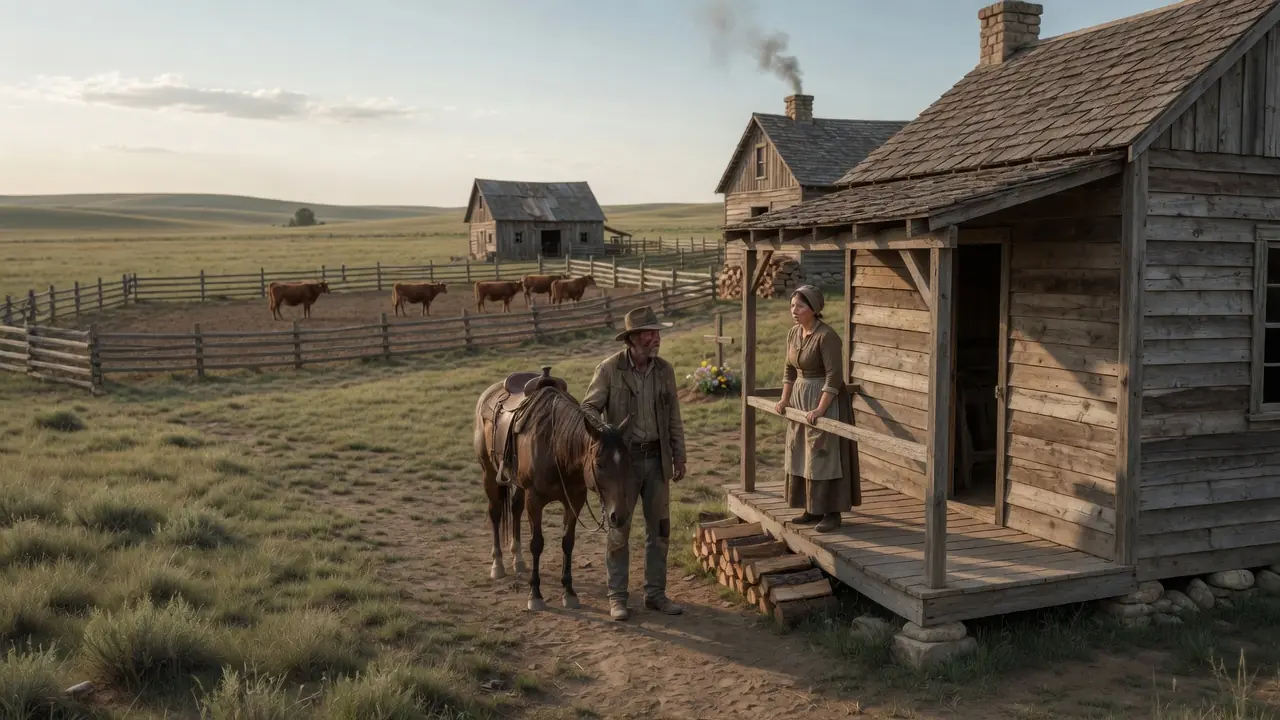
For a long moment, neither of them spoke.
“This is the Lang place,” Cooper finally said, his voice rough from the road. “My place.”
The woman’s face changed.
“I’m Cooper Lang,” he said. “Or I was, before I rode out. Who are you, ma’am, and what are you doing on my land?”
The color drained from her face so fast that Cooper almost stepped forward to catch her. She reached blindly for the porch rail and gripped it with both hands. Her lips parted, but no sound came at first. Then she whispered his name like it was both prayer and ghost.
“Cooper Lang.”
He narrowed his eyes. “That’s right.”
“They said you died,” she breathed. “On the killing winter drive. Everyone said you were dead on the mountain.”
“I came close enough,” he said.
Her eyes filled with tears before he understood why. “You’re alive.”
“I am,” he said, though he was not sure how much of him was. “Barely. Two years late. And I still don’t know who you are.”
The woman pressed one hand to her mouth, then lowered it slowly. “My name is Maud Calvert.”
Cooper searched his memory and found nothing. “I don’t know that name.”
“No,” she said softly. “You wouldn’t.”
He swung down from the horse, stiff and clumsy because of the old break in his leg. Pain shot up through his hip, and he caught the saddle to steady himself. Maud took one step down from the porch like she might help, then stopped herself, uncertain what rights she had in his yard now that the dead man had returned alive. Cooper saw the hesitation and felt something twist inside him.
“How is this place standing?” he asked. “The bank should have seized it the day I missed payment.”
Maud looked toward the fields, then back at him. “They nearly did.”
“And?”
“And I came.”
“Why?”
She swallowed, and when she spoke, her voice shook, though not from fear. “Because seven years ago, you saved my life.”
Cooper stared at her. “I never saved your life.”
“You did.”
“I would remember.”
“No,” Maud said, a sad little smile touching her mouth. “That’s the whole of it. You would not. It was a small thing to you. To me, it was everything.”
He stood in the yard, dust on his coat, one hand still gripping the saddle horn, while she told him the story. Seven years earlier, she had been a young widow two counties east, her husband buried three months and the bank ready to take her farm over a debt too small to matter to rich men and too large for a woman alone. Winter was coming. She had no family, no money, and nowhere to go.
A stranger passing through town heard about the widow losing her land. He went to the bank, paid the debt in full, and refused to make himself important over it. He gave only a first name and told the banker that someone had once helped him when he was down, and he was only passing it along. Later, Maud learned the stranger’s full name.
Cooper Lang.
Cooper listened, stunned. Somewhere far back in his memory, a shape began to form. A bank office. A thin banker with ink on his cuff. A story told over coffee about a widow being turned out. He had paid the sum because he had money then, because Annie was alive, because the world still felt like a place where a man could afford kindness.
“I forgot,” he whispered.
“I did not,” Maud said. “I kept your name for seven years. Like a prayer.”
Cooper looked away, unable to hold the gratitude in her face. He had done that thing lightly, almost carelessly, as a man tosses seed into good ground and rides on without watching it grow. Yet here it stood before him now, in the form of a woman who had crossed into his broken life and mended it while he was gone. The weight of it was almost unbearable.
“When I heard you died,” Maud continued, “and that the bank meant to take this place, I thought I finally knew what I was meant to do with the debt I carried. My own farm was gone by then. My second husband had passed. I had nothing much left but two hands, a strong back, and the memory of what you had done.”
“So you came here.”
“I went to Cedar Springs Bank and begged them to let me take up the note. They cared more for payment than ownership, especially in a bad year. I paid what little I could, then worked the land to pay the rest.”
Cooper looked again at the fields. “You did all this alone?”
“Mostly.”
“The fences?”
“Yes.”
“The cattle?”
“Bought three poor ones with my last savings. Built up from there.”
“The barn?”
“Patched it before the first winter came through.”
“And Annie’s grave?”
Maud’s eyes softened. “I tended it. I did not know her, but I knew she mattered. I hope that was not a liberty.”
That was when Cooper broke.
He turned away, but there was nowhere to hide in his own yard. He covered his face with both hands, and the grief he had been carrying for two years came out of him like water from a split barrel. He wept for Annie, for the mountains, for the lost cattle, for the wages that never came, and for the impossible mercy of finding his home alive because of a kindness he had forgotten. Maud stayed where she was and let him have the dignity of not being watched too closely.
When he could speak again, his voice was ragged. “I came home to say goodbye.”
Maud said nothing.
“I thought it was all gone,” he continued. “The land, the house, Annie’s grave. I had nothing left in me, Maud. Nothing.”
“You have this,” she said gently.
“No,” he replied, turning to her. “Because of you, I have this.”
She looked down at her work-worn hands. “I came to pay a debt.”
“No debt asks two years of a life.”
“This one did.”
The answer was simple, and that made it more devastating. Maud Calvert had not come for gain, not for land, not for praise, not even for him, because she believed him dead. She had come to repay goodness with goodness, and she had done it in silence, without witness, without thanks. Cooper had known brave men in his life, but suddenly he wondered whether courage had always looked more like this woman than any man with a gun.
Maud drew herself up, and a sadness entered her face. “Well,” she said, “you are home now.”
Cooper wiped his face with the back of his hand. “I am.”
“The land is yours. The bank note is near settled, and the stock should carry it the rest of the way come market.”
He heard the farewell before she spoke it.
“I’ll gather my things,” Maud said. “I can be gone by morning.”
Cooper stared at her. “Gone?”
“It is your home, Mr. Lang.”
“It is.”
“And I only ever came to hold it for you.”
He looked toward the porch, the swept yard, the smoke, the fields, the grave with flowers. The idea of her leaving struck him with a force he did not understand at first. It was not only gratitude. It was not only shame at taking back what she had saved. It was the sudden knowledge that if she walked away, the place would feel empty again in a way Cooper could not bear.
“You have somewhere to go?” he asked.
Maud gave a small shrug. “I am used to moving on.”
That answer hurt him more than if she had said no.
She turned toward the door, but Cooper took a step after her. His bad leg dragged slightly, and the pain made him grit his teeth. “Wait.”
Maud stopped.
He moved closer, slowly, not wanting to frighten her. She stood at the porch step, one hand on the rail, eyes wet but steady. Cooper reached out and, with a gentleness that surprised them both, took her work-worn hand before she could pull away. Her fingers were rough from labor, warm from the kitchen, and alive in his palm.
For the first time since the killing winter, Cooper felt warmth that did not come from a stove.
“Don’t go,” he said.
Maud searched his face. “You do not have to offer me anything out of obligation.”
“I know.”
“The debt is paid.”
“I know that too.”
“Then why ask?”
Cooper looked toward Annie’s grave, then back at Maud. “Because I cannot work this place alone. My leg is not what it was. My strength is half spent. And because you know this land now better than I do.”
“That is practical,” she said softly.
“It is,” he said. “But that is not all.”
Her face changed, just slightly.
“I came into this yard a dead man,” he said. “A walking one, maybe, but dead all the same. I expected ruin because ruin was all I knew how to expect. Then I found smoke in my chimney, cattle in my corral, flowers on Annie’s grave, and you standing on my porch like you had been holding back the whole winter by yourself.”
Maud’s eyes filled again.
“And now you say you are leaving,” Cooper continued. “And the first living thing I have felt in two years is standing here telling me goodbye.”
Her mouth trembled. “Cooper.”
He held her hand with both of his now, shy but firm, his thumb brushing over her knuckles as if learning the shape of tenderness again. “Stay. Help me work it. I’ll pay you fair, or give you a partner’s share, whatever is right. You saved this place. You ought to have a place on it.”
She looked at his hands around hers. “A place?”
“Yes.”
“For how long?”
He smiled faintly, though his eyes were wet. “Long as you can stand me.”
Maud laughed once through tears, a small broken sound that seemed to loosen the air between them. Cooper had not heard laughter like that in years. Not bright or easy, but real. It made the porch feel less like a doorway to the past and more like the beginning of something he did not yet have a name for.
“I am not Annie,” Maud said quietly.
Cooper closed his eyes for a moment. “No.”
“I would not want to take her place.”
“You could not,” he said. “And I would not ask it.”
She nodded, because that mattered.
“But maybe,” Cooper said, “there is room here for what was and what might still be.”
Maud looked toward the grave on the rise. “I kept flowers there because I thought she deserved remembering.”
“She did.”
“And you do too.”
That nearly broke him again. Instead, he bowed his head over her hand, not quite a kiss, not quite a prayer, but something close to both. Maud did not pull away. Her other hand rose slowly and rested against his shoulder, light as a question.
The horse shifted behind him. The cattle lowed in the corral. Smoke continued lifting from the chimney into the clear late afternoon, and the cottonwoods moved softly in the breeze. The whole place seemed to wait.
“All right,” Maud said at last. “I will stay for now.”
“For now,” Cooper repeated.
“And we will settle the terms proper.”
“Proper.”
“And you will not work that leg too hard.”
“Yes, ma’am.”
The words made her smile, and Cooper felt something inside him answer it.
That night they ate at the kitchen table, not as strangers exactly and not as family yet, but as two people placed by providence on opposite sides of the same miracle. Maud served stew from the pot, apologized because it was plain, and Cooper told her it was the best meal he had eaten in two years. She did not believe him at first. Then she watched him eat and realized he meant it.
The cabin was both familiar and strange. Annie’s blue cup still sat on the shelf. Cooper’s old chair had been repaired with careful hands. The quilt on the bed in the spare room was one he remembered from before, mended at the corners. Maud had preserved what she could, changed only what had to be changed, and never once treated the house like a prize she had won.
In the morning, Cooper walked to Annie’s grave. Maud did not follow at first. She watched from the porch as he climbed the rise slowly, favoring his bad leg, hat in his hand. He knelt by the marker and stayed there a long time.
When he returned, his face was tired but peaceful.
“Thank you,” he said.
Maud nodded. “You already said that.”
“Not enough.”
“There is no measuring enough.”
The days that followed were awkward in the way beginnings often are. Cooper had to relearn the land, and Maud had to learn how to stop asking permission for every small thing. They argued about fence posts, seed prices, whether the south pasture needed resting, and how soon the cattle could go to market. Cooper discovered that Maud was stubborn. Maud discovered that Cooper was worse.
But the work carried them.
Morning by morning, Cooper grew stronger. His leg still pained him, and some days he cursed the mountain for what it had taken, but he began to move like a man who expected tomorrow to come. Maud kept the books, managed the kitchen garden, traded eggs in town, and never let the bank man leave without a receipt in proper order. Together, they pushed the note down dollar by dollar.
Cedar Springs talked, of course. A dead man returning was enough for gossip, and a widow staying on his place added fuel. Some said Maud had tricked him. Others said Cooper had gone soft in the head from the mountains. Cooper ignored them. Maud ignored them better.
By spring, the field came in strong. By summer, the cattle sold higher than expected. By autumn, the banker stamped the last page and said the Lang place was free and clear. Cooper took the receipt in both hands, and for a moment, he could not speak.
Outside the bank, he handed the paper to Maud.
She read it once. Then again. “Free,” she whispered.
“Free,” he said.
They rode home side by side under a wide sky. Neither spoke much, but the silence was full instead of empty. When the cabin came into view, smoke curling again from the chimney, Cooper looked at the fields and understood that Maud had not only saved the land. She had saved the part of him that could still belong somewhere.
That evening, they sat on the porch where they had first faced each other. The cottonwoods darkened against the sunset, and Annie’s grave held fresh flowers Maud had placed there that morning. Cooper looked at the woman beside him, her hands folded in her lap, her face softened by the day’s last light. She seemed less like a visitor now and more like the answer to a question he had not known he was still asking.
“Seven years ago,” he said, “I paid off a stranger’s debt and forgot it.”
Maud turned her head. “You remembered eventually.”
“Only because it came back and saved me.”
“That is how kindness works sometimes,” she said. “It does not keep count of itself. It just waits.”
Cooper reached for her hand again, and this time it felt natural. She let him take it. Their fingers rested together between them, quiet and certain.
“I came to pay a debt,” Maud said. “I did not expect to find a home.”
Cooper looked at her. “And did you?”
She held his gaze, plain and brave. “Yes.”
Something in his chest eased, like a gate opening after a long winter.
They married that autumn on the rise near Annie’s grave. Maud insisted Annie should be part of it, not as a shadow, but as a blessing, because love that came after grief did not erase what came before. Cooper loved her more for that than he knew how to say. The preacher stood beneath the cottonwood, the fields lay green below, and the house waited with smoke in the chimney.
For forty years, the Lang place thrived under their hands.
People later told the story many ways. Some called it a miracle. Some called it repayment. Some called it frontier luck, which is what people say when they do not understand the quiet power of goodness moving through time. Cooper only called it coming home.
He had ridden back from two years on the trail expecting to find nothing left.
Instead, he found a quiet woman tending his land, his wife’s grave, and the last living piece of his heart.
And in the end, Cooper Lang understood the truest thing he would ever know.
No kindness is ever really lost.
Sometimes it rides ahead of you, waits through the hardest winters, and keeps a fire burning in the house you thought you had lost forever.