My name is Colt Henderson, and after four months of fighting wildfires across the Southwest, I thought the hardest thing waiting for me in Wyoming would be repairing whatever winter and neglect had done to an old mountain lodge. I had spent sixteen weeks inhaling smoke, sleeping in temporary camps, eating meals from plastic containers, and watching entire hillsides turn orange before sunrise. Cedar Ridge Lodge was supposed to be the place where all of that finally stopped following me. Instead, I came home and found a woman wearing my dead aunt’s apron cooking dinner in my kitchen.
The first warning was the silver Lexus parked beside the porch. Cedar Ridge Lake sat far enough from the highway that strangers rarely arrived accidentally, and people who lived in the canyon mostly drove pickups that looked as if they had survived at least one argument with a fence post. The Lexus was spotless, expensive, and positioned beside my porch as confidently as if it had been there all summer. I stopped my old Ford twenty yards away and stared at it while the engine rattled beneath me.
I had been gone since late May working wildfire mitigation contracts in Arizona, New Mexico, and Colorado. The lodge had remained locked, the utilities active, the security service paid, and my neighbor Tommy Jessup had checked the exterior after severe storms. Nothing about the property was abandoned, even if tall grass had grown around the lower fence line and pine needles covered part of the roof. Yet when I stepped onto the porch that September afternoon, the front door was standing open.
The smell hit me first. Lemon cleaner, onions, and fresh bread drifted through the entryway, smells so domestic that for a second my brain refused to treat them as danger. Then I heard someone humming in the kitchen. I set my duffel beside the door and walked toward the sound with my pulse beginning to climb.
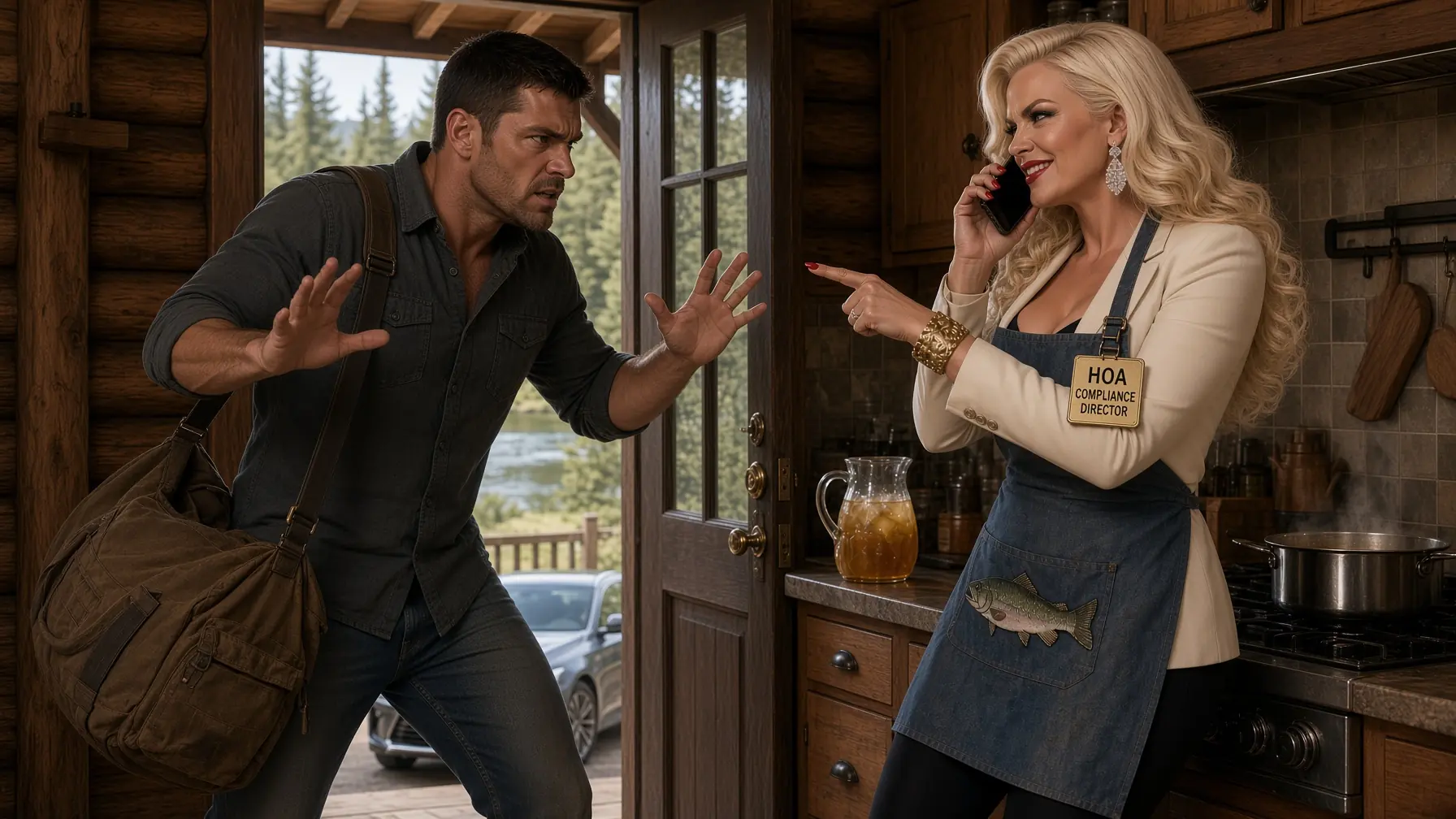
A blonde woman stood at the stove stirring something in a cast-iron pot. She appeared to be in her early forties, with expensive black leggings, a cream blouse, and hair arranged too carefully for someone who had supposedly spent the day maintaining a mountain property. Around her waist was Aunt Lila’s denim apron, faded blue with a crooked trout she had embroidered twenty-five years earlier. Seeing that apron on a stranger affected me more than finding the stranger herself.
Aunt Lila had owned Cedar Ridge Lodge before me. She never married, never had children, and treated my younger brother and me as though we were hers whenever our parents were struggling through long winters on the family ranch. After she died from pancreatic cancer, she left the lodge and its surrounding acreage to me because I had spent years helping her maintain it. The apron hanging inside the pantry had remained exactly where she left it because I had never been able to move it.
The woman turned. Her eyes widened, but not with the confusion I expected from someone who had made an honest mistake. Her reaction was too immediate and too polished. She grabbed her phone before I said anything.
“I need law enforcement at Cedar Ridge Lodge,” she said loudly as she stepped away from me. Her voice rose into panic almost theatrically when she added, “There’s an unknown man inside the residence, and I don’t know whether he’s armed.” I stared at her, unable to decide whether I was more angry that she was calling police from my kitchen or that she was using my aunt’s apron while doing it.
“Who are you?” I asked. The woman lifted one finger toward me as though training a dog and said, “Do not come closer.” Then she told the dispatcher she was Madeleine Pierce, acting compliance director for the Cedar Ridge Community Association, and that she had been conducting a lawful property inspection when an intruder entered.
I almost thought wildfire exhaustion had finally damaged my hearing. Cedar Ridge had once possessed a tiny homeowners association created when several lake parcels were divided in the late 1980s, but it had effectively collapsed after years of disputes over road maintenance and dues. The corporation had been administratively dissolved long before Aunt Lila died. More importantly, our parcel had never granted the association authority to enter the lodge.
“There is no active Cedar Ridge HOA,” I said. Madeleine gave me a pitying smile and told the dispatcher, “He’s becoming argumentative.” I looked around my own kitchen, at my grandmother’s glass pitcher filled with iced tea and Aunt Lila’s apron around Madeleine’s waist, and understood something important. This woman was not lost.
She had prepared for me.
I backed toward the front room and deliberately kept my hands visible. Years on wildfire crews had taught me what panic did to groups of people, especially when everyone believed someone else might make the dangerous decision first. “My name is Colt Henderson,” I said evenly. “I own this lodge, and the deed is recorded with Fremont County.”
Madeleine smiled again. “You can explain your version to law enforcement.”
“My version?”
“You abandoned the property.”
I stared.
She continued, “The community association has been maintaining it because you disappeared.”
“I was working.”
“That isn’t my concern.”
“My utilities are paid.”
“You were absent.”
“So now absence means you can move into someone’s house?”
Madeleine’s expression hardened for the first time.
“I did not move in.”
I looked at the simmering pot.
She glanced toward it.
“This is part of property care.”
That almost made me laugh.
A siren sounded somewhere below the ridge.
Madeleine’s confidence returned.
She walked onto the porch and waited beside the swing Aunt Lila used to sit on every evening with a cup of tea.
I followed only as far as the doorway.
A county sheriff’s cruiser appeared around the last turn three minutes later.
Sheriff Luke Ramirez stepped out.
I had known Luke since high school.
We were never close friends, but we had played baseball together and worked opposite ends of county emergencies enough times that he recognized my truck before he recognized me.
“Colt?”
Madeleine reached him first.
“Sheriff, thank God.”
Luke looked at her.
She pressed one hand to her chest.
“He entered without permission and became aggressive when I asked him to leave.”
Luke looked toward me.
I spread my hands.
“This is my lodge.”
“I know it was your aunt’s place.”
“It’s mine now.”
Madeleine interrupted.
“That ownership is under review because of abandonment and association assessments.”
Luke frowned.
“What association?”
“The Cedar Ridge Community Association.”
His expression changed.
“I thought that dissolved.”
Madeleine immediately removed a folder from a leather bag resting beside the porch.
“We reorganized.”
She handed him papers.
Letterhead.
Meeting minutes.
Assessment schedules.
A laminated badge bearing her photograph.
Everything looked official from several feet away.
Luke flipped through the pages while Madeleine explained that residents had reinstated community governance after property conditions deteriorated around the lake. She claimed my parcel had accumulated unpaid assessments and maintenance violations, allowing the association to enter for emergency preservation. The more she spoke, the more obvious it became that she had practiced every sentence.
I walked toward my truck.
Luke’s head lifted.
“Colt, just stay where I can see you for a minute.”
I stopped.
“I’m getting the deed.”
“That’s fine.”
Madeleine said, “Sheriff, he has already demonstrated hostility.”
I turned.
“By coming home?”
Luke raised his hand.
“Everybody stop.”
His tone ended the argument.
I retrieved a folder from the glove compartment containing a copy of my recorded deed, insurance information, utility statements, and Aunt Lila’s probate documents because remote property ownership teaches you to keep paper near the vehicle. I handed them to Luke. He compared the parcel number with Madeleine’s documents.
His brow tightened.
“Ms. Pierce, your paperwork references Cedar Ridge Community Association Incorporated.”
“Yes.”
“The old organization was Cedar Ridge Lake Homeowners Association.”
“We modernized the name.”
“When?”
“Last year.”
Luke removed his phone.
“I’m going to call dispatch and have them verify filings.”
Madeleine’s mouth tightened.
“That could take hours.”
“It won’t.”
She stepped closer.
“Sheriff, meanwhile you have an unknown man who entered an occupied residence while I was inside.”
Luke looked at me.
I said, “An occupied residence she has no right to occupy.”
Madeleine snapped, “You don’t know what rights I have.”
“You’re wearing my aunt’s apron.”
That shut her up for half a second.
Luke walked away to use his radio.
I remained beside the truck.
Madeleine returned to the porch.
She folded her arms.
Then she smiled.
“You should have sold when you had the chance.”
The words were quiet enough that Luke could not hear.
I looked at her.
“What?”
She changed instantly.
“Nothing.”
“No, say it again.”
She shrugged.
“You heard me.”
I stared at her.
That was the first moment I understood the lodge itself might not be the real target.
Luke returned several minutes later.
His expression had changed.
“County records show the original Cedar Ridge Lake Homeowners Association was administratively dissolved in 2017.”
Madeleine answered immediately.
“We’re a successor organization.”
“There’s no successor filing.”
“Our attorney submitted it.”
“When?”
“Recently.”
Luke looked at the folder.
“These meeting minutes are dated March.”
“Yes.”
“And you’ve been collecting assessments since April?”
“Yes.”
“So where are the filings?”
Madeleine hesitated.
“Administrative delay.”
Luke gave her a long look.
Then he turned to me.
“Colt, I’m not treating you as a trespasser based on this.”
My shoulders loosened.
Madeleine stepped forward.
“Sheriff—”
He raised one hand.
“I’m not done.”
He looked at me again.
“I also don’t want either of you escalating this while I figure out how she got access.”
I nodded.
Madeleine protested.
Luke ignored her.
“Do you have a key?” he asked me.
“Yes.”
“Did you give her one?”
“No.”
“Any property manager?”
“No.”
“Realtor?”
“No.”
Luke turned toward Madeleine.
“How did you get inside?”
She looked annoyed by the question.
“The association secured the structure after repeated maintenance concerns.”
“How?”
“A locksmith.”
“Who authorized the locksmith?”
“The board.”
“What board?”
Her jaw clenched.
“The community board.”
Luke looked toward me.
I could see his skepticism growing.
Still, he was standing between two people making competing claims, and one had been occupying the building before the other arrived.
That complicated the immediate problem.
Luke said, “Nobody is being arrested right now.”
Madeleine looked outraged.
“Sheriff!”
He ignored her.
“Colt, I need you not to go back inside while I make calls.”
I stared at him.
“For how long?”
“Give me tonight.”
“This is my house.”
“I understand.”
“No, Luke.”
I pointed toward the lodge.
“She broke into my home.”
“I don’t know that yet.”
“The deed is in your hand.”
“Ownership and unlawful entry are different questions.”
He was right.
I hated that.
If Madeleine had hired a locksmith after presenting fraudulent documents, proving exactly what happened required more than my anger.
I also knew that forcing my way past her now could create an incident that helped her.
I looked toward the bunkhouse on the southern part of the property.
It sat almost half a mile away.
“My uncle’s bunkhouse is outside the lodge parcel.”
Luke nodded.
“You can stay there.”
Madeleine said, “He shouldn’t remain anywhere near me.”
Luke looked at her.
“The bunkhouse is on his property.”
“I fear retaliation.”
“You met him twenty minutes ago.”
“He threatened me.”
My head snapped toward her.
“When?”
“You said I would regret this.”
“I never said that.”
Her face remained perfectly calm.
Luke looked between us.
That was when I understood her strategy.
Facts did not have to be immediately believed.
They only had to create enough procedural uncertainty to slow everything down.
She wanted time.
I picked up my duffel.
“I’ll use the bunkhouse.”
Madeleine smiled.
I looked at Luke.
“Document everything.”
His expression said he understood exactly what I meant.
“I will.”
I drove down the secondary track while daylight disappeared behind the western ridge.
From the bunkhouse, Cedar Ridge Lodge remained visible through the trees.
Every room lit up after dark.
Madeleine walked through my home switching on lamps as if she were staging a listing.
I stood by the window watching someone else occupy my memories.
The anger was physical.
I wanted to drive back.
Remove her.
Call every neighbor.
Do something.
Instead, I called Erin Walsh.
Erin had been my attorney since Aunt Lila’s estate transferred the lodge to me.
She practiced property and land-use law in Lander, had the patience of a surgeon, and disliked drama because drama produced expensive mistakes.
She answered with, “You better not be calling from Arizona.”
“I’m home.”
“That sounded ominous.”
“There’s a woman living in my lodge.”
Silence.
Then, “Start again.”
I told her everything.
The fake association.
The locksmith.
The sheriff.
The paperwork.
The quiet comment about selling.
Erin asked questions until the story stopped sounding emotional and started sounding useful.
“Did she show a deed?”
“No.”
“Lease?”
“No.”
“Court order?”
“No.”
“Recorded lien?”
“I don’t know.”
“Did Ramirez remove you?”
“No.”
“Did he tell you that you legally couldn’t enter?”
“He asked me to stay away tonight to avoid a confrontation.”
“Good distinction.”
I stared toward the lodge.
“It doesn’t feel good.”
“Feelings aren’t title records.”
I almost smiled.
Erin continued, “Tomorrow morning I’m pulling every filing connected to your parcel, the dissolved HOA, Madeleine Pierce, and whatever entity she claims to represent.”
“Can we remove her?”
“If she has no lawful possessory interest, yes, but we do it correctly.”
“She changed the locks.”
“That may support trespass or criminal entry depending on what she represented to the locksmith.”
I heard typing.
“Do not break your own door tonight.”
“That sentence feels insulting.”
“It’s meant to.”
I leaned against the wall.
“She said I should’ve sold when I had the chance.”
Erin stopped typing.
“To whom?”
“She didn’t say.”
“Interesting.”
“What?”
“People rarely manufacture fake HOA paperwork because they’re passionate about community landscaping.”
That was Erin.
Understatement with teeth.
She told me to photograph the lodge from places I could lawfully occupy, preserve all messages related to the property, and avoid direct contact with Madeleine.
Then she asked whether I still had the trail cameras from wildfire field work.
I did.
“Use them only on your property and avoid windows or areas where someone would reasonably expect privacy.”
“Driveway?”
“Yes.”
“Exterior doors?”
“Yes.”
“Trail to the lake?”
“Yes.”
“Inside?”
“Absolutely not until possession is resolved.”
I respected Erin because she prevented me from converting useful evidence into a legal problem.
By eleven, I had installed three cameras.
One covered the driveway.
One faced the detached equipment shed.
The third monitored the lakeside trail from a tree on the bunkhouse parcel.
They recorded motion with timestamps and uploaded footage to a secure account.
Then I sat beneath the single light inside the bunkhouse and waited.
At 2:13 in the morning, the driveway camera alerted.
A black pickup appeared without headlights until the final turn.
A tall man stepped out.
He wore khaki pants and a collared shirt beneath a dark jacket.
Madeleine opened the lodge door before he knocked.
They spoke on the porch.
No audio.
The man handed her a thick envelope.
Madeleine opened it beneath the porch light.
I zoomed as much as the camera allowed.
The top page appeared to be a map.
The man pointed toward the lake.
Then toward the western boundary of my land.
They talked for thirteen minutes.
Before leaving, he turned toward the ridge.
Even at a distance, there was something familiar about the posture.
Not personally familiar.
Professionally.
A man accustomed to giving instructions.
I saved the footage.
At sunrise, I drove into town.
Tommy Jessup’s feed store opened before almost anything except the diner.
Tommy was seventy-one, shaped like a fence post, and had spent most of his life knowing things the rest of Cedar Ridge learned three days later.
He saw me park.
“Well, look what smoke dragged in.”
I climbed onto the porch.
“You know Madeleine Pierce?”
Tommy stopped smiling.
“Unfortunately.”
That answered enough.
“What’s she been telling people?”
Tommy leaned against the railing.
“That you left.”
“I work seasonally.”
“I know.”
“She know that?”
“She knows whatever version helps.”
My stomach tightened.
Tommy continued.
“She started showing up in June saying she represented some revived neighborhood association.”
“Anyone believe her?”
“Newer owners.”
“Old ones?”
“We laughed.”
“So why didn’t anyone call me?”
Tommy looked embarrassed.
“Thought somebody else had.”
Of course.
Community failure often begins with everyone assuming responsibility belongs to the next person.
Tommy said Madeleine had organized meetings at the diner, issued voluntary “community assessments,” mailed nuisance notices, and claimed she could coordinate maintenance on properties whose owners spent long periods away.
Some people paid her.
Not large amounts.
Two hundred dollars.
Three hundred.