The stage came in off the Laramie road an hour behind time, and the woman who stepped down from it wore a traveling coat cut for a city block. Gray wool, brushed clean, the wrong weight entirely for the last week of October in Wyoming Territory. She had a carpet bag in one hand and a long flat case in the other. The case wrapped in oilcloth and tied twice with a leather strap. And when the driver reached for it, she moved it to her far side and kept walking.
Royal Pike stood on the boardwalk outside the feed store and watched her cross the street the way men watch weather. They do not expect to amount to anything. "Somebody ought to wire Philadelphia," he said, loud enough to carry. "Tell them their girl got down at the wrong stop. " Two men laughed. A third looked at his boots.
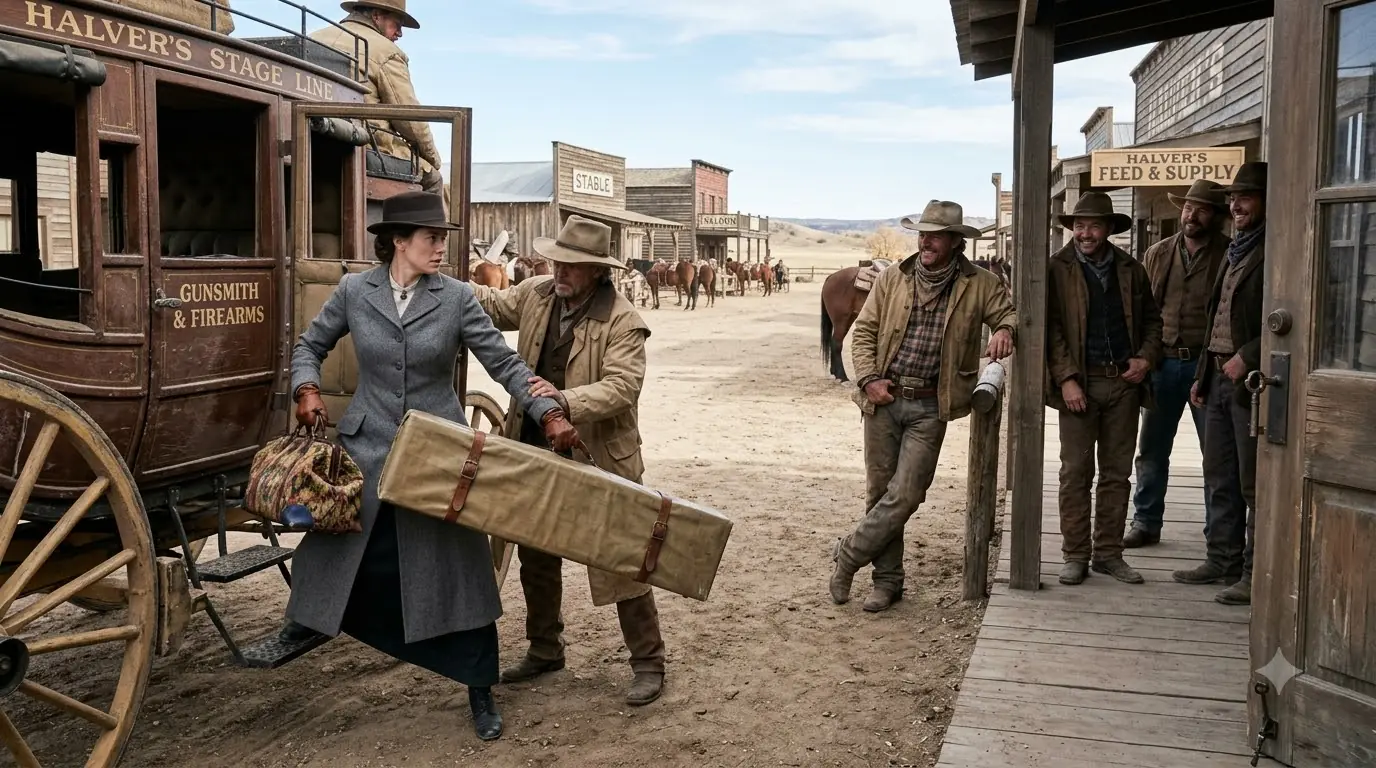
The woman did not turn her head. She went up the steps of the shop on Cearin Street, where the padlock still hung on the door, and worked a key out of her glove. And Pike said the rest of it to her back, the part the town would be repeating by supper. "Fragile city girl," he said, "she will be gone before the first hard freeze. " What Royal Pike did not know was that the case under the oilcloth held a heavy-barreled target rifle, sighted in by the woman carrying it, and that she had been putting 10 shots inside a 4-in circle at 200 yd since she was 11 years old. Her name was Cordelia Vance, and the shop had belonged to her brother.
Peter had come out in '82 and bought the building and the tools off a man named Hollis, who wanted to go back to Ohio. And he had built the trade up from nothing much into something steady. Steady enough that the freight company sent him their guards' carbines twice a year, and the outfits sent their broken hammers and cracked wrists and worn extractors all through the winter. He died in March. Pneumonia took him in 3 days, and the letter took 5 weeks to reach Philadelphia, so that by the time Cordelia read it, the ground over him had thawed once and frozen again.
He had left $340 owing to a bank in Cheyenne and a shop full of other men's guns. She sold the house on Callow Hill Street to settle what could be settled, put the rest of her life into two bags, and came out to finish the thing properly because that was what you did for your own. She had been raised in the back room of her father's shop. Josiah Vance made his living on Callow Hill Street for 31 years, and from the time Cordelia was tall enough to see over the bench, she had been in it with him, sweeping first, then the ledger, then cutting patch paper and casting bullets, and weighing charges to the half grain, then proofing barrels behind the shed with a double load and a string tied to the trigger, and at last sighting in rifles for customer who came in and spoke past her to her father as though the barrel had come off the rack already true. She could load a cartridge that would hold the tin ring before she could sit a horse.
She did not tell people this. Her father had never advertised it either, and the two of them had understood each other on the subject for years without once discussing it aloud. She spent her first week putting the shop right. 4 months of dust and mouse leavings went out the back door. She sorted the racks, matched every gun in the building to a name in Peter's book, and wrote to each owner to say the work would be finished or the gun returned, whichever they preferred.
She oiled the vice. She set her father's loading bench along the north wall where the light came in even all day. The powder scale, the molds, the lubricator, the little brass dipper worn bright at the lip from 30 years of thumbs. Her own book of loads went on the shelf above it, the pages soft at the corners. She hung the flat case on two pegs behind the counter and left it wrapped.
On the Thursday, a boy of about nine came in holding a single barrel shotgun that would not [ __ ] and stood there working up to asking. And she took it from him and had the plate off and the broken mainspring out in the time it took him to decide. She had another spring in Peter's drawer that wanted only a little filing. She fitted it, put the gun back together, snapped it twice, and handed it over. "What do I owe? " he said.
"Sweep the front step," she said. He swept it very thoroughly and told his mother, and that was the first work the shop did under her hands. The rest of the town took longer. The first man came in on Monday with a Sharps under his arm, took his hat off, looked past her at the empty bench, and asked when the smith would be back. "I am the smith," she said.
He looked at her a good while. Then he put his hat on and took his rifle out into the street. And she heard him say something out there that made another man laugh. It went that way for most of two weeks. Some left the gun and came back surprised.
Most did not leave the gun. One who did was a man named Ferris with a shotgun whose wrist had cracked clean through and which Peter had taken in before he took sick. Cordelia cut a new section, pinned it, and finished the wood so that you had to hold it up to the window to find the joint at all. Ferris paid her, looked it over on the walk outside, and told three men in the Elkhorn that evening that Peter Vance must have had the wrist done before he died because no woman alive put that finish on walnut. It came back to her inside a day.
She thought about pulling the work order with the date on it and showing it around town. And then she went out back and split kindling until she no longer wanted to. And in the morning, she opened the shop at 7:00 the way she always did. At the mercantile, Naomi Burn had a great deal to say about a woman living alone over a shop and about city hands and about how a person could tell just by looking at the cut of a coat what a person was accustomed to. And the women listening did not disagree with her out loud.
Emmett Dorn came in on the 8th of November with his hat in his hands and his eyes anywhere but on her face. Dorn had the freight agency and the contract for the guards' carbines, 22 of them, twice a year, and it had been the steadiest money the shop had. "No reflection on you, ma'am," he said. He said the company was particular about who proofed a barrel. He said there was liability in it.
He said the words came down from Cheyenne and not from him. And some of that was even true. Cordelia thanked him for coming to tell her in person instead of writing it. He stood a moment longer, then left. And she heard him stop on the walk outside and blow his breath out hard before he went on.
Royal Pike came in on a Saturday because it entertained him. He rode for the Ordway Cattle Company, and he had killed a man in Ogallala and another one somewhere in the Nations. And the territory had decided some years back that this made him worth listening to. He took a customer's Winchester off the rack without asking, worked the action twice, and set it down harder than he needed to. "Pretty shop," he said, looking around at the swept floor and the sorted racks and the neat rows of Peter's tools.
"Real pretty. " Then he leaned on the counter and said that a barrel was not a hat and that a woman could no more true a barrel than she could shoe a horse or read a brand at 400 yards. And that he said this without meaning any harm by it. Cordelia asked if he had brought anything in that needed work. He had not. "Then I will bid you good day," she said, and went back to the bench.
And it was the not arguing that did it. He stood there a moment with nowhere to put what he had come in carrying, and then he went out and told it in the saloon as a story where he had come off better. Wade Cullen came in the next Thursday. He ran 400 head east of the crossing, and he had been widowed 6 years, and his boy Silas, who was 10, came in behind him and stopped just inside the door the way children do when a room smells interesting. Cullen put a Winchester on the counter and said it would not throw an empty.