There are farmers who switch equipment brands because they are angry, embarrassed, or determined to prove a point to somebody watching from the next field over. Jake Bergman was never that kind of farmer, because after taking over 3,400 acres of corn and soybeans in Cuming County, Nebraska, he had learned that pride did not pay a fuel bill, finish harvest before rain, or get a broken machine moving again. He trusted numbers, maintenance records, weather forecasts, and the quiet evidence that accumulated after thousands of hours behind a steering wheel. That was why the machine that eventually changed Bergman Farms was one Jake had never intended to keep.
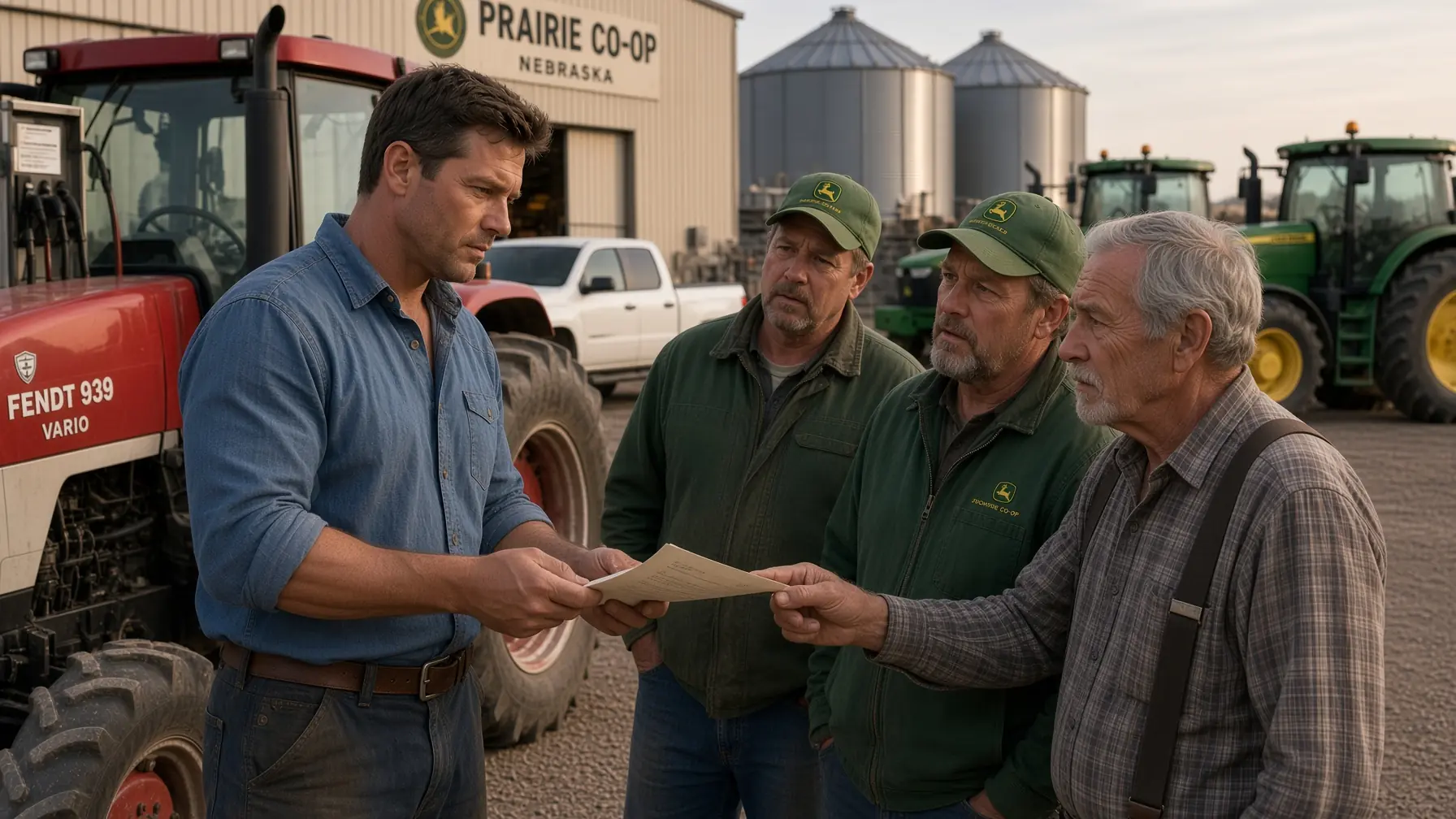
For most of his adult life, green equipment had been as permanent on the Bergman place as the grain bins behind the shop. His father had bought Deere equipment through the same local dealership for decades, and by the time Jake took over the farm in 2011, loyalty to the brand felt less like a purchasing decision and more like one of the unwritten rules attached to the land. Two large Deere tractors handled the heaviest work, another tractor covered lighter jobs, two S-series combines carried harvest, and nearly every machine had been financed or serviced through people Jake knew by name. Nobody had ever sat him down and ordered him to stay with Deere because nobody needed to.
The dealership knew his family, his father knew theirs, and that relationship meant something in a place where a handshake could carry a history longer than many contracts. Jake remembered standing beside his father as a boy while men discussed transmissions, crop prices, rainfall, and machinery problems with a patience people seemed to have lost everywhere else. When Jake became the one signing purchase agreements, he liked knowing exactly who would answer if he called Dinkel Implement in West Point. Predictability might have been expensive, but on a farm where one badly timed breakdown could ruin weeks of work, predictable felt safe.
Jake was not a man who disliked his equipment simply because another machine was newer. His tractors started every spring, pulled his implements through heavy Nebraska soil, and rarely gave him reasons to complain beyond the ordinary frustrations that came with operating machinery for long hours. The combines brought thousands of acres of corn and soybeans out of the fields every fall, and the service department usually found the parts he needed even when that meant waiting several days. He had built an entire operating rhythm around what those machines could do, what they consumed, how they failed, and how long repairs usually took.
Then one February morning in 2023, an accountant’s report put a number in front of him that made the familiar suddenly look different. Total diesel consumption for the previous year had reached 24,600 gallons, and at an average cost of roughly $4.20 per gallon, Jake had spent more than $103,000 just feeding engines. He had known fuel was expensive because he watched the delivery truck arrive and signed the invoices, but knowing something in pieces was different from seeing a six-figure number printed at the bottom of one page. Jake sat at the kitchen table longer than he intended, staring at the report while morning light moved across the paperwork.
He opened his laptop and started doing what he always did when something bothered him: he broke the problem into parts. He compared runtime, fuel consumption, acreage, workload, maintenance history, and the amount of diesel swallowed by his two largest tractors during heavy field operations. The numbers were not accusing Deere of anything because fuel consumption alone did not make a machine bad, but they were asking a question Jake had avoided for years. If another tractor could do the same work with meaningfully less fuel, how much was brand familiarity actually costing him?
That search led him into equipment forums he normally ignored. Farmers from Iowa, Germany, Minnesota, and other places were comparing machines under real loads, and several discussions mentioned Fendt tractors using noticeably less fuel than comparable Deere models. Jake had heard the name before, knew Fendt was German and part of AGCO, and vaguely understood that the Vario transmission was central to the brand’s reputation. What he did not know was whether any of those claims would survive Nebraska soil, Nebraska weather, and the way he actually worked.
He found several reports claiming fuel reductions substantial enough to make him uncomfortable. A few percentage points would not have mattered because operators, implements, field conditions, and measurement methods could easily distort small differences, but the reported gaps were closer to the high teens in some comparisons. Jake knew enough not to treat forum posts like controlled research, yet he also knew when a pattern deserved further investigation. By the time he closed the computer that evening, he had the name of the nearest Fendt dealer and a list of questions long enough to annoy any salesperson who relied mostly on brochures.
Titan Machinery in Norfolk sat about thirty-five miles away. Jake had passed the dealership countless times without stopping because there had never been a reason to turn into the lot, but on March 8 he finally called and asked for someone who could show him actual fuel logs instead of repeating advertising claims. A sales manager named Ron Decker answered, listened to Jake describe his current fleet, and never once tried to interrupt him with a pitch. “Come look at the demo records,” Ron said, and that answer got Jake into his truck that afternoon.
The dealership lot felt wrong at first because Jake’s eyes were trained to recognize a different landscape. Massey Ferguson machines sat beside Fendt equipment, red and white replacing the green and yellow he had seen around farm dealerships for most of his life. Ron met him near the service entrance and walked directly to a Fendt 939 Vario instead of wasting fifteen minutes asking what it would take to earn his business. Jake appreciated that more than he admitted.
The tractor itself did not look revolutionary. It had the cab, tires, hydraulic connections, three-point hitch, and heavy build of a machine designed to spend its life pulling expensive steel through resistant ground. What made it different was less obvious from the outside because the Vario continuously variable transmission was designed to adjust speed and load without the stepped feel Jake had grown accustomed to. Ron opened a tablet and showed him actual operating logs from demo and customer machines.
One set of records showed fuel use under heavy tillage that was meaningfully below what Jake was accustomed to seeing from his own tractor logs. Ron converted the difference into annual gallons and then dollars because salesmen understood farmers usually stopped listening to percentages once somebody translated them into money. The estimate suggested savings large enough that one tractor could potentially reduce Jake’s annual fuel expense by thousands of dollars, and two could make the number much harder to ignore. Jake walked around the 939 again and asked the question that mattered more than the fuel economy.
“What happens when it breaks?” he asked. Ron did not pretend it never would, which gave his answer more credibility. He explained the support package available with the tractor and described how certain warranty programs and dealer support arrangements were intended to keep customers operating when repairs could not be completed quickly. Jake immediately remembered the hydraulic failure on one of his Deere tractors the year before, when he had waited nine days for parts and lost forty-seven hours during planting season.
That breakdown had ended without disaster only because Jake had absorbed the lost time personally. He ran sixteen-hour days after the repair, stayed in the cab until his shoulders cramped, slept for a few hours, and went back out before sunrise because rain was approaching. He finished the field before the weather changed, and everyone looking from the road probably assumed the season had gone normally. Agriculture was full of crises that disappeared from view once a farmer worked hard enough to hide them.
Ron showed him a configured price near $287,000 and estimated Jake’s trade value around $195,000. The roughly $92,000 difference was more money than Jake wanted to spend on curiosity, even if projected fuel savings made the long-term calculation interesting. He told Ron exactly that. Ron answered, “Then don’t buy it because I say it works.”
Jake looked at him. Ron reached into his pocket, pulled out the demo key, and said, “Take it home for a week.” There were no speeches about German engineering or revolutionary technology because Ron understood the machine would have to survive something more convincing than a sales presentation. Jake took the key.
That afternoon, the Fendt 939 traveled thirty-five miles from Norfolk to Bergman Farms and stopped beside a sixteen-shank chisel plow waiting near one of Jake’s heavier fields. The ground carried old residue and areas of compaction that made a useful test because almost any tractor could look good running light work across forgiving soil. Jake connected the implement, climbed into a cab that still smelled unfamiliar, and spent several minutes learning controls before moving into the field. Then he lowered the plow and pushed the tractor hard enough to expose whatever weaknesses the brochure had hidden.
The first thing he noticed was not fuel economy. It was the absence of hesitation. The tractor adjusted continuously as soil resistance changed, and instead of feeling the machine search for the right response, Jake felt power arrive in a smoother stream than he was used to. He spent the first hour listening for something wrong because unfamiliar smoothness can feel suspicious when you have spent years expecting certain mechanical behaviors.
After three hours, suspicion became concentration. After six, concentration became curiosity. Jake worked until nine that night and watched the tractor’s fuel display more obsessively than he watched some crop reports. When he shut it down after eight hours, the number staring back at him was close to what Ron had promised and significantly below the comparison from his own prior work with the Deere.
Jake climbed down with cold air hitting the sweat at the back of his neck. He pulled out his phone, opened old field records, and compared conditions, implement use, and consumption from the previous spring. The comparison was not a laboratory test, and he knew better than to pretend it was, but it was close enough to make the result impossible to dismiss. He called Ron before walking back to the house.
“I want it,” Jake said. Ron laughed once and asked whether he was sure. Jake answered that he had spent eight hours trying to make the tractor disappoint him and instead ended the day wanting to keep running it. Five days later, the paperwork was signed.
The old Deere left on trade, and the Fendt 939 became the first non-green high-horsepower tractor Jake had ever owned. He did not sell everything else, post photographs online, or announce that fifty years of family equipment loyalty had ended because one afternoon had not earned that conclusion. One Fendt could be a mistake, one good week could be luck, and one favorable fuel number could disappear over an entire season. Jake gave himself two years.
Spring planting began before Nebraska had fully decided whether winter was finished. Jake ran the 939 across field after field, recording fuel use, speed, hydraulic response, operator fatigue, and small maintenance issues with the same discipline he brought to financial records. By the end of the first intensive month, the Fendt continued averaging less fuel than the Deere he kept for comparison. The gap did not vanish.
Cab comfort began mattering after the first hundred hours. Farmers liked joking about features that made tractors feel luxurious, but Jake understood how much fatigue affected judgment when a person spent fourteen or sixteen hours operating heavy equipment. The Fendt’s controls became intuitive faster than he expected, and the transmission allowed speed changes through wet or uneven areas without disrupting the rhythm of the machine. At the end of long days, Jake climbed down feeling less battered.
His neighbor Carl Hoffman noticed the tractor before Jake mentioned it. Carl farmed more than four thousand acres two miles west and had spent most of his adult life running Deere equipment, which meant he looked at the Fendt the way a loyal sports fan might examine somebody wearing the wrong jersey in his living room. One evening he stopped at Jake’s shop, walked slowly around the tractor, and asked, “German?” Jake said yes.
Carl asked whether Jake had heard how expensive European parts could be. Jake said he had. Carl asked whether resale value worried him, and Jake admitted it did. Then Carl asked why he bought the thing anyway.
“Fuel,” Jake answered. Carl folded his arms. Jake told him what his logs were showing, and Carl nodded without looking convinced.
“Give it time,” Carl said. Jake smiled because that was exactly what he intended to do. He was not selling an idea. He was running a test.
May gave him more evidence. Jake hooked the Fendt to his planter and worked through acreage he had crossed many times before, slowing through wet spots and accelerating when the ground firmed without the mechanical pause he expected from his older machine. The differences were not dramatic enough to impress somebody watching from the road. They were the kind an operator felt after hundreds of repeated movements.
That was when Jake began understanding why equipment arguments could become irrational. A tractor was not merely a list of specifications because a farmer learned its sounds, responses, weaknesses, controls, repair history, and the subtle warnings that appeared before something failed. Switching brands meant throwing away part of that familiarity and admitting the machine you had defended for years might not be the best answer anymore. Numbers could make that admission logical without making it comfortable.
In June, Jake stopped at the co-op and ran into Tom Dinkel. Their families’ relationship stretched back roughly half a century, and Tom had sold or serviced equipment for the Bergmans through enough seasons that the conversation should have felt ordinary. Instead, Tom opened with, “Heard you bought a Fendt.” Jake could hear the judgment beneath the question.
“Just one,” Jake said. Tom asked how it was running. Jake answered honestly that the fuel economy had been better than his Deere in the work he had tracked.
Tom crossed his arms and reminded him that Fendt resale values in the area might not match Deere, that imported parts could cost more, and that local familiarity mattered when repairs arrived. Those were legitimate concerns, and Jake did not argue because pretending disadvantages did not exist would make him as irrational as someone refusing to consider advantages. Still, something in Tom’s tone bothered him. The conversation sounded less like a dealer advising a customer and more like a man asking why loyalty had been violated.
“I’m not planning to sell it,” Jake said. “I’m planning to run it.” Tom answered that Jake would understand when a difficult repair arrived.
Jake drove home without anger. Tom had known his father, serviced the farm for years, and had every reason to believe the relationship would continue. Still, while Jake crossed the familiar county roads, one thought stayed with him. A relationship that depended on never comparing alternatives was not as secure as he had believed.
By midsummer, the Fendt had passed five hundred hours without a meaningful failure. Routine oil and filter service cost less than Jake expected, and when he compared the period against his historical maintenance records, the difference favored the new tractor again. He opened his accounting software one July afternoon and created a spreadsheet containing fuel, service, downtime, financing cost, and projected ownership expense. The file became more important to him than any equipment brochure.
Jake was not trying to prove that every Fendt was better than every Deere. He was answering a narrower question: whether this specific machine, performing his specific work on his farm, made economic sense compared with what it replaced. That distinction protected him from falling in love with the new brand simply because he liked being surprised. Farmers could make expensive mistakes when enthusiasm became evidence.
The spreadsheet kept favoring the Fendt. Fuel savings remained substantial, routine maintenance remained lower through that period, and the machine had not created the downtime Tom warned him about. Jake projected two years, then five. The longer horizon made the purchase look less like an indulgence.
Still, he kept the second Deere tractor. He kept both Deere combines. The farm remained mostly green because Jake believed a trial should earn expansion.
By August, the 939 had accumulated hundreds more hours. Carl stopped again and asked whether it had broken yet. Jake told him it had not.
“Keeping the Deere?” Carl asked. Jake said yes. Carl nodded approvingly until Jake added, “For now.”
Carl stared at him. “You thinking about another Fendt?” Jake shrugged and said he would decide after seeing how the first one handled more work.
“Deere is the standard for a reason,” Carl said. Jake asked what reason. Carl answered, “Because everybody runs them.”
Jake looked across the yard at decades of equipment decisions embodied in steel. “That isn’t a reason,” he said. “That’s inertia.”
Carl left without arguing. Jake watched his pickup disappear down the gravel road and wondered whether he had just described his own farm for the previous twelve years.
The real turning point arrived on September 4, 2023. It had nothing to do with the Fendt tractor. Jake was harvesting soybeans with his Deere S780 when the header drive gearbox failed in the middle of a 240-acre field, stopping the machine abruptly while alarms filled the cab.
Jake killed the system and climbed down. Gear oil had spread where it should not have been, and metal fragments told him the failure was beyond anything he could fix beside the field. He had nearly 2,900 acres of soybeans remaining and a forecast showing rain approaching in four days. Suddenly every comfortable assumption attached to the color green became secondary to one question.
How fast could he get moving again?
He called Dinkel Implement immediately. The dispatcher said the earliest technician would be the following morning because harvest had put every service truck on the road. Jake pushed but got the same answer.
The technician arrived shortly after eight the next morning, opened the damaged assembly, and confirmed what Jake already feared. The gearbox needed complete replacement. Parts could take several days, possibly longer.
Jake stared at him. “I have rain coming.” The technician said he understood.
“I have twenty-nine hundred acres.” The technician said he understood that too.
Jake wanted to ask why understanding never seemed to change the answer. Instead, he called Tom Dinkel directly.
“I need you to expedite this,” Jake said. “Whatever shipping costs, I’ll pay them.” Tom told him the limitation was not shipping alone because the part had to move through Deere’s supply chain.
“Call somebody,” Jake said. Tom replied that he already had.
Jake stood beside a combine worth hundreds of thousands of dollars that had become an expensive stationary object because one critical assembly was unavailable. His second combine could keep moving, but one machine could not comfortably complete the remaining acreage inside the weather window. Every lost hour increased the possibility that soybeans would sit through rain, quality would suffer, field conditions would worsen, and harvest would stretch into the kind of period where one delay multiplied into several.
Tom could not create a gearbox that did not exist. Jake understood that. What hurt was that after decades of purchasing, servicing, financing, and trusting equipment through the same relationship, the only available answer was wait.
Wait until tomorrow. Wait for the warehouse. Wait for shipping.
Wait while weather moved closer.
Jake walked back toward the shop. Halfway there, he remembered Ron Decker explaining support when they discussed the Fendt tractor months earlier.
The situation was not covered the way a Fendt tractor failure might have been because the broken combine was a Deere. Jake knew that. Still, Titan Machinery sold combines, Ron had treated him well, and calling cost nothing.
Ron answered quickly. Jake told him exactly what happened.
“My S780 is dead,” Jake said. “Gearbox is gone, parts are days out, and I have rain coming.” Ron asked how many acres remained.
“Twenty-nine hundred beans.” Silence.
Then Ron said, “You need another combine.” Jake laughed without humor and said that was why he was calling.
Titan had a Fendt Ideal 10 demo unit available. Ron told him the machine was not sitting around waiting specifically for Jake, and there was no contractual obligation to rescue a customer whose competitor’s combine had broken. But Jake had purchased the 939, the dealership had a demo that could be deployed, and Ron was willing to make the machine available as a customer-support decision. “Get up here,” he said.
Jake looked at his watch. Hours earlier, he had been told his primary combine might sit for most of the weather window. Now someone thirty-five miles away was telling him there might be a machine waiting.
He drove to Norfolk faster than he normally allowed himself. The Ideal 10 sat on the lot looking unlike anything Bergman Farms had ever operated at harvest. White panels, red accents, unfamiliar proportions, unfamiliar controls.
Ron walked him through the machine without pretending Jake had time for a sales seminar. He explained the operating system, capacity, adjustments, and the controls Jake needed first. The rest could be learned in the field.
“What does this cost me?” Jake asked. Ron answered that the immediate arrangement was customer support, not a purchase.
Jake stared at him. Ron smiled and said, “Go harvest.”
That afternoon, the Ideal 10 entered the exact field where the S780 had stopped. Jake opened the header, settled into the controls, and started moving.
The first twenty minutes were awkward because habit kept reaching for controls that were no longer where his hands expected them. Then the machine began teaching him its rhythm. By the first hour, Jake was watching crop flow instead of thinking about the cab.
The Ideal handled the beans differently. Through areas of green stem and changing crop density, the machine kept moving with less hesitation than Jake anticipated. The grain sample looked good, losses stayed manageable, and capacity was enough that he found himself increasing ground speed.
Jake did not allow himself to become impressed immediately. A demo machine should look good during a demonstration because everything from maintenance to setup was likely optimized. He spent the afternoon actively looking for the weaknesses he would later regret.
Instead, the acres accumulated. The tank filled, the machine unloaded, and the field disappeared behind him.
At midnight, Jake shut the machine down after one of the longest harvest days he had run that year. His neck ached, his eyes were tired, and the cab lights illuminated dust hanging in the air around the combine. Then he looked at his acreage.
About 340 acres had disappeared beneath the header. It was more than Jake had ever harvested in one comparable day with the S780.
Fuel use appeared better too, although Jake cared less about that number than he would have six months earlier. Fuel savings mattered over years. A machine arriving while weather was closing in mattered that night.
Jake sat in the quiet cab with both hands resting on the steering wheel. He thought about Tom saying the gearbox might take five days. Then he thought about calling Ron that morning and seeing the Ideal on his property that afternoon.
That contrast did not mean Tom had intentionally failed him. Dinkel Implement could not manufacture unavailable parts, and Jake knew enough about supply chains to understand sometimes there truly was no faster answer. What changed was Jake’s understanding of what a dealer relationship could include.
One relationship said, “We’re trying, but you’ll have to wait.” The other said, “Your machine is not even ours, but we have something that can keep you working.” Both statements could be honest. Only one kept beans moving.
Jake ran the Ideal hard for the next several days. He used the Deere S790 beside it, divided fields, coordinated unloading, ate most meals in a cab, and slept less than any reasonable person should. The rain did not care what brand he preferred.
By September 7, the soybean harvest was finished. Every acre that had looked impossible when the S780 failed was out before the weather changed. The Ideal had run without a breakdown through the emergency.
When the Deere replacement parts finally arrived, Jake no longer felt the relief he expected. The S780 could be repaired. The more important problem was that Jake’s idea of what he should expect from equipment support had already changed.
He returned the Ideal to Norfolk. Ron asked how it went. Jake answered with acreage instead of adjectives.
Then he asked, “What would it take to buy that machine?” Ron paused.
“You want the demo?” Jake said yes.
Ron explained the price, estimated the trade value on the Deere after repair, and showed Jake a gap large enough to make the purchase uncomfortable. The Ideal was not cheap. No combine capable of covering thousands of acres was.
Jake went home without signing. He put every relevant number into his spreadsheet.
Fuel economy favored the Fendt, but not enough by itself to justify everything. Maintenance was still uncertain because the machine had not accumulated enough hours under Jake’s ownership. Resale risk remained real.
The calculation that refused to fit neatly into one cell was uptime. What was one day worth when soybeans were ready and rain was four days away? What did five days of delay cost if weather damaged yield or trapped a machine in wet fields?
Jake tried assigning values. The numbers became assumptions piled on assumptions.
Finally he stopped.
Some business risks could not be precisely calculated before they happened. That did not make them worthless. The harvest he had just finished was evidence.
Jake called Ron. “Write it up.” Ron asked whether he was sure.
Jake looked through the shop window at the disabled Deere. “Yeah,” he said. “I’m sure.”
By October, Bergman Farms looked divided down the middle. One Fendt 939 tractor worked beside the remaining Deere tractor, while the new Ideal 10 combine shared space with the Deere S790. From the road, it looked as though two different families had parked equipment in the same yard.
Neighbors noticed. Farmers notice new equipment the way small towns notice unfamiliar cars.
Tom Dinkel noticed too. Jake stopped at Dinkel Implement for filters and supplies one afternoon, and Tom came out of his office before Jake reached the counter.
“You bought the combine,” Tom said. Jake answered yes.
Tom reminded him that the Bergmans had been customers for decades. Jake agreed.
“After everything we’ve done for your family?” Tom asked. That was when the conversation stopped being about equipment.
Jake set the filter box on the counter. “Tom, my combine sat while I had four days before rain.” Tom said they had done everything possible.
“I know.”
“Then what did you expect?”
Jake looked at him. “An alternative.”
Tom laughed sharply. “So you bought a six-hundred-thousand-dollar machine because you were angry about one part delay?”
“No.”
Jake kept his voice calm. “I bought it because another dealer put a working machine in my field the day I needed one.”
Tom crossed his arms. His face hardened in the way people’s faces do when the explanation hurts more than anger would have.
“You don’t value relationships,” Tom said. “You chase whatever looks better today.”
That landed harder than Jake expected.
He had spent money at Dinkel Implement for years. He had referred neighbors, financed equipment, bought parts, scheduled service, accepted delays, and stayed loyal when other brands offered discounts.
“I valued the relationship,” Jake said. “That’s why I kept coming back.”
Tom said nothing.
Jake continued. “But if the relationship means I’m supposed to stay no matter what happens, that isn’t loyalty.”
The shop became quiet.
A parts employee pretended to study a computer screen.
Jake picked up the filters. “That’s habit.”
He left before the argument became personal enough to destroy whatever respect remained.
Outside, he sat in his truck for several minutes. Ending a business relationship connected to his father felt strangely close to disappointing the dead.
Jake’s father had trusted Dinkel Implement. He had trusted Deere.
For years, Jake had inherited both loyalties without questioning whether the conditions that created them still existed. That was not necessarily foolish because inherited knowledge kept farms functioning across generations.
But inherited answers could outlive the questions that made them correct.
Jake drove home.
Corn harvest became the next test. He ran the Fendt Ideal and Deere S790 side by side whenever conditions allowed, collecting the kind of data that mattered more than arguments at parts counters. Both machines harvested crops.
Both had advantages.
Both required maintenance.
The Ideal gradually covered more acres in the same harvest window. Its capacity, fuel use, unloading rhythm, and the way it moved through Jake’s fields gave it an edge he could measure.
Jake did not tell anyone.
He wrote it down.
By the end of corn harvest, Bergman Farms finished faster than the previous season. Two days did not sound life-changing until Jake considered what two harvest days meant when winter weather could arrive without asking permission.
December brought snow and spreadsheets. Jake parked equipment, changed filters, reviewed service records, reconciled farm accounts, and spent evenings comparing a full season of mixed-fleet performance. The results no longer depended on one spring field or one emergency harvest.
The Fendt tractor had delivered meaningful fuel savings and relatively low routine maintenance through its first season on the farm. The Ideal had contributed operational savings too, but its larger value had been the harvest interruption that never became a disaster. Combined, Jake calculated more than eighteen thousand dollars in operating savings for the period he had tracked.
He stared at the spreadsheet. The number was not large enough to make expensive machinery free. Nothing about modern farm equipment worked that way.
What it did was expose another cost Jake had never entered into his accounting software before. Familiarity had a price.
Brand loyalty had a price.
Waiting had a price.
January arrived with frozen ground and enough distance from harvest for decisions to feel less emotional. Jake opened the five-year equipment plan he had written before purchasing the first Fendt. According to that original plan, the remaining Deere tractor and combine had years of useful life left.
He could keep the split fleet. There were arguments for it.
Multiple dealer relationships reduced dependence on one supplier. Familiar Deere equipment retained local resale confidence. Switching everything at once would concentrate new risk in machines Jake had only used for one season.
Jake spent a week arguing with himself.
Then he returned to the reason he had bought the first 939. Test the numbers.
The numbers had answered.
He called Ron.
“I’m thinking about trading the rest.”
Ron went quiet. “Both?”
“The tractor and combine.”
“You sure?”
“No.”
Ron laughed. “That’s encouraging.”
Jake told him he wanted actual trade figures, financing options, service terms, warranty details, likely delivery timing, and written support expectations. Ron gave him what he could immediately and promised the rest after checking inventory. Jake refused to sign until every number was visible.
That was not distrust.
It was the lesson of the entire year.
When the final proposal arrived, Jake went through it line by line. The second Fendt tractor and second Ideal combine represented a massive capital commitment, and no amount of enthusiasm made debt less real.
He called his accountant.
Then his lender.
Then he reopened the spreadsheet.
He stress-tested lower commodity prices, higher interest expense, maintenance surprises, and weaker resale than expected.
The plan still worked within risk Jake was willing to accept.
Jake signed.
When the second Fendt tractor and another Ideal combine arrived in February 2024, people started talking before the transport trailers were gone. In less than a year, Bergman Farms had moved from an entirely Deere fleet to four major Fendt machines.
The transformation looked sudden from the road. Jake knew it had taken hundreds of hours of measurements.
Carl Hoffman drove over that afternoon. He parked beside the shop, climbed out, and stared at the new machinery without saying anything for nearly a minute.
“You actually did it,” he said.
Jake nodded.
“All of it.”
“Yeah.”
Carl walked toward the second tractor. “Everyone’s talking.”
Jake shrugged.
Carl looked inside the cab. “You care?”
“No.”
“You regret it?”
That question made Jake stop.
He thought about the old Deere machines leaving the yard. He thought about his father standing at the dealership decades earlier.
He thought about Tom.
Then he thought about September.
Five days for a gearbox.
Four days before rain.