The mending shop sat at the very edge of Teller’s Creek, where the wagon road narrowed and the town gave way to open scrubland. By day, people came there with torn shirts, saddle straps, quilts, harness leather, feed sacks, and coats patched so many times the cloth seemed more memory than fabric. By evening, the shop grew quiet, and Josephine Calloway would sit on the porch with one small candle burning on the rail beside her. The flame was never bright enough to light the road, but it was steady enough to prove she was still there.
Josephine had been a widow for four years. The town knew that much, and because small towns remember grief even when they do not know what to do with it, they mostly left her alone. Her husband Jesse and their little boy had been taken by fever in the same cruel week, and after that, Josephine had closed her heart as firmly as she closed her shop door each night. She spoke when business required it, stitched what needed mending, and let silence do the rest.
The candle was the one thing she did not explain. In summer, it burned on the porch rail where Jesse used to read stories to their boy by evening light. In winter or rain, she moved it to the east window and watched it from inside until she went to bed. Some women wept loudly, some packed away every reminder, and some remarried before the loneliness could name itself. Josephine simply lit a candle and sat beside what she had lost.
Cooper Hayes first heard her name in Lydia Hale’s general store. He had ridden in from the Aldrin ranch with a saddle strap that had been repaired twice and was coming apart a third time. Lydia looked at it, turned it over in her hands, and said no man at the livery should touch it again unless Cooper wanted to be thrown from his horse by next Wednesday. “Take it to Josephine Calloway,” she said. “East road, past the last storefront. She works leather better than any man in this county.”
Cooper was thirty-six, tall, lean, and used to being measured before he was welcomed. He had ridden races in two counties, done fence work across three more, and slept in more bunkhouses than he cared to count. Men remembered his riding before they remembered his name, and that had begun to feel like a burden. He did not mind work, but he had grown tired of crowds turning a man into a story he had not agreed to tell.
The next morning, he rode to Josephine’s shop. She came to the door in a plain cream blouse and dark skirt, her chestnut hair pinned back with loose strands near her cheeks. She took the strap from him without a smile, studied the cracked stitching, pressed her thumb along the damage, and named a fair price. “Four days,” she said. “If it is not right, you owe me nothing.”
“It will be right,” Cooper said before he thought better of it. Josephine looked at him then, not offended, not pleased, simply aware that he had spoken more than necessary. “Yes,” she said. “It will.” Then she went back inside, and Cooper stood for a moment on her porch beside the empty tin candle holder.
He saw the candle that evening when he rode back toward the ranch. Josephine sat in the chair beside it, her hands folded in her lap, her gaze fixed down the darkening road. She did not look at him, though she must have heard the horse passing. Cooper tipped his hat anyway, not because he expected acknowledgment, but because some things are owed whether anyone receives them or not.
For the next few evenings, he noticed the same thing. The town would be closed, the saloon lamps glowing behind dirty windows, the livery quiet, and still Josephine’s candle burned at the edge of everything. Sometimes she sat outside. Sometimes the light glowed behind the east window. It was not his business, but loneliness has a shape, and Cooper had known enough of it to recognize another person’s from the road.
On the fourth day, he returned for the strap. Josephine brought it out finished, the seam tight and smooth, the leather treated properly, the repair so clean that the old damage looked ashamed of itself. Cooper ran his thumb over the stitching and nodded once. “This is good work.”
Josephine’s eyes rested on him. “I said it would be.” There was no arrogance in it, only fact. Cooper paid her, added a little extra, and watched her push the extra coins back across the counter. “The price was the price,” she said.
That evening, he rode past her shop and slowed. The porch was dark. The candle was not on the rail, and Josephine was not in her chair. From somewhere inside came a low cough, rough enough to make his hand tighten on the reins.
He sat there a moment, caught between respect and concern. Josephine was not a woman who invited help, and Cooper was not a man who pushed his way into a stranger’s house. Still, there are silences a decent person cannot ride past. He turned his horse and rode back toward town.
Lydia was closing the general store when he stepped inside. She looked up from the ledger, saw his face, and shut it without asking a second question. “Josephine?” she asked. Cooper nodded. “Porch is dark. She is coughing hard.”
Lydia reached for her coat. “I will go.” Cooper stepped back from the counter. “Obliged.” He did not ask to come along, and Lydia did not invite him, but when he rode back east later, he saw a lamp moving inside Josephine’s shop. That was enough.
Lydia stayed three days. She came in the mornings, left after dusk, brought broth, medicine, clean cloths, and the quiet competence of a woman who had seen grief and sickness before. On the fourth day, Josephine was back at her workbench, pale but upright, needle in hand as if stitching could command her body to obey. Lydia stood at the door before leaving and said, “A man came to tell me you were sick.”
Josephine did not look up. “Did he?” Lydia’s hand rested on the doorframe. “Cooper Hayes. From the Aldrin place.” Then she left before Josephine could decide whether to answer.
Josephine sat very still after the door closed. She had not expected that. People in town sometimes cared for her in the way people care for a grave, respectfully and from a distance. But Cooper had noticed the dark porch, noticed the cough, and done something without making himself the hero of it.
A week later, he stopped by again, though he had no broken strap in hand. Josephine was in the doorway with a piece of leather she had just finished for a rancher who was trying to bargain down the price. The man was not shouting, but his voice had the steady pressure of someone used to wearing people down. Josephine’s shoulders were straight, but Cooper saw the weariness beneath her control.
“Everything all right, ma’am?” Cooper asked from the road. He did not ask the man. He asked Josephine. That made the rancher turn, look at Cooper’s horse, then at Cooper, and then reconsider the world.
The man counted out the full amount and set it on the porch rail. “No trouble,” he muttered, and walked away. Josephine watched him until he was gone. Then she turned to Cooper, and for the first time, her face softened by the smallest measure.
“Have you eaten?” she asked. Cooper looked at her a moment, surprised by how much the question seemed to hold. “Not yet.” Josephine stepped aside. “Then tie your horse and come in before the biscuits go cold.”
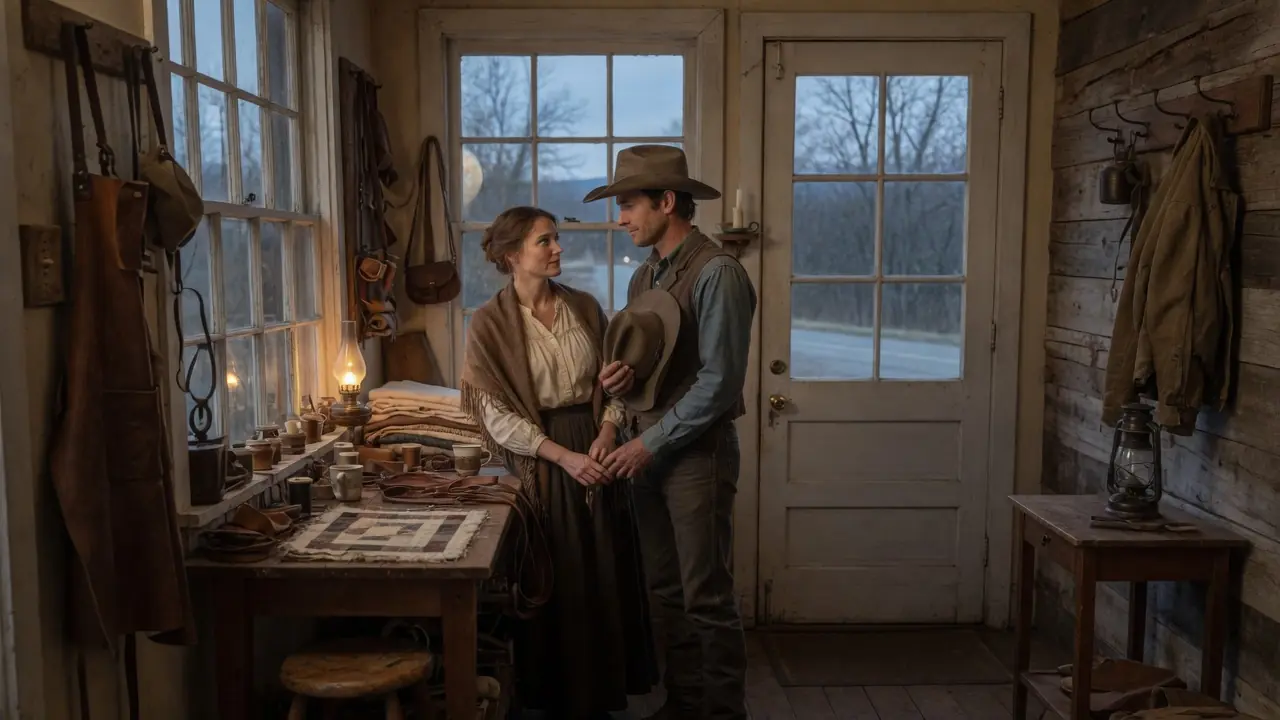
He did as he was told. The kitchen behind the shop was small, plain, and orderly, with a black stove, a scrubbed table, two chairs, and shelves stacked with jars and folded cloth. Josephine moved through the room carefully, not as if entertaining a guest, but as if remembering a habit her body still knew. She put biscuits on a plate, poured coffee, and set a bowl of stew in front of him.
Cooper ate quietly, grateful enough not to make a speech of it. Josephine sat across from him, hands around her cup, and asked about the Aldrin ranch, the broken strap, the road after last rain. He answered what she asked and did not crowd the silence when it came. That, more than the words, made her breathe easier.
After supper, she said, “Lydia told me it was you.” Cooper looked into his cup. “Figured she was the right one to come.” Josephine studied him. “Most men would have come themselves, just to be thanked.”
Cooper turned the cup once between his hands. “A thank-you is not worth much if a man has to chase it.” Josephine looked toward the window where the candle waited in its tin holder. “No,” she said softly. “I suppose it is not.”
He came again the next week with a torn glove, then the week after with a stirrup leather, and after that with nothing more than the excuse of passing by near supper. Josephine let him in more often than she told herself she would. The meals were simple: biscuits, beans, stew, coffee, sometimes dried apples if she had them. Yet the table changed when Cooper sat at it, not because he filled the room, but because he did not demand that she empty herself to make space for him.
Little by little, Josephine began to speak more. She told him about difficult customers, a quilt that would not lie straight, the feed merchant who always wanted work done by morning and paid as if time cost nothing. Cooper told her about fence posts, stubborn horses, and the small ranch closer to town where he had begun taking work. The conversations were plain, but in their plainness, trust began to grow.
One night, she asked about the races. Cooper looked toward the window first, then back at her. “Good work for a while,” he said. “But a crowd changes a thing. Makes a man start riding for the noise instead of the horse.”
Josephine understood that better than he expected. “And you did not want the noise.” Cooper shook his head. “Not anymore.” She looked down at her cup and thought of the candle on the porch, of grief kept private because public pity had a way of turning pain into performance.
October came cold, with sharp mornings and gray afternoons. Cooper found work at a smaller ranch near town, fencing mostly, and began passing Josephine’s shop before dark instead of after. He stayed later when she let him. Neither of them named what was happening because naming it too soon might frighten it away.
One evening, she struggled with a stiff canvas order from the feed merchant. Cooper sat across from her at the workbench and held the fabric flat while she cut and marked. Their hands moved around each other easily after a while, his broad fingers pressing where she needed weight, her shears moving along chalk lines with clean confidence. When the work was finished, neither seemed eager to stand.
She made coffee. He washed the cups afterward without asking where anything was. Josephine watched him find the cloth by the basin and hang it back exactly where it belonged. A strange ache moved through her chest, tender and frightening.
Another evening, the lamp began to go low while she worked leather at the bench. Without looking up, she reached toward the shelf for the oil. Cooper was closer and found it first, setting the tin beside her hand. He knew where it lived now.
Neither of them said anything. Josephine stitched three more neat lines before she had to stop and steady herself. It had been four years since another person moved through her rooms as if he belonged there. She had not known how deeply she missed that until the wanting returned.
On a Tuesday evening late in October, they sat on the porch after supper. Josephine had her shawl around her shoulders, and Cooper sat on the step below her chair, hat resting beside him. The candle burned on the rail between them and the road. The town was quiet, every door shut, every wagon still.
Cooper looked at the candle. “You light it every evening?” Josephine kept her eyes on the flame. “Jesse used to read to our boy out here. By candlelight in the warm months. Inside by the east window when it turned cold.”
Cooper did not speak. Josephine continued, because for once the words did not feel like something being torn out of her. “He had a slower voice for stories. Like the words deserved better than being hurried.” Her fingers tightened in the fringe of her shawl. “They both went in the same week.”
The flame stood straight in the cold air. Cooper sat with the truth she had given him and did not try to soften it. He did not tell her she was still young, did not say Jesse would want her happy, did not reach for any of the clumsy comforts people throw at grief because they cannot bear to sit beside it. He simply stayed.
After a while, Josephine looked at him. “I did not see a reason to stop lighting it.” Cooper nodded slowly. “Then you should not stop.” Something in her face loosened at that, and she looked back at the candle before he could see too much.
From then on, when supper was done, Cooper did not always reach for his hat. Sometimes he stepped outside first and waited on the porch. “I can go,” he said one evening, standing near the rail with the candle burning beside him. “Or I can sit with you awhile, if you would rather.”
Josephine stood in the doorway, her hands still damp from washing cups. He was giving her the choice without leaning on either side of it. He was not asking to replace the dead, not asking to be rewarded for patience, not asking her to move faster than she could. “Sit,” she said.
So he sat. Night after night, he sat on the step below her chair, sometimes speaking, sometimes not. The candle burned beside them, and Josephine began to understand that a person could enter a life without pushing anything out of place. Cooper had not disturbed the memory of Jesse and the boy. He had simply made room for himself beside it.
By November, the town had noticed. Lydia saw Cooper riding east most evenings and said nothing, though her eyes were kinder when Josephine came in for thread. A few men at the saloon made jokes until Cooper looked at them once across his glass, and the jokes stopped being worth the trouble. Teller’s Creek had a way of watching, but sometimes it also knew when to leave something alone.
The smaller ranch offered Cooper steady work. It was not grand, not famous, not the kind of work that made men speak his name over whiskey. It was fences, horses, repairs, morning cold, evening quiet, and a bed that would remain his if he chose it. He accepted, then rode to Josephine’s shop and spent half the evening unsure how to say what the decision meant.
Josephine noticed. She was at the workbench, pulling a harness strap through her hands to find the weak place in the leather. Cooper stood in the middle of the room with his hat in both hands, not leaning, not shifting, not hiding. He looked like a man who had brought all his courage and found it barely enough.
“I have spent a long time moving,” he said. Josephine set the strap down. Cooper’s eyes stayed on hers. “Never bothered me much. Never had a reason to stop that was stronger than the reason to go.”
The shop went quiet around them. Outside, the wind moved once through the scrub grass and settled. Cooper took one breath. “I have one now. And I think you know what it is.”
Josephine’s fingers rested on the workbench. She felt the whole room around her: the thread, the leather, the candle near the door, the cup he had used, the chair he had come to sit in without ever claiming it. Cooper’s voice lowered, not from doubt, but from the weight of the words. “I would like to stay, Josephine, as your husband, if you will have me.”
For a long moment, she could not answer. She saw Jesse’s face, not as a warning, but as memory. She saw her little boy asleep on his father’s shoulder, the candlelight moving over both of them. She saw four years of evenings alone and then, gently, Cooper sitting on the step below her chair without asking the candle to mean anything less.
“If you stay,” she said at last, “you stay with all of it.” Cooper did not move. “The grief. The candle. The memories. The days when I do not know how to be happy without feeling guilty for it.”
Cooper stepped closer, still leaving space between them. “Then I will sit beside all of it,” he said. “As long as you will have me.” Josephine looked at his rough hands holding the hat, hands that had mended fences, handled horses, held canvas flat, and never once reached for more than she was ready to give.
She took one step toward him. Then another. Slowly, deliberately, she placed her hand over his fingers, and his whole body stilled beneath the touch. “Then stay,” she said.
Cooper let out a breath that seemed to have been held for years. He turned his hand beneath hers, carefully, giving her time to pull away if she wished. She did not. Their fingers closed around each other, and the small shop felt suddenly larger, as if the walls had made room for the future.
He lifted her hand, not quickly, not boldly, but with a reverence that made her throat ache. His lips touched her knuckles, warm and steady. Josephine closed her eyes, and the tenderness of it nearly undid her because it asked nothing except permission to exist. When she opened them again, Cooper was watching her as if her answer had given him land under his feet.
That evening, after the coffee was poured and barely touched, Josephine set a finished leather piece aside. The last stitches lay neat across it, because the last stitches are what hold. She looked toward the porch door and then back at Cooper. “Would you light the candle?”
Cooper went still. He understood. She saw the understanding move across his face, careful and deep. Then he stood, took the matchbox from the shelf, and stepped outside.
Josephine listened to the strike of the match. One clean sound in the quiet. She folded the leather, wiped her hands, and went to the doorway. Cooper sat on the step below her chair, forearms on his knees, looking at the flame he had just lit.
The candle burned steady on the rail. Josephine came out and sat in her chair, and Cooper did not look up right away. He gave her the dignity of arriving into her own ritual, not as a guest, not as a man claiming victory, but as someone entrusted with something sacred. At last, she rested her hand lightly on his shoulder.
Cooper covered her hand with his. The touch was quiet, but it held more than any speech could have carried. Josephine looked at the flame and thought of Jesse, of the boy, of stories read slowly because the words deserved care. She thought of Cooper lighting the candle, not in their place, but in honor of the place they would always have.
“Thank you,” she whispered. Cooper tilted his head slightly toward her hand. “For what?” Josephine’s fingers tightened once on his shoulder. “For not asking me to put it out.”
He turned then, looking up at her in the candlelight. “I would not know how to love you if I asked that.” The words were plain, almost rough, and because of that they reached her without defense. Josephine bent slowly and kissed him.
It was not the kiss of young people trying to prove the world could burn around them. It was softer, deeper, a kiss shaped by grief, patience, fear, and the astonishing courage it takes to begin again. Cooper rose carefully from the step, his hand coming to her waist only when she leaned toward him. When they parted, Josephine kept her forehead close to his and breathed as if she had been holding back winter for four years.
The town went quiet around them. A horse shifted somewhere down the road, a door closed, and the last sound of evening folded into the dark. The candle held against the cold air, small and steady. Josephine and Cooper stood beside it, no longer alone, and that was enough.
They did not rush the wedding. There was no need. Cooper moved into the small room behind the shop after Lydia and the pastor’s wife helped Josephine prepare it, and the town pretended not to notice how often he came and went carrying tools, flour, firewood, and whatever else a home required. Josephine still ran the shop, still stitched leather and cloth with the same patient hands, but now there were two coffee cups on the table every morning.
The candle remained. Every evening, Josephine lit it or Cooper did, sometimes together, sometimes one while the other watched. It burned for Jesse, for the boy, for everything that had been loved and lost. It also burned for the life that had come quietly and sat down beside all of it without asking a single memory to move.
Years later, people in Teller’s Creek would say the cowboy came to mend a saddle strap and never truly left. Josephine would always correct them when she heard it. “No,” she would say, smiling toward the porch where Cooper sat with his coffee. “He came hungry, and I asked if he had eaten.”
And Cooper, hearing her from the porch, would look back through the doorway with that steady affection that had once made a widow brave enough to answer yes. He would lift his cup slightly, as if toasting the first meal, the first candle, the first night he had been allowed to stay. Then Josephine would return to her workbench, her heart quiet and full, knowing that some love does not arrive to erase sorrow. Some love simply pulls out a chair, sits down beside it, and never leaves the table.