The blue lights appeared in Marcus Hale’s rearview mirror three blocks after he left the late shift at St. Catherine Medical Center, and his first thought was not that the police were targeting him. His first thought was that the right taillight had finally gone out. The dashboard warning had flickered twice that week, and he had bought the replacement bulb two days earlier but never found the fifteen minutes to install it. He sighed, signaled, pulled into the bright parking lot of a closed pharmacy, and stopped beneath a lamp where both he and the officer would be easy to see.
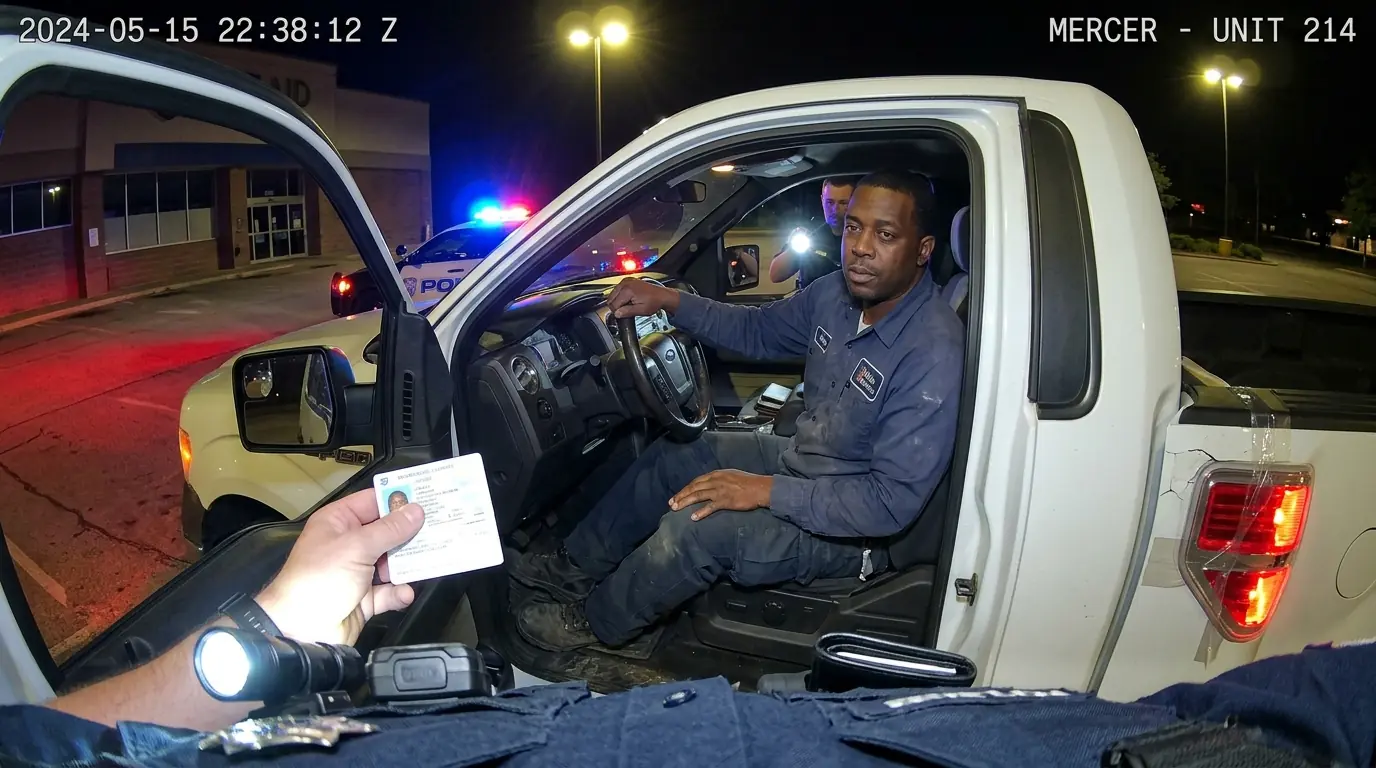
Marcus was forty-two, a commercial electrician, a widower, and the father of a thirteen-year-old girl who had texted him twice asking when he would be home. He had spent the evening replacing damaged conduit in a hospital mechanical room after a water leak forced his crew into overtime. His work shirt smelled faintly of dust and metal, his hands were clean only because he had scrubbed them before getting into his truck, and his body carried the heavy calm of a man who had been awake since five-thirty that morning. He was tired, but not frightened yet.
Before the officer reached the window, Marcus turned off the engine, lowered the glass, and placed both hands at the top of the steering wheel. His license was already in the small card sleeve clipped inside the sun visor, where he kept it during workdays because he frequently moved between job sites requiring identification. His insurance card and registration sat together in the center tray. He took nothing else out.
Officer Grant Mercer approached from the passenger side at first, swept a flashlight through the cab, then came around to the driver’s window. He looked to be in his mid-thirties, broad through the shoulders, with a short haircut and the controlled impatience of someone who expected instructions to become actions immediately. His body camera showed a steady red light.
“Evening,” Marcus said.
“License.”
Marcus handed it over.
“Insurance and registration.”
Marcus passed those through the window next.
Mercer looked at the documents, then at Marcus. “Where’s your wallet?”
Marcus blinked. “My wallet?”
“Hand it over.”
The request landed strangely because the officer was already holding the three things Marcus understood the stop to require. For half a second he wondered whether he had misheard. He glanced toward the closed center console, where his wallet sat beneath a charging cable and a pair of work gloves.
“I’ve given you my license, registration, and insurance,” Marcus said. “Is there something else you need from the wallet?”
Mercer’s face changed only slightly, but the temperature of the conversation dropped. “I said hand me the wallet.”
Marcus felt the instinctive urge to comply just to end the tension. He had spent most of his adult life solving problems quickly because quick solutions got crews home, kept clients calm, and prevented small mistakes from becoming expensive ones. But something about the demand made him hesitate. The wallet was not just money and cards. It contained a pharmacy receipt from his late wife’s final year of treatment that he had never managed to throw away, a folded school photograph of his daughter Zoe, a business card from a grief counselor, two company fuel receipts, his union membership card, and a note Zoe had slipped inside on Father’s Day that read, YOU STILL OWE ME PANCAKES.
It was a small private archive. He did not want a stranger leafing through it without a reason.
“My documents are right there in your hand, officer,” Marcus said carefully. “I’m not consenting to a search of my wallet.”
Mercer stared at him.
“I didn’t ask to search it.”
“You asked me to hand you the whole wallet.”
“What are you hiding?”
Marcus felt his pulse jump. He kept his hands visible. “Nothing. I’ve provided the documents you requested.”
Mercer stepped closer to the window. “Step out of the vehicle.”
Marcus did not argue. He unlocked the door and moved slowly. “I’m stepping out.”
“Hands where I can see them.”
“They’re right here.”
He stood beside the truck while Mercer positioned him near the front fender. The pharmacy sign above them buzzed with a dying fluorescent tube. A car passed on the road and did not slow. Marcus could see the broken right taillight reflected faintly in the store glass and felt almost angry at himself for not changing the bulb when he had the chance.
Mercer asked whether Marcus had weapons. Marcus said no. He asked whether Marcus had drugs. Marcus said no. He asked where Marcus was coming from. Marcus said work. Mercer asked why he looked nervous.
“Because this became a lot more than a taillight very quickly,” Marcus answered.
The officer’s jaw tightened. “Turn around.”
Marcus turned.
Mercer patted the outside of his jacket and pants. When his hand reached Marcus’s back pocket, he paused.