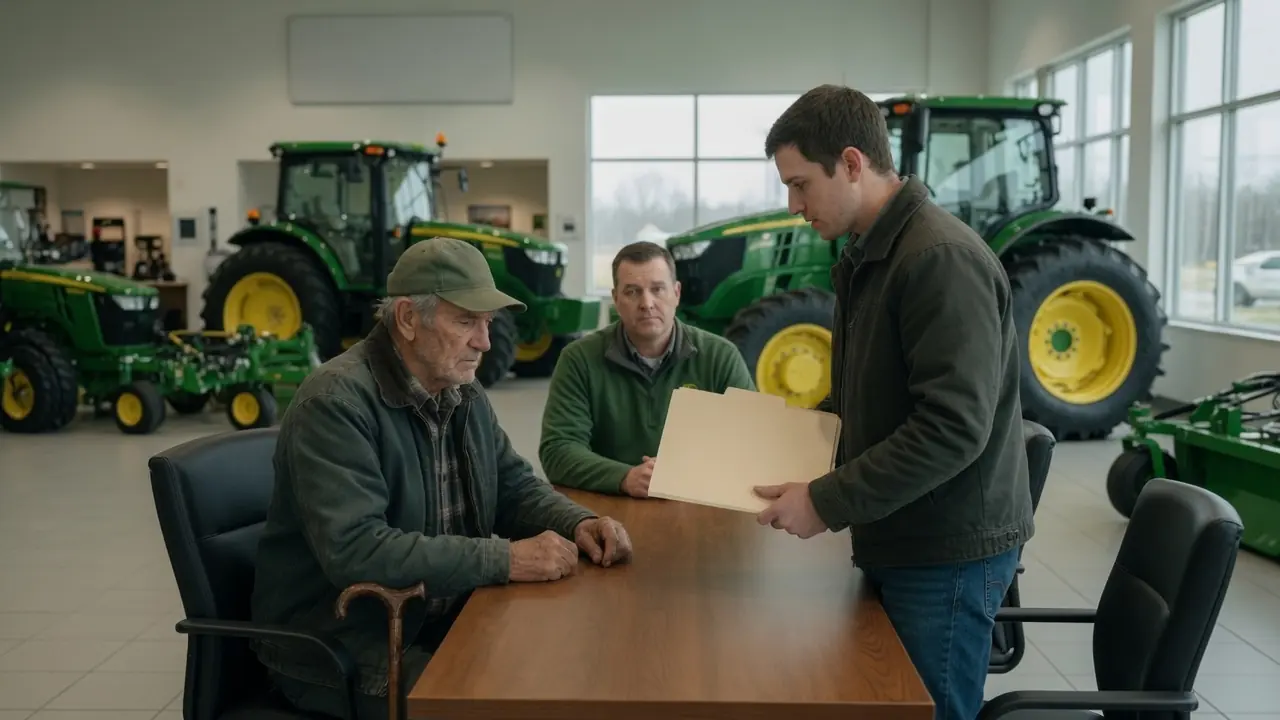
Harold Gentry sat at a polished sales table inside the John Deere dealership in Hardin County, Iowa, with his old green cap pulled low and his cane leaning against the chair beside his boot. Around him, the showroom was filled with bright green tractors, clean glass walls, and the familiar smell of tires, floor polish, and new machinery. For most farmers in the county, this was only a dealership. For Harold, it felt almost like a second office, because for forty years he had bought, repaired, traded, and trusted nearly everything on his farm through this place.
His grandson, Tyler Gentry, stood across from him holding a folder against his chest like it weighed more than paper. Tyler was twenty-seven, tall, quiet, and usually confident around equipment numbers, but today his jaw was tight and his fingers kept shifting along the folder’s edge. Beside the table stood Calvin Ross, the John Deere sales manager, who had known Harold since Tyler was still a boy climbing over combine tires in the showroom. Calvin thought they were here to discuss another tractor upgrade, maybe a newer model to support the Gentry farm’s spring workload.
Harold believed the same thing. He had spent forty years farming four thousand acres with John Deere equipment, and in his mind, the farm and the green machines were almost part of the same sentence. He had started with a John Deere 4440, a borrowed planter, and eight hundred rented acres when he was twenty-eight years old. Now he owned most of his ground, rented the rest, and ran a fleet large enough to plant and harvest everything without asking anyone for help.
That was the point of pride Harold carried into every season. His equipment worked his land, his schedule stayed under his control, and no neighbor’s breakdown or delay became his problem. He did not believe in custom work, did not rent his machines out, and did not chase side money with equipment he had bought for the farm. When neighbors called and asked if his tractors could plant, till, or spray for them, Harold always said no before they finished explaining.
Tyler had learned not to challenge that answer directly. He respected Harold too much to dismiss forty years of discipline as stubbornness, but he had also studied agricultural business and knew how to read numbers without emotion. For three years, he had quietly tracked the custom work requests Harold turned down. The more he tracked, the harder it became to ignore that the farm had capacity sitting idle between its own windows of work.
The opportunity came after Harold’s hip surgery. Harold had gone to Minneapolis to recover at his daughter’s house, angry about being away from the farm but unable to argue with doctors. Before he left, he told Tyler the farm was his to manage for spring, but he gave three firm orders. Do not buy anything, do not sell anything, and do not rearrange the shed.
Tyler obeyed those orders in the narrowest sense and broke them in spirit. He did not buy anything with Harold’s money, did not sell anything, and did not touch the John Deere fleet. Instead, he leased three Massey Ferguson tractors from a dealer in Ames under a seasonal agreement and used them for custom planting and tillage jobs Harold never would have approved. By June, the red tractors had done work on farms across the county and brought in numbers Tyler could not ignore.
Now those numbers sat inside the folder Tyler had carried into the John Deere dealership. Harold leaned back in his chair and looked at his grandson. “Well?” he said. “You said you had something to show me before we talked tractors.” His voice was calm, but Tyler knew that calm was not comfort. It was the kind of stillness that came before an Iowa storm bent the corn rows flat.
Harold did not touch the paper at first. His eyes moved over the title, stopped on the words Massey Ferguson, and then lifted slowly to Tyler’s face. Calvin’s smile faded. The green tractors behind them seemed to become quieter, as if even the machines understood that the wrong color had just been placed on the wrong table.
Harold gripped the top of his cane. “Tell me why there is a Massey Ferguson report on a John Deere table,” he said. The words were quiet, but every syllable was sharpened by forty years of loyalty. Tyler swallowed once and forced himself not to look away. He had imagined this moment for months, but imagining Harold’s disappointment was not the same as sitting across from it.
“Because those red tractors made this farm one hundred seven thousand dollars,” Tyler said. Calvin’s eyes flicked down to the paper, then back to Harold. Harold’s face did not change immediately. He had spent too many years reading markets, weather, and machinery failures to react before he understood the whole field.
Tyler slid the second page forward. It listed the six original clients, the additional two who came later, the acres worked, the gross revenue, the fuel costs, the labor costs, and the lease expenses. The final number was circled in blue ink because Tyler had stared at it enough times to know it by heart. Net profit: $107,000.
Harold stared at that number for a long time. His thumb moved once against the handle of his cane. Tyler remembered being twelve years old, sitting beside Harold in a combine, watching him calculate moisture, yield, price, and storage options without needing a calculator. Harold trusted numbers, but he trusted numbers more when he was the one who had asked for them.
Calvin cleared his throat carefully. “Mr. Gentry,” he said, “did you know Tyler was running another fleet?” Harold turned his head just enough to look at him. “No,” he said. Then he looked back at Tyler. “My grandson forgot I was still the man who built that farm.”
The sentence hit Tyler harder than anger would have. He would have preferred Harold yelling, because yelling could be defended against with facts. Hurt was harder, especially from a man who had taught him how to back a wagon, judge soil, watch clouds, and listen to an engine before trusting the dashboard. Tyler’s hand tightened over the remaining pages.
“I did not forget,” Tyler said. His voice shook at first, then steadied. “I proved the farm could become bigger than your fear.” Calvin’s eyebrows lifted slightly, and Harold’s eyes narrowed. That was the first dangerous sentence, the one Tyler knew might either open the door or seal it shut.
Harold leaned forward. “My fear?” he asked. Tyler nodded, though it hurt to do it. “You always called it protecting the operation,” he said. “And most of the time, you were right. But with custom work, we were not protecting the farm anymore. We were keeping it smaller than it had to be.”
For a moment, Harold said nothing. Through the glass wall of the dealership office, a young salesman walked past and slowed when he saw the tension at the table. Calvin waved him away with one sharp glance. This was not a sales conversation anymore, and everyone near that table knew it.
Tyler continued before his courage failed. “I tracked three years of requests,” he said. “Neighbors were paying outside operators for work we could have done in the windows between our own jobs. They wanted someone local, reliable, and well-equipped. We had the knowledge, the operators, and the demand.”
Harold tapped one finger on the table. “You had permission?” Tyler looked down once, then back up. “No.” The honesty made the room heavier. Harold’s jaw shifted, and Calvin stared at the table because he suddenly wished he were anywhere else.
“No,” Tyler repeated. “I did not ask because I knew you would say no before I finished the first page.” Harold’s face hardened. “So you decided my answer did not matter.” Tyler shook his head quickly. “I decided the numbers deserved to be real before I asked you to judge them.”
Harold gave a short, humorless laugh. “That is a clean way to say you went behind my back.” Tyler accepted the blow with a small nod. “Yes,” he said. “I did. And I knew this moment would come.”
That answer surprised Harold. He had expected excuses, maybe defensiveness, maybe the nervous arrogance of youth trying to explain risk to age. Instead, Tyler looked like a man prepared to pay for his decision without pretending it had cost nothing. Harold glanced down at the report again, and the number pulled at him whether he wanted it to or not.
“One hundred seven thousand,” Harold said quietly. Tyler nodded. “One spring season. Three leased machines. No capital risk to the home farm.” He slid the third page forward. “And if we purchase instead of lease, the year-two projection changes.”
Harold did not reach for the page. He looked at it like it might be bait. Calvin finally moved, pulling out a chair and sitting down at the edge of the table, not as a salesman now, but as a man watching two generations fight over the future of land they both loved. “Those are clean figures,” Calvin said carefully, then stopped when Harold’s eyes cut toward him.
“I did not ask you yet,” Harold said. Calvin lifted both hands slightly. “No, sir.” The old farmer turned back to Tyler. “Talk.”
Tyler opened the next sheet and laid out everything. He explained the lease costs, fuel, labor, insurance coverage, scheduling maps, customer commitments, and completed acreage. He showed Harold how the Massey Fergusons had been used only for custom accounts, while the John Deere fleet stayed on the home farm. He showed him that none of Harold’s spring planting had been delayed, no client job had been missed, and every account had paid.
Harold listened without interrupting. That alone told Tyler the numbers were beginning to reach him. Harold could reject a dream, a theory, or a sales pitch, but he had a harder time rejecting finished work that had already survived weather, logistics, and customer scrutiny. The proof sat on the table like a machine already running.
Still, his hurt did not disappear. “You called a Massey dealer before you called me,” Harold said. Tyler looked ashamed, and this time he did not try to soften it. “Yes.” Harold’s hand tightened over the cane again. “You brought red tractors onto Gentry ground while I was learning how to walk again.”
Tyler’s face changed. That sentence reached the part of him that numbers could not protect. “Grandpa, I never meant it like that,” he said. Harold stared at him. “How did you mean it?”
Tyler took a slow breath. “I meant to have something real to show you when you came back,” he said. “I meant to prove I could manage more than your instructions. I meant to prove I was ready to help lead, not just follow.” His voice lowered. “But I should have found a way to tell you before the tractors showed up.”
Harold looked down at the report again. The John Deere dealership around them suddenly felt painfully ironic. Green machines lined the showroom floor, but the conversation changing Harold’s farm had come from red ones. It should have offended him completely. Instead, the thing that offended him most was that the numbers were good.
Calvin leaned back in his chair. “Harold,” he said carefully, using the familiarity of forty years, “you know I want to sell you green paint every chance I get.” Harold gave him a warning look, but Calvin continued. “But if that boy cleared a hundred seven thousand in one season without disturbing the home farm, I would be lying if I said the idea was foolish.”
Harold looked at him for a long second. “You trying to sell me a John Deere answer to a Massey problem?” Calvin shook his head. “No. I am trying to tell you the problem is not the paint.” The sentence hung between them.
Tyler did not smile, even though part of him wanted to. Calvin’s words had landed exactly where Tyler’s could not. Harold respected Calvin because Calvin had sold him equipment in good years and hard years, had answered calls after storms, and had never treated him like a fool. If Calvin said the paint was not the point, Harold would at least hear it.
Harold picked up the report at last. He flipped through the pages slowly, stopping at the client list. He knew every name there. Men he had farmed beside, competed with, argued with at co-op meetings, and helped after floods or breakdowns. They had all hired Tyler because Harold had always said no.
“Ed Markham paid this?” Harold asked. Tyler nodded. “And called back for fall work.” Harold’s eyebrows moved slightly. “Ed complains if coffee costs a nickel too much.” Tyler almost smiled. “He said we were the most reliable operator he had used in fifteen years.”
Harold read another name. “The Peterson ground?” Tyler nodded again. “Four hundred acres. Heavy section. We finished two days before the rain.” Harold knew that field. He had refused Peterson custom work twice. He looked back at the net figure, then at the projection Tyler had placed beside it.
“How much to buy the machines?” Harold asked. Tyler’s breath caught. The question did not mean approval, but it meant the wall had cracked. He slid the purchase estimate forward, including financing options, service terms, and projected year-two margin. Calvin watched Harold’s eyes move over the numbers.
The old farmer sat back. For the first time since the folder opened, the anger in his face mixed with something else. Not surrender. Not pride. Something slower and harder for him to admit. Consideration.
Tyler stood silently while Harold read. He thought about all the years Harold had spent building the farm from nothing, refusing debt he did not need, fixing machines late at night, taking losses without excuses, and making careful choices that kept the land in the family. Tyler realized then that he had not only challenged a business model. He had challenged a man’s identity.
Harold finally laid the report flat on the table. “You were wrong not to tell me,” he said. Tyler nodded. “I know.” Harold’s voice deepened. “Do not nod easy. I mean it.” Tyler straightened. “I know, Grandpa.”
Harold looked at him for another long moment. “But I was wrong not to leave room for the question.” Tyler’s face shifted with surprise. Calvin looked down quickly, pretending to study a service brochure so Harold would not see his reaction.
The admission cost Harold something. He did not make it loudly, and he did not decorate it with emotion, but Tyler understood its weight. Harold Gentry did not apologize with long speeches. Sometimes he apologized by adjusting the next decision.
Harold reached into the inside pocket of his jacket and pulled out his reading glasses. He put them on, looked at the purchase estimate again, and tapped the deposit number with one finger. “If the numbers are this clear,” he said, “the decision is not complicated.” Tyler stood motionless. “You mean that?”
Harold looked up. “Do not make me say it twice.” Tyler’s throat tightened, and for a second he looked less like a farm manager and more like the grandson who had wanted his grandfather’s respect since childhood. Calvin pushed a blank purchase worksheet onto the table without a word.
Harold took a pen from his pocket and wrote the deposit figure on the margin of Tyler’s projection. “We are not buying anything today from this table,” he said. Tyler’s face fell slightly before Harold finished. “But we are going to call the Massey dealer, bring him to the farm, make him answer every service and warranty question I have, and if the machines hold up under that conversation, we move.”
Tyler nodded quickly. “That is fair.” Harold looked at Calvin. “You offended?” Calvin smiled faintly. “A little.” Harold grunted. “Good. Keeps you honest.”
The tension broke just enough for Tyler to breathe. Calvin stood and walked toward the coffee station, saying all three men looked like they needed something stronger but coffee was all the dealership could legally offer at ten in the morning. Harold did not smile, but his shoulders lowered. Tyler sat down for the first time since the folder had opened.
When Calvin returned with three paper cups, Harold pushed one toward Tyler. “Tell me about the scheduling,” he said. Tyler blinked. “The scheduling?” Harold nodded. “If you ran sixty-eight hundred custom acres without delaying our own planting, I want to know how.”
So Tyler told him. He described the whiteboard in the shop office, the daily field updates, the rain delays, the double-shift recovery, and the way he assigned operators by soil condition and distance from the home farm. Harold asked questions that cut through every weak point. Tyler had answers for most of them, and when he did not, he admitted it.
The conversation shifted without anyone announcing it. It was no longer a grandfather catching a grandson in a secret. It was two farmers examining a working operation. Harold still looked stern, and Tyler still felt the bruise of having hurt him, but the table had changed shape between them.
By the time they stood to leave the dealership, the folder looked different too. It was no longer evidence of betrayal alone. It was evidence of a door Harold had refused to open and Tyler had forced without permission. Both truths sat together, uncomfortable but real.
At the doorway, Harold paused and looked back at the rows of green tractors. “I am not giving up John Deere,” he said. Tyler almost laughed from relief. “I did not ask you to.” Harold nodded toward the folder in Tyler’s hand. “And I am not pretending those red machines did not earn their place.”
Outside, the July air was heavy and bright. Harold moved carefully with his cane, and Tyler walked beside him, not too close, not too far. The old man stopped beside the truck and looked across the dealership lot. “Your grandmother would have liked the profit,” he said.
Tyler smiled softly. “She would have told us both we were stubborn.” Harold opened the passenger door. “She would have been right.” Then he climbed in slowly, leaving Tyler standing with the folder and a feeling he could not name.
Two weeks later, the Massey dealer came to the Gentry farm and answered Harold’s questions for nearly three hours. Harold inspected the tractors, checked the service plan, asked about parts availability, looked under panels, sat in the cab, and said almost nothing that sounded like praise. But when the dealer left, Harold told Tyler the machines were well built. In Harold’s language, that was nearly a blessing.
By August, the three Massey Fergusons were purchased. The John Deere fleet stayed exactly where it had always been, clean and maintained, still responsible for the home farm that Harold built. The red tractors took the custom work, and the green tractors kept doing what they had always done. The shed became full in a way it had never been before.
The next season, the custom operation grew. More neighbors called, and Tyler accepted only the work they could complete at a standard Harold would respect. Harold stayed involved, less as commander and more as advisor, asking questions that made the operation sharper. Tyler began making decisions Harold once would have kept for himself.
One winter evening, long after the dealership confrontation had become a story neither of them told often, Harold and Tyler sat in the shop office with coffee between them. The year’s numbers were spread across the desk, and the custom operation had made more than either of them had projected. Harold stared at the total for a long time.
“I spent a lot of years protecting this farm from risk,” Harold said. Tyler looked up. Harold kept his eyes on the paper. “Sometimes I could not tell the difference between protecting it and keeping it small.”
Tyler did not answer. He understood the sentence was not asking for comfort. It was one of those rare truths Harold would only say once, and Tyler knew enough to let it stand.
Years later, people in Hardin County still talked about the day Harold Gentry’s grandson put a Massey Ferguson report on a John Deere table. Some told it like a story about brand loyalty being challenged. Others told it like a story about an old farmer finally admitting his grandson had been right. But Tyler knew it was really about something deeper than green paint or red paint.
It was about succession, trust, pride, and the painful moment when the future has to prove itself to the past. Harold had built the farm through discipline, caution, and numbers. Tyler had expanded it through the same things, just pointed in a direction Harold had refused to look. In the end, the numbers did what neither of them could do alone.
They made the truth impossible to ignore.