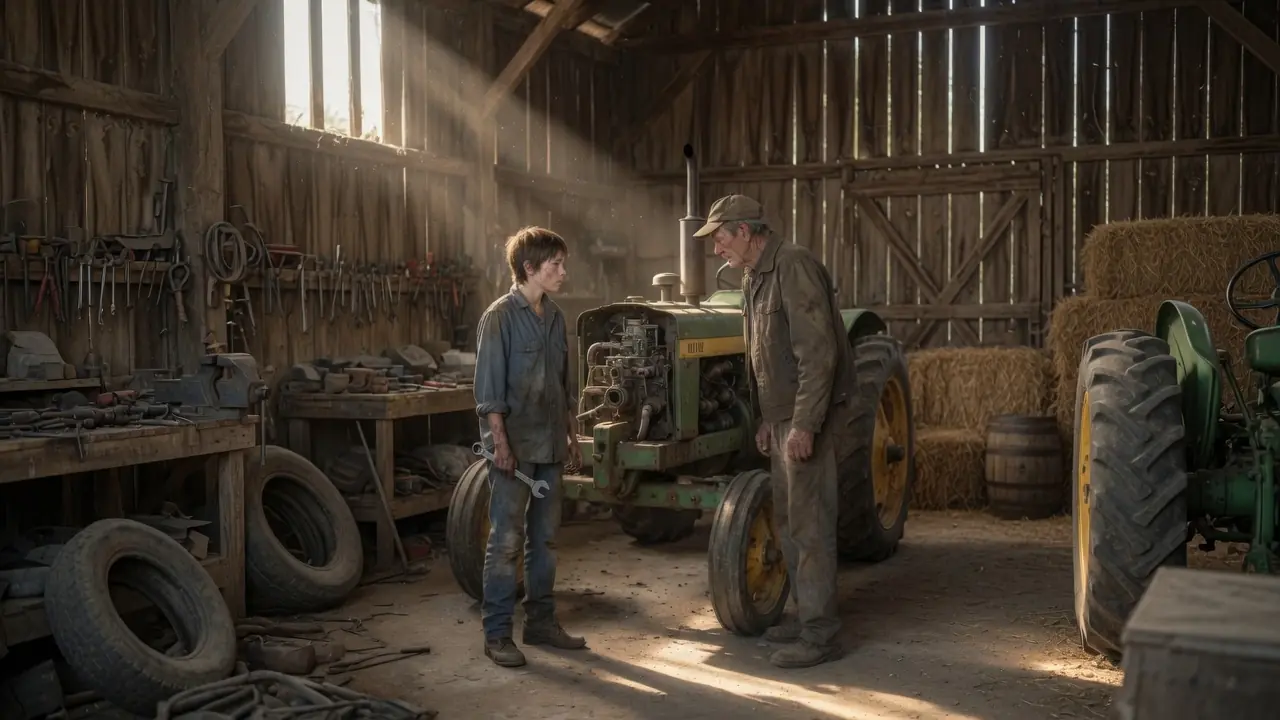
Grandpa Gus froze in the barn doorway as if the whole Kansas morning had stopped breathing with him. His overnight bag slipped from his hand and landed softly in the dust, but he did not look down. His eyes were fixed on the John Deere Model B sitting in the middle of the barn, the same tractor he had tended every evening for more than twenty years. Only now it was different, and I was the reason.
I stood beside the tractor with a wrench in my hand and oil under my fingernails. My father’s old blue work shirt hung too loose on my shoulders, the sleeves rolled high because they were too long for my arms. I was fifteen years old, too skinny, too stubborn, and too scared to admit how badly my hands were shaking. Grandpa stared at the new carburetor, the altered air intake, the welded exhaust, and the fresh scratches I had tried to hide.
“Tell me you didn’t touch Jasper’s machine, girl,” he said.
His voice was not loud. That made it worse. Grandpa Gus Hartwell was not a man who wasted words, and when his voice came that low, it carried more weight than yelling ever could. I swallowed hard and tightened my grip on the wrench. “I made it stronger,” I said. “Because this farm is dying.”
The words hit him like a slap. His weathered face tightened, and his pale eyes moved from me to the tractor, then back to me again. “Your father said that before this tractor took him,” he said, and his voice broke on the last part. That was the first time anyone had said something so plain about my father’s death in front of me. Until that morning, the truth had always lived behind softer words.
My father, Jasper Hartwell, had been gone seven years. I remembered his hands more than his face, though I hated admitting that. He had taught me how to hold a wrench, how to feel when a bolt had enough pressure, and how to listen to an engine before deciding what it needed. “Metal doesn’t care if you’re a girl or a boy,” he used to tell me. “It only cares whether you understand it.”
I had spent my childhood trying to become the kind of person he believed I could be. Other girls at Oak Ridge High talked about music, dresses, and boys with polished cars, while I read Popular Mechanics until the pages curled at the corners. I wore boots that used to belong to my father and work shirts with pockets deep enough for tools. People called me strange, and maybe I was, but engines made more sense to me than people ever had.
The Hartwell farm sat on sixty acres of flat Kansas ground where the horizon stretched so far it looked like the earth had no end. Our farmhouse had once been white, but the sun had worn it down to peeling gray, and the barn roof rusted where Grandpa kept meaning to repair it. We owed money to First National Bank, and Grandma Lorelei kept the numbers in a ledger so carefully that every page looked like a prayer. The farm was not failing all at once; it was failing by inches.
The John Deere was the center of everything. Grandpa had bought it used in 1946, after he came home from the war, and he treated it like something between a tool and a promise. It had plowed, planted, hauled, and carried us through years when better-equipped farms around us struggled. Every evening at six, Grandpa walked to the barn and checked oil, fittings, belts, hoses, and bolts with the same quiet discipline. I used to think he loved that machine more than anything.
Then I understood it was not love.
It was fear.
He had lost my father around that tractor, though no one ever told me exactly how. The adults would lower their voices when I came near, saying only that it was quick, that there was an accident, that Jasper had been working too late and too hard. Grandpa never explained. He simply got quieter and spent longer hours in the barn, touching every part of the machine as if checking whether grief could be prevented by maintenance.
The summer everything changed started with money. Grandma’s medicine cost more than it used to, and the bank note was due in September. Iris, my older sister, came home from nursing work with worry in her shoulders and told us the hospital had raised prices again. Grandma opened her ledger, ran her finger down the columns, and said nothing. That silence told me more than numbers could.
That Sunday afternoon, Weston Caldwell drove up in his red Jeep. His father owned the biggest farm in the county, with new tractors, fresh-painted barns, and equipment that looked like it belonged in a dealership window. West climbed out in clean jeans and made a point of looking into our barn. “My dad says tractors that old belong in museums,” he said, loud enough for me to hear.
That night, I heard Grandpa and Grandma talking in the kitchen. I was supposed to be asleep, but the floorboards creaked under my bare feet as I moved closer to my bedroom door. Grandpa said we did not have enough money. Grandma said maybe they should consider selling the farm. Then I heard her cry, softly, like she was trying not to let the house know.
Something inside me changed then.
The next morning, I climbed into the attic and opened boxes of my father’s things. I found his old leather journal beneath a stack of faded shirts and farm receipts. His handwriting was careful, slightly slanted, and seeing it felt like hearing his voice through dust. Near the middle, I found an entry from June 1960 about a failed attempt to improve the John Deere’s carburetor.
He had written that he thought he could increase horsepower by changing airflow and fuel mixture. He admitted he had failed and that Grandpa had been furious. But at the bottom of the page, he wrote something that made my chest ache. “Maybe Goldie will figure it out someday. My smart girl will be better than I was.”
I sat in the attic and cried until my throat hurt.
Then I started planning.
For six weeks, I studied everything I could find. I rode my bicycle to the library and checked out books about internal combustion engines, fuel systems, carburetor design, and exhaust flow. I filled notebooks with diagrams and calculations, testing each idea on paper until the pages blurred. At Mrs. Dotty Finch’s welding shop, I experimented on an old truck engine she kept for scrap.
Mrs. Finch had been teaching me welding since I was thirteen. She was fifty-eight, widowed, tough as a fence staple, and the best welder in the county, though men hated admitting it. She taught me that metal remembered every mistake you made with it. She also warned me never to practice on something I could not afford to lose.
I promised her I understood.
Then I broke that promise.
The chance came when Grandpa and Iris left for Kansas City to help Grandpa’s cousin, and Grandma drove to Springfield to talk to a bank officer and buy medicine. I had forty-eight hours alone on the farm. The morning they left, I walked into the barn with my notebook, my father’s journal, Iris’s Polaroid camera, and every tool I thought I would need. The John Deere sat waiting in the morning light like a question I had already chosen to answer.
I documented everything first. Twenty-three Polaroid photos from every angle, sketches of every hose, bolt, bracket, and wire, measurements written carefully in the margins. If I destroyed the tractor, I needed to know how to return it to what it had been. That thought should have stopped me. Instead, it made me feel prepared.
The old carburetor came off more easily than I expected. I had watched Grandpa clean it enough times that my hands knew the sequence. The new carburetor was larger, built to breathe better and mix fuel more efficiently, and I had ordered it from a catalog with money I earned fixing neighbors’ bicycles and mowers. For one trembling hour, it felt like everything might work.
Then a rusted mounting bolt refused to move.
I tried every tool in the barn. Nothing worked. By midafternoon, I rode my bicycle to Mrs. Finch’s shop and asked to borrow a heavy-duty penetrating wrench. She raised her face shield and looked at me hard enough to make my lie die before I spoke it. “You’re touching the John Deere, aren’t you?” she asked.
I did not answer.
She swore under her breath and set down her torch. “That is the stupidest thing you have ever tried to do.”
“I know,” I said. “But I have to try.”
“Prove it to who?” she asked. “That Caldwell boy? Your grandpa? Yourself?”
“All of them,” I said.
She stared at me for a long time. Then she sighed and pulled off her gloves. “If you are determined to be that reckless, you are not doing it alone.” She loaded tools into her truck and followed me back to the farm. That is how Mrs. Finch became the only adult witness to my worst decision and maybe my best work.
We worked through Tuesday and Wednesday. She freed the bolt, inspected my modifications, caught two mistakes before they became disasters, and made me redo welds that were almost good enough. “Almost good enough breaks under pressure,” she said. I hated hearing it, but she was right every time. By Wednesday night, the new intake and exhaust system were in place.
Then Iris called.
Grandma was coming home early.
The bank in Springfield had closed for a holiday, and she had finished her business faster than expected. She would be home Thursday afternoon. Suddenly, I did not have a day to test the tractor. I had hours.
Mrs. Finch stayed through the night. We drank bitter coffee on Grandma’s stove and worked under barn lights until my hands ached and my eyes burned. At three in the morning, while we waited for the engine to cool before final checks, she told me her husband once ruined a truck trying to prove himself worthy. “Sometimes bravery and foolishness wear the same boots,” she said. “The trick is learning which one walked in.”
At dawn, I climbed into the John Deere’s seat and turned the key.
The engine turned once, twice, then nothing.
Panic took my breath. I had killed it. I had destroyed the only machine standing between my family and ruin. Mrs. Finch leaned in, found a loose wire, and pushed it into place. “Try again,” she said.
The second time, the engine came alive.
It sounded deeper than before, stronger, as if the old tractor had been waiting years to draw a proper breath. I drove it slowly out of the barn into the early morning light, and for a while it worked better than I had dared imagine. It pulled cleanly, responded sharply, and climbed the slight rise behind the barn without complaint. I felt like my father was somewhere near me, laughing.
By noon, Iris arrived unexpectedly.
She walked into the barn, saw the scattered tools, the old carburetor, the oil stains, and me standing there with grease on my shirt. “What did you do?” she asked, and her voice sounded like fear trying to become anger. I told her I had improved it, but the word sounded smaller once it left my mouth. Iris turned pale.
“You took apart the only tractor we own,” she said. “The one thing keeping this farm alive.”
“It works,” I insisted. “Let me show you.”
She wiped her eyes with the heel of her hand. “You have one day. If anything is wrong, you tell Grandpa the second he comes home.” I promised her I would. I meant it then.
The south field became my proof.
I hitched the heaviest plow to the John Deere and took it across the soil. At first, everything was perfect. The tractor pulled faster and cleaner than it ever had for Grandpa. Iris watched from the fence line, terrified but unable to deny what she saw.
Then I took a turn too fast.
The tractor was stronger than my instincts expected. The rear wheels lost traction near the irrigation ditch, and before I could correct it, the machine slid down the embankment and came to rest at a terrifying angle. It did not roll. It did not crush me. But the exhaust cracked, an oil line loosened, and the fresh scratches across the side were impossible to miss.
Iris ran to me screaming my name.
Mrs. Finch called her son Everett, who came with a winch and chains. We pulled the tractor from the ditch and spent the next two hours repairing everything we could before Grandma came home. I rewelded the exhaust too fast, and I knew the bead was not beautiful. Everett fixed the oil line. Iris painted over the worst scratches with trembling hands.
Grandma arrived just after we closed the barn doors.
I thought we had hidden enough.
She stepped out of her car, looked at me, then pointed at the ground. “There is fresh oil on the driveway, and I can see it on your shirt,” she said. “What did you do to the tractor?” I could have lied, but her eyes were too steady. So I told her.
She did not yell. Somehow that hurt worse. She only said, “Tomorrow morning, your grandfather will see what you have done, and you will tell him the whole truth.” That night, she came to my door and said one more thing. “Trust matters more than machinery, Goldie.”
The next morning, Grandpa came home.
That brought us back to the barn, to his frozen body, to the bag on the floor, to the altered tractor sitting between us like a confession. He held my father’s journal in one hand because I had left it in the barn by accident. When he looked at me, his eyes were wet. “You knew Jasper tried this,” he said.
“Yes, sir.”
“And you did it anyway?”
“I learned from his mistakes.”
Grandpa walked around the tractor, touching each changed part with trembling hands. “This tractor is all we have,” he said. “Without it, we lose everything.” I could not stop myself then. “We are losing everything anyway,” I said. “Grandma needs medicine. The bank wants money. If we keep doing the same thing, we fail. At least this way, we have a chance.”
Grandpa leaned against the tractor hood and began to cry.
I had never seen him cry before.
“I lost your father to this machine,” he said, each word broken by breath. Then he told me what no one had ever told me plainly. My father had tried to adjust the tractor while it was running, convinced he could make it better, convinced he understood the risk. Something caught, something went wrong, and Grandpa reached him too late.
The barn seemed to tilt beneath me.
“I did not know,” I whispered.
“Now you do,” Grandpa said. “Now you know why I cannot lose you too.”
Grandma came in then and stood between us. “Goldie is not Jasper,” she said gently. “She prepared. She studied. She had Dotty Finch supervising her. What she did in secret was wrong, but the work itself may not be.” Then she turned to me. “But you broke trust, and you will earn it back slowly.”
Grandpa wanted to reject the whole thing. I could see it in his face. But Grandma told him to test the tractor before deciding whether my work was foolish. So he drove it to Northridge field, the one with the heaviest clay soil, the field where my father had died. I rode on the fender in silence while Iris, Grandma, and Mrs. Finch followed.
For ten minutes, the tractor pulled beautifully.
Grandpa’s grip on the wheel loosened. The old machine handled the heavy plow better than it ever had. I saw hope flicker in his face, and for a moment I thought maybe everything would be all right. Then the ticking noise returned.
Grandpa killed the engine immediately.
“What is that?”
I told him about the ditch.
Every detail.
His face changed from anger to disbelief to something colder. “You crashed it and did not tell me when I walked into the barn,” he said. “You let me discover it in the field.” I looked at the ground. There was no answer that could make that right.
He crawled beneath the tractor and started inspecting the underside. I knelt beside him, ashamed and silent. After several minutes, his hand stopped on an old gasket. “This has been failing for weeks,” he said.
“It was not from my modifications?”
“No. Original equipment. Rotted through.”
He kept checking, tracing the loosened oil line, examining the mounts, studying parts I had barely noticed. The crash had exposed weaknesses that had already been waiting. If I had never taken the tractor apart, Grandpa might not have found them until harvest. By then, the engine could have failed at the worst possible time.
“So I saved it accidentally?” I asked.
Grandpa slid out from underneath, oil on his sleeve and sorrow still in his eyes. “You had no right to do this without permission,” he said. “You broke our trust and put yourself in danger. But yes, you may have saved the farm from a worse disaster.”
That was the beginning of rebuilding.
Not the tractor.
Us.
The next week, Grandpa and I worked together under Mrs. Finch’s sharp supervision. We replaced the gasket, rebuilt the mounts, redid my rushed welds properly, and checked every piece twice. Grandpa made me explain every decision I had made, every calculation, every assumption, and every mistake. When I guessed, he stopped me.
“No guessing,” he said. “You either know, or you say you do not know.”
By the following Friday, the John Deere ran cleanly. No ticking, no oil leaks, no hesitation. Grandpa stood beside it after the final test, one hand on the hood, and shook his head like he still could not believe it. “Your father would have been proud,” he said. Then he added, “And furious.”
I laughed because I did not know whether to cry.
Word spread through Oak Ridge that the Hartwell girl had modified the old John Deere. Some people called it foolish. Some called it brilliant. Virgil Brennan, a neighbor with a struggling International Harvester, came by one Saturday and asked if I could take a look. Grandpa agreed, but only with conditions: he supervised, we charged fairly, and I did not touch anything alone.
The first paid job nearly ruined me.
I made a wrong assumption about a gasket type on Virgil’s engine. I was sure newer meant better, but the machine proved me wrong. Three days later, his tractor failed badly enough to need a major rebuild. Virgil was furious, and he had every right to be.
The repair cost five hundred dollars.
We did not have it.
Mrs. Finch arrived the next morning with an envelope. Inside was the money she had saved from wages I had earned helping her over the past two years. “This is your education,” she said. “But you pay me back by becoming careful enough to deserve your talent.” I took the envelope with both hands, feeling the weight of failure and mercy together.
That mistake changed me more than the first success ever had.
For the next year, I worked slowly. Grandpa taught me to respect each machine as its own problem. Mrs. Finch taught me that good work was not the same as exciting work. Grandma taught me that intelligence without honesty could hurt the people you loved. Iris reminded me that fear did not mean stop, only pay attention.
The farm survived.
The John Deere’s extra power let us finish our work earlier and take custom jobs from neighbors. The money did not make us rich, but it kept the bank from taking our land. Grandma’s ledger began showing numbers that no longer looked like a sentence. By winter, the farm felt like it was breathing again.
Grandpa gave me a set of precision measuring tools for Christmas. Micrometers, calipers, gauges, tools I had only seen in catalogs. “Talent without discipline is dangerous,” he said. “These help with discipline.” Grandma gave me a framed photograph of my father standing beside the John Deere, grease on his hands and a grin on his face.
“He would be proud of what you learned,” she said. “Not because you never made mistakes, but because you stopped hiding them.”
In time, people began bringing machines to the Hartwell barn. Tractors, mowers, pumps, augers, and trucks came through our doors, each with its own story and stubbornness. I learned that the best mechanics did not force answers from metal. They listened until the problem told the truth.
Weston Caldwell came too.
At first, I expected him to mock me again, but he looked smaller than before. His father’s new tractor had a problem the dealership could not solve, and West had begun to understand that money did not teach you how machines worked. He apologized for what he had said about girls and machinery. I accepted, not because it stopped hurting, but because I had better things to do than carry his ignorance.
By the time I finished high school, I had a reputation.
Not as the miracle girl.
As the careful one.
That mattered more.
A counselor encouraged me to apply to engineering schools. I thought she was joking at first. Girls like me did not go to places like MIT. Girls like me stayed on farms, fixed what broke, and made themselves useful enough not to be questioned. But Grandma said someone had to be first, and Grandpa said the farm would not fall apart just because I left to become what I was meant to be.
The acceptance letter came in May 1970.
Full scholarship.
I sat at the kitchen table staring at the paper while Grandma cried openly and Grandpa read the letter twice. “You are going,” he said. I started to argue, but he stopped me with one look. “Your father wanted you to build something bigger than his mistakes. Do not insult him by staying small.”
The night before I left for Boston, Grandpa walked with me to the barn. The John Deere sat in its usual place, old and altered, scarred and strong. He put his hand on the hood. “This machine taught you the first lesson,” he said.
“What lesson?”
“That sometimes you risk what you have to protect what you love,” he said. “But love does not excuse secrecy. Courage needs honesty, or it becomes pride.”
He handed me a page from my father’s journal, one I had never seen. Jasper had written that if I ever found his notes, I should not work alone, not hide my plans, and not mistake help for weakness. At the bottom, he wrote, “If you succeed where I failed, don’t stop there. Build something bigger.”
I cried in the barn that night.
Grandpa did too.
Years later, in lecture halls and laboratories far from Kansas, I carried that barn with me. When equations felt impossible, I remembered the sound of the John Deere starting for the first time after my modifications. When professors doubted whether a farm girl belonged in engineering, I remembered my father saying metal did not care if I was a girl. When I made mistakes, I remembered Virgil Brennan’s tractor and the five hundred dollars that taught me humility.
I became an engineer because of a tractor, yes.
But not only because I changed it.
Because I learned that a machine can be repaired faster than trust. Because I learned that brilliance without honesty can frighten the people who love you. Because I learned that failure, if faced directly, can become the strongest tool you own.
And every time I returned to the farm, Grandpa and I walked first to the barn.
The John Deere remained there, green paint faded, yellow wheels worn, still running, still stubborn, still ours. It had nearly broken us and helped save us. It carried my father’s mistake, my mistake, Grandpa’s grief, Grandma’s wisdom, Iris’s fear, Mrs. Finch’s mercy, and the first proof that I could become more than the town expected.
On my last night before returning to school, I placed my hand on its hood and whispered, “Thank you.”
I was not sure if I meant the machine, my father, Grandpa, or the scared fifteen-year-old girl who had once stood in the barn with a wrench and shaking hands.
Maybe I meant all of them.