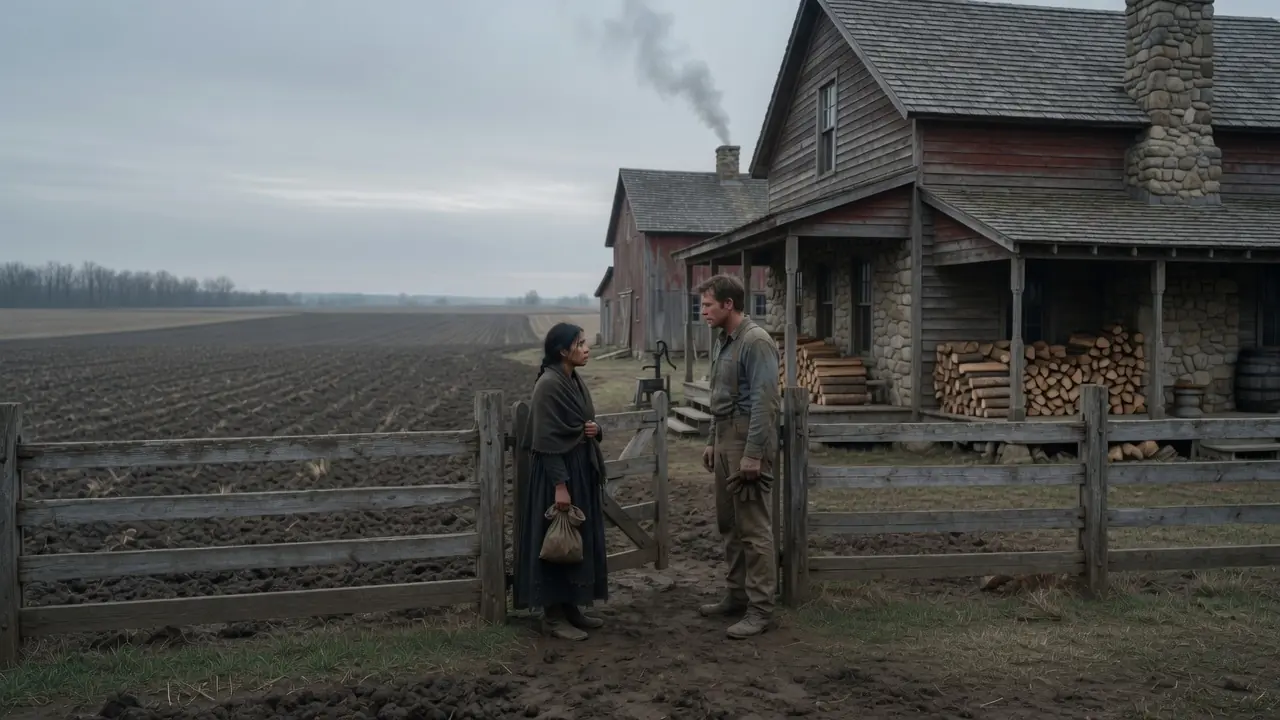
Elena Gray arrived at Morrison Farm on a cold morning with a small cloth bag in her hands and a silence in her chest that felt heavier than fear. The road behind her was not long by distance, but it felt endless because every mile had carried her farther from anything that still felt like choice. The valley opened wide before her, gray under the early sky, with plowed fields waiting for spring, a weathered red barn, a split-rail fence, and a farmhouse made of wood and stone. Smoke rose from the chimney in a thin line, calm and ordinary, as if the house did not know a person had just been brought to its gate like payment.
She was twenty-seven years old, Apache, strong from work, and tired in the way a person becomes tired when life has spent too long deciding for her. Her uncle’s debt had become her burden after a dispute with a powerful rancher named Victor Hale, a man who knew how to twist old papers and hard times into weapons. Elena had not signed the agreement. She had not stood at the table where men spoke about money, land, and obligation. Yet somehow, when the papers were folded and the signatures dried, she had been the one sent away.
The people in the nearby town had already watched her pass. Some stared openly from windows and porches. Others lowered their voices as if she could not hear the shape of suspicion, pity, and curiosity. Elena understood what they saw. A woman brought under obligation, carrying one small bag, walking toward a farm owned by a widower known for hard work and few words.
Daniel Morrison had been told she was coming, but the arrangement had not been his idea. He was thirty-six, a white farmer and widower, tall and sturdy, with tired blue eyes, rough hands, and the weathered face of a man who had stood under too many seasons without asking for mercy. He stepped out onto the porch with work gloves in one hand and did not speak at once. He looked at Elena standing near the gate, then at the paper held by the man who had escorted her, then back at her face. For one long moment, no one moved.
Elena lifted her chin because lowering it would have made the humiliation easier for them. She expected him to inspect her like labor. She expected questions about how much work she could do, how long she would stay, and whether she understood orders. Instead, Daniel’s gaze moved past the paper and settled on her as if he were trying to see the person under the arrangement. When he finally spoke, his voice was quiet and plain.
“You can stay in the small room near the back of the house,” he said. “You will be treated fairly while you are here.”
Elena did not thank him. There was nothing to thank yet. Fair words meant little until the days proved whether they could hold weight. She adjusted the cloth bag in her hands and looked toward the farmhouse door. “And what am I here to be?” she asked.
Daniel’s jaw tightened, but not at her. “Not property,” he said. “Not a mistake. You are here because other men put their names on paper, but under my roof, you will be treated as a person.”
The man who had escorted Elena shifted uncomfortably, as if Daniel had made the arrangement sound uglier than they all already knew it was. Elena watched Daniel’s face for mockery, pity, or performance. She found none. His words were not warm, but they were not cruel either. They were the kind of words a man used when he understood that kindness meant nothing without conduct behind it.
She followed him toward the farmhouse, aware of every step she took on unfamiliar ground. The yard smelled of damp soil, ash, horses, and cold wood. A water pump stood near the porch, and stacked firewood leaned neatly beside the wall. Beyond the barn, the fields stretched wide and unfinished, showing all the work the year would demand before it gave anything back.
“This land does not stop for anyone,” Daniel said quietly as they walked. “We work because we must.”
Daniel glanced at her, perhaps hearing more in the answer than the words themselves. Then he opened the door and stepped aside instead of entering first, giving her enough space to cross the threshold without being pushed into it. The house was plain, clean, and quiet. There was a table near the window, a stove in the corner, a few shelves, a chair with worn arms, and a smaller room toward the back with a narrow bed, folded blanket, and a latch on the inside of the door.
Elena noticed the latch immediately. Daniel saw her notice it. He said nothing, which made the small mercy sharper. Men who wanted praise for decency usually pointed at it. Daniel simply left the room to her and went back outside.
The days that followed settled into the rhythm of Morrison Farm. Elena rose before sunrise because sleep did not come easily in a house where she still felt like a stranger. Daniel was usually outside before her, feeding animals, checking the barn, or hauling tools toward the fields. There were crops to prepare, water to carry, repairs that never seemed finished, and fences that leaned again as soon as one section was made straight. The farm demanded effort from everyone and gave no room for wounded pride.
At first, the hired workers watched Elena with caution. Some kept their distance, unsure whether to pity her, resent her, or pretend she was not there. Others spoke in low voices when she passed, careless enough to think she did not understand tone if she did not answer it. Elena answered by working. She carried water, sorted seed, patched feed sacks, helped mend fence, and learned where tools were kept without asking twice.
Daniel did not treat her as separate from the rest. He gave instructions clearly, no softer and no harsher than he gave them to anyone else. At first, Elena thought this was another kind of coldness. Then she noticed that he did not ask less from her because he pitied her, and he did not ask more because of the debt. His fairness was not gentle in appearance, but it was steady, and steadiness had a way of becoming visible over time.
One afternoon, while they were repairing a broken fence near the edge of the property, Elena’s hand slipped against a rough piece of wood. A sharp cut opened across her palm. She closed her fingers around it and kept working, swallowing the pain before anyone could use it against her. Pain was familiar. Attention was more dangerous.
Daniel noticed anyway. He crossed the short distance between them, took one look at her hand, and set down the fencing tool he carried. “You should have said something,” he said.
“It is not serious,” Elena replied.
“It still matters.”
The words were simple, but they struck a place in her she had not meant to leave open. Daniel tore a clean strip from a cloth in his pocket, washed the cut with water from the canteen, and wrapped it with careful hands. He did not touch more than he needed to. He did not make the moment into tenderness, but it was tenderness anyway because it asked nothing from her in return.
After that, the silence between them changed. It did not vanish, and it did not become easy conversation. It simply stopped feeling empty. Sometimes they worked side by side for an hour without speaking, and the quiet no longer felt like a wall. It felt like weather they both understood.
By the third week, Elena knew the farm’s sounds. She knew the creak of the barn door, the groan of the pump handle, the way the wind crossed the open field before touching the house. She knew which boards on the porch complained under weight and which ones stayed still. She knew Daniel drank coffee standing up when he expected a hard day, and sitting down when he was more tired than he wanted to show. She knew he always paused near the small fenced grave behind the house before walking toward the north field.
She did not ask about the grave. She already knew enough to understand grief when it shaped a man’s movements. Daniel wore his loss plainly, though he never spoke of it. The farmhouse had the order of someone who kept working because stopping would let memory catch him. Elena recognized that too. Different griefs could speak the same language.
Trouble began at the boundary fence. At first, Daniel thought the men were travelers passing through the valley. They stood near the far line, watched the field, then rode away before anyone approached. The next day, they returned and stayed longer. Their presence did not carry curiosity. It carried measurement.
One evening, Daniel came back from town with news that settled over the farm like bad weather. Victor Hale had begun claiming pieces of land across the valley. He used old papers, pressure, and fear to force smaller farms into selling. Some farmers had already given in rather than fight a man with money, riders, and patience for cruelty. Elena listened without interrupting, feeling the old shape of the debt close around her again.
A few days later, Victor’s men returned. This time, one of them came forward while Elena stood near the fence with Daniel. He was a narrow-faced man in a dark coat, with eyes that moved past Daniel and settled on Elena like she was part of the property line. He said she was still bound by the agreement that brought her there. He said if the debt holders demanded it, she could be taken back.
Elena froze.
For a moment, the field, the fence, the barn, and the cold air all disappeared. She was back on the road with her small bag in her hands, listening to men decide what her life was worth. Her injured palm tightened under its cloth wrap. She wanted to speak, but old fear rose before words could.
Daniel stepped forward before the man could move closer. His voice was low, but it carried. “She is not property to be moved between men.”
The man looked at him, surprised by the force beneath the calm. “That paper says otherwise.”
“Paper can say many things,” Daniel replied. “It does not make them right.”
The man did not argue further. He studied Elena for a long moment, then turned and left with the others. No fight came. No shot was fired. Yet the silence afterward felt as if something violent had passed near them and missed by inches.
That night, Elena could not sleep. She stood outside the farmhouse, wrapped in her shawl, looking across the dark fields. The moon lit the furrows faintly, and the barn stood like a shadow against the pale ground. Daniel came out after a while and stood nearby without asking why she was there. He seemed to understand that some questions should wait until invited.
“Why did you stop them?” Elena asked.
Daniel looked toward the fields. “Because some lines should not be crossed.”
“You could have avoided trouble.”
“Trouble finds its way here either way.”
The answer was not brave in the loud way men often enjoyed being brave. It was tired and true. Elena studied his face in the moonlight, trying to understand the sorrow beneath his restraint. After a long silence, Daniel added, “This land has already taken enough from me. I will not let it take more.”
Elena did not ask what he meant. She looked toward the small grave behind the house and understood enough. The farm was not just soil to Daniel. It was memory. It was loss. It was the place where he had buried someone he could not replace and continued living because the animals still needed feeding, the crops still needed tending, and morning still came whether a man welcomed it or not.
Winter arrived earlier than expected. The fields turned white under a snow that softened the hard lines of the farm but made every chore slower. Work did not stop, but it changed. There was wood to split, animals to tend, roofs to check, and food to stretch. Elena spent long evenings near the stove mending sacks, repairing shirts, and learning the farm’s winter quiet. Daniel sat across the room sharpening tools or reading old newspapers, and the silence between them became something neither of them feared.
One afternoon, a passing trader brought Elena a letter. She knew her uncle’s handwriting before she opened it. The lines were uneven, full of regret and shame. He wrote that the agreement that sent her to Morrison Farm had not been fair. He had been pressured by Victor Hale’s people, threatened with losing what little remained to him, and frightened into signing papers he did not fully understand.
Elena read the letter twice. Then she folded it carefully and put it in her pocket. For the rest of the day, she worked as if nothing had changed, but every movement felt different. If the agreement had been false from the beginning, then what was she now? Not payment. Not debtor. Not bound.
That evening, she showed the letter to Daniel. He read it slowly beside the stove, his face tightening with every line. When he finished, he handed it back without speaking. Elena waited, listening to the wind press softly against the house. Finally, she said, “So I was never part of a real agreement.”
“It seems that way,” Daniel said.
“Then I should leave when the roads open.”
Daniel did not answer immediately. The silence between them grew heavier than any answer would have been. He looked toward the window where snow gathered in the corners. “You have already given more to this place than any debt could demand,” he said at last.
Elena looked down at the folded letter. She had imagined freedom as a door opening wide, clear and unquestionable. Yet now that the door stood before her, she did not know where she would go. The road back did not promise safety. The world beyond the valley did not promise welcome. Morrison Farm, the place she had been sent against her will, had become the only place where a man had told her she mattered and then acted as if the words were true.
The storm broke a few days later. Snow softened into mud, and paths began to reopen. Word spread quickly that Victor Hale’s riders were pushing deeper into the valley. They brought offers that were not offers, warnings dressed as advice, and papers designed to frighten people who could not afford lawyers. Smaller farms began closing their shutters when strange horses appeared.
One morning, Victor Hale himself came to Morrison Farm. He did not enter the house. He stood near the boundary fence with two men beside him and called for Daniel as if summoning a tenant instead of a landowner. Victor was broad-shouldered, polished, and calm, the kind of man who kept his cruelty clean enough to pass for business. Elena stood near the porch and watched Daniel walk toward him.
Victor spoke of land, ownership, old claims, and opportunities. He said Daniel could sell now and avoid hardship later. He mentioned uncertain boundaries, disputed water access, and the cost of fighting legal pressure. Every word had been chosen to sound reasonable while carrying a threat beneath it. Daniel listened without interrupting.
When Victor finished, Daniel said, “This farm is not for sale.”
Victor smiled faintly. “Every farm is for sale when the owner becomes tired enough.”
Daniel’s eyes did not move. “Then you have come too early.”
Victor’s smile thinned. He glanced toward Elena, and that look alone made Daniel’s shoulders harden. “Some men invite trouble by keeping what does not belong to them,” Victor said.
Daniel stepped closer to the fence. “She belongs to herself. The land belongs to me. You are wrong on both counts.”
Victor studied him for a moment, then turned away. “Winter makes men proud. Spring makes them practical.” He mounted his horse and left with his riders.
After they were gone, Elena stood beside Daniel near the fence line. The wind moved through the open land, cold but no longer sharp. “You could lose everything,” she said.
Daniel looked across the fields. “I already lost what I could not replace.”
This time, Elena did ask. “Who is buried behind the house?”
Daniel closed his eyes for one breath, then opened them. “My wife, Sarah. Fever took her three years ago. We had a son too. He was born too early and lived two days.” His voice did not break, but it became quieter. “After that, people kept telling me the farm would heal me if I stayed busy. They were wrong. Work does not heal. It only keeps a man standing long enough to decide whether he wants to live.”
Elena felt the words settle between them. She thought of her own losses, the home she had left, the people who had looked away when the debt became her chain, and the shame of being carried into another person’s life by papers she never signed. “And have you decided?” she asked.
Daniel looked at her then. “I am beginning to.”
Neither of them moved closer, but something between them did.
The following days carried danger and tenderness in equal measure. Daniel began gathering records, deeds, and boundary papers. Elena helped him sort them at the kitchen table by lamplight, her quick eyes catching dates and signatures he had missed. She could not read every legal phrase, but she understood patterns, pressure, and lies. Victor Hale’s strength depended on people believing they stood alone.
Daniel rode to nearby farms and asked men and women to bring their papers together. Some were afraid. Some were ashamed that they had nearly signed away land that had belonged to their families for years. Elena went with him when the roads allowed, not as a servant, not as debt, but as someone whose own life had been used by the same kind of power. When people saw her stand beside Daniel, they understood something about what he was fighting.
Victor’s men came twice more, but they found Morrison Farm less isolated each time. A neighbor’s wagon stood in the yard one morning. Two farmers were helping repair the fence the next. Lydia Barnes from the eastern field brought copies of old water rights and stayed for coffee. Slowly, the valley began to remember that fear worked best when each house kept its door closed.
Elena’s freedom remained between them, unspoken but present. The roads were open now. She could leave. Daniel never asked her to stay. He even set money on the table one evening, enough for travel, food, and new lodging if she chose to go.
Elena looked at the coins, then at him. “Is this payment?”
“No,” Daniel said. “It is a choice made easier.”
She studied him for a long time. “You keep giving me doors.”
“You have had enough walls.”
The words were too much. Elena turned away before he could see how they moved through her. That night, she lay in the small back room with the latch on the door and realized the latch no longer felt like protection from Daniel. It felt like proof that he had given her safety before asking for trust.
Spring came slowly. The fields softened, and planting began. Elena worked beside Daniel in the rows, hands deep in soil that no longer felt strange beneath her fingers. They spoke more now, though still not constantly. He told her where Sarah had planted beans and how the barn roof had collapsed the first winter he owned the place. She told him about her mother’s songs, the desert winds of her childhood, and the way her people taught that land was not something a person owned so much as something a person answered to.
Daniel listened the way he worked, with patience and attention. He did not interrupt to correct what he did not understand. Sometimes he asked questions. Sometimes he only nodded and carried her words quietly. Elena had known men who listened in order to reply, men who listened in order to judge, and men who did not listen at all. Daniel listened as if words were seeds, and careless handling could ruin them.
The final confrontation with Victor Hale came after the first planting. He arrived with legal men, riders, and a confidence that faltered when he saw five neighboring farmers standing with Daniel at the fence. Papers had been gathered. Witnesses had been found. Elena’s uncle’s letter had been copied and sworn before the town clerk. Victor’s pressure had left marks in too many places, and now those marks had been laid out in daylight.
Victor tried to speak over them, but the valley had grown tired of lowering its head. Daniel said little. He let the documents do most of the work. Elena stood beside him, holding the letter that proved the agreement against her had been forced. When Victor’s eyes turned toward her, she did not look away.
“You were never owed my life,” she said.
Victor’s face darkened, but he had no answer that would hold in front of witnesses. By the time he rode away, the power he had carried into the valley was not gone, but it had cracked. That mattered. Cracks let light in. Cracks also warned people where to push next.
That evening, Morrison Farm was quiet. The neighbors had gone home. The fields lay under the last light, newly planted and still uncertain. Daniel stood near the fence, his hands resting on the top rail, watching the road where Victor had disappeared. Elena came to stand beside him.
“You are free to leave when you want,” he said.
“I know,” Elena answered.
This time, the words did not frighten her. She looked at the barn, the house, the pump, the fields, and the grave behind the house. She thought of arriving with one small bag and no choice. She thought of the back room with the latch, the bandage around her palm, the night Daniel stood beside her under the moon, and the way he had said she was not property before anyone else dared say it.
Daniel looked at her carefully. “I will not ask you to stay because you are grateful.”
“I would not stay for gratitude.”
“Then why?”
Elena turned toward him. “Because this is the first place I was given a choice and wanted to choose it.”
The words changed his face. Not into triumph. Daniel was not a man who took joy in winning another person. His expression softened with something like wonder and fear together. He looked toward the fields, then back at her.
“I do not know how to begin again,” he admitted.
“Neither do I.”
“That may make us poor farmers of the heart.”
Elena almost smiled. “You are already a farmer. Perhaps you should trust slow things.”
Daniel let out a quiet breath. “And you?”
“I have survived men who thought papers could decide my life,” she said. “I can learn to trust a man who never asked to own it.”
He reached for her hand slowly, giving her time to refuse. She did not. His fingers closed around hers, careful around the place where the old cut had healed into a thin pale mark. They stood that way until the evening deepened and the first stars came out above the quiet rural valley.
Elena did not fall in love with Daniel because he saved her in one grand moment. She fell in love because he did the harder thing, day after day. He treated her dignity as real before she trusted him with it. He gave her work without humiliation, protection without ownership, silence without neglect, and freedom without punishment.
Daniel did not love Elena because she filled the emptiness Sarah left behind. No one could fill that space, and Elena would never have wanted to. He loved her because she stood beside him in the field with steady hands and honest eyes, because she understood loss without demanding it speak too soon, and because the farm felt less like a place of survival when she walked across it. She did not replace the past. She helped him believe there could still be a future.
By harvest, Elena had moved from the back room into the life of the farm by choice, not by pressure. Some people in town still whispered, because towns often cling to their smallness before learning shame. Daniel did not answer them. Elena did not either. The work answered. The land answered. The way they stood beside each other answered.
Years later, people would tell the story differently depending on who told it. Some said Elena had been given to a farmer as payment for a debt. Some said Daniel Morrison had taken in a woman everyone else had reduced to paper. Some said Victor Hale lost his grip on the valley because one farmer refused to let cruelty pass as law. Elena knew the truest version was quieter.
She had arrived at Morrison Farm with no choice.
Daniel had refused to make her smaller.
And when freedom finally came, she stayed because the farm no longer felt like the place she had been sent.
It felt like the place where she had been seen.