The night Ria Mercer wrapped a rusted chain around her fist and stepped into the dark, she wasn't thinking about consequences. She wasn't thinking about her grandmother's oxygen bills stacked on the kitchen counter, or the eviction notice tucked behind the coffee maker, or the three job rejections she'd collected that week like bad omens. She was thinking about the old man on his knees in the gravel, bleeding from his lip while six men laughed at him under a buzzing gas station light. She was thinking about her grandfather's voice, ragged and certain as an engine turning over in winter. Someone has to stop.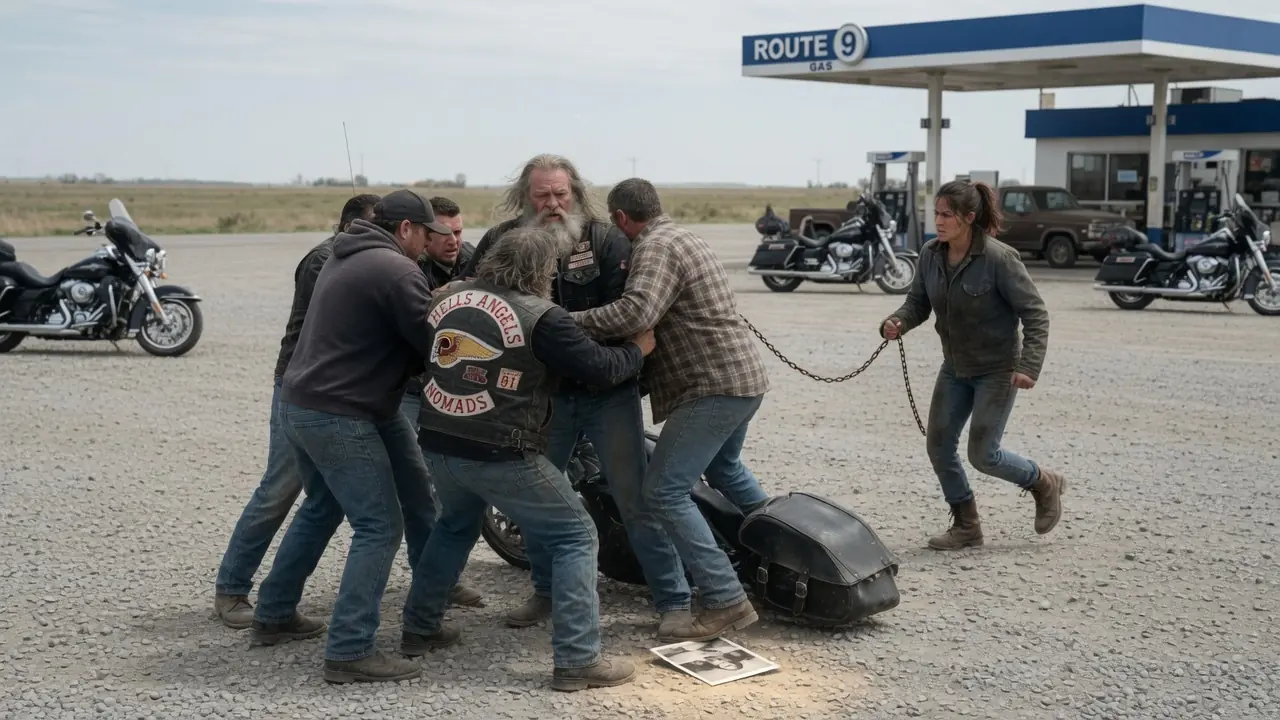
What she didn't know, what nobody warned her about, was that stepping into that circle of light would cost her everything she thought she was and give her everything she never knew she needed. And somewhere in the darkness beyond that gas station, engines were already running. The gas station on Route 9 had been dying for years. The sign above the canopy was missing two letters. The pumps accepted cards only on alternating Tuesdays, and the single fluorescent tube above the restroom entrance flickered so reliably it had become a kind of clock for the long haul drivers who stopped there out of desperation rather than preference.
The parking lot was cracked asphalt and old oil stains. And at 11:17 on a Thursday in late October, it was exactly the kind of place where bad things happened and nobody official ever arrived in time. Ria Mercer was halfway across that parking lot when she heard the first sound. Not a shout, but a low, wet laugh that didn't have any warmth in it. She stopped.
Her grocery bag was light in her hand, a loaf of bread, a can of soup, two apples she'd checked three times for bruising because every dollar was accounted for this week. The wind came off the tree line to the east, carrying dead leaves and the smell of coming frost. And beneath it, she caught something else. diesel, worn leather, and the particular stillness of men who wanted witnesses to be absent. She should have kept moving. She knew that.
She'd learned how to keep moving when she was 17, and her parents' car note disappeared and the apartment went with it. And she'd refined the skill every year since. Staying invisible wasn't cowardice. It was math. She was 24 years old, 132 pounds of motorcycle grease, and borrowed time. and she had a grandmother whose oxygen concentrator hummed through the wall every night like a prayer she wasn't sure anyone was answering.
She took three more steps toward the road. Then she heard the old man's voice. "I'll get up when I'm ready," he said, and it came out steady, not begging, not afraid, just a statement from somewhere very deep in the chest of someone who had learned how to absorb pain without flinching. The kind of voice that had been steady once in a place where steadiness meant survival. Ria turned.
There were six of them arranged in a loose half circle near the far Pump Island where two motorcycles sat idling on their kickstands. Older Harleys, a Sportster, and a Road King, both carrying the particular patina of machines that had been ridden hard and maintained with love. The man on his knees in front of them was somewhere past 70, broad- shouldered still, with white hair tucked under a battered leather vest that had more patches than open space. His hands were on the gravel and his lip was split and the nearest one, a thick-necked man in a Carhartt jacket, was laughing. "What's he going to do? " Carhartt said to the others.
"Call his little biker friends. " More laughter. One of them kicked the old man's saddle bag over and the contents spread across the pavement. a small tool roll, a folded road map, a photograph in a cracked plastic sleeve that skidded six feet and landed face up under the fluorescent light. The old man reached for it. Carhartt put his boot on it. Something shifted in Ria's chest.
Not a decision exactly, more like a lock releasing. She set her grocery bag on the ground carefully. She picked up what she'd spotted when she first walked into this lot and cataloged from habit the way every mechanic cataloged useful objects. A length of rusted logging chain, maybe 18 inches, coiled loose beside the air pump housing. She wrapped one end twice around her right hand, let the rest hang, and walked toward the light.
Her boots were steel-toed. That wasn't an accident. She'd bought them two years ago for the garage floor and never found a reason to wear anything else. Her hands were calloused at every knuckle. That wasn't an accident either.
She came into the edge of the fluorescent light and six heads turned. "Hey," she said, just the one word. "No threat in it, no bravado, just the sound of someone arriving who hadn't been asked to. " Carhartt looked at her the way men like him always looked at women who interrupted them. First dismissal, then recalculation, then something that thought it was menace. "Walk away, sweetheart.
Nothing here for you. " You're on his photograph, Ria said. Nobody moved. Your boot, she said. You're standing on his photograph. Step off it.
The man to Carhartt's left actually smiled. A real one, like she'd done something funny. Two of the others traded a look. The old man on the gravel was very still. And in that stillness, Ria caught something she hadn't expected.
He wasn't watching the men around him anymore. He was watching her. His eyes were dark, deep set, patient as water. They weren't afraid. They were waiting.
"Last chance," Carhartt said and moved toward her. What happened next took 11 seconds. Ria knew this later, playing it back the way she always replayed mechanical problems, analytically in sequence, looking for the points of failure and the points of leverage. Carhartt came fast for a big man, but he telegraphed everything with his right shoulder, and she sidestepped left and let the chain swing low and hard against his shin. not his head, not his ribs, against the shin where the bone sits shallow under the skin, and the pain is immediate and total. He went down on one knee.
The man behind him reached and she pulled back and snapped the chain's free end into the grab. And then something extraordinary happened. The old man rose, not slowly. Not the way a beaten man climbs to his feet. He rose the way a structure long under pressure finally, deliberately fully extends all at once with a kind of suppressed engineering.
He was up and inside their formation before two of them registered the shift, and he moved with an economy of motion that Ria associated with people who had stopped needing to prove anything to anyone. His elbow caught one man across the jaw. His foot swept another's leg. A third backed into the pump island and didn't come forward again. It lasted less than 30 seconds total.
When it was done, Carhartt was on the asphalt holding his shin. Two others had retreated to a dented Silverado at the lot's edge. The remaining three stood at the uncertain distance men choose when they've already lost the encounter and are trying to decide whether their pride is worth the additional cost. The old man reached down and picked up his photograph from the pavement. He looked at it once, then tucked it inside his vest close to his chest.
He turned to Ria. "Thank you," he said. "Don't thank me yet," she said, "because in the distance, from the direction of the highway, she could already see the flicker of red and blue lights. " "Button," her name was Ria Mercer, and she was, by most practical definitions, losing. She'd been losing slowly enough that she'd almost convinced herself it was standing still, which was how that particular kind of losing worked. She'd grown up in Caldwell, a town of 14,000 people 40 miles from anywhere that mattered.
Raised after her parents, left by her grandparents in a house that smelled like motor oil and biscuits and the particular mustiness of old magazines kept for the articles. Her grandfather had run a one bay garage on the county road until his hands gave out. He taught her how to read an engine the way some people learn to read faces, by sound, by feel, by the subtle language of things that were working the way they should, and things that were quietly failing. He died when Ria was 22 and left her the house and a debt. Her grandmother, Eleanor, had lungs that had been fighting for years.
First dust, then age, then the particular exhaustion of outliving everything familiar. The oxygen concentrator beside her chair cost $90 a month to run. The medications cost more. Ria worked the garage 3 days a week for a man named Devlin who paid her cash and shorted her hours and told her she was lucky to have the work, which was the kind of thing people said when they knew you had nowhere else to go. The other day she cleaned houses twice for families who left notes on the counter about which surfaces needed extra attention and called her by her first name. the way people named things they owned.
She'd applied for a loan twice. Both times she'd been politely declined. She'd filed for assistance twice. Both times the paperwork had been lost or the income threshold hadn't worked out or she'd missed a document she hadn't known was required. The second time, the woman at the county office had looked at her with the specific compassion of someone who understood the system was failing and had decided to make peace with that understanding and said, "I'm so sorry, honey.
There's just nothing I can do. There was never anything anyone could do. So Ria moved through her days with the low-grade vigilance of someone waiting for the next impact. Kept her head down and tried not to step into circles of light that had nothing to do with her. She hadn't managed it tonight.
The deputy's name was Hollis, and he was young and meticulous and took down everything in a notebook with a cover that had a coffee ring on it. He asked Ria her name four times in slightly different configurations, as though one of the configurations might produce a different answer. He asked the old man, who had given his name as Silas Crowe, calmly and with identification produced from an inner vest pocket, whether he needed medical attention. "No," Silas said. "Sir, your lip is I'm aware of my lip," Silas said.
"It'll close. " Hollis wrote something in the notebook. Carhartt and two of his group had remained for the questioning, which Ria took as a sign that they had experience with this process and knew how it generally concluded. She watched Carhartt answer Hollis's questions with the practiced ease of someone who had been interviewed by young deputies before, and she watched how the story rearranged itself in the telling. An argument that had gotten out of hand, a misunderstanding, no real harm done. And by the way, wasn't that woman the one who'd swung a chain at a paying customer?
Hollis looked at Ria. The chain? He said, "I set it down. " She said, "You can look for it if you want. " The chain that you were someone reports you were brandishing. I picked it up from the ground. She said, "It's on the ground.
Someone who was in the process of assaulting an elderly man tells you I was brandishing it. And I'm telling you, I set it down and stepped away. I'm not sure what that adds up to for you. Silas was watching her again from 4 ft away. The same patient unhurried attention like she was a mechanism he was trying to understand.
Hollis took more notes. The conversation went around a full circuit and arrived back where it had started which was the standard conclusion. No one formally pressing charges tonight. No one formally arrested. Everyone advised to move along.
Ria understood that this was not justice. She understood it so thoroughly that she didn't feel anything particular about it. It was just the shape of the world she lived in, the same shape as the county office with the coffee ring on the notebook. When Hollis's cruiser pulled back onto the highway, she retrieved her grocery bag from where she'd set it. The soup can had rolled toward the air pump.
She picked it up, checked the top for dents, found two. You know how to read carburetors? She turned. Silas was watching her, his vest straightened, the split lip already drying at the edges. Motorcycle or small engine, she said.
Motorcycle? Yes. Harley specifically? That's mostly what I work on. He looked at her for a long moment, not the way Hollis had looked at her, not gathering information for a form, but actually looking, the way her grandfather had looked at machines he was considering whether to fix or whether to part out.
You have a job," he said. It wasn't quite a question. "I have two jobs," she said. "Neither of them pays enough. " He reached into the inner pocket again and came out, not with identification this time, but with a card. Creamcolored stock worn at one corner, two lines of print, and nothing else.
Crow iron works. A phone number below it. No address, no website, no tagline. You'd be working on bikes, he said, not cleaning up after them. Real work.
She looked at the card. She looked at him. You don't know anything about me. I know you picked up a chain and walked into something that wasn't your problem, he said. And I know you're still standing here when you could have walked away before the deputy arrived.
He paused. I know you checked that soup can for dents. She almost laughed. She wasn't sure why. That's not a reference check.
No, he agreed. Come see the shop. Decide then. He took a saddle bag from the pavement. Someone had rezippered it.
She noticed he'd done that while she was talking to Hollis quietly and without drawing attention. And swung it over the road king's rear rack. The engine came alive with a sound that resonated in her sternum, deep and unapologetic, the particular voice of a machine that had been maintained past its years by someone who understood it. He pulled out of the lot without looking back. She stood with his card in one hand and a dented soup can in the other, and the red tail lights of the road king got smaller and smaller down Route 9 until the dark closed over them completely.
She didn't call the number that night. She went home, heated the soup, listened to Eleanor's concentrator through the wall, and sat at the kitchen table looking at the card until she couldn't keep her eyes open anymore. But she didn't throw it away. She called on Saturday from the garage between a brake bleed and a throttle cable replacement with grease on her fingers and Devlin out at lunch. The phone rang four times and then a voice answered.
That wasn't Silas. Younger, flat, a little wary. Crow iron. I met Silas on Thursday. She said Route 9.
A pause. You're the mechanic. He told you about that? Said someone stepped up. Another pause shorter.
You free Sunday morning? The address she wrote down on the back of a parts receipt turned out to be 12 miles outside of town, past the county line, down a road she'd driven once when she was 19 and looking for a campsite and had taken a wrong turn. The kind of road that didn't appear confidently on maps. Gravel for the last quarter mile through second growth timber and then a clearing that opened up without warning. A long metal building with wide doors, three or four motorcycles visible inside, and the smell of welding flux and fresh coffee carried on the morning cold.
There were men outside, four of them, standing with the particular casual arrangement of people who weren't actually casual, close enough to talk, spread out enough to see everything around them. Vests, all of them. Most of the patches were worn enough that the colors had faded to suggestion rather than declaration. One of them saw her truck and didn't move. She parked and got out.
"Ria Mercer," said the youngest of them. "The one from the phone," she guessed, mid30s, a scar on his chin that looked like it had been stitched by someone with other things on their mind. "Yeah," she said. "Decker," he said, not offering a hand yet. "Silas said you'd come. " "He said that before I called.
He said that before you called. " She didn't know what to do with that. So she looked past him into the shop where the overhead fluorescent lit a space that was organized with a precision she recognized. The specific order of a place where people who had learned to trust nothing except competence arranged their tools. Bikes in various states of assembly, a frame in a jig, a wall of reference manuals behind glass. Silas came out from between two workbenches, and she saw him in daylight for the first time, older than she'd registered in the gas station, dark, late 60s, maybe 70.
The white hair longer than it had seemed, the leather vest exchanged for a work shirt with the sleeves rolled. His hands, when he offered one, were a mechanic's hands, broad, mapped with old cuts, the knuckles permanently darkened by decades of residue that no amount of washing fully removed. She shook it. You came, he said. I said I might.
People who aren't going to come don't say they might, he said. People who aren't going to come say they'll think about it. He walked her through the shop without preamble. The way someone shows you a place they don't need to perform for, opening parts drawers and closing them, pointing at the frame jig with a brief and technical description, showing her the bike they were currently stuck on. a 1978 shovel head with a primary chain issue that had resisted two different diagnosis. She crouched next to it and looked without touching, tracing the visible components.
"Primary cover come off? " she asked. "Three times," said a voice from behind her. She looked up. A broad man with arms like industrial pipe, and an expression of permanent mild displeasure was leaning against the neighboring bench. "Three different people have been inside that primary, and the chain still walks. " Who adjusted the tensioner last?
I did, he said, which somehow seemed to be a point of pride and a sore spot simultaneously. Did you check the compensator sprocket for play before you set tension? Silence. The compensator, she said again. I know what a compensator sprocket is.
Did you check it for play? A longer silence. His expression went through several evolutions that she tracked the same way she tracked mechanical problems. each phase indicating something different about the systems actual state. No, he finally said it seemed to cost him something. Compensator absorbs primary chain shock.
Silas said he's been wrenching on Harley's for 30 years. Okay, she said. He's never been wrong about a tensioner before. Silas said he wasn't wrong about the tensioner. She said he was wrong about the order of operations.
She stood up, wiping her hands on her jeans from habit. It's a different problem. The tensioner is probably fine. Rex made a sound that might have been a laugh or might have been something else. He picked up a ratchet from his bench and without further conversation crouched next to the shovel head and began pulling the primary cover.
Silas watched him for a moment, then looked back at Ria. Sunday rate is $40, he said. If you can do weekdays, we go to 50. There's enough work here to fill a week if you can take it. $50 a day wasn't enough. But $50 a day from a place where they were doing real work.
Real work she understood and could learn from was different from what she was currently doing. and she knew it. I need to see what my other hours look like, she said. Fair. And I have Tuesdays and Thursday mornings I can't give up. Cleaning job.
Understood. He said it without any freight on it, without the particular kind of sympathy that felt like observation, like it was simply information. We don't need to advertise what anybody does outside of here. She looked at him. Is that a general policy?
It's the only policy, he said. What somebody carries in is their own weight. We don't catalog it. From inside the primary cover Rex had just removed. She could hear him going still.
The silence of someone who has found what they were looking for and aren't sure how to feel about it. Compensators got play. Rex said flat factual. Silas didn't look surprised. He didn't look like he'd been proven right.
He just nodded once. The way people nodded when the world confirmed what they already understood about it. There's coffee, he said to Ria. If you're staying, she stayed. Well, she stayed through Sunday and came back Monday, and by Wednesday, she'd reorganized the fastener bins with a labeling system that Decker objected to for approximately 4 minutes before admitting was better than the previous one. and the shovel head was running clean and straight, and Rex had said nothing additional to her except to pass her a coffee that morning, black, which she understood was not nothing.
The men in the shop were She struggled to find a category for them, not what she'd expected, not what she'd feared. There was Decker, whose full name was Marcus Decker, 36, who she gathered from fragments of conversation had been a marine and had come back from somewhere with a leg that worked almost right and a sleep schedule that had never fully recovered. He did most of the administrative work, the parts sourcing and the billing and the few client conversations that were necessary with the expression of someone performing tasks that were beneath his actual capabilities and who had decided that was acceptable. He made coffee at 6:15 every morning without fail, and the first cup went to Silas, and the second he drank standing at the window looking at the driveway. Rex's last name, she eventually learned, was Bowmont, and he had a daughter in college three states away whose tuition he paid in installments and who called him every Sunday.
And on Sunday afternoons, he was noticeably less likely to be sharpedged with anyone. He'd been wrenching since he was 15, had worked at a dealership, had been fired from the dealership for a reason nobody seemed to fully articulate, and had been at Crow Iron for 9 years. He was not, she came to understand, a cruel man. He was a precise man who had developed cruelty as a secondary characteristic in environments where precision wasn't rewarded. When precision was rewarded, as it was here, the cruelty receded.
The others rotated. men who came in for a day or a week, worked on specific bikes, drank coffee, and spoke in the abbreviated language of people who didn't need preamble with each other. She learned to read the dynamic, who deferred to whom, which silences meant disagreement, and which meant respect, how Silas moved through the space without ever appearing to lead it, and yet remained the axis around which everything else arranged itself. She didn't ask about the vests. She didn't ask about the club, what was left of it, what it had been. She understood from the way these things worked that those questions would either answer themselves or wouldn't, and pushing would cost her something she hadn't yet earned.
She was 3 weeks in uh Thursday, cold rain against the metal roof, when Silas sat down across the workbench from her while she was cleaning a carburetor and said without introduction, "My sister's name was May. " She kept cleaning the carb. She was 11 years younger than me, he said. I was 16 when she was born. I thought he stopped, started again differently. I thought that was enough being 16 and thinking I was watching out for her.
He turned the coffee cup in his hands. There was a man when she was 17. I found out about it a year later and by then she'd already He didn't finish the sentence. By then, the damage was done. I was trying to get back.
I was in the wrong state. I was doing things I've spent 40 years not being proud of. Ria sat down the carburetor brush. She made it through. He said, "She's alive.
She's She's got kids now, grandkids. We talk on her birthday. " He looked at his coffee. But the damage was done. And I was 16 and I thought being the older brother was enough. Like that was a substitute for being present.
She waited at that gas station. He said, "You were the first person in a very long time who showed up before I asked. " He looked at her directly. "I don't know what that cost you. " "Nothing," she said. "I don't have enough to have things to lose. " He looked at her for a long moment. "That's not true," he said.
"That's what people say when they've learned to protect themselves by deciding they don't. She didn't have an answer for that. " My grandmother, she said finally. She needs There are bills. There's always another bill. And I've been I've been trying to stay small, stay below the radar.
If I don't ask for anything, nobody can say I owe them. Yeah, he said. I know that math. He stood up, taking his coffee with him. It's not wrong math, he said.
It's just not the only math. He went back to the frame jig and she went back to the carburetor and the rain came down hard on the metal roof and from somewhere in the bay behind her she could hear Rex humming something tuneless and Rex did not in her experience hum unless something was resolving correctly. She put the car back together and ran through the circuit three times and each time arrived at the same place. This was something. She didn't have a name for what it was, but it was not nothing, and nothing was what she'd had before.
She was putting her tools away at the end of the day when Decker appeared at her bench. Silas wants you to have a full week next week, he said. Monday through Friday. We've got four bikes in and a restoration that needs two sets of hands. I have the cleaning job Tuesday and Thursday morning.
Can you do those before 7? She thought about it. Mrs. Hargrove on Tuesday started at 8. Mrs. Callaway on Thursdays at 7:30. Both could theoretically be renegotiated if she explained she had more work.
Possibly, she said. Think about it. Decker said. He was already walking away. Then without turning, Rex said to tell you the shovelheads been running 40 m with no chain walk.
She waited. He didn't add anything. That's it, she said. That's the compliment. Decker actually smiled, brief and real.
The first genuine smile she'd seen from him. From Rex. That's a monument. She drove home through the rain with the heater in her truck running loud because the thermostat was sticking. Another thing on the list of things that needed fixing.
And she thought about what Silas had said about math. She thought about her grandmother's concentrator and the bills on the counter and the loan rejections and the county office with the coffee ring on the notebook. and she thought about a man who had risen from gravel with the particular deliberateness of someone deciding to stop absorbing punishment. She thought about Rex humming. She was still thinking when she pulled into her driveway and saw the car parked at the curb, a gray sedan with county plates and a woman standing at her front door with a clipboard and Eleanor visible through the window in her chair, expression careful and still. Ria sat in the truck for 3 seconds, then she got out.
The woman with the clipboard turned. She was perhaps 45, professionally dressed for a county office with reading glasses on a lanyard and a name badge that caught the porch light. Miss Mercer, I'm from the Caldwell County Health Services Office. I'm here regarding a complaint that was filed about the living conditions and care situation of Eleanor Mercer, your grandmother. The rain fell between them.
What complaint? Ria said, "I'm not able to disclose who filed the complaint. " Ms. Mercer, the county received a report indicating who filed the complaint. The woman held her clipboard a little tighter. The documentation suggests a neighbor expressed concern about, "My grandmother is fine," Ria said. "She has her medication.
She has her equipment. She sees her doctor. " Whatever concerns somebody expressed, I'd very much like to know what they said and who they are. I understand this feels. I don't need you to tell me what this feels like, Ria said. I need you to tell me what happens next.
The woman explained what happened next. It involved paperwork. It involved a follow-up visit. It involved a period of assessment during which Eleanor's care situation would be evaluated for adequacy. and if found inadequate, certain interventions, she used the word interventions, might be considered. She said all of this with the specific compassion of someone who had said it many times before and had decided to make peace with the gap between the words and what they meant in practice.
The clipboard woman left. Ria went inside. Eleanor was looking at the television but not watching it. How long has that been a thing? Ria said.
She came by last week, too. Eleanor said. I didn't want to worry you. Grandma, you've got enough. Eleanor said.
I've got enough. It's fine. Ria, it's not fine. Someone filed something. Someone is saying that I'm not taking care of you.
Devlin. Eleanor said very quietly. He called here 2 days ago. Something about your hours. I think I think he heard you were picking up work somewhere else.
Ria stood in the middle of the kitchen with her keys still in her hand and the rain still loud on the windows and the concentrator humming through the wall and the sound of all the math she'd been running for 2 years shifting suddenly into a different configuration. Devlin who paid her cash and shorted her hours and told her she was lucky. Devlin who had her grandmother's address from the emergency contact form she'd filled out when she started working for him four years ago. Devlin, who had apparently decided that if she was going to build something outside of his control, he would reach for the one thing she couldn't afford to lose. Her phone buzzed.
Unknown number, she answered. It's Silas, the voice said. Don't ask how I know something is wrong. Are you all right? She looked at the eviction notice behind the coffee maker.
She looked at the oxygen concentrator through the doorway. She looked at her own hands, calloused at every knuckle. and she thought about a rusted chain on a gas station lot and an old man rising from gravel. No, she said, I'm not all right. A silence, then come to the shop tomorrow early. Silas, whatever you're thinking, come to the shop, he said.
Bring the paperwork. The line went quiet. She put the phone down on the counter. Eleanor was still watching the television that wasn't watching her back, and her concentrator was still keeping its steady time through the wall. And somewhere on Route 9 heading east, the sound of a single motorcycle engine was moving through the rain.
Ria didn't know yet what the shop could do. She didn't know yet what Silas Crow's name still meant in this county to people who dealt with him across 30 years of roads and decisions and consequences. She didn't know that Decker had already made two phone calls by the time she hung up, or that Rex, Rex, who hummed when something resolved, had made one more. She didn't know any of that. What she knew, standing in her grandmother's kitchen with the rain coming down, was that when she'd said, "No, I'm not all right," she'd said it to someone who had asked.
And that had not happened. She realized it had not happened in a very long time. and that in the morning there would be a shop with its lights on and coffee made at 6:15 and she would not be arriving there alone. What she didn't know yet, what none of them knew, was that the man who had sent that woman with the clipboard, was not acting alone. And the second name on the paperwork, the one the county woman hadn't mentioned, belonged to someone with connections that reached much further than Devlin's garage. Someone who had been watching Crow Iron Works for reasons that had nothing to do with Eleanor Mercer's oxygen bills.
The rain came harder. Somewhere in the dark, engines were already running. She came to the shop at 5:45 in the morning before the coffee was made, before anyone had turned on the overhead lights, and she sat in her truck in the dark of the clearing for 4 minutes before she got out. The rain had stopped somewhere around 3. The gravel was wet and the tree line was black against a sky going gray at the edges.
And the cold was the serious kind, the kind that came in under your collar, no matter how you pulled the jacket closed. Her breath showed white. She had the county paperwork on the passenger seat in a manila folder that she'd straightened three times during the drive, as though the documents inside would be more manageable if they arrived in a neat container. She got out. Her boots found the wet gravel.
She stood with her hands in her jacket pockets and looked at the dark building and let out a slow breath that she watched dissolve in the cold air. And then the side door opened and Decker was standing in it with the lights on behind him and a mug in each hand. He held one out without saying anything. She walked over and took it. "Silas is inside," he said.
"You're not going to ask what happened? " "No," he said. He stepped back to let her through. The shop was warm. The propane heater in the corner had been running a while, which meant somebody had been here before 5:45, maybe before 5, and that information sat in her chest in a way she didn't fully examine. Silas was at the long workbench in the back, not working on anything, just sitting on the stool with his coffee and his hands around it, and the particular stillness he carried that she'd stopped reading as emptiness, and started reading as a choice.
Rex was at the other end of the bench doing something with a notebook that looked like parts inventory, which was Rex's version of being present without being intrusive. She put the manila folder on the bench between her and Silas. He looked at it. He didn't touch it yet. "Walk me through it," he said.
She walked him through it. The woman with the clipboard, the complaint that had been filed, the language about care adequacy, the follow-up assessment, the interventions. She told him about Devlin and the phone call and Eleanor not telling her about the first visit because she had enough already. And when she said that last part, her voice did something she hadn't planned. And she stopped talking for 3 seconds.
Silas waited through the 3 seconds. The second name on the paperwork, he said. The one she didn't give you. I looked it up last night. The county complaint process requires a second contact for corroboration on care concerns.
Someone filed alongside Devlin. The name listed is she opened the folder, found the page. Akyle Masson, Caldwell County, works for the county assessor's office. Silence. Rex had gone still at the other end of the bench.
Decker behind her set his coffee mug down on a metal surface, and the sound of it was very precise in the quiet room. "Say that name again," Silas said. His voice had not changed volume or tone, but something in it had changed the way an engine changes when a load is suddenly applied. The same sound carrying more weight. Masson, she said.
Kyle Masson. Silas looked at Rex. Rex looked at the parts notebook. He closed it. He was at the gas station.
Rex said. He said it to the notebook. Then he looked up. He wasn't one of the six you saw. He was in the Silverado driver.
She processed this. You know him. We know the name, Silas said. What does that mean? Silas put his coffee down and turned on the stool to face the wall behind him, which had a corkboard she hadn't paid much attention to before.
She'd read it as a parts board, notes and receipts and phone numbers. Looking at it now, she saw it differently. There were names on some of those cards, locations, dates written in Silas's handwriting. This county has had a problem for about 6 years, Silas said. Properties that go into assessment for code violations or care complaints or zoning issues and then end up transferred or sold at a loss before the owners can fight it.
Small properties, family places, mostly people who don't have the resources or the knowledge to push back. He paused. The assessor's office has been involved in several of those transfers. Nobody's proven the mechanism yet. And Devlin is connected to that.
Devlin owns a garage, Decker said from behind her. He also owns the building the garage is in and the two lots adjacent to it. We think he's been a referral source. Someone needs leverage on a property owner. Devlin knows the right person's name.
The right person in the assessor's office makes a call. Ria turned and looked at Decker fully for the first time that morning. and my grandmother's house. Your grandfather's property, Silas said. County Road frontage, half an acre. It's not large, but it's positioned.
He paused again the way he paused when he was choosing his next words with the same care he used with tools. Using the right one for the job, not the nearest one. Ria, this didn't start with the gas station. She stood very still. This started before I brought you here, he said.
We think it started when Devlin found out your grandfather's estate was in arrears and you were the only one standing between the property and a default. He's been building a file. The complaint is it's designed to look like a welfare concern. What it actually does is create a county record that can be used in a property inadequacy case to compel assessment. The propane heater ticked in the corner.
Her coffee was in her hand and she hadn't taken a second sip of it. You knew this when you gave me the card. She said, "I suspected the name. " Silas said, "I didn't know you were the target. I knew the gas station wasn't random. " Masson organized the attack. "We think he sent those men to establish that I'd been in an altercation in the area.
It would have given him grounds to request that the county review Crow Iron's operating status. We've had a long running," he chose the word carefully. friction with certain people in this county. Taking me out of the picture removes a complication. And I walked into it, she said. You walked into it, he said, and I brought you here.
And now you're carrying something that started before you knew what it was, and I need you to know that. She put the coffee down on the bench. She looked at him for a long moment. This man who had risen from gravel and handed her a card and told her to decide at the shop. She was not at this moment afraid.
She was something else. Something that was colder and more deliberate than fear. "What are you going to do? " she said. "That depends," Silas said, "on what you want. " B. What she wanted, she told him, was for her grandmother to be safe.
Everything else could be organized around that. The meeting that happened at 9 that morning was the first meeting she'd been present for at Crow Iron that resembled in any way an actual meeting. The other time she'd seen decisions made, they'd happened in the incremental distributed way of a group that communicated in frequency rather than volume. Something was understood. Something else followed from it.
Nobody formally voted. This was different. Decker brought in two men she hadn't seen before. an older man named Castillo with closecropped silver hair and a mechanic's vest but a lawyer's eyes. And a woman in her 50s named Burch who drove a pickup and wore a denim jacket and said almost nothing for the first 20 minutes and then said three sentences that rearranged everything on the table. The complaint has a 14-day response window.
Burch said within that window, a documented counter response with evidence of adequate care removes the county's standing to pursue assessment. We file the counter response. We also file a records request for all communications between the complainants and the assessor's office in the last 18 months. If there's a pattern, there's a pattern, Castillo said. Then the pattern becomes part of a complaint to the state oversight board, Burch said.
And Kyle Masson has a problem. That's larger than whatever he's building for Devlin. How long? Ria said to file properly, 3 days to see any result? Months.
My grandmother has a visit scheduled in 11 days. Then we have 8 days to build something she doesn't have to face alone. Burch said it was the longest sentence she'd put together, and she said it the way she said the others, flat, factual, with the underlying temperature of someone who had done this before and knew exactly what it cost and had decided to pay it anyway. Ria looked at Silas. He was watching Birch.
There was something in his expression. She was starting to learn to read. A kind of weary recognition, the look of a man seeing something he had hoped for and is relieved to find still exists. "She's a paralegal," Decker said quietly for Ria's benefit. "Retired mostly. " "She's more than that," Silas said, and Burch glanced at him briefly and looked away and said nothing, which was also information.
The days that followed were the fullest she'd had in years. Not in the way of good fullness, the satiation of things going well, but in the way of full capacity, every system running at load, no reserve to draw from. She was at the shop before 7, working bikes, keeping her hands busy because her hands were where she thought best, and the thinking required this week was not the kind she could manage sitting still. She drove home for lunch to check on Eleanor and stayed an hour. helped her eat, watched her concentrator, made a grocery list on the back of an envelope. She went back to the shop.
She worked until the light outside the high windows went gray and then dark. She drove home and made dinner and sat at the kitchen table with Eleanor's files organized in three piles and Burch's preliminary document draft on her left and her own handwritten notes on the right. Eleanor watched her from across the table on the fourth night and said, "You've got the same look your grandfather got when something was actually worth fighting. " "I'm just tired," Ria said. "You're not just tired," Eleanor said. "You're deciding something. " Ria looked up from the files.
"He got that look when he decided the garage was worth keeping," Eleanor said. When everybody told him to sell, he sat just like that for three nights. She folded her hands on the table the way she folded them when she was done being indirect. Who are these people helping you? They're Ria started.
I work for them now. The shop outside of town. Bikers, Eleanor said. Not a question. Some of them.
Are they good people? Ria thought about Rex humming. She thought about Decker and two cups of coffee in the dark before anyone asked him to. She thought about Burch saying something she doesn't have to face alone in the tone of someone keeping a promise they'd made a long time ago to someone not in the room. I think so, she said.
I'm still figuring it out. Eleanor nodded once slowly. Your grandfather would have liked them, she said. And then she went back to her television program, which was Ria's grandmother's way of saying the conversation had arrived where it needed to, and anything further would be excess. It was on the sixth day that the first crack appeared.
She arrived at the shop at 6:50 to find Rex and Decker standing outside in the cold, which was unusual. Decker was always inside by the time she arrived, and Rex didn't stand outside unless he was smoking, and he wasn't smoking. They were looking at the door. Someone had been at the lock, not broken through, not even close to through, but worked at by someone who knew what they were doing and had taken their time and still hadn't managed it, which said something about the lock and also something about whoever had ordered the attempt. It wasn't a smash and grab.
It was information gathering or intimidation or both. Decker was photographing it with his phone. When? She said. Between 2 and 4, Rex said.
Motion sensor clipped. Silas got an alert at 3:12, but by the time he drove out here, he stopped. Nothing was taken. Nothing was touched inside. How do you know nothing was touched inside if they didn't get in?
Rex looked at Decker. Decker looked at his phone. There was someone inside already, Decker said. Silas keeps a rotation on the shop nights we've had any kind of exposure. She absorbed this.
There's been exposure before this. There have been rumblings, Decker said. Since before you arrived, since he stopped, started differently. Masson's been applying pressure to this county for a long time. Crow iron is one of the things that's been in his way.
We hold notes on three properties locally that he's wanted moved. People came to us when they had nowhere else to go. We helped where we could. He doesn't like that. Why didn't Silas tell me this?
Ask Silas, Decker said, which was not an evasion. It was a direction. She found Silas at his bench where he was working, actually working, which surprised her. She'd expected to find him in the kind of focused stillness that meant he was managing something internally. Instead, he was into a carburetor rebuild, hands moving with the automatic competence of someone doing something they could do without thinking. and his expression was the flat particular blankness of a man who had been awake since 3:12 in the morning.
"Tell me about the properties," she said. He kept working. "Sit down. Tell me standing. " He put the float down on the bench cloth, turned to look at her. His eyes were tired in the way that was deeper than sleep.
The kind of tired that accumulated in layers over years, and didn't fully lift even when things were quiet. "There are three families in this county we've been helping stay in their homes," he said. a widow named Harmon about 8 mi north, a man named Petrovsky whose son has been in county medical care for 2 years, and a couple named Okafor who run a small farm. He picked up the float again. Masson's been working the edges of all three situations, looking for leverage. The pressure on you and Eleanor is connected to pressure on the others.
It's the same playbook applied in parallel to make the response too distributed to be effective. And you didn't tell me this because because you came in for work, he said, not for a war. That's not your decision, she said. He put the float down again and turned all the way around on the stool and looked at her fully. And in that look was something she hadn't seen from him before.
Not apology exactly, but the particular acknowledgement of a man who understood he had made a choice on someone else's behalf and was prepared to account for it. No, he said it's not. I walked into something that had a context you had. She said, "I came here with my grandmother's paperwork, and you laid out a piece of it, and I thanked you for it, but there's more, and I need to know what I'm actually in. " He was quiet for a moment. "Sit down," he said again.
She pulled the other stool and sat. He told her the rest. It took 22 minutes, and he told it without embellishment. dates, names, the shape of what Masson had been building, the three properties, the operating friction with county administration that went back six years, the two occasions when Crow Iron itself had been the subject of zoning complaints that hadn't gone anywhere, but had cost them time and attorney fees. He told her about a man named Garrett, who had been their primary contact inside county administration and who had retired 18 months ago and not been replaced by anyone sympathetic. He told her that Burch specifically had been involved in two of the earlier property defenses and knew the county system in the way of someone who had beaten it before and had a very clear sense of where its joints were weak.
When he finished, she sat with it for a moment. The rotation on the shop knights, she said, "How many people is that right now? " Four, including me. I want a shift. Ria, I want a shift, she said. I'm not asking for your permission.
I'm telling you what I'm going to do. You can either schedule me into what you're already running or I'll do it independently and we'll step on each other. Silas looked at her for a long moment. Something in his face moved through several stages. The same reluctance, the same reckoning, and finally the same recognition she'd seen in him at the gas station when she'd stepped into the light.
Like she was confirming something he'd already understood and had been waiting to stop arguing with. Tuesdays and Thursdays are yours, he said. Midnight to 4:00, Decker sets you up with a radio. You see anything, you call in. You don't engage.
And if something engages me, he picked up the float for the third time. Then you use the judgment you already proved you have, he said. And you call immediately after. Her first shift was a Tuesday, cold and clear, the stars visible above the tree line in the way they got when the air had been scrubbed clean by the last of the autumn fronts. She sat in her truck 30 ft from the shop door with the radio on the seat and a thermos of coffee and the particular quality of alertness that came from absolute quiet, not relaxed, not afraid, but calibrated.
All systems running at a frequency she recognized from the gas station lot. Nothing happened. 3 hours and 40 milesnutes of nothing, which was its own kind of information. She was back the following Thursday. Thursday at 217, the radio clicked twice.
That was the signal for contact. Two clicks from whoever was on the perimeter. She straightened in the seat, hand on the door, watching the tree line. A single headlight came down the gravel road. Too slow for a regular arrival, too deliberate for a wrong turn.
It stopped at the edge of the clearing 50 yard from the shop. Engine idling. She clicked the radio twice in response and waited. The headlight stayed. Engine running.
She could hear it from inside the truck. A different machine than the Harley. She knew something foreign. Something running harder than it needed to at idle. Aggressive idle.
The kind of thing you chose or the kind of thing that told you something was wrong internally. It sat there for 4 minutes and 12 seconds. She counted. Then it turned around and went back up the road and the sound of it faded into the tree line and the dark came back all at once. Decker was on the radio 11 seconds later.
"You good? " "Yeah," she said. "Plate. " "Got it," he said. "Partial running it. " She sat with the thermos in her hand and the cold coming through the truck's weather stripping and the absolute quiet of the clearing in the wake of that engine, and she understood that something had just changed. Not dramatically, not irreversibly, not yet. But the boundary had been tested and the test had been observed, and the next test would know that much more.
She drove home at 4:15 in the first gray of morning and was back at the shop for work at 7, and Rex handed her a coffee without looking at her, and she understood from that exactly what Decker had told him, and what it had meant to Rex, that she'd held the position. The counter response to the county complaint was filed on day 8 by Burch and Castillo together with documentation that included Eleanor's full medical history, records of all medication fills and equipment maintenance, two letters from Eleanor's physician, and a supplemental document that laid out without accusation but with precise chronology the relationship between Devlin Kyle Masson and three previous property assessment cases in Caldwell County in which both names appeared in adjacent documents. Burch said when she sent the confirmation, "Now we wait and they decide whether they want to look like what they are. " Ria read it three times on her phone, standing in the shop's parking area with the cold on her face. She was still reading it when a truck she didn't recognized pulled into the clearing, not slow like the headlight had been, steady, direct, the arrival of someone who'd been here before. A man got out.
Late 40s, sport coat over a flannel shirt, boots that were new enough that he hadn't broken them in yet. He looked at the shop and then at Ria and smiled with his mouth only. Ria Mercer, he said. Who's asking? Kyle Masson, he said.
County assessor's office. I was in the area and thought I'd introduce myself. The cold air sat between them. She kept her face still and her hands still, and she looked at him the way she'd learned to look at engines she suspected were about to fail. Cataloging, noting, making no premature moves.
"You're a long way from in the area," she said. He smiled again with the same mouth. Wanted to make sure there were no hard feelings about the county process. "These things can feel adversarial when they're really just procedures. " "The filing's been submitted," she said. If you have something to say to me, say it to Burch.
Something shifted in his expression at the name. Not much. Enough. Just a friendly visit, he said. Then we're done, she said.
Have a safe drive. He stood where he was for 3 seconds. Not long, but the kind of not long that was a decision rather than a pause. Then he got back in his truck. She waited until the truck was at the top of the gravel road before she went inside.
And when she came through the door, Silas was standing in the center of the shop floor and Rex was at the window and Decker was on his phone and the temperature of the room had changed while she was outside. He came himself, Silas said. It wasn't a question. To introduce himself, she said. He smiled twice.
"How was the smile? " Like something that had learned to look like a smile. Rex turned from the window. "What do you want to do? " he said, and he was asking Silas, but looking at her, which was something she filed. Silas looked at the floor for a moment, then at her. He came here because the filing scared him, he said.
"That's good. That means it has teeth," he paused. "It also means he's recalibrating. If he came in person, he's done with the peripheral pressure. " "What comes after peripheral? " she said. Silas picked up his coffee from the bench, held it without drinking.
Direct, he said. She looked at him like what? I don't know yet, he said. But it'll come faster now. He set the coffee down.
Go home and check on Eleanor. Don't stay late tonight. I need to make some calls. She drove home and checked on Eleanor, who was fine, who was watching her program, and had chicken soup on the stove that she'd made herself. Because Eleanor's stubbornness about being capable was both a comfort and a recurring source of the particular tension between love and helplessness.
She sat with her grandmother through dinner and they talked about small things. The neighbor's new dog, a program Eleanor had seen the night before, whether the truck's heater was going to make it through another winter. She was doing the dishes when her phone rang. Decker, the plate from Thursday night, he said, "We got a full read from another source. The bike is registered to a man named Torrance Web.
He's got two prior, one assault, one weapons charge, both in the last four years, both reduced. He paused. He works for a private asset management company out of the regional office. The company's name is Harrow Capital. She dried her hands on the dish towel.
Outside the kitchen window, the night was complete dark. No stars now, clouds having moved in from the west. And Harrow Capital, she said, is the company that has been acquiring the transferred properties, Decker said. Every property Masson's assessment office has pushed through in the last 6 years. Everyone.
Harrow Capital is the end buyer. She stood in her grandmother's kitchen with the dish towel in her hands. This isn't a local real estate scheme, she said. No, Decker said. It isn't.
How big? A pause. We're still mapping it. But the Okafor property and the Harmon property and Petrovsky's place, all three would give Harrow Capital a contiguous parcel of about 80 acres along the county road corridor. With your grandmother's halfacre, it connects.
He stopped. Ria, the county road corridor is the only viable route for the regional logistics hub the state approved last year. Land along that corridor is going to be worth I know what it's going to be worth, she said. She set the dish towel on the counter, the corridor. She'd read about the hub in the local paper back in the spring and filed it away as one of those economic development announcements that meant something to someone and usually meant nothing to the people who actually lived in the affected area.
She hadn't thought about it in months. She hadn't connected it to anything. But the halfacre on the county road that her grandfather had maintained for 40 years, that Eleanor still called home, that had the gravel driveway he'd laid himself in the old pecan tree he'd planted the year Ria's mother was born, it was the connector. Without it, the parcel didn't cohere. Without it, the corridor access was fractured.
Without Eleanor Mercer's house on the county road, Harrow Capital's 80 acre consolidation had a gap in it that made the whole thing functionally worthless. Her grandmother's house wasn't a welfare concern. It was a keystone. And she, Ria Mercer, had been walking around for 3 weeks thinking this was about Devlin shorting her hours. Silas knew.
She said it wasn't fully a question. He suspected the scale. Decker said carefully. He didn't have the Harrow connection confirmed until tonight. And he still she stopped herself.
She thought about what Silas had said that morning in the shop. You came in for work, not for a war. She thought about what she'd said back. That's not your decision. Where is he right now?
She said, making calls, Decker said. He's been on the phone for 3 hours. To who? A pause. Longer than the others.
Decker, she said. To who? People who've ridden with him a long time, Decker said. people who owe him something or who understand what this is or who've been watching Harrow Capital from other counties where it's already done what it's trying to do here. He stopped. Ria, he's not going to let this become something that costs you more than you already know about.
But you need to understand when Silas makes calls like this, it means the thing we're dealing with is bigger than what three or four people in a shop can handle. She looked out the kitchen window at the dark. How many people? she said. And Decker said, "Enough. " She stood there for a long moment, the phone at her ear and the house quiet around her and the concentrator humming its steady 40 cycles per minute rhythm through the wall. And she understood that she had arrived somewhere she could not back out of.
Not because anyone had forced her there, because she had taken each step herself, from the gas station lot to the card to the shop to the counter filing to the night shifts in the cold truck. and each step had been hers. She was not afraid. She was something much more complicated than afraid. "Tell Silas I'm coming back to the shop," she said. "It's 9:00 at night," Decker said.
"Tell him anyway. " She hung up and went to the doorway and looked at Eleanor who was watching her program with the blanket over her legs and the lamplight soft on the side of her face. And she thought about a keystone, about what it meant to be the thing that held something together, about her grandfather laying that gravel driveway in a summer she hadn't been born for yet. She got her jacket. She was halfway to the door when Eleanor said without turning, "Be careful. " "I will," she said. "That's not what I meant," Eleanor said.
I meant be careful who you protect and who you let protect you. Your grandfather made that mistake once. She paused. Once was enough to teach him the difference. Ria stood at the door with her hand on the frame.
What's the difference? She said. Eleanor finally looked at her and in her face was something that had been there a long time. Quiet as the concentrator, steady as the 40 cycles per minute, waiting for the right question. Protection that asked nothing back.
Eleanor said is just another kind of control. The door closed behind Ria and her boots found the wet gravel of the driveway and the night was absolute around her. And somewhere between the house and her truck she understood that her grandmother had just told her something she was going to need before the end of this and she didn't yet know which person she was being warned about. She got in the truck. The heater ticked and labored and found its way to warmth by the time she reached Route 9, and the road was empty in both directions, dark and straight and going somewhere.
Her phone buzzed on the seat. Unknown number. She let it ring twice. Picked up. Silence on the line.
Not dead silence, but the kind with presence in it. Someone there and waiting. Then a voice she didn't know, low and measured. A man's voice with no regional accent she could place. Ms. Mercer.
My name is not important. What's important is that you understand something before tomorrow morning. A pause. Silas Crow is a man with a very long history in this county. Some of that history is what he's told you.
Some of it is what he hasn't. Before you walk back into that shop tonight, you should ask yourself why a man who claims to help people in trouble waited 3 weeks to tell you the full shape of yours. The line went dead. She sat on Route 9 with the truck idling and the heater finally running hot in the dark in every direction. And she thought about the question in the call.
Not the threat in it, not the obvious attempt to fracture something that was still being built, but the question underneath it, the one that had its own weight independent of who was asking it. Why had he waited? And was there an answer she was going to like? She drove the rest of Route 9 with the unknown voice still in her ear and the heater running and the dark unbroken on either side of the road. And she made herself think through it the way she thought through mechanical problems.
Not with the first response, which was defensive, but with the second one, which was diagnostic. Why had he waited? There were two possible answers, and they lived on opposite ends of something she couldn't fully name yet. The first, he had waited because he was protecting her, rationing information the way you rationed fuel on a long run when you didn't know where the next stop was. The second, he had waited because some part of what he was protecting was not her.
She pulled into Crow Iron's clearing at 9:34 and the shop lights were on and there were two motorcycles outside. She didn't recognize a Road Glide and a Dyna, both dark-colored, both carrying the particular wear of machines ridden hard across distance rather than kept for appearance. Someone had come in while she was on Route 9. Someone had ridden in the cold to be here tonight. She sat in the truck for 30 seconds, then she got out.
Decker met her at the door. His expression was calibrated to neutral in the specific way that meant things were not neutral. He's inside. He said he's been waiting. Who else is in there?
Two men from the Harland chapter. Decker said older. They wrote in about an hour ago. Silas called them. The Harland chapter of what?
Decker looked at her. of the Brotherhood," he said. "The original chapter from before this county, before Crow Iron, from when there were 40 of them riding instead of four. " She walked past him. The shop was the same shop. Same propane heater, same overhead fluorescents, same smell of oil and welding flux, and the particular metallic cold that came through the walls after dark. But it had a different pressure inside it. the way a room changed when the people in it had known each other across time and circumstance she didn't have access to.
Silas was at the long bench. The two men from Harland were standing, not sitting, both past 60, both carrying the build of men who had been physically large once, and were still wide across the shoulders even with the weight of years. One had a beard gone white at the edges. The other had a scar that crossed his left eyebrow and kept going into the hairline. Neither of them looked at her when she came in the way strangers looked at new people.
They looked at her the way people looked at something they'd already been briefed on and had formed a preliminary assessment of. Rex was in the back of the shop at a bench that wasn't his usual station, doing nothing in particular, which was Rex's version of standing guard. Silas looked up when she entered. She looked at him and said, "Who called me on Route 9? " The room changed temperature. What?
Silas said unknown number man's voice told me to ask why you waited 3 weeks to tell me the full shape of my situation. She kept her eyes on him. Who has my number outside of this shop? Silas sat down what was in his hands. He looked at the two men from Harland and the look was brief and carried a full conversation in it.
Then he looked back at her. Sit down, he said. I'll stand, she said. Who has my number? I don't know, he said and then before she could respond.
That's the truth. Your number isn't something I've given out, but there are people who've been watching the situation from the outside and they have resources I can't fully account for. Masson's people, she said. Possibly, he said. Or Harrow's people, which is different.
Masson is local. Harrow is not local. The bearded man from Harland, she'd get his name in a minute. She was still processing geometry. made a sound that was not quite a word, and Silas glanced at him again. "Tell her," the bearded man said.
His voice was the kind that had spent decades outdoors. "Tell me what," she said. Silas was quiet for 3 seconds. She'd learned to count his silences. 3 seconds meant he was organizing something that resisted organization.
"Harrow Capital isn't a regional player," he said. "We've been mapping it for the last 6 hours. Burch has been on her contacts in the state capital. Castillo has a source in the county registrar's office who's been nervous about certain filings for 2 years and tonight finally said so. He paused.
Harrow is a subsidiary. It sits inside a holding structure that goes up three or four layers before you find the actual ownership. But Burch found the thread and pulled it. She waited. The corridor acquisition, the 80 acres, your grandmother's property, all of it.
It's not about the logistics hub, Silas said. The logistics hub is real, but it's secondary. The primary value of the corridor is underground. She looked at him. There's a water table under that county road corridor.
He said it was mapped in a state geological survey 4 years ago. The report is public, but it's boring enough that nobody outside of a very specific kind of investment interest read it carefully. The aquifer under those 80 acres extended with your grandmother's parcel is one of the largest undeveloped freshwater reserves in this part of the state. He stopped. Water rights in the state attached to surface ownership.
Whoever owns the land owns the water. She stood in the middle of the shop floor and the propane heater ticked and the fluorescence hummed and somewhere outside the cold was absolute and the two motorcycles in the lot were ticking as their engines cooled. It's not property development, she said. No, it's water. Yes.
She looked at Rex, who was looking at the floor. She looked at Decker in the doorway. She looked at the two men from Harland who were looking at her with the particular attention of people waiting to see what someone did with hard information. What's the water worth? She said, "In 20 years, with the climate projections Birch's source is citing," Silas said, "that aquifer is worth more than every piece of development on that corridor put together.
More than the logistics hub, more than the land," he paused. "A great deal more. " She thought about Eleanor's halfacre, the pecan tree, the gravel driveway, 40 years of her grandfather's maintenance, his hands in that earth, the particular way he had talked about property as something you held in trust rather than owned outright. She thought about the county woman with the clipboard and the word interventions and the absolute compassion of someone who had made their peace with a system that was built to produce exactly this outcome. They were going to take it, she said. Not a question.
They were going to take all of it. Silas said the Harmon property, Petrovsky, the Okafors, Eleanor, all of it through four different pressure mechanisms over a period of months. Each case looking like an isolated local issue. Nobody connecting the thread. He looked at her steadily.
Nobody was supposed to connect the thread. And then I walked into a gas station, she said. And then you walked into a gas station, he said. She understood now why the call on Route 9 had asked its question that way, not to fracture her trust in Silas, or not only that, to make her ask the question at the worst possible moment, when she was alone on a dark road and processing information in sequence rather than whole, to make her hesitate, to make her walk into this room sideways instead of straight. It had almost worked.
The call was Harrow, she said. Someone on their side who knows I'm involved and wants me uncertain. That's what I think, Silas said. Which means they know about me. Not just Eleanor.
Me specifically. Yes, which means they've been watching this shop. Yes, Silas said, "Since you started here. " She looked at him and she felt something settle inside her. Not calm, nothing like calm, but the particular resolution that came when all the noise finally organized itself into a signal she could work with. She had been circling the shape of this for 3 weeks without knowing it was a shape.
Now it had edges. The question you haven't answered, she said. He waited. Why you waited? She said 3 weeks.
You knew the shape of the harrow situation before I came here. You knew or suspected that my grandmother's property was connected. Why did you give me information in pieces? The bearded man from Harland shifted his weight. Silas said nothing for 4 seconds.
Five. Because I wasn't sure of you, he said. The room was quiet. Not of your character, he said before she could respond. Not of your courage.
Those were clear at the gas station. I was not sure. He stopped, restarted. There are people who've come to this shop looking for something. We have access to the people we protect, information about the properties.
We've had two situations in 8 years where someone came in with a good story and a genuine seeming need and they were sent by someone else. Both times we caught it early. Both times it cost us. He looked at the floor briefly, then back at her. I needed to know that you were what you appeared to be, and I needed to know that before I gave you the full picture.
She let that sit. And now you know, she said. I've known for about 2 weeks, he said. I should have told you sooner. That's on me.
She looked at the two men from Harland. Why are they here tonight? The one with the scar spoke for the first time. His name, she would learn, was Aldis Crane, and he had been riding with Silas since before Ria's parents were born. Because this went past what four people in a shop can manage, he said.
And because Silas called in a marker he's been holding for 9 years. What marker? That's between me and Silas, Crane said. Not hostile, just factual. The door closed without a slam.
She looked at Silas. There are other properties in other counties where Harrow has done this already, Silas said. Aldis and Garrett. He indicated the bearded man who was Garrett Moss. She filed the name.
They've been watching Harrow from the east side of the state for 3 years. They have documentation we don't have. Chain of title wire transfer records that a source in the state AG's office copied and passed along before he retired. They came tonight because what we have from Burch combined with what they have is enough. Enough for what?
She said to give to the right person in the federal system. Crane said wire fraud if the transfers crossed state lines, possibly more depending on how the water rights documentation was manipulated in the geological survey redactions. There were redactions. Four paragraphs, Moss said, "From the public version of the survey, the unredacted version is in a file I've been sitting on for 14 months, waiting for a case solid enough to attach it to. " She looked at Silas. This isn't about Eleanor's house anymore.
She said it was never only about Eleanor's house. He said it became bigger than that the moment you filed the counter response and Masson came here in person. He came because the counter response combined with Burch's supplemental puts his name on a timeline that starts to look like a pattern. He came to assess whether we understood what we had. And we told him we did, she said by not flinching.
Yes. She exhaled long and slow, watching her breath not show in the warm air of the shop. She looked at her hands, the calloused knuckles, the grease in the lines of her palms that never fully washed out. The right hand that had wrapped a chain on a October night and stepped into a circle of light. What happens now?
She said, now we need three things, Silas said. We need the unredacted survey in the right hands. We need Eleanor's situation stabilized so Masson can't use the assessment process as pressure while we build the federal case. And we need to keep this shop operational and visible because if we go quiet now, Harrow knows they've scared us into stillness and they accelerate. The three things have different timelines, Crane said.
The Eleanor situation is days. The federal contact is weeks, keeping this shop visible. He looked at Silas. uh that's ongoing and it's the riskiest one because whoever called that woman on Route 9 tonight has already decided she's a pressure point. She felt it then not fear but the cold specific weight of being identified as a vulnerability in someone else's strategy of being the soft target of being in Harrow's calculation the easiest thing to move because she had the least to fight back with that calculation was wrong. She had decided it was wrong before she finished the thought.
"I want to be in the room when the federal contact happens," she said. Silas started to speak. "I'm not asking," she said. "My grandmother's property is the keystone. My name is on the counter response.
I'm already in this whether you put me in the room or not. I'd rather be in the room. " Moss looked at Crane. Crane looked at Silas. Silas said, "Yes. " She drove home at 11:45 and sat with Eleanor for 20 minutes without telling her anything useful and went to bed and did not sleep for 2 hours. And when sleep came, it was thin and full of the sound of engines she couldn't locate.
She was back at the shop at 6:15. The Road Glide and the dyno were still in the lot. Crane and Moss had stayed, sleeping in the shop on the two cots in the back room that she hadn't known were there, but somehow wasn't surprised by. Decker had coffee made. She took a cup.
Rex was already under the shovel head doing something that turned out to be unnecessary, which was Rex's version of processing a difficult night. At 8:17, Burch called Silas on his cell and he put it on speaker at the bench without ceremony. The state AG contact had confirmed receipt of the documentation package and had flagged it for the federal desk. The word he'd used was significant. Burch said significant in that context meant the man was trying not to show how large he thought the case was.
Ria stood at the bench and drank her coffee and listened and she felt the architecture of it settling. The way a frame settled when the welds were complete and the jig came off. The particular rigidity of something that had been assembled correctly. That was 8:18 inches the morning. By 10:40, the architecture had come apart.
Rex found it first going through the parts delivery that arrived Thursday mornings from their supplier in the next county. The delivery was normal boxes of gaskets, a set of brake components on back order since September, two carburetors she'd specifically sourced for the restoration project. But tucked inside the brake component box beneath the packaging foam was a manila envelope. Rex brought it to Silas without opening it. He set it on the bench and stepped back and put his hands in his pockets, and his expression was the controlled flat of a man who recognized what something was from a distance, and wanted no ambiguity about the chain of handling.
Silas opened it. Inside were eight photographs printed on standard paper, slightly soft at the edges, the way photos printed from a screen capture looked. She recognized the locations. Crow irons clearing at night, three of them, timestamped from the past two weeks. The truck, her truck on Route 9 twice, the plate number visible and circled in pen.
Eleanor's house. The front door. The pecan tree in the sideyard with the afternoon light on it. And a note typed. 11 words.
A fire doesn't care what it burns. Think about the tree. Crane read it and said nothing. Moss said nothing. Rex said nothing.
Decker came from the doorway and read it over Silas's shoulder and his jaw tightened and he stepped back. Ria took the note from Silas's hand and read it twice. "They're not threatening me," she said. Everyone looked at her. "They're threatening Eleanor," she said.
"The tree is specific. They've been to the property. They've identified something she cares about. They're using it to tell me they're willing to go through her to get to me. " She set the note down on the bench. This is a message to make me back down from the federal filing.
Yes, Silas said. How did this get into the parts delivery? She said. Decker was already on his phone. He walked outside.
They could hear his voice through the metal wall, low and controlled, asking questions in the flat way he asked questions when he was containing something. Crane picked up one of the photographs, the one of Eleanor's house, and held it by the edge. "Someone's been on that property," he said. "This isn't a telephoto from the road. This is 15 20 ft from the tree.
It's a warning, Moss said, not a plan. If they'd wanted to move on the property, they'd have moved on the property. What's the difference between a warning and a plan that hasn't been executed yet? Ria said time. Moss said, "A warning exists in the space between when they decided to threaten and when they decide to act.
The size of that space depends on what we do in it. " Decker came back inside. parts supplier didn't know anything. He said the driver said a man paid him $50 to include the envelope with the crow iron delivery. Paid him cash at the supplier's loading dock before the truck went out. Description is generic. Average height, jacket, cap.
Didn't get a plate. Torrance web. Ria said could be Decker said. She picked up the photograph of Eleanor's house again. She looked at the pecan tree and she thought about her grandfather planting it the year her mother was born.
And she thought about Eleanor watching her at the door last night, saying, "Be careful who you protect and who you let protect you. " And she thought about the gap between a warning and a plan, and what it meant that someone had stood 20 ft from that tree with a camera. "I need to bring Eleanor here," she said. "The room absorbed this to the shop," Silas said, until the federal contact is confirmed and the case is formally opened, she said. Once it's on federal record, moving against us creates obstruction exposure. Harrow's lawyers will shut down anything like this the second it becomes a federal matter because the liability calculus changes completely.
But right now in the space between she stopped. I'm not leaving her in that house. Silas looked at Crane. The shop has two rooms in the back. Crane said it's not comfortable.
Eleanor has been uncomfortable before. Ria said she's lived through things that would end this conversation early if I told you about them. What she hasn't done is sit in that house not knowing what's outside the window. Bring her Silas said. She drove out to the house at 11:00 and told Eleanor the minimum that was sufficient, that there was a legal situation developing that made it prudent for her to be somewhere else for a few days, that it was precautionary, that she'd have her concentrator and her medications and her television program if they could arrange it.
She did not mention the photograph. She did not mention the tree. Eleanor looked at her for a long moment and said, "How much trouble are you in? " "Manageable trouble," Ria said. That's a new category. We're fine, Grandma.
Eleanor looked at the pecan tree through the kitchen window. She looked at it for a moment. That was slightly too long, and when she looked back, her eyes were steady, but carrying something additional that hadn't been there before. Someone's been in the yard, she said. Ria went still.
"Two nights ago," Eleanor said. "I heard something after midnight. I thought it was the neighbor's dog. " She paused. It wasn't the dog. You didn't call me.
You had enough. Eleanor said for the third time she had said this. You have enough. As if Ria's capacity for trouble was a finite resource that needed careful management. As if the instinct to protect her granddaughter from information had survived longer than it had any right to.
I need you to stop deciding what I can handle. Ria said. Quiet. Not angry. Precise.
Eleanor looked at her, then slowly she nodded. "All right," she said. "All right, Ria. " They packed in 20 minutes. Concentrator, medications, the small bag Eleanor kept ready from her hospital years, the television program guide she still kept on paper, a photograph from the mantelpiece that was Ria's grandfather in front of the garage the year it opened. Eleanor moved without complaint with the efficiency of a woman who had relocated under difficulty before, and when they went out to the truck, she paused at the pecan tree and put her hand on the bark for just a moment.
Not dramatically, not lingering, just a brief contact the way you touched something you were leaving. Ria watched and did not say anything. The afternoon was operational in a way that had no room for stillness. Burch arrived at the shop at 1:00 with Castillo and two accordion files of documentation. Crane and Moss reorganized the back room into something that could accommodate Eleanor with her equipment and a chair.
Rex wordlessly produced a small flat screen television from somewhere in the storage room and mounted it on a bracket he fabricated in 40 milesnutes with materials from the parts bins, which was the most purely Rex thing she had ever watched him do. Eleanor sat in the arranged space and watched her afternoon program and said when Rex finished the bracket. Thank you. Rex said reception might be poor. Eleanor said it always is.
Rex almost smiled. Silas spent the afternoon on the phone in increments. Federal contact confirmed through Burch's state a source. The case had a desk. It had a number.
It was not yet formally opened, but it had a number, which meant it existed in a system, which meant the space between the warning and the plan had just gotten more complicated for Harrow Capital. At 4:15, Decker came to Ria where she was working on the restoration bike, keeping her hands moving, keeping the diagnostic part of her brain occupied, and said quietly, "Silas needs you at the bench. " She came to the bench. Silas was standing. Crane and Moss were sitting, which was unusual. They were men who stood.
The shift in their posture told her something before Silas said anything. "Birch found something else," Silas said. She waited. "In the chain of title for the properties," he said. "When she went back through the Harmon transfer, the first one Masson pushed through four years ago, she found a name in the intermediary LLC that processed the sale. " He paused.
The name is listed as a passive investor. He wouldn't have had operational involvement, but his money is in the structure. Who? She said. Silas looked at the bench.
Silas, she said. Who? A man named Daniel Puit, he said. He's a retired city councilman from the next county. He's been retired for 6 years.
He paused again. He was May's husband for 11 years. my sister's ex-husband. They divorced four years ago. The bench was between them and she was glad of it because it gave her something to look at while she processed this. Your sister's ex-husband, she said, is invested in the Harrow structure. as of four years ago.
Silas said around the time of the divorce. Burch thinks the investment may have been part of a settlement asset transfer that it was structured to look like a passive investment but was actually capital that moved through the divorce. Does your sister know? I don't know. Have you talked to her?
Not yet. She looked at him. Silas, if Puit is in the Harrow structure and May is connected to Puit, even through a divorce, I know he said Harrow's lawyers are going to identify that connection when the federal case opens. They're going to use it. They're going to say this whole action was motivated by a family dispute.
They're going to try to contaminate the case by making it personal. I know, he said again. Were you protecting her? Ria said when you waited 3 weeks to tell me were you was some part of what you were waiting to understand whether May's name was in it. The silence was the longest she'd heard from him longer than the 3-second organizational pauses.
This was a different kind of silence, the kind that came from the center of something a person had been carrying for 50 years and hadn't fully put down. Yes, he said. She looked at Crane. Crane was looking at the floor. Moss had his eyes on Silas with the expression of someone watching a person finally say a thing that should have been said a long time ago.
"You were protecting her and you put me in a position where I didn't have the full picture," Ria said. "Your instinct to protect your sister cost me 3 weeks of context. " "Yes," he said. "And now her name is in the case regardless. " "Yes. " She put her hands flat on the bench. She looked at them. The callous knuckles, the grease lines, the right hand that had held the chain.
She thought about Eleanor saying protection that asks nothing back is just another kind of control. She thought about the difference between a man who waited because he wasn't sure of her and a man who waited because he was trying to manage something around her. And she thought about how both things could be true simultaneously in a person who was at his core trying to do what he understood as the right thing and was doing it imperfectly in the way of every person who ever tried. She thought about May, 11 years younger, 17 when the damage was done. A husband who turned out to be connected to something that was taking people's homes and their water and their futures. and a brother who had found out and had been carrying it in silence the way he carried everything else.
"You need to call her," Ria said. "I know. Tonight before the federal desk does. She needs to hear it from you. " He said nothing. "Silas," she said.
"You spent 40 years feeling like you failed her because you weren't present. Call her tonight. That's how you stop failing her. " He looked at her and in his face she saw something she hadn't seen before. Not the patient steadiness, not the organizational quiet, but something underneath all of that older and more raw. The face of a 16-year-old boy who had been trying to make up for a specific absence for the better part of a lifetime.
I'll call her, he said. At 6:40 that evening, while Silas was in the back room on his phone and Eleanor was watching her program and Rex was on his third unnecessary task, Decker's radio crackled. The perimeter sensor on the east tree line, the one facing the county road, two clicks, contact. Then, before anyone could respond, three clicks, which was not a code she'd been taught, which meant whoever was on the perimeter had made it up in the moment, which meant the situation was outside the parameters they'd planned for. Decker was already moving.
Ria was right behind him. They went out the side door into the dark and the cold was immediate. The kind of cold that went directly to the wrists and the back of the neck. And she could see Crane coming around the corner of the building from the east side at a low run, which was not how Crane moved. And that told her everything before he said anything.
He reached them and said, breathing hard, "Three vehicles, they came off the county road without lights, parked in the trees, east side, outside the sensor line. " He paused. They knew where the sensor was. Decker said, "How many? " "I counted four on foot before I pulled back. " Crane said, "Could be more in the vehicles. " "Torrance Web," Ria said. "Possibly," Crane said. "Possibly more than just Web.
They're not moving yet. They're positioned. " Position for what? Decker said. Crane looked at him. For us to make a decision under pressure, he said.
For us to call the police and have this be a misunderstanding or to go out there and have this be a confrontation or to stay inside and let them decide the next move? He paused. All three outcomes work for Harrow. A police call creates a record of an incident at this property 3 days before a federal case opens. A confrontation creates a record of us as aggressors.
Staying inside lets them control the tempo. She stood in the cold with her breath visible and the dark absolute in the tree line 30 yard away and the sound of absolutely nothing from it which was the most frightening sound because it meant four people were in it being deliberately quiet. There's a fourth option, she said. Both men looked at her. We don't choose any of their options, she said.
We choose ours which is Decker said. She looked at the shop, at the lights, at the two motorcycles in the lot. She thought about what Silas had said. Keep this shop operational and visible. She thought about what Crane had said.
If we go quiet, they know they've scared us into stillness. Turn on every light in this building, she said. Every single one. Open the bay doors. Start every bike on the lot.
Not for them. For anyone who drives past on that county road at 7:00 in the evening and sees this shop open and loud and lit up like it's the middle of a working day. Crane looked at the tree line. Visibility, he said. They came without lights to be invisible, she said.
We answer with the opposite. Decker was already moving back to the door. She stayed where she was for one more moment, looking at the east tree line, looking at the dark and the quiet of it. And she felt the shift fully for the first time, not the incremental adjustments of the past 3 weeks, the calibrations and the counter filings and the night shifts and the pieces of information arriving in sequence, the full shift. She was not the woman who had kept her head down because survival meant staying invisible.
She was not the woman who had filed and waited and managed and contained. She was not even the woman who had picked up a chain at a gas station because her grandfather's voice told her someone had to stop. She was something else now. She didn't have a name for it yet, but it had weight and it had direction and it had come from the accumulated pressure of everything that had happened since the night she set her groceries on the ground and walked into the light. Behind her, the bay doors rumbled open.
The overhead fluorescence blazed into the dark. The first Harley started. Rex's the shovel head she'd fixed. Its voice deep and immediate and unapologetic. And then a second, and the sound of them filled the clearing and went out into the cold air, and carried to the county road, and carried to the tree line, and went into the dark, where four people were standing in silence, making a calculation.
She turned and walked back into the light, and her phone rang. Unknown number. She picked up. Silence on the line. The same quality as before. the presence in silence, someone there and listening.
Then the voice, same man, low and measured, and what he said in 11 seconds rewrote the entire shape of what she thought she understood. And she stood in the middle of the lit bay with Rex's shovel head roaring beside her, and she went very still. "Miss Mercer," the voice said. My name is Daniel Puit, and I need you to understand that Silas Crowe has been lying to you since the night he handed you that card. She stood in the lit bay with the shovel head roaring beside her and Daniel Puit's voice in her ear, and she did not move for three full seconds.
Then she said, "Talk. " "Not on the phone," Puit said. "I'm at the East tree line. I'm the one who told them to stand down. I came alone. The vehicles are mine.
The men are mine. and they will stay in the trees for as long as this conversation goes correctly. A pause. I need 10 minutes with you and Silas. 10 minutes. After that, you can make any decision you want.
You sent the envelope, she said. The photographs, the note about the tree. No, he said I did not. Then who? 10 minutes, he said.
Please. She lowered the phone and looked across the bay. Decker was at the far wall with his hand near the radio. Rex had killed the shovelhead's engine and was standing beside it with a wrench in his hand that he wasn't going to use as a wrench. Crane was in the doorway to the back room and behind him she could see the edge of the light where Eleanor was and the sound of the television program coming through as a thin thread of normalcy through everything else.
Silas came out of the back room. His phone was in his hand, and his face was the closed particular expression of a man who had just ended a very difficult call and was carrying the weight of it visibly for the first time she'd seen. "He looked at Ria," he looked at her face. "Who called you? " he said. "Puit," she said.
"He's at the tree line. He wants 10 minutes. " The room went absolutely still. Even the propane heater seemed to hold. Silas looked at the east wall as though he could see through it. his jaw set and released a motion she'd learned to read as him processing something at a level below language. You say anything else?
Silas said he said he didn't send the envelope. Silas looked at her. You believe him? I don't know yet. She said 10 minutes will tell me more than standing in here.
Will Decker said Silas? I heard her. Silas said if Puit came to the tree line with four men in vehicles, he said stand down. Ria said. He said they're staying in the trees.
A man with four men in the trees who tells you he's calling them off is still a man with four men in the trees. Decker said. Yes, she said. And a man who drove to a lit building with four men when he could have sent the same message through Masson or through a lawyer or through another unknown number call is a man who decided that in person was safer. That means something.
Rex turned the wrench over in his hand once. "It means he doesn't trust his own people," Rex said, flat, factual. The most precise thing said in the room so far, everyone absorbed that. Silas said, "Call him back. Tell him to come to the front of the building alone, hands visible. " Daniel Puit was 61 years old and looked at without apology. gray at the temples, lines in his face that were the topographic record of decisions made under pressure across decades, a frame that had been broad once and was still carrying the structure of it beneath a quilted vest and a flannel shirt that was not what you wore when you were trying to project authority.
He walked out of the dark and into the flood of the overhead lights with his hands at his sides and his palms forward, and he stopped 10 ft from the bay door and looked at Silas. Silas looked back at him. 40 years of history in that look, maybe more. Ria stood to Silas's left and slightly back, and she watched the two men take the measure of each other in the particular silence of people who had been connected through someone they both loved and had never been in the same room. Silas said, Daniel, Silas said one word.
No temperature in it either direction, just acknowledgement, the sound of someone confirming that a thing exists. I'm going to say this fast because I don't have much runway. Puit said the envelope, the photographs, the note, that was massen operating independently. He's been running a side pressure campaign that Harrow's principles don't know about and would shut down immediately if they did because it creates criminal exposure that poisons the property acquisitions. He paused.
I found out 2 days ago. I've spent two days trying to decide what to do about it. And you decided to come here. Silas said. I decided to come here.
Puit said. Why? Puit looked at Ria briefly, then back to Silas. Because May called me tonight, he said. She called me because you finally called her and she told me what you told her.
And then she said he stopped. He looked at his hands for a moment, the gesture of a man doing something unfamiliar with his composure. She said that whatever I'd gotten myself into with Harrow, I needed to find a way out that didn't cost anyone else what it had already cost her. The bay was quiet, except for the heater and the distant sound of Eleanor's television. What did it cost her?
Ria said. Puit looked at her. Four years of a marriage that was already over, he said. Puit Capital was my retirement vehicle. I structured it through a real estate holding on advice from a financial planner who turned out to be connected to Harrow's acquisition team.
I didn't know what the underlying land strategy was when I invested. By the time I understood what I was in, I was in it deeply enough that extracting myself was he stopped. I told myself it was passive. I told myself I wasn't the one making decisions about which properties went through assessment. I told myself a lot of things and the divorce.
Silas said May found a document. Puit said in the house before we separated, a transfer document for the Harmon property. She knew the Harmons. She grew up 2 miles from them. He looked at Silas.
She didn't tell you because she didn't want to give you a reason to. He stopped again. She knew what you'd do. What would I do? Silas said.
His voice had gone quiet in the way that was not calm. Come after me, Puit said. And she didn't want that even then. Even after everything, he exhaled. She protected me from you, Silas.
After everything I'd done. That's the kind of person your sister is. Silas's face went through something Ria couldn't fully track. Too fast, too deep. The movement of something that had been still for decades and was now responding to a force it hadn't been braced for.
He turned away from Puit for a moment and looked at the far wall of the shop and she could see his hands at his sides and the particular stillness of his shoulders that was not stillness but containment. What do you want? Silas said still facing the wall. I want to give you Masson, Puit said. Documentation.
Everything he's done independently, the threat campaign, the envelope, the men he hired, including Torrance Web. All of it with chain of custody I can testify to. In exchange, you want immunity, Decker said from the side. I want the chance to cooperate with the federal investigation. Puit said, "That's not immunity.
That's exposure management. I'll still answer for what I was part of. I'm asking for the chance to answer for it in a way that leads somewhere instead of just ending. " Crane came out of the backroom doorway and stood in the bay. The addition of his size and his stillness changed the room's geometry. He looked at Puit the way he had looked at the east tree line.
Assessing, not hostile, making calculations. The four men in the trees, Crane said. Who are they? Security, Puit said. Personal, not connected to Harrow or to Masson.
Names. I'll give you names, Puit said. I'll give you everything I have tonight, but I need your word. He looked at Silas's back. I need your word that what I bring goes through the federal process and not through whatever else you could do with it.
Silas turned around. He looked at Puit for a long moment. His face had settled back into the closed expression, but underneath it something had shifted, the way sediment shifted after a disturbance. Everything still present, rearranged. "You hurt May," Silas said.
"Not with your hands, with choices, with what you put her in proximity to. " "Yes," Puit said. If I take what you're offering and the federal case goes the way it should go, you still answer for that. The passive investor position doesn't disappear. I know. And Harmon, Silas said.
Ruth Harmon is 78 years old and she lost her property and she moved into her daughter's spare room in another state and she hasn't been back to this county. I know. Puit said again quieter. You can't give me anything that fixes that. No, Puit said, I can't.
The silence held. What I can give you, Puit said, is enough to stop it happening to anyone else in this county or the next one or the one after that. He looked at Silas steadily. That's the only thing I have worth trading. Silas looked at Ria.
She looked back at him. She didn't have an answer to give him. Not a yes or a no, not a directive. What she gave him was just her presence, her eyes on his. The same thing she'd given on the gas station lot when she'd stepped into the light and he'd risen from gravel.
The confirmation that someone was here and whatever came next, they were not in it alone. Silas looked at Puit. Sit down, he said. We're going to need Burch on the phone. Well, what followed was 3 hours that she would later compress into a series of images rather than a sequence.
Puit at the bench with his phone producing documents. Burch's voice on speaker with questions that cut straight to the legal architecture of what Puit was offering. Crane and Moss reading transfer documents with the close attention of men who had been reading this kind of paperwork for years and knew where the weight was. Decker on his laptop cross-referencing names. Rex outside walking the perimeter, not because anyone asked him to, but because Rex understood that someone needed to be watching while the room was consumed by documents and phone calls and the particular focused tension of people building something under time pressure.
She stayed at the bench and she read what Puit gave them and she translated it in her mind from legal and financial language into the language she understood. Cause effect, failure point, loadbearing component. The Masson documentation was the most immediately useful. Communications, texts, a payment record showing Web's name, and a cash transfer, a photograph Puit had taken of Masson's own file on the property threat campaign. Independent of Harrow, personal initiative, a man who had decided that the legal pressure wasn't moving fast enough and had reached for something uglier without telling his principles.
The photograph of Eleanor's pecan tree had been taken by Torrance Webb. The note had been written by Masson. At 1:17 in the morning, Burch said through the speaker, "This is enough. This plus what we already have. This is enough to open the federal case formally and to name Masson in a criminal referral independent of the civil property matter.
The Harrow structure takes longer, but Masson can be moved on immediately. " Ria looked at Silas. "How immediate? " Silas said. "Days," Burch said. If the AG desk moves on the referral, they'll move. Castillo's voice came in the background.
He'd been listening. Given what's in this package, they'll move. Puit was sitting at the bench looking at his hands. He'd said very little in the last hour. He'd answered questions when Burch asked them.
He'd produced what he was asked to produce, and then he'd gone quiet with the particular quality of a man who had put down something heavy, and was now feeling the weight of what putting it down meant. Silas stood up from the bench. He walked to the bay door and stood in it, looking out at the dark, and she came to stand beside him. "May," she said quietly. "She knew," he said.
She protected him for 2 years after she found out. And I I didn't know enough to help her because I was so busy managing the situation here that I didn't He stopped. I called her tonight and I told her about the case and she said she said she'd been waiting for someone to do something about it since the day she found that document. She just didn't think it was going to be me. Why not you?
Because I was always the one who came late, he said after the damage. That's been my pattern with her. He looked at the dark tonight. She asked me why it took a 24year-old woman with a chain in a gas station lot to get me moving. Ria almost laughed.
It came out as something that was close to a laugh. What did you tell her? She said. I told her sometimes a person shows up who makes it impossible to stay still, he said. He looked at her sideways briefly.
She said she wanted to meet you. Ria looked at the dark and the cold and the tree line where Puit's four security men were presumably still standing and felt something in her chest that she didn't have an immediate category for. Something that was not happiness exactly but was in the same neighborhood. Then Decker's radio crackled one click, then two fast, then one more. That was not a code.
That was Rex not using a code. That was Rex hitting the transmit button in a pattern that meant he was moving and didn't have time for language. She and Silas both turned. Crane was already at the side door. The sound reached them before the visual.
An engine, not a motorcycle, something larger, coming down the gravel road at a speed that was not consistent with a reasonable visit. Coming fast, coming without the tentiveness of someone unsure of the address, Decker killed the exterior lights. The bay went from blazing to dark in 2 seconds and the dark was total and she stood in it blinking getting her eyes to adjust and the engine sound was getting louder. Back room, Silas said. Eleanor.
She was already moving. She went through the shop in the dark using the layout she'd memorized over weeks, feeling the bench edges with her fingertips, stepping around the frame jig by memory, through the door and into the back room where the television was still on. And Eleanor was sitting up in her chair with the expression of a woman who had been listening to everything and had been waiting for this. "Stay here," Ria said. "I know," Eleanor said.
She said it the way she said everything that was important without drama with the full weight of someone who understood exactly what it meant. "Ria went back to the bay. The vehicle had stopped on the gravel road before the clearing. She could see the headlights through the high windows, stationary now, pointed at the building. The kind of high-mounted lights that came on a truck rather than a car.
The engine was still running. Nobody had gotten out. "Masson," Crane said from beside her. She hadn't heard him approach. "You think she said he found outuit came here? " Crane said either he's been watching Puit or one of Puit's people told him.
He paused. He's been running an independent operation. His principles at Harrow don't know. If Puit's sitting in this shop talking to a federal referral attorney, then Masson's entire position collapses. She said, "Everything he did independently becomes criminal exposure with no protective cover from the Harrow lawyers. " "Yes," Crane said.
"He's not here to negotiate. " She turned to find Silas. He was already behind her. "Where's Puit? " she said. "Bench, Silas said. He hasn't moved.
She looked at the high windows. The headlights hadn't moved either. He's waiting for something. She said he stopped before the clearing. He can see the building is dark.
He doesn't know how many people are inside. He knows Puit's here. Silas said he knows what Puit came with. So, he's calculating whether coming in gets him anything or just adds to his exposure. She said, "He's sitting in that truck doing the same math we're doing. " From the back of the bay, Rex's voice, low, controlled.
There's a second vehicle came off the county road from the other direction, parked in the south tree line. Two vehicles, two positions. Crane said, "They're bracketing the building. " She looked at Silas in the dark. She could barely see his face, but she could read his posture, the weight distribution, the set of the shoulders, the absolute economy of a man who had arrived at a decision and was holding it steady. Options, she said.
We call county law enforcement, Decker said. We have an active federal referral. We have documentation of Masson's independent threat campaign. We have Puit's testimony. An incident here tonight takes hours to resolve and gives Masson time to build a counternarrative.
Crane said county law enforcement in this county on a call to Crow Iron at 2 in the morning with Kyle Masson present. He let the sentence finish itself. Silas said we call the AG desk directly. Burch has the emergency contact. It's 2:00 in the morning.
Decker said, "I know what time it is. " Silas said, "Call Bur. Tell her what's happening. She'll know whether the desk has a night line. Decker had his phone out. She looked at the headlights in the high windows, still stationary, still running.
The engine sound was steady and patient, and she tracked it the way she tracked an engine she suspected was about to do something. Listening for the change, the shift in load, the signal that something was about to happen. Then the headlights moved not toward the building. They turned partially, swinging left, pointing toward the south tree line. A communication, a signal between the two vehicles.
She had seen this once before in a different context, and she understood it. Masson was coordinating. He had someone in the south tree line, and he was orienting them. "He's moving the south vehicle," she said. Crane saw it, too.
"South vehicle comes around the building's blind side," he said. East wall has no windows. If they come through the east wall, there's no door on the east wall, Rex said. There doesn't need to be a door, Crane said. She looked at Silas.
He looked at her. The same exchange as before. Not a question, not a directive, but a recognition. They'd been here before in various forms across the past weeks, across the incremental escalations, across every moment where something larger revealed itself. They'd arrived at each of those together.
The bikes, she said. Yes, he said. All of them out the front bay now. Decker looked up from his phone. Ria, if we're visible, they can't make a move that creates witness exposure, she said.
Masson came here in the dark. If this shop is running and loud and lit, whatever he does becomes a choice he made in front of evidence. He came to intimidate us into stillness. We give him the opposite of stillness. Silas said to Crane, "Get Moss.
Both of you on bikes. " He looked at Rex. "The shovel head. She's ready. " Rex said he was already moving. She went to the bay door controls and found the switch by feel and hit it. And the bay doors rolled up and the cold came in all at once.
A wall of October air that hit her face and hands and cut straight through her jacket. And she didn't stop moving. She went to the nearest bike, the Road King Silas's, and found it by touch and swung a leg over it, and found the key by memory, and kicked it to life. And the sound of it in the open bay was enormous and immediate, and she felt it in her sternum the way she always did. The particular resonance of a machine saying, "I am here to everyone within half a mile. " Rex's shovel head started.
Crane's Road Glide came alive. Moss was on the dinina. four engines in the open bay and the sound of them went out through the bay doors and up into the cold air and out to the county road and into both tree lines. And she understood in that moment why Silas had told her to keep the shop visible, not as a strategy, not as a tactic, but as a statement about what they were, about what didn't go dark and didn't go quiet, regardless of what was parked in the trees. She looked at the headlights in the high windows. They hadn't moved again.
Masson's truck was still on the gravel road, still running, still pointed at the building, and now it was pointed at a building with its bay doors open and four motorcycles running and the overhead lights back on full. Decker came to her elbow. Burch reached the night line, Chad, he said. A G duty officer is calling county sheriff directly. Not the local substation.
The sheriff. They're flagging Masson by name. They're citing the referral number. How long? She said, "20, 30 minutes," he said.
She nodded. Kept the Road King running. Kept her hands on the bars. "He's not going to wait 30 minutes," she said. "No," Decker said.
"So, we hold 30 minutes," she said. "From the south tree line," she heard it before she saw it. The second vehicle moved, "Not toward the building. It came out of the trees and onto the county road and its headlights swung and for a moment they pointed directly into the bay and she was looking at a truck, dark-colored, big and in the cab she could see a shape that resolved into a man and the man was on a phone. Masson's truck on the gravel road also moved, turned all the way around facing back toward the county road, the headlights now pointing away from the building.
She kept her hands on the bars and watched. Both vehicles sat on the county road for 40 seconds running, not leaving, not approaching. 40 seconds of the particular paralysis that came when a calculation had failed and the man doing it was running a new one. Then the truck she recognized as Massons pulled out, turned south, accelerated. The second truck followed.
The county road was empty. She kept the road king running for another full minute before she let herself breathe at full depth. Then she reached down and killed the engine. In the sudden relative quiet, the other bikes still running sounded louder and she heard Rex let the shovel head idle down and crane and moss and the bay went to a low collective rumble and then to silence as each engine stopped. The cold came back in the absence of the exhaust heat.
She got off the Road King and stood beside it, and her hands were shaking very slightly, not from fear. She identified this carefully, but from the sustained adrenaline of 20 minutes of managed tension. She pressed her hands flat on the tank until they stopped. Silas came to stand beside her. "He'll be back," she said.
"Not tonight," he said. The AG call changes everything. He knows the referral has a number. He knows the duty officer has his name. Anything he does before his lawyers know what he's facing is he's not rational right now.
She said, "You know that a man who sent photographs of an old woman's tree to a target and wrote a note about fire is not running the same calculation that Harrow's lawyers are running. " Silas was quiet. "He's going to do something personal," she said. "Something that doesn't run through Harrow the same way the envelope didn't. He's going to come at something that matters to me because that's the language he's been speaking since the beginning. Eleanor's house, Silas said.
She looked at him. You see, he's already been to the property, Silas said. He knows the layout. He knows the pecan tree. He knows what the house looks like at night.
He paused. He drove away from here, but he didn't drive toward anywhere that has a lawyer or a strategy. He drove south. The house is south. She was already moving toward her truck.
Silas said, "Take Crane. " There's no time. "Take Crane," he said again. "Not a request, not a command, either. Something between them, the language they developed over weeks of building this thing together. A specific weight in two words.
You're not driving out there alone. " She looked at Crane, who was already picking up his helmet from the bench. "I'm faster on the bike," Crane said. Then go," she said. He went. She was in the truck with the engine running before Crane had his Road Glide out of the bay, and she watched in the mirror as his headlight came on and swung toward the county road.
And she pulled out after it, and the gravel road went under her fast, and the trees went past, and the county road opened up, and she hit it hard, going south with crane single headlight in her mirror, and the cold and the dark, and the 12 mi between the shop and Eleanor's house, unrolling ahead of her at a speed that was not safe, and that she did not moderate. Her phone was on the seat. She picked it up, looked at it for a second, driving with one hand, and called Eleanor's number. It rang four times. Five.
Eleanor picked up on the sixth. Ria, are you in the shop room? Ria said. I'm in the shop room. Eleanor said.
Rex is outside the door. She exhaled. Stay there. Don't open the door for anyone but me or Silas. All right, Eleanor said.
And then, "Where are you going? " She looked at the road ahead. The headlights cut into the dark and the county road went straight and empty. and the 12 mi felt like a distance she needed to close in the next 60 seconds. "Home," she said. She ended the call and pressed harder on the accelerator, and Crane's headlight stayed in her mirror, and the dark on either side of the road was total, and the cold was coming through every gap in the truck's weather stripping, and she drove. 7 mi out, she saw it.
Not a vehicle, a light. Orange and wrong in the specific way that orange light was always wrong at 2:00 in the morning. Not a porch light, not a street light, not anything that belonged in the dark in that place at that hour. She knew what it was before she knew what she was going to do about it. And both pieces of knowledge arrived at the same moment, the pecan tree.
The note had said, "A fire doesn't care what it burns. " She hit the radio on the truck's dash and found the channel she'd used for the perimeter shifts. "Decker," she said. "County Road South, 7 mi out. There's a fire at the property. Call it in. " Decker's voice came back immediately.
Already seeing it on the county alert system. Fire department is being paged. How far out? 12 minutes minimum. 12 minutes.
She was 3 minutes out at this speed. crane behind her, his road glide capable of more than her truck on a straight road, his headlight getting larger in the mirror as he pushed it. 2 minutes. She could see it clearly now. Not the house, the tree, the old pecan at the side of the yard, the one Eleanor had touched on the way out, the one her grandfather had planted the year her mother was born, burning from its lower branches up, a clean, deliberate fire that had been started rather than found. The house behind it was dark.
The house was not on fire. And she understood that this was a message that was still in the process of being sent. Not to destroy, not yet, but to demonstrate capability. To show her what the next step looked like. She pulled into the driveway and before the truck stopped fully, she was out of it.
Door open, feet on the gravel her grandfather had laid, and the heat of the fire reached her from 40 ft away, and the smoke was in her eyes immediately, and she looked at the tree. her grandfather's tree, its branches moving with the fire's own convection, the bark blackening from the base. And she looked at the house, and the house was untouched. And she looked at the yard, and the yard was empty. Cranes Road. Glide came in behind her truck, and he was off the bike in two movements and had a fire extinguisher from his saddle bag.
She registered this with the part of her brain that was still cataloging, and he was moving toward the tree. Then she heard the vehicle, not on the county road, from the back of the property. An engine starting, not a truck this time, something smaller, something that had been parked behind the house while the fire burned in the front yard, and the sound of it pulling away through the field behind the property, through the gap in the back fence that her grandfather had always meant to fix, going south through the field toward the far road. She ran around the side of the house through the dark, her feet finding the grass by memory because she'd run this yard a hundred times as a child, past the corner of the house and into the back field. And she could see the tail lights, small red, a car or something light, 50 yards out and moving.
And she was not going to catch it on foot. And she knew it. And she ran anyway. She stopped at the fence line. The tail lights kept going.
The field swallowed them. She stood at the back of her grandfather's property with the smoke in her hair and the cold on her face and the sound of cranes extinguisher still going at the front of the house. And she breathed ragged deep the full breath of someone who had been running on compressed air for 3 weeks and was finally taking in as much as her lungs could hold. Then she turned around and walked back. Crane had the fire down to smoke.
The tree was damaged, the lower third of it, the bark scorched, and the lowest two branches gone, but the core of it was standing. It would survive. She looked at it in the dark at the smoke rising from what was left of those branches, and she thought about Eleanor's hand on the bark, the brief particular touch of something being left. And she felt something moved through her that had no clean emotional name. Not grief, not rage, not relief, some compound of all three, and something else underneath it that was much older than any of them.
Crane came to stand beside her. He still had the extinguisher. He looked at the tree. It'll live, he said. I know, she said.
The house is clean, he said. He didn't touch the house. He didn't want to touch the house, she said. He wanted to touch something that mattered, something that couldn't be repaired in a lawyer's office. She looked at the scorched bark.
He still doesn't understand what he's dealing with. No, Crane said. He doesn't. Her phone buzzed. Silas.
I see the call from Decker, Silas said when she picked up. Are you all right? Yes, sis. She said, "Trees damaged, house is clean. He was here and he's gone.
License plate on the vehicle. I didn't get it, she said. Went out through the back field. A pause. Masson was on a call when he left the county road.
Silas said we think he called someone who was already at the property. Web possibly. The fire was set before Masson left the shop, which meant it had been running while they were all watching the headlights on the county road. while she was on the road king with the engine running and the baylights blazing and the four motorcycles saying we are here. The fire had been burning while they held the position. He planned for both outcomes, she said.
Yes, Silas said if we held and he backed down, the message still got sent. She said if we didn't hold, he had more planned. Silas said, "I think so. " She looked at the scorched tree. She looked at the house. dark, quiet, undamaged. The same house her grandfather had come home to for 40 years.
The same house where Eleanor made soup on the stove and called her by her first name when she worried and said, "You have enough. " when she was trying to carry something alone. The fire department was somewhere on the county road. She could hear the distant change in the air that came before sirens, the way sound bent around a coming vehicle. "Silas," she said. Yeah.
Masson has nothing left. She said everything he built independently is in Puit's documentation. The fire is criminal evidence. Web left tracks in that field. She watched the smoke.
He has nothing left except the thing desperate people do when they have nothing left. A long pause. I know, Silas said. He's going to come directly. Not at me, she said.
He's done coming at me. I'm not the soft target anymore, and he knows it. She looked at the house. He's going to come at you. The silence on the line had a different quality now.
Not the organizational 3-second silence, not the weightbearing silence. Something older. The silence of a man receiving information he had already considered and had been hoping was wrong. When Silas said tonight, she said before his lawyers know what Puit gave us. before the AG desk opens in the morning and the referral becomes formal. He has one window and it closes at sunrise and he knows it.
She turned away from the tree. Get everyone inside, lock the bay, call Birch, and tell her to stay on the night line. And you, he said. She was already walking back around the house toward her truck. Crane was beside her, reading the direction of her movement, putting the extinguisher back in his saddle bag.
I'm coming back, she said. Ria, I'm coming back. She said crane's with me. We'll be there in 12 minutes. She got to the truck and opened the door and the dome light came on and in the light she could see her own hands on the wheel.
Steady, calloused, the grease lines in her palms. Don't let him stall you, she said. Don't let him get to a conversation. If he comes to that shop tonight, he's not coming to talk. I know what he's coming for, Silas said.
Then don't be alone when he gets there, she said. Promise me that. A pause. The length of it told her something she didn't want to know. Silas, she said.
I promise, he said. She ended the call and started the truck and pulled out of the driveway and onto the county road heading north. Crane's headlight behind her and the 12 miles opened up ahead in the dark. And she drove them with the particular focused emptiness of someone who has compressed everything unnecessary and is running on the one thing that remains, the absolute certainty of where she needed to be and the absolute refusal to arrive too late. 5 mi north, her headlights hit something on the road.
A truck, dark colored, stopped sideways across the county road, blocking both lanes. She hit the brakes. The truck was empty. Nobody in the cab, nobody on the road, just the vehicle, sideways, lights off, engine off, sitting across the road in the dark like a decision that had already been made. And from behind her, from the direction of Eleanor's house, she heard an engine start, not Crane's Road Glide, something she didn't recognize, something that had been waiting in the dark on the south side of the road behind her, between her and the shop. in the exact position that meant she was not driving north anymore until someone moved the truck that was blocking the road or she found another way around it.
And that 12 minutes had just become something she didn't yet know how to calculate. She looked in the mirror. Crane's headlight had stopped behind her. She could see him getting off the road glide reading the situation, his hand going to his radio. Her phone buzzed.
Silas. She picked up and he said before she could speak, "He's here. " She looked at the truck blocking the road and she looked at the mirror and she looked at her phone with Silas's voice coming through it saying, "He's here. " And she made three calculations in the space of 2 seconds. The truck across the road was not there to hold her indefinitely. It was there to hold her long enough. Long enough for whatever was happening at Crow Iron to conclude before she arrived.
That was the architecture of it. splitter from the shop, split crane from the shop, reduce what Silas had around him at 2:30 in the morning to whatever remained inside those walls. "How many? " she said into the phone. "I can see two vehicles from the window," Silas said. His voice was even controlled, the voice of a man who had been in worse positions and had survived them through the specific discipline of not allowing his voice to tell anyone how bad it was. Masson and at least three others, they're in the lot.
Are they inside? Not yet, Decker. Here, Silas said. Moss. Puit.
Puit it. She said he's not leaving. Silas said. It carried something she didn't have time to unpack. A note of something that was almost surprised respect from a man who didn't surprise easily.
Rex, she said. A pause. Rex went out the back 20 minutes ago. Silas said I couldn't stop him. She looked at the road.
She looked at the truck blocking it. Crane was beside her window now on foot. The road glide on its kickstand behind them. And he was looking at the blockage with the same assessment she'd been running. Side road.
Crane said. Quiet. Not a question. She knew it. 2 miles back.
A farm access road that ran parallel to the county road through the Okafor property. the Okafor property that Harrow had been trying to acquire. The property that now had a federal case number attached to it. The property where the Okafors had been fighting to stay in their home for 2 years and where she had never been, but whose access road she had driven past 40 times and clocked by habit because habit was how she'd survived this long. 2 mi back, she said to Silas, "Keep them outside. Do not open that bay. " "I know how to hold a position," Silas said. dry almost.
She ended the call and reversed the truck 30 ft, turned it, and drove back south with Crane's headlight behind her. And the farm road came up on the left where she knew it would. And she turned, and the road was unpaved, and her headlights bounced, and the truck suspension took it hard through a quarter mile of ruts. And then the parallel county road opened up, and she turned north and drove. 8 minutes.
She made it in seven. The lot at Crow Iron had four people in it when she pulled in, and none of them were Masson. They were on the ground. She stopped the truck and got out, and the cold air hit her, and she looked at the lot and understood what she was looking at. Three men down, positions consistent with people who had decided to stay where they'd landed rather than test the alternative, and a fourth sitting against the shop wall with his knees up and his head down and his hands, she checked, empty.
Rex was standing near the bay door with a length of steel bar stock in his hand that he'd clearly taken from the shop. He was not breathing hard. He was looking at the man against the wall with the particular patient expression he wore when something had been resolved to his satisfaction. She looked at Rex. Where's Masson?
Rex tilted his head toward the bay door. She went inside. The shop was lit full and Silas was at the center of it and across from him near the far bench stood Kyle Masson. And the geometry of what she walked into was this. Masson had something in his right hand, not a weapon.
She registered this immediately. a phone, his phone, its screen lit, and he was looking at it and then at Silas with the expression of a man who had arrived with a plan and found the plan insufficient and was now in the process of determining what came after insufficient. Decker was to the left, Moss to the right. Puit was near the backroom door, and behind him, just visible through the gap, Eleanor's television was still running. Masson looked at Ria when she came through the bay door. He looked at her for a long moment.
In his face, she saw the full inventory of a man who had spent 6 years building something complicated and careful and was watching it come apart in a shop he'd tried to pressure into silence and hadn't managed to quiet. He was 53 years old, and he looked older than that tonight. The kind of older that wasn't time, but was the specific aging that happened when the structure a person had been hiding inside finally stopped holding. "Ms. Mercer," he said. Mr. Masson.
She said, "I came to He stopped. Started differently. The AG desk contact. Whatever Puit gave you, it's going to look different when our attorneys contextualize it. Your attorneys don't know you're here," she said.
A pause. Your attorneys, she said, are going to find out in approximately 4 hours that their client drove to the site of a federal referral at 2:30 in the morning with three men who are currently on the ground outside. That's what they're going to be contextualizing. Masson looked at his phone. There's nothing on that phone that helps you right now, Silas said.
He said it without heat, almost gently. The gentleness of someone who understood what it was to have nothing left that helped. Masson looked at Silas. "You've been in my way for 6 years," he said. "You and this. " He looked around the shop, at the benches, the frame jig, the reference manuals behind glass.
Rex's tools arranged with the precision of a man who trusted order. "This place protecting people who couldn't protect themselves, making it complicated. " "Yes," Silas said. "Do you know what this corridor is worth? " Masson said. Do you have any idea? I know what it's worth, Silas said.
I also know what Ruth Harmon's house was worth to Ruth Harmon. Those are different numbers. Masson was quiet. Put the phone down, Silas said. Sit down and we're going to wait for the county sheriff who is going to arrive in approximately 8 minutes because the AG duty officer called him directly and gave him your name 40 minutes ago.
Masson looked at the phone. He looked at the door. He looked at Ria standing in it and at Crane who had come in behind her and was standing with the quiet solidity of a man who had closed doors behind people for a long time and was very good at it. Masson sat down. He set the phone on the bench beside him face down.
He put his hands on his knees. He looked at the floor. Nobody said anything for a long time. The propane heater ticked. Eleanor's television made its thin sound through the back room door.
Outside, Rex was walking the perimeter in the cold, which was Rex performing the function he had decided was his and would continue performing until someone told him to stop and nobody was going to tell him to stop. 8 minutes later, the county sheriff arrived, not a deputy. the sheriff. His name was Alderman and he was 60 years old and he had the look of a man who had received a call from a state ag duty officer at 2 in the morning and had decided that the kind of call warranted him personally rather than the dispatch chain. He came in, looked at Masson, looked at Silas, looked at Ria, and said, "Somebody tell me the sequence. " Silas told him the sequence. He took 22 minutes and he told it without embellishment and Alderman listened without interrupting which told her something about Alderman.
At the end he looked at Masson and said, "Kyle, just the name. " Masson looked at him. Something passed between them that had a history she wasn't part of. A long-standing county relationship. The specific weight of a man who had operated inside the system being looked at by the man who was supposed to be the system. "You want to tell me anything? " Alderman said.
Masson shook his head. "All right," alderman said. He looked at his deputy, who had come in behind him and been standing near the door. "Get him out to the car. " When Masson was gone, the room shifted. Not in relief.
Not quite that. In the way room shifted when the thing they had been arranged against was no longer present, and they were returning to what they actually were. Silas sat down on his stool at the bench. He put his hands flat on the work surface and looked at them for a moment. Then he picked up his coffee, cold by now, hours old, and drank from it anyway.
Ria sat on the other stool. Her legs were tired. She hadn't noticed until she sat down. "Rex," Silas called. Rex appeared in the bay door, still had the bartock.
"Yeah, come have some coffee. " Rex looked at the barstock. He set it against the wall outside and came in. Bar alderman stayed 2 hours. His deputy processed the scene outside, documented the three men Rex had persuaded to stay on the ground, ran plates, made calls. Alderman himself sat at the bench with a legal pad and went through the documentation with Puit, with Burch, who was on the phone with Castillo.
At 4:15, he said to Ria, "Your grandmother's property, the assessment complaint. I'm going to personally call the county health office when it opens this morning and tell them the complaint has been withdrawn and the documentation supporting it has been referred to the AG for review. She looked at him. You can do that. It's my county, he said.
Not proud, just factual. Why didn't you do something sooner? She said, not accusatory. Genuinely asking the way she asked mechanical questions, looking for the failure point. Alderman looked at his legal pad.
Because I didn't have the full shape of it, he said. Masson filed things correctly. Puit's investment was structured to be invisible. What I had were suspicions about individual transactions that didn't add up to enough. He paused.
And because Masson has been in this county a long time, and I gave him the benefit I give people who've been around a long time, which I should have stopped giving earlier, he looked at her. That's on me. she nodded. It was the most honest thing anyone in official capacity had said to her in two years of trying to get help through official channels. She didn't thank him for it. It wasn't a thank you situation, but she filed it as the first moment in a long time when an institution had looked at itself without deflection.
At 4:45, alderman left. The shop was quiet. The propane heater ran. Crane was asleep on one of the back CS, upright, arms crossed. the sleep of someone who could drop into it and come back out of it in seconds. Moss was at the bench with a cup of coffee, reading the transfer documentation one more time with the methodical attention of a man who didn't trust conclusions until he'd reached them independently three times.
Puit had fallen asleep in a chair he'd pulled from the corner, chin to chest, the sleep of someone who had put down something very heavy, and was feeling the full weight of the absence. Decker was outside. Rex was at his bench doing nothing, just sitting. She'd never seen Rex sit and do nothing. It looked foreign on him, like a large tool stored in the wrong place.
She watched him for a moment. "You all right? " she said. "Yes," he said. "The bar stock. " "It was available," he said. She almost smiled.
"Rex, it was available. " He looked at her. "Those men had no business in this lot," he said. "That's all it was. I know, she said. That's all it ever is with you.
He looked at his bench. He picked up a wrench and set it back down. My daughter called last Sunday, he said. Like usual, she asked if anything interesting was happening at work. He paused.
I told her no. Good call. She said she's studying public interest law. He said third year. He said it the way he said everything important.
Flat like information with all the weight in the flatness. She wants to work on housing cases, property rights. He was quiet for a moment. I didn't tell her about this because she'd want to help and I don't. He stopped.
She's done enough getting herself somewhere. I don't need to put my problems in her path. Ria looked at him. at the sight of his face. The permanent faint displeasure that she had learned was not displeasure at all, but simply the face of a man who felt things deeply and had decided long ago that depth required armor. "Rex," she said.
She's studying housing cases. "You just spent 3 weeks in the middle of one," she paused. "She might want to know. " He looked at his bench for a long moment. "Maybe," he said. It was the most yielding thing she'd heard him say.
The sun came up at 6:42 and it came up the way October suns came up in that part of the country without drama, without warmth, just the slow increase of light that turned the tree line from black to gray to the particular amber of bare branches in mourning. She stood in the bay door and watched it arrive and drank the fresh coffee Decker had made when he came back inside at 6:15, smelling of cold air and cigarette smoke. She hadn't known he smoked, had never seen him do it, understood that it was what he did when he had processed things to their edge, and needed to stand outside himself for a moment. Eleanor appeared at the back room door at 7. She had her cardigan on, and her hair arranged, and her expression was the one she wore when she had been awake for a long time, and was not going to discuss it.
She looked at the shop, at Crane still upright on the cot, at Moss with his documentation, at Puit asleep in the chair, at Rex at his bench, at Decker with his fresh coffee, at Silas on his stool, and she took all of it in with the slow, comprehensive attention of a woman who had outlived a great deal and knew how to read a room that had survived something. Then she looked at Ria. The tree, she said, damaged, Ria said. Lower third, the core is standing. It'll come back.
Eleanor nodded once. Your grandfather planted that tree the June before your mother was born. She said he planted it because he said every house needed something living that wasn't inside it. She was quiet for a moment. He was right about most things.
I know, Ria said. Eleanor looked around the shop again. Is it over? She said. Ria looked at Silas.
Silas was looking at his coffee. The immediate part, she said. The rest takes longer. Courts, filings, the federal case, months. But the immediate part is, yes, it's over.
Eleanor looked at Puit asleep in the chair. She looked at him for a moment with an expression that was complex and unreadable in the way of someone processing a moral position that had too many competing pieces to resolve into something simple. Then she went to the small camp stove Decker had set up in the corner and began without asking anyone making more coffee. Nobody said anything about this. Silas looked up from his coffee, looked at Eleanor at the camp stove, and something moved across his face that was not an expression she had a category for, something very old and very private.
He looked back down at his cup. Crane woke at 7:15 with the complete and immediate alertness of someone whose nervous system had never fully agreed to sleep deeply. He looked at the room, assessed its current state, and said, "Coffee being made," Decker said. Crane nodded and stood and rolled his neck and went outside without putting a jacket on, which Ria had come to understand was how Crane communicated that he was fine and didn't need anyone to check. Puit woke at 7:40.
He sat in his chair for a moment looking at the room coming back to himself in pieces. Then he looked at Silas. Silas looked back at him. May Puit said, "I called her again this morning. " Silas said at 5:00 she was already awake. He paused.
She said she'd been awake since I called her last night. Puit nodded. "She wants me to tell you. " Silas stopped. He looked at the bench. He looked at his hands.
She said to tell you that she's not interested in what the lawyers work out. She said that separately. Whatever it is, she wants you to go see the Harmons. He paused. She knows where they are.
She looked them up herself. He stopped again. She said if you don't go, she'll know what that means. And if you do, she'll know what that means, too. Puit was quiet for a long time.
All right, he said. That was all. He stood up slowly, the way people stood up after the kind of sleep that hadn't really rested them. He looked at Ria. For what it's worth, he said, for whatever it's worth, he stopped.
I'm sorry it took what it took. She looked at him at his face, which was the face of a man at the start of a very long road rather than the end of one. It took what it took, she said. Go see the Harmons. He picked up his jacket from the bench.
He went out. Um, at 8:30, Burch called. The AG desk had formally opened the case at 8:00. The case number was now active in the federal system. An investigator had been assigned.
The Harmon, Petrovsky, and Okafor property transfers were all under review. The Harrow capital acquisition structure was under examination. Masson had been processed through county booking on three charges: criminal threatening, criminal mischief for the fire at Eleanor's property, and conspiracy, with more to come as the documentation was reviewed. Webb had been picked up at 6:00 in the morning at a motel on the county road south. His phone had been taken.
His phone was apparently very useful. Burch said all of this in the flat measured way she said everything. And at the end she said, "Ria, you did this. We did this. " Ria said, "You did this. " Burch said again in the tone that was not going to negotiate the point. The counter response was yours.
The night shifts were yours. Going back to that property last night, she stopped. Some cases take years to build and then they need one person at the right moment to hold a position that matters. You held it. She didn't know what to say to that.
She looked at the shop, at Silas on his stool, at Rex at his bench, at Eleanor pouring coffee for Moss, who had accepted it with the precise nod of a man unaccustomed to being handed things and working on it. "I had people," she said. "You had people," Burch agreed. Silas found her at 9:00 in the lot, standing beside her truck in the thin October morning. She was looking at nothing in particular, at the tree line, at the road, at the sky going from gray to something that wasn't quite blue, but was trying.
He stood beside her. Neither of them said anything for a moment. "May's coming next week," he said. "She wants to see the shop. " He paused. She wants to meet you.
I told you. You told me. She said, "She also wants to see Puit. " He said, "Whatever that looks like. " He was quiet. I'm not going to manage that. I spent too long managing things around her.
She can manage it herself. That's growth, she said. He looked at her sideways with something that was as close to dry humor as she'd seen from him. Don't push it, he said. She almost laughed.
She let herself this time. It came out fully brief and real, the laugh of someone who had been running on compressed air for 3 weeks and could finally take in more than the minimum. the shop. She said pro iron. What happens now? We keep working.
He said, "We've got the restoration. We've got three bikes in Q. And Rex appears to have committed himself to a carburetor rebuild he started last night as a coping mechanism, and it would be unkind to interrupt it. " "That's not what I mean," she said. He looked at the tree line. "I know what you mean. " He was quiet for a moment.
I'm 68 years old. He said, "I started this shop because I needed a place to do something that was useful after a long time of doing things that were complicated and not always useful. " He paused. It became more than that. It became, he looked for the word, a holding place for people who needed to be held while they figured out what came next. "Yes," she said.
I've been thinking for a while that it needed someone younger to carry the next part of that. He said, "Someone who understood the work, understood what it was actually for. " He looked at her. "I've been thinking that since about the third day you were here. " She looked at her truck, at the rust on the wheel wells, at the weather stripping she'd been meaning to replace for 2 months. "You're talking about the shop," she said. "I'm talking about the shop," he said.
"And the rest of it. " "What the shop means? What comes through the door? " He paused. Mercer and Crow. It has a sound to it. She looked at the lot, at the bay doors open in the morning air, at Rex visible through them, bent over the carburetor, humming, at Decker coming out with two cups of coffee and not finding her at the bench and looking around until he spotted her in the lot and heading toward them with the third cup that he had apparently made on instinct because Decker was at his core a man who thought in logistics.
She thought about her grandfather's garage on the county road, the one bay space that smelled like oil and motor dreams, and the specific mustustiness of a life spent doing something you understood. She thought about what he'd said, that every house needed something living that wasn't inside it. She thought about a pecan tree with its lower third scorched and its core standing. She thought about a rusted chain on a gas station lot, about a card with no address, about a shovel head running clean after three failed diagnosis and Rex humming, and the sound of that as a kind of language. "All right," she said.
Silas nodded. "Once. " Decker arrived and held out the third cup. She took it. It was hot and it was black and it was exactly what she would have asked for if anyone had asked. "What did I miss? " Decker said.
Nothing," Silas said. Decker looked at Ria. "Nothing," she agreed. Decker looked between them with the expression of a man who understood that nothing in this context carried a great deal, and had decided to let it carry without inspection. He drank his coffee.
They stood in the lot in the thin morning, and the cold was still real, but had less force to it than it had at 3:00 in the morning, the way cold always lost something when the light came back. Ruth Harmon came home 3 weeks later. Ria didn't know this directly. She heard it from Bur, who heard it from the county recorder's office, where the title on the Harmon property was being reviewed for reversal as part of the federal proceeding. Ruth Harmon was 78 years old and had been in her daughter's spare room in another state for 14 months.
And when she heard there was a process to get the property back, she had apparently said, according to Burch's source, that she needed two days to pack. She got her property back on a Tuesday morning in November. Ria wasn't there. There was a brief article in the county paper, three paragraphs, that mentioned an ongoing federal investigation into property transfer irregularities and noted that one transfer had been reversed pending further review. The article did not mention Crow Iron or Silas or Ria or a gas station on Route 9 in October.
That was fine. The Okafor stayed in their home. Petrovsky's son was still in county medical, but his father received a call from the federal investigator telling him that the pressure on his property had been formally documented and no further assessment action would proceed during the investigation. Devlin lost three clients in November. Ria didn't arrange this.
She didn't have to. Word moved in a county the way weather moved without asking permission, following its own logic, going where conditions allowed. She kept the cleaning jobs through the end of October, finished each one properly, told both clients she was moving to full-time shop work. Mrs. Hargrove gave her a card. Mrs. Callaway gave her an envelope with 2 weeks extra pay, which Ria accepted because it was given without the weight of condescension and because Eleanor's prescriptions had gone up again, and the math was still the math.
But it was different math now. $50 a day had become a conversation about partnership and equity that Burch was helping her structure, slow and careful, into something that would last. Mercer and Crow restoration was a name on a piece of paper as of the third week of November, not yet painted on anything, not yet announced to anyone, but real in the way that things became real when you signed something and felt the weight of it in the pen. Well, M Crow, she'd kept the name after the marriage, which Ria had asked her about once directly, and May had said simply, "It was my name first. " The marriage borrowed it. Came to the shop on a Saturday in the second week of November. She drove herself a 4-hour drive, arriving at 11:00 in the morning in a Subaru that had been well-maintained by someone other than a professional, which told Ria something specific and warm about her before she'd said a word.
She was 62, and she had Silas's eyes, same depth, same patience, but where his had the stillness of someone who had learned to contain things, hers had the look of someone who had learned to let things through. She was not fragile. She was not the version of herself that Ria had constructed from the fragments of what people had said about her across months. Not the protected sister, not the betrayed wife, not the held secret. She was a 62-year-old woman who drove 4 hours on a Saturday because she wanted to see something for herself, which was its own kind of statement.
She shook Ria's hand in the lot and held it for a moment longer than a handshake required. "My brother says you're the reason any of this happened," she said. Your brother gives me too much credit, Ria said. He doesn't give anyone too much credit, May said. It's actually his primary failure as a person.
She looked at the shop, at the open bay doors, at wrecks visible inside, at the frame jig, at the organized evidence of people doing real work. He built something here, she said. He did, Ria said. He needed someone to build it forward. May said he's been needing that for a long time and not knowing how to ask.
She looked at Ria. He didn't ask, did he? He just offered. He offered, Ria said. May almost smiled.
That's him, she said. Can't ask. Can only offer and hope the person is paying attention. She looked at the shop again. Are you paying attention?
I'm trying, Ria said. May nodded once. It was the same nod as Silas's nod. The same gesture. Origin unmistakable.
Good, she said. That's the whole job. Inside, Silas and his sister stood in the bay and looked at each other for a moment, in which a great deal passed that Ria did not try to witness directly. She went to her bench and picked up the carburetor she'd been working on and heard without listening the specific quality of two people beginning to dismantle something that had stood between them for a very long time. Rex appeared at her elbow.
Lunch, he said. It was 11:15 in the morning. "Rex," she said. "There's a diner. " He said, "On the highway. It's early, but they have pie. " She looked at him at the absolute seriousness of his face.
"All right," she said. "Let's get pie. " The diner was called Helman's, and it had been there since before the highway was fully paved, and it showed this in the way of places that had absorbed decades without updating their self-concept. The booths were red vinyl. The coffee came in thick white cups. The pie was under a glass dome on the counter, and the filling was dark, and the crust was the kind that had been made by someone who had made it 10,000 times and stopped thinking about it.
Six of them fit in the two booths. Ria and Rex and Decker on one side, Crane and Moss and Eleanor on the other. Silas and May stayed at the shop. The diner understood groups of people who came in from a night of something and needed the specific restoration of hot food and bad lighting and nobody asking them anything. Eleanor ordered coffee and cherry pie and looked around the diner with the alert pleasure of a woman who had spent 3 weeks in a back room and was reacquainting herself with the fact of public space.
Crane ordered pie without looking at the menu, which told Ria he'd been here before. Decker wrapped his hands around his coffee cup and looked out the window at the highway and said nothing, which was Decker restored to his default state after a period of intense operational focus. And the default state suited him. Rex ate his pie with the precise attention he gave to everything he did fully without distraction, not performing enjoyment, but having it in the specific way of someone who had learned that pleasures were small and should be taken seriously. Moss told a story about a road in the western part of the state from 20 years ago that involved a rainstorm, a wrong map, and a roadside diner not entirely unlike this one.
And Crane corrected two details in it. And Moss said the corrections were wrong. And Crane said he had photographs. And Moss said photographs lied. And Eleanor said she would very much like to see the photographs.
And it was the first thing approaching ordinary conversation Ria had been part of in 3 weeks. And it landed on her like the coffee did. warm, functional, exactly what the system needed. She looked at the six of them in the two booths at the different distances they'd traveled to be here. Rex from his 30 years of wrenching and his three failed tensioner diagnosis and his daughter studying housing law. Decker from whatever road had left the leg that worked almost right and the sleep schedule that hadn't recovered.
Crane and Moss from the long east road and 14 months of sitting on an unredacted document waiting for the right case. Eleanor from 40 years in a house on a county road and a husband who planted trees and a granddaughter he'd taught to read engines like faces. All of them here. This booth, this coffee, this pie under the bad lighting of a diner on a November morning outside which the highway went both ways into a cold that was real but no longer felt like it had intention. She thought about what Silas had said, a holding place for people who needed to be held while they figured out what came next.
She thought about walking into a circle of light on a gas station lot with a rusted chain because her grandfather's voice said, "Someone has to stop. " She thought about what it had cost, the sleep, the fear she hadn't named while she was running on it. The 3 weeks of compressed air. Eleanor's tree damaged at its base but standing. the math that had been wrong for two years and was slowly month by month becoming different math. She thought about what it had given back. And she couldn't do that accounting cleanly because it wasn't the kind of thing you could put in a column.
It was the kind of thing you felt in a diner booth at 11:30 in the morning when a man who never hummed unless something resolved was eating pie across from you and doing it seriously. She drank her coffee. Outside the diner windows, the highway was thin and gray and empty in both directions, the way it was in November before the truck traffic picked up. A single motorcycle went past heading west. Someone she didn't recognize, a dark jacket, a machine she couldn't identify at the speed they were going.
There and gone. Just the sound of it which lasted a little past the visual, the way engine sounds always did. Eleanor was watching the window. She saw the motorcycle, too. She watched the space where it had been for a moment.
Your grandfather would have liked all of this, Eleanor said. Not to anyone in particular. To the window, to the coffee, to the receding sound of that engine. Nobody disagreed. The blue bandanna had been in Silas's pocket since the night at the gas station.
She hadn't known this until December when he told her. He'd used it that night to blot his split lip, and then he'd kept it without fully deciding to. the way people kept small things that had been present at moments that turned out to matter. He brought it to the shop on the day Mercer and Crow restoration officially opened, which was not a ceremony, which was a Tuesday morning when Ria arrived to find the sign already changed over the bay door, old letters down and new ones up, and Silas standing inside drinking his coffee and looking at the frame jig with the expression of a man deciding where he was going to set his tools down for the last time. He gave her the bandanna folded into a square. "For whatever it's worth," he said.
"It's worth something," she said. "I want you to know something," he said. Before the day gets moving, he looked at his coffee. "When I gave you that card at the gas station, I told myself it was because I saw loyalty in you, something that couldn't be taught. " He paused. "That was true.
But it was also because I was 68 years old and standing in a gas station parking lot with a split lip. And for the first time in a long time, someone had showed up before I needed to ask, and I didn't know what to do with that except give them a card. She looked at the bandana in her hands. I hadn't been shown up for in a long time, he said. May will tell you the same thing.
It's my pattern. I show up for people. I don't make it easy to show up for me. He looked at her. You made it easy by not asking whether it was appropriate by just He stopped.
By just doing it. She looked at him at the white hair and the patient eyes and the mechanic's hands and the particular cost that 40 years of carrying things alone had put in his face and she understood that what he was giving her was not a bandana and not a business and not a sign over a bay door. It was the specific acknowledgement that she had changed something in the shape of his life and he was a man who did not say this kind of thing without meaning it completely. Thank you, she said. It was insufficient.
She said it anyway. He nodded once, picked up his coffee. The shovelhead needs an oil check before 9. He said, "Rex said a new ring last night, and I want to know what we're seeing before we put it back on the road. " "I'll look at it," she said. She went to the bench.
She set the bandana on the corner of it, folded. She looked at it for a moment. Then she got her tools out and went to work. The bay doors were open. The propane heater ticked.
Rex arrived at 6:15 and made coffee without speaking, and the first cup went to Silas, and the second he drank at the window, same as always, looking at the driveway. Decker came in at 6:30 and opened his laptop and began the logistics of the day with the focused efficiency of someone who had found the thing they were built for. Crane and Moss had gone back east, back to their own roads with the promise, not formal, not documented, just given, that the East Corridor and Crow Iron were now talking to each other in a way they hadn't before. Burch sent a case update at 7, and it was one paragraph, and the paragraph contained the word proceeding four times, and Ria had learned to read Bir's language well enough to know that proceeding from Birch meant progressing. Well, Eleanor was home.
The peon tree was still standing in the sideyard, its lower third darkened and scarred, but its canopy intact, its roots still in her grandfather's earth, its core still living in the way that things lived, when they had been planted by someone who understood that some things needed to outlast the person who planted them. At 7:45, the first customer of the day of Mercer and Crow restoration came down the gravel road. an older man in a truck, a 68 Electrolide on a trailer that had been sitting in a barn for 6 years, waiting for someone who understood it. He got out of the truck and looked at the sign over the bay door and looked at Ria and said, "This the place that fixes forgotten bikes. " She wiped her hands on her rag. She looked at the Electrolide on the trailer, at the chrome that was oxidized but not destroyed, at the engine that was complete and waiting. At the particular quality of a machine that had been preserved by neglect rather than damaged by it, just sitting, waiting to run again.
"Come on in," she said. The Harley's idled somewhere on a road she couldn't see. The engines faded into the cold American morning, into the distance, into the particular silence that wasn't absence, but continuation.
The sound of things still moving that you couldn't hear anymore. Going somewhere, keeping a promise that didn't require anyone to say it out loud. She went back to work.