The sound reached Bristow before the motorcycles did.
Low.
Heavy.
Steady.
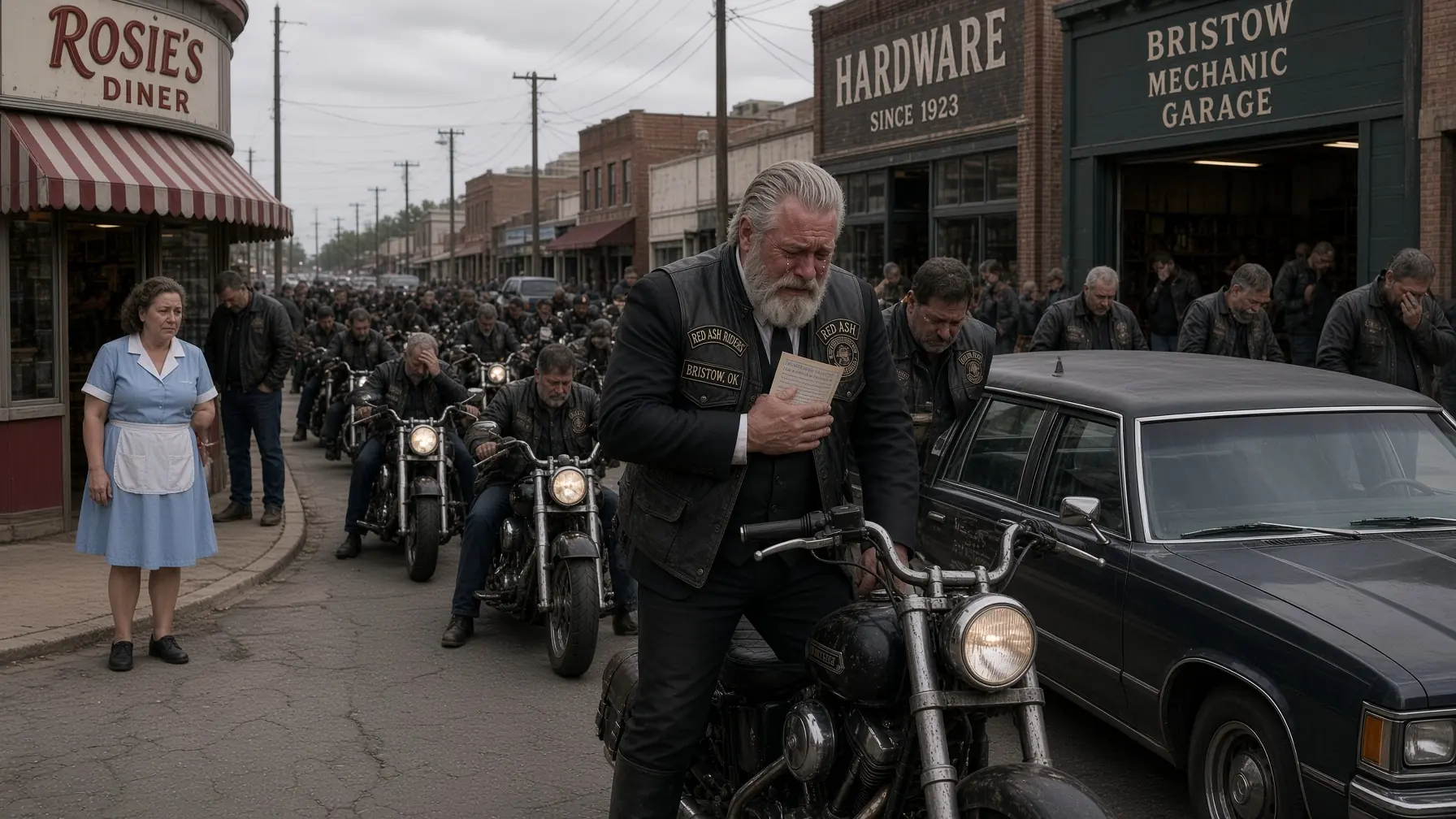
Forty-seven Harley engines rolling together along the old highway, their exhaust merging into a single vibration that seemed to travel through windows, tabletops, and storefront glass.
At Rosie’s Diner, forks paused halfway to mouths.
Across the street, a mechanic walked out of his garage with a rag still in one hand.
The barber stopped cutting hair.
Curtains moved in upstairs windows.
A mother outside the pharmacy pulled her little boy closer when the first motorcycles appeared at the edge of town.
Black leather.
Dark jackets.
Heavy boots.
Silver chains.
Gray beards.
Young faces trying to look older.
Old faces that had stopped trying to look like anything.
Then came the hearse.
Slowly.
Exactly in the middle of the formation.
More motorcycles followed behind it.
Someone outside the hardware store muttered:
“Must’ve been somebody important.”
Another man said:
“Probably their president.”
The waitress at Rosie’s looked at the line of motorcycles and quietly turned the little sign on the door from OPEN to CLOSED.
Nobody asked her to.
Fear rarely waited for instructions.
The procession turned toward First Methodist Church.
At the front rode Graham Beckett.
Sixty-three.
Six-foot-four.
Broad enough across the shoulders that even a black funeral suit could not make him look formal.
A scar crossed his left cheek from an accident decades earlier.
His beard had gone almost completely silver.
He looked exactly like the kind of man strangers moved away from in convenience stores.
Graham stopped his motorcycle beside the hearse.
Killed the engine.
Removed his gloves.
That was when several people watching from across the street noticed something that did not fit the story they had already written about him.
His hands were shaking.
Not slightly.
Badly.
He reached into his coat and removed a small index card folded down the middle.
He held it so carefully that the piece of paper seemed more fragile than anything else in the street.
One of the riders behind him stepped closer.
“You good?”
Graham nodded.
He was not.
The young rider did not challenge the lie.
Nobody did.
Then the funeral director opened the rear of the hearse.
And the men who had arrived sounding like thunder suddenly became very quiet.
Because the person inside was not a biker president.
Not some feared road captain.
Not an outlaw legend.
It was Miriam Beckett.
Graham’s wife.
Seventy-one years old.
Five-foot-three.
Silver-threaded hair.
Reading glasses she had spent thirty years losing and accusing everyone else of moving.
A woman who owned exactly one piece of black leather in her entire life, and it was an old handbag she disliked because the clasp never worked properly.
Most of Bristow had never heard her name.
The forty-seven men outside the church knew it by heart.
Long before the funeral procession entered town, there had been a little white house outside Sapulpa with a screened porch that leaned slightly toward the west.
Two rocking chairs sat beside the door.
One belonged to Graham.
One belonged to Miriam.
Everyone knew which was which because Graham’s chair squeaked whenever he moved and Miriam refused to let anyone fix it.
“I need to know when he’s getting up,” she used to say.
Her herb pots sat beneath the kitchen window.
Rosemary.
Thyme.
Mint that spread everywhere despite her constant attempts to contain it.
The screen door stuck in damp weather.
The porch wind chime made the softest sound imaginable.
And on Thursday evenings, the driveway filled with motorcycles.
Sometimes six.
Sometimes twenty.
Once thirty-two.
Neighbors got used to it.
At first they assumed Graham was holding biker meetings.
They were wrong.
Thursday belonged to Miriam.
Dinner at six.
No invitation required.
No reservation.
No questions.
If you were hungry, you came.
If you were hurting, you came.
If you had just gotten divorced and were pretending it did not matter, you came.
If you were sober three days and afraid there would not be a fourth, you came.
If your son had stopped speaking to you, your boss had fired you, your mother had died, your motorcycle had broken, or you simply could not stand eating another meal alone—
you came.
And Miriam fed you.
Graham met her in 1987.
At the time he was twenty-six and already riding with the Red Ash Riders.
The club was smaller then.
Mostly veterans, mechanics, welders, oil-field workers, truck drivers, and men who liked long roads more than polite conversation.
Graham had been riding since he was sixteen.
He thought that made him interesting.
Miriam disagreed.
Their first conversation happened at a church fundraiser.
Graham arrived late wearing a leather vest because he had not considered changing clothes.
Miriam was serving beans.
He held out his plate.
She looked at him.
“You planning to eat wearing sunglasses?”
“Yes.”
“We’re indoors.”
“I know.”
“You blind?”
“No.”
“Then take them off.”
Graham stared.
Nobody spoke to him that way.
He removed the glasses.
Miriam served the beans.
“Thank you.”
“You’re welcome.”
That was the beginning.
He proposed eleven months later.
She said no.
He waited three weeks.
Proposed again.
She said:
“You didn’t listen very well the first time.”
He waited six months.
Changed jobs.
Stopped drinking whiskey every night.
Started saving money.
Asked again.
Miriam looked at him for almost a full minute.
“What changed?”
“I did.”
“Maybe.”
“Is that a yes?”
“It’s permission to keep trying.”
They married the following spring.
Miriam never became a biker.
She never wanted to.
Graham once offered to buy her a motorcycle.
She looked horrified.
“I married a man who owns enough dangerous machinery for both of us.”
She rode behind him occasionally.
Mostly when they were younger.
Eventually she preferred the pickup.
But somehow she became more important to the Red Ash Riders than most patched members.
It happened slowly.
First, Graham brought two riders home after a long trip.
Miriam made stew.
The next week, five came.
She made more.
A month later, one of the club members, Curtis Lane, crashed outside Tulsa.
Broken collarbone.
Three ribs.
Could not work construction for eight weeks.
His wife had just had their second child.
Miriam organized food.
Not dramatically.
She simply put a sheet of paper on the refrigerator.
CURTIS — DINNERS
Then names.
Monday.
Tuesday.
Wednesday.
Before anyone realized what happened, Curtis’s family had two months of meals covered.
When another rider lost his job, Miriam found him work through a cousin.
When somebody’s house flooded, she organized cleanup.
When a young member named Eric Danner showed up drunk and angry after his father died, he started shouting in her kitchen.
Miriam put down the wooden spoon.
“Not in my kitchen.”
Eric stopped.
Everyone stopped.
He stared at her.
Then broke down crying.
Miriam handed him a dish towel because it was closer than a tissue.
“You can fall apart.”
She told him.
“You just can’t hurt anybody while you’re doing it.”
Eric remembered that sentence twenty-seven years later.
He was one of the forty-seven men outside the church.
Miriam had rules.
Nobody fought in the house.
Nobody arrived drunk enough to frighten people.
Nobody insulted another man’s wife.
Nobody complained about vegetables.
That last one was mostly directed at Graham.
If Miriam learned someone was struggling, she never announced it in front of the group.
She simply adjusted.
One rider had diabetes.
Suddenly there was always a dessert he could eat.
Another had lost most of his teeth.
Miriam began serving softer vegetables without mentioning why.
One man had stomach problems from medication.
His beans stopped containing onions.
Nobody knew except him.
She remembered all of it.
On recipe cards.
Hundreds of them.
Her old wooden recipe box sat beside the stove.
At first glance, the cards looked ordinary.
Chicken and Dumplings.
Beef Stew.
Thursday Beans.
Peach Cobbler.
But on the backs, in Miriam’s small handwriting, were notes.
Eric — no onions if stomach acting up.
Graham pretends he hates carrots. Ignore him.
Luke — extra biscuits. Usually hasn’t eaten lunch.
Roy — half salt. Blood pressure.
Cal — coffee before asking questions.
There were birthdays.
Children’s names.
Sobriety dates.
Food allergies.
Who had lost a parent.
Who had remarried.
Who should never be seated beside whom if everyone wanted a peaceful evening.
Miriam never called the box important.
It was simply how she remembered.
The Red Ash Riders changed over the years.
Some chapters grew.
Some disappeared.
Members came and went.
Graham eventually became president of the Sapulpa chapter.
He held the position for fourteen years.
People assumed that made him the most powerful person in the clubhouse.
The riders knew better.
Once, during an argument over whether a suspended member could return early, Graham and three officers came to his house after midnight.
Miriam walked into the living room in her robe.
She listened for five minutes.
Then said:
“You’re all hungry.”
Graham started:
“Miriam—”
“No.”
She pointed toward the kitchen.
“You haven’t eaten since lunch.”
“How do you know?”
“Because when you’re hungry, you mistake volume for intelligence.”
Twenty minutes later, four grown men were eating reheated pot roast.
They solved the dispute calmly.
Graham later told new members:
“I run the chapter.”
“Miriam runs the temperature.”
Nobody laughed because it was true.
People outside the club saw leather.
Noise.
Tattoos.
Old arrest records belonging to some members.
Arguments.
Road stories exaggerated over beer.
Miriam saw men.
That was her gift.
Not blindness.
She was not naive.
If someone behaved badly, she knew.
If a member frightened his wife, Miriam did not hide it.
If someone stole from another rider, she did not call it brotherhood.
If someone came to her house after hurting somebody, she fed him only after telling him exactly what she thought.
One Thursday, a younger rider bragged about terrifying a clerk who had refused him service five minutes before closing.
Miriam put his plate on the counter instead of the table.
He looked confused.
“Aren’t I eating?”
“You are.”
“Why over here?”
“Because until you understand that frightening a seventeen-year-old girl does not make you important, I don’t want you sitting beside adults.”
The room went silent.
Graham looked down at his plate to hide a smile.
The young man apologized to the clerk the next day.
Not because Graham ordered him.
Because Miriam asked whether he wanted to become the kind of man people warned their daughters about.
The cancer appeared quietly.
Miriam began losing weight.
At first she blamed age.
Then appetite.
Then stomach trouble.
By the time Graham convinced her to see a specialist, pancreatic cancer had already spread.
The oncologist spoke carefully.
Miriam listened without crying.
Graham did enough crying for both of them later.
On the drive home, he gripped the steering wheel until his hands hurt.
Miriam looked through the window.
Finally she said:
“I’m not dead yet.”
Graham nodded.
“No.”
“So stop burying me.”
“I’m not.”
“You are.”
She reached across and opened his right hand from the steering wheel.
“You’ve got me today.”
He looked at her.
“Today.”
“That’s the unit.”
For eleven months, they lived inside that unit.
Today.
Chemotherapy.
Good weeks.
Bad weeks.
Hospital stays.
Thursday dinners became smaller.
Then rarer.
The riders tried taking over.
That was a disaster.
Graham burned cornbread.
Eric oversalted stew so badly everyone drank water all evening.
Three members argued about whether dumplings should be rolled or dropped.
Miriam sat at the table wearing a headscarf and laughed until she coughed.
“Thirty years.”
She said.
“I’ve fed all of you for thirty years and none of you learned anything.”
Eric pointed toward the recipe box.
“Your handwriting is impossible.”
“My handwriting is excellent.”
“You wrote ‘pinch.’”
“How much is a pinch?”
“A pinch.”
“That isn’t a measurement.”
“It has been a measurement longer than you’ve been alive.”
They kept trying.
That mattered.
Near the end, Miriam stopped coming downstairs.
Graham moved a chair beside the bed.
Riders visited one or two at a time.
No motorcycles revved in the driveway.
Nobody stayed too long.
Men who had once walked confidently into dangerous situations stood outside the bedroom door frightened to enter.
Miriam usually called:
“If you’re going to stand in the hallway like a burglar, at least bring coffee.”
Then they came in.
One by one.
Eric thanked her for the night his father died.
Roy thanked her for helping his family when he went to rehab.
Luke Danner thanked her for letting him sleep on the couch for three months after his marriage collapsed.
Another man could not speak at all.
Miriam held his hand.
“You don’t have to.”
He nodded.
Cried.
Left.
Graham watched all of it.
Some part of him had always known she mattered to the club.
He had never understood the scale.
Then, three days before she died, Miriam asked for the recipe box.
Graham brought it upstairs.
She spent almost an hour going through cards.
He sat beside her.
“What are you doing?”
“Organizing.”
“For what?”
“You know.”
“No.”
She looked at him.
He hated when she did that.
The look meant:
Stop making me say something just because you don’t want it to be true.
Graham looked away.
Miriam removed one recipe card.
Folded it.
Handed it to him.
“Keep this.”
“What is it?”
“Don’t read it yet.”
“Miriam.”
“Graham.”
He put it into his wallet.
“Bossy woman.”
“Slow learner.”
She smiled.
Three days later, just before dawn, Miriam Beckett died with Graham holding her left hand.
The recipe card remained in his wallet.
He could not bring himself to open it.
The funeral home asked how many people would attend.
Graham said:
“Maybe fifty.”
That was wrong.
Word spread through Red Ash chapters across Oklahoma, Arkansas, Kansas, Missouri, and Texas.
Men who had eaten at Miriam’s table twenty-five years earlier changed work schedules.
One drove from Amarillo overnight.
Another came from Wichita.
Two former members who had not spoken to Graham in nine years rode in separately and stood on opposite sides of the parking lot.
Miriam had fed both.
For one day, that was enough.
The funeral director called Graham.
“We’re getting requests from people asking whether motorcycles are permitted.”
Graham said:
“They are.”
“How many?”
“I don’t know.”
Forty-seven arrived for the procession.
More came directly to the church.
Inside First Methodist, the townspeople finally saw the casket.
It was open.
Miriam wore a simple blue dress.
No leather.
No club symbols.
Her silver hair had been arranged the way she wore it before chemotherapy.
Her reading glasses rested folded beside her.
And across her hands lay a white kitchen apron.
Not a ceremonial object.
Her actual apron.
Small coffee stain near the pocket.
One repaired strap.
A faint yellow mark from turmeric that never washed out completely.
Beside it sat the old wooden recipe box.
People entering the church slowed when they saw it.
The bikers stopped completely.
Eric Danner covered his mouth.
Roy looked down.
Luke began crying before he reached the first pew.
Graham stood beside the casket.
His hands still shook.
A woman from town whispered:
“Who was she?”
The funeral director answered quietly:
“Apparently everybody’s mother.”
Not literally.
But close enough.
The service began.
The pastor knew Miriam from years earlier.
He spoke about kindness.
Faith.
Marriage.
Ordinary acts repeated until they became a life.
Then he invited anyone who wished to speak.
For ten seconds, nobody moved.
Then Eric stood.
He looked terrifying to half the room.
Six-foot-one.
Bald.
Full beard.
Tattoos running onto both hands.
He reached the lectern.
Opened his mouth.
Nothing came out.
He tried again.
“Miriam fed me the night I decided not to kill myself.”
The church became utterly still.
Graham looked up.
He had never known.
Eric continued.
“My father died.”
“My marriage was failing.”
“I had a gun in my truck.”
“I came to Graham’s house because I thought I wanted somebody to drink with.”
“Miriam took one look at me and said I wasn’t driving anywhere.”
“She made coffee.”
“Then eggs.”
“I told her I wasn’t hungry.”
“She said that wasn’t the question.”
A few riders smiled through tears.
Eric swallowed.
“She sat with me until sunrise.”
“She never told anyone why.”
“Not even Graham.”
Graham’s face broke.
Eric looked toward the casket.
“She saved my life.”
Then he stepped down.
Another rider spoke.
Then another.
One told how Miriam paid his electric bill anonymously after a workplace injury.
Another said she taught him to make biscuits after his wife died because his twelve-year-old daughter missed her mother’s breakfast.
One remembered Miriam sitting with him outside a rehab clinic for forty minutes because he was too frightened to walk inside alone.
A former member said:
“I left the club angry.”
“Miriam called every Christmas anyway.”
The townspeople who had locked doors when the motorcycles arrived began looking at the men differently.
Not because leather suddenly meant goodness.
It did not.
Because human beings became harder to summarize once their stories were visible.
Graham was the final speaker.
He approached carrying the folded recipe card.
For almost a minute, he simply stood there.
Then:
“Miriam gave me this three days before she died.”
He held up the card.
“She told me not to read it.”
“I assumed she meant until after.”
A few people laughed softly.
“I still haven’t.”
He looked toward the casket.
“I’m afraid to.”
The honesty hit him harder than he expected.
His voice broke.
“I have kicked doors down.”
“I’ve been in fights I’m ashamed of and a few I’m not.”
“I’ve broken bones.”
“I’ve buried friends.”
“I sat beside her through eleven months of cancer.”
“And somehow this…”
He held up the little card.
“…is the thing I’m scared of.”
Eric said quietly from the first pew:
“Read it.”
Graham looked at him.
Then unfolded the card.
The front contained a recipe.
Thursday Beef Stew
Underneath:
Beef chuck.
Potatoes.
Carrots.
Celery.
Onion.
Tomato paste.
Stock.
Thyme.
Salt.
Pepper.
Nothing remarkable.
Graham smiled through tears.
“She knew I hated carrots.”
A few riders laughed.
Then he turned the card over.
His expression changed.
Miriam had written on the back.
Graham read silently first.
Then again.
He tried to speak.
Couldn’t.
The pastor approached.
Graham shook his head.
He would do it himself.
Finally he read:
“Graham—
If you’re reading this, you’ve probably decided nobody in Oklahoma can cook anymore.”
Laughter moved through the church.
Graham continued.
“Thursday was never about dinner.”
The laughter disappeared.
“The food only gave men an excuse to come through the door.”
Graham stopped.
His hands shook harder.
Then:
“Keep the table.”
“Not the recipes.”
“The table.”
“If somebody is hungry, feed him.”
“If somebody is angry, let him cool down before he ruins his life.”
“If somebody disappears, go find him.”
“And for heaven’s sake, teach those men how to cook because I refuse to spend eternity watching Eric destroy another pot roast.”
Eric laughed while crying openly.
Graham continued:
“You spent your life believing you had to protect everyone with your hands.”
“Sometimes people need protecting with a chair, a plate, and somewhere safe enough to tell the truth.”
Then the final line.
Graham almost whispered it.
“Do not let my kitchen die because I did.”
He lowered the card.
No one in the church moved.
The burial took place outside Bristow beneath a gray Oklahoma sky.
Forty-seven motorcycles stood silent.
No engines.
No music from speakers.
No unnecessary noise.
Graham placed the recipe card into his breast pocket.
When the service ended, he remained beside the grave until almost everyone left.
Eric stood nearby.
Finally he asked:
“What are you going to do?”
Graham looked at him.
“About what?”
“Thursday.”
Graham stared.
“Miriam’s gone.”
“I know.”
“I can’t cook.”
“We established that.”
Eric kicked at the dirt.
“She said keep the table.”
Graham looked toward the road.
The riders were preparing to leave.
Men gathering helmets.
Pulling on gloves.
Returning to whatever waited at home.
Some had wives.
Some empty apartments.
Some good lives.
Some lives coming apart quietly.
Graham understood.
Thursday had never been about Miriam showing them she could cook.
It had been infrastructure.
A bridge disguised as dinner.
Once a week, men who had been trained by life to disappear when they hurt were given somewhere they were expected to appear.
If somebody stopped coming, people noticed.
Graham looked at Eric.
“Six o’clock.”
Eric nodded.
“Thursday?”
“Thursday.”
“What are we cooking?”
Graham considered.
“Stew.”
“With carrots?”
“Don’t push it.”
The first Thursday after the funeral was awful.
Twelve men arrived.
Three brought food because they correctly assumed Graham would fail.
The stew burned slightly.
The biscuits came from a tube.
Somebody forgot coffee.
The table looked wrong without Miriam.
Her chair remained empty.
Halfway through dinner, nobody spoke.
Then Luke said:
“I hate this.”
Graham looked at him.
“The food?”
“No.”
“This.”
He pointed toward Miriam’s chair.
Graham understood.
“So do I.”
Silence.
Then Eric stood.
Walked to the old wooden recipe box.
Opened it.
“What did she make when Luke got dumped?”
Luke glared.
“I did not get dumped.”
“Your wife changed the locks.”
“Temporary misunderstanding.”
Eric found a card.
“Chicken and dumplings.”
On the back, Miriam had written:
Luke — extra pepper. Don’t ask about marriage until he asks first.
The room went quiet.
Luke stared.
Then laughed.
A deep, helpless laugh that turned into crying.
That opened the door.
One card after another.
Roy — less salt.
Eric — watch him in November. Father died then.
Graham — pretending not to worry means worrying.
Cal — send leftovers home. Won’t ask.
Miriam had been keeping them alive in margins.
Not with speeches.
With reminders.
Food.
Observation.
Small adjustments.
The recipe box was not a collection of meals.
It was a map of people.
Thursday continued.
At first because Miriam told them to.
Later because they needed it.
The Red Ash Riders changed too.
Not dramatically.
Not overnight.
They still rode loud motorcycles.
Still told bad jokes.
Still argued.
Still looked intimidating to strangers.
Miriam’s death did not magically turn complicated men into saints.
But Graham began asking a new question during chapter meetings.
“Who haven’t we seen lately?”
Sometimes the answer meant nothing.
Work.
Vacation.
Family.
Sometimes it mattered.
A member named Danny stopped showing up.
Two riders went to his apartment.
They found him three days into a drinking relapse.
They took him to treatment.
Another man lost his job and told nobody.
Thursday dinner revealed it when he quietly put half his food into a napkin for later.
Graham remembered Miriam’s card.
They found him work.
A young prospect started coming early simply to help chop vegetables.
Nobody mocked him.
At least not much.
The story of Miriam’s funeral spread around Bristow.
The waitress at Rosie’s who had locked the door felt embarrassed.
Weeks later, Graham stopped for coffee.
She approached his booth.
“Mr. Beckett?”
“Graham.”
“I owe you an apology.”
“For what?”
“The funeral.”
She explained.
The motorcycles.
The fear.
Locking the door.
Graham listened.
Then shrugged.
“Forty-seven motorcycles coming down Main Street can be a lot.”
“That doesn’t excuse assuming—”
“No.”
He looked at her.
“But fear is information.”
“What you do with it comes next.”
She nodded.
Then:
“Who was she?”
Graham smiled.
“My wife.”
“I know.”
“I mean…”
The waitress struggled.
“Why did all those men come?”
Graham looked into his coffee.
“Because she remembered what they needed before they learned how to ask.”
The waitress did not completely understand.
That was all right.
It had taken Graham thirty years.
One year after Miriam died, the Red Ash Riders held a memorial ride.
Not for the club.
For a women’s shelter outside Tulsa and a veterans’ food program Miriam had quietly supported for years.
No giant portrait.
No dramatic speeches.
At Graham’s insistence, the ride ended at his house.
Forty-three motorcycles crowded the driveway.
The porch sagged under too many boots.
Inside, pots covered every burner.
Eric had finally learned pot roast.
Almost.
Luke made dumplings.
Graham made stew.
He still removed several carrots from his own bowl.
A young rider caught him.
“Miriam’s card says you’re supposed to eat those.”
Graham pointed toward the door.
“My house.”
The young man smiled.
“Miriam’s kitchen.”
The room erupted.
Graham looked toward the empty chair at the end of the table.
Then smiled too.
“Fair.”
He ate the carrot.
Years passed.
The Thursday table grew.
Then shrank.
Then grew again.
Old riders died.
Young riders joined.
Some brought wives.
Children.
Neighbors.
Stranded travelers.
A delivery driver once arrived at six fifteen with a package and somehow ended up eating chili.
Nobody remembered inviting him.
That would have pleased Miriam.
The recipe cards wore out from use.
Graham had them copied.
The originals returned to the wooden box.
He never allowed anyone to laminate them.
“They’re supposed to feel like her hands touched them.”
When Graham eventually stepped down as chapter president, his replacement asked what traditions absolutely had to continue.
Graham listed safety rules.
Funeral support.
Emergency funds.
Then:
“Thursday.”
The new president smiled.
“That’s not official club business.”
Graham looked at him.
“It’s the most important club business we do.”
Five years after Miriam’s death, another funeral procession rode through Bristow.
Fewer motorcycles this time.
Twenty-nine.
A former Red Ash Rider named Roy Bennett had died from heart disease.
People in town stepped outside as the procession passed.
The reaction was different.
Not because everyone suddenly loved motorcycles.
Some still hated the noise.
But Rosie’s Diner did not lock its door.
The mechanic across the street removed his cap.
An older woman outside the pharmacy bowed her head.
At the cemetery, Graham noticed a young boy watching the riders.
The boy’s mother whispered something to him.
The child asked loudly:
“Are those the guys with the dinner?”
Graham almost laughed.
That was what the club had become known for locally.
Not feared road kings.
Not dangerous strangers.
The guys with the dinner.
Miriam would have considered that progress.
Graham lived eight years after her.
His beard turned white.
His hands became stiff.
He rode less.
Eventually he stopped.
The motorcycle remained in the garage.
Thursday continued.
On his final birthday, Eric gave him a framed copy of Miriam’s note.
Graham stared at it.
“You framed a recipe card?”
“The back.”
“I know what’s on the back.”
“Then stop complaining.”
Graham hung it beside the kitchen doorway.
The final line sat at eye level.
Do not let my kitchen die because I did.
Graham read it every Thursday.
After he was gone, the house eventually passed to relatives.
The Red Ash Riders could no longer use Miriam’s kitchen.
For several weeks, Thursday stopped.
People assumed the tradition had ended.
Then Eric Danner opened the clubhouse one evening.
He pushed two long tables together.
Set out folding chairs.
Put a pot on the stove.
Luke arrived with biscuits.
A younger rider brought coffee.
Someone placed Miriam’s wooden recipe box in the middle of the table.
At six o’clock, they ate.
Not because they had nowhere else to go.
Because they had learned why Miriam made sure there was always somewhere to go.
That distinction became the real inheritance.
People who remembered the funeral still told the story incorrectly.
They said forty-seven dangerous bikers rode into Bristow to bury some powerful woman.
That was not true.
Miriam Beckett had possessed almost no formal power.
She never led the Red Ash Riders.
Never wore their patch.
Never voted in their meetings.
Never commanded a convoy.
She did something less visible.
And far more difficult.
She created a place where men who spent the rest of their lives pretending they needed nothing were allowed to need one another.
Food was merely the language she chose.
The old wooden table was never just furniture.
It was an excuse to show up.
The recipe cards were never just recipes.
They were records of attention.
And the forty-seven motorcycles that shook Bristow on the morning of her funeral were not announcing the burial of a feared biker queen.
They were carrying forty-seven pieces of evidence that one quiet woman had mattered.
That was why Graham’s hands shook.
That was why hardened men cried beside an apron.
That was why a recipe card frightened him more than any fight ever had.
Because he knew how to protect people from danger.
Miriam had spent thirty years teaching him something harder.
How to protect people from being alone.
And when the funeral was over, she left him one final instruction.
Not to preserve her house.
Not to preserve her cooking.
Not even to preserve her memory.
Just the thing beneath all of it.
Keep the table.