The last thing Ryder Callahan expected to find at the edge of death was a child holding a candle. Six men, a dead mountain road, a blizzard that didn't care who they were or how many wars they'd survived. The Harleys had gone silent one by one, like soldiers falling in formation, engines choking on ice, throttles going stiff, machines that had never failed them failing all at once. Ryder stood in the white nothing, snow cutting his face like shrapnel, and understood with cold clarity that the mountain was going to win tonight. 7 months of disappearances, a land gone silent.
And somewhere out in the dark, something small, something impossible, something standing where nothing should be able to stand. A single flame burning against the storm. He didn't know yet that the flame belonged to an 8-year-old girl who had been surviving alone since April. He didn't know yet that she would save all of them. And he didn't know yet that someone had made sure he would end up here.
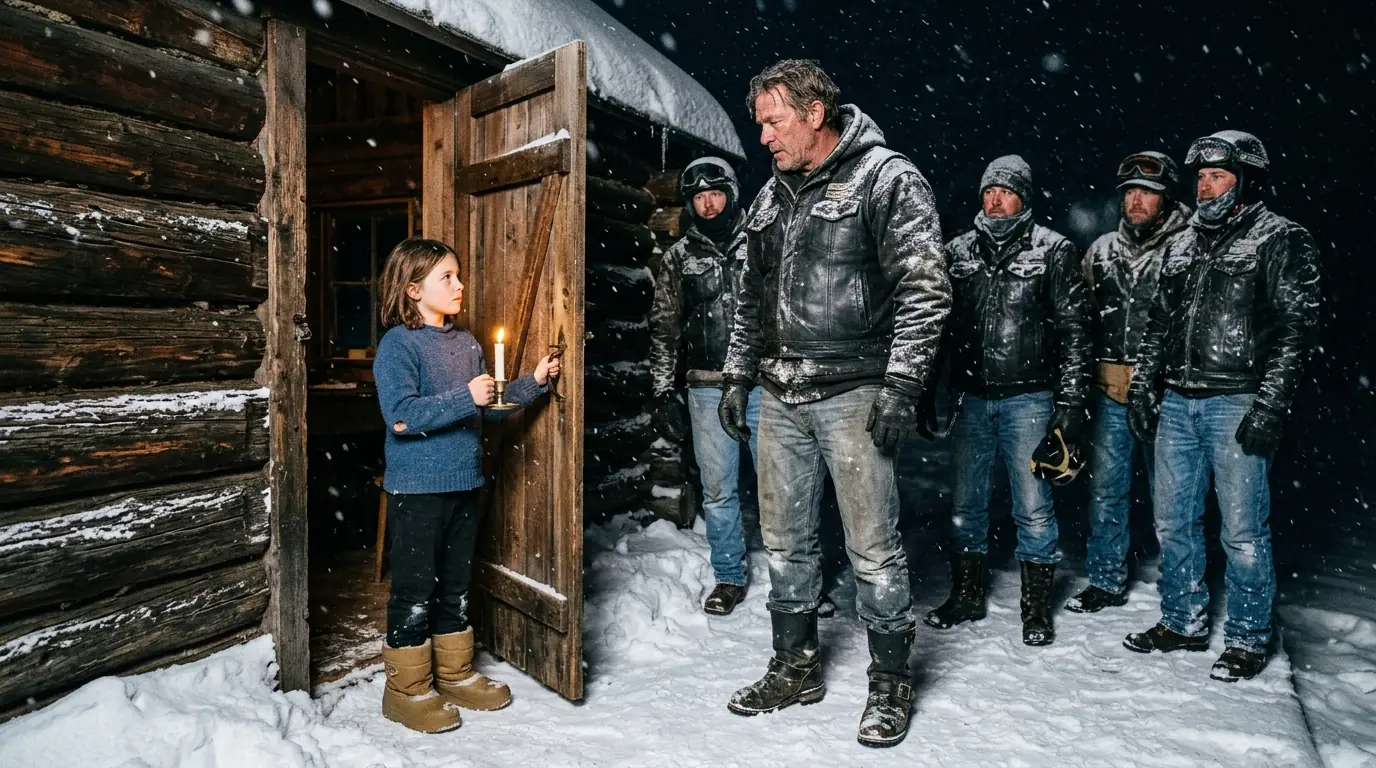
Made sure all six of them would end up here, helpless, freezing, walking straight into the middle of a secret that powerful men had spent months trying to bury. But the candle was burning, and Ryder Callahan walked toward it. The storm came down off the Rockies the way bad news always came, fast, without warning, and worse than anything the forecast had promised. By the time Ryder Callahan's crew hit the switchbacks above Ridgeline Pass, the temperature had dropped 20° in 40 minutes, and the road had turned into something that wasn't a road anymore. It was a white wall, a moving thing. wind that didn't push so much as it pressed, leaning on the bikes with the steady, malicious patience of something that had all the time in the world and knew it.
Ryder rode point the way he always did, not because anyone had given him the position, but because the men behind him had learned years ago that Ryder Callahan was the kind of man who walked into rooms first and checked them before anyone else had to. His Harley Road King was a 2009 model he'd rebuilt three times with his own hands. every scar on the chrome earned, every repair a memory. He knew the sound of that engine the way he knew his own heartbeat. Which is why when it started missing on the downstroke somewhere around mile marker 42, he felt it in his chest before he heard it with his ears. He throttled back, listened.
The missing beat came again, a hollow skip like a stone bouncing off ice, and then the engine smoothed and he thought, "Maybe nothing. Maybe the cold. Maybe his nerves playing games the way nerves did when the weather got bad enough and the road got empty enough and the dark pressed in close enough to make a man start imagining ghosts. Church pulled up alongside him. Church's real name was Charles William Bowmont, but nobody had called him that since 1987.
He was 53 years old, built like a man who had absorbed a great deal of punishment and converted it all into scar tissue and patience. He drove a soft tail he'd bought off a widow in New Mexico and never named because Church didn't name things he might have to leave behind. He leaned close, his voice barely carrying over the wind. Your engine sounds wrong. I know.
How wrong? Ryder didn't answer. The answer came 4 seconds later when the road king shuddered once deeply like a horse refusing a jump and died. not sputtered, not stalled, died completely, suddenly with a finality that Ryder had only heard from machines that were done. He coasted to the shoulder and put his boots down and sat there in the white roaring dark, listening to the wind and the distant sound of the other five bikes pulling up behind him. Marco first, then Earl, then Tommy, and Jake together, because those two always rode in tandem, even when the roads were good. six motorcycles on the shoulder of a mountain road with 17 mi to the nearest town and a storm that was showing no interest in stopping.
Marco Vega climbed off his bike and crouched beside Ryder's engine without being asked. He was 38, the youngest of the crew by 4 years, and he had a mechanical mind that other men paid for and envied. He pulled off his glove, the wrong move in this temperature. But Marco always worked with bare hands because he said gloves made him stupid and put his fingers against the engine block. His face did the thing it did when something was wrong.
The jaw went slightly tight. The eyes went slightly flat. Fuel lines compromised, he said. From what? Marco didn't answer immediately.
He turned something over in his fingers, a small fitting barely the size of a coin, and held it up in the thin beam of Tommy's headlight. "This was cracked deliberate," he said quietly. "That's not cold damage. That's a tool mark. " Nobody said anything. The wind said enough.
Earl Hutchkins was the oldest of them at 61, a Korean War legacy kid who'd grown up watching his father come home wrong and had spent 40 years trying to understand what wrong looked like in himself. He stood with his hands in his jacket pockets and looked up the road the way men look when they're measuring something they can't see. Rest of the bikes, he said. Tommy checked his, Jake checked his. The diagnosis spread down the line in low voices and tight expressions.
Not all of them, not as catastrophic as writers, but enough. Enough loose connections, enough tampered seals, enough small deliberate sabotage that riding the 17 mi to town in this storm would be asking to die on the asphalt. Rider's bike was the worst. Churches was second. Between the six machines, they had maybe three that could make a careful run.
And careful meant slow. And slow in this storm meant dangerous in ways that math could demonstrate, but pride kept trying to argue with. Ryder stood in the snow and looked at the mountain and felt something he hadn't felt in a long time, which was the specific helplessness of a man who has survived extraordinary things and is being beaten by an ordinary one. Cold, wind, bad luck, or something that was dressed like bad luck and moved like bad luck, but smelled underneath like something with a plan. Someone knew we were coming through here, Church said.
Not a question. Nobody knew we were coming through here, Ryder said. Then someone knew we were coming through somewhere and covered the options. Church pulled his collar up. We're 17 mi from the nearest gas station and the temperatures dropping.
We stay out here long enough, the conversation stops mattering. Tommy Briggs was the quiet one, which was notable because none of them were particularly loud. He was 44, had a face that had taken more than its share of damage and healed in ways that changed the geometry, and he communicated mostly in single words, and the occasional sentence when the situation seemed to require more than one. He looked up from where he'd been scanning the treeine and said, "Light. " They all looked through the snow and the dark and the swaying shapes of pine trees bending under the weight of the storm. There was a light, faint, flickering, not electric, too unsteady, too warm in its color, the kind of light that came from fire rather than wire.