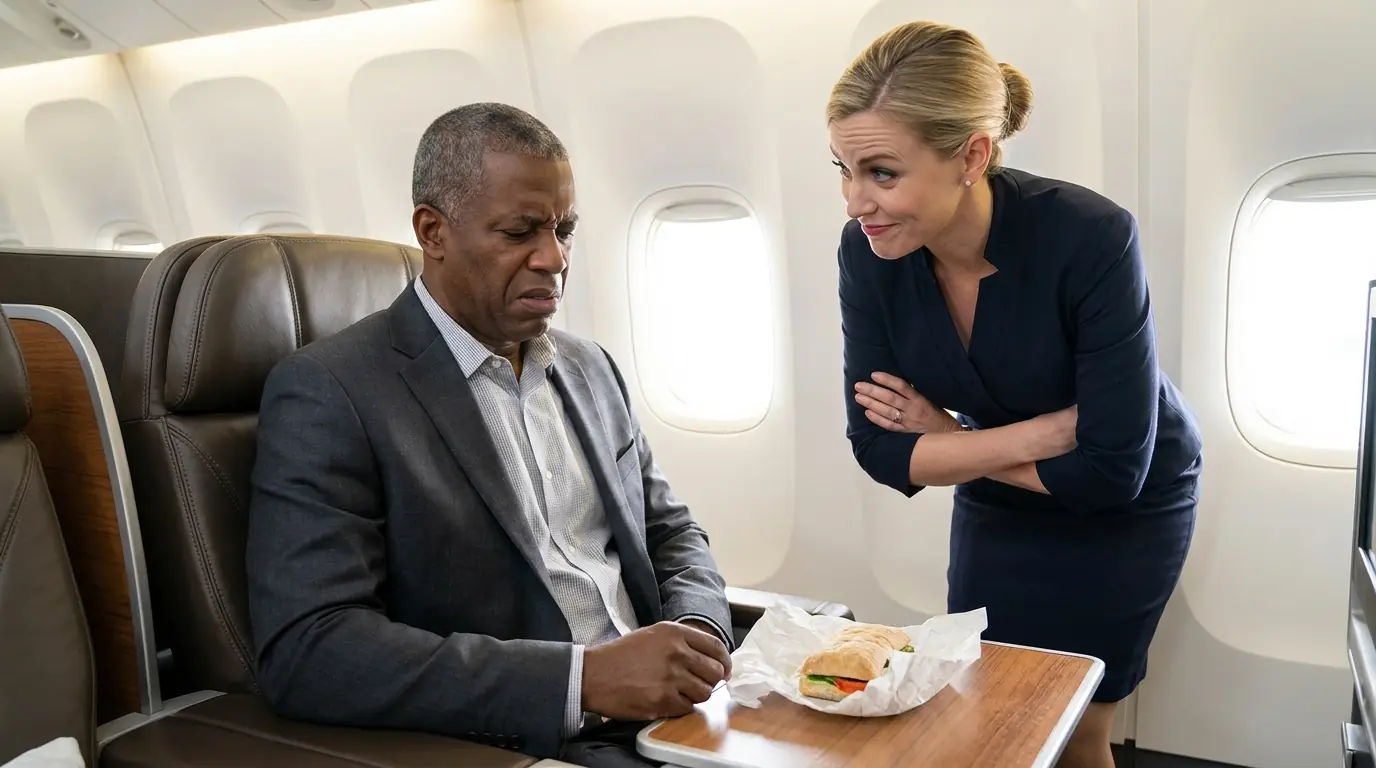
The moldy sandwich landed on Marcus Reynolds’s first-class tray with such casual contempt that, for several seconds, he simply stared at it.
Across the aisle, a silver-haired passenger was eating seared salmon from white china.
Behind Marcus, a couple shared a bottle of wine.
Fresh bread sat in a basket two rows ahead.
And in front of Marcus was a dry sandwich on stale white bread, one corner already curling upward.
Flight attendant Clare Wilson placed a small cup of apple juice beside it.
“There.”
Marcus looked up.
Clare was forty-two, experienced, polished, and smiling in a way that was not remotely friendly.
“I believe there’s been a mistake,” Marcus said.
Clare’s eyes moved over him.
Dark tailored suit.
White shirt.
Expensive watch.
Black skin.
Her smile tightened.
“That’s what’s available.”
Marcus did not raise his voice.
“I pre-ordered the chef’s special.”
“Then the system must have made an error.”
Marcus glanced around the cabin.
Every other first-class passenger seemed to have received exactly what they ordered.
He lifted the top slice of bread.
A patch of green-gray mold spread along the underside.
Marcus closed the sandwich.
Then he looked at Clare again.
“This bread is spoiled.”
She barely glanced at it.
“I don’t see anything.”
Marcus pressed the call button above his seat.
Clare’s expression hardened.
“Sir, if you don’t like the meal, you don’t have to eat it.”
“I’m asking for the meal I paid for.”
“And I’m telling you we don’t have it.”
Her voice dropped lower.
“Some people should learn to be grateful for what they’re given.”
The sentence was quiet enough that she might later deny it.
But not quiet enough.
The man across the aisle stopped eating.
Marcus noticed.
So did Clare.
For just a moment, their eyes met.
Then she turned and walked toward the galley.
Marcus watched her disappear behind the curtain.
He did not chase her.
Did not shout.
Did not demand a manager.
Instead, he took out his phone and typed one sentence to his executive assistant.
Jessica. Keep your phone close. Something is wrong on Flight 347.
Then he looked up toward the small dark lens built unobtrusively into the premium-cabin ceiling.
Three months earlier, Marcus had personally approved the pilot program that put it there.
Clare Wilson had no idea.
And that was the first mistake she made that afternoon.
Elite Airways Flight 347 had left New York shortly after noon, bound for San Francisco.
Marcus Reynolds occupied seat 2A.
At fifty-one, he had spent almost three decades building Reynolds Technologies from a small software consultancy into a national infrastructure and enterprise-services company.
He was not famous in the way actors or athletes were famous.
But in corporate circles, his name carried weight.
Three years earlier, one of Reynolds Technologies’ investment partnerships had acquired a significant minority stake in Elite Airways during a restructuring.
Marcus had taken a board seat through the investment group but deliberately stayed out of public advertising and day-to-day operations.
Most Elite employees had never seen his face.
That was intentional.
He preferred seeing businesses from places where people did not know they were being observed by someone powerful.
He flew the airline frequently.
Booked under his own name.
Paid normal published fares.
Did not request executive treatment.
His philosophy was simple.
If you wanted to know what customers experienced, occasionally you had to become one.
That morning, Marcus had boarded expecting nothing more interesting than six quiet hours reviewing quarterly numbers before meetings in San Francisco.
He noticed Clare immediately.
Not because she was rude.
Because she was selectively warm.
“Welcome aboard, Mr. Wittman,” she had said to the older white man across the aisle. “Champagne?”
Then she reached Marcus.
“Towel?”
No welcome.
No beverage offer.
Marcus accepted the towel.
“Thank you.”
Clare moved behind him and immediately brightened again.
“Mrs. Harper, wonderful to see you.”
Marcus noticed.
Then dismissed it.
One interaction proved very little.
Ten minutes later, almost every passenger around him had a pre-departure drink.
Marcus did not.
He pressed the call button.
Clare returned.
“Yes?”
“I believe I’m still waiting for the Macallan I pre-ordered.”
Her eyebrows lifted slightly.
“I don’t see that in our system.”
Marcus opened the confirmation email on his tablet.
“It’s here.”
Clare barely looked.
“We’re low on premium beverages.”
Marcus glanced toward the galley cart.
He could see the bottle.
“I can offer orange juice,” Clare continued.
“Could you please check again?”
Her face cooled another degree.
“I already told you what’s available.”
She turned away.
A minute later, Marcus watched her pour the same whisky he had requested for another passenger.
That was when he sent Jessica his first real message.
Please pull premium-cabin service complaints for the last twelve months. Specifically unequal-service or discrimination complaints. Don’t contact anyone yet. Just gather.
Her answer came fifteen minutes later.
17 formal complaints involving minority passengers in premium cabins. Five name Clare Wilson. Three closed insufficient evidence. Two resolved with travel vouchers. Pulling details.
Marcus read the message twice.
Now the problem was no longer a drink.
After takeoff, Clare distributed warm mixed nuts.
Marcus received pretzels in a sealed economy packet.
Again, he said nothing immediately.
He recorded the time.
The passenger across the aisle noticed.
His name was Harold Wittman, a retired investment banker in his late sixties.
He leaned slightly toward Marcus.
“That’s odd.”
Marcus looked at him.
“What is?”
Wittman nodded toward the pretzels.
“Everybody else got the warm nuts.”
Marcus gave a small smile.
“I noticed.”
Wittman watched Clare move away.
“You complain?”
“I asked once.”
“What did she say?”
“Limited stock.”
Wittman looked at the full bowl on her cart.
Neither man needed to say more.
Marcus reopened his tablet.
The quarterly reports showed Elite’s premium-cabin customer satisfaction had risen four percent year over year.
On paper, things looked good.
But averages had always bothered Marcus.
An average could rise while a specific group’s experience deteriorated.
A company could congratulate itself with numbers that concealed exactly the people it had failed.
That was why he had pushed for better complaint analytics.
And why the airline had recently installed a limited monitoring system in premium cabins and galley areas.
The system had been controversial internally.
It did not record lavatories or private passenger screens.
It was disclosed in employee policies and used primarily to investigate security events, service disputes, and serious complaints.
Marcus had argued for it after repeated cases in which passengers and crew gave completely contradictory accounts and there was no evidence beyond memory.
Today, for the first time, he found himself personally depending on it.
Jessica messaged again.
The five Clare complaints show similar themes: premium items “unavailable,” dismissive language, passengers described as aggressive after asking for corrections. No conclusive evidence in prior cases. Diane Chen in HR can pull the files if you authorize.
Marcus replied:
Authorize discreet review. Preserve Flight 347 footage immediately. Do not intervene yet unless safety becomes an issue.
He wanted to know how far the behavior went when Clare believed there would be no consequence.
He hated himself slightly for even thinking that.
No one should need to endure more mistreatment to prove mistreatment already happened.
But Marcus had spent enough years in executive meetings to know what would happen if evidence remained ambiguous.
Someone would call it tone.
Someone would call it misunderstanding.
Someone would say both sides contributed.
He wanted facts.
The meal service arrived twenty minutes later.