The moldy sandwich landed on Marcus Reynolds’s first-class tray with a soft, ugly thud.
The flight attendant did not apologize.
She did not explain why every other passenger had received white china, polished silverware, fresh bread, and carefully prepared entrées while he had been handed a dry sandwich wrapped in thin plastic.
Instead, Claire Wilson looked down at him with a faint, satisfied smile.
“Your meal,” she said.
Marcus slowly lifted the top slice of bread.
Dark green spots covered the underside.
A sour smell rose from the plate.
Across the aisle, an elderly gentleman paused with a forkful of seared salmon halfway to his mouth. The woman seated behind Marcus leaned forward, trying to see what had been placed in front of him.
Claire had already turned away.
Marcus did not call after her immediately.
He reached into the inside pocket of his custom-tailored jacket and removed his phone. With one calm movement, he opened a secure application and confirmed that the surveillance system in the premium cabin was active.
The cameras were recording.
So were the microphones hidden near the galley curtain.
Claire did not know that Marcus had personally approved the system three months earlier.
She also did not know that the quiet passenger in seat 2A was not simply a successful businessman traveling to San Francisco.
He was one of the largest private investors in Elite Airways.
And every dismissive glance, every whispered insult, and every deliberate act of humiliation was being preserved on servers she could not reach.
Marcus set the phone beside his tablet and pressed the call button again.
His face showed no anger.
Only patience.
That patience would soon prove far more dangerous to Claire’s career than any shouted confrontation.
Six hours earlier, Marcus had arrived at John F. Kennedy International Airport expecting an uneventful business trip.
At fifty-two, he had spent more than two decades building Reynolds Technologies from a small software-consulting company into one of the most respected digital infrastructure firms in the country.
He had become accustomed to private cars, executive lounges, and first-class cabins, but he had never allowed luxury to become proof of his worth.
He remembered too clearly the years when people had looked past him in boardrooms, assumed he was an assistant, or asked whether he had entered through the correct door.
Those experiences had taught him two things.
Never confuse politeness with weakness.
And never make an accusation without evidence strong enough to survive the denial that would follow.
Marcus boarded Elite Airways Flight 347 early and settled into seat 2A.
He chose the seat deliberately.
Three years earlier, his investment group had acquired a significant ownership position in Elite Airways. Marcus had remained a silent partner, preferring to influence the company through strategy, technology, and board decisions rather than public appearances.
He often traveled anonymously on the airline.
Quarterly reports could tell him how much money the company made.
Customer surveys could tell him how passengers described their experiences.
But neither could show him what employees did when they believed no executive was watching.
As the first-class cabin filled, Marcus opened his tablet and began reviewing Elite Airways’ latest performance report.
Premium bookings had risen fifteen percent.
Customer retention was improving.
Complaints appeared to be declining.
The numbers looked encouraging.
Then Claire Wilson approached the silver-haired passenger across the aisle.
“Welcome aboard, Mr. Whitman,” she said warmly. “May I offer you a glass of our signature champagne before departure?”
Thomas Whitman smiled.
“That would be wonderful.”
Claire placed a linen napkin beside his hand and offered him a heated towel with metal tongs.
When she reached Marcus, her expression changed.
The smile disappeared.
Her eyes moved briefly over his face, his dark skin, and his expensive suit before settling somewhere above his shoulder.
“Towel?”
“Yes, thank you.”
She dropped the rolled towel into his hand instead of presenting it with the tongs.
Then she walked away.
Marcus watched her move to the passengers behind him.
Her voice immediately became brighter.
“Welcome aboard. Champagne or sparkling water?”
Marcus said nothing.
One difference in tone could be explained.
One forgotten drink could be an accident.
He returned to his report.
Ten minutes passed.
Every other passenger in the first-class cabin received a beverage.
Marcus had preordered a glass of Macallan 18, a small ritual he allowed himself on long flights. His confirmation email listed the request clearly.
His tray remained empty.
He pressed the call button.
Claire returned several minutes later.
“Yes, sir?”
“I believe I am still waiting for the beverage I ordered.”
She glanced toward the galley.
“I’m not seeing anything in our system.”
Marcus opened the confirmation email on his tablet.
“It appears here.”
Claire barely looked.
“We have limited premium stock today.”
Marcus glanced past her toward the fully loaded beverage cart.
“I can see several unopened bottles.”
“Those may already be assigned to other passengers.”
“My request was confirmed when I purchased the ticket.”
Claire’s mouth tightened.
“I can bring you orange juice or water.”
Before Marcus could respond, she walked away.
A moment later, he heard laughter behind the galley curtain.
Another flight attendant looked toward him and quickly looked away.
Marcus opened the secure messaging application he used with his executive assistant.
Jessica, please note a possible service discrepancy on Flight 347. It may be nothing. Ask Diane in Human Resources whether this crew has received prior complaints.
Jessica replied less than a minute later.
Understood. I’ll check.
The aircraft began taxiing.
Claire moved through the cabin distributing warm mixed nuts in small porcelain dishes.
Thomas Whitman received almonds and cashews with a folded napkin.
The couple behind Marcus received the same.
Claire placed a sealed economy-class packet of pretzels on Marcus’s tray.
She did not pause.
Marcus looked at the packet.
The pattern was becoming difficult to dismiss.
He sent Jessica another message.
Also confirm that the premium-cabin surveillance system is active on this aircraft.
The reply came as the plane accelerated down the runway.
Installed fleetwide three months ago. Flight 347 is fully operational. Audio and video are stored for thirty days.
Marcus watched New York fall away beneath the wing.
Stay near your phone.
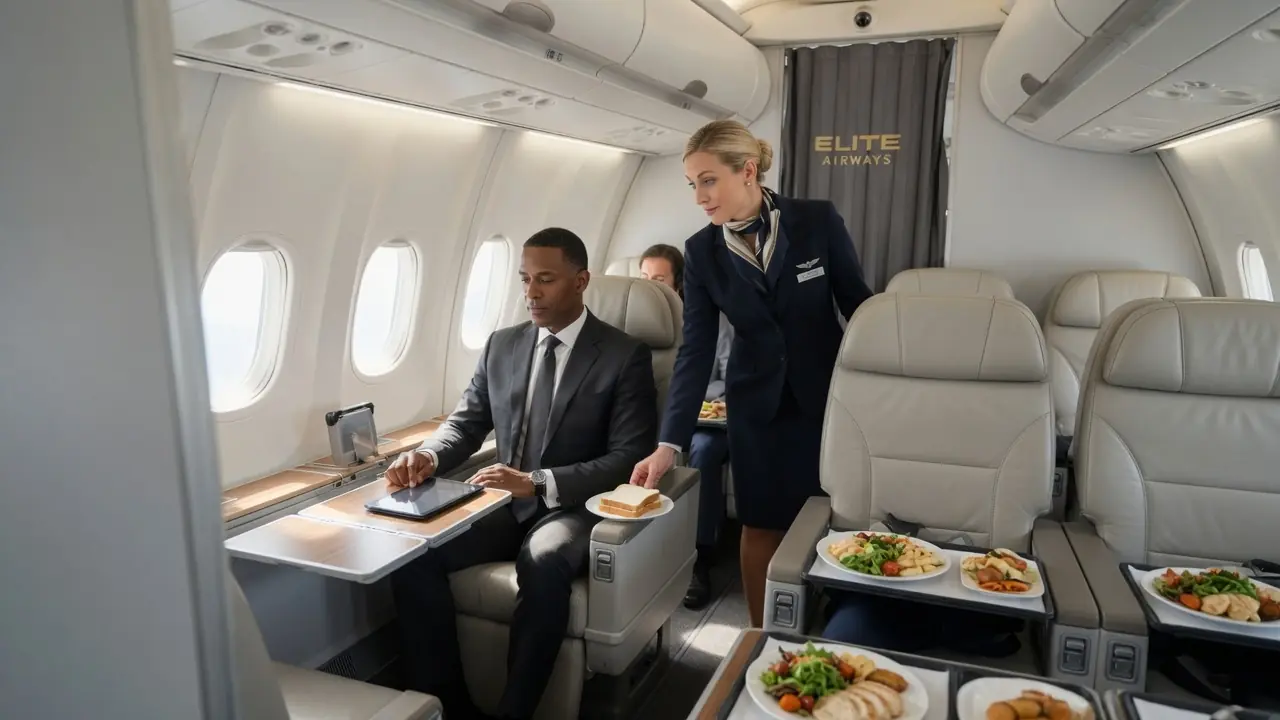
The seat-belt sign went dark after the aircraft reached cruising altitude.
Claire and another flight attendant began preparing the meal service.
Marcus’s tablet illuminated with a new message from Jessica.
Human Resources found seventeen formal complaints from minority passengers in premium cabins during the past year. Five name Claire Wilson. Three were dismissed for insufficient evidence. Two resulted in travel vouchers. No disciplinary action.
Marcus read the message twice.
Seventeen people had complained.
Five had identified the same employee.
Yet the reports had been separated, minimized, and closed individually until the pattern disappeared.
Marcus felt a familiar heaviness settle over him.
The burden of proof was always heavier for certain passengers.
Claire approached Thomas Whitman with a covered plate.
“Mr. Whitman, your seared salmon with truffle risotto. I also brought the white Burgundy you requested.”
The smell of butter and herbs filled the cabin.
She described the wine pairing and offered extra bread.
Other passengers received steak, roasted vegetables, fresh salads, and warm rolls.
When Claire reached Marcus, she placed a covered plate on his tray without looking at him.
“Your meal.”
She turned away.
Marcus removed the cover.
A dry sandwich sat on a paper plate beside a plastic cup of lukewarm apple juice.
He examined it silently.
“Excuse me,” he called.
Claire stopped.
“I believe there has been a mistake. I preordered the chef’s special.”
“We do not have a record of that.”
Marcus showed her the confirmation.
She glanced at it for less than a second.
“The system sometimes overbooks premium meals.”
“I appear to be the only passenger in this cabin without one.”
“We prioritize passengers according to loyalty status.”
“I am a Platinum Elite member. I flew more than two hundred thousand miles with this airline last year.”
Claire’s eyes flickered.
“I’ll speak to my supervisor.”
She disappeared behind the curtain.
Marcus waited.
No supervisor came.
He pressed the call button again.
A young male flight attendant approached. His name tag read MICHAEL BARTON.
“What do you need?”
“I would like to speak with the purser regarding the meal service.”
“Claire is handling this section.”
“She informed me that premium meals were assigned according to loyalty status. I have the airline’s highest status, yet I was given an economy-class sandwich.”
Michael looked down at the tray.
“Sometimes adjustments have to be made.”
“What criteria were used?”
“Sir, you need to lower your voice.”
Marcus had not raised it.
Several passengers turned toward them.
“My voice is already low.”
“You are disturbing the cabin.”
“I am asking a direct question about the service I received.”
Michael’s posture became defensive.
“We cannot accommodate every special request.”
“This was not a special request. It was a confirmed first-class meal.”
Michael leaned closer.
“You have been given food. If you continue creating a problem, the crew may need to take additional action.”
Marcus looked directly at him.
“What problem have I created?”
Michael did not answer.
He retreated toward the galley and whispered to Claire.
Marcus picked up the sandwich.
The edges had curled from age. When he lifted the top slice, green mold covered the bread beneath it.
This was not a mistaken meal.
Someone had deliberately selected spoiled food and placed it before him.
Thomas Whitman rose from his seat and crossed the aisle.
“I saw what they served you,” he said quietly. “Would you like me to speak to someone?”
Marcus appreciated the offer.
“Thank you, but I would prefer that you remain a witness.”
Whitman understood.
He returned to his seat.
Marcus pressed the call button once more.
Michael appeared again.
“There is visible mold on this sandwich,” Marcus said. “I would like to speak with the captain.”
Michael bent down and pretended to inspect it.
“I do not see anything unusual.”
Marcus turned the bread so the green spots faced the light.
“It is clearly spoiled.”
Claire emerged from the galley.
“Is there another problem?”
“Yes. I have been served moldy food.”
“If you do not like it, do not eat it.”
Marcus stared at her.
“Every passenger around me received the meal they ordered. I received spoiled food after being denied my confirmed beverage and given economy-class snacks.”
Claire’s eyes narrowed.
“Some people should be grateful for what they receive instead of always demanding special treatment.”
The cabin became quiet.
Marcus placed the sandwich back on the tray.
“I am not asking for special treatment. I am asking for equal treatment.”
Claire leaned closer and lowered her voice.
“I do not know how you managed to get into this cabin, but people like you always come up here and act as if you own the place.”
Marcus felt his heartbeat quicken.
He did not raise his voice.
“What exactly do you mean by people like me?”
Claire glanced around.
Several passengers were now holding phones.
Michael touched her arm.
“Claire, that’s enough.”
But her anger had already carried her too far.
“You know exactly what I mean,” she whispered. “You do not belong here. Sit down, be quiet, and be thankful you are not in the back of the plane.”
Thomas Whitman stood.
A woman behind Marcus lifted her phone higher.
Claire saw the cameras and quickly retreated behind the curtain with Michael.
Marcus opened the Elite Airways executive application.
The live surveillance feed showed both flight attendants entering the galley.
Their voices came clearly through his earpiece.
“I cannot believe these people,” Claire said. “He probably used points or some diversity program to get into first class.”
Michael lowered his voice.
“You should have given him the regular meal.”
“Why? So he can sit there acting like he owns the airline?”
Marcus saved the recording reference number.
A few minutes later, the purser approached. Her name was Angela Morris.
“Mr. Reynolds, I understand there has been confusion concerning your meal.”
“There has been no confusion.”
“We can provide something from the business-class menu.”
“Your flight attendant deliberately gave me spoiled food and told me I did not belong in this cabin.”
Angela’s expression tightened.
“I am sure you misunderstood her.”
“Several passengers heard her.”
“Claire is one of our most experienced employees.”
“Experience does not prevent prejudice. Sometimes it only gives prejudice more opportunities to hide behind procedure.”
The intercom activated.
Captain Daniel Hoffman’s voice filled the cabin.
“Ladies and gentlemen, the crew has informed me of a disturbance in the first-class section. All passengers are reminded that crew instructions must be followed. Disruptive behavior will not be tolerated.”
Every face turned toward Marcus.
The story was being rewritten before his eyes.
He had calmly questioned discriminatory treatment.
Now the captain had identified him as a threat without speaking to him.
Angela straightened.
“You need to accept the situation and stop questioning the crew.”
“What safety instruction have I refused?”
“Your continued complaints are creating tension.”
“I did not create the tension.”
Thomas Whitman stepped into the aisle.
“I have watched this from the beginning,” he said. “Mr. Reynolds has been calm. Your crew ignored his order, served him moldy food, and insulted him.”
Angela’s tone softened immediately when she addressed Whitman.
“Sir, we appreciate your concern.”
“I am not asking for appreciation. I am telling you that what happened was discrimination.”
Other passengers began speaking.
“He never raised his voice.”
“I heard the flight attendant.”
“I recorded part of it.”
The galley door opened.
Captain Hoffman entered the cabin.
He approached Marcus with the controlled aggression of a man expecting obedience.
“I understand you are causing a disturbance.”
Marcus remained seated.
“Did you ask any witness what happened?”
“My crew informed me.”
“Your crew is responsible for the incident.”
Hoffman’s face hardened.
“This is my aircraft. If you continue undermining the crew, I will divert the flight.”
“What instruction have I refused?”
“You are disrupting cabin operations.”
“By asking why I was served spoiled food?”
“By refusing to let the matter end.”
Marcus looked around the cabin.
“Multiple passengers have witnessed the treatment.”
“I determine what constitutes a safety issue.”
“And are you saying that a passenger calmly requesting equal service is a safety issue?”
Hoffman did not answer directly.
“This is your final warning.”
Marcus opened his tablet and began writing an email to the airline’s board.
Captain Hoffman leaned closer.
“Put the device away and comply.”
“With what?”
“Stop challenging the crew.”
“Your flight attendant told me I did not belong in first class because of how I look. She then served me moldy food. Do you believe I am obligated to remain silent?”
The captain glanced toward Claire.
She stood near the galley, pale but defiant.
Thomas Whitman moved beside Marcus.
“The passenger is telling the truth,” he said. “If you divert this aircraft, you will punish him for reporting your crew’s conduct.”
A woman across the aisle raised her phone.
“I recorded Claire’s comments.”
Another passenger spoke from behind her.
“So did I.”
The captain’s authority was weakening.
Marcus finished the email.
“Captain Hoffman, before you inconvenience every person aboard, there is something you should know.”
“I have already made my decision.”
“That is the problem. You made it before gathering the facts.”
Hoffman’s jaw tightened.
“Comply, or I will declare an emergency and land at the nearest suitable airport.”
Marcus pressed send.
The email went to the board chairman, the chief executive officer, Human Resources, and the airline’s legal department.
“I have requested an immediate review of this cabin’s surveillance footage.”
The captain stared at him.
“There are no cameras in this cabin.”
“Yes, there are.”
The color slowly left Hoffman’s face.
“The premium-cabin monitoring system was installed three months ago. It has recorded every interaction since boarding, including the conversations behind the galley curtain.”
Claire disappeared behind the curtain.
Her frightened voice remained audible.
“Nobody told us there were cameras.”
Marcus looked at the captain.
“Your next decision will also be recorded.”
Hoffman returned to the cockpit without another word.
Minutes later, the first officer announced that the plane would divert to Denver because of an unspecified technical concern.
Marcus understood what was happening.
Hoffman was still trying to remove him from the aircraft, but he no longer dared identify him publicly as the reason.
Marcus messaged Jessica.
Diversion to Denver confirmed. Have Diane Chen and the legal team waiting at the gate. Preserve all footage.
Jessica responded immediately.
The board has reviewed the live incident report. Diane is traveling to the gate. Full footage is being secured in three locations.
As the aircraft descended, Jessica sent Marcus a transcript recovered from the galley.
Claire’s words appeared on his screen.
These people need to learn their place. First they take over coach. Now they are pushing into first class.
Then Michael’s response.
Lower your voice.
Then Captain Hoffman.
Has he threatened anyone or violated safety rules?
Claire had answered:
Not exactly, but he has an attitude. He is always looking for special treatment and playing the race card. We should remove him and put him on the no-fly list.
The captain had replied:
If he does not cooperate, that is what we will do.
Marcus closed the transcript.
The evidence was complete.
Thomas Whitman leaned toward him.
“You seem remarkably calm.”
“I have learned that anger rarely receives the same credibility as evidence.”
Whitman studied him.
“What kind of work do you do?”
“Technology and strategic investment.”
“Reynolds Technologies?”
Marcus nodded.
Recognition spread across Whitman’s face.
“Then Captain Hoffman has made a very serious mistake.”
“He made the same mistake before knowing my name that he would have made after knowing it,” Marcus replied. “My position should not determine whether I deserve dignity.”
The aircraft landed in Denver.
Passengers were ordered to remain seated.
Captain Hoffman emerged from the cockpit.
“Mr. Reynolds, representatives are waiting at the gate. You will leave the aircraft first.”
“For the record, why was the flight diverted?”
“A technical concern.”
“What concern?”
“This is not the place to discuss it.”
“These passengers lost time and connections. They deserve an explanation.”
Hoffman’s patience broke.
“Security will escort you from the aircraft.”
The door opened.
A woman in a dark tailored suit entered, followed by two Elite Airways executives.
Diane Chen, the airline’s head of Human Resources, walked directly toward them.
“Captain Hoffman, security will not be removing Mr. Reynolds.”
The captain stared at her.
“I am the commander of this aircraft.”
“Your command has been suspended pending investigation.”
One of the executives stepped forward.
“You, Claire Wilson, Michael Barton, and Purser Angela Morris are being removed from duty. A replacement crew is boarding through the rear entrance.”
Hoffman looked at Marcus.
“Who are you?”
Marcus stood.
“Someone who expected your airline to do better.”
Diane turned toward him.
“Mr. Reynolds, on behalf of Elite Airways, I apologize for the discriminatory treatment you experienced. The surveillance footage confirms every detail of your report.”
Claire stepped into the aisle.
“This is ridiculous. He was difficult from the beginning.”
Diane raised her tablet.
“We have audio and video of you withholding his confirmed beverage, serving him economy snacks, replacing his premium meal with spoiled food, and making discriminatory statements.”
Claire looked toward the ceiling.
“You recorded private conversations?”
“All premium-cabin employees signed updated monitoring agreements three months ago. Your training record confirms attendance.”
Claire’s confidence disappeared.
Captain Hoffman faced Marcus.
“You planned this. You boarded looking for a reason to punish us.”
“I boarded expecting to reach San Francisco,” Marcus said. “Every decision after that was yours.”
The disgraced crew gathered their belongings and left through the jetway.
A replacement team boarded several minutes later, led by Captain Sarah Lindstrom.
She addressed the cabin with calm professionalism.
“My crew will complete the journey to San Francisco. We expect to depart within twenty minutes.”
Diane approached Marcus.
“What can we do to make this right?”
Marcus looked around the cabin.
Passengers had missed meetings, connections, and family commitments because the captain had chosen escalation over accountability.
“This affected everyone,” he said. “They deserve the truth.”
Before takeoff, Marcus stood at the front of the aircraft with the intercom handset.
“My name is Marcus Reynolds. Some of you witnessed what happened in first class today. Others only know that your flight was diverted.”
The cabin became silent.
“I was denied services that had been confirmed, deliberately served spoiled food, and subjected to discriminatory comments. When I questioned that treatment, members of the crew described me as disruptive and convinced the captain to divert the aircraft.”
Passengers in economy turned toward the front.
“What the crew did not know is that I am a part owner of Elite Airways. Three years ago, I invested in this company because I believed it could provide consistent service and dignity to every passenger.”
A murmur moved through the cabin.
“The surveillance system recorded the entire incident. The responsible employees have been removed, and a full investigation is underway.”
Marcus paused.
“Your plans were disrupted because discrimination was allowed to become an operational decision. Elite Airways will refund every ticket on this flight. In addition, each passenger will receive ten thousand dollars in compensation and five years of complimentary elite-status upgrades.”
For several seconds, no one spoke.
Then applause erupted.
Marcus raised one hand.
“This compensation is not intended to purchase silence. It acknowledges that injustice damages more than its immediate target. When bias is allowed to guide authority, everyone eventually pays the price.”
He returned to his seat.
A young woman from economy approached before departure.
“Thank you for refusing to let it disappear,” she whispered. “Most people do not have the power to fight back.”
Her words stayed with Marcus.
His influence had protected him in the end.
But dozens of previous passengers had submitted complaints without being believed.
The real test would be whether the company changed for people whose names never reached a boardroom.
The replacement crew completed the flight professionally.
Every passenger received the same respect.
Marcus spent the remaining hours preparing for the emergency board meeting scheduled for the following morning.
When the aircraft landed in San Francisco, Elite Airways executives had already established a response center inside the private terminal.
Analysts reviewed years of complaints.
Patterns appeared almost immediately.
Passengers from minority backgrounds consistently reported lower satisfaction in premium cabins.
Certain crew rotations produced disproportionate complaints.
Seventy-eight reports involving discriminatory treatment had been closed without meaningful investigation during the previous three years.
Some had been labeled misunderstandings.
Others had been resolved with travel vouchers.
Almost none had resulted in deeper review.
Chief Operating Officer James Peterson stared at the data.
“We did not see the pattern.”
Marcus looked at him.
“Or the system was designed not to see it.”
Human Resources had required multiple complaints against the same employee within a narrow period before triggering investigation. Complaints separated by months or assigned different categories were never connected.
The system had not failed accidentally.
It had performed exactly as designed.
It protected the company from uncomfortable conclusions.
The following morning, Marcus stood before the Elite Airways board.
The surveillance footage played on the large screen.
Claire’s expression as she delivered the spoiled sandwich.
Michael accusing Marcus of raising his voice.
The captain threatening diversion without identifying a safety violation.
Then the conversation behind the curtain.
When the footage ended, Marcus displayed the complaint data.
“This was not an isolated incident,” he said. “It was one visible result of a system that repeatedly dismissed evidence.”
A longtime board member leaned forward.
“The ten-million-dollar compensation package was excessive.”
“It was expensive,” Marcus replied. “Ignoring the problem would cost more.”
Another director lifted the reform proposal.
“Fleetwide monitoring, independent complaint review, new training, revised hiring standards—implementation will require millions.”
Marcus nodded.
“So would class-action litigation, federal investigation, and the permanent loss of public trust.”
The debate lasted three hours.
Some directors argued that the airline should punish only the individuals involved.
Marcus refused.
“Removing four employees may satisfy public anger. It will not explain why five earlier complaints naming Claire Wilson produced no disciplinary action.”
Board Chairman Robert Chen agreed.
“The company cannot claim surprise when passengers had already warned us.”
The reform package passed eleven votes to three.
Elite Airways established an independent review committee for discrimination complaints.
Premium-cabin monitoring expanded across the fleet, with clear notice to employees and strict privacy controls.
Complaints would no longer be evaluated in isolation.
Junior employees received protected channels for reporting misconduct by senior crew members.
Training moved beyond scripted presentations and included recorded case studies, real passenger testimony, and accountability for supervisors who ignored patterns.
Six months later, Marcus boarded Flight 347 again.
He chose seat 2A.
The cabin had been renovated, but the most important differences were not visible in the leather seats or new lighting.
Head flight attendant Sarah Johnson approached.
“Good morning, Mr. Reynolds. Your Macallan 18 and chef’s special are confirmed. May I bring your hot towel before departure?”
“Yes, thank you.”
Sarah greeted every passenger with the same warmth.
She offered assistance without studying clothing, skin color, age, or perceived status.
Before returning to the galley, she placed an envelope on Marcus’s tray.
It contained a handwritten note signed by the entire crew.
What happened six months ago forced this airline to confront what too many people had been allowed to ignore. We are proud to serve on a flight where first-class treatment refers to the quality of service, not the kind of person believed worthy of receiving it.
Marcus folded the note and placed it inside his jacket.
Claire Wilson, Michael Barton, Angela Morris, and Captain Hoffman had all been dismissed after the investigation.
Their appeals failed when the surveillance footage was presented during arbitration.
The Federal Aviation Administration separately reviewed Hoffman’s decision to divert the aircraft without legitimate safety cause and temporarily suspended his commercial license.
The incident entered training programs across the industry as an example of how prejudice could influence operational judgment.
But Marcus did not measure success by punishment.
Punishment removed people.
Reform changed what the next person would be permitted to do.
Elite Airways’ new review committee had reopened dozens of old complaints.
Several passengers received formal apologies and compensation.
Employees who had previously remained silent began reporting conduct without fear of immediate retaliation.
Three competing airlines adopted similar complaint-tracking systems.
Premium bookings increased rather than declined.
Customers responded not to the original failure, but to the transparency that followed.
As Flight 347 accelerated down the runway, Marcus looked through the window at the city growing smaller below.
Six months earlier, he had entered the same cabin and been treated like an intruder.
Not because he lacked a ticket.
Not because he violated a rule.
Not because he had behaved badly.
Someone had simply decided that a man who looked like him did not belong in a place associated with wealth and authority.
His title had eventually changed the balance of power.
But Marcus understood that his title was not the lesson.
The lesson was that he should never have needed one.
The passenger without ownership shares deserved fresh food.
The traveler without an executive assistant deserved to be believed.
The person without access to surveillance records deserved the same dignity Marcus had demanded.
The aircraft rose above the clouds.
A flight attendant placed his confirmed beverage on the tray with a linen napkin.
“Enjoy your flight, Mr. Reynolds.”
Marcus thanked her and returned to the quarterly report on his tablet.
The numbers were strong.
Complaints were being investigated faster.
Customer trust was rising.
But the metric that mattered most could not be reduced to a percentage.
For the first time in years, Marcus sat in a first-class cabin without feeling that he had entered a space where his presence required explanation.
He was not being treated as an exception.
He was not being watched as an intruder.
He was simply a passenger.
And that was all he had ever asked to be.