The smell reached Adaeze Okafor before she saw the pile. It was sweet at first, then sour underneath, the thick fermented smell of fruit that had ripened too far beneath tropical heat and begun collapsing under its own sugar. Flies moved lazily above wooden crates overturned behind the Nworie Regional Produce Market, where five tons of mangoes lay bruised, split, leaking juice, and waiting for a municipal truck to carry them away. Workers barely looked at the waste because for them it was Tuesday, and Tuesday during peak mango season often smelled exactly like that.
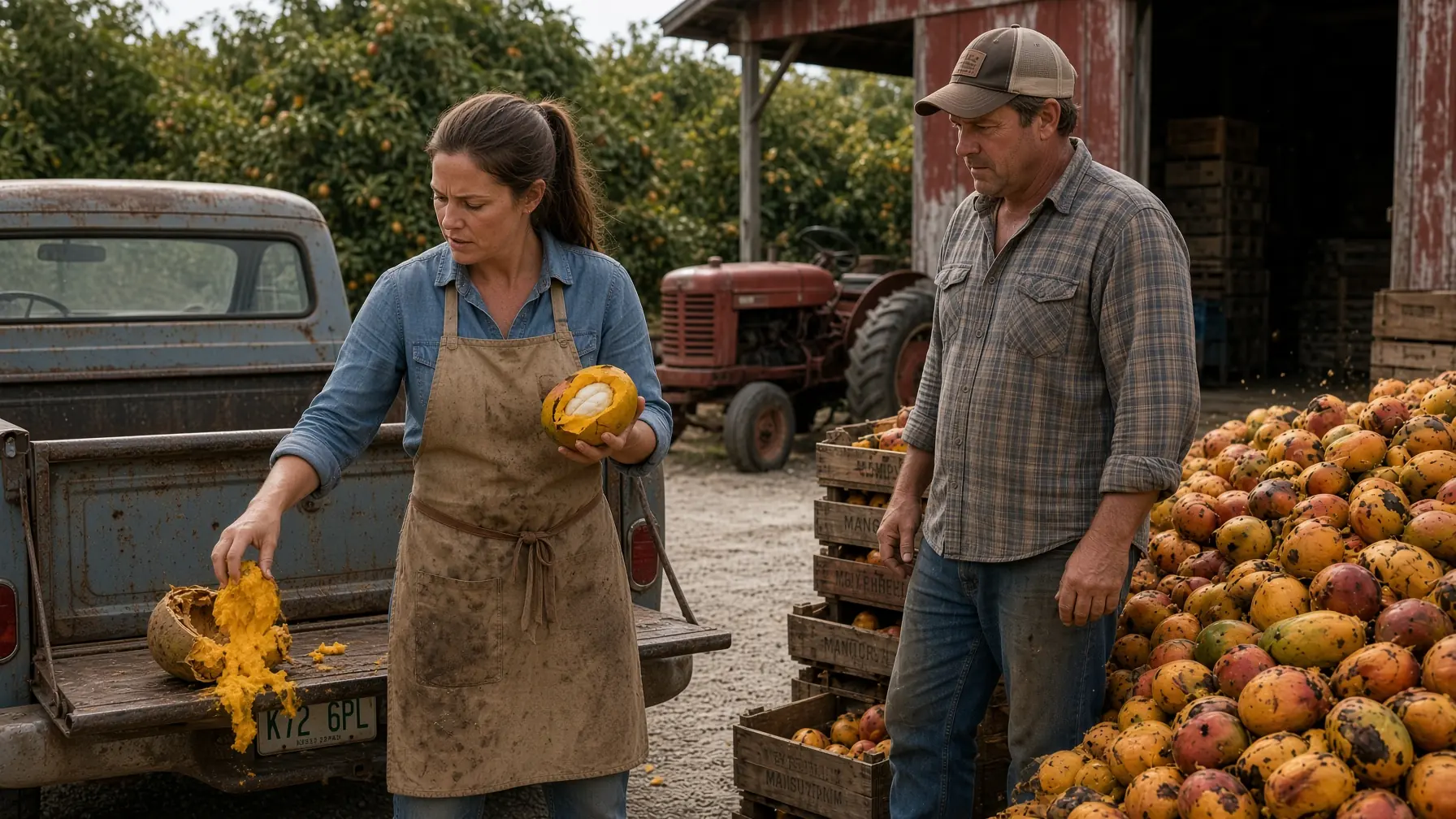
Adaeze stood with both arms folded while another crate was tipped onto the heap. Some fruit was clearly spoiled beyond any safe use, dark with mold or leaking from deep damage, but much of the pile looked different when she studied it carefully. There were mangoes rejected because one side had bruised during transport, fruit that had ripened faster than wholesalers could move it, and crates whose appearance no supermarket buyer would accept even though portions were still sound. Everyone around her saw one category called waste, while Adaeze had begun wondering whether they were throwing away several very different things together.
A porter named Chike noticed her returning for the third afternoon that week. He wiped his forehead with a stained towel and asked whether she had developed an interest in garbage. Adaeze pointed toward the pile and said, “What actually happens to all of this after the truck comes?” Chike shrugged and answered, “It goes where everything unwanted goes.”
She asked who paid for the truck. Chike told her the market association contributed to waste removal while some large traders paid additional fees when their spoilage exceeded normal amounts. Adaeze stared at the discarded fruit again and asked, “So people lose the mangoes and then pay to lose them?” Chike laughed, but he did not have an answer that satisfied her.
Adaeze was thirty-four and had spent almost twelve years selling produce from a narrow stall near the eastern entrance of the market. Her parents had grown vegetables, plantains, citrus, and a few mango trees on a small mixed farm outside the city, and she grew up knowing exactly how much work could disappear between harvest and sale. She understood buyers, bargaining, seasonal gluts, transport delays, and the way one soft spot could reduce the price of an entire basket. What she did not understand was processing, manufacturing, food science, or how a person with almost no capital transformed perishability into time.
Her stall had once provided a comfortable living. Adaeze bought from nearby growers, sold to households and restaurant buyers, and made enough to help her mother after her father died while also paying part of the trade-school fees for her younger brother, Chinedu. Then larger produce sellers began purchasing directly from bigger farms at prices Adaeze could not match. Two seasons of shrinking margins had turned a stable business into one that survived largely because Adaeze worked longer hours instead of earning more.
She had stopped replacing damaged shelves. She delayed buying a refrigerator for drinks because the money had to go toward Chinedu’s tuition. Several regular customers still came to her because they trusted her judgment, but loyalty did not erase arithmetic. By the beginning of that mango season, Adaeze knew something in her business had to change.
The market itself provided the contradiction she could not stop thinking about. Every morning trucks arrived carrying more mangoes than the city could consume immediately, and by afternoon the prices often softened because sellers feared what another night of heat would do. Fruit that looked perfect in the morning might become discounted by evening, and crates bruised during transport could become nearly worthless before anyone tested whether most of the flesh remained usable. Supply was abundant enough to destroy the price of the very crop farmers had spent months producing.
Adaeze had watched that cycle for years without seeing opportunity in it. Waste was waste because nobody she knew had the equipment to do anything else with it, and anything involving packaged food sounded like a business for factories, laboratories, stainless-steel machinery, and people wearing coats with company logos. Then her income fell far enough that impossibility became less convincing. Sometimes people reconsidered the obvious only after the obvious stopped paying their bills.
The first person she spoke to seriously was her mother, Grace. Grace was sixty-two, practical, religious without being theatrical, and suspicious of business ideas that began with the words “everyone else throws this away.” When Adaeze explained the mango pile over dinner, Grace listened while sorting dried beans. Then she asked, “Are you planning to sell rotten fruit to people?”
“No,” Adaeze said immediately. She explained that some rejected mangoes were unusable, but others were discarded because they had bruises, surface damage, uneven ripeness, or appearance problems. Grace asked how Adaeze intended to tell the difference safely. Adaeze opened her mouth, then admitted, “I don’t know yet.”
Grace nodded. “Then that is your first problem, not your business.” Adaeze disliked the sentence because it was obviously correct. Chinedu, twenty-one and studying electrical installation, asked whether she could turn the fruit into juice. Grace looked at him and said, “Your sister just admitted she doesn’t know which mangoes are safe, and you have already built a juice company.”
The next afternoon Adaeze returned to Chike. She asked whether the market supervisor would allow her to take a small quantity of fruit scheduled for disposal. Chike laughed again and said the supervisor might pay her if she took enough. Adaeze told him she wanted only fruit from identifiable crates before it became mixed with obvious spoilage.
That distinction created the first complication. Once fruit entered the communal waste pile, contamination from dirt, leaking spoiled fruit, insects, broken crates, and general refuse made it unsuitable for any food experiment Adaeze considered responsible. She needed to intercept certain rejected mangoes before they entered that pile. That meant speaking to traders and farmers individually rather than collecting whatever remained after dumping.
The market supervisor, Mr. Eze, listened with visible skepticism. Adaeze told him she wanted permission to speak with sellers who were already discarding mangoes and collect only lots she could inspect before disposal. Mr. Eze asked whether the market would be responsible if somebody became sick. Adaeze said she would not sell anything until she understood the requirements and that she was beginning with household experiments rather than commercial production.
“People always say that before somebody prints labels,” Mr. Eze replied. Adaeze promised to put the permission in writing if he wanted. His eyebrows rose slightly because most people asking for free waste did not arrive offering paperwork. He finally said she could make private arrangements with sellers as long as she did not interfere with market sanitation or represent the market as approving her products.
Adaeze began with twenty kilograms. She selected mangoes from one trader’s rejected crates, discarding anything moldy, leaking from internal decay, heavily damaged, or carrying suspicious odors. The fruit she took home was ugly but mostly intact, and she felt almost triumphant until Grace looked at three basins filling the kitchen and said, “You have brought the garbage argument into my house.” Adaeze answered, “Research.”
Her first idea was puree. She washed the fruit, peeled sound portions, removed damaged areas, mashed the flesh, and filled several clean household jars. The result tasted excellent that afternoon.
Two days later, half the jars smelled fermented. Adaeze opened one and heard pressure release. Grace ordered every questionable jar out of the kitchen immediately.
Adaeze had created a perishable raw fruit product without understanding microbial growth, temperature control, safe processing, packaging, or shelf life. The failure was obvious enough that she did not need a laboratory to know the jars could not be sold. She dumped the batch and scrubbed the kitchen until midnight. The mangoes had been nearly free, but her time, cooking gas, water, jars, and confidence were not.
Her second experiment involved drying slices. Adaeze had seen dried banana and plantain sold in sealed packets, so she sliced mangoes thinly and arranged them on clean cloth under the sun in the courtyard. She covered part of the batch loosely but left the rest exposed because air circulation seemed more important.
Dust arrived first. Then ants. By afternoon, flies had discovered the trays, and a gust of wind dropped half a cloth onto the ground.
Chinedu returned from class and found his sister staring at the ruined fruit. “Successful day?” he asked carefully. Adaeze said, “I have successfully fed every insect in the neighborhood.” He helped her throw the batch away.
The third experiment failed less dramatically. Adaeze blended fresh mango for immediate use and tried offering small portions to two regular restaurant customers who already bought fruit from her stall. Both liked the flavor.
Neither wanted to buy. One chef said he could blend mango himself, while the other asked what guarantee Adaeze could offer that every container would taste and behave the same way. Adaeze realized she had created a product without solving anyone’s problem.
For almost three weeks, that became the pattern. She tested ideas in tiny quantities, rejected more fruit than she used, lost batches to spoilage, and spent evenings reading borrowed books and whatever food-processing materials she could find. The more she learned, the less comfortable she became with her original assumptions. Processing food safely was not simply cooking or drying what looked acceptable and hoping customers appreciated the effort.
She needed sorting criteria. She needed cleaning procedures, potable water, suitable surfaces, temperature control, protected drying, proper packaging, recordkeeping, and eventually regulatory approval if she intended to sell beyond informal experiments. She also needed a product people wanted enough to pay for repeatedly. Every answer seemed to create two additional questions.
The laughter at the market continued. One trader asked whether Adaeze had become a scientist. Another said she could save time by setting her money directly on fire instead of driving mangoes home first. Adaeze smiled because arguing would not improve the experiments.
Privately, she worried they were right. Her produce stall was losing income while she spent money on basins, containers, transport, and failed trials. Chinedu’s next school payment was due in six weeks. Grace had begun asking whether Adaeze wanted help calculating how long curiosity could remain affordable.
The worst week came after Adaeze tried another drying method using raised trays she had built with Chinedu. She covered the fruit more carefully and improved airflow, but several pieces retained more moisture than she realized. Mold appeared after packaging.
She discovered it before selling any. That was the good news. The bad news was that she had spent four days producing something she could not trust.
That evening Adaeze sat on the back step after everyone else went inside. The air still smelled faintly of mango because the yard had become a place where fruit seemed permanently present, and she felt sick of a smell she once loved. Chinedu sat beside her and asked, “Do you still think there is something here?” Adaeze looked at the dark courtyard and said, “I think there is waste, and I think there is value, but I’m no longer sure I’m the person who knows how to connect them.”
Chinedu did not tell her to continue. He also did not tell her to quit. “Then find somebody who knows the part you don’t,” he said. Adaeze laughed because the advice sounded obvious after three weeks of trying to learn everything alone.
Two days later she met Nneka Obi. Nneka was twenty-four, studying food science at a university several hours away, and had returned home during break to help her aunt sell baked goods near Adaeze’s stall. Adaeze asked what Nneka thought about processing rejected mangoes.
Nneka’s first answer disappointed her. “Depends why they were rejected.” Adaeze had hoped for enthusiasm. Instead Nneka began asking exactly the questions Grace had asked weeks earlier.
Was the fruit rejected for appearance, bruising, overripeness, decay, pest damage, contamination, or unknown handling conditions. How long had it remained in the heat. Could Adaeze trace each batch to a seller before the fruit entered communal waste.
Adaeze answered honestly. Nneka said, “Then you don’t have mango waste yet, you have several different streams mixed together.” The sentence changed everything.
Nneka visited Adaeze’s yard the following Sunday. She examined the drying racks, containers, washing setup, notebooks, and failed-product notes. Instead of laughing, she said Adaeze had already learned one of the hardest lessons.
“What lesson?” Adaeze asked. Nneka answered, “That the fruit doesn’t become safe because you need it to be.”
They spent three hours discussing sorting. Fruit with mold, fermentation, deep decay, unknown contamination, or unsafe conditions would never enter the food stream. Mangoes with cosmetic defects or limited bruising might be suitable if sound portions were handled quickly under a controlled process, while overripe but still wholesome fruit might fit certain uses better than others. Processing could extend value, but it could not turn spoiled food into safe food.
Adaeze wrote everything down. Nneka told her to stop experimenting with shelf-stable puree until she had proper processing guidance because acidity, heat treatment, packaging, storage, and contamination control required more than guesswork. She suggested Adaeze first target products with clear same-day or refrigerated delivery while she sought formal technical help. Adaeze felt both restricted and relieved.
Then Nneka asked what happened to mango seeds. Adaeze said she threw them away. Nneka smiled.
Mango kernels could contain fats used in cosmetic and industrial applications after appropriate processing. Nneka cautioned that Adaeze should not start crushing kernels in her kitchen or making safety claims she could not support, but she might be able to dry and aggregate clean seed material for a specialist buyer. The pit suddenly stopped being a nuisance created after pulp removal. It became another potential raw-material stream.
That night Adaeze filled three pages with a new diagram. At the top she wrote MANGOES, then divided the page by condition. Safe food-grade fruit could become refrigerated puree or properly dried fruit once her process was controlled, while cleaned seeds from suitable processing could move to a separate non-food buyer capable of handling kernels correctly.
At the bottom she wrote UNSAFE = DISCARD, underlined twice. The business idea became clearer precisely because she had accepted that not everything deserved saving. Waste reduction was not the same as zero waste.
Her first serious customer came from a bakery two streets from the market. Mama Ifeoma’s bakery produced meat pies, bread, small cakes, and seasonal pastries for schools and offices. Adaeze knew the owner because the bakery bought bananas and citrus from her stall.
She asked whether they ever used mango. Mama Ifeoma said only occasionally because preparing ripe fruit during peak season created mess, labor, and inconsistent supply. Adaeze asked whether a refrigerated, ready-to-use puree delivered twice weekly would solve a problem if it met their specifications.
Mama Ifeoma narrowed her eyes. “How much?” Adaeze named a small trial price. The baker replied, “Bring me enough for twenty pastries, not twenty customers.”
That first order was tiny. Adaeze sourced fruit directly from one grower whose rejected mangoes were mostly surface-bruised during transport, selected only sound fruit suitable for processing, and worked with Nneka to establish a cleaner workflow using food-safe equipment and cold storage borrowed from the bakery for the trial. Adaeze recorded the weight entering, weight discarded, finished yield, preparation time, and delivery time.
Mama Ifeoma tested the puree the same day. The pastry filling held well after she adjusted sugar and starch. She ordered another batch.
Adaeze went home smiling. Grace asked how much money she made. The smile became smaller.
After transport, packaging, fruit payment, ice, water, and her time, almost nothing remained. Grace said, “Congratulations, you have created employment for yourself without salary.” Adaeze answered, “The second batch will be better.”
The second batch was not better. The puree was thinner because the mango variety and ripeness differed from the first lot. Mama Ifeoma called and said her filling required nearly twice as much thickener.
Adaeze refunded part of the order. She had her first repeat customer and had already disappointed her. That hurt more than the discarded experiments because this failure belonged to someone else too.
Nneka helped her understand consistency. Different mango varieties carried different fiber, sweetness, acidity, and moisture, while ripeness changed texture even within one variety. Adaeze needed to define what she was selling rather than simply calling every blended mango the same product. She began separating varieties, controlling ripeness ranges more carefully, and measuring simple characteristics consistently within the limits of her small operation.
Mama Ifeoma agreed to another trial. This time Adaeze documented the blend and delivered a smaller sample before the full order. The bakery approved it.
A second customer came three weeks later. A juice stall near a bus terminal wanted puree for smoothies during periods when fresh mango prices increased. The owner, Emeka, ordered ten liters.
Adaeze delivered. He ordered again. The second batch tasted different enough that his regular customers noticed.
Emeka stopped calling. He never complained directly, which made the lesson harder because Adaeze learned only after visiting and asking. “I cannot tell customers the mango changes every Tuesday,” he said.
Adaeze offered to replace the order. Emeka declined. Reliability had already become more expensive than the lost sale.
She went home and rewrote her process. Every batch received a date, supplier, variety where known, incoming condition, usable yield, processing time, storage details, and customer destination. She created acceptance ranges and stopped purchasing some fruit lots that were too variable even if they were cheap.
The new discipline reduced the amount she could process. It also reduced unpleasant surprises. Grace watched Adaeze label containers at midnight and said, “Your garbage business has more paperwork than a bank.”
Adaeze replied, “Banks have air conditioning.” Grace said, “Then perhaps you chose the wrong industry.”
The dried-fruit problem remained. Open sun drying was too exposed, and improvised racks produced uneven results. Nneka connected Adaeze with a small agricultural processing center operated by a local cooperative that rented access to improved solar drying equipment during unused hours.
The fee frightened Adaeze. The equipment offered protected airflow and more controlled drying than her yard setup, but paying for access meant dried mango had to become a real product rather than an experiment. She booked one small session anyway.
The first batch was disappointing. Adaeze sliced too many pieces at inconsistent thickness, and the finished product varied more than she wanted. Some pieces became hard while others remained too moist.
She did not sell it. The cooperative technician, Mr. Daniel Umeh, showed her how inconsistent preparation affected drying time and encouraged her to develop a standardized cut and loading pattern rather than increasing volume immediately. Adaeze returned the following week.
The second batch improved. The third was good enough for samples. Adaeze packed small amounts in plain food-safe bags with temporary compliant information required for testing through approved channels rather than pretending she already possessed a polished retail brand.
A snack packager named Harvest Bite tried it. The owner, Kelechi Nwosu, bought dried pineapple and banana from several processors and sold mixed snack packs to offices and small grocery stores. He liked the mango but asked whether Adaeze could supply twenty kilograms every week for eight weeks.
Adaeze nearly said yes. Then she remembered Emeka. “Not yet,” she answered.
Kelechi raised an eyebrow. Suppliers usually exaggerated capacity, not reduced it. Adaeze explained that she could probably produce the volume once but had not proved she could produce it consistently every week.
“How much can you guarantee?” he asked. She said eight kilograms. Kelechi ordered eight.
That decision became more important than the size of the order. Adaeze fulfilled eight kilograms the first week, eight the second, and ten the third after improving sorting and booking additional dryer time. By week six, she reliably supplied fifteen kilograms.
Kelechi noticed. “Most people promise twenty and bring eleven,” he told her. Adaeze said, “I was afraid you would stop calling.”
“I stop calling when I cannot plan.” The sentence joined her notebook of things customers had taught her more efficiently than textbooks.
By the fourth month, Adaeze’s house could no longer contain the work. Crates occupied the courtyard, washing consumed the family water storage too quickly, Grace’s kitchen had become unavailable for normal meals at inconvenient hours, and Chinedu could not cross the yard without stepping around something drying, draining, or waiting for inspection. Even successful batches created disorder.
Grace called a family meeting. “This business must either become a business or leave my kitchen,” she announced. Adaeze said she technically contributed most of the rent.
Grace answered, “The mangoes do not.”
They rented a small outbuilding behind a mechanic’s shop near the market. The space had concrete floors, running water nearby, enough ventilation for preliminary work, and walls that could be cleaned properly after repairs. It was not automatically suitable for food processing, so Adaeze consulted local health and small-enterprise officials before moving production.
The list of required improvements made her stomach tighten. She needed washable work surfaces, proper handwashing arrangements, safer water handling, pest control, separation between incoming fruit and finished product, suitable storage, cleaning schedules, waste management, and records proving that good intentions were not her sanitation system. Some requirements meant spending money she had not yet earned.
Adaeze considered returning to the yard. Nneka said, “Then you stay small enough that one mistake can end everything.” Adaeze asked whether the new room prevented mistakes.
“No.” Nneka shook her head. “It makes mistakes easier to see and harder to hide.”
Adaeze used nearly all her early earnings on improvements. Chinedu rewired two unsafe electrical points under supervision from his instructor, refusing payment because Adaeze had helped finance his schooling. A welder built simple worktables.
Grace contributed money secretly through Nneka. Adaeze discovered it when a supplier mentioned the deposit had already been paid. She confronted her mother.
Grace said, “I invested.” Adaeze asked how much ownership she expected. “Enough to remove mango crates from my kitchen.”
The first employee was Ijeoma, a neighbor with two school-age children who wanted flexible morning work. Adaeze trained her to sort fruit according to the criteria they had developed, but the first week exposed how much of the process existed only inside Adaeze’s head. She would reject a mango for one reason, accept another that looked worse, then struggle to explain the distinction precisely.
Ijeoma finally said, “If you want me to see what you see, you must tell me what you see.” Adaeze went home and created illustrated sorting guides. Nneka reviewed them and corrected several areas where Adaeze’s definitions were still too subjective.
The second worker was Samuel, a quiet twenty-six-year-old whose previous construction job had ended. Samuel was fast, which Adaeze initially appreciated. Then she discovered speed created errors when he began moving crates before inspection was recorded.
“You’re paying me to move mangoes,” he said. Adaeze answered, “I’m paying you to move the correct mangoes.”
Samuel slowed down. Within months, he became one of her most reliable workers because he treated every correction as information rather than insult. Adaeze learned that people did not arrive trained for systems she had invented.
The seed stream developed more slowly. Nneka located a small cosmetic-ingredient processor two towns away that purchased cleaned, properly dried mango kernels in bulk from established suppliers. The company initially showed no interest in Adaeze because her volume was tiny and her quality specifications uncertain.
Adaeze asked what would make the material useful. The purchasing manager listed moisture, cleanliness, contamination, storage, traceability, and minimum shipment quantities. Adaeze wrote everything down.
She did not try to process cosmetic butter herself. Instead, she separated clean pits from appropriate fruit-processing batches, removed residual pulp using a controlled non-food workflow separate from finished food areas, dried them according to the buyer’s requirements, and aggregated them until she had enough for evaluation. The first shipment failed.
The processor rejected it for excessive residual moisture. Adaeze had spent weeks storing material that could not be sold. Chinedu found her carrying bags toward disposal and asked whether kernels had joined the list of things she hated.
“Today.” She threw another bag onto the stack. “Ask tomorrow.”
The second trial passed. The price per kilogram was modest and nothing like the miracle figures people later attached to the story. Yet it converted a waste-handling expense into a small revenue stream and reduced what Adaeze paid to dispose of.
That mattered. Profit often hid in costs that stopped occurring. Adaeze began measuring not only what each product sold for but how much waste each process created and what that waste cost her to handle.
Peels and unsafe organic scraps remained a challenge. A nearby livestock farmer asked whether he could feed them directly to animals, but Adaeze refused to make claims without proper guidance. Eventually she arranged for suitable organic waste to enter a managed composting stream.
Not everything became a product. That fact frustrated people who heard about the business later and expected a perfect circular system. Adaeze preferred safe disposal over inventing a market simply to claim nothing was wasted.
The larger order arrived six months after her first bakery sale. Kelechi from Harvest Bite called and said a regional grocery distributor wanted a trial run of snack packs containing dried mango. Harvest Bite needed one hundred and twenty kilograms of dried mango across the next month.
Adaeze sat silently with the phone against her ear. Her highest monthly output so far had been forty-six kilograms. Kelechi said he needed an answer by afternoon.
Her old instinct screamed yes. Her newer instinct asked what failure would look like. Adaeze told him she needed three hours.
She called Nneka. She called the cooperative drying center. She called three farmers who supplied her irregularly.
The numbers did not work. Even if she obtained enough raw fruit, dryer access during peak season could not guarantee the required capacity. Adaeze called Kelechi back and offered seventy kilograms with an option to increase if another processor could safely take part of the volume.
Kelechi surprised her. “I can use seventy.” The remaining volume would come from another supplier.
Adaeze had expected losing part of the order to feel like failure. Instead she felt relief. She had sold almost fifty percent more volume than ever before without making a promise the business could not support.
Filling that order still changed everything. Her three informal suppliers could not reliably provide enough suitable rejected fruit because not every rejected mango met Adaeze’s food-grade standards. She needed a broader sourcing network.
She visited farmers directly. Rather than asking for free rejects, Adaeze offered a small payment for mangoes meeting agreed acceptance criteria but unsuitable for premium fresh sale because of cosmetic damage, size variation, limited bruising, or market oversupply. Anything spoiled, contaminated, or outside those criteria remained rejected.
Some growers laughed at the payment because it seemed almost symbolic. Then they calculated that fruit previously earning nothing could at least pay part of sorting and transport. Three growers joined.
Within two months, there were seven. By the next season, twelve farms participated during peak supply.
Adaeze learned sourcing had its own problems. One farmer began placing poor-quality fruit beneath acceptable mangoes because the buyer was “only processing it anyway.” Her team rejected the load.
The farmer became angry. “You started with fruit people threw away.” Adaeze answered, “I started with fruit people rejected for sale, not fruit people should not eat.”