The metallic clank came halfway up Miller’s Hill.
One sharp strike.
Then silence.
Caleb Turner eased the throttle back and listened as the old John Deere climbed the remaining slope with a wagon of seed corn rattling behind it. The engine sounded steady. Oil pressure held. Temperature stayed normal.
Nothing else happened.
At the top of the hill, Caleb stopped the tractor, set the brake, and looked down through the open platform at the transmission housing beneath his boots.
He had heard that same sound twelve times in three weeks.
Never on level ground.
Never while pulling downhill.
Only when the tractor climbed a grade under load.
One clean metallic clank, as if someone beneath the machine had struck a cast-iron housing with a ball-peen hammer.
Caleb shut off the engine.
The wagon settled behind him. Wind moved through the dry October corn on both sides of the lane.
He climbed down and walked around the tractor.
The machine was a 1952 John Deere G, green paint faded nearly gray across the hood and yellow wheels darkened by years of oil, dust, and weather. Caleb’s grandfather had bought it used in 1967. His father had cultivated corn with it through the 1980s. Caleb had spent half his childhood riding on the left axle beside the fender while his father worked ground too slowly for boredom and too loudly for conversation.
The tractor had never been beautiful.
It had been dependable.
That mattered more.
Caleb crouched beneath the drawbar and looked for fresh marks, loose bolts, or anything hanging where it should not. The wagon tongue was straight. The hitch pin was secure. The rear axle housings showed no oil leaks.
He checked the wheel wedges.
Tight.
The brake linkage.
Tight.
The flywheel.
No visible movement.
He returned to the platform and restarted the tractor.
The two-cylinder engine came alive with its familiar uneven rhythm.
Pop.
Pause.
Pop.
Pause.
The sound had been part of Turner Farm longer than Caleb had been alive.
He pulled the wagon the remaining half mile to the seed shed without hearing the clank again.
That evening, he called Martin Keller at Keller Agricultural Repair in Franklin, Iowa.
Martin had rebuilt John Deere transmissions for thirty-one years.
“If it only happens uphill, it’s probably backlash changing under load,” Martin said. “Could be a chipped gear tooth.”
“It doesn’t repeat.”
“A broken tooth doesn’t have to repeat if the gear only shifts enough to contact under torque.”
“Wouldn’t I hear it more than once?”
“Not necessarily.”
Caleb looked through the kitchen window toward the machine shed.
The John Deere sat inside beneath a single hanging bulb.
“How soon can you look at it?”
“Bring it Monday.”
Caleb’s wife, Hannah, stood at the sink drying dishes.
“You’re taking the G apart during harvest?” she asked after he hung up.
“If it’s a transmission tooth, I’d rather find it in the shop than on a hill with six tons behind me.”
“Your father would keep running it.”
“My father also drove three miles with no oil pressure because he thought the gauge was wrong.”
Hannah smiled slightly.
“He was right.”
“Once.”
Caleb had inherited the farm after his father died the previous winter. There had been no dramatic transfer, no final conversation beside a hospital bed.
Walter Turner had suffered a heart attack while repairing a fence.
By the time Caleb reached the county hospital, his father was gone.
What remained was four hundred and twenty acres, three sheds, two mortgages, a house with more deferred repairs than good paint, and machinery held together by careful maintenance and family memory.
The John Deere G had been Walter’s favorite.
It was also the one machine Caleb could sell without affecting the modern operation.
But selling it felt like removing his father’s chair from the kitchen before the cushion had cooled.
So Caleb kept it working.
On Monday morning, he drove the tractor twelve miles to Keller Agricultural Repair.
Martin stood outside the main bay with his foreman, Wes Dalton.
Wes was thirty-five and had the restless energy of a man who trusted diagnostic equipment more than waiting. He had worked at dealerships with electronic service tools before returning to Franklin to join Martin.
He watched the John Deere approach.
“That the hill-clanker?”
Caleb shut off the engine.
“That’s what Martin called it?”
“That’s what everyone calls it now.”
Caleb looked into the shop.
Three mechanics glanced toward him and quickly looked away.
Franklin was a small town. Machinery problems traveled faster than weather.
Martin wiped his hands on a shop rag.
“Tell us exactly when it happens.”
Caleb described the sound again.
One metallic clank.
Only uphill.
Only under load.
Never during a steady pull on level ground.
“Which gear?” Wes asked.
“Usually fourth. Once in third.”
“Engine speed?”
“About half throttle.”
“Wagon loaded every time?”
“Almost.”
“Almost?”
“I heard it once without the wagon. I was climbing from the lower pasture.”
Wes nodded as if the answer confirmed something.
“Transmission.”
Martin looked less certain.
“Could be differential.”
“Same housing,” Wes said.
“Not the same problem.”
They spent the morning inspecting the tractor without disassembly.
Wes put it on axle stands and ran it through every gear while Martin listened with a mechanic’s stethoscope.
Nothing.
They drained the transmission oil through a fine screen.
No bronze.
No chipped teeth.
The oil was dark but clean enough for a machine more than seventy years old.
They removed the inspection cover and rotated the gears by hand.
No visible damage.
Wes used a dial indicator to measure shaft endplay.
Within service limits.
Martin checked the differential backlash.
Slightly worn.
Not enough to produce the sound Caleb described.
At noon, they hitched the tractor to the shop’s loaded equipment trailer and drove toward the quarry road, where a long grade rose out of the river valley.
Caleb followed in Martin’s pickup.
Wes drove the John Deere.
Halfway up the grade, the clank sounded.
Caleb heard it through the open pickup window.
Martin lifted one hand.
“There.”
Wes stopped at the top.
He climbed down smiling.
“Transmission.”
“You didn’t hear where it came from,” Martin said.
“I felt it through the floorboard.”
“That means it could be anywhere from the flywheel to the drawbar.”
“It came from under the seat.”
Caleb looked back down the slope.
“One clank.”
Wes nodded.
“Something shifts under torque. We tear it down.”
Martin did not answer immediately.
He walked around the tractor, then rested one hand against the left rear tire.
“What are you thinking?” Caleb asked.
“That I don’t like opening a machine without knowing what I’m looking for.”
Wes laughed.
“That’s how you find what you’re looking for.”
“No. That’s how you create ten new places for trouble.”
They returned to the shop.
Caleb gave permission for the teardown.
He did not have much choice.
The tractor could not safely pull wagons through hilly ground while carrying an unexplained mechanical strike.
Martin and Wes removed the seat assembly, platform, rockshaft housing, transmission cover, and rear case components.
They inspected every gear.
The first reduction gear showed normal polishing.
The sliding gears had worn edges but no cracks.
The countershaft bearings were serviceable.
The differential gears showed no broken teeth.
Wes used magnetic-particle testing on two suspicious areas.
Both were clean.
They replaced one bearing that had minor pitting, resealed the transmission, and filled it with new oil.
The bill reached $1,860.
Caleb paid it.
Two days later, he drove the John Deere home.
The clank returned on Miller’s Hill.
Same place.
Same load.
Same single metallic strike.
Caleb stopped at the top and sat with both hands on the steering wheel.
For the first time, he felt something close to anger toward the tractor.
Not because it had failed.
Because it refused to explain itself.
He turned around and drove back to Keller’s.
Martin heard the machine before seeing Caleb’s face.
“It did it again.”
Caleb shut off the engine.
“Yes.”
Wes came from the back room.
“That’s impossible.”
Caleb looked at him.
“I heard it.”
“We had the entire transmission open.”
“And it still clanked.”
Wes climbed onto the platform and moved the gearshift through its pattern.
“Could be the new bearing seating.”
“It sounded exactly the same.”
Martin leaned against the workbench.
“Did you bring the wagon?”
“It’s on the hill.”
Wes stared.
“You left it there?”
“I blocked the wheels.”
Martin picked up his coat.
They returned to Miller’s Hill with the shop truck.
Wes drove the tractor up and down the grade five times.
No clank.
Caleb drove it.
On the third climb, the sound came.
Wes cursed.
Martin held up a hand.
“Again.”
Caleb backed down.
Fourth gear.
Half throttle.
The tractor climbed.
Clank.
Martin walked beside it, listening.
“Again.”
Third climb.
Nothing.
Fourth.
Clank.
Martin frowned.
“It’s not inside the main case.”
Wes crossed his arms.
“You can’t know that.”
“It’s too sharp.”
“Sharp means gear contact.”
“Not that sharp.”
They returned to the shop and spent the afternoon checking everything outside the transmission.
Drawbar support.
Brake drums.
Wheel centers.
Axle bearings.
Fenders.
Seat frame.
Battery box.
Fuel tank mounts.
Exhaust clamps.
Nothing showed enough movement to strike.
Wes became convinced the noise came from the final drive.
Martin disagreed.
Caleb watched both men argue beneath fluorescent lights while the tractor stood between them like a witness refusing to testify.
“Open it again,” Wes said.
Martin shook his head.
“We didn’t miss a broken gear.”
“We missed something.”
“Then find it before unbolting half the tractor.”
The disagreement continued for two days.
Finally, Martin called Caleb.
“We want to pull the final drives.”
“How much?”
“Could be another two thousand if we replace bearings.”
“And if you find nothing?”
Martin was silent.
Caleb looked at his father’s account book on the kitchen table.
The farm had survived the spring only because grain prices had improved in July. Two thousand dollars would not ruin him.
But it would matter.
Everything mattered now.
“Do it,” he said.
The second teardown took longer.
The mechanics removed both rear wheels, hubs, axle housings, and final-drive components.
The left bull gear showed a faint contact pattern near one edge. Wes believed the axle shaft might be flexing under uphill load.
Martin measured it.
The shaft was straight.
They checked the wheel center for movement.
None.
The right final-drive bearing showed slight looseness.
Wes replaced it.
The brake shoes were glazed, so they relined those too.
Every component went back together according to the service manual.
The second bill was $2,740.
Caleb did not mention the total to Hannah.
She learned when she opened the bank statement.
“You have almost five thousand dollars in a tractor worth maybe three.”
“It’s not about what it’s worth.”
“I know.”
Her voice remained calm.
“That’s what worries me.”
Caleb folded the statement.
“My father kept it running for fifty years.”
“Your father also knew when a machine was telling him something.”
“What is that supposed to mean?”
“It means maybe the tractor isn’t the only thing you’re trying to fix.”
Caleb looked toward the dark window.
The John Deere was still at Keller’s.
“You think I’m doing this because of Dad.”
“I think every time someone says the tractor may be finished, you hear them saying he is.”
Caleb stood.
“That’s not fair.”
“No.”
Hannah placed the statement on the table.
“It isn’t.”
The next morning, Martin called.
The tractor was ready.
Caleb drove it home by way of Miller’s Hill.
He had no wagon attached.
Halfway up, the metallic clank struck beneath him.
One sound.
Clean.
Unchanged.
Caleb stopped the tractor in the road.
He switched off the engine and listened to the silence after it.
Then he laughed.
It was not amusement.
It was exhaustion escaping through the wrong door.
He remained there until a county truck came up behind him and honked.
That afternoon, Keller Agricultural Repair became quieter than usual.
Wes stood beside the tractor with both hands on his hips.
Martin sat on a rolling stool.
Caleb placed both invoices on the workbench.
“No more guessing.”
Wes looked offended.
“We didn’t guess.”
“You opened it twice.”
“Because the sound indicates driveline movement.”
“And you found normal wear.”
“We found a bearing.”
“You found a bearing that wasn’t making the noise.”
Martin rubbed his forehead.
“He’s right.”
Wes turned.
“You approved both jobs.”
“I did.”
“So don’t act like this was my decision.”
“It was our decision.”
Caleb looked at Martin.
“What happens now?”
Martin glanced at the tractor.
“I don’t know.”
Wes said, “We call Deere’s antique service group.”
“They’ll tell us to inspect everything we already inspected.”
“Then maybe there’s a cracked case that opens under load.”
Martin shook his head.
“A case crack would leak.”
“Not always.”
Caleb gathered the invoices.
“I’m taking it home.”
“You shouldn’t pull with it,” Martin said.
“I know.”
For the next two weeks, the John Deere sat inside Caleb’s machine shed.
Harvest continued with newer equipment.
The G was no longer needed for work, but Caleb walked past it every morning.
He resented it.
Then he felt guilty for resenting it.
On Sundays, he wiped dust from the hood.
His father used to say old machines did not ask for affection. They asked for oil, fuel, and attention.
Caleb had given the tractor all three.
It still answered with one unexplained clank.
The story spread.
Farmers discussed it at the co-op, the feed store, and the café on Main Street.
Some offered theories.
Loose flywheel.
Broken axle key.
Shift fork.
Drawbar slap.
Governor weights.
Clutch-driver movement.
One man suggested a stone trapped inside the wheel rim.
Another said the sound came from the wagon, though Caleb had heard it without one.
A retired teacher insisted metal contraction from cold weather caused it.
Each theory failed one detail.
The noise only occurred while climbing.
It did not depend on speed, gear, engine temperature, or attachment.
One Saturday morning, a boy named Tyler James came to the farm with his mother.
Tyler was seventeen and enrolled in the high school agricultural mechanics program. His teacher had assigned students to investigate real machinery problems.
“Mr. Turner, can I record the sound?”
Caleb almost refused.
Then he saw the notebook beneath Tyler’s arm.
“Sure.”
They drove to Miller’s Hill.
Tyler attached three small microphones to the tractor.
One near the transmission.
One near the rear axle.
One beneath the hood.
Caleb made four climbs.
The clank occurred twice.
Back at the school shop, Tyler studied the recordings.
The hood microphone captured the sound first.
Only by a fraction of a second.
The difference was too small to be conclusive.
But it suggested the sound might originate farther forward than everyone believed.
Tyler showed the waveform to Martin.
Wes dismissed it.
“Sound travels through cast iron.”
Martin listened again.
“Bring the tractor.”
Caleb returned it to the shop.
They inspected the engine.
Flywheel tight.
Crankshaft endplay acceptable.
Clutch dogs not worn enough to strike.
Governor gears intact.
Exhaust pipe secure.
Fan shaft smooth.
Radiator mounts firm.
Hood clips tight.
They drained the crankcase.
No metal.
Removed the valve cover.
Nothing loose.
They ran the tractor on a chassis dynamometer to simulate load.
The engine pulled steadily.
No clank.
Wes pointed at the silent machine.
“It needs the angle.”
Martin nodded.
“So what changes when it climbs?”
“Torque direction.”
“Fluid angle.”
“Weight transfer.”
“Fuel position.”
“Nothing in the engine should make one clank from fuel position.”
Wes looked at the front axle.
“Steering pedestal?”
They lifted the front.
Checked the center pivot.
Worn, but not enough to strike.
Radius rods secure.
Front-wheel bearings adjusted.
The shop spent another day without billing Caleb.
They found nothing.
On Monday, Martin placed a handwritten sign on the office window.
NO MORE THEORIES WITHOUT EVIDENCE.
Someone crossed out EVIDENCE and wrote COFFEE.
The mystery became a joke to everyone except the men working on it.
Then, on a cold Thursday in November, an eighty-year-old farmer named Samuel Boone entered the shop.
Samuel had retired from farming twelve years earlier. Before that, he had worked the same ground north of Franklin since 1958.
He had also repaired tractors.
Not officially.
There had been no sign on his barn and no labor rate posted on a wall.
Farmers simply brought him things that would not run.
Samuel fixed magnetos, carburetors, water pumps, clutches, binders, combines, and once a county snowplow that three trained mechanics had declared beyond repair.
He moved slowly now.
His back had bowed.
Arthritis enlarged his knuckles.
A hearing aid sat behind his left ear, though he often turned it off when people spoke too much.
He came to Keller’s that morning to pick up a repaired hydraulic cylinder.
The John Deere stood in the center bay.
Both rear wheels carried fresh wrench marks from the second teardown.
Samuel stopped beside it.
“Whose G?”
“Caleb Turner’s,” Martin said.
“Walter’s boy?”
“Yes.”
Samuel placed one hand on the hood.
“Heard you’ve been hunting a ghost.”
Wes looked up from the parts washer.
“We have a noise under load.”
“Same thing, usually.”
Martin smiled faintly.
Samuel walked around the tractor.
“What kind of noise?”
“Single clank climbing hills,” Caleb said from the office doorway.
He had arrived moments earlier to review the latest inspection.
Samuel turned.
“You Walter’s son?”
“Yes.”
“Look like your mother.”
Caleb did not know how to answer.
Samuel pointed toward the tractor.
“Show me.”
Wes began explaining everything they had inspected.
Transmission.
Differential.
Final drives.
Axles.
Clutch.
Engine.
Samuel raised one finger.
“I asked him.”
Wes stopped.
Caleb described the sound in two sentences.
Samuel listened.
“Always one?”
“Yes.”
“Ever two?”
“No.”
“Does it happen when the hill starts or near the middle?”
“Usually after the tractor has been climbing several seconds.”
“Same hill?”
“Mostly. We reproduced it on quarry road.”
“Does the tractor have to be warm?”
“No.”
“Full fuel tank?”
Caleb paused.
“I don’t know.”
Samuel looked at Martin.
“You check the tank?”
Martin frowned.
“Fuel flow is good.”
“Didn’t ask that.”
Samuel climbed onto the tractor.
It took effort.
Caleb offered a hand, but Samuel waved him away.
He sat on the cracked yellow seat and looked forward.
Then he rocked his body backward.
The tractor did not move.
He leaned left.
Right.
He opened the fuel cap and looked inside.
“Get me a flashlight.”
Wes handed him one.
Samuel shone it into the tank.
“How much fuel?”
“About eight gallons,” Martin said.
Samuel grunted.
He climbed down.
Instead of looking at the engine, transmission, or rear end, he walked to the right side of the tractor and crouched beside the fuel tank support.
His knees cracked loudly.
He reached beneath the tank with two fingers.
Then he looked at the hood.
“Take the side panel off.”
Wes removed it.
Samuel pointed toward the rear tank strap.
“Loose.”
Martin touched the bolt.
“It’s tight.”
“The bolt is tight.”
Samuel tapped the strap.
“The pad is gone.”
Beneath the steel strap should have been a narrow strip of rubberized fabric separating metal from metal.
Only a few hardened fragments remained.
Wes shook his head.
“That can’t make the sound. The tank doesn’t move enough.”
Samuel looked at him.
“Fill it.”
“What?”
“Fill the fuel tank.”
Martin glanced at Caleb.
The John Deere’s tank held roughly twenty-seven gallons.
They brought fuel cans from the storage area and added fifteen gallons.
Samuel climbed back onto the platform.
The rear of the tank settled slightly under the weight.
He rocked backward.
A faint metallic tick came from beneath the cowl.
Everyone heard it.
Wes stepped closer.
Samuel pointed toward the tank outlet fitting.
A steel sediment-bowl assembly extended from the bottom of the tank. Near it ran a rigid control rod connected to the shutter linkage.
On level ground, the two parts cleared each other by less than half an inch.
“When the tractor climbs,” Samuel said, “fuel runs to the back of the tank.”
Wes stared.
Samuel continued.
“Tank gets heavier at the rear. Pad’s gone. Strap lets it settle. Mount twists just enough.”
He pushed down on the back corner of the tank.
The sediment-bowl fitting moved.
It struck the control-rod bracket.
Clank.
One sharp metallic sound.
Exactly the sound from Miller’s Hill.
No one spoke.
Samuel released the tank.
It lifted away.
“The fuel moves once,” he said. “Hits once. Then stays against the bracket until the tractor levels out.”
Caleb felt the hair rise on his arms.
Martin pushed the tank down again.
Clank.
Wes looked from the bracket to the transmission housing beneath the platform.
“The sound traveled through the frame.”
“Cast iron carries lies better than people,” Samuel said.
Martin laughed first.
Then Caleb.
Even Wes smiled, though reluctantly.
Samuel reached beneath the support and pulled out a hard black fragment.
The remains of the original tank pad crumbled between his fingers.
“How did you know?” Tyler asked.
The high school student had been standing near the office with his recorder.
Samuel looked at him.
“I didn’t.”
Everyone waited.
“I knew a single sound means a single movement. Gears keep turning. Bearings keep turning. If something inside the transmission hit hard enough to hear, it would usually hit again.”
Wes folded his arms.
“Not always.”
Samuel nodded.
“Not always. But you already proved the gears were sound.”
He pointed toward the tractor.
“Then you opened them again because you trusted the location of the sound more than the nature of it.”
Martin’s expression changed.
The lesson landed harder on him than on the younger mechanics.
Samuel continued.
“Hill changes three things. Load, angle, and where the liquids go. You checked load. You tore apart everything carrying torque.”
He tapped the fuel tank.
“Nobody checked what angle did.”
Tyler looked at his recorder.
“The front microphone picked it up first.”
“Tank’s in front.”
Wes stared at the missing pad.
“Why didn’t it happen with a low fuel level?”
“Not enough weight shifting to move the tank.”
“Why only uphill?”
“Fuel moves rearward. Downhill, it moves away from the bracket.”
“Why did it start now?”
Samuel looked at Caleb.
“When was the tank last removed?”
Caleb thought.
“Dad cleaned it three years ago.”
“Who put it back?”
“I did.”
The answer settled in the shop.
Caleb remembered the day.
His father had been recovering from pneumonia. They removed the tank to flush rust from the bottom. Walter sat on an overturned bucket and directed the work.
Caleb had replaced the straps.
He remembered seeing the old pad material.
Black.
Cracked.
He had thrown most of it away.
His father told him to cut new strips from a piece of belting.
Caleb had been in a hurry to finish before dark.
He reused what remained.
“You knew,” Caleb whispered.
Samuel looked at him.
“Knew what?”
“My father knew the pad needed replacing.”
“Walter knew most old things need cushioning somewhere.”
Caleb stared at the tank.
The clank had not begun until years later, after the remaining material hardened and fell away.
Wes stepped toward the parts shelves.
“We can order the correct pad.”
Samuel shook his head.
“Cut one.”
“From what?”
“Conveyor belting. Quarter-inch. Oil resistant.”
Martin already had a roll in the back.
They removed the tank.
The steel support showed a bright polished mark where it had been moving. The rod bracket carried a matching dent.
There was the evidence.
Small.
Obvious only after someone knew where to look.
Martin cut new pads, installed them beneath both straps, and adjusted the bracket for additional clearance.
The repair required forty-seven minutes.
The material cost less than six dollars.
That afternoon, they took the tractor to Miller’s Hill with the fuel tank nearly full.
Caleb drove.
Martin rode in the pickup beside Samuel. Wes and Tyler followed.
The John Deere started up the slope.
Half throttle.
Fourth gear.
The engine settled under load.
Caleb waited.
The place where the clank usually came passed beneath the rear wheels.
Nothing.
He continued to the top.
Then turned around.
They made six climbs.
No clank.
On the seventh, Caleb stopped at the crest and looked down at the green hood.
He expected relief.
Instead, he felt grief.
His father had given him the answer three years earlier.
Cut new pads.
Caleb had ignored it because the job seemed unimportant.
Now thousands of dollars, two teardowns, and weeks of frustration had led back to one unfinished instruction.
Samuel climbed slowly from the pickup.
“Fixed?”
“Yes.”
“You don’t sound pleased.”
Caleb shut off the tractor.
“My father told me to replace those pads.”
Samuel put both hands on his cane.
“Did he tell you why?”
“No.”
“Then he didn’t give you the answer.”
“He told me what to do.”
“That’s different.”
Caleb looked at him.
Samuel continued.
“Instructions keep machines running. Understanding keeps people from repeating mistakes.”
The others remained several yards away.
Caleb lowered his voice.
“I’ve been trying to keep everything the way he left it.”
Samuel looked across the fields.
Corn stubble stretched toward the horizon beneath a pale November sky.
“Can’t.”
“I know.”
“No, you know the words.”
Samuel rested one hand on the tractor tire.
“Your father changed this farm every year he owned it. New terraces. Different seed. Bigger planter. Sold the milk cows. Tore down the old crib.”
“He kept the G.”
“Because it worked.”
Caleb looked toward the fuel tank.
“Until I didn’t listen.”
Samuel gave him a tired look.
“You think Walter listened every time someone older spoke?”
Despite himself, Caleb smiled.
“No.”
“He once ran a corn picker half a day with a chain slapping the elevator housing because he said stopping would waste time.”
“You knew about that?”
“I was the one who welded the housing after it broke.”
Caleb laughed.
Samuel pointed toward the tractor.
“Machines survive people. Sometimes people survive learning.”
Back at the shop, Martin removed both invoices from Caleb’s account folder.
He placed them on the counter.
“What are you doing?” Caleb asked.
“We charged you for work that didn’t solve the complaint.”
“You replaced worn parts.”
“Parts you didn’t ask us to replace.”
“The bearings were worn.”
“Not enough.”
Wes looked toward Martin.
“We spent labor.”
Martin nodded.
“We did.”
He tore the second invoice in half.
Then the first.
Caleb stared.
“I’m not letting you eat almost five thousand dollars.”
“You already paid for the first.”
“I’ll refund it.”
“No.”
Martin’s face hardened.
“This isn’t charity.”
“Neither is paying for our education.”
Samuel sat in the waiting area drinking coffee.
“Split it,” he said.
Everyone turned.
Martin raised an eyebrow.
“Who asked you?”
“Nobody. That’s why it’s useful.”
Samuel pointed his cup toward Caleb.
“He got bearings, brakes, seals, and clean oil. Those have value.”
Then he pointed toward Martin.
“You opened a sound tractor twice because you were sure before you knew. That has cost.”
Martin considered it.
They settled on Caleb paying for parts and one-third of the labor.
The rest became shop loss.
Wes did not like the decision.
He said so after Caleb left.
“We followed reasonable diagnostics.”
Martin cleaned the counter slowly.
“We followed the first reasonable diagnosis after evidence contradicted it.”
“The sound felt like transmission.”
“I know.”
“You agreed.”
“I know.”
Wes looked toward the John Deere service manual lying open on the bench.
“So what were we supposed to do?”
Martin glanced at Samuel.
The old farmer had turned off his hearing aid and appeared to be asleep.
“Ask better questions.”
Wes walked away.
For several weeks, the incident remained a source of embarrassment at Keller Agricultural Repair.
Mechanics from other towns heard the story.
A shop had torn down a John Deere twice to find a six-dollar fuel-tank pad.
Someone left a rubber strip on Martin’s desk with a note:
TRANSMISSION REBUILD KIT.
Wes threw it away.
Martin kept it.
He pinned it above the main workbench.
Beneath it, he wrote:
WHAT CHANGES WHEN THE FAILURE APPEARS?
The question became part of the shop’s diagnostic process.
When a combine lost power only after turning left, they stopped blaming fuel injectors and found grain shifting against a damaged wiring harness.
When a baler knocked only with a full chamber, they inspected frame deflection before opening the gearbox.
When a tractor overheated only while traveling east in late afternoon, they discovered chaff trapped behind the radiator and sunlight affecting a damaged temperature gauge connector.
The mechanics did not stop using measurements.
They used more.
They did not stop opening machines.
They opened fewer without cause.
Tyler James made the John Deere noise the center of his agricultural mechanics project.
He titled it:
ONE CLANK: WHY FAILURE CONDITIONS MATTER MORE THAN FAILURE LOCATION.
His presentation included audio waveforms, photographs of the missing pad, and a diagram showing fuel shifting inside the tank on a grade.
At the state competition, a judge asked how the shop had missed such a simple cause.
Tyler answered, “Because complicated repairs are easier to respect than simple observations.”
He won first place.
Wes attended the award ceremony.
Afterward, he stood beside Tyler’s display and studied the sentence.
“You make us sound stupid.”
Tyler looked alarmed.
“I didn’t mean—”
Wes smiled.
“We were.”
It was the first time he admitted it.
Samuel Boone returned to Keller’s several times that winter.
Sometimes he needed parts.
Sometimes he only wanted coffee.
Young mechanics began asking him questions.
He rarely answered directly.
A technician described a diesel engine that stalled every time a loader bucket reached full height.
Samuel asked, “What moves besides the bucket?”
The technician found a hydraulic hose pulling against the shutoff linkage.
Another mechanic complained about a truck that vibrated only with a full fuel tank.
Samuel asked, “What bends when weight goes behind the axle?”
The truck had a cracked frame crossmember.
People began calling Samuel a genius.
He disliked the word.
“Genius is what people call experience after ignoring it,” he said.
Caleb continued using the John Deere G.
The tractor no longer pulled heavy grain wagons. Newer machines handled that work.
But every spring, Caleb used it to drag the lane, pull a small planter in the garden field, and run an auger during harvest.
He checked the fuel-tank pads each winter.
They never moved again.
One evening in March, Hannah found him sitting on the tractor inside the shed.
The engine was off.
He held his father’s old pocketknife.
“You all right?” she asked.
Caleb looked at the hood.
“I sold the north eighty.”
Hannah knew.
They had discussed it for months.
The land carried poor drainage and the highest mortgage balance. Selling it would stabilize the rest of the farm.
Still, the decision hurt.
“Your father would understand,” she said.
“He never sold land.”
“He also never paid what we pay for fertilizer.”
Caleb smiled faintly.
“I keep wondering what he’d tell me.”
“Probably something unhelpful.”
“Probably.”
Hannah climbed onto the platform beside him.
There was barely room for two adults.
Caleb looked at the missing cushion beside the fender where he had ridden as a child.
“I thought preserving the farm meant keeping his decisions.”
Hannah rested her shoulder against his.
“Maybe it means making yours carefully.”
The following summer, Martin invited Samuel to speak at a regional farm-equipment service meeting.
Samuel refused.
“I don’t give speeches.”
“You talk for free all morning at the café.”
“That’s complaining. Different skill.”
Martin eventually convinced him by promising lunch.
The meeting took place in a community college shop filled with dealership technicians, independent mechanics, instructors, and students.
Samuel stood beside the John Deere G.
Caleb had driven it there.
Martin introduced the story without exaggeration.
He explained the sound, the first teardown, the second teardown, the recordings, and the final discovery.
Then he asked Samuel to explain how he solved it.
Samuel looked at the audience.
“I didn’t solve it in minutes.”
Martin frowned.
“You found it in less than ten.”
“No.”
Samuel placed a hand on the fuel tank.
“I spent sixty years watching machines move.”
The room quieted.
“My father taught me to listen before replacing. A neighbor taught me that sounds travel. A combine taught me that grain shifts. A loose saddle tank taught me that liquids move weight. Walter Turner taught me these tanks lose their pads.”
He looked toward Caleb.
“Those minutes had a lot of years inside them.”
A young technician raised his hand.
“How do you know when to trust experience over the service manual?”
Samuel answered immediately.
“You don’t.”
The technician looked confused.
“The manual tells you what the machine was designed to do. Experience tells you what age, dirt, repairs, weather, and people have done to the design.”
He tapped the tank.
“Use both.”
Another man asked, “What was the shop’s biggest mistake?”
Wes sat in the second row.
Samuel looked toward him.
Wes nodded once.
Samuel answered.
“They treated every new inspection as proof of the first theory instead of a chance to replace it.”
Martin wrote the sentence down.
Caleb watched Samuel speak and understood why his father had respected the old man.
Samuel did not make mechanics feel foolish for missing something.
He made certainty feel expensive.
After the meeting, people gathered around the tractor.
Some inspected the tank pad.
Others asked about the transmission work.
One dealership manager offered Caleb $9,000 for the John Deere.
“It’s the famous clanking G,” he joked.
Caleb declined.
On the drive home, the tractor climbed a long county grade.
No clank.
Only the slow two-cylinder rhythm and the soft movement of fuel inside the tank.
Samuel Boone died the following January.
He was eighty-one.
His funeral was held in a small Lutheran church north of Franklin. Farmers filled the pews. Mechanics stood along the back wall in clean work shirts.
Near the altar, Samuel’s family placed his cane, hearing aid case, and a grease-stained notebook containing measurements, part numbers, and short observations collected over decades.
Martin attended with Wes and Tyler.
Caleb sat beside Hannah.
During the service, Samuel’s daughter read a note found inside the notebook.
It contained one sentence.
If the machine only fails sometimes, study the sometimes.
Martin looked down.
The strip of rubber remained pinned above his workbench for years.
Keller Agricultural Repair expanded in 2028. A second bay was added. Wes eventually purchased part of the business.
He installed new lifts, digital diagnostic systems, thermal cameras, vibration sensors, and computerized alignment equipment.
He kept the rubber strip.
New employees asked about it.
Wes told the story.
He never removed himself from the mistake.
“We tore down a good transmission twice,” he said. “Then an old farmer asked what the fuel was doing.”
One apprentice usually laughed.
Wes would point toward the shop floor.
“You laugh now. Someday you’ll spend twelve hours looking directly at the wrong thing.”
The apprentice always stopped laughing.
Years later, Tyler returned to Franklin after studying mechanical engineering.
He could have worked for a large equipment manufacturer. Instead, he joined Keller’s and developed a diagnostic training program for rural repair shops.
His first lesson used no computer.
He placed a metal box on a tilting table.
Inside, a loose weight moved only when the angle changed.
Technicians listened to the strike.
Then Tyler asked them where the sound came from.
Most guessed incorrectly.
That was the point.
Caleb farmed Turner ground for another twenty-six years.
He sold some acres.
Rented others.
Added no dramatic fortune to the family name.
The farm survived.
So did the John Deere.
On Caleb’s seventieth birthday, his granddaughter, Lucy, asked to drive it.
She was fifteen.
He showed her the clutch, throttle, brakes, and hand-starting procedure, though the tractor had been converted to electric start years earlier.
Before she climbed on, he pointed beneath the fuel tank.
“See those pads?”
She crouched.
“The black strips?”
“Yes.”
“What do they do?”
“Keep the tank from talking.”
Lucy looked at him.
“That makes no sense.”
“It will.”
They drove toward Miller’s Hill.
Caleb sat beside her on a small platform extension he had built with proper guards and a seat.
At the bottom, Lucy shifted into fourth.
The tractor began climbing.
Fuel moved toward the rear of the tank.
The new pads held it firmly.
No metal touched the control-rod bracket.
No clank came.
At the top, Lucy stopped.
“Was something supposed to happen?”
“No.”
“Then why are you smiling?”
Caleb looked across the land.
The north eighty no longer belonged to the family. A new house stood where his father once planted soybeans. Wind turbines turned slowly beyond the county line.
The farm had changed.
The machine had changed.
He had changed.
But the hill remained.
“Years ago, this tractor made one noise right here,” he said.
“What kind?”
“A clank.”
“What was wrong?”
“A six-dollar piece of rubber.”
Lucy stared.
“That’s all?”
“That’s all that was wrong with the tractor.”
“What was wrong with everyone else?”
Caleb laughed.
“They were listening to where the sound seemed to be.”
“Instead of?”
“What the hill changed.”
Lucy looked at the fuel tank.
“The gas moved.”
“Yes.”
She nodded as if the answer were obvious.
To her, now, it was.
Caleb thought of Samuel standing in Keller’s shop at eighty years old, ignoring the opened transmission and placing two fingers beneath the tank.
The old farmer had not solved the problem because age made him magical.
He solved it because he respected conditions more than assumptions.
A machine could carry sound away from its source.
A full tank could become a moving weight.
A missing strip of fabric could imitate a broken transmission.
And experts could become so invested in a difficult answer that they stopped allowing the truth to remain simple.
Lucy released the brake.
They continued down the far side of the hill.
The John Deere’s two cylinders fired steadily beneath the faded green hood.
Pop.
Pause.
Pop.
Pause.
The tractor had once been torn apart twice because everyone listened to the clank.
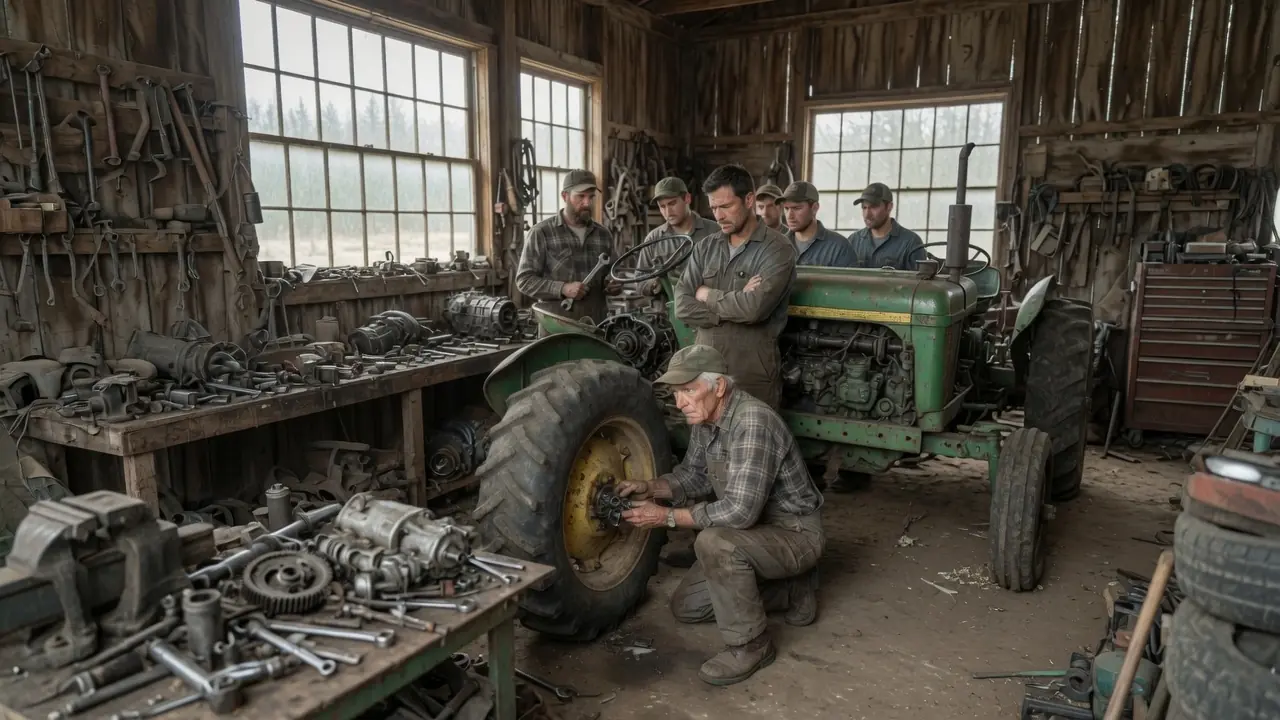
Samuel Boone listened to the silence around it.
One strike.
Only on a hill.
Only after several seconds.
Only when fuel had time to move.
The answer had been there every trip.
Not hidden inside the transmission.
Not buried in the engine.
Waiting beneath the tank, where no one had thought to look.
The old John Deere kept working.
And above the bench at Keller Agricultural Repair, Samuel’s question remained long after the men who first heard the noise had retired:
What changes when the failure appears?